
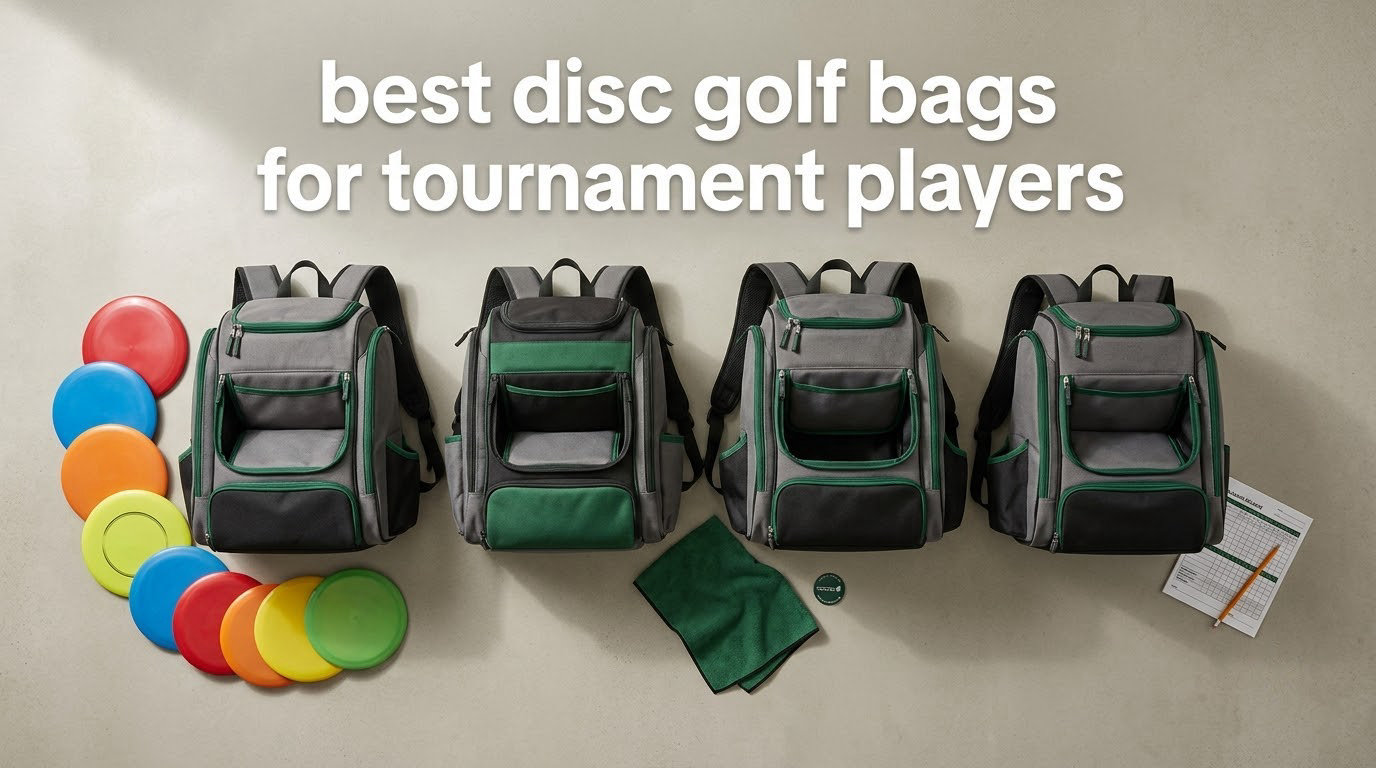
A bag failure at hole 12 of a sanctioned event is a small disaster. A bottle holder that lets a 32 oz bottle drop into the brush costs you a minute. A soft-sided bag that folds flat the moment you set it down on a slope costs you a lie, a drop, and the rhythm you spent 11 holes building. Tournament play asks more of a bag than a Saturday round, and most of the bags that look identical on a product page fail differently under that load.
That is what we set out to sort out. We compared ten disc golf bags that real players carry into PDGA and club events, weighing the things that actually break down on a 36-hole or 54-hole weekend: disc capacity against the number on the label, harness support, base stability on uneven lies, fabric denier, pocket layout, and what happens to the stitching after two seasons. This guide covers the best disc golf bags for tournament players in 2026, from the entry nylon pack most players start with to the premium builds that show up on the carts at A-tier events.
One thing to clear up before we start: you are allowed to carry far more than you throw. Tournament rules limit how many discs you may put into play on a hole, not how many you can have in the bag. That is why a tournament player walking a long, windy course carries backups for lost discs and water hazards, and why capacity is the first spec we look at rather than the last.
Table of Contents
What Is the Best Disc Golf Bag for Tournament Play?
The best disc golf bag for tournament play is the Dynamic Discs Trooper. It holds 18+ discs, weighs about 2 pounds, has padded shoulder straps and a supportive back panel, and a base that stands on sloped ground without collapsing. For summer events, the Throwback Sports insulated pack wins on hydration. For 30+ disc loadouts, the Prodigy BP-1 V3 takes the capacity.
A tournament bag earns its place over a casual bag in three specific ways. The harness has to move weight off your shoulders onto your hips, because a 36-hole day on a loaded bag is a shoulder problem long before it is a fitness problem. The base needs structure, because hillside lies are the single most repeated complaint in player discussions about bags. And the storage needs to be organised so that a putter, a marker and a phone are all reachable without unpacking the disc compartment.
Capacity is the fourth filter, and it is the one most product pages oversell. The number printed on the bag is a best case, measured with nothing else in the pockets. Once you add dividers, a rain layer, a towel, snacks and a water bottle, count on 20 to 25 percent less than the label. We come back to this in detail below because it changes which bag you should buy more than any other single number.
Top 3 Picks: Best Disc Golf Bags for Tournament Players (October 2026)
The Trooper leads because of what it combines: a rating at the top of this group, a review count in the thousands, a stable base, and a two-pound weight that stays manageable across a full tournament day. The Axiom Shuttle is the value pick for players who want a padded harness, a 32 oz bottle holder and a lifetime warranty without leaving the entry tier. The Himal Outdoors pack is the lightest way to get 22+ discs on your back.

Dynamic Discs Trooper
- Holds 18+ discs
- Padded straps and back panel
- Stable base
- About 2 pounds

Axiom Discs Shuttle
- 18+ discs plus 6 up top
- 32 oz bottle holder
- 900D polyester
- Limited lifetime warranty
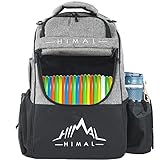
Himal Outdoors 22+ Disc Pack
- 22+ disc capacity
- 600D oxford
- Under 2 pounds
- Three zippered pockets
All 10 Bags at a Glance
Every bag below appears once in this table and again in its own review. The capacity figures are the manufacturer numbers, not our measured counts, and the real capacity section further down explains the gap between the two.
| Product | Specifications | Action |
|---|---|---|
| Dynamic Discs Trooper |
|
Check Latest Price |
| Himal Outdoors Disc Golf Bag |
|
Check Latest Price |
| Axiom Discs Shuttle |
|
Check Latest Price |
 Throwback Sports Insulated Backpack Throwback Sports Insulated Backpack |
|
Check Latest Price |
 MVP Disc Sports Nucleus MVP Disc Sports Nucleus |
|
Check Latest Price |
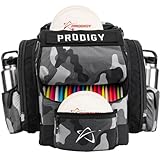 Prodigy Disc BP-1 V3 Prodigy Disc BP-1 V3 |
|
Check Latest Price |
 Innova Adventure Pack Innova Adventure Pack |
|
Check Latest Price |
 Discology OG V3 Discology OG V3 |
|
Check Latest Price |
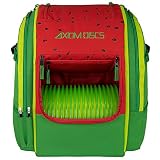 Axiom Discs Voyager Lite Axiom Discs Voyager Lite |
|
Check Latest Price |
 Dynamic Discs Combat Ranger Dynamic Discs Combat Ranger |
|
Check Latest Price |
1. Dynamic Discs Trooper – The Tournament Workhorse
Dynamic Discs Trooper Disc Golf Backpack, Holds 18+ Discs, Black
Holds 18+ discs
About 2 pounds
Nylon with padded straps
Stable base
Pros
- Holds 18+ discs with room to grow
- Padded shoulder straps and a supportive back panel
- Durable nylon that survives years of regular play
- Multiple external pockets for keys wallet scorecards and minis
- Lightweight and easy to clean
Cons
- Main compartment runs a few inches short when packed full
- Putters in the top pocket can slide down into the main compartment
- D-rings near the handle are plastic
This is the bag we kept reaching for. The Trooper measures 10 by 4 by 20 inches, weighs about 2 pounds, and holds 18+ discs in a nylon body with padded shoulder straps and a supportive back panel. Two compartments plus three external accessory pockets cover the tournament checklist: discs, phone, keys, scorecard, mini markers and a snack.
What earns it the top spot is the base. It sits upright when you set it down, which matters constantly on wooded courses where the ground is never flat. Reviewers single out the stable base, and the drawstring water bottle holder keeps a bottle from wandering into the disc compartment mid-round.
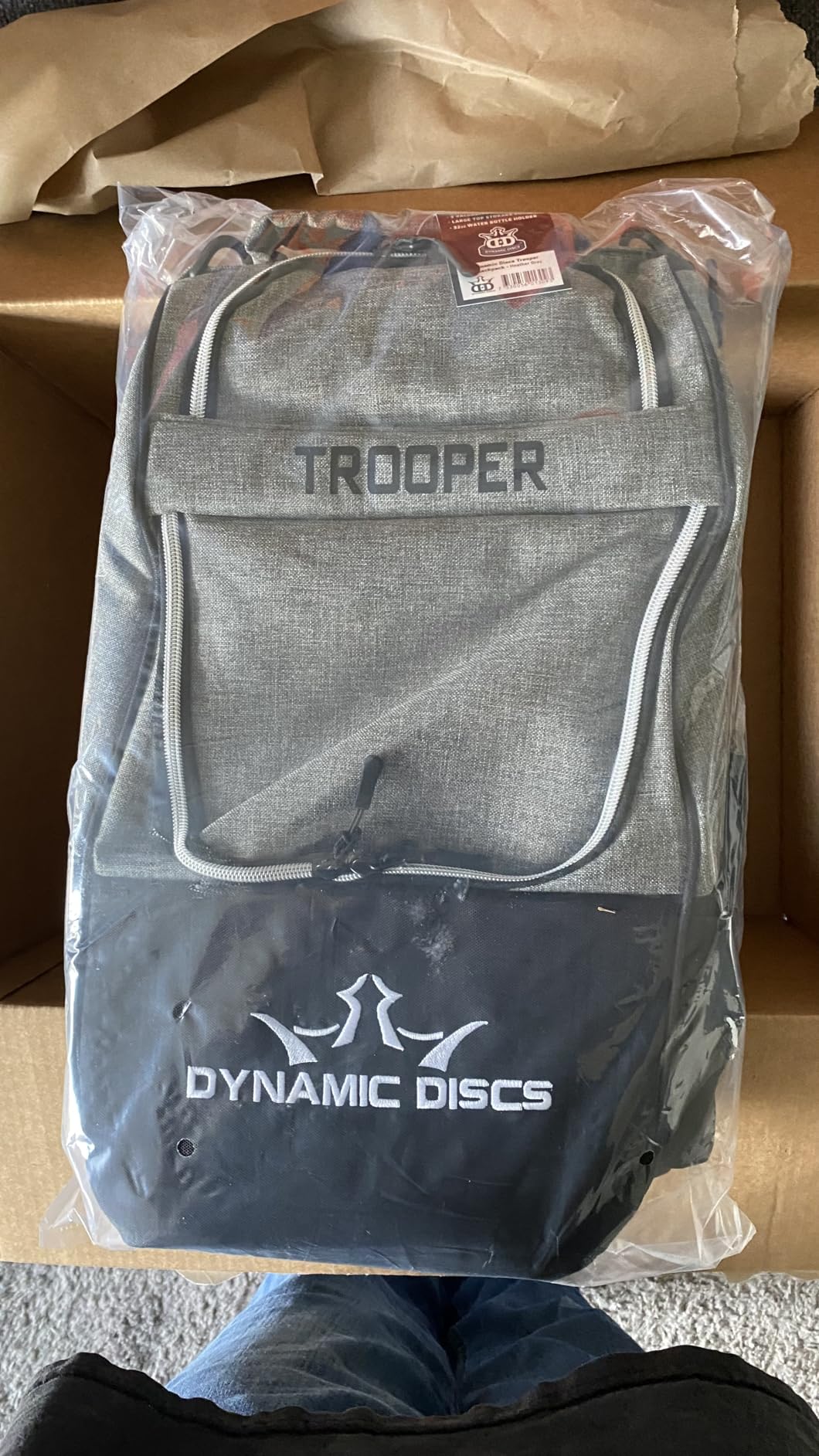
The honest weakness is the main compartment height. Owners filling it to the stated capacity report that the lowest discs get hard to pull out one-handed, especially mid-round when you are reaching without looking. If your routine is a slow sort before every throw, that is an irritation. If you pull by feel, you will adapt inside a week.
A second detail worth knowing: the D-rings near the top handle are plastic. They are not attachment points for anything heavy, and treating them as such is how stitching fails. The zippered external pockets are the right place for a towel, and the haul handle is genuinely useful for hoisting the bag into a car between rounds.
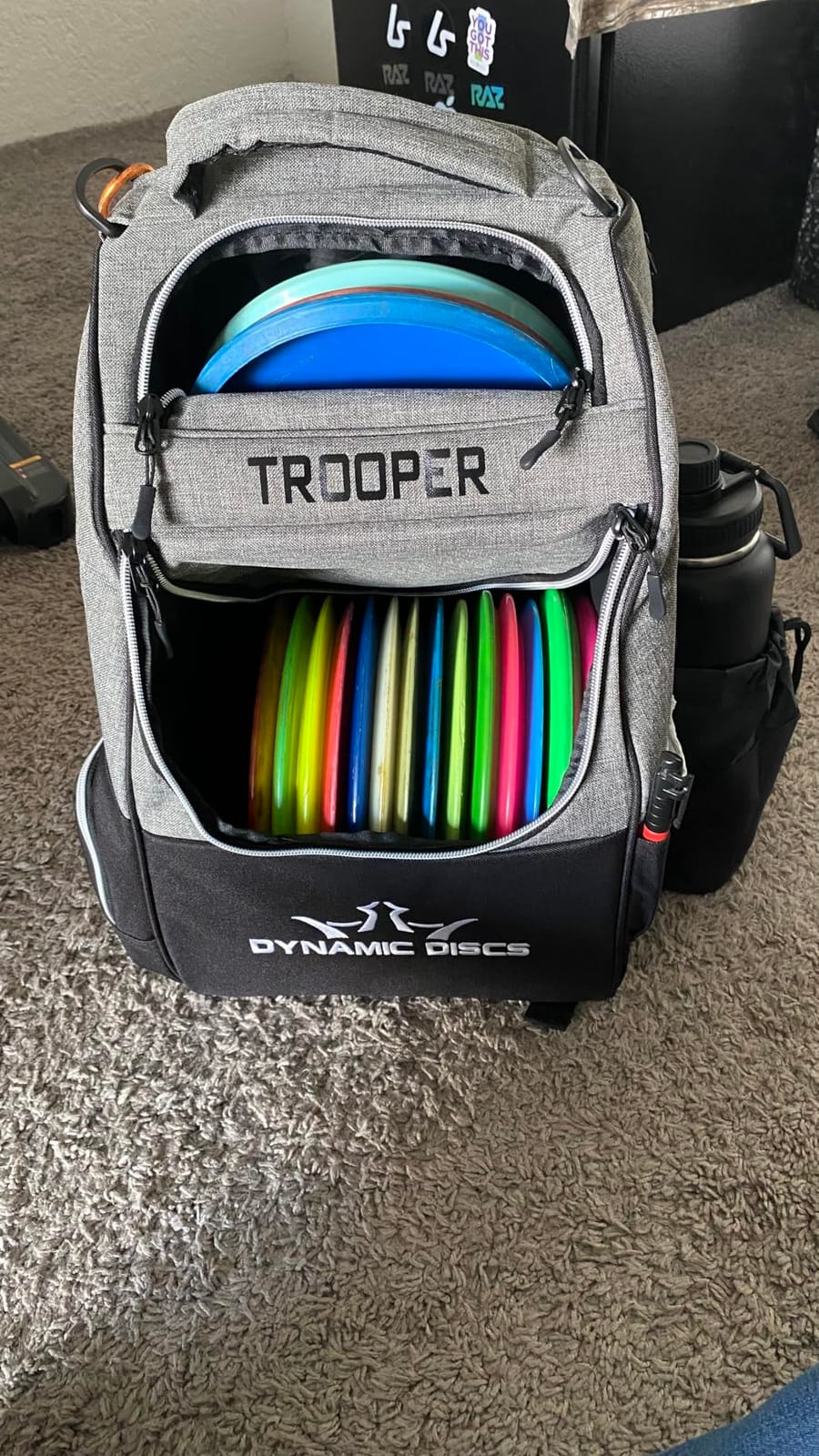
Who the Trooper suits
It suits a player carrying 18 to 24 discs who walks and wants a two-pound bag with a wide accessory footprint. Two days of carry in a summer event, a towel in the side pocket, a bottle in the holder and the bag still stands on a sidehill.
It also suits anyone moving up from a tote or a basic sling, because the padded harness and supportive back panel are the first real comfort upgrade most players notice. The bag has enough pockets to stop you from strapping extras to the outside.
Where the Trooper falls short
It is not a 30-disc bag, and if you run a full competition lineup with multiple backup drivers the compartment will feel tight. The top putter pocket also lets putters migrate downward when you set the bag down on its side, which is a habit most players have and most players forget.
If you want a hard base that survives being set down on rock, or a rigid skeleton that keeps discs separated when the bag is half empty, the MVP Nucleus and the Prodigy BP-1 V3 both do that job better. The Trooper wins on balance: capacity, weight, stability and price all land in the right place at once.
2. Himal Outdoors Disc Golf Bag – Lightest 22+ Disc Loadout
HIMAL HIMAL Disc Golf Bag, 22+ Discs Lightweight Backpack Grey
22+ disc capacity
600D oxford fabric
Under 2 pounds
Three zippered compartments
Pros
- 18+ discs in the main compartment plus 4 more up top
- Lightweight 600D oxford construction under 2 pounds
- Drawstring-lock bottle holder keeps bottles steady
- Multiple organised pockets
- Honeycomb mesh back panel with padded straps
Cons
- Soft shell has limited structure so discs shift when partly filled
- Less long-term track record than an established disc golf brand
Himal Outdoors put the capacity up front: 18+ discs in the main compartment and four more in the upper section, 22 in total, in a bag that weighs under 2 pounds. The 600D high-strength oxford fabric is the same weight class used across the entry tier, and it shrugs off the kind of abrasion you get from setting a bag down on gravel.
The drawstring-lock water bottle holder is the detail that separates this from a generic school backpack. A loose holder lets a bottle swing into the disc slots and tip the bag; a lock holds it in place through a walk. The honeycomb mesh back panel and padded straps also do more work than they sound like they would on a bag this light.
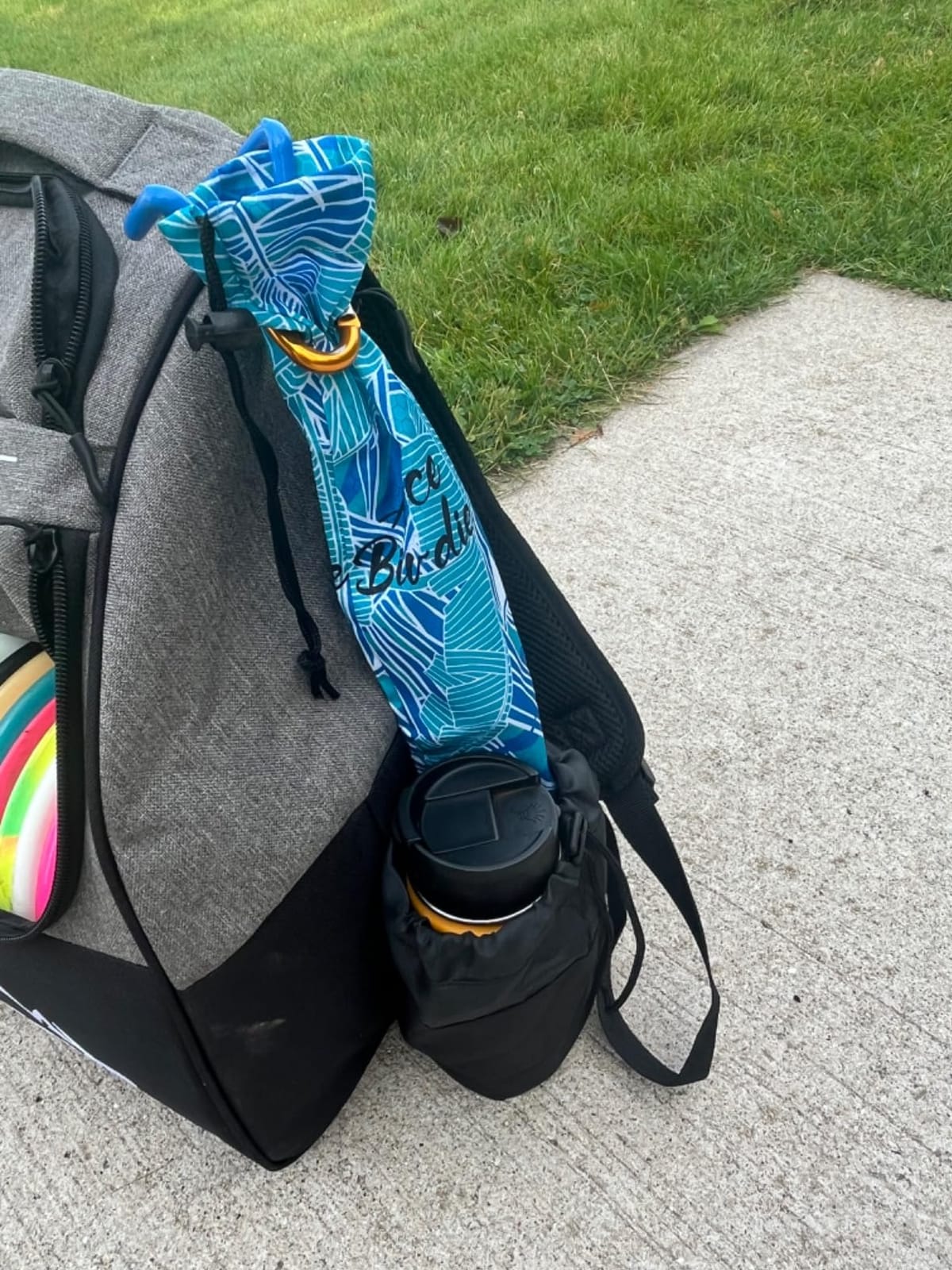
The soft shell is the trade. With limited structure, discs flop and lean when the bag is not fully packed, and a half-full Himal bag on a sloped lie will not stand the way the Trooper does. If you carry a tournament loadout of 20-plus discs it behaves well. If you run a fast 12-disc setup, the discs will not stay vertical on their own.
There are three zippered compartments, an upper section for a rain shell or extra layer, and a stash pocket for valuables. Reviewers treat this as a capable budget bag rather than a premium one, and the general expectation is modest build quality next to a lifetime-warranted disc golf brand.
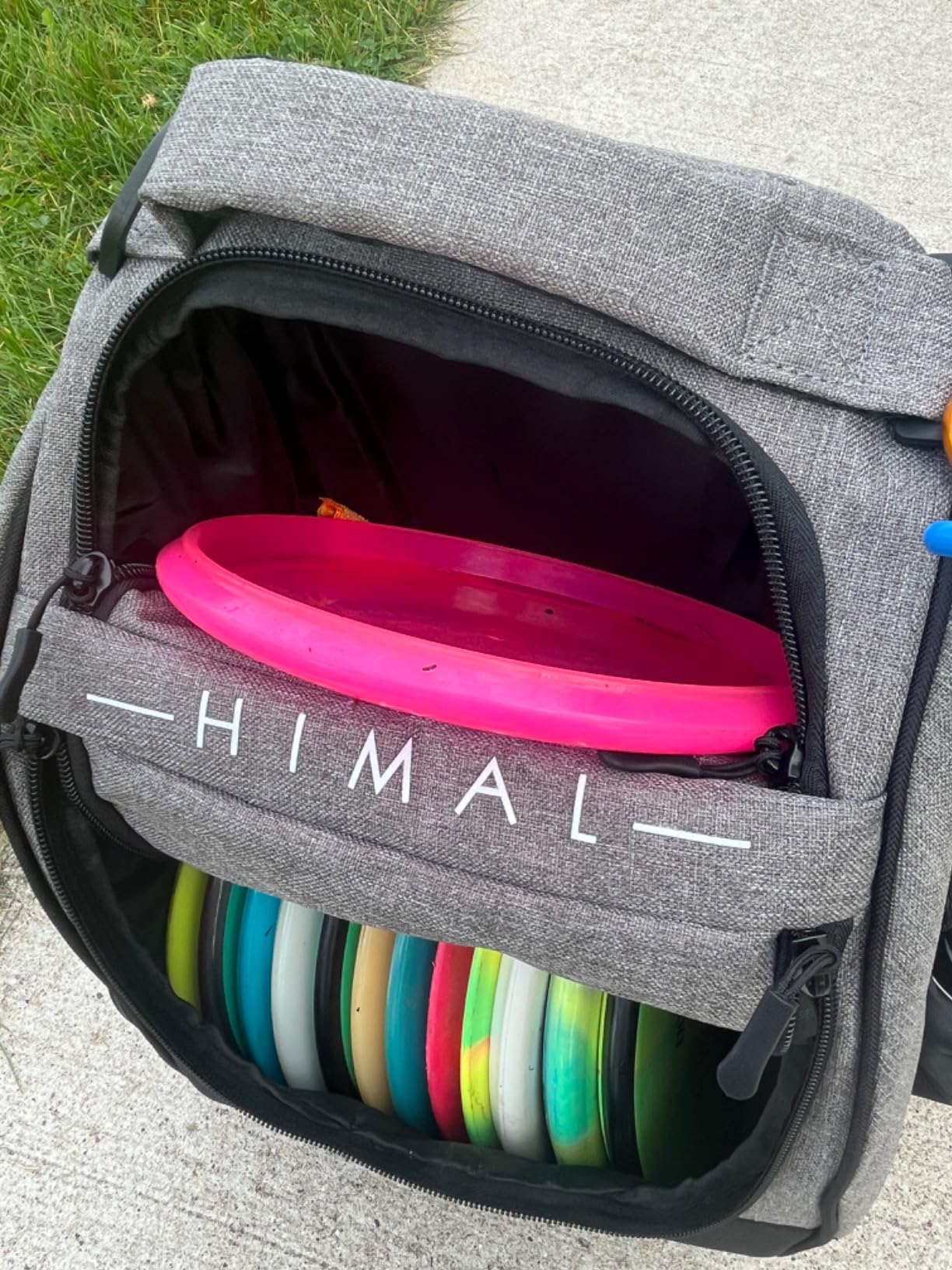
Who the Himal Outdoors pack suits
It suits a player carrying 18 to 22 discs who wants a pack that stays under 2 pounds and who is not fussy about a structured base. Three zippered compartments plus a stash pocket cover a one-day event comfortably, including a spare layer for a wet afternoon.
It also suits anyone who wants a second bag. A second pack in the car holding backups and a change of clothes is a common tournament habit, and this is an inexpensive way to do it without buying a second premium pack.
Where the Himal Outdoors pack falls short
The soft shell is the main limit. On hilly courses with a partly filled bag, expect to prop it against a tree or your leg. Reviewers also note the general build quality is a notch below the disc-golf-specific brands, which show up in fabric finish and zipper hardware.
Over a long tournament weekend you will feel the difference between a 2-pound soft bag and a 2-pound structured one. If you can carry 20-plus discs, add a disc or two to the load and the softness stops mattering. If you cannot, look at a bag with internal support walls.
3. Axiom Discs Shuttle – Best Value Padded Pack
Axiom Discs Shuttle Disc Golf Backpack Bag (Watermelon Edition)
18+ discs plus 6 up top
900D polyester
32 oz bottle holder
Limited lifetime warranty
Pros
- Holds 18+ discs in the main compartment plus up to 6 more on top
- Padded straps and padded back panel
- Three extra pockets plus a 32 oz drawstring bottle holder
- Limited lifetime warranty from an established disc manufacturer
- Many colour and side-panel options
Cons
- Soft-sided body gives limited disc separation and structure
- Discs and bottles are not included
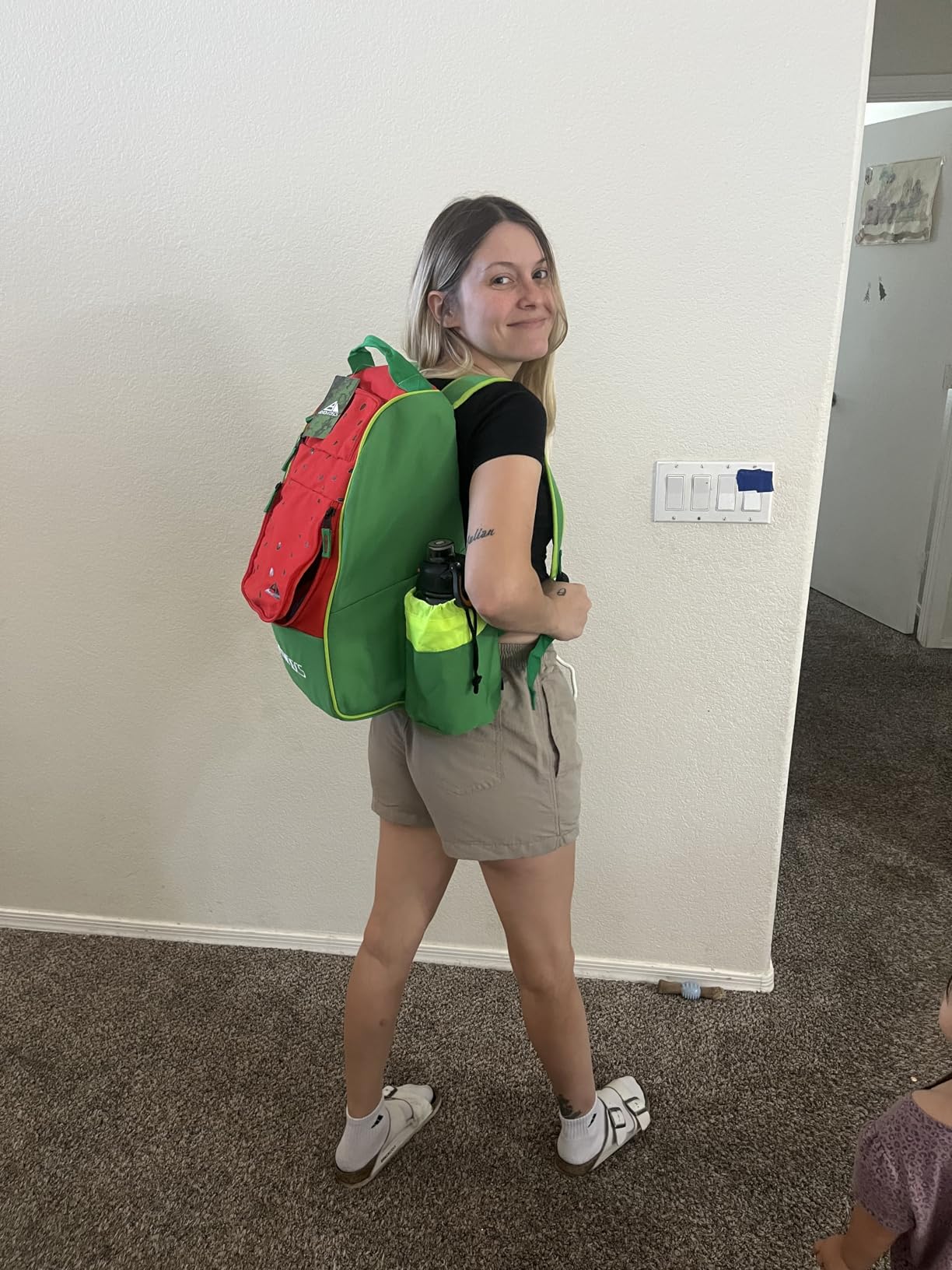
The Shuttle measures 13 by 2 by 19 inches and lists eight compartments, which is unusual at this tier. Reviewers regularly load 18+ discs into the main compartment and up to six more into the top section, and the 900D polyester shell is water resistant with a padded back panel and adjustable padded straps.
The 32 oz drawstring water bottle holder is the part that sells it. A full-size bottle fits, and a drawstring enclosure keeps it from swinging into the disc slots on a walk between holes. Three additional pockets handle the phone, keys, wallet and a towel without any outside strapping.
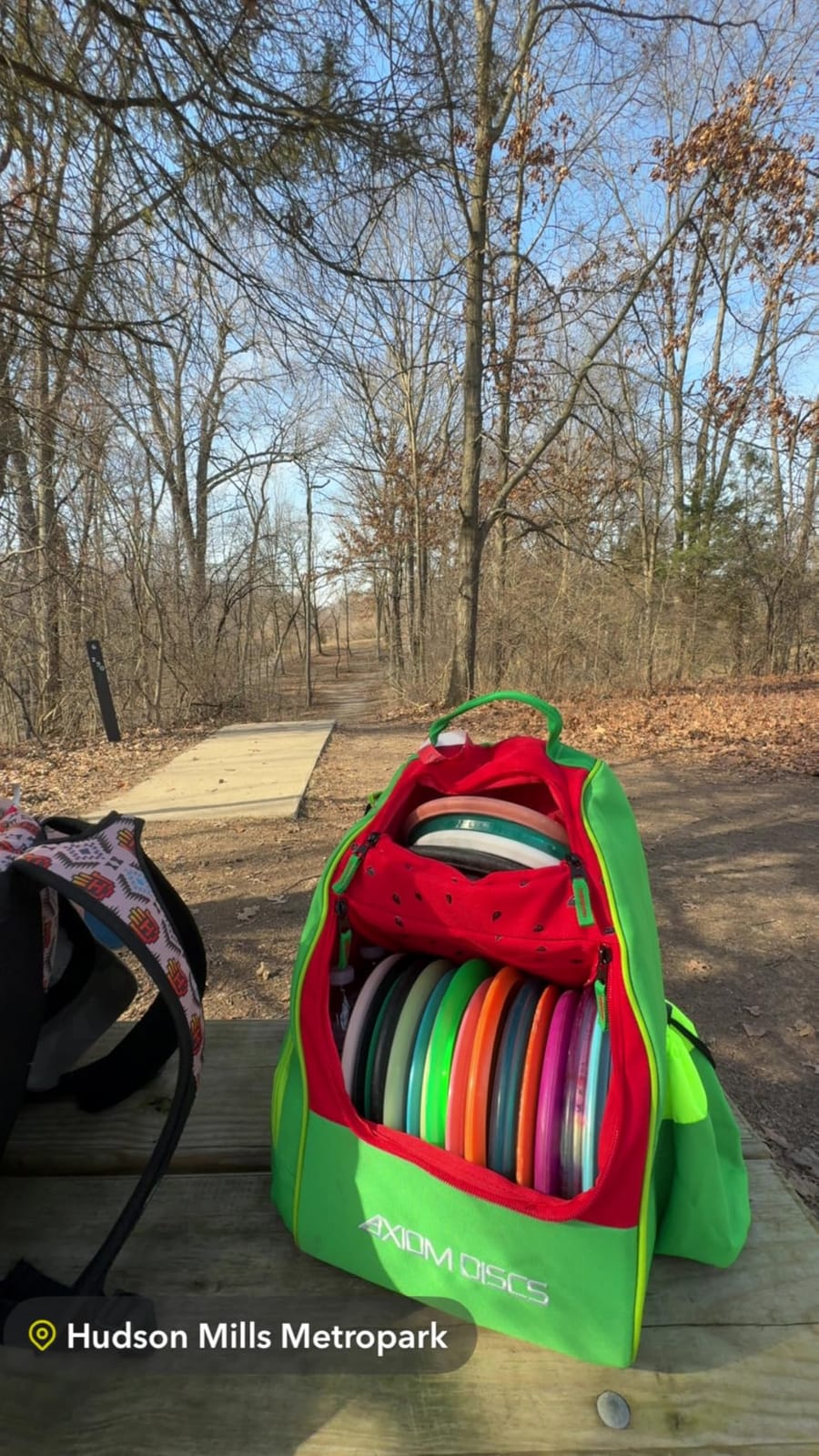
Where the Shuttle divides from its competitors is the limited lifetime warranty from Axiom Discs, a disc manufacturer with a track record. Reviewers mention the warranty as a real reason to buy over a generic bag of similar weight, because defects in materials and workmanship are covered rather than replaced at goodwill.
The soft-sided body is the recurring complaint. Compartments are only as stiff as the fabric, so a partly filled bag gives you limited disc separation. Several buyers also note that water bottles and discs are sold separately, which is worth remembering when you compare total setup cost.
Who the Shuttle suits
It suits a player moving into their first or second sanctioned event who wants padded carry and a real warranty without moving up a tier. The pocket count and the 32 oz holder handle a full tournament day of small items in one place.
It also suits players who like to match gear to a disc brand. Axiom Discs stamps this bag in ten colourways and offers side-panel styles, so matching your bag to your plastic is straightforward.
Where the Shuttle falls short
Twenty-plus discs is the practical ceiling even though the top compartment adds more, because the soft body compresses rather than holds discs apart. If you carry 26 or more, the Voyager Lite or a hard-bottom bag is a better fit for structure.
The other limit is the fabric-soft compartments. Water resistance keeps light moisture out longer than an untreated bag, but the structure is the fabric itself. If your event season runs through autumn, pack a rain cover in one of the side pockets.
4. Throwback Sports Insulated Backpack – Cooler-Equipped for Summer Events
Throwback Sports Insulated Disc Golf Backpack with Cooler for 16+ Frisbees, Water Bottle Holder, Padded Straps, Quick-Access Pockets – Durable Disc Golf Bag for All-Day Comfort
Insulated cooler compartment
16+ disc capacity
Stretch side pockets
Hard plastic base
Pros
- Insulated main compartment works as a cooler for drinks and snacks
- Very light empty and weight sits off to the sides
- Three stretch disc pockets on each side hold discs when jostled
- Discs stay visible so you can track the bag
- Hard plastic base keeps it upright and off wet ground
Cons
- Elastic side pockets stretch out with heavy repeated use
- Top bottle holder is shallow and will not take a 32 oz bottle
- Can tip on sloped ground when the cooler section is empty
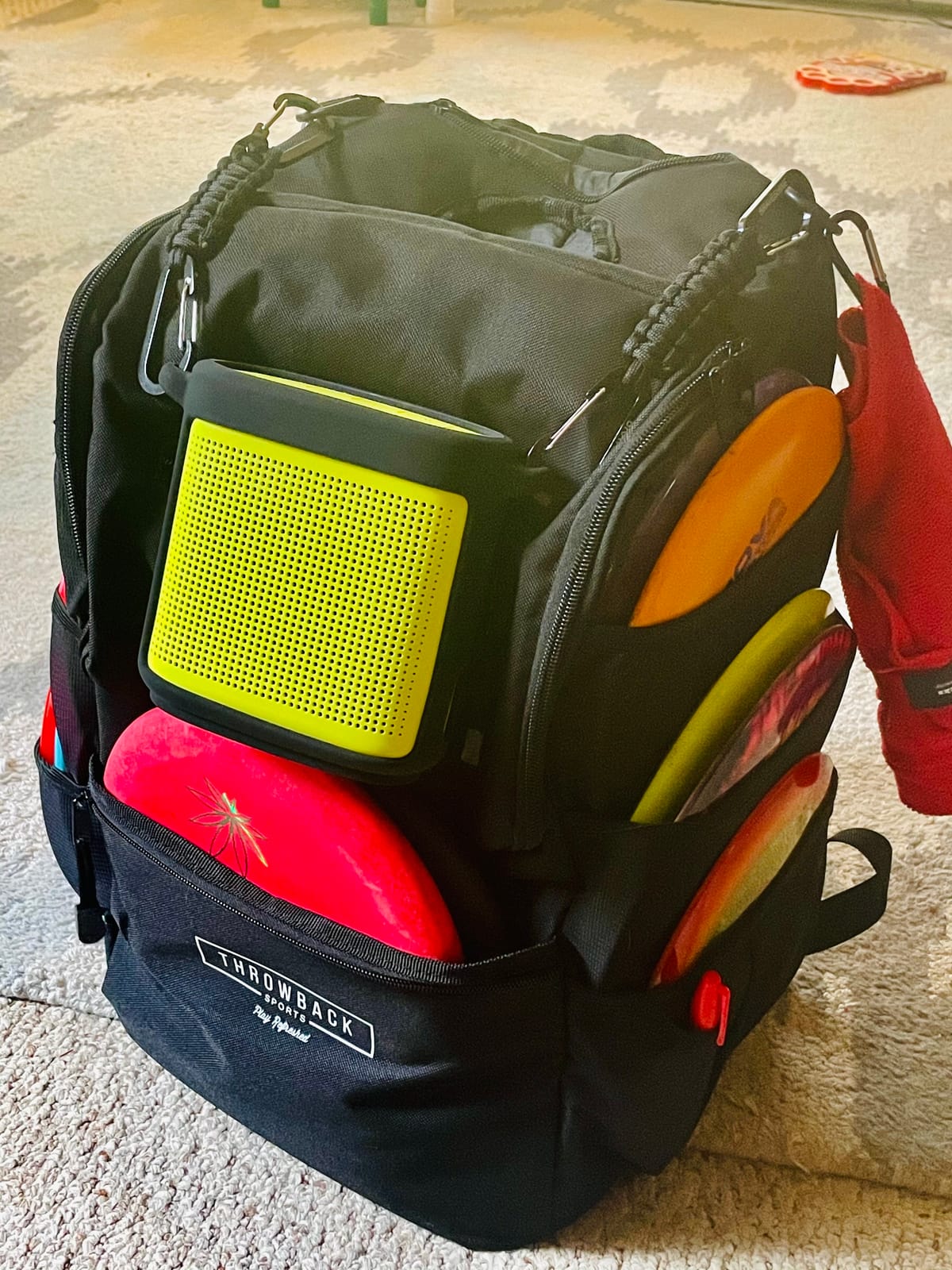
Most bags treat water as an afterthought. This one makes the insulated main compartment the centre of the design, and buyers confirm it holds a nine-pack plus ice, or more than two dozen cans, alongside a working disc loadout. In a July tournament round that is the difference between a playable afternoon and a slow fade.
The layout is unusual for a disc golf bag. Three stretch pockets on each side hold discs where you can see them, plus two putter pockets, so you can track your bag at a glance and pull a disc without opening the main compartment. Weight also sits out toward the sides rather than hanging in one column, which reviewers credit with easing neck and back strain.
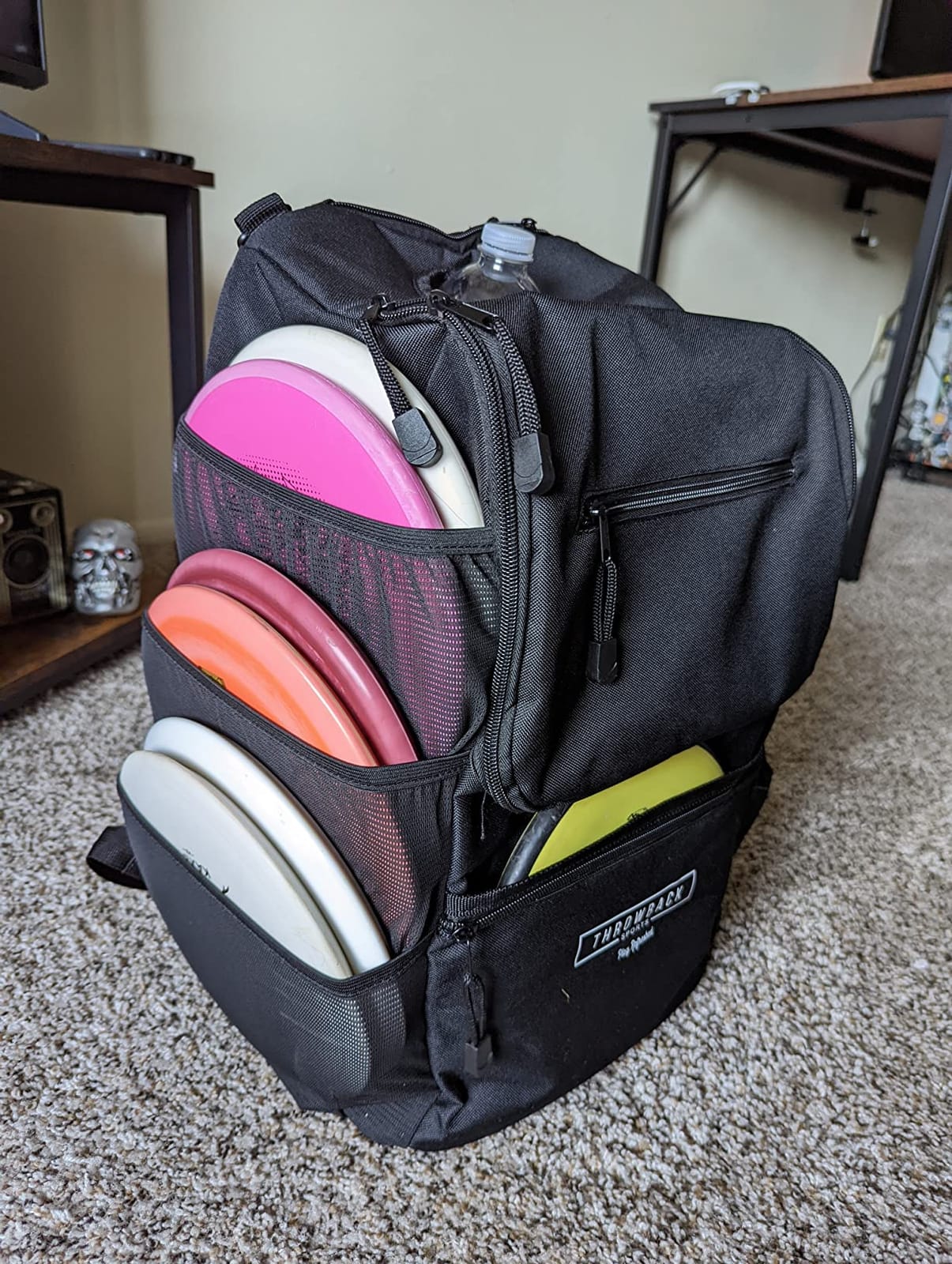
The hard plastic base is a genuine asset in wet conditions. It keeps the bag upright and off damp ground, and it means the bag does not soak from below when you set it on dewy grass at the first tee. The 20 oz top bottle slot is convenient when the bag is already on the ground and you do not want to swing it onto your back.
Three problems recur in the reviews. The elastic side pockets stretch out under repeated heavy use, the top bottle holder is too shallow for a tall 32 oz bottle, and the bag can tip on sloped ground when the cooler section is empty. That last one matters more than it sounds, because a bag with an empty insulated section loses exactly the weight that would have stabilised it.
Who the Throwback pack suits
It suits players whose events land in hot months, especially doubles players, league nights and summer scrambles where hydration and snacks matter as much as disc selection. The visible side pockets also help in group play, where a matching bag sitting 30 yards back is easy to miss.
It suits cart-adjacent setups too. If you are not walking a full 36 holes and want one bag that handles discs and drinks together, the five-compartment layout keeps both in the same place without a separate cooler bag.
Where the Throwback pack falls short
At 16+ discs of capacity it is the smallest loadout in this group, so it is the least useful choice for a 30-disc competition bag, and the elastic pockets are the first thing to fail with a full carry. If you load it to its limit every round, the side pockets will stretch within a season or two.
For a player running a full tournament lineup, the empty-section tipping issue is the deciding problem. Keep the cooler compartment at least half full and the base behaves; empty it out and you have a soft bag on a hill.
5. MVP Disc Sports Nucleus – Compact Hard-Bottom Bag
MVP Disc Sports Nucleus Tournament Disc Golf Bag (Lime)
22 to 32 disc capacity
Rigid hard shell bottom
900D polyester
Quad strap or shoulder carry
Pros
- Compact footprint that still stores around 26 to 30 discs
- Rigid hard shell bottom and thick padded walls keep it upright
- Dual zippered putter pockets hold 2 to 3 discs each
- Side hooks mount an assembled disc grabber
- Cup holder fits a full-size drink bottle
Cons
- Snug near the 30 disc limit for a midrange-heavy bag
- Can feel heavy loaded and the supplied shoulder strap is basic
- Some examples report stitching coming undone on the side pockets
The Nucleus is the bag we would put on a cart, and the one we would hand someone who hates loose discs. The 900D polyester body has a rigid hard shell bottom and thick padded walls, so the bag stands up on its own and stays structured when it is not full.
Reviewers fit 26 to 30 discs in a footprint smaller than most bags rated for the same count, which is the most efficient capacity-to-size pairing in this roundup.
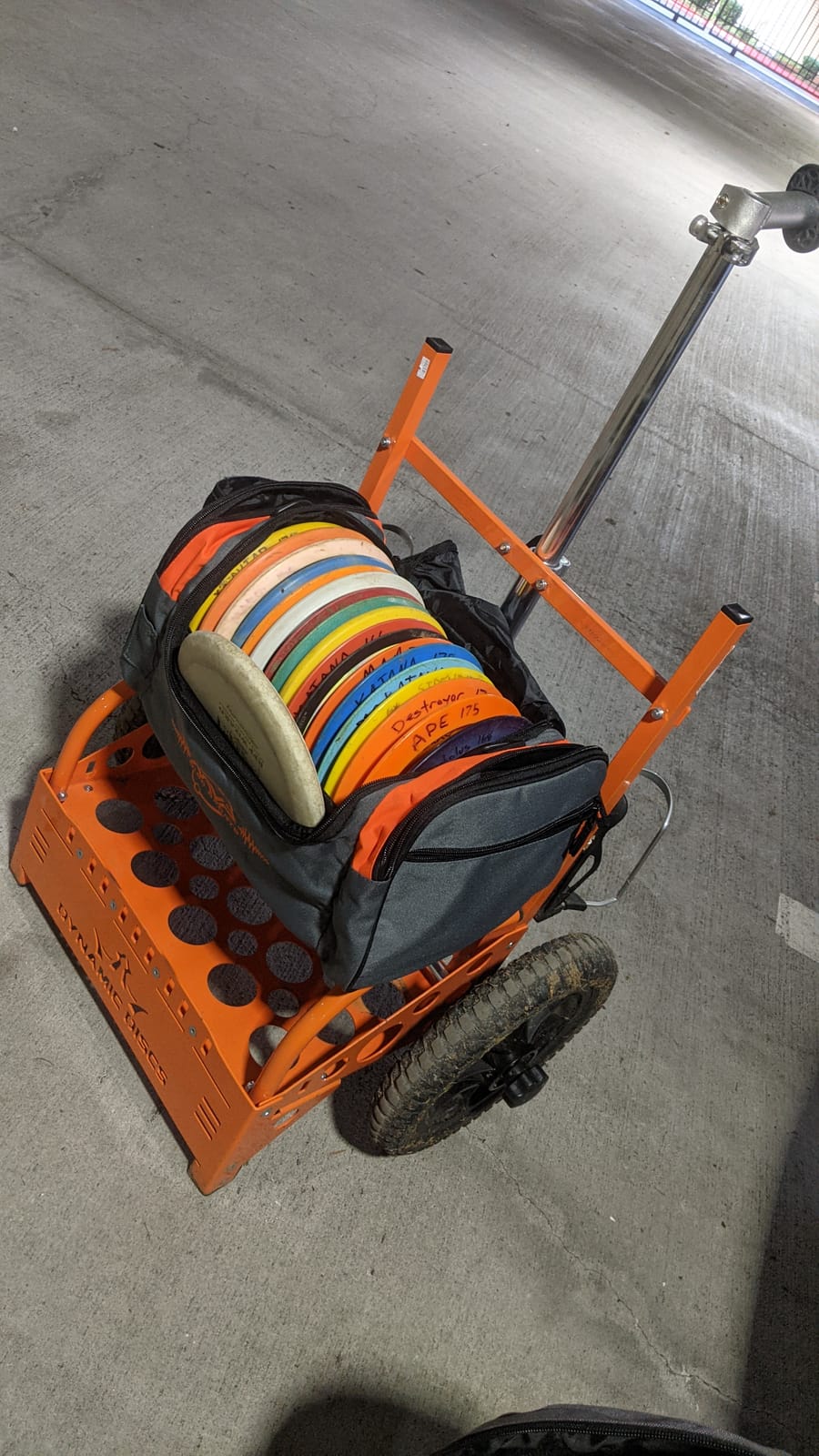
Carry options are what separate it. It works with a disc golf cart, a shoulder strap, or the quad strap system, and the side hooks let you mount an assembled disc grabber without taking it apart. Two zippered putter pockets each hold two or three putters or small accessories, and the cup holder takes a full-size bottle.
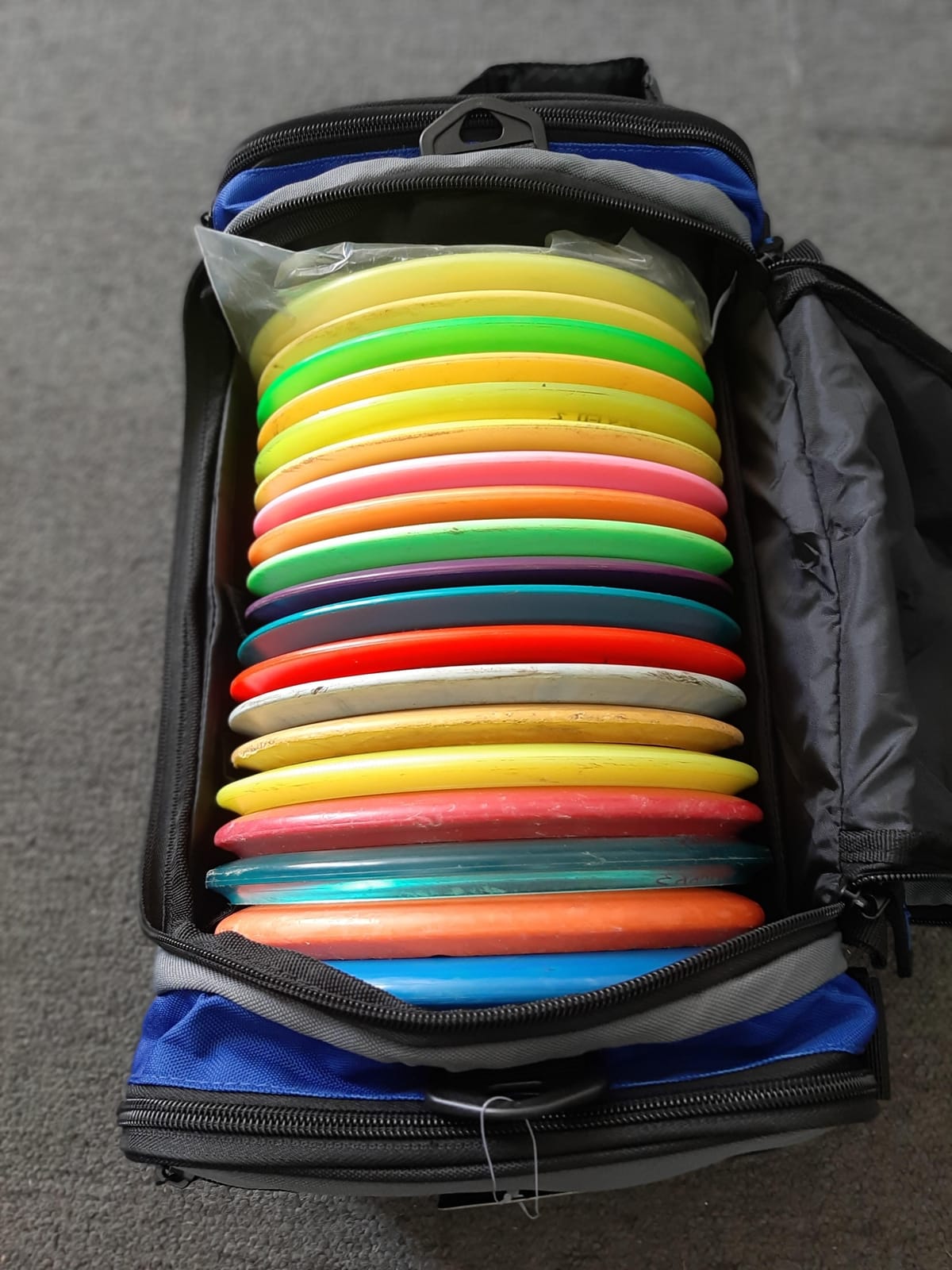
On a cart, the hard bottom and the quad straps solve the two problems walking players fight: bags collapsing at the tee and load digging into the shoulders. Several users run this as their primary tournament bag and mount a grabber on the side, so nothing has to leave the bag between holes.
The catch is that accessories and straps are sold separately. The quad strap system is the single most worthwhile add-on, because the supplied shoulder strap is basic and a fully loaded Nucleus is not a light single-shoulder carry.
Who the Nucleus suits
It suits cart players and anyone whose events involve long courses, doubles formats or cart rules. The hard shell means the bag survives being set down on concrete, packed into a car trunk and unloaded at the next tee without the base deforming.
It also suits players with a midrange-heavy bag. Because the structure holds discs apart, a 26-disc loadout of drivers and midranges stays ordered rather than collapsing into a single leaning column, which is a real problem in soft-sided bags.
Where the Nucleus falls short
Midrange-heavy loadouts can feel snug near the 30 disc limit, and the small footprint means less room for a rain layer and snacks than a taller bag of the same rating. Fully loaded, it also reads heavier than its 2-pound empty weight suggests.
Build consistency varies a little between examples, which is a manufacturing matter rather than a design flaw, but it is the kind of thing to check on arrival if you buy one. The manufacturer warranty has replaced broken bags for buyers, which is the reason we still rate it here.
6. Prodigy Disc BP-1 V3 – The Big Loadout Bag
Prodigy Disc BP-1 V3 Disc Golf Backpack | Backpack Storage for Disc Golf Discs | Disc Golf Bag with 30+ Disc Capacity | Tear & Water Resistant | Golf Bags for Men | Outdoor Backpack for Disc
30+ disc capacity
14 compartments
Two 32 oz bottle slots
Water resistant nylon
Pros
- Fits 30+ discs alongside the top pocket and putter pocket
- Design keeps the bag upright so it does not tip
- Twin 32 oz bottle holders and expandable side pockets
- Bottom rails keep the main bag off the ground
- Responsive warranty service replaces defective bags
Cons
- Internal panels are tight to install and take 15 minutes or more on a first build
- V3 lacks the disc separators the earlier version had
- Heaviest and most premium option in this roundup
When a player tells us they are carrying 30+ discs, this is the bag we point them at. The storage layout lists 30+ discs in the main area, 5+ in the top pocket, 2 putters in the front putter pocket, and two 32 oz water bottle slots, spread across 14 compartments. Very few bags at any size put that much in one place.
The design is tournament-oriented in a specific way. It stays upright and does not tip, and the bottom rails keep the main bag off the ground so a rain layer or a towel at the base stays clean. Owners also report that weight stays balanced and manageable even when the bag is full, which is not automatic in a bag this deep.
Assembly is the thing to plan for. The internal panels and inserts are very tight to fit, and first builds can take 15 minutes or more. Allow that time before your first event rather than in the parking lot. There is no reason to rush a build, because the panel layout is what gives the bag its structure.
Two other notes. The panels could be stiffer, so discs flop around inside when the bag is not full, and the V3 version dropped the disc separators the earlier version had. The water bottle holder is also slightly too small for a full 32 oz bottle in some reports, so test it before you rely on it on a hot course.
Who the BP-1 V3 suits
It suits players running a full competition loadout across multiple rounds, especially where conditions vary and you want options for wind, water hazards and lost discs. The expandable side pockets and the deep pocket count mean clothes and snacks do not have to displace discs.
It also suits players whose discs get wet. The water-resistant nylon, the bottom rails and the upright stance are all aimed at keeping a bag and its contents out of the ground when conditions turn.
Where the BP-1 V3 falls short
It is the heaviest option in this group, and that extra weight shows up in a loaded carry. If your bag is 20 discs rather than 30, you are carrying empty volume every hole for no benefit.
Separately, a few owners report stitching or clip straps giving out within months, so it is worth inspecting the seams and clips in your first few events. Most owners still consider the capacity worth the step up, but the build time and the panel stiffness are the two real compromises.
7. Innova Adventure Pack – Cleanest First-Tournament Setup
Innova Adventure Pack Disc Golf Backpack – Holds 25 Discs – Includes Mini, Disc Golf Bag (Sand/Coffee)
Holds 25 discs
Six compartments
Includes a Stars mini marker
About 2 pounds
Pros
- Wide main opening makes discs easy to reach in and out
- Stands up on its own when set down
- Durable stitching and construction
- Five zippered pockets plus a stealth pocket and front putter pocket
- Adjustable drink holder fits a range of bottles
Cons
- Soft base means the bag only sits flat on level ground
- Top putter pouch holds about three discs
- Capacity is a step down from 30+ disc tournament bags
The Adventure Pack is the easiest bag in this roundup to explain to a first-time tournament player. It holds 25 discs, weighs about 2 pounds, and includes a Stars stamp mini marker, which is one less small thing to lose before your first card.
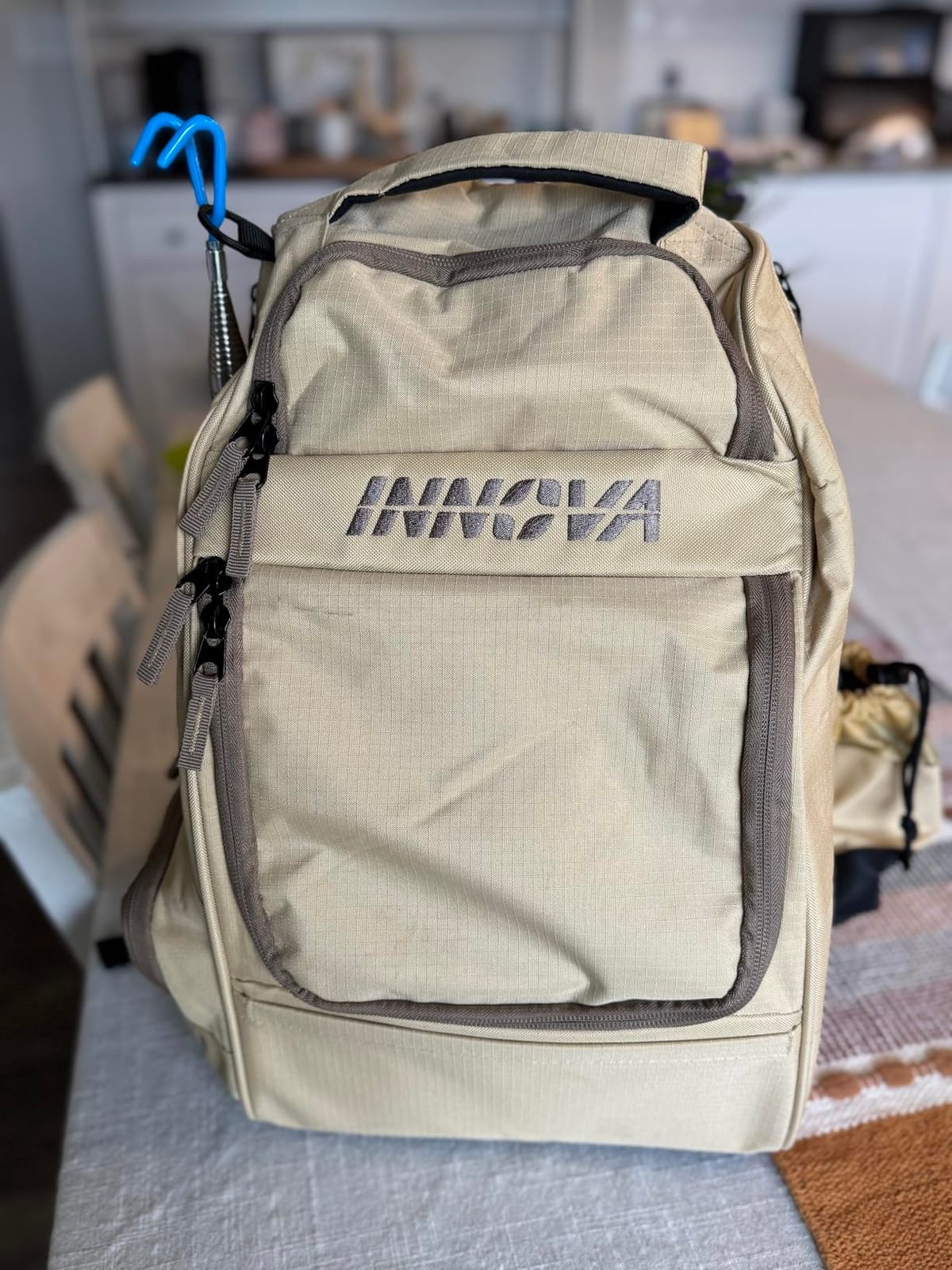
The latest version widened the main disc compartment opening and added a fifth zippered pocket, and both changes are obvious in use. A wide opening means you can see and reach discs instead of fishing for them, and the change is noticeable immediately because disc selection happens dozens of times a round.
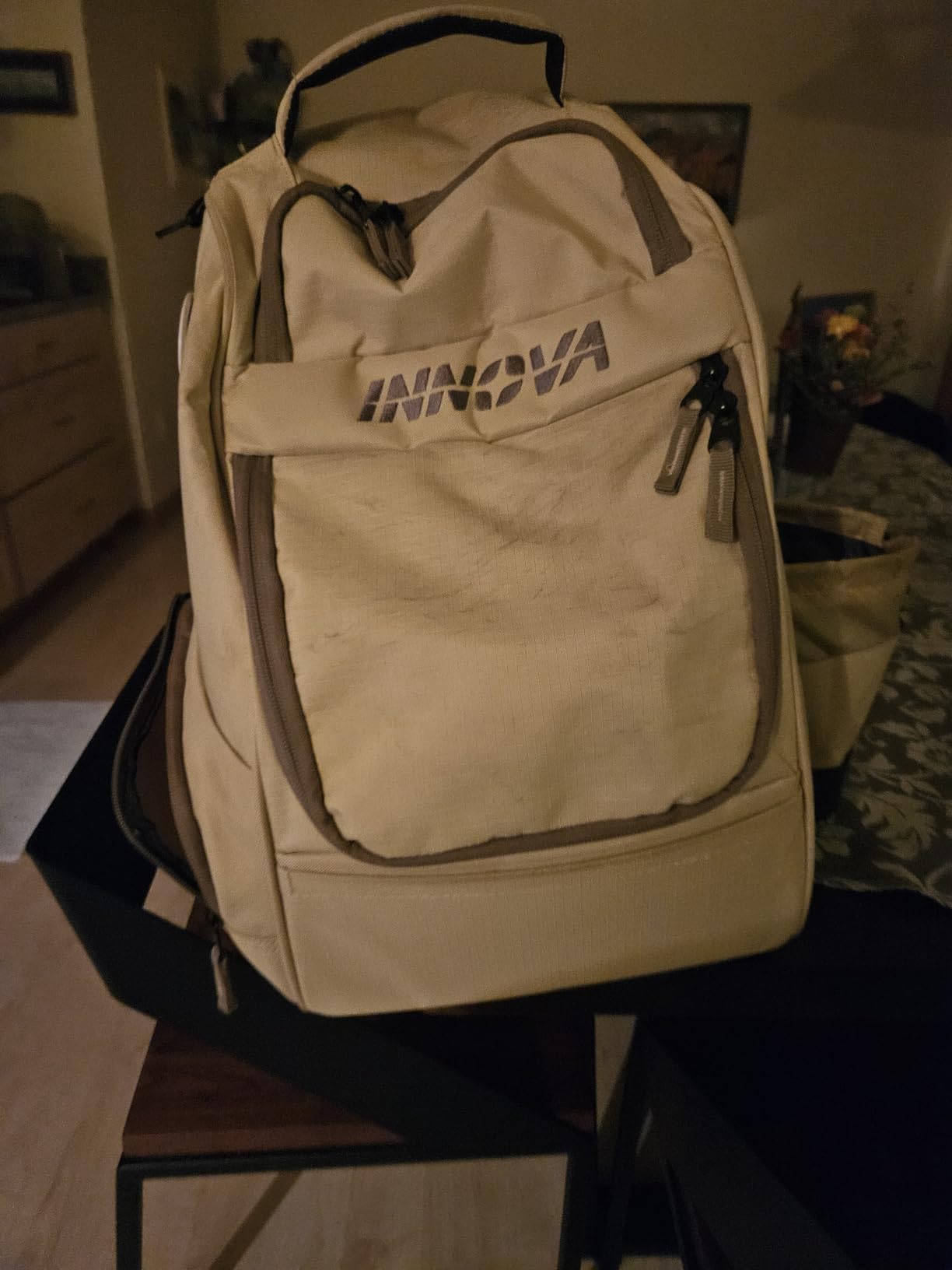
There are six compartments in total: five zippered pockets, a stealth pocket for a phone or wallet, and a front putter pocket. The adjustable drink holder takes a range of bottles and cups, and the padded top handle makes grabbing the bag out of a car trunk straightforward. Reviewers consistently note that it stands up on its own rather than falling over.
The limitation is the soft base. It sits flat on level ground and rocks or leans on a slope, which is the standard trade for a 2-pound bag with a 25-disc ceiling. The top putter pouch also takes about three discs, so keep your primary putting three within reach and park the rest in the main compartment.
Who the Adventure Pack suits
It suits a player entering their first PDGA or club event, because the included mini, the wide opening and the upright stance remove the three most common beginner-day frustrations. A 25-disc loadout covers a full lineup with a few backups.
It also suits anyone who wants a low-maintenance bag with a clean pocket layout. The drink holder is adjustable rather than fixed, and the pocket count covers markers, a phone, a towel and snacks without exterior strapping.
Where the Adventure Pack falls short
25 discs is a step down from the 30+ bags if you like options, and the soft base rules it out for players who play a lot on sidehills. If your home course has elevation, test it on a slope before you commit.
The three-disc top putter pouch is also the tightest storage spec in this roundup. A single-disc putting routine works well. A rotation of six putters needs the main compartment, which slows the most repeated action in the sport.
8. Discology OG V3 – Customisable 26+ Disc Pack
Discology Disc Golf OG V3 Disc Golf Bag | 26+ Disc Capacity | Premium Disc Golf Backpack Bag | Tough, Durable Design | 2 Large Top and Side Compartments | Top Patch Panel with Three Patchs Included
26+ disc capacity
Water-repellent 900D polyester
Two large top putter pouches
Patch panel included
Pros
- 26+ discs spread across the main compartment and several putter pouches
- Water-resistant 900D polyester with reinforced stitching
- Well-padded back panel and reinforced padded straps
- Top patch panel included for customisation
Cons
- Lower average rating than the rest of this group
- Soft shell gives less disc separation than hard-bottom bags
The OG V3 is the bag for players who want their tournament bag to look like theirs. It includes a top patch panel with three patches, and the panel sits exactly where a custom patch is most visible on the course and in photos. The disc capacity is 26+: 17 in the main compartment, 2 putter slots on the front panel, and 2 large putter pouches on top.
It measures 15 by 8 by 19 inches and uses water-repellent 900D polyester with reinforced stitching, which is a heavier fabric than the entry bags use. The back panel is well padded, and the shoulder straps are reinforced as well, both of which help across a 54-hole weekend.
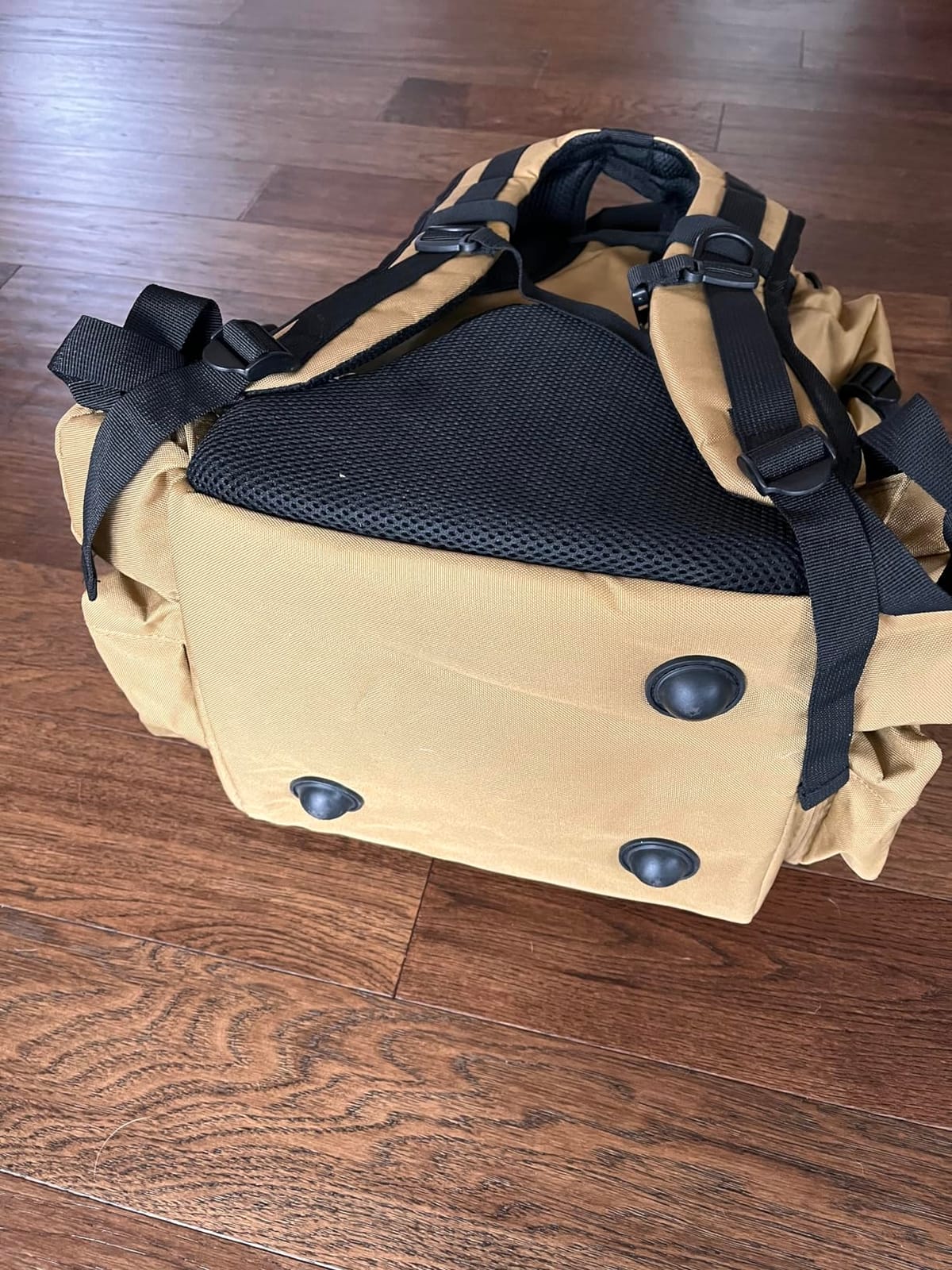
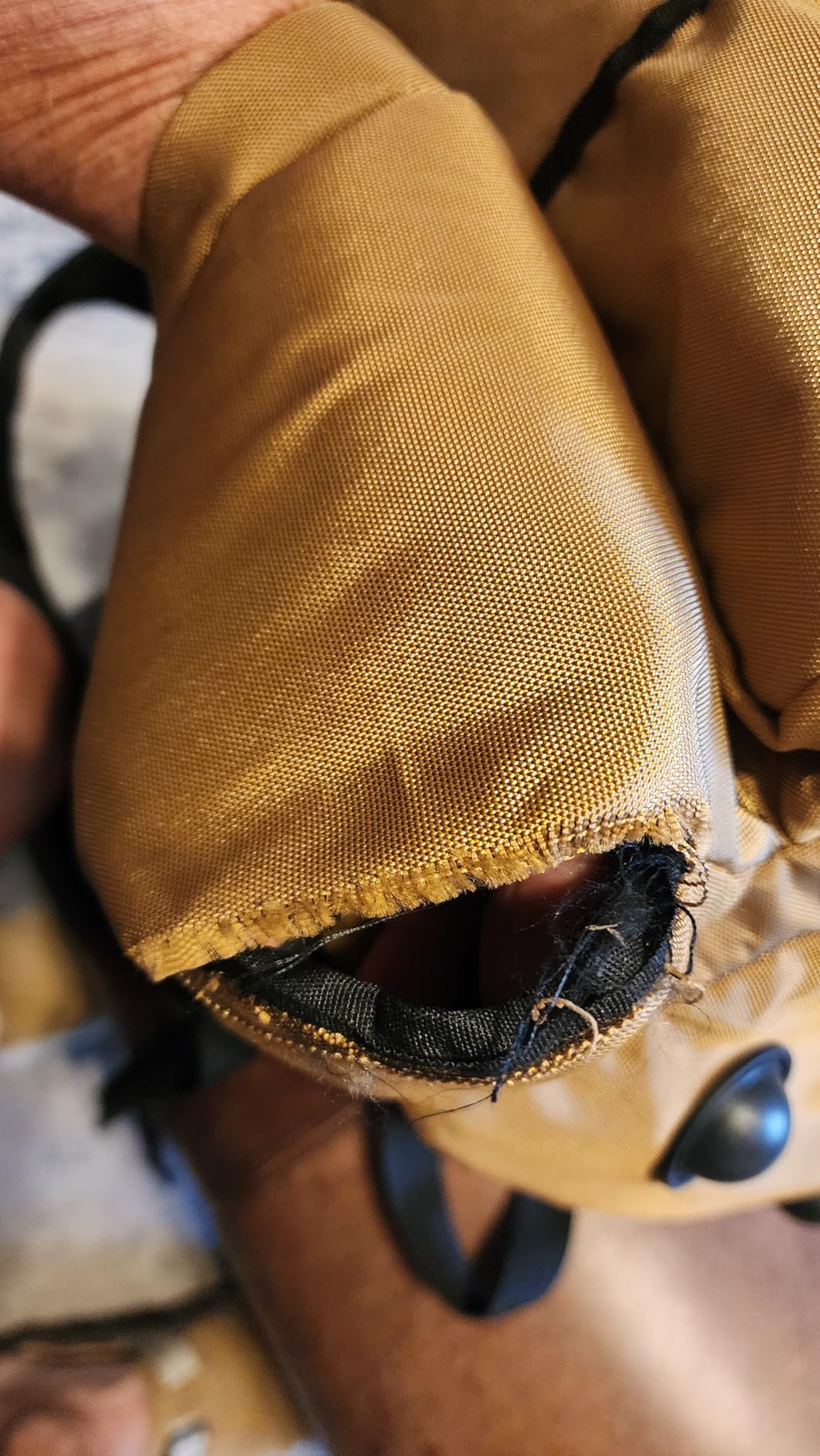
This is the third version, and the brand states that issues from the first two were corrected with enhanced structure, reinforced stitching and improved materials. That claim is worth checking against your own experience, because the reviews on this bag are the most mixed in the group. A higher share of critical reviews cite durability and structure concerns rather than comfort or features.
The soft shell is the recurring structural note. Discs have less separation here than in a hard-bottom bag, so a 26-disc loadout relies on the dividers doing the work. Buyers who care most about a stable base and rigid panels tend to prefer another option in this range.
Who the OG V3 suits
It suits players who want a large-capacity bag with a distinctive look and do not mind supplying their own patches. The two large top pouches take more putters than most bags of this size, which is useful if you rotate through several on warm days.
It also suits players who prefer heavier fabric. The 900D polyester with reinforced stitching is a step up in abrasion resistance from 600D, and water-repellent treatment helps in light rain.
Where the OG V3 falls short
It carries the lowest average rating in this roundup, and the critical reviews concentrate on durability rather than comfort. If you want the 900D fabric and the 26-disc layout with more consistency, a hard-bottom bag in a similar tier is a safer buy.
The soft body is the other limit. On sidehill lies with a partly filled bag, discs lean and the bag follows them. Pack it full and it settles; carry a light load and it does not.
9. Axiom Discs Voyager Lite – Best All-Day Carry
Axiom Discs Voyager Lite Backpack Disc Golf Bag (Watermelon Edition)
18 discs plus 5 or 6 on top
Internal support walls
Two drink holders
Limited lifetime warranty
Pros
- Highest average rating in this group with consistently strong reviews
- Stands up on its own even when empty
- Main compartment holds 18 discs with a top compartment adding 5 to 6
- Two drink holders that take large bottles
- Metal D-rings and zippers that do not snag
Cons
- Pickup handle is uncomfortable for carrying any real distance
- Slim profile means a smaller load than a dedicated 30+ disc bag
- A few buyers report real main-compartment capacity closer to 10 to 15 discs
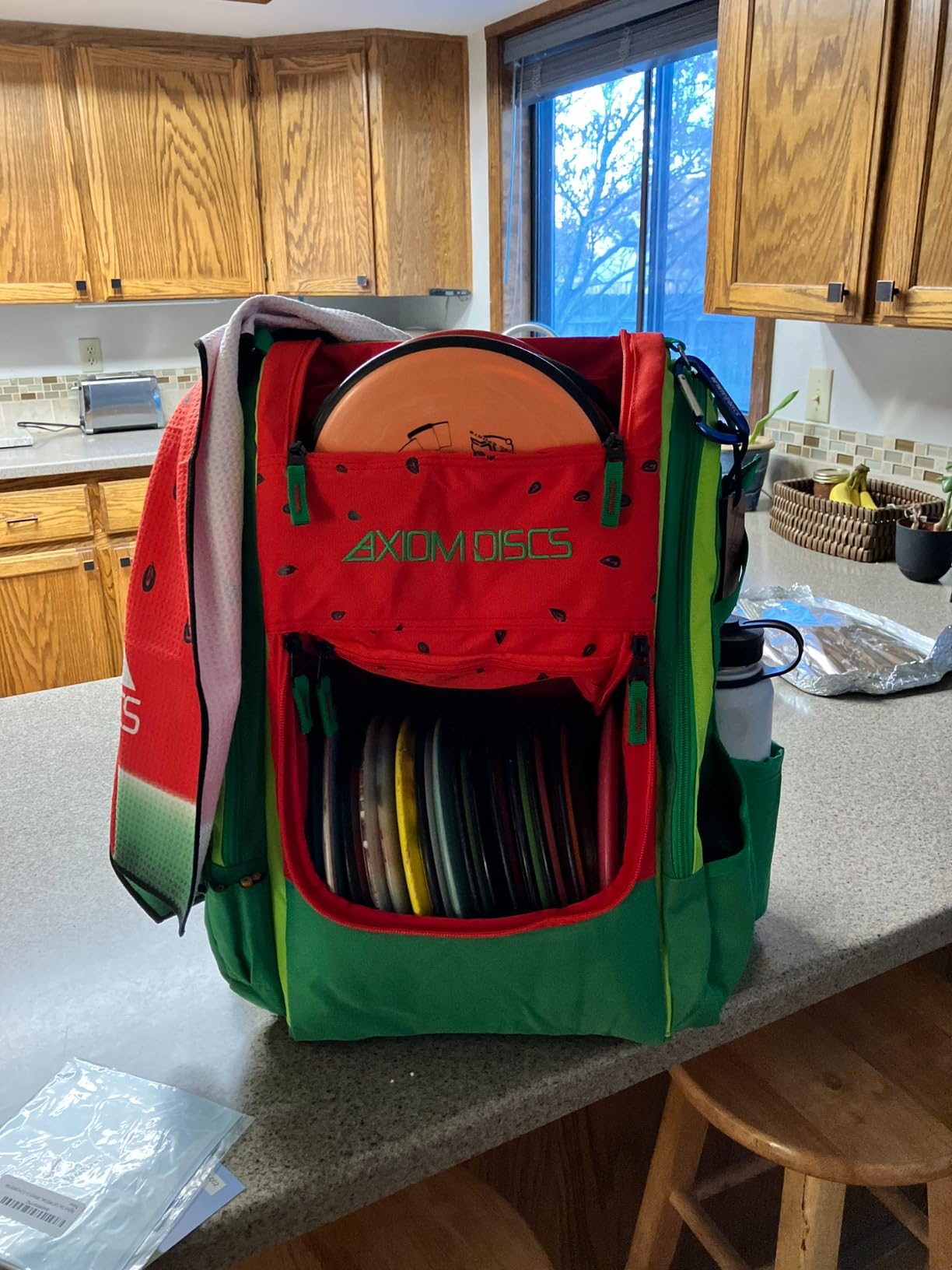
The Voyager Lite is the Axiom Shuttle with more structure, more padding and a warranty, and it is the bag we reach for on a three-day event. The 900D polyester body has internal support walls, a padded back panel and padded straps, and that internal structure is why it stands up on its own even when it is empty.
Two drink holders are the quiet strength here. Reviewers note they accommodate large bottles, which solves the complaint we hear most about entry bags: a holder that fits a 20 oz bottle and nothing else. The putter pocket takes about six putters snugly, with room for a chalk bag or a towel beside it.
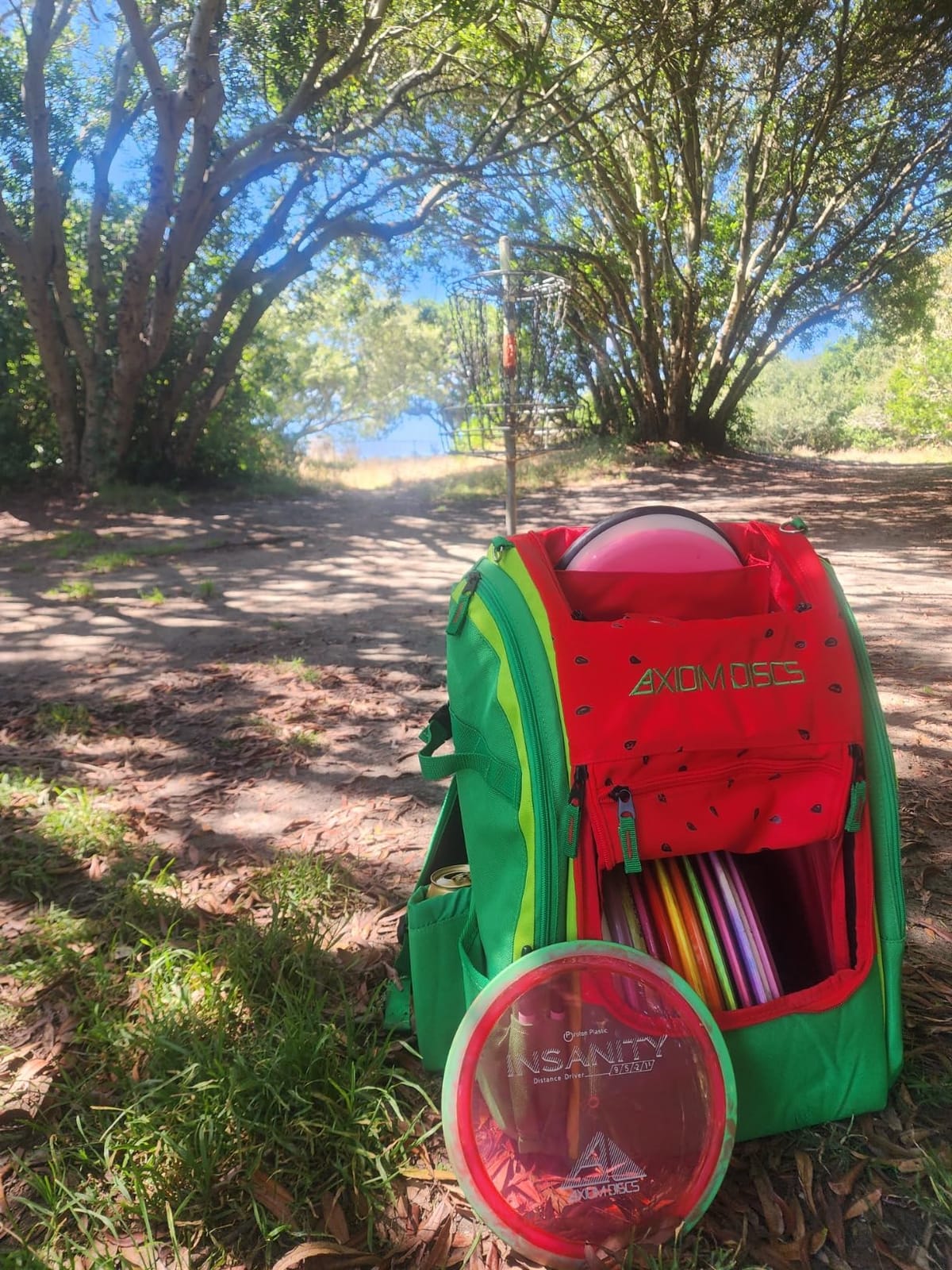
Main compartment capacity is 18 discs, with a velcro top compartment adding roughly 5 to 6 more for putters, discs or a layer. Large side pockets take an umbrella, a rain cover, snacks, a phone and keys, so the bag functions for travel as well as for the course.
Small hardware details matter on a bag used for three days. This one has metal D-rings, side straps for a retriever or a tripod, and zippers that do not snag. The two issues owners raise most are the unpadded pickup handle, which is uncomfortable for any real distance, and the need to use a zippered pocket for mini markers.
Who the Voyager Lite suits
It suits multi-day players and anyone walking 36 holes with a full load, because the internal support walls keep the bag shaped and the two drink holders keep hydration sorted. The limited lifetime warranty also makes it the lowest-risk premium entry in this roundup.
It suits travel. The side pockets swallow a rain cover, a towel and a layer, and the bag has attachment points for a retriever, so it doubles as a travel companion on the way to a multi-day event.
Where the Voyager Lite falls short
The slim profile means a smaller total load than a dedicated 30+ disc tournament bag. A few buyers report real main-compartment capacity closer to 10 to 15 discs once dividers and accessories are in place, which is a good reminder of the real-capacity rule.
One reviewer also reported a seam failure inside two weeks. That is an outlier rather than a pattern, but it is worth inspecting the seams when the bag arrives, especially if you are buying ahead of an event.
10. Dynamic Discs Combat Ranger – Premium Weather-Ready Pack
Dynamic Discs Combat Ranger Disc Golf Backpack, Holds 20+ Discs, Sandstone
Holds 20+ discs
Large top putter compartment
Built-in 32 oz bottle holder
Weather-resistant build
Pros
- Premium construction and styling from a flagship disc golf brand
- Large top compartment makes putters easy to grab between throws
- Built-in 32 oz water bottle holder
- Holds 20+ discs while staying lightweight and ergonomic
- Weather-resistant construction for all-season play
Cons
- Most premium bag in this roundup
- Far fewer customer reviews than the value-priced Trooper
The Combat Ranger is the premium end of the Dynamic Discs line, and the difference from the Trooper shows up in materials and finish rather than in capacity. It holds 20+ discs, adds a large top compartment for putters, and includes a built-in 32 oz water bottle holder for hydration on the course.
The top compartment is the feature that gets used most. Reviewers call out how easy it is to grab a putter between throws without opening the main compartment, which matters when you are playing a rapid-fire doubles final and want to keep your pace. The build is described as lightweight and ergonomic with weather-resistant premium materials.
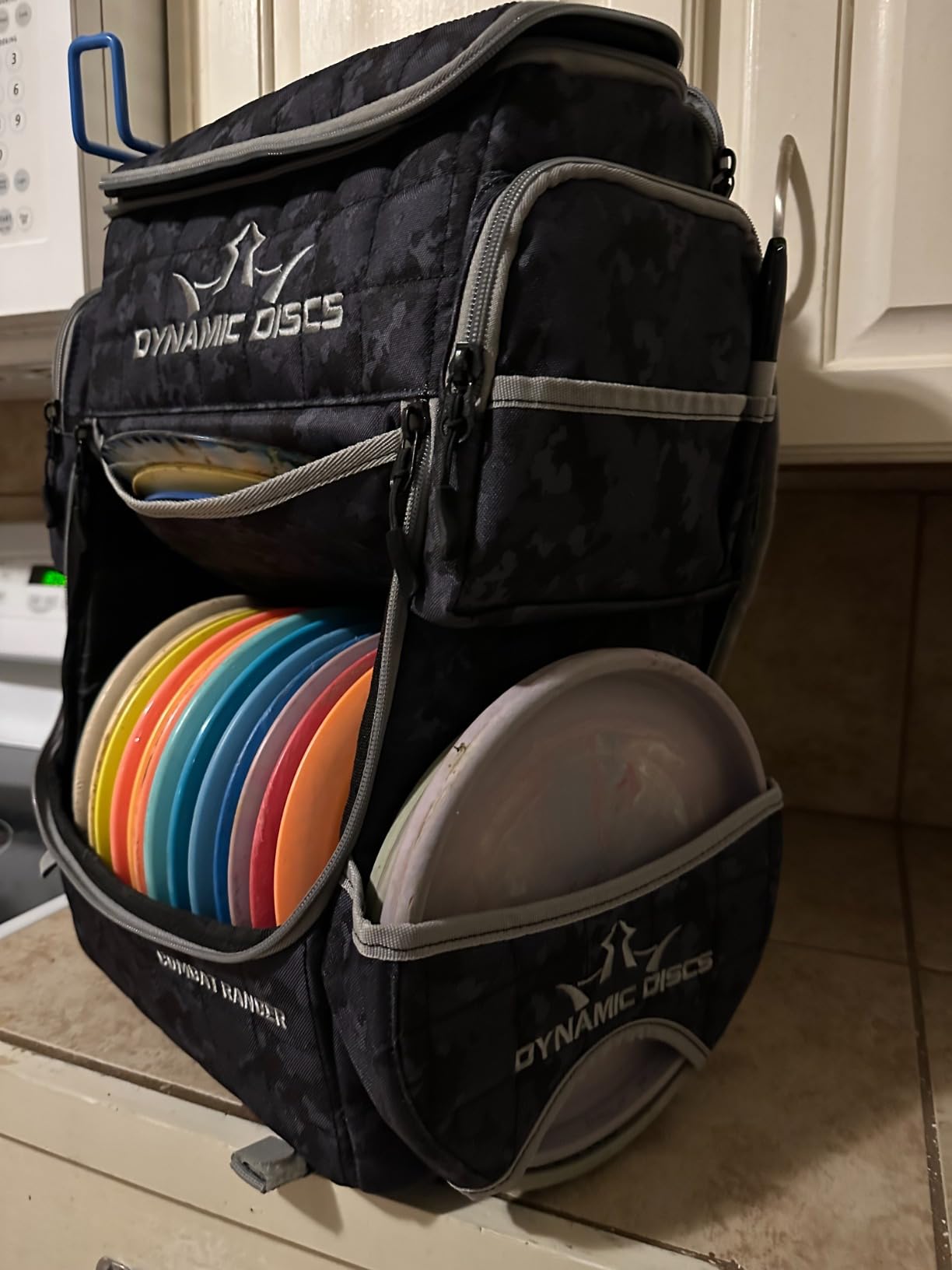
Capacity is 18+ discs with room for snacks, water bottles and accessories, and the styling is the most finished in this group. For a player who carries one bag to every event and wants a putter pocket that stays open and reachable, that finish has real value.
The catch is straightforward. This is the most premium option in the roundup, and it has far fewer customer reviews than the value-priced Trooper from the same brand. Stepping up for a better finish and top compartment is a reasonable choice, but it is not the same as stepping up for a structural upgrade.
Who the Combat Ranger suits
It suits a player who already knows their loadout fits in 20+ discs and wants the simplest putter access in this group. The large top compartment and the built-in 32 oz holder remove two small frictions that repeat all day.
It suits players in wet-season events. The weather-resistant construction is the stated focus, and for autumn and winter tournaments that is a reasonable reason to step up a tier from a nylon entry pack.
Where the Combat Ranger falls short
It is the most premium option here with the smallest review base, so you are buying on brand reputation and finish rather than on a long public track record. If you would rather spend on capacity, a 30-disc bag serves a bigger loadout for a lower step up.
It is also not the choice for a player who wants maximum structure. At 20+ discs, if you are on sidehills often, a hard-bottom design with rails will stay upright more reliably than a premium soft-sided pack.
What Bags Do Pro and Tournament Players Actually Use?
Searching the player forums for this question turns up a consistent shortlist: GripEQ bags in the AX line, Pound bags including the Octothorpe and the Legend series, Upper Park packs such as the Shift and the Rebel, and Dynamic Discs premium models. On the shopping side, the Revolution Carolina Team V3 and a range of high-end backpacks fill the tour tier. In r/discgolf threads, players repeatedly describe Pound and Upper Park bags as the quality benchmark, and one long-running post reports roughly 1000 rounds each with no issues on an Upper Park Shift and Rebel.
That is the community view, and it does not always match the competition-bag reality. A large share of competitive players use a cart and carry a minimal bag, so a lot of the “pro bag” you see on a Sunday leaderboard is a small pack and a push cart rather than a 30-disc backpack. A separate thread in the community recommends the Prodigy BP-1 for players who want a large tournament loadout without moving to a premium brand.
Seats are the other answer that keeps coming up. Players in r/discgolf call bags with a built-in seat the best tournament bags of all, with the Pound Legend 3.0 preferred for comfort, because at a 54-hole event a seat is worth more than another compartment. No bag in this roundup has one, and that is a genuine gap in the Amazon-available category.
For a specific player association, treat the forum lists as a guide rather than a record. Players change bags, sponsors rotate, and exact models are rarely verified. The reliable takeaway is the shape of the answer: premium touring bags, cart plus minimal pack, or a seat-equipped bag for long events.
Backpack vs Push Cart for Tournament Play
Cart play is the most under-covered decision in this category, and it changes the bag you should buy. A cart is not a shortcut; on a long or hilly course, a well-built cart with a stable bag often plays faster than carrying 25 discs uphill, and several of the bags in this roundup are designed to mount to one.
Choose a backpack when the course is short, when cart rules are restrictive, or when you want to control your own walking pace and shot selection from the lie. A backpack also wins when you need to leave the bag behind, for example on a course where a temporary water rule sends you down a path the cart cannot follow.
Choose a cart when the course exceeds roughly 6000 feet of walking, when the event runs multiple rounds, or when you are playing with a group that will not mind the pace. Cart players should prioritise capacity and attachment points over harness comfort, because the bag spends its life on a platform. The MVP Nucleus is built for exactly this, with a rigid hard shell bottom, side hooks for an assembled grabber and a cup holder. If you want a closer look at how carried bags differ from cart bags in another sport, our guide to golf bags for cart and carry lays out the same trade-offs in more detail.
The hybrid answer works too. A cart plus a smaller walking bag of 12 to 15 discs works for many players, and it is why minimal-loadout sling bags keep appearing in community recommendations. If you fly to events, check carry-on sizing before you commit, and compare against our travel bags guide for the general rules on packed size.
Real Capacity vs Spec Sheet Capacity
Almost every capacity number on a product page is a best case. Discs are counted standing in an empty main compartment with no dividers, no layer, no towel and no snacks. Add the things a tournament day actually requires and count on 20 to 25 percent less than the printed figure.
So a bag advertised at 18+ discs realistically holds 14 to 15 once you add a divider panel, a rain shell, snacks and a full bottle. A 30+ disc bag behaves closer to 23 to 25 in those conditions. If you are deciding between two bags that look identical on paper, the real figure is the one that should decide it.
There is a second version of this rule for the top compartments. Putters stacked in a top pouch or pocket are counted separately from the main compartment on most listings, and that space is the first thing to fill with putters, a towel and a rain cover. The result is a bag that is full on paper and cramped in hand.
A simple test settles it for your own loadout. Pack the bag the way you would on a final round, with dividers, a layer, a towel, snacks and a full-size bottle, then count. If your real number is at or above 18, you have a tournament bag. If it comes out closer to 12, you have a casual bag with a large label, and you will be reaching past small items mid-round.
How to Choose a Tournament Disc Golf Bag
Use this checklist in order, because the earlier questions eliminate most of the list before you get to fabric and pockets.
1. Pick your capacity by event format. A one-day local event usually needs 15 to 18 discs. A two-day A-tier or B-tier weekend needs 18 to 25. A three-day event or one with genuinely variable wind needs 25 to 35, and cart players should look at 30 or more. Then subtract the 20 to 25 percent real-capacity gap before you commit.
2. Check the harness, not just the padding. Straps at least 2 inches wide, a padded back panel, a sternum strap and a lumbar pad that contacts your lower back are the markers of a harness built for a loaded day. A padded strap on its own moves very little weight off your shoulders.
3. Decide about a hip belt. There is no hip belt on any bag in this roundup, which is worth flagging directly. For 18+ discs over 36 or more holes, a hip belt is the difference between a comfortable final nine and a sore one. None of the bags here include one, so if you carry a heavy loadout look for a waist strap or plan a lighter bag.
4. Test the base on a slope. A structured base or rigid skeleton, reinforced bottom or hard shell keeps the bag upright on a sidehill lie. Soft shells with internal support walls are a middle option. Pure fabric bags with no structure need a full load to stand up, which is why they tip most often.
5. Read the fabric denier. 600D polyester is the entry class: light, abrasion-resistant for casual use, thinner than you want in wet grass or brush. 900D polyester is the workhorse for a full tournament bag. 1000D Cordura is the premium class and shrugs off abrasion and repeated zipping. Heavier fabric adds ounces, so weigh durability against carry weight honestly.
6. Check putter access. A dedicated top putter pocket lets you grab a putter without opening the main compartment. Three putters in a small pouch is fine for a single-disc routine; six is better if you rotate. Nothing speeds up a round more than not unpacking between throws.
7. Look at warranty and pockets last. A limited lifetime warranty on materials and workmanship is the strongest quality signal at this category, and two bags in this roundup carry one. Pocket count matters less than layout, and bottle holders matter most when they accept a full-size bottle rather than a slim one.
For players who also carry gear on the walk, our walking bag comparison covers the same harness questions in a different frame.
Frequently Asked Questions
What bags do pro disc golfers use?
Community lists for pro and tour bags consistently name GripEQ AX-series bags, Pound bags such as the Octothorpe and Legend 3.0, Upper Park packs like the Shift and Rebel, and premium Dynamic Discs models, with the Revolution Carolina Team V3 filling the tour cart tier. Many competitive players run a cart with a smaller pack instead, and bags with a built-in seat are popular for 54-hole events.
How many discs do I need for tournament play?
Most tournament players carry 18 to 25 discs: a core lineup plus backups for lost discs, water hazards and changing wind. Three-day events or genuinely variable conditions push that to 25 to 35, and cart players often carry 30 or more. Rules limit how many discs you may put into play, not how many you may carry.
Should I get a backpack or a shoulder bag for disc golf?
Take a backpack for 18 or more discs and rounds of 18 holes or more, because a two-strap harness and a back panel spread the load far better. A shoulder or sling bag suits 10 to 15 discs and quick rounds. If you use a push cart, prioritise capacity and attachment points over the harness entirely.
How do I stop my disc golf bag from tipping over on a hill?
Choose a bag with a structured base, rigid internal walls or a hard shell, keep it at least half full so the weight sits low and centred, pack heavy items in the main compartment rather than the top pocket, and set it down on the uphill side with the base flat against the lie. Soft fabric bags without internal structure tip no matter how you place them.
Do I need a hip belt for a disc golf bag?
For 18 or more discs over 36 or more holes, yes. A hip belt moves the load from your shoulders onto your pelvis, which is where the body is built to carry weight. None of the bags in this roundup include one, so if you carry a heavy loadout look for a waist strap or plan a lighter bag. Players on hilly courses feel the difference fastest.
What is the 35 rule in disc golf?
The 35 rule is community shorthand that circulates around a 35-gram disc weight reference. Wherever you land on weight, it matters to a bag: a loadout of heavier discs adds weight to a bag you are already carrying for 36 holes, and lighter discs let you carry more of them. Tournament rules govern which discs you may put into play, not how many you carry.
Which Tournament Disc Golf Bag Should You Buy?
The Dynamic Discs Trooper is our pick for the best disc golf bags for tournament players in 2026, because it balances the four things that decide a tournament day better than anything else here: 18+ disc capacity, a 2-pound weight, a harness that stays comfortable, and a base that stands on a slope. If you need more capacity, the Prodigy BP-1 V3 takes 30+ discs and keeps the bag upright on bottom rails. If you need hydration in summer, the Throwback Sports insulated pack is the one to buy.
Match the bag to the loadout instead of to the label. Twenty to twenty-five discs and a walking event points to the Trooper or the Axiom Voyager Lite. A full competition lineup with backups points to the BP-1 V3. Cart play points to the MVP Nucleus. A first event points to the Innova Adventure Pack, which even includes a mini marker. And test the real capacity with your own discs packed before you commit to anything.