
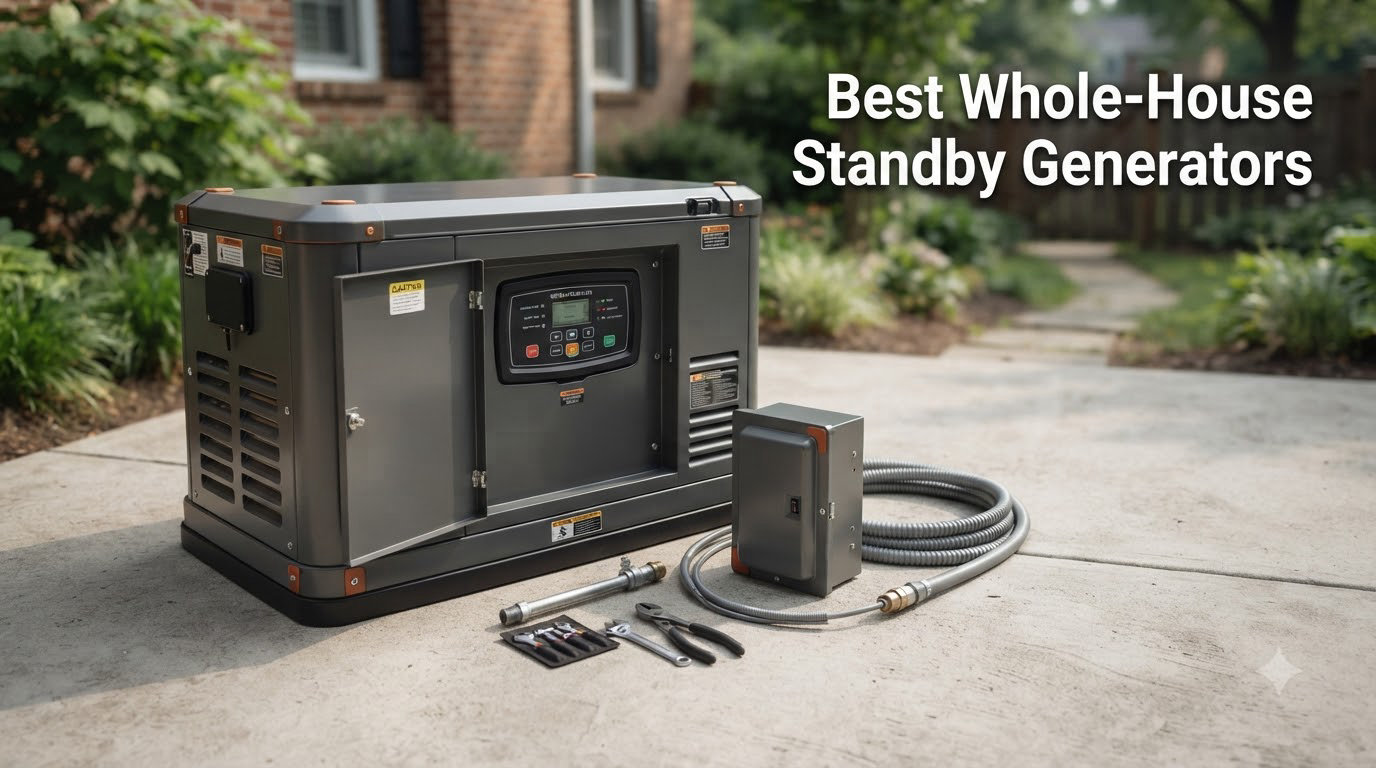
The best whole-house standby generators keep critical systems running without the refueling, extension cords, or manual start required by portable units. My first choice is the Generac Guardian 24kW because it combines 24,000 watts, under 5% harmonic distortion, a 200 Amp service-entrance transfer switch, dual-fuel flexibility, WiFi monitoring, and a five-year limited warranty in one package.
A permanently installed automatic standby generator starts after an outage, transfers the selected load away from the utility, and restores power in seconds. I would choose the 24kW model for a larger home with electric heating, central air, well equipment, or multiple high-draw appliances; households protecting only essentials can save capacity and fuel with a 14kW model.
This roundup compares all eight available products by output, transfer equipment, fuel support, monitoring, warranty, and owner evidence. Prices and inventory can change, and installation is separate, so I treat the unit specifications—not a dealer’s installation estimate—as the basis for each recommendation.
Table of Contents
- Top 3 Whole-House Standby Generator Picks for 2026
- Whole-House Standby Generators in 2026
- 1. Generac Guardian 24kW — Best for Whole-House Power and Clean Electronics Support
- 2. Kohler 20RESCL-200SELS — Best Premium Alternative for Fast, Corrosion-Resistant Backup
- 3. Generac 14kW Cellular — Best Value for Automatic Essential-Circuit Coverage
- 4. Generac 14kW with 200 Amp Switch — Best Bundle for a More Direct Whole-House Setup
- 5. Generac 22kW with 200 Amp Switch — Best Newer Option for a Larger Home
- 6. Honeywell 18kW — Best for a Mounting-Pad Included Package
- 7. Generac 18kW Cellular — Best for Connected Monitoring at a Middle Capacity
- 8. Generac 26kW with 200 Amp Switch — Best Maximum-Capacity Choice for Demanding Homes
- How to Choose a Whole-House Standby Generator
- Frequently Asked Questions
- Final Recommendation for the Best Whole-House Standby Generators in 2026
Top 3 Whole-House Standby Generator Picks for 2026

Generac Guardian 24kW Whole House Generator
- 24kW
- 200 Amp transfer switch
- Natural gas or propane


Whole-House Standby Generators in 2026
| Product | Specifications | Action |
|---|---|---|
| Generac Guardian 24kW |
|
Check Latest Price |
| Kohler 20RESCL-200SELS |
|
Check Latest Price |
| Generac 14kW Cellular |
|
Check Latest Price |
 Generac 14kW with 200 Amp Switch Generac 14kW with 200 Amp Switch |
|
Check Latest Price |
| Generac 22kW with 200 Amp Switch |
|
Check Latest Price |
 Honeywell 18kW Honeywell 18kW |
|
Check Latest Price |
| Generac 18kW Cellular |
|
Check Latest Price |
| Generac 26kW with 200 Amp Switch |
|
Check Latest Price |
1. Generac Guardian 24kW — Best for Whole-House Power and Clean Electronics Support
Generac Guardian 24kW Home Generator, Transfer Switch & WiFi Monitoring
24kW
200 Amp SER switch
Under 5% THD
Natural gas or LP
Pros
- Automatic transfer
- Mobile Link WiFi
- Quiet operation
- Five-year warranty
Cons
- Battery and cold kit separate
- Installer availability varies
I would put the Guardian 24kW at the top of this list for a home that genuinely needs one circuit to carry most major systems. Its 24,000-watt output is the strongest established option here by review depth, while the included 200 Amp service-entrance-rated transfer switch reduces the number of separate compatibility decisions.
True Power Technology is the detail I would care about most after capacity. The listed harmonic distortion stays under 5%, which is a useful specification for sensitive electronics, home-office equipment, and modern HVAC controls rather than merely a headline wattage number.
Mobile Link gives me the kind of status information I want during a storm: whether the unit is ready, exercising, running, or needs service. Owners also praise quiet operation, but the consensus from home-generator forums is that installation quality and local dealer support matter as much as the badge on the enclosure.
The compromises are specific and manageable. The battery is not included, Generac sells a cold kit separately for severe climates, and a few owners report difficulty finding installers. I would confirm service coverage, fuel-line routing, pad placement, and commissioning before treating the five-year limited warranty as complete protection.
Who the Generac Guardian 24kW is best for
This is my pick for a larger residence with central air, electric resistance loads, a well pump, or several appliances that may overlap. It also makes sense when clean power and whole-house transfer capability matter more than minimizing fuel use.
It is less attractive for a small home that only needs refrigeration, internet, lights, and a sump pump. An electrician’s load calculation can show whether a 14kW or 18kW unit would handle the same essential circuits with less operating fuel.
What can limit the Generac Guardian 24kW?
The 455-pound weight and outdoor placement require a proper pad, clearances, gas supply, and professional electrical work. I would also budget for the battery, possible cold-weather accessories, permits, and annual service rather than comparing the package price with installation-ready total cost.
Its warranty applies only within its stated terms, and a transfer switch does not make every large appliance start automatically. Motor starting loads still need to be included in the home’s load assessment.
2. Kohler 20RESCL-200SELS — Best Premium Alternative for Fast, Corrosion-Resistant Backup
Kohler 20RESCL-200SELS 20, 000W Air-Cooled Standby Generator with 200 Amp Whole-House, Service Entrance Rated, Load Shedding Automatic Transfer Switch
20kW
200 Amp load-shedding switch
10-second response
Corrosion-proof enclosure
Pros
- Fast automatic startup
- Premium power quality
- Quiet operation
- Five-year/2000-hour warranty
Cons
- Professional commissioning required
- Service availability may vary
- Group 51 battery needed
Kohler’s 20RESCL is the strongest alternative for buyers who value enclosure construction, fast transfer, and a premium power-quality story. The package includes a 200 Amp whole-house, service-entrance-rated, load-shedding automatic transfer switch, so it is designed for broad circuit coverage rather than a small critical-load panel.
The stated 10-second response is meaningful during a storm, especially when refrigeration, lighting, communications, and a sump pump need to come back quickly. I also like the corrosion-proof enclosure for homes exposed to coastal air, road salt, or persistent moisture.
Owner feedback is positive but less abundant than the market’s Generac discussions. The 4.1-star average across 32 reviews points to solid performance when the system is installed and commissioned correctly, while forum users repeatedly identify local technician availability as a practical brand-selection factor.
Installation is not a DIY job. A Group 51 battery, gas connection, permitting, pad, and service commissioning must be planned, and regional Kohler support may not be as convenient as another brand’s dealer network. I would verify the nearest authorized service contractor before choosing this premium model.
Who the Kohler 20RESCL-200SELS is best for
I would recommend it to a homeowner who wants a 20kW air-cooled system, fast automatic response, and a load-shedding transfer switch in one coordinated package. The corrosion-resistant enclosure is an added reason to consider it in harsh weather environments.
It is a particularly sensible choice when an installer has direct Kohler experience and can document the warranty registration. That service relationship can matter more than a small difference in unit price.
What can limit the Kohler 20RESCL-200SELS?
The 500-pound weight, 48-by-26.2-by-29-inch footprint, and professional commissioning make site planning important. The rating is not as strong as the Generac Guardian’s 4.4 average, and the 32-review sample is small, so I would not treat it as a universal reliability ranking.
It may also be excessive for homes that have gas heat and only need selected circuits. Load shedding helps, but only a proper load calculation can confirm that a 20kW unit is appropriately matched.
3. Generac 14kW Cellular — Best Value for Automatic Essential-Circuit Coverage
Generac 14kW Whole Home Generator, Cellular Capability
14kW
Cellular monitoring
Automatic whole-house coverage
Dual fuel
Pros
- 300+ owner hours reported
- Mobile Link app
- Oil level sensors
- Cold-start improvements
Cons
- Can be noisy
- Higher fuel use
- Battery replacement required
This 14kW model is my value pick for buyers who want automatic backup without paying for capacity they cannot use. It is rated for natural gas or propane, starts automatically, and has built-in cellular connectivity, which makes remote status monitoring possible without relying on a local WiFi connection alone.
The five reviews are unusually positive, including reports of 300+ operating hours and whole-house performance with multiple mini-split systems. I would read that evidence as encouraging, not conclusive: the sample is only five reviews, and a small number of experiences cannot establish long-term reliability.
Its compact 46.4-by-26.3-by-30.7-inch body weighs 391 pounds, and the fully enclosed design is described as super quiet, although owners also report noise and meaningful fuel consumption. A standby unit is still an engine, so location, exhaust direction, and neighbor relations deserve attention.
The included-components listing is an owner’s manual only in the supplied data, so I would ask exactly which transfer switch, battery, pad, and commissioning items are included in the purchaser’s configuration. That clarification prevents a lower-capacity purchase from becoming a surprise installation project.
Who the Generac 14kW Cellular is best for
I would choose it for a moderately sized home with gas heat, efficient cooling, and a manageable set of essential loads. It is also a good fit for a buyer who wants cellular monitoring and dual-fuel operation but does not need a 200 Amp whole-house switch included in the base package.
It can still power a whole house when the load is modest and the transfer arrangement is designed correctly. I would not use the word “whole house” as a substitute for measuring starting current from HVAC compressors, pumps, and motors.
What can limit the Generac 14kW Cellular?
Fourteen kilowatts may be insufficient for electric resistance heating, multiple large HVAC zones, or a home with an electric range and water heater running at once. The 5.0-star rating has just five reviews, and delivery is listed as taking one to two months, which may matter for an approaching storm.
I would also check cellular coverage at the installation location. Remote diagnostics are valuable only when the signal is dependable, and the battery still needs periodic replacement and maintenance.
4. Generac 14kW with 200 Amp Switch — Best Bundle for a More Direct Whole-House Setup
Generac 14kW Whole Home Generator, Transfer Switch & Cellular Capability
14kW
Automatic 200 Amp switch
Cellular monitoring
Dual fuel
Pros
- Transfer switch included
- 300+ owner hours reported
- Mobile Link app
- Five-year warranty
Cons
- Can be noisy
- Higher fuel use
- Battery sold separately
The main difference between this 14kW configuration and the previous Generac is clarity of scope: the package includes an automatic 200 Amp transfer switch. I would favor that arrangement when a homeowner wants a more direct path to whole-house protection and does not want to source the switch separately.
The 14,000-watt output is supported by a five-year limited warranty, oil-level sensors, built-in cellular connectivity, and natural-gas or propane capability. Owners report 300+ hours of operation and successful use with multiple mini-splits, which is useful evidence for a compact system serving a well-managed load.
Noise, fuel use, and a separately sold battery are the tradeoffs. I would ask the installer to model starting loads and to explain whether the selected 200 Amp switch is service-entrance rated and configured for load shedding in the exact home.
Like the other 14kW model, the 46.4-by-26.3-by-30.7-inch footprint is manageable compared with the 24kW and 26kW units, but 391 pounds is still substantial. Proper pad placement, gas sizing, ventilation, and access for service are part of the product decision.
Who the Generac 14kW with 200 Amp Switch is best for
This is the most straightforward Generac choice for a household that needs 14kW and wants the transfer switch identified in the same offer. It suits homes with gas heat, efficient cooling, and essential circuits such as a refrigerator, modem, lighting, and sump pump.
It is not my first choice for a large all-electric home. If the load calculation includes electric heat, a well pump, and several compressors, capacity—not convenience—should determine the size.
What can limit the Generac 14kW with 200 Amp Switch?
The transfer switch does not increase generator output, and a 200 Amp switch is not a promise that every 200-Amp load can run. I would also account for the battery, pad, permits, fuel work, and a professional installation in the budget.
The rating of 5.0 stars comes from five reviews, so I would place more weight on the specifications and local service network than on the perfect average. A newer product with little long-term feedback deserves a conservative ownership plan.
5. Generac 22kW with 200 Amp Switch — Best Newer Option for a Larger Home
Generac 22kW Whole Home Generator, Transfer Switch & Cellular Capability
22kW
Automatic 200 Amp switch
Cellular monitoring
Dual-fuel ready
Pros
- High 22kW capacity
- Transfer switch included
- Seamless operation
- Five-year warranty
Cons
- Only one review
- Newer product with limited feedback
The 22kW configuration fills the gap between the established 20kW Kohler and the 24kW Guardian. It includes a 200 Amp automatic transfer switch and built-in cellular connectivity, making it a compelling package for a larger home that does not quite need the Guardian’s full 24,000 watts.
Its electronic fuel and ignition controls, enclosed design, 451-pound weight, and five-year limited warranty make the specification sheet look complete. The 22kW rating also gives a homeowner more room for central air, kitchen circuits, and motor loads than a 14kW or 18kW unit.
The caution is the evidence base: there is only one five-star review. I would not call it the reliability winner based on that sample, but I would recognize it as a newer, full-capacity option with an integrated switch and Prime eligibility listed in the current data.
I would compare its installation footprint, gas-line requirement, transfer-switch compatibility, and service access with the 24kW model. A modest capacity reduction is useful only if the home’s measured load fits comfortably, not merely close to the limit.
Who the Generac 22kW with 200 Amp Switch is best for
I would recommend it to a larger home that needs more than the mid-size 14kW and 18kW units can provide but has no reason to pay for 26kW. It is also a good fit for buyers who want cellular monitoring in the package rather than as an add-on.
It may work well for homes with two or more cooling systems, gas heat, and a well pump. A professional load calculation remains the deciding test.
What can limit the Generac 22kW with 200 Amp Switch?
The 46.4-by-26.3-by-30.7-inch enclosure and 451-pound weight still require a prepared outdoor site. The limited review history means warranty support, installer familiarity, and parts availability should be checked locally before purchase.
Because the product listing says ships in two to three days, availability may be easier than for some alternatives, but that does not replace service coverage. I would also confirm whether the listed transfer switch is service-entrance rated for the home’s panel.
6. Honeywell 18kW — Best for a Mounting-Pad Included Package
Honeywell 18kW Whole Home Standby Generator
18kW
Natural gas or propane
Mounting pad included
Weather-resistant aluminum
Pros
- Dual-fuel flexibility
- Composite pad included
- LCD control
- Automatic shutdown
Cons
- Only one review
- Three-year warranty
The Honeywell 18kW is a practical middle-capacity choice for homeowners who want a mounting pad included and a weather-resistant aluminum enclosure. It accepts natural gas or propane, provides automatic backup, and includes a transfer switch according to the supplied product listing.
The 18,000-watt rating sits between the 14kW and 22kW options, which can be a useful fit for a home with moderate central cooling and several essential circuits. Its composite mounting pad is a small but meaningful convenience because it helps establish the required stable, level installation base.
The main limitation is evidence. One five-star review praises fast shipping and price but cannot establish long-term reliability, and the three-year limited warranty is shorter than the five-year coverage listed for most Generac configurations.
I would treat the Honeywell as a configuration choice rather than a proven brand winner. Confirm the transfer-switch rating, gas capacity, local service route, and whether the composite pad alone is acceptable under the local permit requirements.
Who the Honeywell 18kW is best for
I would consider it for a homeowner who values a ready-to-plan pad and needs 18kW of capacity without moving to a 22kW or 24kW system. It is a sensible fit where a dealer can provide installation, fuel, and service as a single project.
It is less compelling to a buyer who puts warranty length and long-term review history first. In that case, a better-documented 18kW or 24kW package may reduce uncertainty.
What can limit the Honeywell 18kW?
The product data lists a 120-volt rating even though whole-house standby systems generally require a properly designed 240-volt service arrangement. I would have the installer verify the actual voltage, phase, transfer-switch compatibility, and all required electrical code details rather than relying on a single listing field.
With a 483-pound weight, 48-by-25-by-29-inch body, and only one review, installation access and local support deserve more attention than the convenience of the included pad.
7. Generac 18kW Cellular — Best for Connected Monitoring at a Middle Capacity
Generac 18kW Whole Home Generator, Cellular Capability
18kW
Cellular and WiFi
Dual fuel
Automatic backup
Pros
- Mobile Link connectivity
- Oil level sensors
- Cold-start improvements
- Automatic idle control
- Remote monitoring
Cons
- Internet-dependent features
- Battery-drain reports
- 3.9-star mixed reviews
This 18kW Generac is aimed at connected homes. Built-in cellular capability, WiFi monitoring, oil-level sensors, automatic idle control, and compatibility with the Generac Home Energy Ecosystem make it a strong monitoring-first option.
Its 18,000-watt capacity should cover more of a typical home’s mixed essential loads than a 14kW unit while using less fuel than the largest 26kW system. The fully enclosed design and overload protection are useful features, but they do not remove the need to check starting watts and motor loads.
The listed 3.9-star average across five reviews is a warning to investigate real-world service experiences. Reports mention dependence on internet connectivity, battery drain when shut down, and fuel-efficiency concerns, so I would ask for the local cellular coverage and a clear battery-maintenance schedule.
I would also verify whether the model requires a separate transfer switch. The product data lists the owner’s manual as the included component, unlike several bundles that identify a 200 Amp switch in the package.
Who the Generac 18kW Cellular is best for
This is my pick for a homeowner who wants remote status, oil-level visibility, and a moderate 18kW capacity. It suits a connected household that can benefit from Mobile Link notifications and has a straightforward route to professional service.
It is not the safest recommendation for someone who wants the most mature review history. The small review count and mixed feedback make local support especially important.
What can limit the Generac 18kW Cellular?
Remote features depend on connectivity, and a battery that drains while the unit is off undermines readiness if maintenance is neglected. I would test the monitoring setup during installation and add a written exercise schedule.
The 426-pound enclosure and 46.4-by-26.3-by-30.7-inch dimensions still need proper clearances. Before ordering, I would confirm fuel availability, transfer-switch size, and the maximum simultaneous starting load.
8. Generac 26kW with 200 Amp Switch — Best Maximum-Capacity Choice for Demanding Homes
Generac 26kW Whole Home Generator, Transfer Switch & Cellular Capability
26kW
200 Amp automatic switch
Cellular and WiFi
Dual fuel
Pros
- Highest listed output
- 200 Amp switch included
- Low oil shutdown
- Five-year warranty
Cons
- Heavy 524-pound unit
- Missing-component reports
- Only three reviews
The Generac 26kW is the maximum-capacity model in this roundup. I would reserve it for a genuinely demanding home with multiple large HVAC systems, electric appliances, a well pump, or other loads that make 14kW to 24kW capacity too tight.
The included 200 Amp automatic transfer switch, dual-fuel compatibility, cellular and WiFi monitoring, low-oil shutdown, and five-year limited warranty create a feature-rich package. Automatic idle control and voltage regulation are useful when the system is running for long outages.
The tradeoff is the heaviest listed unit at 524 pounds, along with a 46.4-by-26.3-by-30.7-inch footprint. It also has the lowest rating in the product set, 3.8 stars across three reviews, and reports of missing transfer-switch components in some shipments.
I would inspect the shipment carefully and use a documented installer checklist. Maximum capacity is valuable only when the generator, switch, fuel system, pad, wiring, and service plan are all correctly specified.
Who the Generac 26kW with 200 Amp Switch is best for
I would choose it for a large or all-electric home where the load calculation shows that lower-output alternatives are not safe. It is also a fit for a property that wants room for future circuits or simultaneous motor and appliance operation.
It is not a default choice for a smaller home. Oversizing can increase fuel use, noise, purchase cost, and installation complexity without improving the experience.
What can limit the Generac 26kW with 200 Amp Switch?
The three-review sample is too small to treat its 3.8-star average as a reliable ownership score, and missing-component reports make packaging inspection important. I would require the installer to confirm every switch component before signing off.
The heavy enclosure and high output also demand careful gas sizing, pad engineering, and local permitting. Confirm service access and warranty registration before installation day.
How to Choose a Whole-House Standby Generator
Size the unit from measured loads, not square footage alone
A 14kW to 18kW model is often a starting point for homes with gas heat and efficient cooling, while 20kW to 26kW systems suit larger homes, multiple HVAC zones, electric appliances, well pumps, or future loads. The correct decision comes from adding running watts, starting watts, motor surge, and the circuits that must operate together.
I would ask an electrician or qualified generator installer to inspect the service panel, HVAC nameplates, water heater, range, pump, and medical equipment. A 200 Amp transfer switch does not change the fact that a 14kW generator has only 14kW of usable output.
Compare Generac, Kohler, and Honeywell support
Generac is the easiest brand to recommend when owner history, broad market recognition, cellular or WiFi monitoring, and multiple capacity bundles matter. Kohler earns consideration for its corrosion-proof enclosure, fast response, premium power quality, and load-shedding package. Honeywell may suit buyers who specifically want an included mounting pad and an 18kW middle-capacity configuration.
Forum users consistently say the best brand is the one with a nearby authorized technician. I would confirm warranty registration, parts availability, emergency response, and whether the installer has handled that exact engine and transfer switch before choosing between similarly sized units.
Choose natural gas or propane deliberately
Natural gas is convenient when a home already has a properly sized utility line and the utility can maintain service during a storm. Propane is useful where natural gas is unavailable or a homeowner wants an on-site fuel reserve, but tank size, refill access, local supply, and propane consumption need to be planned.
Dual-fuel models provide flexibility but are not magic. The same generator will not necessarily produce identical capacity on every fuel, so I would verify the fuel-specific load chart and have the installer size the supply line accordingly.
Budget for the complete standby generator installation
The generator price is only one part of the project. I would budget for a concrete or composite pad, transfer switch if not included, battery, permits, fuel piping, electrical labor, trenching, load-shedding equipment, and commissioning.
Forum complaints about installation cost surprises usually come from comparing equipment-only prices with a turnkey system. Ask for a written scope that identifies who handles the pad, gas connection, utility coordination, inspection, startup, and warranty registration.
Plan maintenance, monitoring, and noise
A standby generator should exercise regularly, have its oil and filter serviced, and receive periodic battery and transfer-switch checks. Mobile Link or cellular monitoring helps with readiness alerts, but it cannot replace an exercise schedule or professional inspection.
Noise is a legitimate neighborhood concern. Place the unit where local rules and manufacturer clearances allow safe exhaust discharge, keep it away from windows and property lines when possible, and test it during a normal hour so the household knows its normal sound level.
Ask whether incentives apply before buying
A whole-house generator is not automatically a federal tax credit simply because it provides emergency backup power. Eligibility can depend on the equipment, how it is used, local programs, and whether it is part of a broader energy upgrade, so I would check current federal and state guidance with a tax professional rather than rely on a seller’s claim.
For 2026, the right approach is to preserve documentation for the purchase, installation, fuel system, and any energy-efficiency or resilience program requirements. Rules and utility rebates can change, and the IRS or local authority should be the final source for eligibility.
Frequently Asked Questions
Which is better for a whole house generator, Kohler or Generac?
Generac is the stronger all-around pick for most buyers because it offers a wide range of capacities, cellular or WiFi monitoring, and more owner feedback. Kohler is worth choosing when you prioritize its corrosion-proof enclosure, fast 10-second response, premium power quality, and a 200 Amp load-shedding package. Verify local service and warranty support before deciding.
What size generator would I need to run an entire house?
A 14kW to 18kW model often suits a home with gas heat and efficient cooling, while 20kW to 26kW is more appropriate for larger homes, multiple HVAC systems, electric appliances, or well pumps. Have an electrician calculate running and starting loads because square footage alone cannot size a generator safely.
Is there a tax credit for a whole house generator?
A whole-house standby generator is not automatically a federal tax credit simply because it supplies emergency power. Eligibility may depend on the system, how it is used, local programs, and whether it is part of an eligible energy upgrade. Check current IRS guidance and your state or utility programs with a tax professional before purchasing.
How long can a standby generator run?
A properly maintained standby generator can run for extended outages when it has a continuous fuel supply and receives routine service. Runtime is limited by fuel supply, maintenance, load, and the engine rather than a fixed hours-per-day number, so I would confirm fuel availability and service intervals with the installer.
Which brand of standby whole house generator is best for homeowners?
Generac is the most practical default for many homeowners because of its broad product range, monitoring options, and larger base of owner feedback. Kohler is a strong premium alternative, Honeywell offers a notable 18kW package, and local authorized service quality can matter more than brand preference.
Final Recommendation for the Best Whole-House Standby Generators in 2026
The Generac Guardian 24kW is my overall recommendation because it combines high whole-house output, under 5% harmonic distortion, an included 200 Amp transfer switch, dual-fuel support, remote monitoring, and the strongest established review base in this group. The Generac 14kW with the 200 Amp switch is the better value for homes that can meet their loads without 24kW, while the Kohler 20RESCL is the premium alternative for buyers who value fast response, enclosure protection, and a coordinated load-shedding package.
Before ordering, ask a qualified installer to calculate your loads, inspect your fuel supply, confirm transfer-switch compatibility, and provide a complete installation scope. The right home standby generator is the one that starts automatically, powers the circuits you actually need, and has a service plan you can use after the storm.