
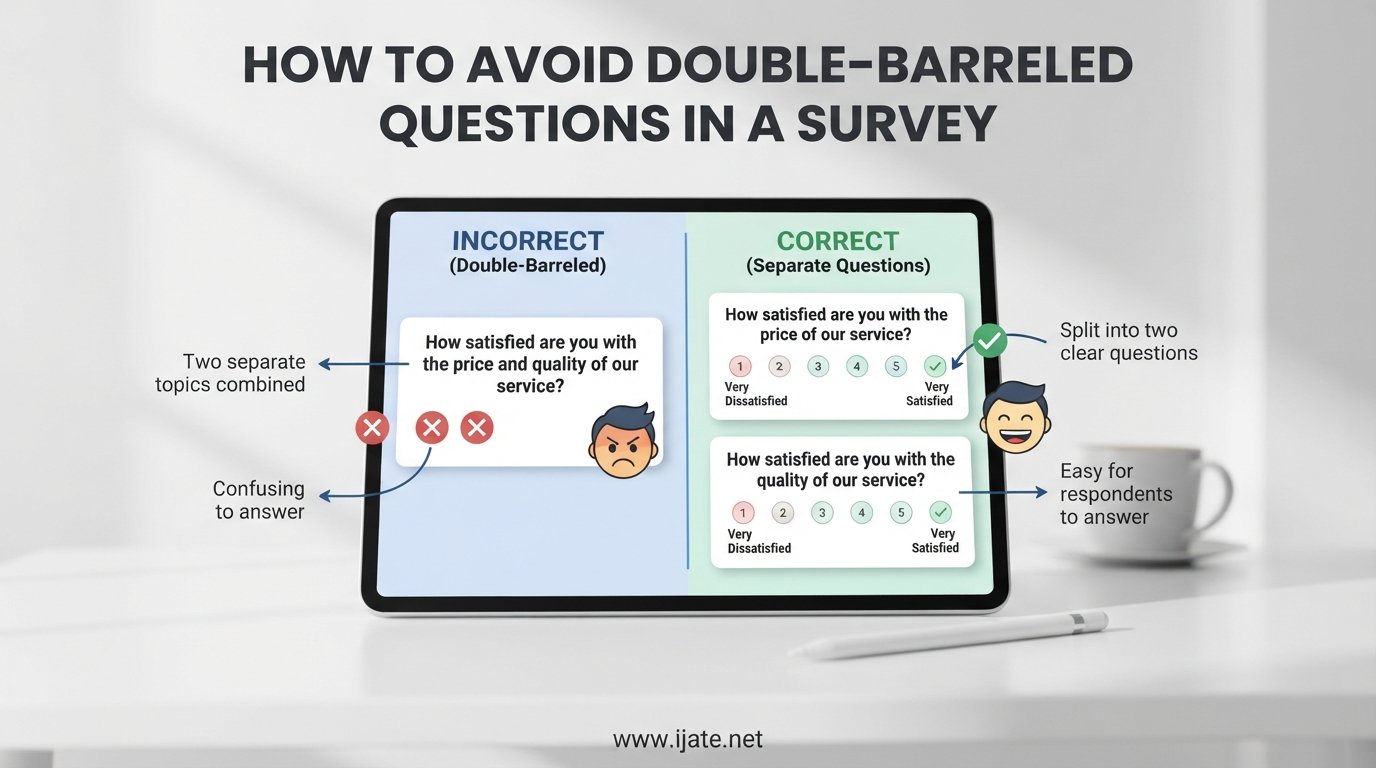
A double-barreled question is a survey question that asks about two or more distinct topics at the same time but only allows one answer. When respondents cannot separate their feelings about each topic, the data you collect becomes unreliable and hard to interpret. Learning how to avoid double-barreled questions in a survey is one of the fastest ways to improve data quality, reduce respondent confusion, and protect the validity of your research.
Our team has spent years reviewing survey instruments across customer feedback, employee engagement, academic research, and market research projects. In nearly every case, double-barreled questions were the most common and most damaging mistake hiding inside the questionnaire. The good news is they are also one of the easiest problems to fix once you know the warning signs.
This guide breaks down what double-barreled questions look like, why they distort results, how to spot them before launch, and the exact steps to avoid them. You will also find industry-specific examples, a fix-it process for surveys already in the field, and a quick checklist you can use on every questionnaire you build.
Table of Contents
What Is a Double-Barreled Question?
A double-barreled question combines two separate ideas into a single survey question while only giving the respondent one opportunity to answer. The phrase comes from the image of a double-barreled shotgun firing two shots at once from a single trigger. In survey methodology, this means one response represents two distinct constructs, and there is no way to tell which construct the respondent was actually rating.
Most double-barreled questions use conjunctions like “and,” “or,” or “as well as” to join two topics. They can also hide inside longer statements where two attributes are bundled together. Related terms you may see include “compound question,” “double-direct question,” or “double-loaded question,” but they all describe the same structural flaw.
The core problem is that a respondent might feel positively about the first part of the question and negatively about the second. Forced to pick a single answer, they either average their response, pick randomly, or abandon the survey entirely. Each of those outcomes contaminates your data.
Examples of Double-Barreled Questions in Surveys
Real examples make this concept much easier to recognize. Here are common double-barreled questions broken down by survey type, along with the corrected version that splits each into single-construct questions.
Customer Feedback Surveys
Double-barreled: “How satisfied are you with the quality and price of our product?”
The problem here is obvious when you slow down. A customer might love the quality but feel the price is too high. With a single satisfaction scale, you cannot tell which sentiment drove their answer.
Fixed version: Split into two questions. “How satisfied are you with the quality of our product?” and “How satisfied are you with the price of our product?”
Employee Engagement Surveys
Double-barreled: “My manager is supportive and gives me clear feedback.”
Someone might have a supportive manager who is terrible at giving specific feedback, or the reverse. Either way, a single agreement rating hides the real issue.
Fixed version: “My manager is supportive when I face challenges.” and “My manager gives me clear and actionable feedback.”
Academic Research Surveys
Double-barreled: “The training program was engaging and improved my skills.”
A training session can be entertaining without teaching anything useful, or highly effective but delivered in a boring format. Lumping engagement and skill improvement together damages construct validity.
Fixed version: “The training program held my attention.” and “The training program improved my skills.”
Market Research Surveys
Double-barreled: “How often do you purchase and recommend our brand to others?”
Purchasing behavior and recommendation behavior are two different metrics with two different drivers. Combining them makes the data unusable for either analysis.
Fixed version: “How often do you purchase products from our brand?” and “How likely are you to recommend our brand to a friend or colleague?”
Quick Comparison: Bad vs. Good Question Structure
Bad: “Was the website easy to use and visually appealing?” — two constructs, one answer.
Good: “Was the website easy to navigate?” followed by “Was the website visually appealing?” — one construct per question.
Bad: “Do you agree that the event was well-organized and informative?”
Good: “The event was well-organized.” followed by “The event provided valuable information.”
Bad: “Are you satisfied with the speed and accuracy of our customer support?”
Good: “Are you satisfied with how quickly customer support responded?” followed by “Are you satisfied with how accurately customer support resolved your issue?”
Why Double-Barreled Questions Are Problematic
Double-barreled questions damage survey results in several specific ways. Understanding each one helps explain why this mistake is worth catching before launch rather than after data collection.
Respondent confusion: When a respondent reads a question that asks two things at once, they have to guess which part to answer. Some pick the part they feel most strongly about, others average their opinions, and some simply give up and skip the question entirely.
Misleading data: Even when respondents do answer, the data is ambiguous. A low score on “quality and price” could mean dissatisfaction with quality, price, or both. You cannot separate the signals, which makes any analysis built on that question unreliable.
Reduced construct validity: Survey methodology depends on each question measuring one construct at a time. When two constructs are bundled, the question no longer measures anything cleanly, which undermines the entire scale. This is especially damaging in academic research and psychometric testing.
Higher respondent burden: Confusing questions make surveys feel longer and harder to complete. Respondents tire faster, drop out at higher rates, and provide lower-quality answers to the rest of the questionnaire.
Psychological impact on respondents: When people feel a question is impossible to answer honestly, they lose trust in the survey itself. That trust deficit carries over to later questions, producing rushed or careless responses that further degrade data quality.
Researchers on communities like Reddit’s r/AcademicPsychology and r/IOPsychology frequently report that double-barreled questions are the most common flaw they find when auditing enterprise surveys. The cost of fixing them before launch is tiny compared to the cost of running an entire study on contaminated data.
How to Identify Double-Barreled Questions
You do not need special software to catch double-barreled questions, though some survey tools now include basic detection features. A simple, repeatable review process works well. Use these steps on every question before you publish a survey.
Step 1: Scan for conjunctions. Look for the words “and,” “or,” “as well as,” “but also,” and similar joining words. Every conjunction is a candidate for a double-barreled question. Not all conjunctions create problems, but every double-barreled question involves joining two ideas.
Step 2: Count the constructs. Ask yourself, “How many separate things is this question measuring?” If the answer is more than one, you have a problem. A construct is a single concept like satisfaction, ease of use, speed, or friendliness.
Step 3: Test for split opinions. Imagine a respondent who feels positive about the first part of the question and negative about the second. If that respondent cannot give a single honest answer, the question is double-barreled.
Step 4: Check the response scale. If one rating is supposed to reflect two different attributes, the scale is overloaded. Each scale point should represent a single level of agreement, satisfaction, or frequency for one construct only.
Step 5: Read the question aloud. Hearing the question often reveals awkwardness that silent reading hides. If the question sounds like it is asking two things when spoken, it probably is.
Step 6: Run a pilot test. Ask five to ten people to take your survey and then explain their answers in a follow-up interview. If anyone says “I was not sure which part to answer,” you have found a double-barreled question.
How to Avoid Double-Barreled Questions in a Survey
Knowing how to avoid double-barreled questions in a survey is more valuable than fixing them after the fact. The following methods, drawn from survey methodology best practices, will help you write clean questions from the start. If you work in survey scale development methodology, these principles are especially important for protecting measurement reliability.
1. Write One Question per Construct
Before you write any question, identify the single construct you want to measure. If you need to measure satisfaction with both speed and friendliness, that is two questions, not one. Build the habit of asking “What exactly am I measuring?” for every item on your survey.
2. Use the Split Technique
Whenever you catch yourself writing “and” or “or” in a question, stop and split it into two separate items. This is the single fastest fix and the most reliable prevention method. Treat every conjunction as a red flag until proven otherwise.
3. Keep Sentences Short
Long, complex sentences invite double-barreled phrasing because writers naturally try to pack related ideas together. Aim for questions under fifteen words. Short questions are easier for respondents to parse and harder for writers to accidentally overload.
4. Avoid Bundling Attributes
Resist the temptation to combine related attributes like “fast and friendly” or “clear and concise.” Even when attributes feel connected, respondents often have different opinions about each one. Measure them separately so your analysis stays clean.
5. Use Matrix Questions Carefully
Matrix or grid questions, where respondents rate several items on the same scale, are useful but risky. Make sure each row in the matrix measures only one construct. A matrix row like “Our staff was knowledgeable and courteous” is still a double-barreled question in disguise.
6. Pre-Test with Real Respondents
Run a small pilot before full launch and ask pilot respondents to think aloud as they answer. Their verbal reactions will reveal double-barreled questions your own review missed. Even five pilot respondents can catch problems that would otherwise contaminate thousands of responses.
7. Use a Peer Review Checklist
Have a colleague who did not write the survey review each question against a simple checklist. Fresh eyes catch conjunctions and bundled constructs that the original writer is blind to. The checklist at the end of this article gives you a starting point.
8. Borrow from Validated Scales
Whenever possible, use questions from validated survey instruments published in academic research. These scales have already been tested for double-barreled flaws and other issues. Adapting a validated scale saves time and protects your data quality. You can explore examples of this approach in survey attitude measurement research.
Quick Checklist for Reviewing Survey Questions
Does the question contain “and,” “or,” or another conjunction?
Could a respondent feel differently about each part of the question?
Does the question measure more than one construct?
Is the response scale trying to capture two attributes at once?
Would a pilot respondent be confused by this question?
Is the question borrowed from a validated scale, or written from scratch?
If you answer “yes” or “not sure” to any of these, rewrite the question before launch.
How to Fix Double-Barreled Questions You Already Have
Sometimes you inherit a survey that is already full of double-barreled questions, or you discover the problem after data collection has started. Here is how to handle each scenario.
Before Launch
Split each double-barreled question into two single-construct questions. Reorder the items so related questions sit near each other but remain independent. Then pilot test the revised survey to confirm the fix worked. This is the cleanest path and should be your default approach.
During Data Collection
If a survey is already live, stop collecting data on the affected questions if possible. Pause the survey, fix the items, and relaunch. Continuing to collect contaminated data wastes budget and makes analysis harder. In most survey platforms you can edit questions without losing already-collected responses.
After Data Collection
If the survey is already complete, you cannot truly fix double-barreled questions retroactively. The best you can do is flag the affected items in your analysis, avoid drawing strong conclusions from them, and use them only as rough indicators. Document the limitation clearly in any report so stakeholders understand the data quality issue. Future surveys should be redesigned from scratch using the principles in this guide. For broader context on designing better survey research methods, academic literature is a good starting point.
Survey Best Practices Beyond Double-Barreled Questions
Avoiding double-barreled questions is important, but it is just one piece of writing better survey questions. Keep these related best practices in mind as you review your entire questionnaire.
Avoid leading questions. Leading questions push respondents toward a particular answer through biased wording. “How excellent was our service?” assumes the service was excellent. Use neutral wording like “How would you rate our service?”
Avoid loaded questions. Loaded questions contain assumptions that may not apply to the respondent. “Why do you dislike our product?” assumes dislike. Screen first, then ask follow-ups based on the answer.
Avoid double negatives. Statements like “I do not disagree with the new policy” force respondents to do mental gymnastics. Use clear, direct, positively framed language.
Use consistent scales. Mixing a 5-point scale on one question with a 7-point scale on the next creates cognitive friction. Pick scales that fit your analysis and stick with them across the survey.
Keep surveys short. Respondent attention drops sharply after about ten minutes. Prioritize the questions that matter most and cut the rest. Shorter surveys produce higher-quality data than long, exhaustive ones.
FAQs
What is a double-barreled question in a survey?
A double-barreled question is a survey question that asks about two or more distinct topics at the same time but only allows a single response, making it impossible for respondents to answer accurately about either topic.
How to avoid double-barreled questions?
To avoid double-barreled questions, write one question per construct, scan for conjunctions like and or or, use the split technique to separate bundled ideas, keep sentences short, pre-test with real respondents, and use a peer review checklist before launch.
How to fix a double-barreled question?
Split the question into two or more separate items, each measuring a single construct. For example, change u0022How satisfied are you with the quality and price?u0022 into two questions: one about quality and one about price, each with its own response scale.
Can double-barreled questions invalidate a survey?
Yes. Double-barreled questions produce ambiguous data because a single response reflects two unknown constructs. In academic and psychometric research, enough double-barreled items can undermine construct validity and call the entire study into question.
Why avoid double-barreled questions?
Double-barreled questions cause respondent confusion, produce misleading data, reduce construct validity, increase respondent burden, and lower trust in the survey itself. Avoiding them protects data quality and makes analysis far more reliable.
What is an example of a double-barreled question in a survey?
A common example is u0022How satisfied are you with the quality and price of our product?u0022 This question asks about two separate things, quality and price, but only allows one satisfaction rating, so you cannot tell which attribute the respondent is actually evaluating.
Do double-barreled questions affect survey results?
Yes. They distort results by forcing respondents to give a single answer for two topics, which means the data cannot be cleanly attributed to either construct. This leads to unreliable analysis and potentially wrong business or research decisions.
Conclusion
Double-barreled questions are one of the most common and most damaging mistakes in survey design, but they are also one of the easiest to prevent. By writing one question per construct, scanning for conjunctions, splitting bundled ideas, and pre-testing with real respondents, you can protect your data quality and produce results you can actually trust.
Learning how to avoid double-barreled questions in a survey pays off across every type of research, from quick customer feedback forms to large-scale academic studies. The principles are simple, but they require discipline and a consistent review process.
Your next step is to take the checklist from this guide and run it against your current or next survey. Look for every “and” and “or,” count the constructs in each question, and split anything that tries to measure two things at once. A clean questionnaire is the foundation of reliable research, and that foundation starts with single-barreled questions.