
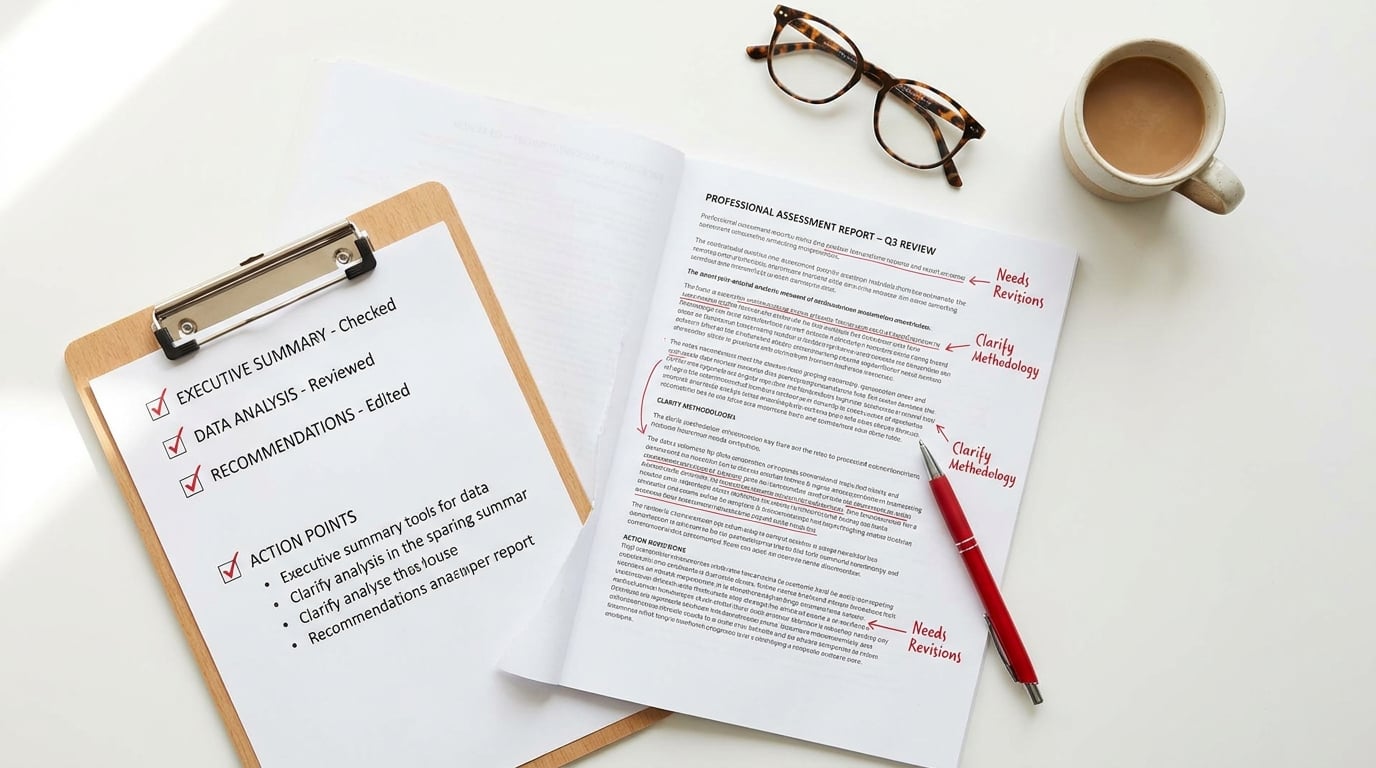
You spent weeks collecting data, drafting findings, and polishing your assessment report. You submitted it confidently. Then the reviewer comments came back, and suddenly you are revising, defending, or starting over.
If this sounds familiar, you are not alone. Most professionals who write assessment reports, whether for academic accreditation, program evaluation, HR performance reviews, or compliance audits, will tell you the same thing. The writing is only half the battle. Getting reviewers to accept your report is the other half.
Learning how to write an assessment report reviewers will accept means understanding what reviewers look for before you write a single word. It means structuring your findings so they are impossible to misunderstand. It means anticipating objections, providing evidence for every claim, and showing that you have closed the loop on past feedback.
In this guide, I will walk you through the exact structure, writing process, and reviewer psychology that separates accepted reports from rejected ones. I have pulled together insights from assessment professionals, accreditation guidelines, and real reviewer feedback to give you a framework that works in 2026.
Table of Contents
Quick Summary: What Makes an Assessment Report Reviewers Will Accept
An accepted assessment report has five traits in common: a clear purpose statement, transparent methodology, evidence-backed findings, actionable recommendations, and a closing-the-loop section that shows how past results drove improvement. Reviewers reject reports that lack data, blur conclusions with opinions, or skip the follow-up plan.
If you only take one thing from this article, take this: reviewers are not looking for perfection. They are looking for rigor, transparency, and a logical thread that connects your assessment plan to your data to your recommendations. Get those three things right, and acceptance rates go up sharply.
What Is an Assessment Report?
An assessment report is a formal document that evaluates a person, project, program, or process against defined criteria, presenting findings, analysis, and actionable recommendations to inform decision-making. It differs from a simple evaluation because it follows a structured methodology and is typically reviewed by peers, accreditation bodies, or senior stakeholders.
You might be writing one for an academic program review, an employee performance cycle, a clinical assessment, a compliance audit, or a consulting engagement. The audience and depth change, but the core expectations stay the same. Reviewers want to see that you measured something real, interpreted it honestly, and proposed a path forward.
The reason getting accepted matters is simple. Assessment reports feed into accreditation decisions, funding renewals, personnel actions, and curriculum changes. A rejected report can delay an entire review cycle by months. In academic settings, that can stall accreditation. In business settings, it can stall budgets and headcount.
How to Write an Assessment Report Reviewers Will Accept: Core Structure
The fastest way to get rejected is to skip sections reviewers expect to see. Whether you are writing for an accreditation board, a journal editor, or an internal stakeholder committee, the bones of an accepted report follow a predictable structure.
Here is the outline reviewers want to see, in order:
- Cover page and metadata — program name, assessment period, authors, reviewer chain, submission date.
- Executive summary — one page maximum, written last, covering purpose, method, key findings, and top three recommendations.
- Introduction and purpose statement — what was assessed, why it matters, and what questions the report answers.
- Assessment plan and learning outcomes — the outcomes or criteria you measured, mapped to specific benchmarks or standards.
- Methodology and data collection — instruments used, sample size, scoring rubrics, inter-rater reliability steps, and data collection schedule.
- Findings and analysis — results presented against threshold values, with charts, tables, and narrative interpretation.
- Conclusions — what the findings mean, separate from raw data and from recommendations.
- Recommendations and action plan — specific, owned, time-bound steps tied to each finding.
- Closing the loop — what changed because of the last assessment cycle and what evidence supports it.
- Appendices — raw data, rubrics, survey instruments, and supplementary artifacts.
Notice that recommendations and conclusions are separate sections. Reviewers consistently flag reports that merge them. Conclusions interpret data. Recommendations propose action. Mixing the two weakens both.
Step-by-Step Guide to Writing Each Section
Now that you have the structure, let me walk through how to write each section in a way that satisfies reviewers. I will keep this practical because the details are where reports win or lose acceptance.
Step 1: Write the Cover Page and Metadata First
This sounds trivial, but reviewers reject reports for incomplete metadata more often than you would think. Every accreditation body and institutional reviewer has a checklist, and missing fields are the first thing flagged.
Include program or unit name, academic or business year assessed, names of all contributors, the assessment period covered, the version number if this is a revision, and the date of submission. If your institution uses a standard cover page template, use it exactly. Do not improvise.
Step 2: Draft the Executive Summary Last
The executive summary is the single most-read section of your report. Many reviewers read only this and the recommendations. Write it after everything else is finished so you can summarize accurately rather than aspirationally.
Keep it to one page. Open with the purpose in one sentence. Add the method in one sentence. List the three most important findings as bullet points. Close with the top two or three recommendations. Avoid jargon here because this is where non-specialist reviewers form their first impression.
Step 3: Write a Purpose Statement That Answers One Question
Your introduction should answer a single question: what was assessed and why? Reviewers reject reports that bury the purpose under background paragraphs. State the purpose in the first paragraph of the introduction.
Then provide context. Name the learning outcomes or performance criteria you measured. Reference the assessment plan that was approved earlier in the cycle. If you changed the plan mid-cycle, say so and explain why. Reviewers notice unexplained deviations, and unexplained deviations trigger rejection faster than almost anything else.
Step 4: Document Your Methodology Transparently
This is where most first-time reports fail. Reviewers want to see exactly how you collected data, who scored it, what instruments you used, and how you ensured reliability. A methodology section that says “we surveyed students and analyzed results” will not pass review.
Instead, specify the instrument name, the number of respondents, the response rate, the scoring rubric (and where to find it in the appendices), the threshold values you set for success, and any steps taken to establish inter-rater reliability if multiple scorers were involved. If you used qualitative interviews, describe how many, how they were coded, and by whom.
Step 5: Present Findings Against Threshold Values
Findings mean nothing without a benchmark. Reviewers want to see your results compared against the threshold values you defined in your assessment plan. If your plan said 80 percent of students would meet the rubric criterion for outcome three, your findings section should state exactly what percentage did and whether that meets, exceeds, or falls short of the threshold.
Use tables and charts, but do not let them carry the section alone. Every chart needs a narrative paragraph explaining what it shows and what it means. Reviewers reject reports that drop data into tables without interpretation. The interpretation is the analysis, and the analysis is the point.
Step 6: Separate Conclusions from Recommendations
Conclusions interpret the findings. They tell the reviewer what the data means in plain language. If 65 percent of students met the threshold and your target was 80 percent, the conclusion is that students are falling short on this outcome and the gap is significant.
Recommendations propose what to do about it. Each recommendation should be specific, owned by a named person or department, and time-bound. Vague recommendations like “improve instruction” get flagged in review because they cannot be acted on or measured in the next cycle.
Step 7: Write the Closing-the-Loop Section
This is the section that most reports skip and that most reviewers weight heavily. Closing the loop means showing what changed because of your last assessment. Did you revise a rubric? Add a tutoring session? Change a curriculum sequence? Show the change, show the evidence that it worked, and connect it to the current findings.
Reviewers see closing the loop as proof that assessment is not just paperwork. Reports without it look like a treadmill, measuring the same things every year with nothing changing. That pattern triggers rejection because it suggests the assessment process is not actually driving improvement.
Step 8: Assemble Appendices That Prove Your Rigor
Appendices are where you put the artifacts that would clutter the main report but that reviewers need to verify your work. Include the full scoring rubric, blank survey instruments, sample scored student work with names redacted, raw data tables, and any committee meeting notes that document methodology decisions.
Well-organized appendices signal professionalism. Reviewers may not read every page, but they notice when appendices are missing, disorganized, or clearly copied from a previous cycle without updates.
What Reviewers Actually Look For
Understanding the reviewer perspective changes how you write. Reviewers are usually volunteers or appointed committee members working under deadlines. They have a rubric of their own, and they are looking for reasons to approve your report quickly so they can move on.
Here is what reviewers want to see compared with what authors typically provide:
- Reviewers want: Clear alignment between outcomes, measures, findings, and recommendations. Authors provide: Findings that drift from the original outcomes.
- Reviewers want: Direct answers about whether thresholds were met. Authors provide: Data without explicit pass or fail statements.
- Reviewers want: Evidence-based recommendations tied to findings. Authors provide: Generic improvement statements.
- Reviewers want: A closing-the-loop narrative. Authors provide: A repeat of last year’s findings.
- Reviewers want: Clean formatting with labeled tables and charts. Authors provide: Inconsistent numbering and unlabeled figures.
- Reviewers want: Honest reporting of negative results. Authors provide: Spun language that obscures shortfalls.
- Reviewers want: Complete metadata and signed approvals. Authors provide: Missing names, dates, or version numbers.
The pattern is clear. Reviewers reward reports that make their job easy. If your report answers their questions before they have to ask, you are far more likely to get accepted on the first round.
Understanding Reviewer Psychology
Reviewers are not adversarial. They are cautious. Their reputation depends on catching errors, so they err on the side of asking for revisions rather than approving reports that might embarrass them later. Knowing this, you can preempt their concerns.
The most common reviewer anxiety is that a report looks polished but lacks substance underneath. If your formatting is beautiful but your methodology is thin, reviewers will probe harder. If your methodology is rigorous and your formatting is clean, reviewers relax and approve faster.
Common Mistakes That Get Assessment Reports Rejected
Avoiding rejection is easier than fixing a rejected report. Here are the mistakes that come up most often in reviewer comments, drawn from accreditation feedback and forum discussions among assessment professionals.
Mistake 1: No explicit threshold values. If your report never states what success looks like, reviewers cannot tell whether your findings are good or bad. Define thresholds in your assessment plan and reference them in your findings.
Mistake 2: Conclusions based on opinion instead of data. Reviewers catch this fast. Every conclusion must trace back to a finding, and every finding must trace back to data. If you cannot draw a line from data to conclusion, cut the conclusion.
Mistake 3: Recommendations with no owner or timeline. “We recommend improving student writing” means nothing. “The composition committee will revise the rubric by fall 2026 and pilot it in two sections” is a recommendation reviewers can accept.
Mistake 4: Skipping closing the loop. This is the number one reason reports get sent back for revision. If you cannot show what changed since the last cycle, reviewers assume the assessment is not being used and they reject the report as incomplete.
Mistake 5: Inconsistent data across sections. If your executive summary says 78 percent and your findings table says 72 percent, reviewers lose trust in the entire report. Reconcile every number before submission.
Mistake 6: Copying language from previous cycles. Reviewers notice when boilerplate language appears year after year. It signals that the assessment is performative rather than substantive, and it triggers deeper scrutiny of everything else in the report.
Mistake 7: Missing inter-rater reliability documentation. If multiple people scored the assessment, reviewers want evidence that they scored consistently. Document any calibration sessions, double-scoring, or reliability checks in your methodology.
Mistake 8: No response to prior reviewer feedback. If reviewers asked for changes last time and you ignored them, they will reject the new report. Always address prior comments explicitly, even briefly.
How to Respond to Reviewer Feedback (and Rejection)
Even strong reports get reviewer comments. The way you respond matters as much as the report itself. Reviewers watch how authors handle feedback because it tells them whether the author takes the process seriously.
Step 1: Read All Comments Before Responding to Any
When you get a long list of reviewer comments, your instinct is to start defending yourself immediately. Do not. Read every comment first, group them by theme, and identify patterns. Often, three comments that feel like attacks are actually the same concern expressed different ways.
This also helps you spot contradictions. Reviewers sometimes disagree with each other. When that happens, your response should acknowledge both perspectives and explain which direction you chose and why.
Step 2: Respond Point by Point
Create a response document that lists every reviewer comment, paired with your response and the specific change you made in the report. Reviewers love this format because it lets them verify that you addressed everything without hunting through a revised document.
Even if you disagree with a comment, respond professionally. Acknowledge the concern, explain your reasoning, and offer a compromise where possible. Dismissing a comment outright signals disrespect for the review process and hardens reviewer resistance.
Step 3: Distinguish Between Substantive and Editorial Comments
Editorial comments about wording, formatting, or clarity are easy wins. Address them all. Substantive comments about methodology, findings, or conclusions require more thought. For substantive comments, explain what you changed and why, or explain why you did not change and what evidence supports your position.
Step 4: Handle Rejection Without Panic
If your report is rejected outright rather than sent back for revision, take a breath before responding. Rejection usually means a structural problem, not a quality problem. Common causes include missing sections, methodology that cannot support the conclusions, or a complete absence of closing-the-loop content.
Request a meeting with the lead reviewer if possible. Ask for specific guidance on what a successful resubmission would look like. Most reviewers are willing to help because their goal is a usable report, not a punishment.
Step 5: Document Everything for Next Cycle
Save every reviewer comment and every response. When you write your next assessment report, review these first. They are the most accurate guide to what your specific reviewers care about, and addressing those concerns proactively is the fastest path to acceptance next time.
Sample Reviewer Comments and How to Handle Them
Here are real patterns of reviewer feedback and recommended responses:
Comment: “The findings do not clearly connect to the stated learning outcomes.” Response: Add a mapping table that explicitly links each outcome to the finding that measures it. Revise the findings narrative to reference outcomes by name.
Comment: “Inter-rater reliability is not addressed.” Response: Add a methodology subsection describing calibration sessions, double-scoring percentage, and the reliability statistic you calculated.
Comment: “Recommendations are vague.” Response: Rewrite each recommendation in the format: who, will do what, by when, measured how.
Comment: “Closing the loop is absent.” Response: Add a dedicated section documenting at least one change from the prior cycle and its measured impact.
Pre-Submission Checklist for Assessment Reports
Before you submit, run through this checklist. It covers the items that reviewers check first and the gaps that most often trigger revisions.
- Every required metadata field on the cover page is complete, including names, dates, and version number.
- The executive summary is one page or less and covers purpose, method, top findings, and top recommendations.
- The purpose statement appears in the first paragraph of the introduction.
- Each learning outcome or criterion has a defined threshold value for success.
- The methodology names instruments, sample sizes, response rates, scoring rubrics, and reliability checks.
- Every finding explicitly states whether the threshold was met, exceeded, or missed.
- Conclusions and recommendations are in separate sections.
- Every recommendation has an owner, an action, and a deadline.
- A closing-the-loop section documents at least one change from the prior cycle.
- All numbers are consistent across the executive summary, findings tables, and conclusions.
- All tables and charts are numbered, titled, and referenced in the narrative.
- Appendices include the full rubric, blank instruments, and raw data.
- Prior reviewer comments have been addressed or acknowledged.
- The report follows the institutional or accreditation formatting template exactly.
- A colleague has read the report and confirmed it makes sense to someone outside the team.
If you can check every box, your report is in strong shape for acceptance. If any box is unchecked, fix it before submission. Reviewers notice what is missing faster than they appreciate what is present.
Frequently Asked Questions
How to write a good assessment report?
A good assessment report includes a clear purpose statement, transparent methodology with named instruments and sample sizes, findings presented against defined threshold values, conclusions separated from recommendations, actionable next steps with owners and deadlines, and a closing-the-loop section showing how prior results drove change. Reviewers accept reports that connect outcomes to data to recommendations in a single logical thread.
How do you respond to assessment reviews?
Read every reviewer comment before responding to any, then create a point-by-point response document that pairs each comment with your reply and the specific change made. Address editorial comments fully, explain your reasoning on substantive disagreements with evidence, and always respond professionally even when comments seem unfair. Documenting every comment and response helps you write stronger reports in the next cycle.
How to write a reviewer report?
Start by summarizing the purpose and main findings of the work you reviewed to show you read it carefully. Then list specific strengths, followed by specific concerns with line or section references. Close with a clear recommendation and prioritized suggestions. Strong reviewer reports are specific, evidence-based, and respectful in tone, avoiding vague or contradictory comments.
How to give feedback on an assessment?
Give assessment feedback that is specific, tied to defined criteria, and actionable. Reference the rubric or standard being applied, point to concrete examples in the work, and suggest a clear next step. Avoid generic praise or criticism without examples, and separate observations from interpretations so the recipient can understand both what you saw and what you concluded.
Final Thoughts on Writing Assessment Reports Reviewers Accept
Writing an assessment report reviewers will accept comes down to three things: rigor, transparency, and respect for the reviewer’s time. Rigor means your methodology holds up under scrutiny. Transparency means you show your work, including the parts that did not go well. Respect means you structure the report so reviewers can find what they need without hunting.
If you follow the structure in this guide, document your methodology honestly, separate your conclusions from your recommendations, and always close the loop, your acceptance rate will climb. The reviewers are not your opponents. They are your first audience, and the same clarity that satisfies them will make your report more useful to everyone who reads it after.
Start with the checklist. Address every box. Then write with confidence, knowing your report is built the way reviewers expect it to be built.