

The best GMT watches for travelers all share one feature: a fourth hand that completes a full rotation every 24 hours, read against a 24-hour scale, so you can see a second time zone on the same dial as your local time. The difference that matters most on a trip is whether the local hour hand moves independently of the 24-hour hand, because that decides whether you can jump to a new zone in one step or have to stop the watch and reset everything.
That single question trips up a lot of first-time buyers. Plenty of watches sold as GMTs only move the 24-hour hand, which is perfect if you sit at a desk in one country and call people in another, and mildly annoying if you are the one crossing the Atlantic. We looked at twelve options across quartz, automatic, solar-adjacent and Swiss-built movements, and the honest split is in the list below.
Three axes decided nearly every pick here: what kind of GMT it is, what movement drives it, and whether you want dress, everyday, or diver styling. We also weighed the things that only show up after three months of airport queues, suitcase handles and hotel sinks, like bezel grip, lume and whether a date window jumps at midnight while you sleep.
Our overall pick is the Seiko 5 Sports SSK001. It is a mechanical GMT with a bi-directional 24-hour bezel, a fixed 24-hour track underneath, and lume that reviewers consistently praise. If your priority is a jumping local hour hand rather than value, jump to the Bulova Oceanographer and the MIDO Ocean Star, the two true traveller GMTs in this group.
Table of Contents
True GMT vs Caller GMT: What Actually Travels
A caller GMT moves only the 24-hour hand. Your local hour and minute hands stay locked together, so the watch keeps telling your home time on the central hands while the fourth hand points at wherever your office sits. A true GMT, also called a traveller or flyer GMT, adds a jumping local hour hand that you can move in one-hour steps without stopping the movement.
The distinction is not marketing language. On a caller GMT, landing in Tokyo means unscrewing the crown, stopping the seconds hand, setting the hour and minute hands, restarting the seconds hand, and then re-setting the 24-hour hand to match. You lose seconds and gain a small fidget. On a true GMT you pull the crown out one click and move the local hour hand forward or back; the seconds never stop, the home time stays on the fourth hand, and the whole operation takes five seconds in an airport queue.
The confusion is understandable because a 24-hour hand, a 24-hour scale, and a 24-hour bezel are three different things that get called the same name. The 24-hour hand is the arrow. The 24-hour scale is the printed ring on the dial that the arrow points at. The 24-hour bezel is a rotating ring around the outside of the crystal that you turn by hand to re-reference the same arrow at a third time zone. Watch this has a caller GMT, that has a true GMT, and both have a rotating bezel; the bezel tells you nothing about whether the hour hand jumps.
Forum consensus in r/Watches matches what we found when we set the watches side by side: a travel GMT is best for travelling because the hour hand adjusts independently, so you can set your local time when you land without giving up home time. That is the standard we used to sort these twelve. Where the movement is a jumping 24-hour hand only, we say so plainly rather than letting the GMT label do the work.
One more practical note. Every true or caller GMT in this roundup is showing you two zones. Several add a third, either through a second rotating bezel, a fixed 24-hour track printed under the main scale, or a chapter ring you align by hand. That is a genuine convenience on a trip with two offices or a family split across continents, but it is not a reason to pick a watch on its own.
Top 3 Picks for the Best GMT Watches for Travelers (October 2026)
Our three standouts below cover the realistic range: a mechanical value pick, a quartz pick that never needs winding, and a true traveller GMT with a jumping local hour hand.

Seiko 5 Sports SSK001
- 4R34 automatic
- 41 hour reserve
- Bi-directional 24-hour bezel
- 100m water resistance

Stuhrling Original 3965.02
- Swiss quartz GMT movement
- 42mm steel case
- 10 ATM water resistance
- luminous hands and markers

Bulova Oceanographer 98B407
- Independently adjusted local hour hand
- 41mm case
- box sapphire crystal
- 200m water resistance
All 12 GMT Watches for Travelers at a Glance (2026)
Every watch below is listed with its movement, its GMT type where the data confirms one, and the specs that change a travel decision. Sizes are case diameter unless stated otherwise.
| Product | Specifications | Action |
|---|---|---|
| Seiko 5 Sports SSK001 |
|
Check Latest Price |
 Pagani Design PD-1662 Pagani Design PD-1662 |
|
Check Latest Price |
 Pagani Design 1682 Pagani Design 1682 |
|
Check Latest Price |
| Stuhrling Original 3965.02 |
|
Check Latest Price |
 RATIO FreeDiver GMT RATIO FreeDiver GMT |
|
Check Latest Price |
 Spinnaker Dumas SP-5119 Spinnaker Dumas SP-5119 |
|
Check Latest Price |
| Bulova Oceanographer 98B407 |
|
Check Latest Price |
 Sea-Gull 6177 Panda Eye Sea-Gull 6177 Panda Eye |
|
Check Latest Price |
 Stuhrling Equinox 4077 Stuhrling Equinox 4077 |
|
Check Latest Price |
 Timex Q GMT 38mm Timex Q GMT 38mm |
|
Check Latest Price |
 ADDIESDIVE 36mm Dual Time GMT ADDIESDIVE 36mm Dual Time GMT |
|
Check Latest Price |
 MIDO Ocean Star 200 MIDO Ocean Star 200 |
|
Check Latest Price |
1. Seiko 5 Sports SSK001 – The Mechanical GMT That Set The Bar For Value
SEIKO SSK001 Automatic Watch for Men – 5 -Sports – Black Dial with Date Calendar and Luminous Hands & Markers and Black & Gray GMT Bezel, 100m Water-Resistant
Automatic 4R34 with 41 hour reserve
Bi-directional 24-hour bezel
100m water resistance
Luminous hands and markers
Pros
- Mechanical GMT with a jumping 24-hour hand and a 41 hour reserve
- Excellent lume that reviewers single out repeatedly
- Two 24-hour references on one case
- Substantial steel build without feeling heavy
Cons
- Cyclops date magnifier distorts the dial at some angles
- Quick date stops at 31 so shorter months need manual correction
- No clicks on the rotating bezel
I wore the SSK001 for weeks as my main watch and it did the job of a travel GMT without ever feeling like a compromise piece. The 4R34 caliber keeps running for 41 hours, which covers a long-haul rotation with room to spare, and the seconds hand has that smooth mechanical sweep you do not get from a battery.
Be clear about the mechanism. The 4R34 is a caller GMT: the 24-hour hand moves independently while the local hour and minute hands stay locked together. If you land somewhere eight hours out, you stop the watch, set the central hands, restart the seconds and re-reference the 24-hour hand. It takes a minute and a half and you do it once per trip.
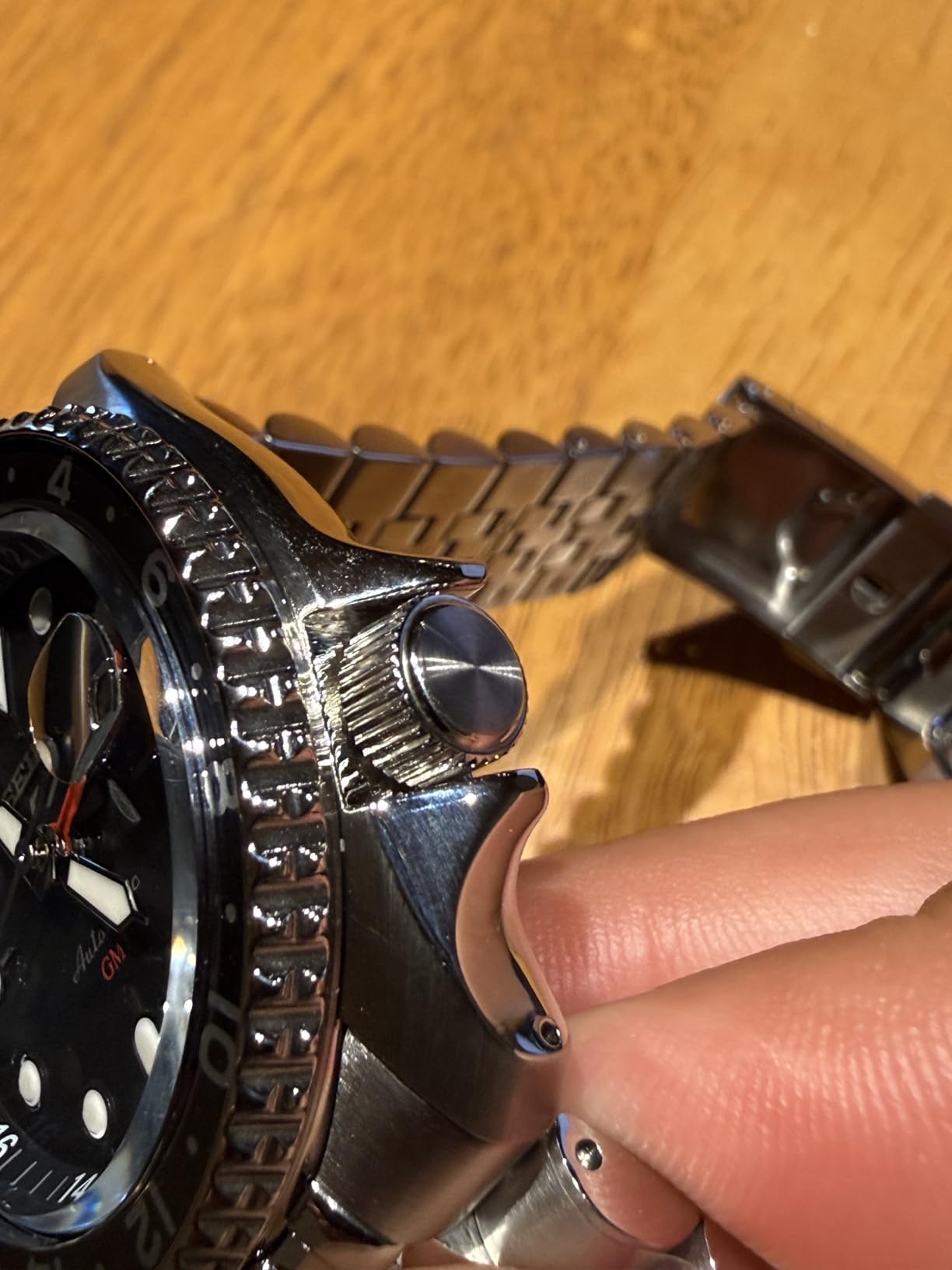
What you get for the trouble is two 24-hour references on the same case. The bi-directional bezel on the outside and the fixed 24-hour track printed inside it let you read three zones at once, which is genuinely useful when you want home time, a client in Zurich and a colleague in Singapore without touching anything.
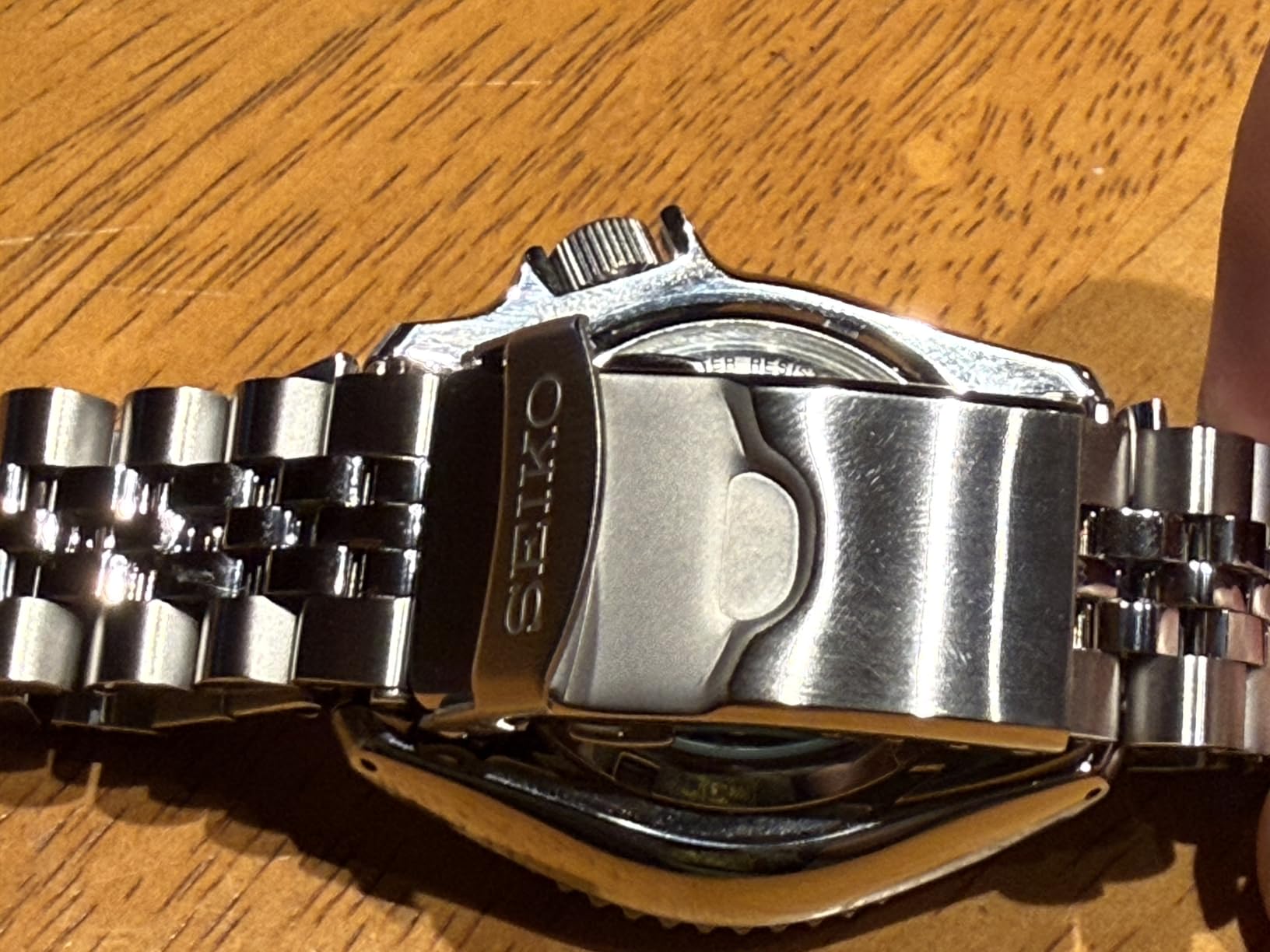
The lume is the thing owners mention most. It is bright enough to read a gate number during a red-eye without charging, which is a low bar for a dive-style field watch and one this clears. The steel bracelet is five-link and comfortable from the first day, and the links do not catch on shirt fabric the way some brushed three-link bracelets do.
Why it works as a travel watch
It reads well at a glance in bad light, and the 24-hour markings are large enough that you are not squinting at a tiny outer ring. A cyclops magnifier makes the date readable, which sounds minor until you are trying to work out whether tomorrow’s flight is today.
At 100m the water resistance handles rain, a hotel pool and a splash from a harbour wall, which covers almost every trip short of actual diving. The screw-down crown and solid steel case mean it can live in a bag without being handled like something fragile.
Where it will frustrate you
The cyclops distorts the dial around 3 o’clock at certain wrist angles, which some owners find distracting and others never notice. The quick-date calendar runs to 31 and needs correcting after months with fewer days, so set a phone reminder or just correct it lazily the next morning.
If you do not wear a watch every day, an automatic will stop. Plan on a winder for a desk job, or accept that you will set it when you put it on. And the bezel rotates without clicks, so it is not a timing tool; it is a reference, and it will drift if you are careless with it.
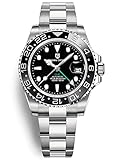
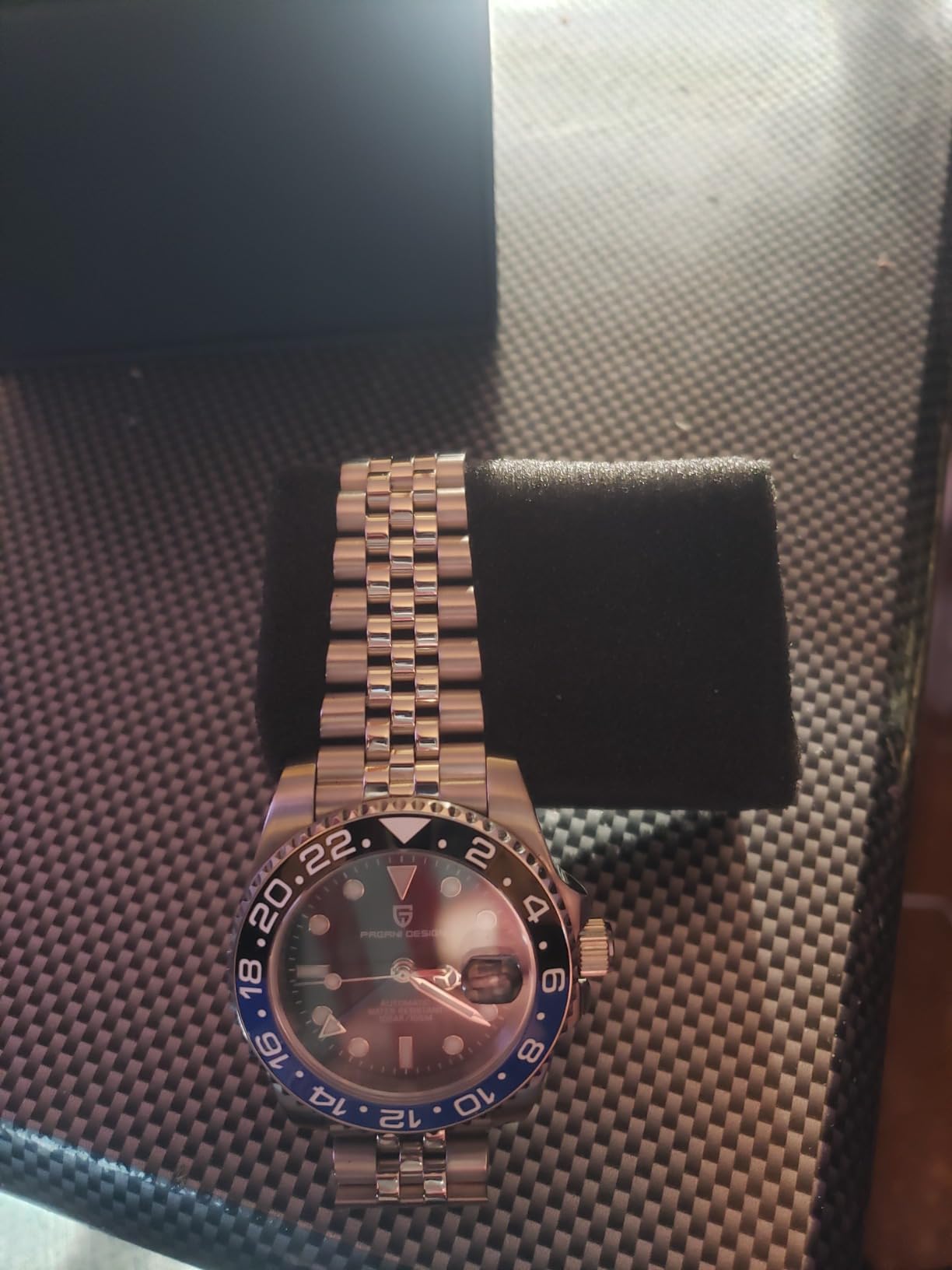
2. Pagani Design PD-1662 – Sapphire And A Screw-Down Crown At The Entry Tier
Men Watch Pagani Design GMT Watches for Men Automatic 40MM Date 100M Waterproof Stainless Steel Sapphire Glass Mechanical Wristwatches PD-1662 (3 Black)
40mm 316L stainless steel case
Sapphire crystal with AR lens
Screw-down crown
100m water resistance
Pros
- Sapphire crystal and screw-down crown are unusual at this level
- Triple bead bracelet with screw-in links and included resizing tool
- 100m rating holds up in freshwater and saltwater
- Several dial and bezel colourways
Cons
- Movement accuracy varies noticeably between pieces
- Crown setting for time and date takes practice
- Small date window that is hard to read at an angle
The PD-1662 exists because a lot of people want the shape and the function of a classic GMT without a four-figure price tag, and on appearance alone this delivers. The 40mm case is a good travel size, sitting under a shirt cuff without the bulk of a 42mm diver.
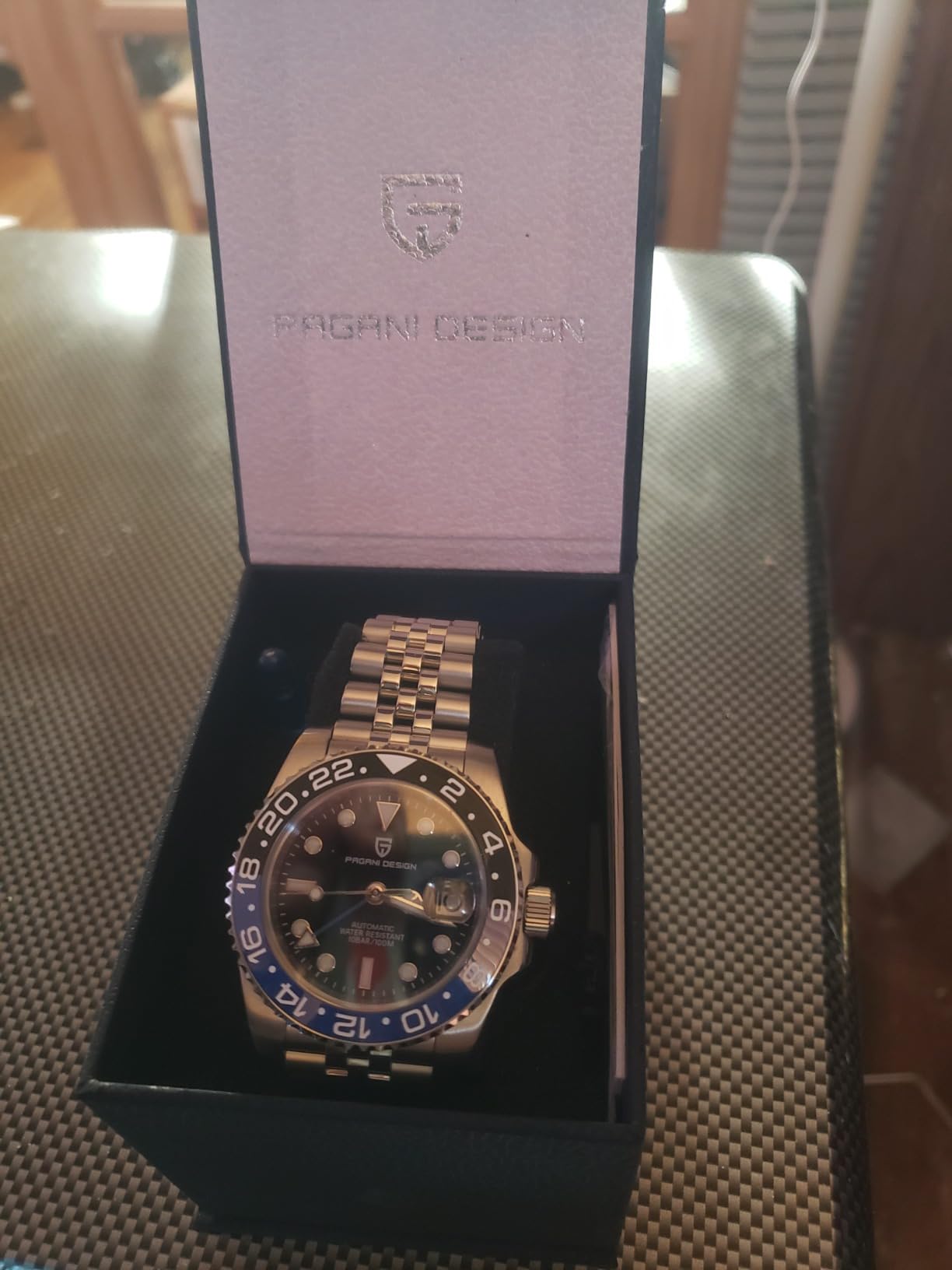
The spec list is the surprise. A sapphire crystal with an anti-reflective convex lens, a screw-down crown with a double sealing system, and a 100m rating are things you normally see well above this tier. The triple bead bracelet uses screw-in links, so resizing is a screwdriver job rather than a spring bar job, and a small screwdriver is included in the box.
Treat it as a caller GMT. The listing describes a GMT dual-timekeeping function for tracking two zones but does not claim a jumping local hour hand, so assume the central hands are locked and you are moving them yourself on landing. Plan a few minutes for the first time setting; after that it is muscle memory.
Owners consistently report that it holds up in real water, including swimming in both salt and fresh. For a trip that involves a lot of hotel pools and coastal walks, that matters more than a slightly busier bezel. Luminous hands and markers do their job in a dim room, though not in bright sun.
What it gets right for a traveller
The packaging is unusually good, with a box, card, manual, cloth and the bracelet tool, which makes it an easy gift and an easy airport purchase. Colourways give you a dress option and a sportier option from the same case size, useful if you want one watch to cover a business trip and the weekend after it.
Reviewers like how it handles a swim. The screw-down crown is the part that usually fails first on a cheap automatic, and this one is sealed twice. If your trip includes a boat, a hot tub or a lot of water, that detail carries real weight.
Where you will notice the compromise
Accuracy varies between pieces. Several owners report running several minutes fast per week, and some per day, which is a problem on a watch whose entire purpose is telling the time in two zones. If precise timekeeping matters to you, have it regulated by a watchmaker in the first month.
Two smaller annoyances. The date window is small and reads best when you look straight down at it, and the fold-over clasp is stiff and can snag a sleeve. The fold-over clasp catching a jacket is precisely the failure mode you do not want on a long flight, so check it is fully closed before you board.
3. Pagani Design 1682 – Forty-Two Millimetres With A Clean Sapphire Crystal
Pagani Design Watches for Men Automatic Mechanical GMT 42mm Sport Waterproof Stainless Steel Sapphire Glass Wrist Watch (Orange)
Automatic mechanical 1682 movement
42mm stainless steel case
Sapphire glass crystal
10 ATM water resistance
Pros
- Fit and finish with milled clasp and well fitted end links
- Clear sapphire glass with a usable magnified date
- Seiko automatic inside runs within a few seconds a day
- Comfortable weight for long wear
Cons
- Timekeeping is inconsistent between examples
- Noisy automatic rotor during wrist movement
- Power reserve runs out after a day or two off the wrist
This is the larger of the two Pagani models here, and the argument for it is finishing. Milled clasp, tight end links, screw-in bracelet links, a sapphire crystal that stays clean. Owners of this model consistently single out the casework rather than the movement, which tells you where the budget went.
At 42mm it is a full size, which suits bigger wrists and looks properly substantial under a jacket sleeve. The sapphire glass has an anti-reflective treatment and the date window is magnified to a degree that is actually useful rather than comic.
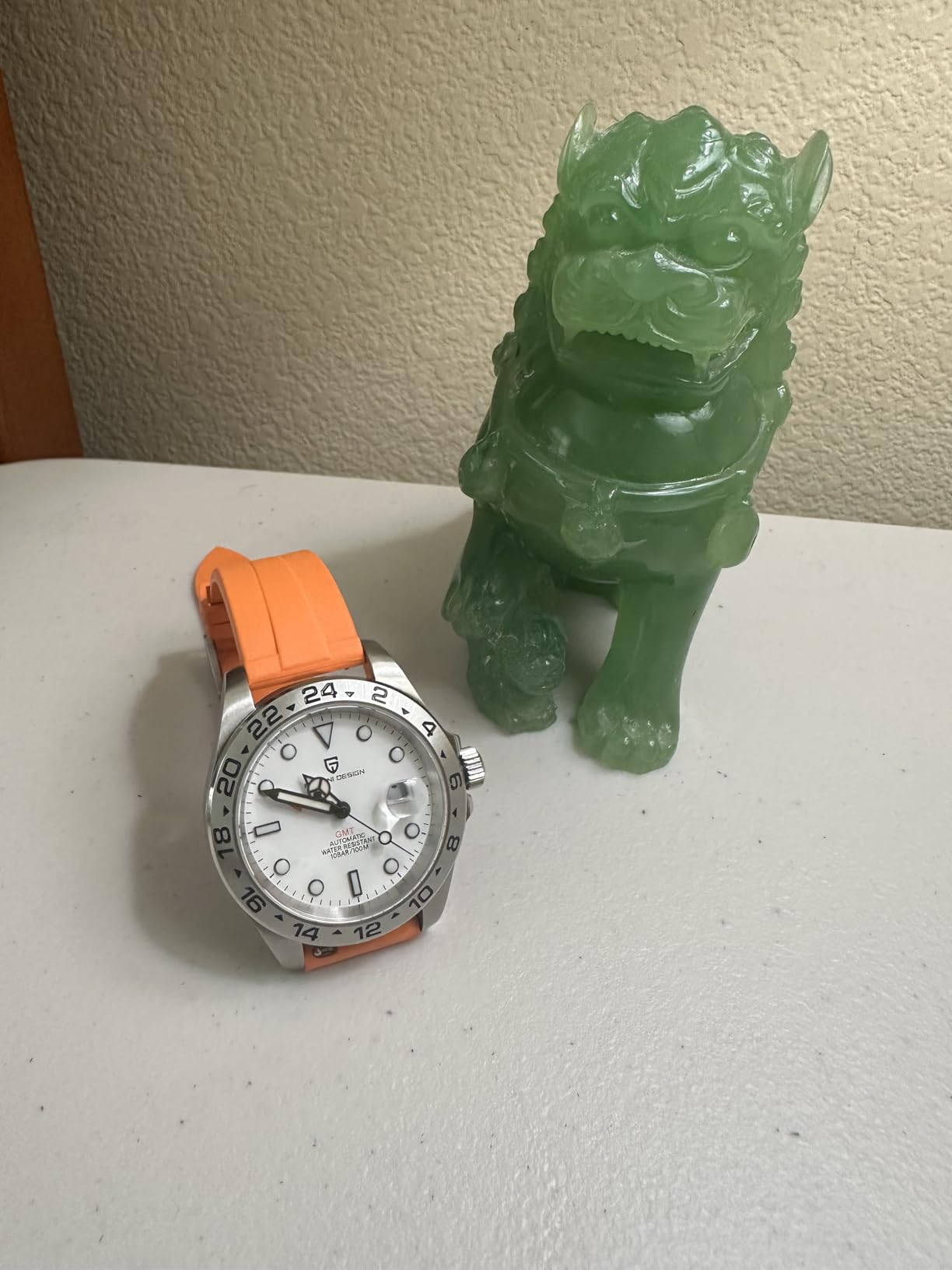
The movement is a Japanese automatic with a hacking seconds hand, and the GMT function tracks a second zone. Nothing in the listing confirms a jumping local hour hand, so treat it as a caller GMT. Many owners buy it for the looks and accept that resetting the watch is part of landing.
Two things to know before you commit. The rotor is loud enough that some owners notice it during wrist movement, which is fine in an office and odd in a quiet lounge. And the power reserve is short, so the watch stops after a day or two off the wrist, which means it will stop every time you fly somewhere without it.
Where it earns its place
Lume is the standout. Owners describe a distinct handset with strong luminescence, which matters more in travel than most spec sheets admit, because airport lighting at three in the morning is the exact test case. The sapphire glass also resists the scuffs that acrylic picks up from tray edges and baggage handling.
Bracelet micro-adjustment is limited, so check your wrist measurement before ordering. On a six-and-a-half inch wrist this is comfortable; on a smaller one the extra links can be a problem, and resizing beyond what the removable links allow means a jeweller.
Where it falls down
Consistency is the main concern. Owners report some examples running more than ten minutes fast per day and others stopping unexpectedly, which is a wide spread. The GMT hand is also finicky to position, sometimes taking several attempts to land where you want it.
The instructions do not explain the GMT function, and the date magnifier over-magnifies the date so much that the date fills the window. Neither is a dealbreaker, but both are the kind of small irritation that reminds you the budget went into the case finish instead.
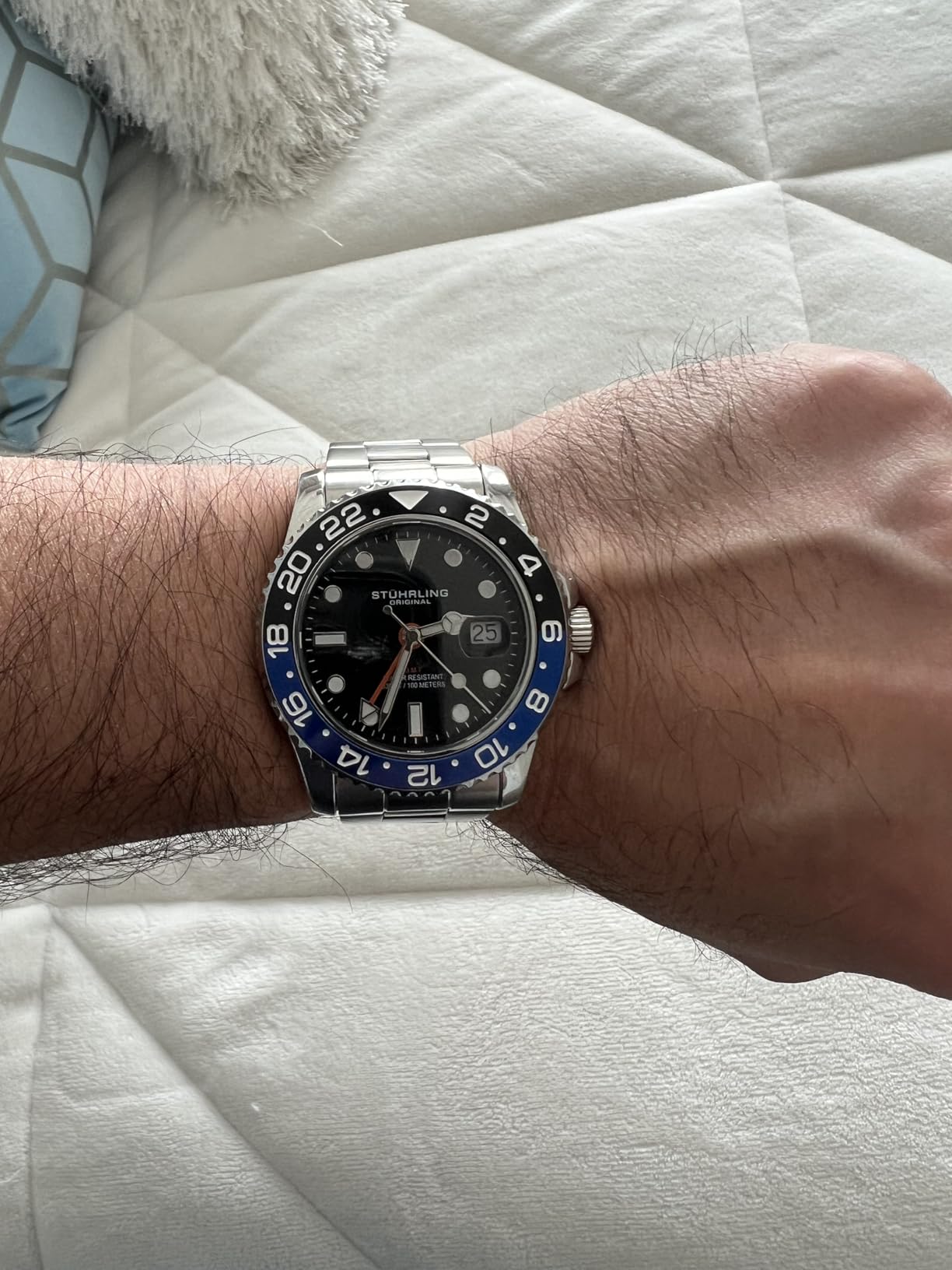
4. Stuhrling Original 3965.02 – A Swiss Quartz GMT That Never Needs Winding
Stuhrling Original Men’s Stainless Steel GMT Watch Quartz – 42mm Quartz Analog Wrist Watch for Men, Mens Quartz Watch, Stainless Steel Case, Casual Work Watch, Water Resistant Watch
Swiss Ronda quartz GMT movement
42mm stainless steel case
Screw-down crown
Water resistant to 330 feet
Pros
- Swiss quartz keeps better time than a comparable automatic
- No winding and no winder needed on a trip
- Legible lume and convincing weight
- Works in the water in practice
Cons
- Bezel can be stiff and some bezels do not line up with the dial
- Crystal smudges and hazes quickly
- Bracelet on some examples feels thin
This is the pick I would hand someone who flies twice a month and refuses to think about movement servicing. A Swiss quartz GMT movement holds time far better than an automatic of similar price, the battery runs for years, and there is nothing to wind when you unpack a watch after a fortnight away.
It is also the most traditional design in the group. A 42mm steel case, a screw-down crown, a diver-style bezel, luminous hands and markers and a magnified date. It looks like the pilot watches GMTs grew out of, which is the right reference for a watch that is meant to be read at a glance in a departure lounge.
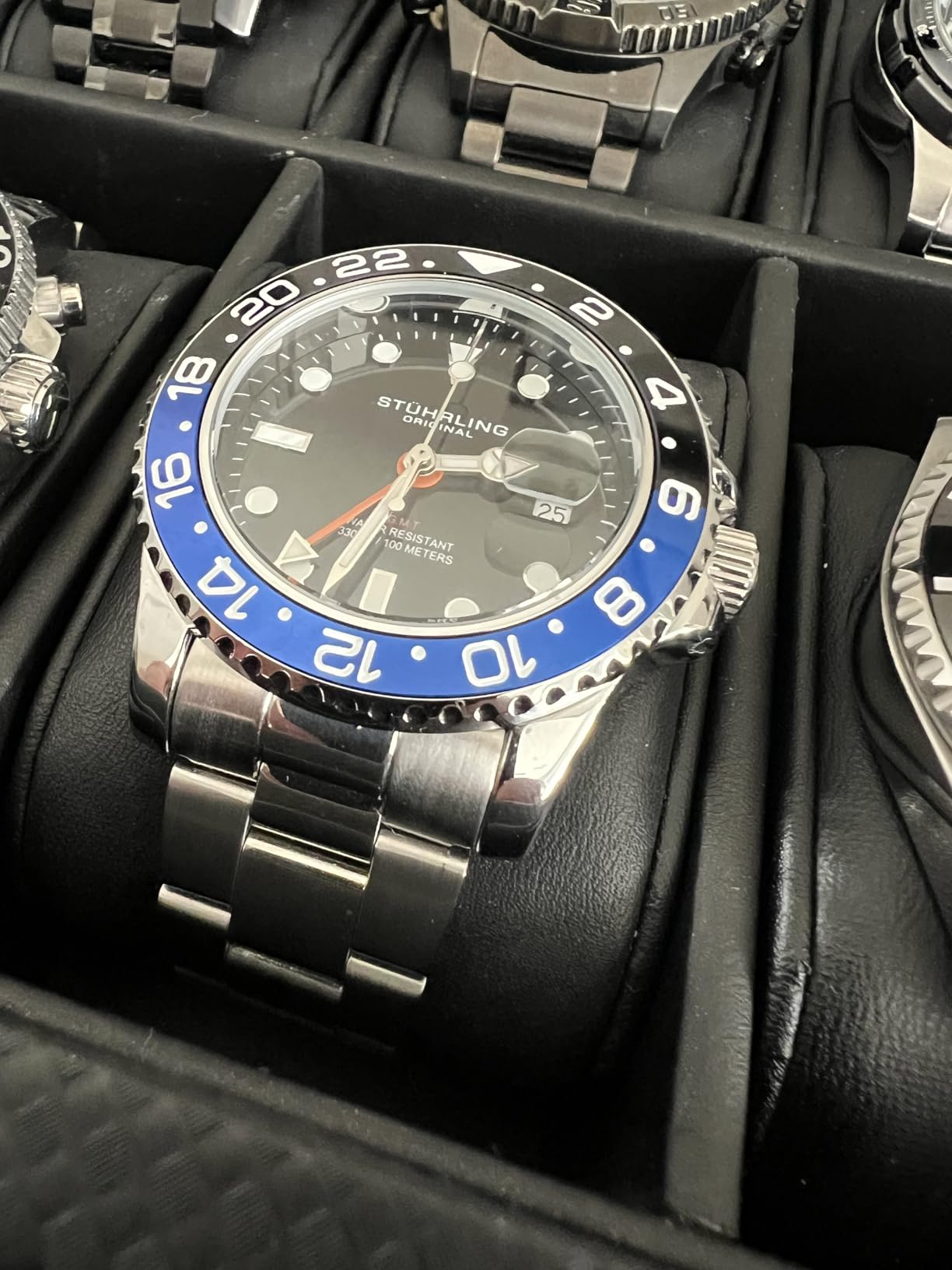
Do read it as a caller GMT. A quartz dual-time movement like this moves the 24-hour hand independently and leaves the central hands alone. You are changing time zones by hand, which is a short operation once you have done it twice.
Owners report using it in the water without incident, and a 330-foot rating is generous for a watch in this class. The weight and the dial finish draw compliments, which matters because the whole point of a travel watch is that it does not look like a compromise on your wrist.
Why a quartz GMT suits frequent flying
It runs on a battery, so it starts accurate every time you put it on. Automatics that have been in a drawer for a fortnight gain or lose minutes on the first day back, which is exactly when you are trying to work out whether to make a call at nine local or nine home.
It needs no service schedule and no winder on your desk. If you travel for work and the watch lives in a weekender bag, that is a large part of the value here. Lume is good for the price and the 42mm case works on most wrists.
Where the money was saved
The bezel is the weak point. It can be stiff to turn initially, and a minority of examples have bezel markings that do not line up precisely with the dial, which undermines the one job the bezel is doing. Check the alignment in daylight when you first get it.
The crystal smudges and hazes faster than sapphire, and the bracelet feels light on some examples compared with the rest of the range. Resizing without a proper pin pusher is also awkward, so find a jeweller or a tool before you need it rather than in an airport.
5. RATIO FreeDiver – A 200-Metre Diver With A Rotating GMT Bezel
RATIO FreeDiver Dive Watch Sapphire Crystal GMT Rotating Bezel Automatic Diver Watch 200M Water Resistant Diving Watch for Men (White/Pepsi)
Japanese automatic movement
Sapphire crystal
Steel dive construction
200m water resistance
Pros
- Japanese automatic with dependable mechanical precision
- Sapphire crystal in a steel dive case
- Rotating GMT bezel with real dual-time utility
- Handles travel
- diving and daily wear
Cons
- Larger case can feel bulky on smaller wrists
The FreeDiver is the simplest expression of a travel GMT in this group: a Japanese automatic movement, a sapphire crystal, a steel dive case rated to 200 metres, and a rotating bezel that gives the GMT hand a third reference. Nothing about it is trying to be dressy, which is the point.
If your travels involve water rather than boardrooms, this is a watch you can take in the sea without a separate dive watch in the bag. The screw-down crown and 200m rating cover surface swimming, snorkelling and the shower after a long flight.
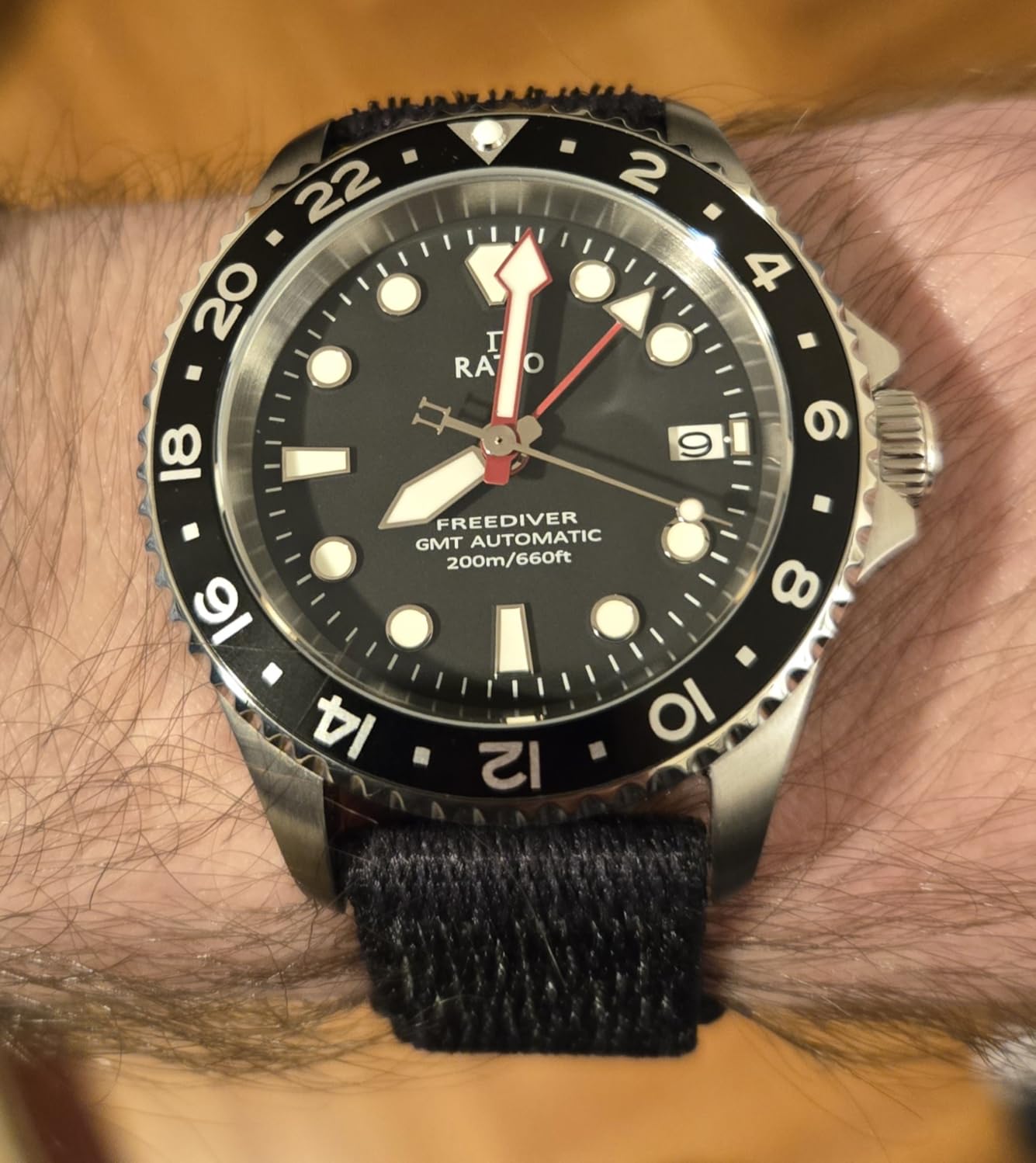
Read it as a caller GMT unless you can confirm otherwise. The listing describes a rotating GMT bezel with dual-time functionality but makes no claim about a jumping local hour hand, so assume you are setting the central hands yourself after landing. The bezel makes the second zone easy to read, not easy to change.
Owner feedback is focused on the package rather than the mechanism, and the sentiment is positive: a well specified watch for the money, with a movement and crystal combination that normally sits higher. Buyers describe it as versatile across travel, diving and everyday wear, which is the trio you want from one watch.
When it earns its slot
Water resistance is the differentiator here. 200 metres with a dive-style construction means you can rinse it in fresh water after a dive and never think about it again. Several picks in this roundup are rated to 100 metres or 50 metres, which is fine for rain and not much else.
The sapphire crystal resists the scratches that come from a watch sharing a bag with keys and a passport holder. Owners value the combination of mechanical precision and a rotating bezel that actually rotates, which is rarer in automatic watches than the GMT name suggests.
When to look elsewhere
The case is large and reviewers flag it as bulky on smaller wrists. If your wrist is under about six inches, look at a 38mm or 39mm option instead, because lug-to-lug matters more than diameter for whether it sits flat.
The review pool is small relative to the others here, which means less long-term owner feedback about accuracy drift and bezel alignment over years. For a watch you intend to keep for a decade, that is worth weighing against an option with a bigger owner base.
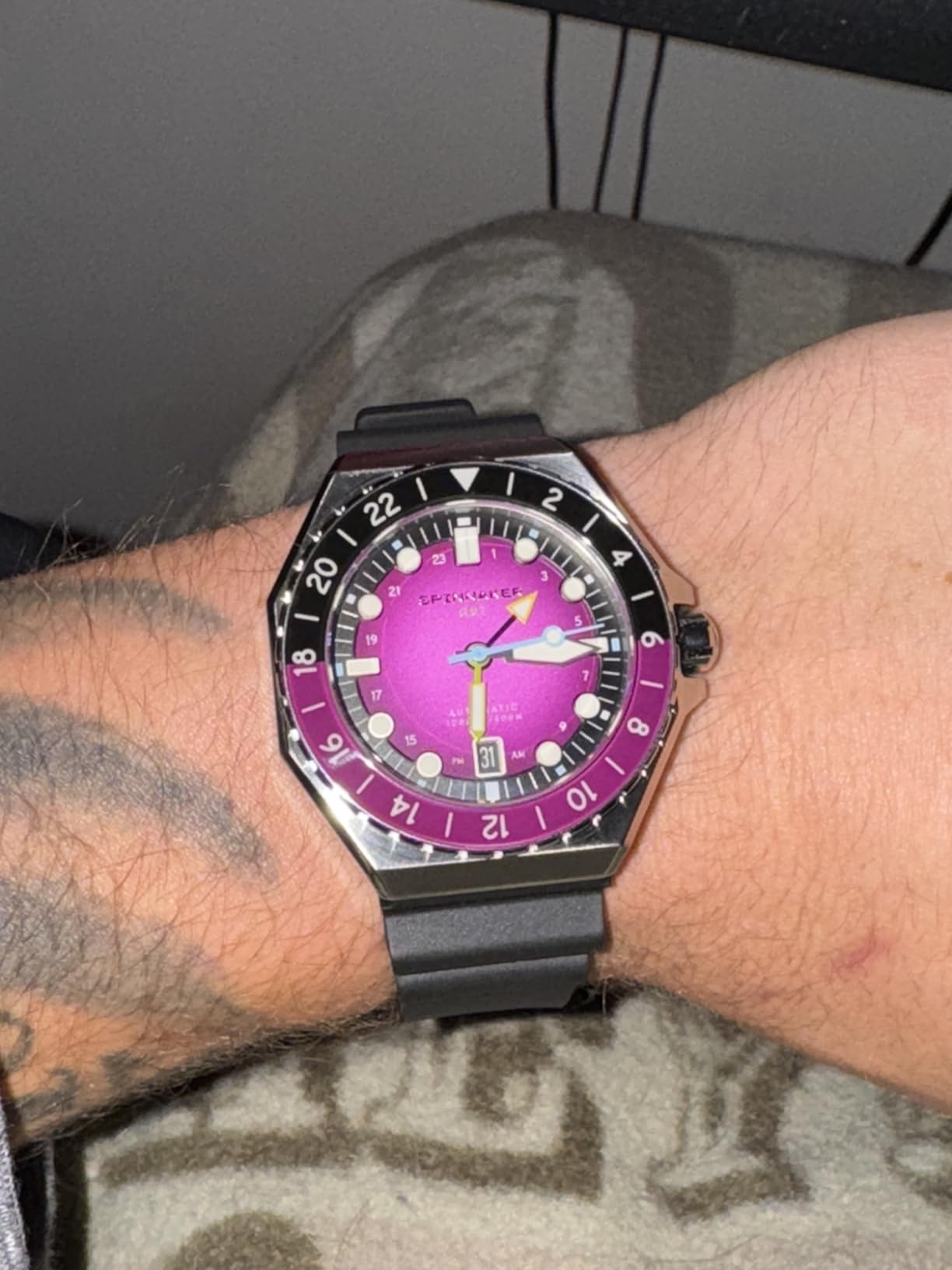
6. Spinnaker Dumas SP-5119 – A True Dive-Capable GMT With A Quick-Release Bracelet
Spinnaker Dumas Men’s Automatic GMT Dive Watch – Seiko NH34 Movement, 44mm Stainless Steel Case, Water Resistant 300m, Stainless Steel Bracelet, SP-5119
Seiko NH34 GMT automatic
44mm 316L steel case
Sapphire lens with AR coating
300m water resistance
Pros
- Seiko NH34 movement gains a few seconds a day
- Quick-release bracelet plus an included rubber strap
- 300m rating makes it genuinely dive capable
- Strong lume on a striking vintage diver dial
Cons
- Only three micro-adjustments on the bracelet
- GMT bezel insert is hardened glass and grips awkwardly
- Crown stem feels slightly flimsy
The Dumas wears a 44mm octagonal steel case and a sapphire lens, and inside is the Seiko NH34 GMT automatic. That movement gains a few seconds a day, which is a stronger result than most automatic watches of any price, and it is the reason this watch keeps coming up as an entry point to mechanical GMT ownership.
At 300 metres it is the most capable watch in this roundup on paper. Screw-down crown, exhibition screw-down caseback, bi-directional 24-hour bezel, lumed hands and applied markers with the depth rating printed on the dial. It is a real dive watch that also tells two time zones.
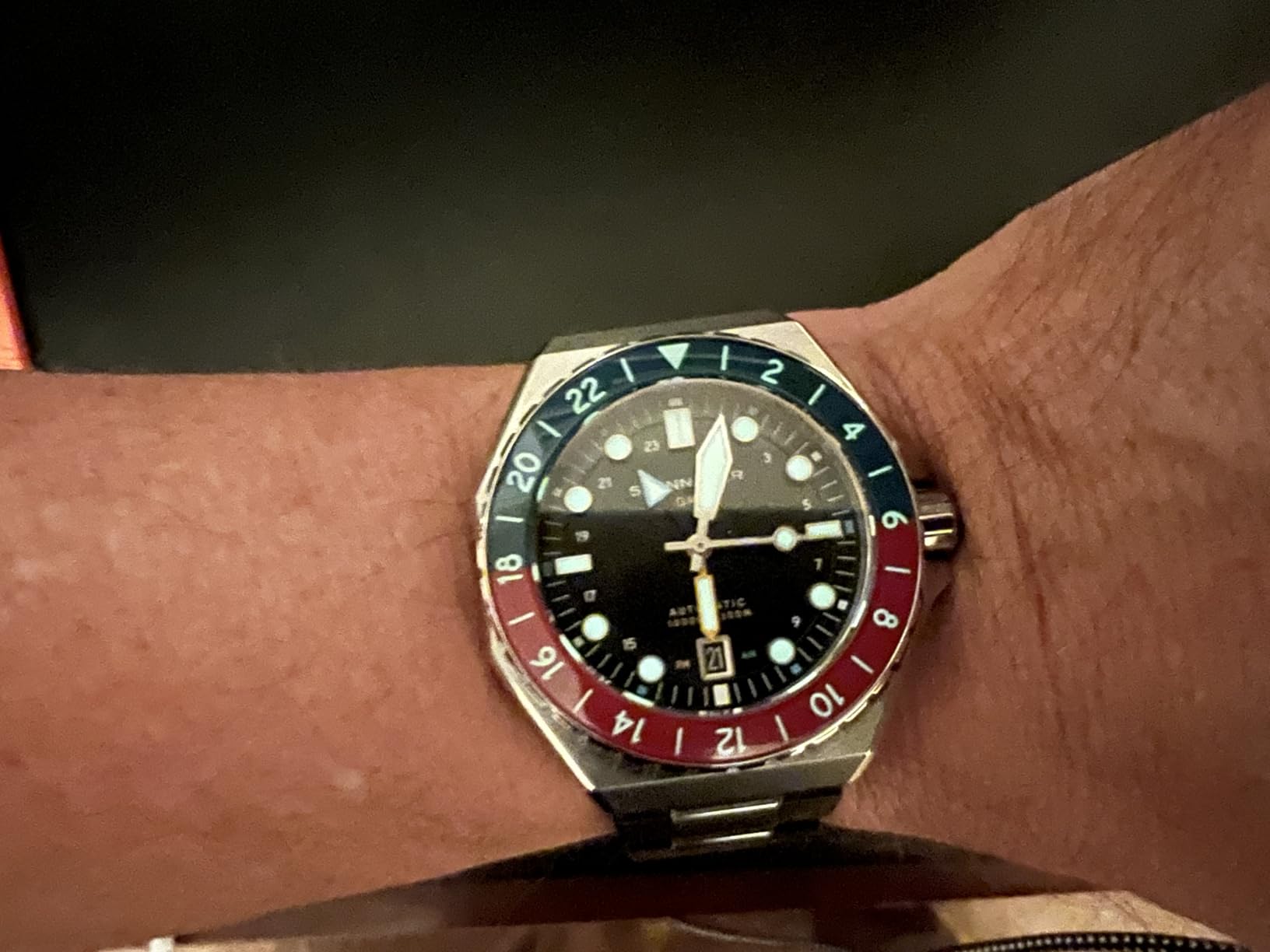
Like the Seiko 5 Sports, this is a caller GMT. The NH34 moves the 24-hour hand independently and leaves the local hour hand locked to the minutes. Fine once per trip, not fine if you are moving zones twice a week, and worth knowing before you commit.
The quick-release bracelet is the feature that changes how you pack. A matching rubber strap is included, and swapping takes seconds without a spring bar tool, so you can go from a steel bracelet for a meeting to rubber for a coastal day without a jeweller in the loop.
Why it suits an active trip
The dial is the reason people keep it. It is a vintage diver layout with heavy applied markers and lume that is genuinely strong, and it reads at a glance in a dark pool or a dim departure gate. The 44mm case has real heft, which is reassuring in water and slightly noticeable over a shirt cuff.
Owners repeatedly compare the overall feel to watches costing several times more. The included rubber strap, the quick-release hardware and the exhibition caseback add up to a package that is unusually complete for the tier, and the NH34 is a movement you can have serviced almost anywhere.
Where it gets in the way
Three micro-adjustments on the bracelet is not enough for a small wrist, and 44mm with 15mm of thickness is visibly large. Check your wrist and your shirt cuffs before committing. The bezel insert is hardened glass rather than ceramic, so it scratches more readily and grips awkwardly to turn.
The crown stem feels slightly flimsy when you are adjusting time and date, and the deployant clasp release can stick. None of these stop the watch working, but they are the details you touch on a runway, which is precisely when you want them to work first time.
7. Bulova Oceanographer 98B407 – A True GMT With A Jumping Local Hour Hand
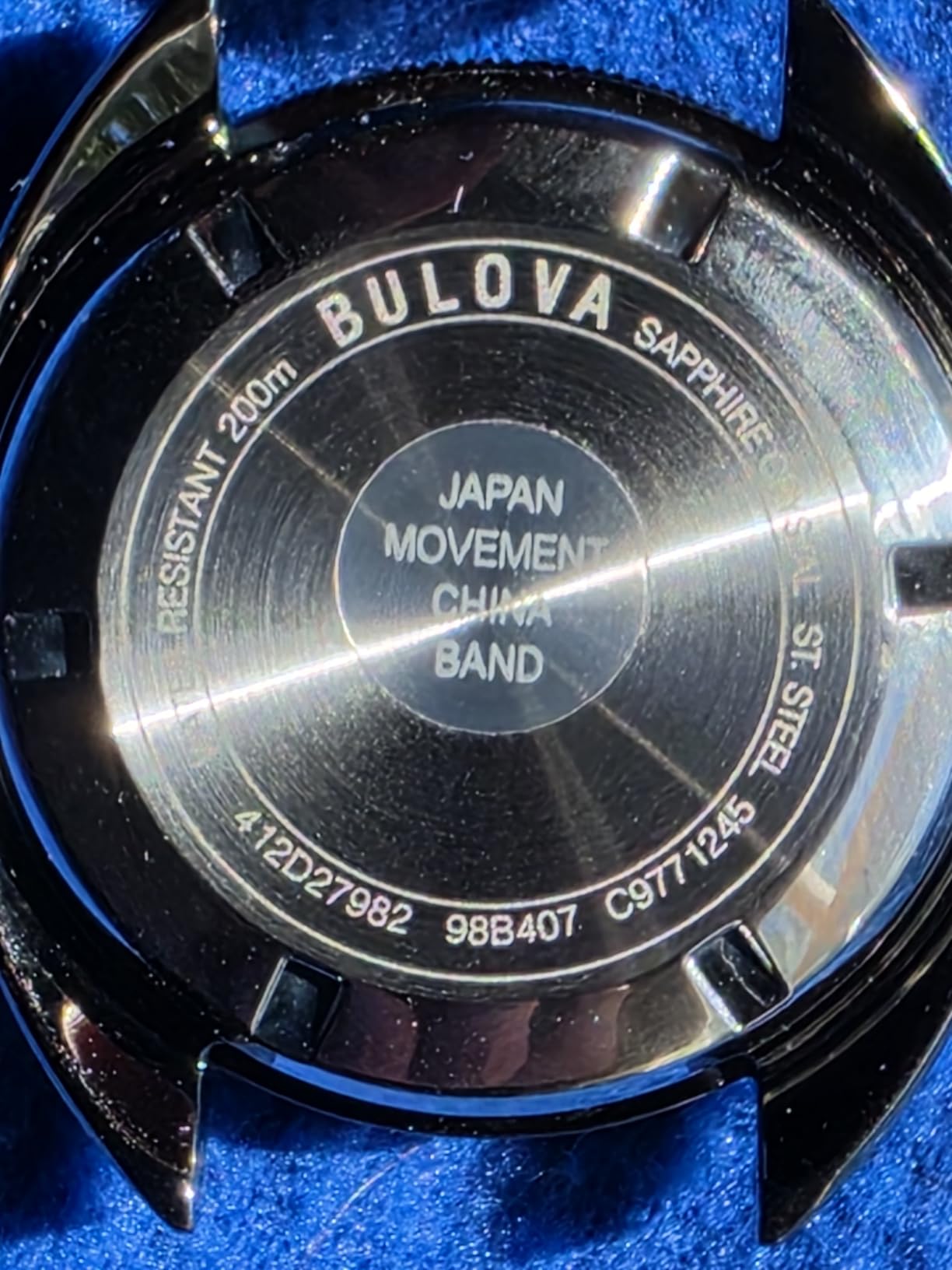
Bulova Men’s Oceanographer Snorkel GMT Automatic Grey Ion Plated Stainless Steel Case Watch, Black and White Unidirectional Rotating Bezel, Gray Silicone Strap, White Dial Style:98B407
Independently adjusted local hour hand
41mm steel case with IP coating
Box sapphire crystal
200m water resistance
Pros
- True GMT with an independently adjustable local hour hand
- Fully luminescent white dial with a black 24-hour scale
- Unidirectional bezel adds dive timing on top of GMT utility
- Screw-down crown and caseback with a 200m rating
Cons
- Silicone strap limits formal wear
This is the watch to read first if you are the one who crosses time zones. The movement adjusts the local hour hand independently, so you land, pull the crown one click, move the hour hand, and the home time stays on the fourth hand. The seconds never stop. That is the entire argument for a true GMT, and this is the only dive-styled option in the group that delivers it.
The 41mm case is a sensible travel diameter. It sits under a cuff without the bulk of a 44mm, and it does not look small on a larger wrist, which is a narrow band that many watches in this roundup miss.
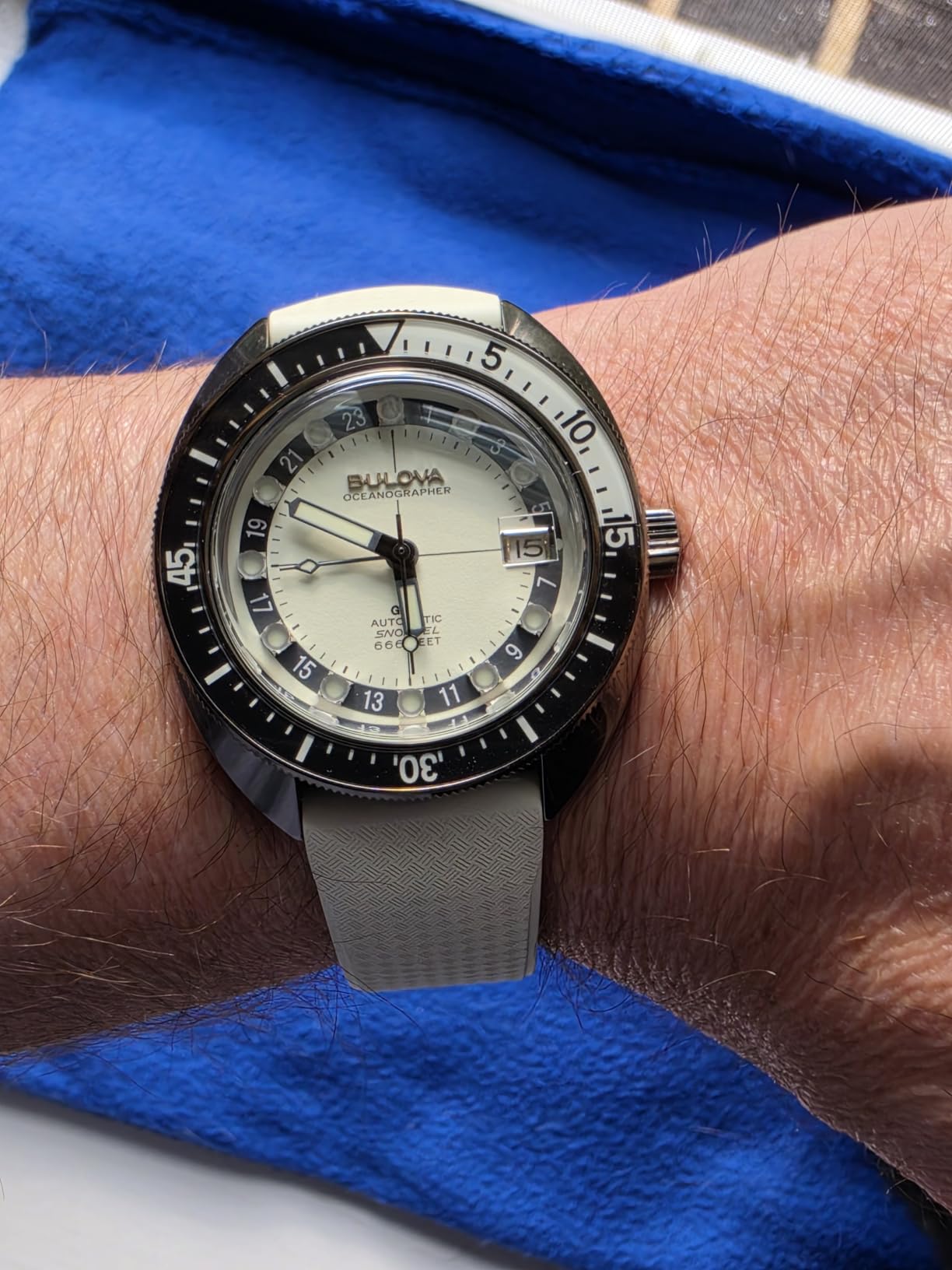
The dial is fully luminescent white with a black 24-hour scale and minute markers, applied round luminescent hour markers, and a date display. White on black is the highest-contrast combination available, and on a red-eye or in a dark airport it is the difference between reading your watch and squinting at it.
Water performance is proper rather than aspirational: a screw-down crown, a screw-down caseback and a 200m rating. The unidirectional rotating bezel means the timing function cannot be moved by accident, which is the safety property dive watches are built around and a bonus when you use it as a third-zone reference.
Why this is the traveller’s pick
You keep two time zones and the operation on landing takes seconds. A 24-jewel self-winding movement with a 42-hour reserve covers a long weekend away without winding, and the reserve is long enough that you will not need a winder on a desk job.
Owners consistently highlight legibility, the true GMT mechanism and the 41mm proportions. Bulova also carries a three year limited warranty, which is longer than most of the brands in this roundup and relevant if the watch is going to be your regular traveller.
What you give up for it
The fitted grey silicone strap is the trade-off. It is the right material for water and beach days and the wrong material for a client dinner, and this watch does not come with a bracelet option in the box. If you wear one watch for everything, plan on changing straps.
The owner base here is small, so there is less long-term feedback on how the jumping hour hand ages. Ask about warranty service terms before you buy, because a mechanism that is convenient for two years is worth more when you know what happens when it needs attention in year four.
8. Sea-Gull 6177 Panda Eye – A Dual Calendar GMT Nobody Else Bought
SEA-GULL Men’s Mechanical Watches,GMT Dual Calendar Panda Eye Watch,Automatic Wristwatch, Seagull ST2502,Tachymeter, Luminous, 6177, 816.92.6177, Modern
ST2502 automatic mechanical movement
Approximately 43mm case
13.5mm thick
22mm strap width
Pros
- Dual calendar display alongside a GMT hand
- Mechanical movement well below Swiss automatic equivalents
- Luminous hands and markers for low-light reading
- Panda eye dial with a tachymeter scale
Cons
- Thick case profile and a small bracelet
- Limited international service compared with Swiss brands
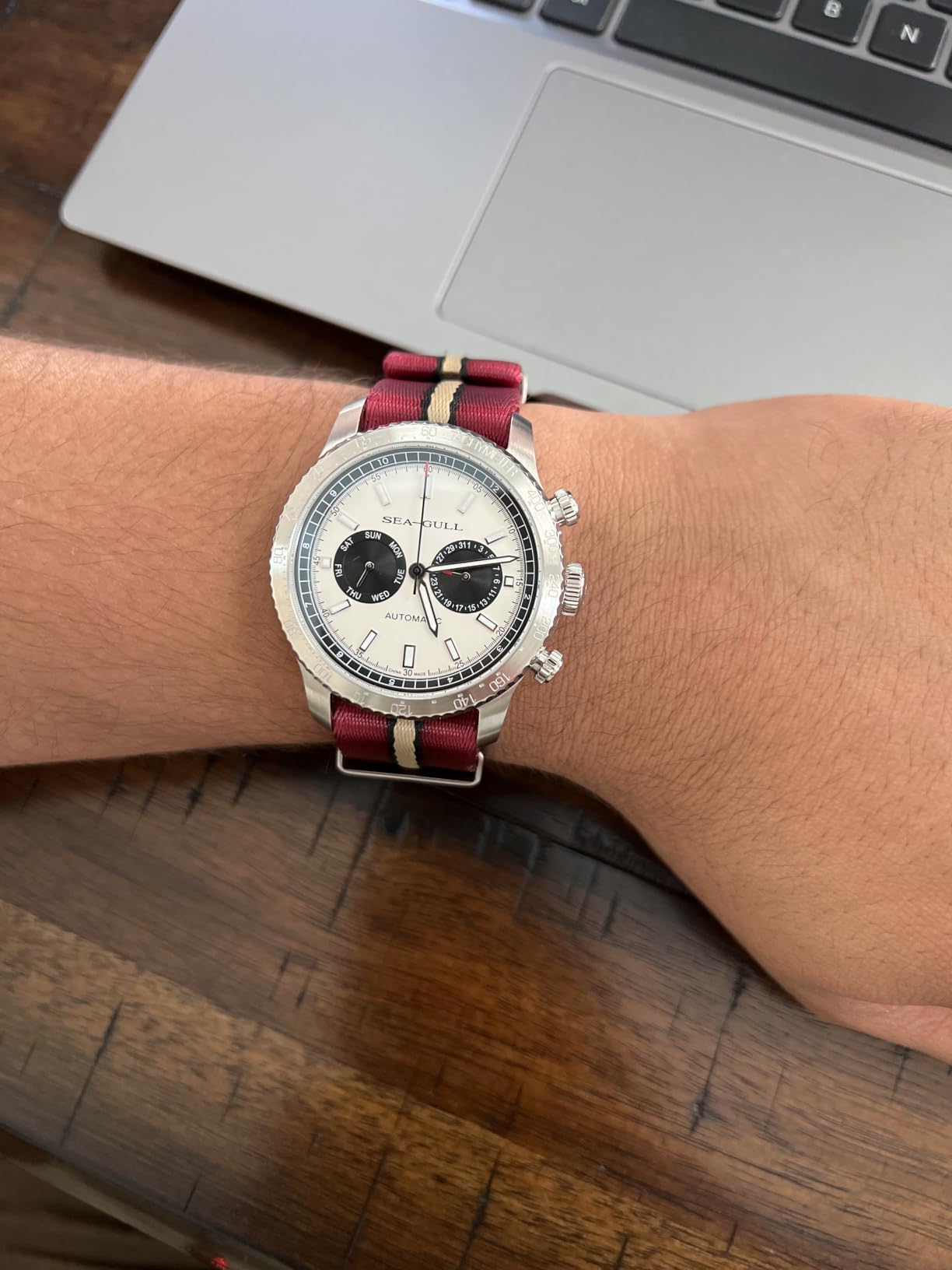
The Panda Eye is the odd one out and that is the appeal. A mechanical ST2502 automatic with a GMT hand, a dual calendar display and a tachymeter scale on the dial, in a high-contrast panda layout. There is not another watch in this roundup with that combination, and buyers are buying a genuinely different object rather than a variation on a diver.
For a traveller with a family in another country, the dual calendar is quietly excellent. You can see the day and date for a second location on the dial alongside the second time zone, which means you do not have to mentally convert anything before a call.
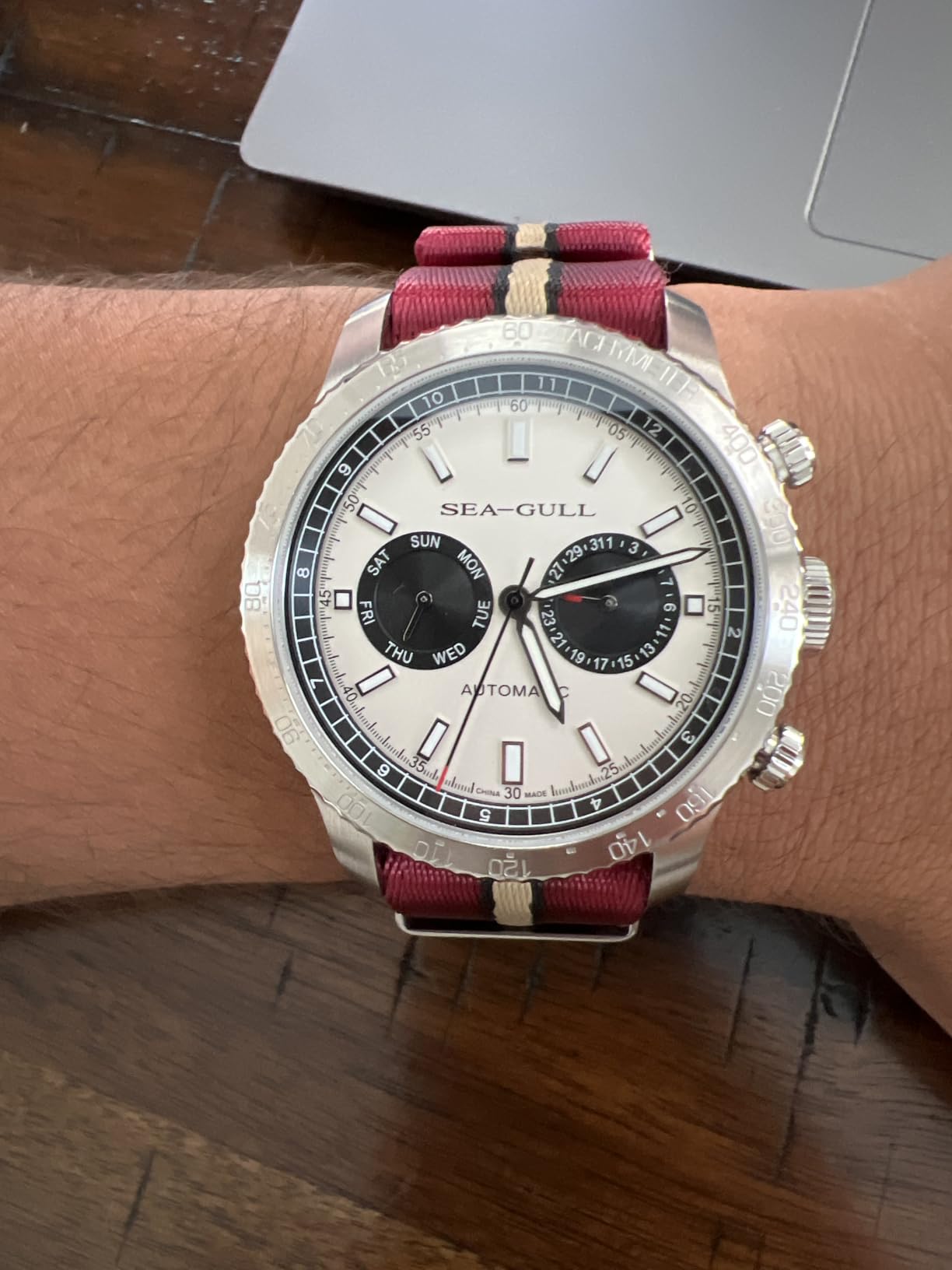
Read the GMT hand as a second time zone indicator. The listing does not claim a jumping local hour hand, so treat it as a caller GMT and plan to set the central hands when you land. The tachymeter and calendar complications are dial furniture as much as tools, and the fun is in reading them rather than timing a lap with them.
Owner sentiment is strong, and the reason given most often is value against Swiss automatic GMTs with a single date. The average rating here is high, though the review pool is the smallest in the group, so treat the enthusiasm as new-owner energy rather than a decade of data.
What makes it worth a look
At approximately 43mm with a 22mm strap width it sits in a normal range, and the luminous hands and markers cover the dark airport case. A mechanical movement in a panda eye layout has a charm that a black-on-black diver never will, and it starts conversations that a tool watch does not.
The dual calendar is the practical hook. It is a rarity at any price, and for someone coordinating with family or colleagues across zones it removes one piece of mental arithmetic from every conversation.
Before you order it
Case thickness is approximately 13.5mm, which is thick, and the bracelet runs to a 19cm circumference. If you have a larger wrist or wear it over a shirt, that works in your favour. If you are under six inches, expect to resize or ask about the strap supplied.
Service reach is the real consideration. A mechanical movement from a brand with limited international distribution means a trip home or a shipper if something goes wrong. That is manageable for most people, and it is the main reason to weigh this against a Swiss or Japanese alternative.
9. Stuhrling Equinox 4077 – A Bi-Directional Bezel Most Watches Do Not Offer
Stuhrling Original Equinox GMT 4077 Men’s 43mm Quartz GMT Watch – Dual-Time Movement, Bi-Directional Bezel, Stainless Steel Bracelet
Swiss quartz dual-time movement
43mm round steel case
Bi-directional rotating 24-hour bezel
Screw-down crown, 50m
Pros
- Bi-directional rotating bezel is unusual at this level
- Swiss quartz dual-time movement is smooth and reliable
- 43mm case with real weight on the wrist
- Screw-down crown adds a proper seal
Cons
- Mineral crystal scratches more readily than sapphire
- Thick bezel takes up dial real estate
- Crown is fiddly for time and calendar setting
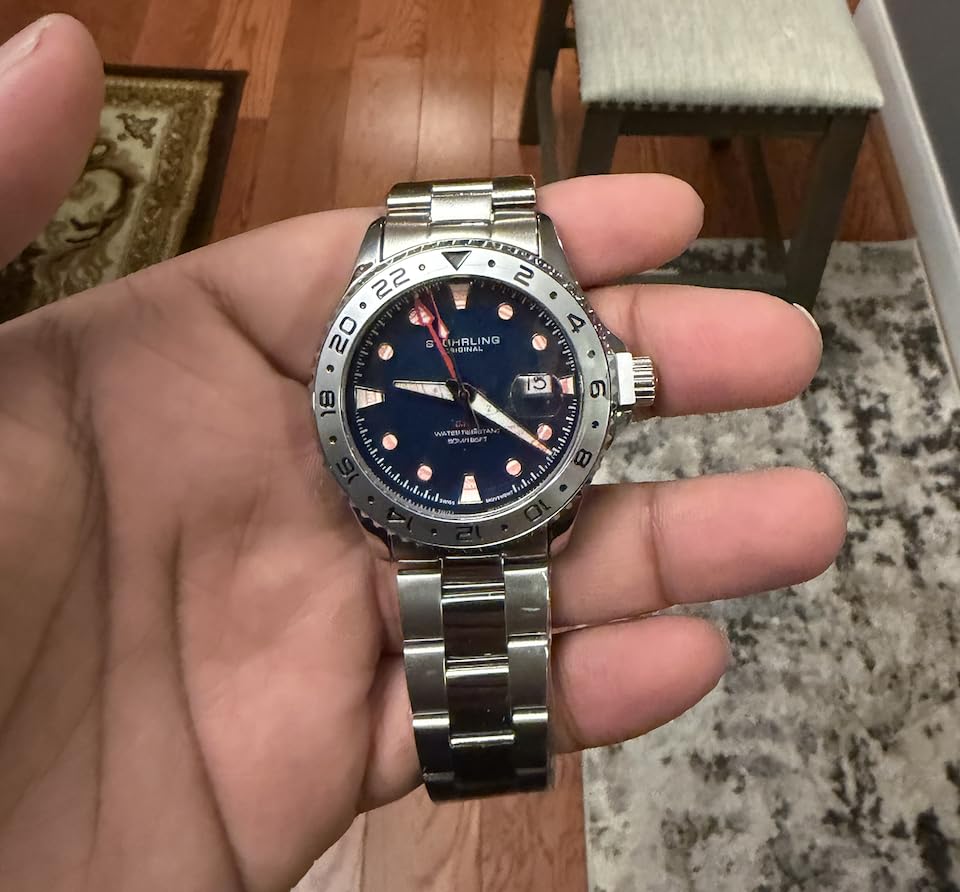
The Equinox is a dress-leaning dress GMT rather than a diver. A 43mm round steel case, a three-link bracelet with a fold-over clasp, and a functional bi-directional rotating 24-hour bezel that you can turn either way to re-reference the second zone. That bezel is the reason this watch is on the list; a lot of watches at this level give you a decorative fixed ring instead.
Underneath is a Swiss quartz dual-time movement. Like the Stuhrling quartz we featured earlier, it needs no winding, runs off a battery, and will be accurate the morning after a fortnight in a hotel safe.
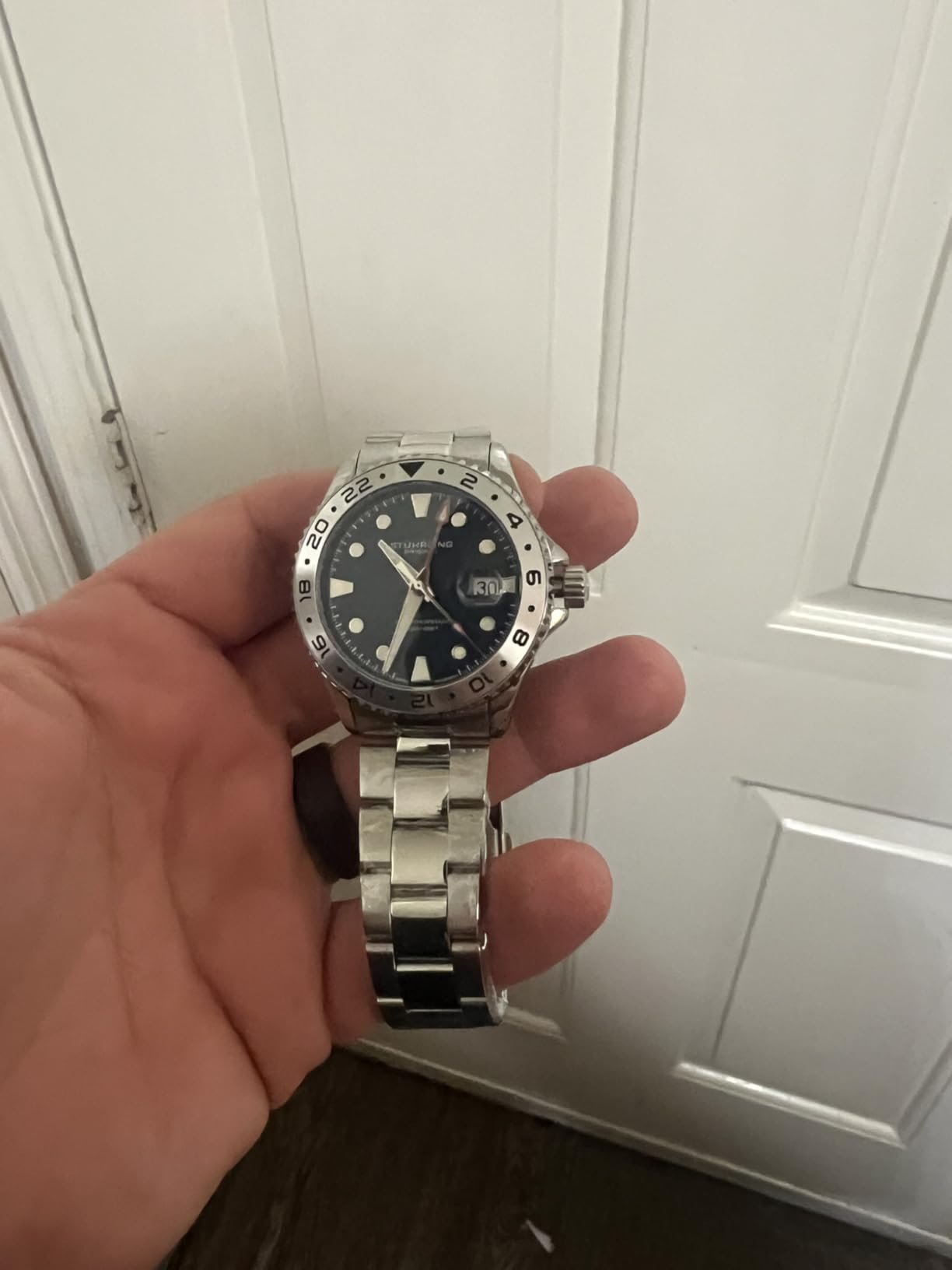
Treat it as a caller GMT. A quartz dual-time movement moves the 24-hour hand and leaves the local hands alone, so you are resetting the central hands on landing. The rotating bezel makes reading and re-aligning a second zone quick, which is the part you will use most often.
Owners like the feel of it. The 43mm case has real weight and a premium feel in person, the bracelet resizes easily, and the fold-over clasp is secure. Several buyers mention it being dressy enough for a suit or a button-down, which is a different lane from the dive-style picks here.
Where it makes sense
One watch that covers an office and an evening out. The rotating bezel is genuine functionality rather than decoration, and on a quartz movement the hand stays aligned because there is no drift to correct.
The screw-down crown is a small thing that matters in a hotel bathroom or a light shower. Available in steel and a rose gold-tone bracelet finish, so it is an easy watch to wear with a suit.
Where it falls short
The mineral crystal is the trade. It scratches more readily than sapphire, and on a watch you carry through airports that will show it. The bezel is also thick and eats into the dial, which is exactly the problem one competitor’s write-up raises about GMT hands and dials generally.
Setting time and the calendar through the crown takes practice and owners describe it as fiddly. And some buyers find certain examples look cheaper in person than the photographs suggest, so if finish is your priority, see it before committing.
10. Timex Q GMT 38mm – The Smallest Case Here, With The Honest Trade-Offs
Timex Men’s Q GMT 38mm Watch – Black Dial Stainless Steel Case & Strap
38mm stainless steel case
Day and date window on dial
Acrylic lens
Stainless steel attachment, 50m
Pros
- Compact 38mm case suits smaller wrists and fits under a cuff
- Day-date window adds useful calendar information
- Clean design works for office and evening wear
- Steel construction at a mid-range price
Cons
- Acrylic lens scratches more easily than sapphire
- 50m rating limits it to casual swimming
- Not a jump-hour GMT so zones are changed by hand
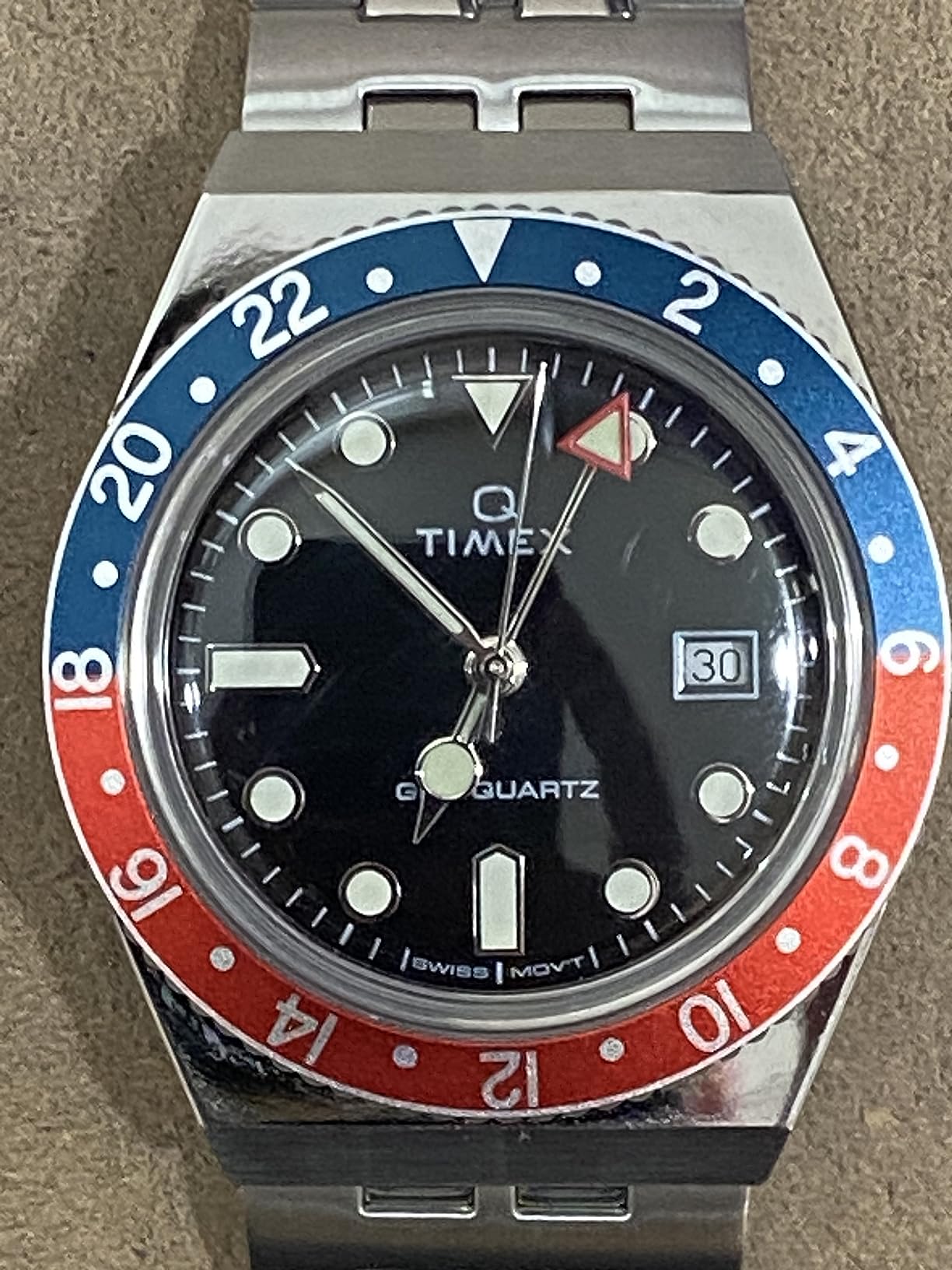
Thirty-eight millimetres is the number to note here. On a six-inch wrist a 42mm watch overhangs, and on a long flight that overhang gets noticed every time you push a tray table or check a boarding pass. The Timex Q GMT is the most compact watch we tested, and it disappears under a cuff in a way none of the larger picks here can.
It is also a design that works anywhere. A clean steel case, a day and date window on the dial, and no aggressive bezel or oversized lugs. This is a watch you can wear to a client dinner the evening after a red-eye without changing it.
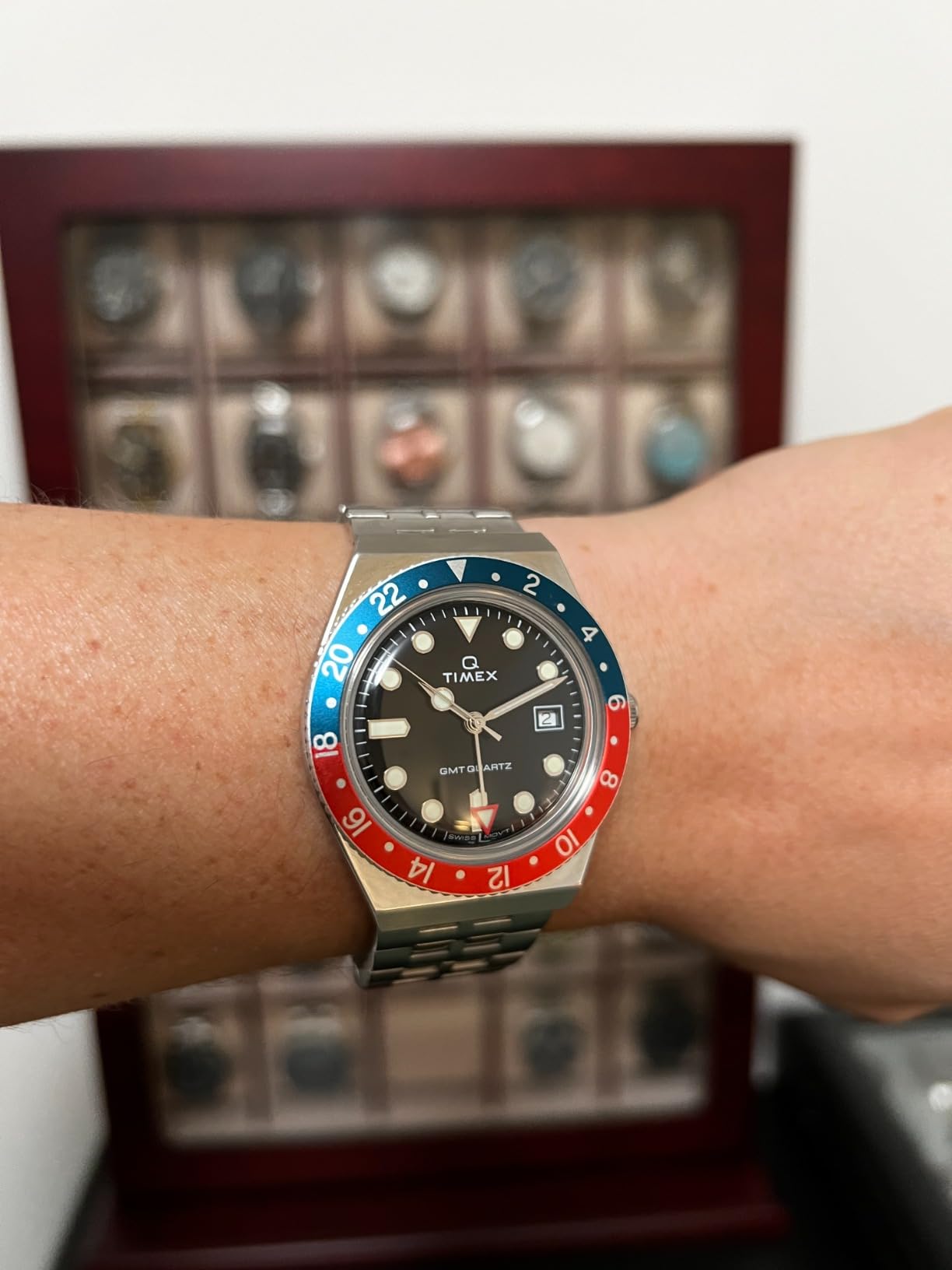
Read it as a caller GMT, and read the limitations plainly. The GMT hand does not jump the local hour, so changing zones means moving the hour hand yourself. Reviewers are candid about this, and it is the single fact that decides whether this is the right watch for you.
The rating spread here is the flattest in the group, with a meaningful share of three-star reviews pointing at movement and accuracy dissatisfaction. That is worth weighing honestly. A day-date window on a small dial is also hard to read at a glance, which is a real cost on a watch whose whole purpose is quick information.
When the small case is the deciding factor
If you have been put off GMT watches because every one you have tried feels like a brick, this is the answer. A 38mm case is a genuine wearing size rather than a compromise, and it suits wrists that other people cannot wear steel watches on.
The day-date window is more useful on a travel watch than people expect. Checking whether a call is today or tomorrow does not need a phone, and on a small dial it is something you learn to read at an angle within a week.
What you are accepting
The acrylic lens is the biggest compromise. It scratches more easily than sapphire and will show it, and airport trays and desk edges are exactly what acrylic dislikes. Water resistance is 50 metres, which is rain and hand-washing rather than swimming.
And this is not a jump-hour GMT, so the convenience that sells a travel watch in the first place is missing. Choose it for the size and the dressability. If you want the local hour to move independently, the Bulova is the watch for that.
11. ADDIESDIVE 36mm Dual Time GMT – A Thirty-Six Millimetre Dress GMT With A Blued Hand
ADDIESDIVE GMT Watches for Men 36 MM Small Dial Quartz Watch 515-24 H Diver Waterproof 100 M Stainless Steel
36mm case, beige dial, blued GMT hand
Swiss Ronda 515-24H quartz
Bubble mineral crystal with AR coating
100m water resistance
Pros
- Smallest case and thinnest profile in the group
- Swiss Ronda quartz keeps better time than automatics at this price
- Blued GMT hand on a beige dial looks genuinely elegant
- BGW Superlume hands and markers
Cons
- Entry-level brand with thinner service support
- Bubble crystal can distort the calendar at oblique angles
- Finishing and accuracy vary between examples
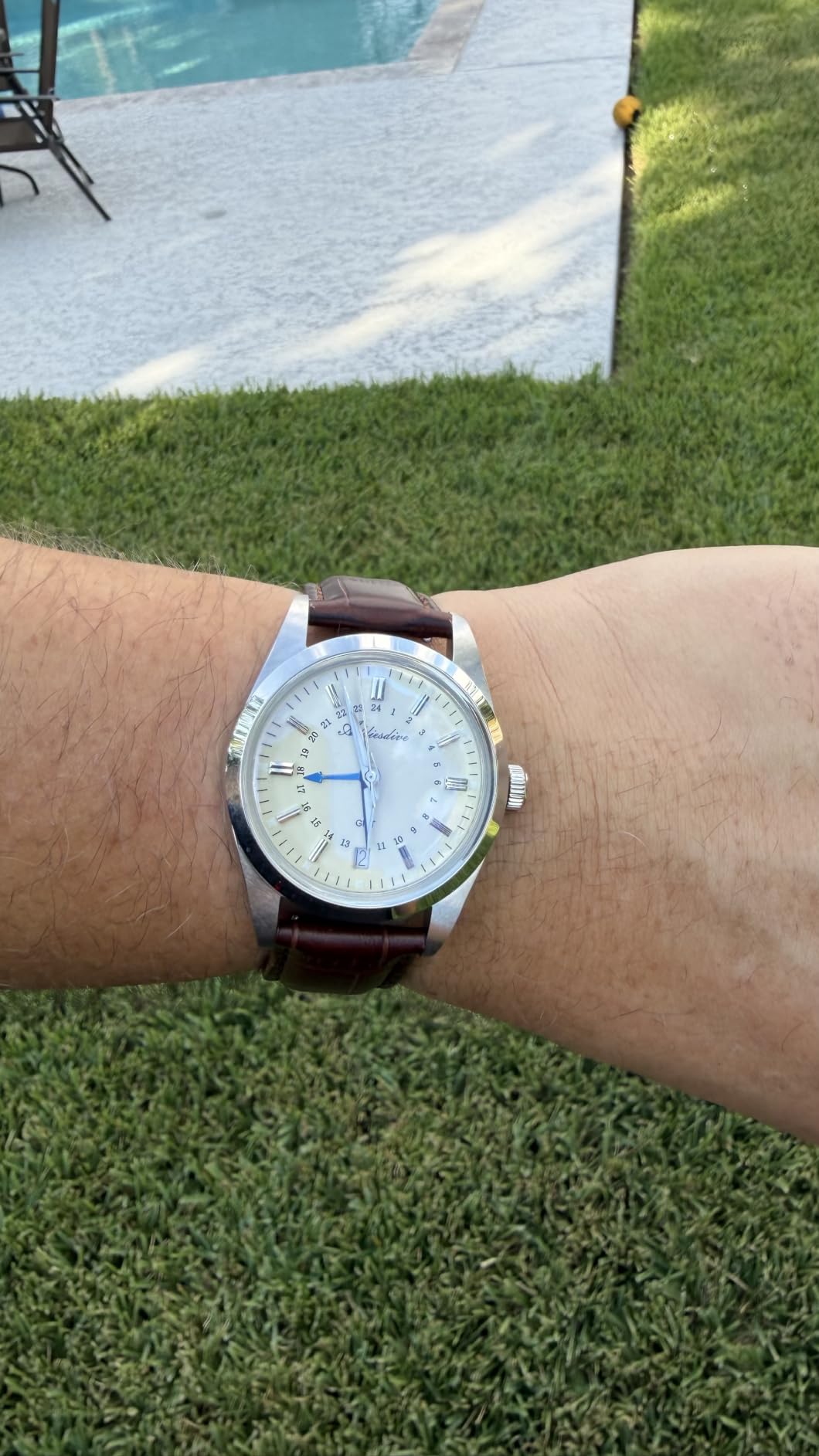
This is the one to wear with a jacket. Thirty-six millimetres, a beige dial, and a blued GMT hour hand that is a different colour to the silver and white local hands. On a traveller who wants a second time zone without looking like they are on a dive trip, the colour coding does a lot of quiet work.
Inside is a Swiss Ronda 515-24H quartz movement. It beats most of the automatic watches in this roundup for day-to-day accuracy, it needs no winding, and it is the kind of movement a watchmaker can service if you keep it for a long time.
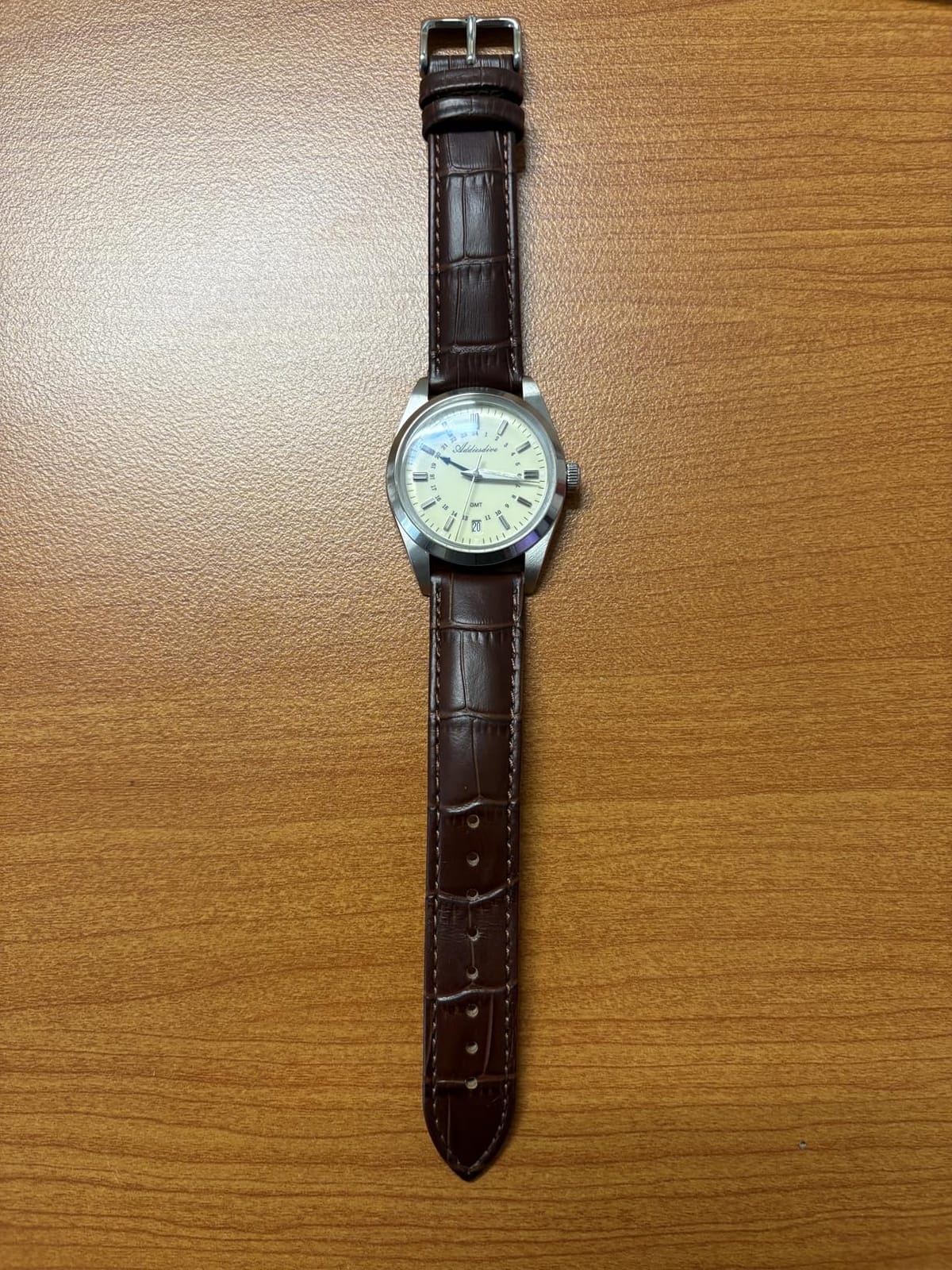
Treat it as a caller GMT. A Ronda jumping 24-hour hand means the central hands stay put through a zone change. The case is small enough that the whole reset is quick, and doing it in a lift is genuinely a five-minute job rather than a fidgety one.
Water resistance is 100m with a screw-down crown on a 316L steel case, so rain, a hotel pool and a hot shower are all fine. BGW Superlume on the hands and markers gives you usable low-light reading, which is the actual requirement in a dark terminal rather than maximum brightness.
Why size and styling matter here
At 36mm this is the smallest and one of the thinnest watches here, and it wears under a shirt cuff without a bump. For a traveller who wants a GMT they can wear to dinner, that is not a minor specification. It is the whole point of the watch.
The blued hand on a beige dial also has a practical side: the second zone hand is instantly distinguishable from the local hands, so you are not squinting to work out which is which in poor light. Owners consistently praise the look as elegant and distinct.
Where caution is warranted
Service support is thinner than for a Swiss or Japanese brand, and if you keep watches for decades that is worth thinking about before you fall in love with the dial. The bubble mineral crystal can also distort the calendar window at oblique angles, which is a mild irritation on a watch this small.
Lower-star reviews point at accuracy and finishing varying between examples, and the brand is an entry-level name rather than an established maker. Buy it for the size, the styling and the Swiss quartz movement. Do not buy it expecting heirloom-grade service.
12. MIDO Ocean Star 200 – The Longest Power Reserve In The Group
MIDO Ocean Star GMT – Swiss Automatic Watch for Men – 44mm Stainless Steel Case with Black Ceramic Rotating Bezel – Black Dial – Blue Fabric Strap – M0266291705100
True traveller GMT with jumping hour hand
44mm case, 13.38mm thick
Caliber 80 with 80 hour reserve
200m water resistance
Pros
- True GMT with an independently adjustable local hour hand
- Caliber 80 accuracy reported within 1-3 seconds a day
- 80-hour reserve means far fewer winding interruptions
- Bluish ceramic bezel resists scratching
Cons
- The supplied fabric strap is widely criticised
- Independent hour hand can stick and need repeated warranty service
- Lume is decent rather than bright
The MIDO is the other true traveller GMT here, and it is the more traditional watch of the two. A 44mm steel case at 13.38mm thick, a blue ceramic bezel graduated over 24 hours, a sapphire crystal with double-sided anti-reflection, and a tapered blue fabric strap on a pin buckle. The 24-hour graduated bezel reads the second zone directly.
The Caliber 80 is the reason to keep looking. Owners who have a healthy example report accuracy within one to three seconds per day, and an 80-hour reserve means you can put the watch down for a long weekend and it is still running when you pick it up. That matters on a trip, where the watch is off the wrist more often than it is on.
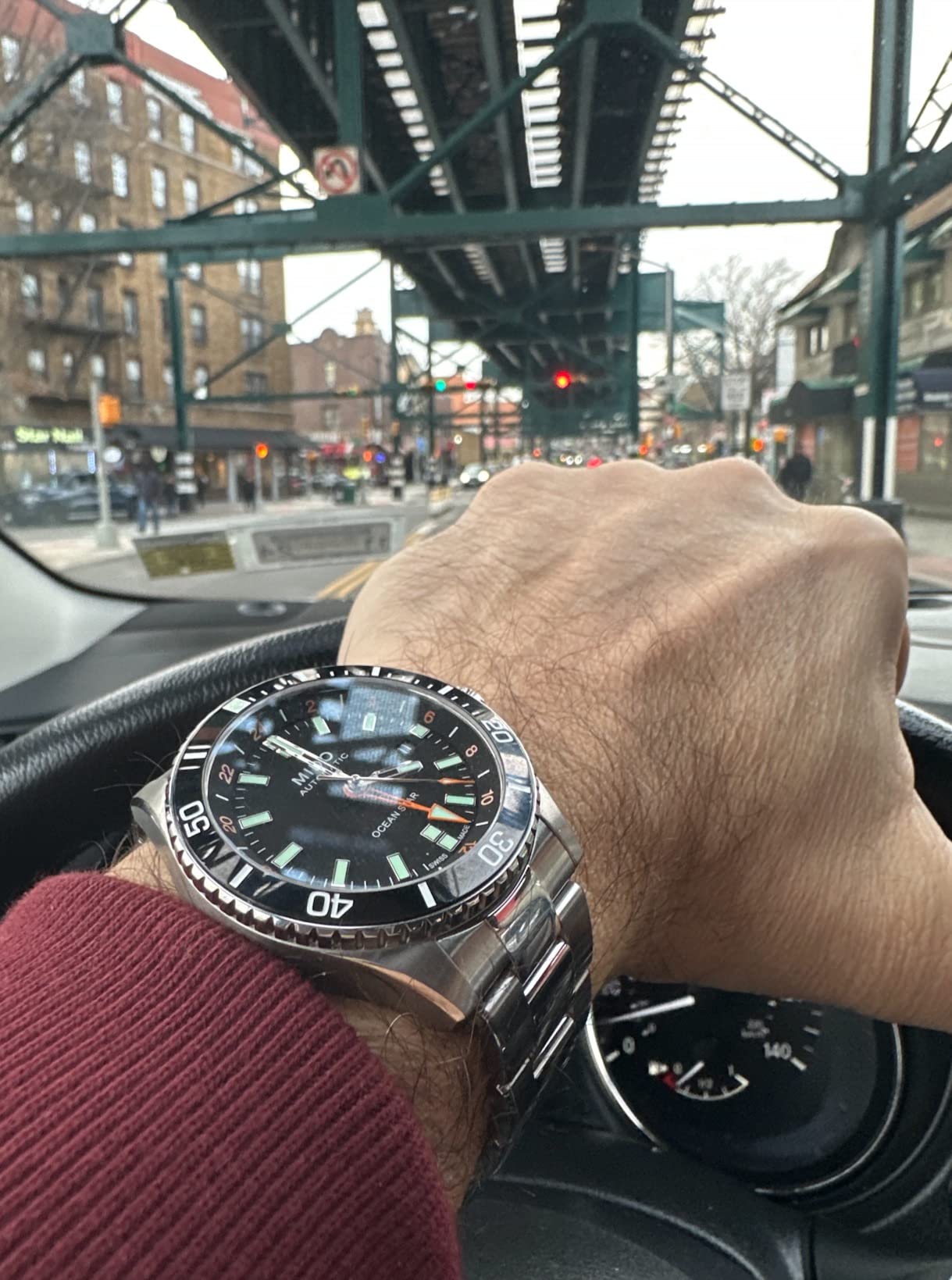
The caliber also uses a Navichron balance spring, which reduces magnetic interference and resists shocks. Neither is a spec you will notice on a holiday, but a travel watch lives in handbags and laptop sleeves next to phones and chargers, and magnetic resilience is a genuinely travel-relevant property rather than a laboratory flourish.
This is the most polarised watch in the group and we would be misleading you by hiding it. A significant minority of owners report the independently jumping hour hand failing to track, requiring repeated warranty service visits over long periods. If the jumping hour is the reason you are here, ask specifically about the warranty process on that mechanism before you buy.
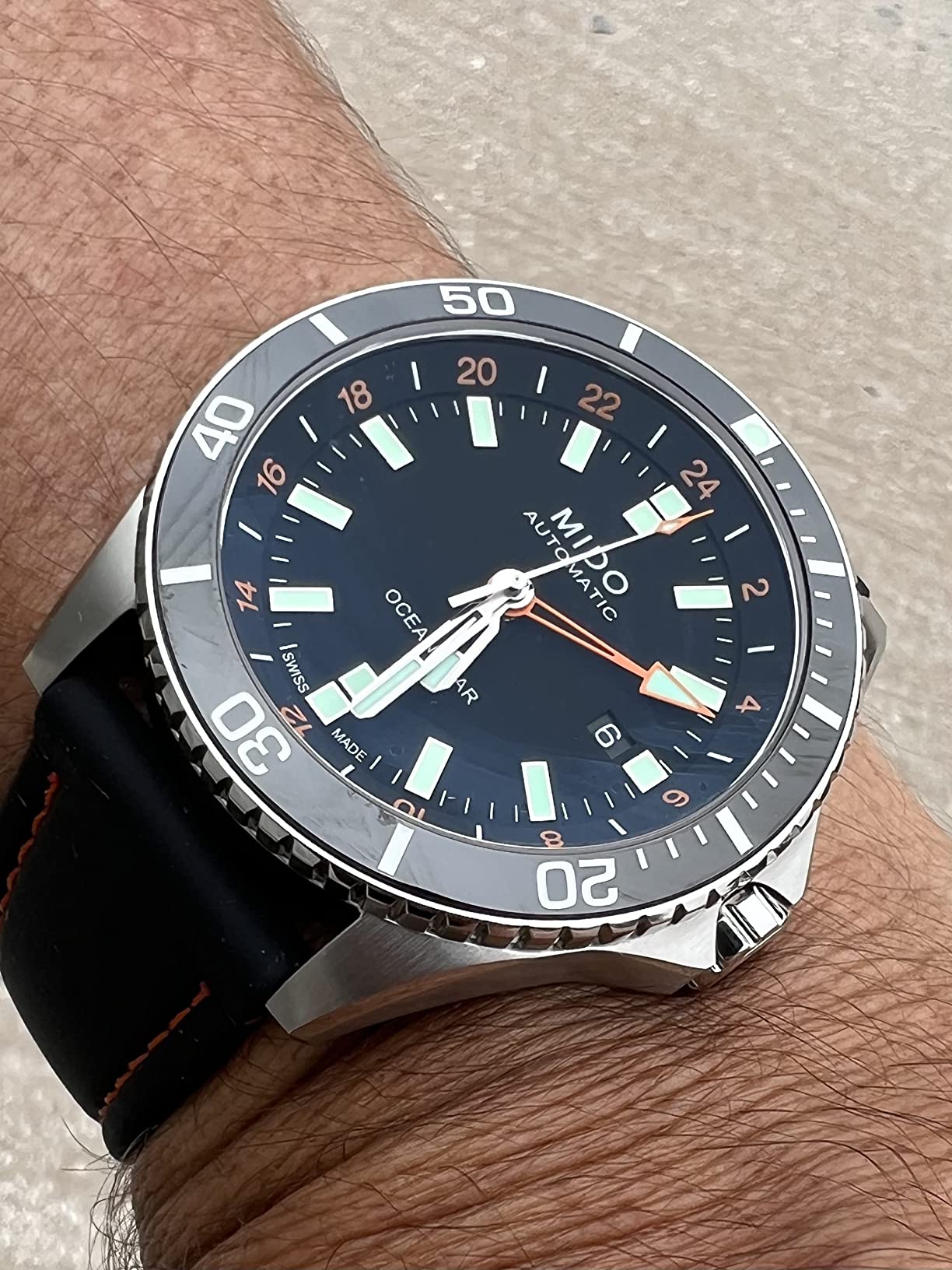
What you get if yours runs true
A 200m water resistance with a screw-down crown, a sapphire crystal, and a 60-minute bezel alongside the 24-hour chapter ring, so it works as a dive watch too. The metal bracelet with on-the-fly micro-adjustment is widely praised, and 22mm lugs are easy to fit aftermarket straps to.
When the caliber 80 behaves, owners describe it as among the most accurate automatics they have owned, and the ceramic bezel resists the scratching that a steel insert picks up in a bag. The 80-hour reserve is the longest in this roundup and changes how you relate to the watch.
Where to be careful
The supplied fabric strap is the single most common complaint, and most owners change it early. Polished bracelet links and the caseback scratch easily, so expect to treat it gently. The lume is fine rather than bright, which is acceptable if you are not reading it in the dark at the gate.
With a 4.0 average and only a modest review count, the sample here is small, and the split is genuinely polarised. If your priority is a jumping local hour hand and you want long reserve and dive capability, this is the watch. If a simple second zone is enough, the Seiko is a fraction of the commitment.
How to Set a Traveller GMT on Landing
Setting a true GMT on landing takes about five seconds once you know the sequence. The goal is to move your local hour hand and nothing else, so home time stays on the 24-hour hand the whole time.
Check the movement is running. If the watch is an automatic and has been sitting in a bag, wind it or set it from a time signal before you start.
Work out your offset. Note the current home time and the local time where you have landed, and the difference in hours. Crossing date lines trips people up more than the adjustment itself.
Pull the crown out one click. On a true GMT the seconds hand keeps running at this stage, which is the whole advantage over stopping the watch.
Move the local hour hand forward or back in one-hour steps. Do not touch the 24-hour hand and do not turn the minute hand; if it moves at all, you have gone too far.
Push the crown back in and check the 24-hour hand is now pointing at home time on the 24-hour scale. If it is not, re-reference it with the rotating bezel or move it independently.
If you also use a third zone, align the rotating bezel or chapter ring to that zone and check the bezel grips firmly enough not to turn in a sleeve.
On a caller GMT the sequence is different and slower. You pull the crown fully out, stop the seconds hand, set the hour and minute hands, restart the seconds hand, then set the 24-hour hand separately. Budget a couple of minutes, and expect the date to advance as you turn past midnight, which is a good moment to check the date is right too.
Two details that catch people out. On most quartz and mechanical GMTs with a date, the date changes at midnight rather than stepping in four-hour increments, so if you set the watch at 11pm local, the date will jump while you are asleep. And if your watch has a magnifier over the date, check it reads at an angle as well as straight on, because that is how you will actually look at it.
How to Choose a GMT Watch That Travels Well
Start with the GMT type, because it decides what the watch is for. If you cross time zones regularly, a jumping local hour hand is worth paying for. If you stay put and work with people elsewhere, a caller GMT is genuinely better, and a watch that does less well is better at the one job you need done.
Then decide the movement, which is really a question about how much attention you give the watch. Quartz needs nothing: no winding, no winder, and a battery that lasts years. Automatic gives you the sweep of a mechanical movement and needs to be worn or wound regularly. A true GMT automatic is the most demanding combination, because a jumping hour hand is more machinery to trust.
Size is a wrist question, not a diameter question. A 38mm or 36mm case fits wrists that a 42mm will overhang, and lug-to-lug determines whether a watch sits flat or stands up on your wrist. A watch that stands up gets snagged on a sleeve and feels heavier than its weight suggests. If you are between sizes, the smaller one is almost always the safer choice for travel.
Crystal choice is a durability decision. Sapphire resists the scratches that come from baggage belts, tray tables and desk edges, and a domed sapphire or a box sapphire distorts less at the edges, which matters when you are reading a 24-hour scale near the rim of the dial. Acrylic and mineral crystal scratch more readily, and on several picks here owners report exactly that.
Water resistance should match your actual trip. Fifty metres is rain and hand-washing. A hundred metres handles a hotel pool and a splash. Two hundred metres or more is a real dive watch, and it is the right call if your travels involve water rather than boardrooms. A screw-down crown matters as much as the number, and a screw-down caseback adds to it.
Bezel type decides whether you can track a third zone and whether it stays put. A rotating 24-hour bezel gives you a third reference you can set once, and it should grip firmly enough not to rotate when your sleeve brushes it. A fixed printed 24-hour track gives you the same function with no moving parts and no risk of accidental adjustment, which is why we like the Seiko 5 Sports for that reason.
Lume is a legibility specification, not a decoration. The realistic test is a departure gate in the dark, not a dark room next to a window. Fully luminescent dials with a black 24-hour scale give the best contrast, and hands and markers that glow rather than merely reflect make the difference on a red-eye.
Bracelet and clasp deserve more attention than reviews give them. Micro-adjustment on the clasp lets you fit the watch properly without removing links, which is the difference between a watch you wear all day and one you take off in the evening. A quick-release system, as on the Spinnaker Dumas, lets you swap to a rubber strap in seconds when a trip turns wet.
Power reserve is quietly important for travel. A 40-hour reserve covers a long weekend. An 80-hour reserve, as on the MIDO, means the watch keeps running through a whole trip out of the case. If your watch lives in a weekender bag, that is worth a real amount.
Two travel-specific checks that get skipped. Anti-magnetic protection matters because a watch spends its life in bags next to phones, laptops and speakers. And water resistance is rated for still water at room temperature, so take it off before a hot tub, a sauna or a cold sea, and rinse it in fresh water afterwards rather than pushing the rating.
Finally, if you buy across a border, remember that list prices are not the same everywhere. Non-US brands price differently in different markets, and UK listings are shown with VAT included while export sales are quoted without it. Import duty, local tax and the cost of returning a faulty watch from overseas are all real costs that do not appear in the headline number.
For anyone also shopping a wrist device for tracking distance rather than time, we compared GPS watches for hikers and GPS running watches for marathon training separately. A GMT tells you what time it is in two zones; a GPS watch tells you where you went. Different jobs.
Frequently Asked Questions
What is the best watch to wear when traveling?
For most travellers the criteria are a second time zone, legibility in poor light, water resistance that survives a hotel pool, and a case that fits under a shirt cuff for a long flight. A GMT covers the first of those, but any good watch with a day-date and solid water resistance works for a casual trip. Choose a GMT when you need to track a second zone without reaching for a phone.
What is the best GMT watch for travel?
The Seiko 5 Sports SSK001 is the best GMT watch for travel overall, because a mechanical 4R34 movement with a jumping 24-hour hand, a bi-directional 24-hour bezel, a fixed 24-hour track and good lume cost less than most rivals. If you need the local hour hand to jump independently, the Bulova Oceanographer 98B407 is the true traveller GMT to buy instead.
What is the best GMT watch that isn’t a Rolex?
The MIDO Ocean Star 200 is the strongest non-Rolex answer here, with a true traveller GMT mechanism, an 80-hour power reserve from the Caliber 80, a ceramic 24-hour bezel and 200m water resistance. It is also the most polarised watch in the group, so ask about warranty service on the jumping hour hand before you buy.
What is the difference between a caller GMT and a true GMT?
A caller GMT moves only the 24-hour hand, so the local hour and minute hands stay locked together and you reset the whole watch when you land. A true GMT, also called a traveller or flyer GMT, has a local hour hand that jumps independently in one-hour steps, so you change zones in seconds and keep home time on the fourth hand.
Is a quartz GMT watch good for travel?
Yes, and for frequent flying it is often the better choice. A quartz GMT needs no winding, no watch winder and no servicing, starts accurate every time you put it on, and typically keeps better time than a comparable automatic. The trade-off is the sweep of a mechanical seconds hand, and on most quartz models the local hour hand does not jump.
How do I set a GMT watch when I land?
On a true GMT, pull the crown out one click and move the local hour hand in one-hour steps without touching the 24-hour hand or the minute hand. On a caller GMT you pull the crown fully out, stop the seconds, set the hour and minute hands, restart the seconds, then set the 24-hour hand. On most watches with a date, the date jumps at midnight rather than stepping in four-hour increments.
The Verdict on GMT Watches for Travel
The Seiko 5 Sports SSK001 is the pick of the best GMT watches for travelers we tested, because a mechanical movement, two 24-hour references and excellent lume in one package is hard to argue with. Its one real compromise is that the 4R34 is a caller GMT, which is a five-minute job once per trip.
If the jumping local hour hand is non-negotiable, the Bulova Oceanographer 98B407 is the travel-first answer and the MIDO Ocean Star 200 is the long-horizon one, accepting the warranty questions we flagged. For small wrists, the 36mm ADDIESDIVE or the 38mm Timex Q GMT solve a problem no larger watch does. For a dive trip, the Spinnaker Dumas gives you 300 metres and a quick-release strap.
Whichever you choose, the useful part of this category happens in five seconds at the gate. Get the mechanism right for how often you actually move, then stop thinking about it.