
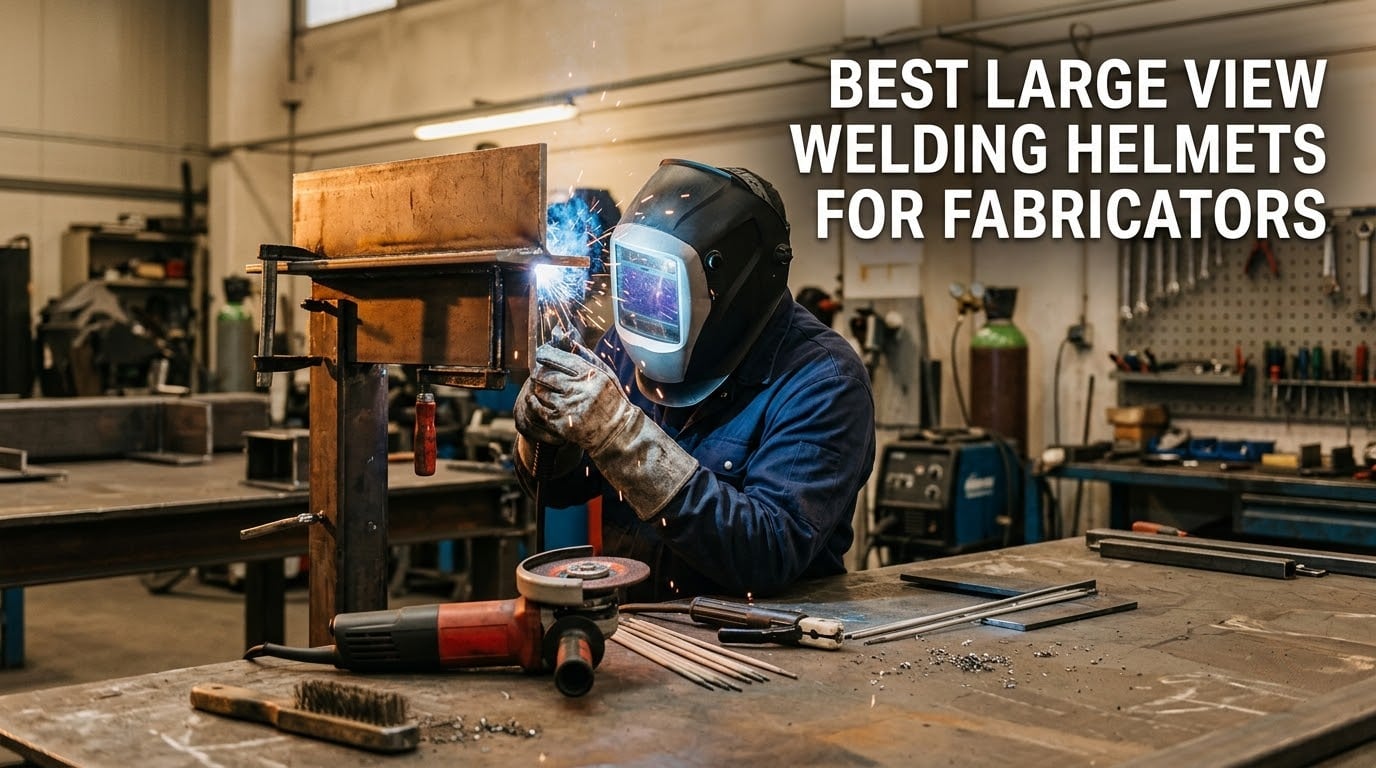
Most fabricators do not need a bigger screen on a bench, a welder on a trailer or a hood in a machine shop. They need to see the joint, the puddle and the fit-up while the work is above their head and the gun is at an angle they did not choose. That is the whole argument for the best large view welding helmets for fabricators.
A standard auto-darkening hood gives you roughly 3.5 to 4 square inches of viewing area. A large view helmet gives you somewhere between 9 and 13 square inches, and a panoramic model spreads that further across side windows. On a ten hour shift in a fabrication shop welding overhead, out of position, or doing close-tolerance TIG on stainless, the difference shows up in your neck and in your inspection time.
We compared 12 large view welding helmets for this guide, weighing published viewing area against shell weight, sensor count, optical clarity, headgear and warranty length. Everything we list comes from published specifications and owner feedback, and we flag where a helmet falls short on its own large view claim. If you are also sizing a shop, our welding table roundup for home fabricators covers the bench side of the same setup.
Table of Contents
What Is a Large View Welding Helmet?
A large view welding helmet is an auto-darkening welding helmet with a lens viewing area of roughly 9 to 13 square inches, about two to three times the 3.5 to 4 square inches of a standard hood. A wider or taller window lets a fabricator track the joint and the workpiece with less head movement during overhead, out-of-position and close-fit-up welding.
Panoramic models push the idea further, adding wraparound side windows so you keep peripheral context while tacking and positioning. Helmet mass grows with the window, so the practical limit is how long you can wear one before your neck tells you about it.
Top 3 Large View Welding Helmets (October 2026)

Lincoln Electric Viking 3350
- 12.5 sq inch extra large lens
- 4C lens technology rated 1/1/1/1
- X6 headgear
- 5 year warranty
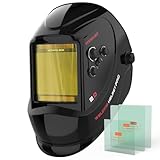
YESWELDER LYG-M800H
- 3.93 x 3.66 inch large view
- 1/1/1/1 true color
- 4 arc sensors at 1/30
- 000s
- CR2450 power

ARCCAPTAIN LY800J 180 degree
- 3.94 x 7.06 inch field of view
- DIN 5 wraparound side windows
- 4 arc sensors at 1/25
- 000s
- Dual solar panels
Best Large View Welding Helmets for Fabricators in 2026: Quick Overview
Every helmet below is listed in the order we recommend them. Specs come from the manufacturer listings; the view size column is the number that decides whether a model actually earns the large view label.
| Product | Specifications | Action |
|---|---|---|
| Lincoln Electric Viking 3350 |
|
Check Latest Price |
| YESWELDER LYG-M800H |
|
Check Latest Price |
 YESWELDER LYG-Q800D YESWELDER LYG-Q800D |
|
Check Latest Price |
 TOOLIOM True Color Large View TOOLIOM True Color Large View |
|
Check Latest Price |
 ARCCAPTAIN 3.94 x 3.66 Large View ARCCAPTAIN 3.94 x 3.66 Large View |
|
Check Latest Price |
 YESWELDER BW-10MAXTRI 180 degree YESWELDER BW-10MAXTRI 180 degree |
|
Check Latest Price |
 Hobart 770890 Widescreen Hobart 770890 Widescreen |
|
Check Latest Price |
 MIGVAN H-21 True Color Large View MIGVAN H-21 True Color Large View |
|
Check Latest Price |
 ESAB Sentinel A60 ESAB Sentinel A60 |
|
Check Latest Price |
 TGR Extra Large View 4 x 3.65 inch TGR Extra Large View 4 x 3.65 inch |
|
Check Latest Price |
| ARCCAPTAIN LY800J 180 degree |
|
Check Latest Price |
 Miller Classic ClearLight Miller Classic ClearLight |
|
Check Latest Price |
How We Evaluated 12 Large View Helmets
Every helmet here was checked against the same five criteria, using published manufacturer specifications and owner feedback rather than marketing adjectives.
1. Viewing area in square inches, with dimensions. A single number hides whether a window is tall or wide, and that matters for overhead work. We recorded both the area and the actual width and height.
2. Optical clarity. The 1/1/1/1 classification under EN 379 relates to light transmission, chromatic aberration and UV plus IR filtering. A 1/1/1/2 lens is a visible step down on stainless and aluminum, where you are judging colour and surface finish.
3. Arc sensors and switching speed. Four sensors is the practical floor for out-of-position work, because a two sensor helmet can miss the arc when the gun blocks the sensing area. Switching speed is published on some models and absent on others, and we note that gap.
4. Shell weight and headgear. A large window on a heavy shell is the top complaint we found about large view helmets in shop discussions. Published weight is listed for every model that states it, and we flag any shell above about 2.5 pounds.
5. Certification and warranty. We cross-checked ANSI Z87.1, EN 379, CSA Z94.3 and ANSI Z89.1 claims where the manufacturer states them, plus the warranty term. Warranty length ranges from 180 days to five years across this group, and that gap is worth more than most buyers expect.
For context on how these fit into a broader buying decision, our auto-darkening helmet roundup covers standard-view models that still make sense for occasional shop work.
1. Lincoln Electric K3034-4 Viking 3350 – Best Overall Large View Helmet
Lincoln Electric K3034-4 VIKING 3350 Auto Darkening Welding Helmet with 4C Lens Technology, Matte Black, extra large
12.5 sq inch extra large lens
1/1/1/1 4C optics
X6 headgear
5 year warranty
Pros
- Extra large 12.5 sq inch viewing area
- Bright resting shade near DIN 4
- X6 headgear spreads weight
- Standard non proprietary cover lenses
- Five year warranty
Cons
- Internal shade switch must be set correctly
- Occasional slow reaction at arc strike
- Headgear adjustment takes practice
- Nylon shell feels light duty for scrap work
The Viking 3350 is the helmet we put on the shortlist for anyone running a full production schedule in a large view welding helmet. The lens is a 12.5 square inch extra large panel rated 1/1/1/1 under Lincoln’s 4C lens technology, and at 1.4 pounds it is one of the lighter shells in our group despite the size of the window.
What stands out in owner feedback is puddle visibility. Welders coming off older hoods describe the jump in clarity as the moment they stopped guessing at penetration. The resting shade of roughly 4, compared with shade 8 or 9 on many auto-darkening lenses, means the shop stays visible between passes, which cuts the constant flipping that wears down headgear.
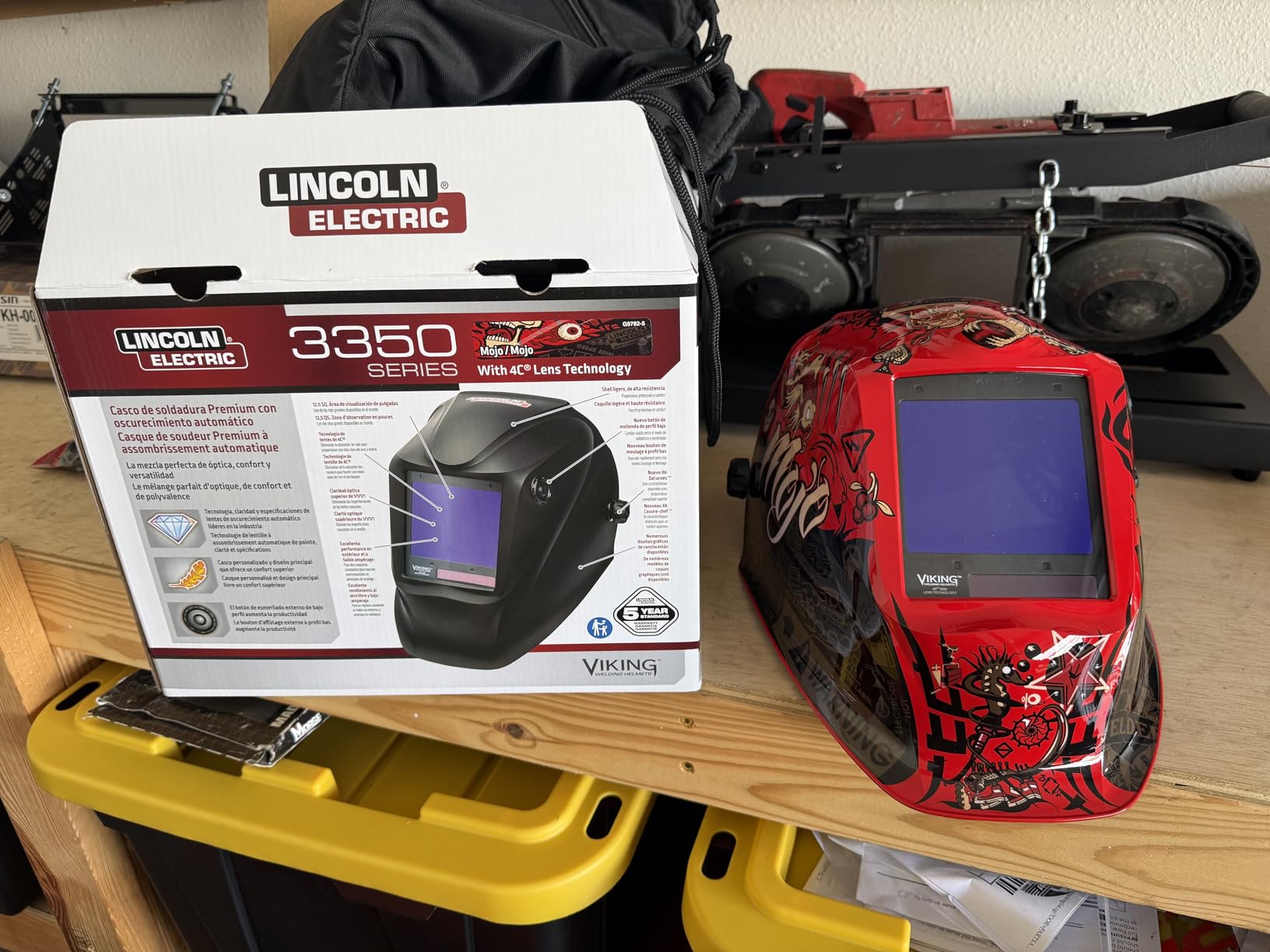
The X6 headgear distributes weight rather than hanging it from a front band, and the ratchet knob lets you set tightness with one hand. It fits hat sizes 6.5 through 8, which covers most fabricators, and the shell is shaped for both downhand and overhead work.
Consumables are the sleeper advantage. The Viking uses non proprietary cover lenses, with the KP2898-1 outside and KP3044-1 inside, and the box already includes five outside and two inside covers. Shops that chew through cover lenses with spatter will feel that five year warranty differently than anyone else.
There are three fair criticisms. The internal shade switch has to be set correctly from inside the hood or it will not behave, one full-time welder reported it being slow to react at arc strike even with sensitivity maxed, and the headgear adjustment takes a few shifts to dial in. Some users also find the nylon shell light duty compared with heavy pro hoods in scrap yards. If your work is clean indoor fabrication, none of that comes close to mattering.
Why the Viking 3350 works for full-shift fabrication
The combination that matters here is size plus low mass. A 12.5 square inch window at 1.4 pounds is a rare balance, and it is the direct answer to the neck fatigue complaint we kept hearing about large view helmets in shop forums.
The bright light state means you can wear the hood down between welds on a production run instead of flipping up and down hundreds of times. Fewer flips means less adjustment drift and less wear on the headgear mechanism over a week.
Where it falls short
It is a passive filter, not a smart auto-shade unit, so there is no digital readout for shade and delay. If you switch between stainless TIG and flux core several times a shift and want a screen that tells you the exact setting, one of the digital models further down this list fits better.
The 5 year warranty is the longest in the group and the main reason we rank it first for shop duty rather than for weekend work.
2. YESWELDER LYG-M800H – Best Value Large View Helmet
YESWELDER Auto Darkening Welding Helmet, Large View, LYG-M800H
3.93 x 3.66 inch large view
1/1/1/1 true color
4 arc sensors at 1/30,000s
CR2450 battery
Pros
- Deepest owner history in this group with over 8000 ratings
- Wide 3.93 x 3.66 inch viewport
- True color 1/1/1/1 optics
- External shade and mode controls
- Light shell for long sessions
Cons
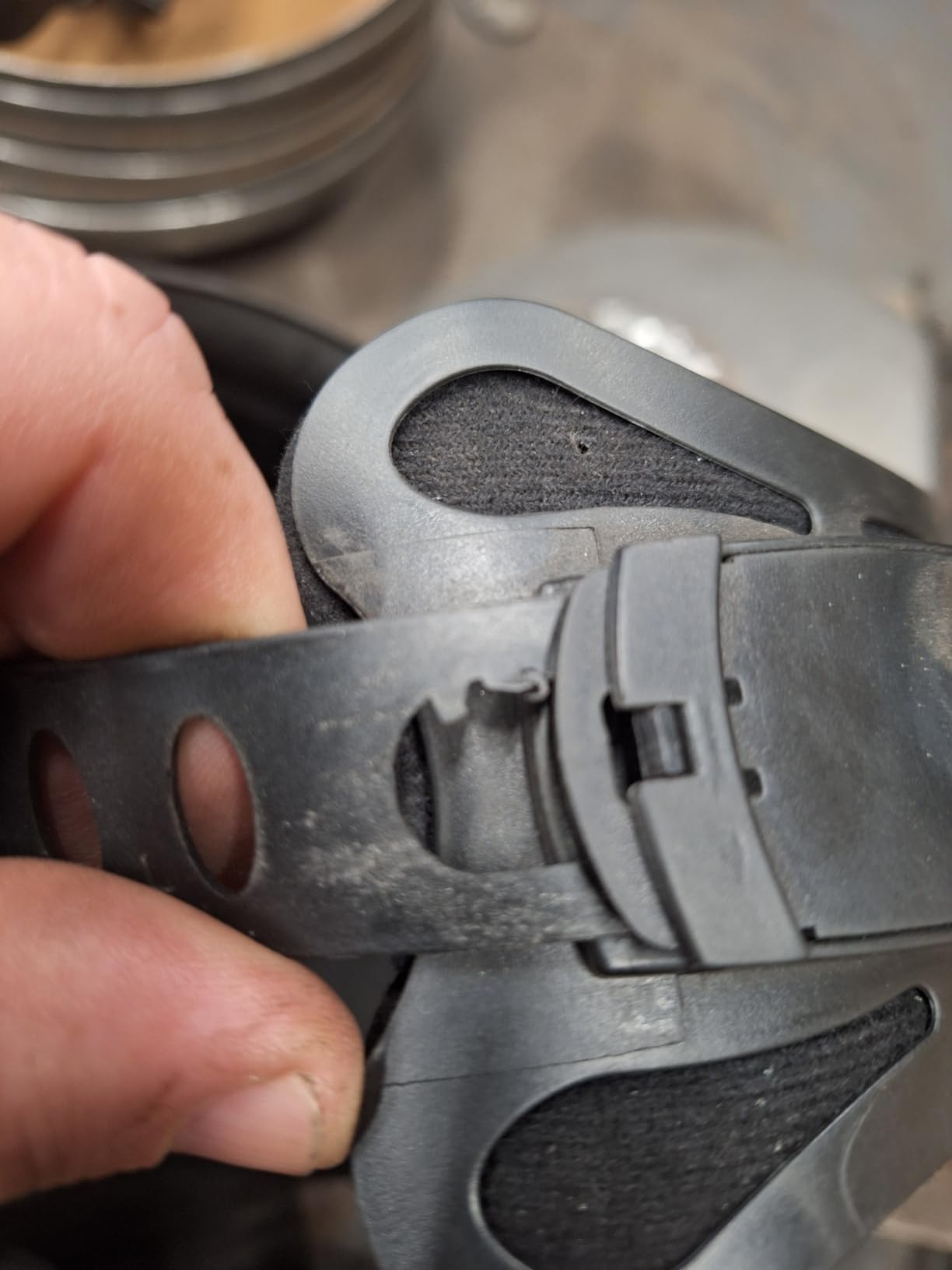
- Flip up tension knobs feel flimsy
- Strap and pivot headgear can slip
- Fiddly coin battery access
- Thin plastic shell
With more than 8000 ratings on file, the LYG-M800H has the deepest owner history of anything we looked at, and that matters more than a spec sheet when you are outfitting a crew. If a model has been through thousands of shop welders, the mechanical weak points surface early and in public.
The viewing area is 3.93 by 3.66 inches, a genuinely large square window rather than a stretched rectangle. The optics are 1/1/1/1 true color with a blue light blocking outer lens, so the green cast that made older filters tiring is gone. Four arc sensors and a 1/30,000 second response cover MIG, stick, TIG, cutting and grinding through shade 3/5-9 and 9-13 settings.
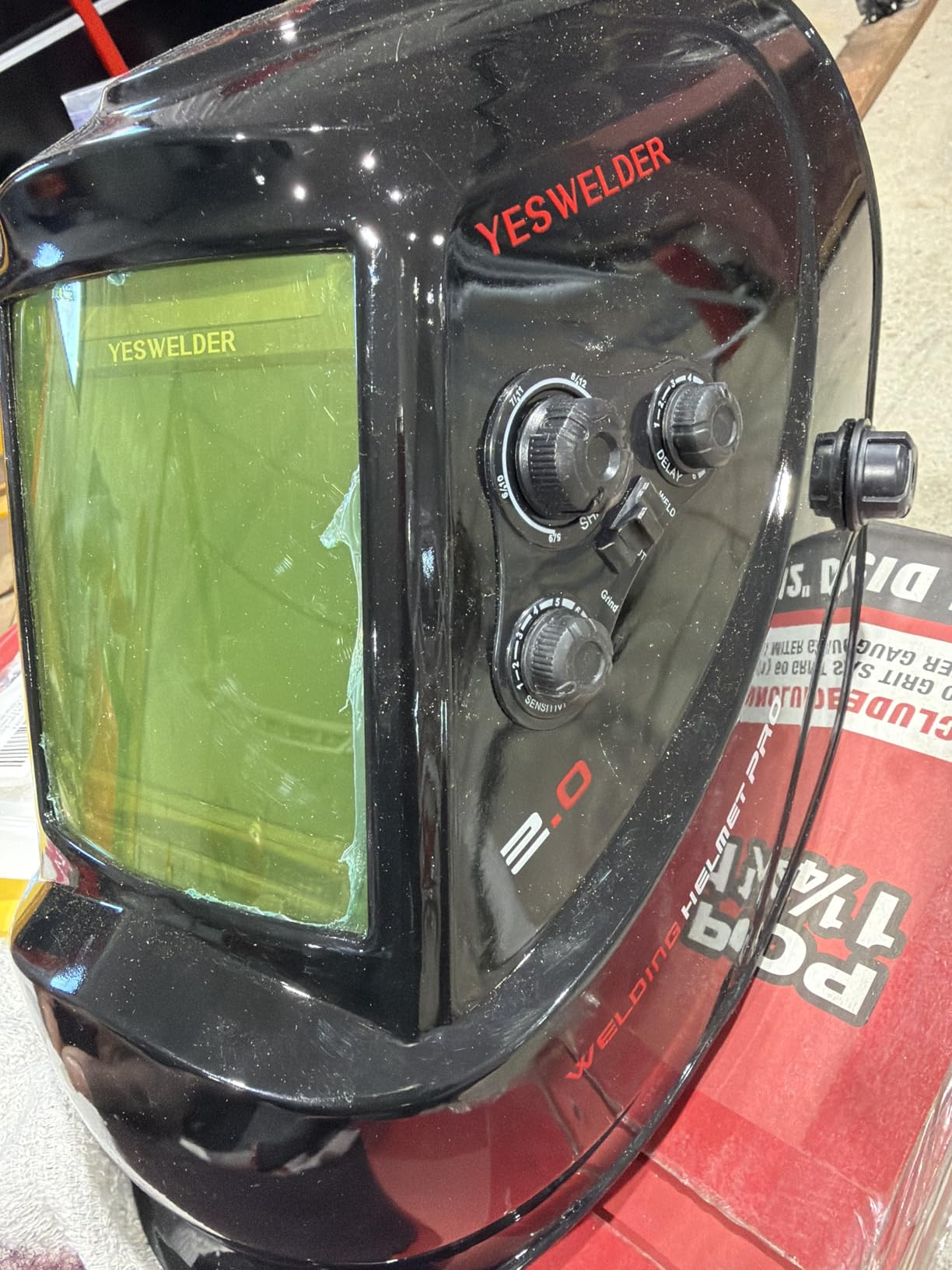
One practical detail gets overlooked: every shade and mode control sits on the outside of the shell. You can change shade between passes with your gloves on without lifting the helmet off your head, which in a fit-up and tack cycle saves a surprising number of awkward movements.
Owners consistently report that the wide viewport and true color optics transformed how they work, particularly on trailer and auto body jobs where seeing the joint edge matters more than arc aesthetics. Cheater and magnifying lenses fit, too, if you are doing close inspection work.
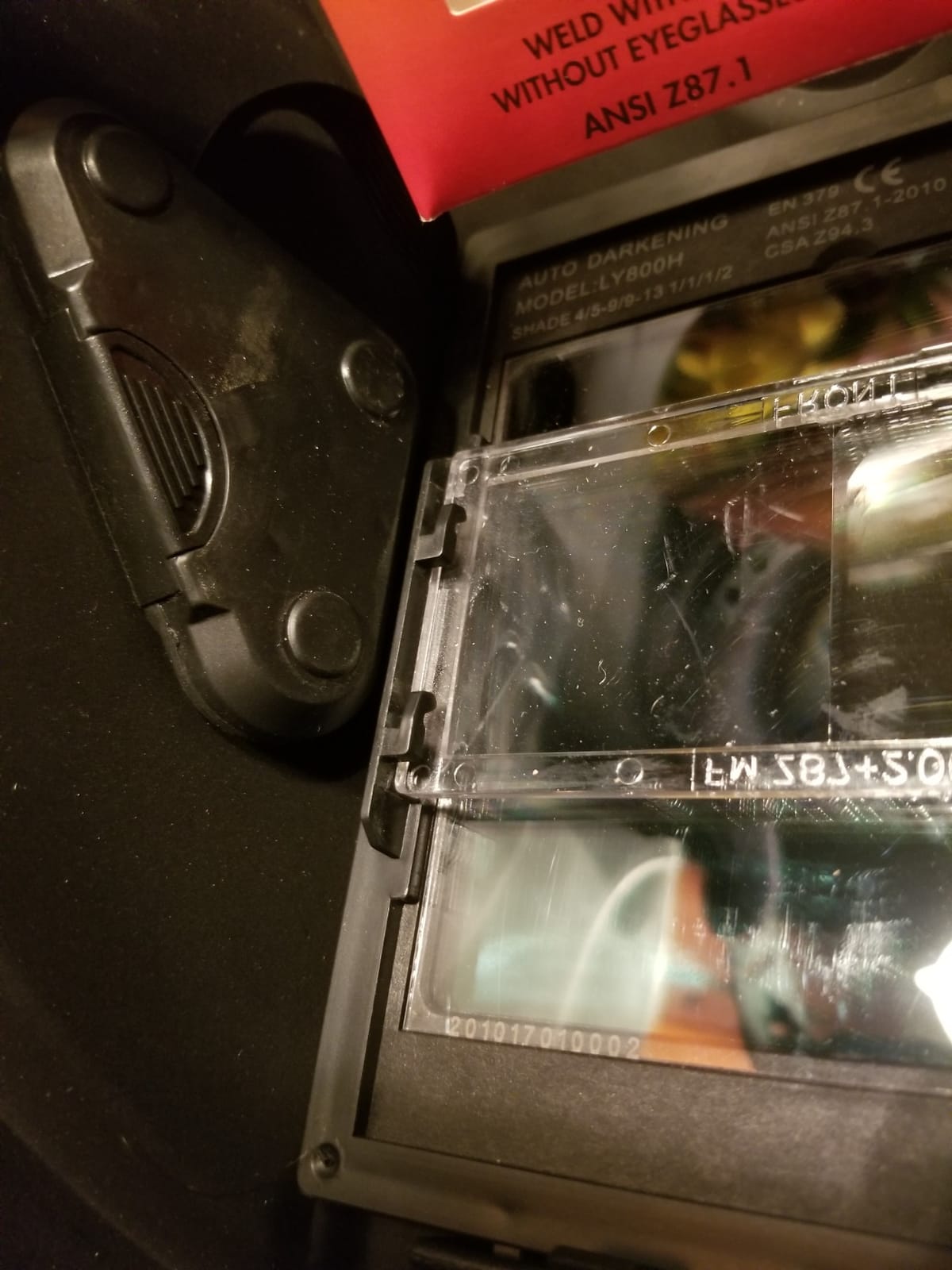
The complaints are mechanical rather than optical. The side tension knobs that hold the helmet in the raised position feel flimsy and have to be cranked very tight, the pivot style headgear can creep forward when you nod if tension is not set correctly, and one reviewer reported a head strap breaking within two days. Battery access is also awkward, and the thin plastic shell offers less impact resistance than a heavy pro hood.
Why the LYG-M800H earns the value slot
The core question is how much of a large view helmet you actually need. If your fabrication work is downhand and vertical, a 3.93 by 3.66 inch window with true color optics is most of the benefit at a fraction of the flagship cost. The optical performance is genuinely good.
External controls and 1/30,000 second switching mean you are not settling for slow reaction to get there. That matters for short-arc TIG and for spot welds where the arc flickers on and off.
Where it falls short
Flip-up retention is the weak point. If you work with the helmet raised constantly, for grinding between tacks or inspecting fit-up, expect to tighten those knobs more than once a shift. Shops that flip up and down hundreds of times a day would be better served by a ratchet or pivot headgear system that holds position.
It also carries no published warranty term, which matters when you are buying in multiples.
3. YESWELDER LYG-Q800D – Best for Layout, Tacking and Peripheral Vision
YESWELDER Auto Darkening Welding Helmet with LED, 180° View, LYG-Q800D
3.94 x 3.23 inch view with DIN 5 side window
1/1/1/1 true color
Solar plus CR2450
2.2 pound shell
Pros
- Wraparound DIN 5 side window for layout work
- Blue light blocking outer lens
- True color 1/1/1/1 optics
- Solar plus battery dual power
- Reinforced PP construction
Cons
- Main window is wider than it is tall
- Solar only supplements the coin battery
- Some lenses show a faint green tint
- Inner lens covers not sold separately
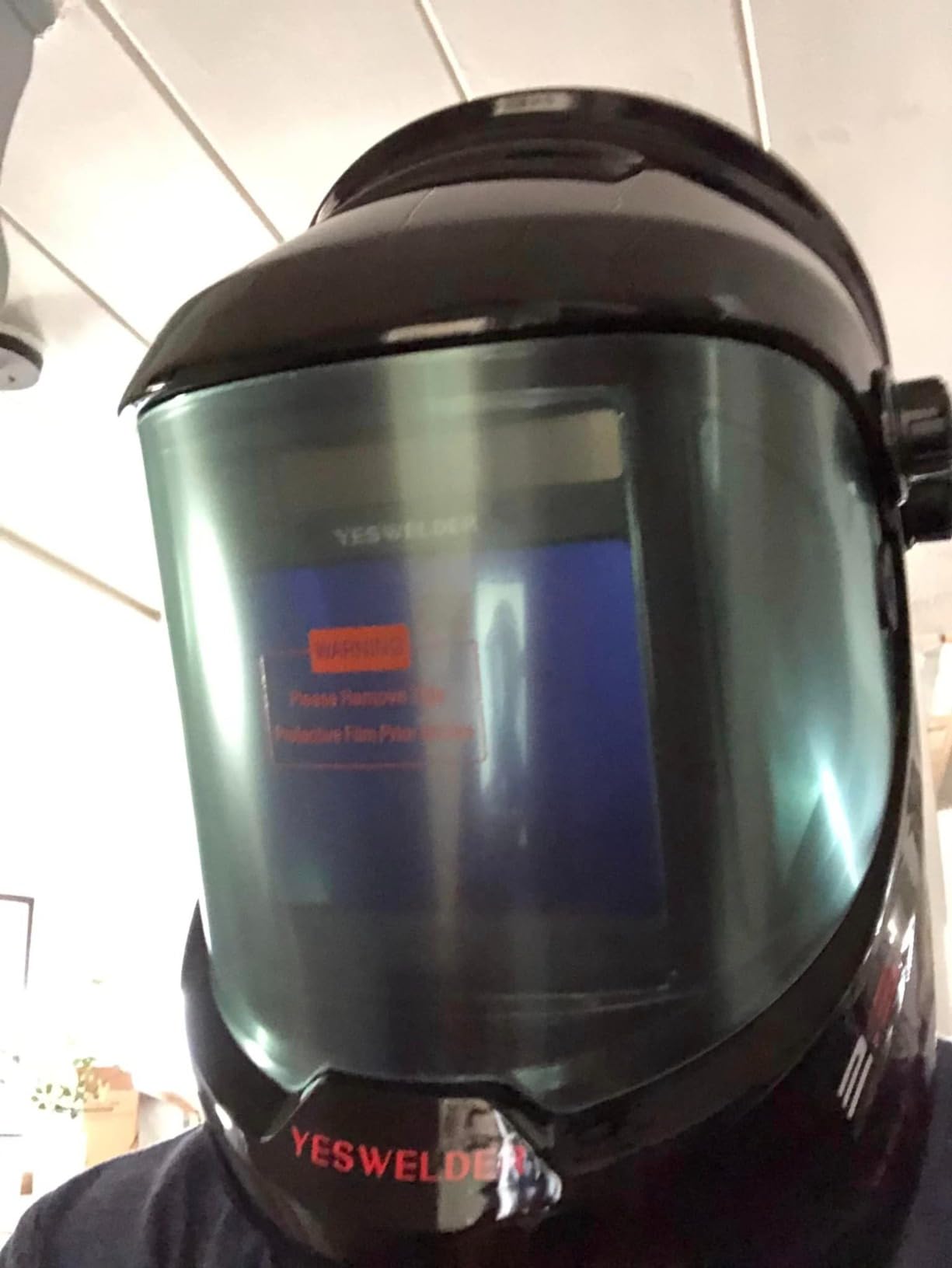
A lot of large view helmets solve the wrong problem. If your bottleneck is not the arc but getting the part positioned, tacked and checked, what you need is peripheral vision, not a bigger darkening window. The LYG-Q800D does both: a 3.94 by 3.23 inch auto-darkening main window plus a non auto-darkening side window at DIN 5 across a 180 degree layout.
That side window means you can read a tape, check a gap or watch your layout lines without flipping anything. For a fabricator doing fit-up on assemblies where both ends have to be seen at once, that changes the pace of the job.
The optics are 1/1/1/1 true color on both the main and side windows, with a blue light blocking outer lens that reduces eye fatigue over long production sessions. Four arc sensors, 1/30,000 second switching and shade 3/5-9 and 9-13 across weld, cut and grind modes cover every process in one hood.
Power is solar plus a replaceable CR2450 lithium battery, which is a sensible pairing for a dim shop where a solar-only unit would lose charge. The construction is thicker PP, rated heavier than the M800H budget sibling, and the shell measures 8.5 by 7.8 by 12.8 inches.
The honest caveats: the main window is slightly wider than it is tall, so it is not as comfortable overhead as a tall-viewport design. The solar panel only supplements the battery while an arc is lit, so during long storage the coin cell still has to come out. A minority of buyers report a faint green tint rather than fully neutral true color, and replacement inner lens covers are not sold separately by the manufacturer.
Why the side window beats a bigger main window for fit-up work
Auto-darkening lenses react to an arc. During layout, measurement and tacking there is no arc, so a larger darkening window gives you nothing extra. The DIN 5 side window stays usable in the light state, which is exactly when a fabricator needs peripheral context.
It also handles dim environments better than a solar-only design, since the replaceable CR2450 carries you through a power outage in the booth without a dead filter.
Where it falls short
If your week is mostly vertical plate work, the side window is unused real estate and you would be better served by a taller main window. Buy this one for layout-heavy assembly work, not for a stack of overhead stringers.
Green tint reports and unavailable inner covers are small annoyances rather than deal breakers, but plan a spare lens supply before you outfit a crew.
4. TOOLIOM TL-M800D – Best Budget True Color Large View Helmet
TOOLIOM True Color Auto Darkening Welding Helmet with Large View
3.94 x 3.27 inch large view
1/1/1/1 true color
4 arc sensors
Weld cut and grind shades
Pros
- Genuinely large 3.94 x 3.27 inch window
- True color 1/1/1/1 optics
- Separate weld cut and grind shade ranges
- Spare lenses and extra battery in the box
- ANSI Z89.1 compliant
Cons
- Strap closure is less secure for long shifts
- Smaller window than the 3.94 x 3.66 flagships
- Plastic shell has the least impact protection
- Fewer long term shop duty reports
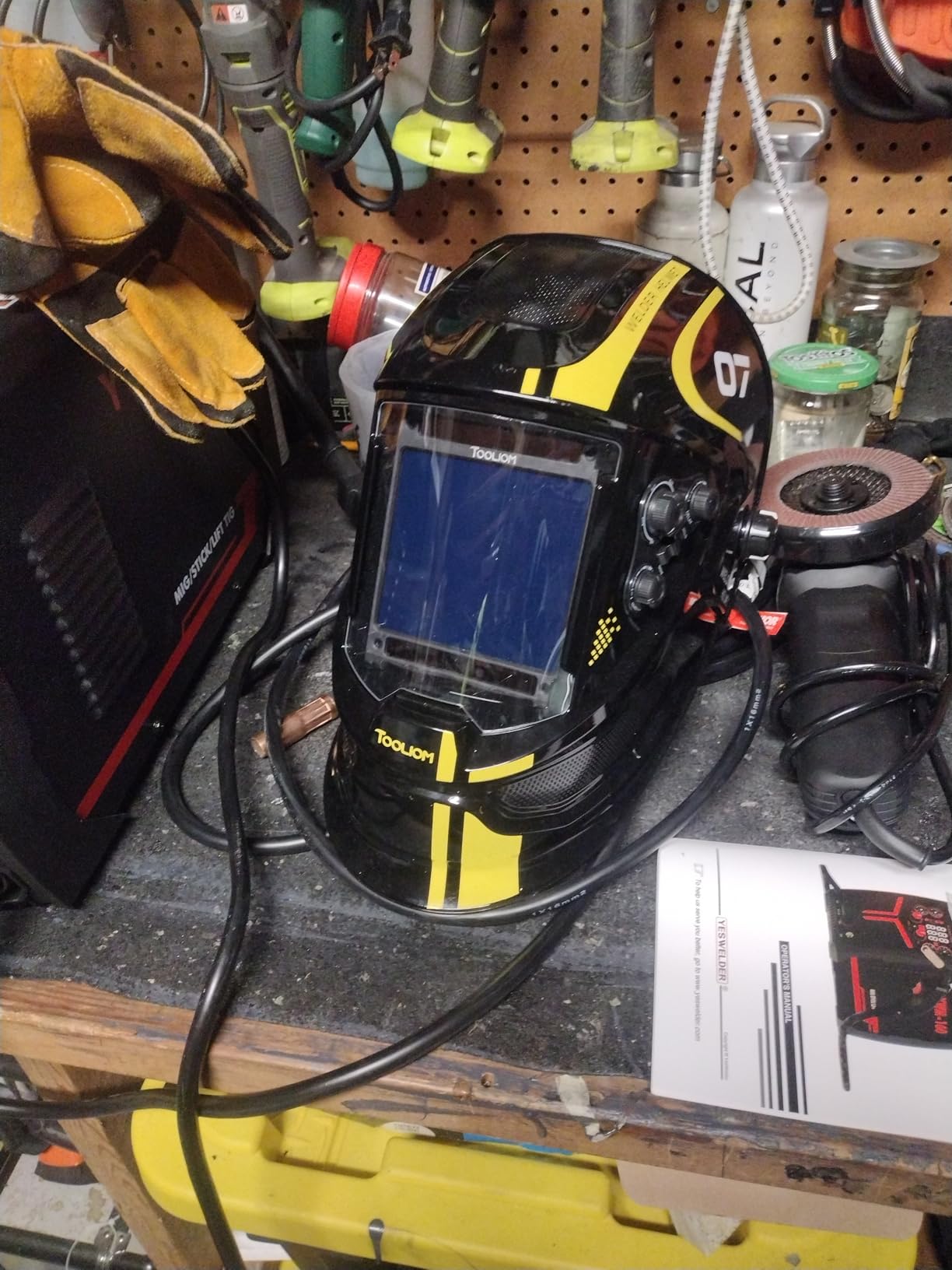
The TL-M800D answers a straightforward question: how little do you have to spend to get a real large view window and true color optics. The viewing area is 3.94 by 3.27 inches, which the specification sheet lists as 12.9 square inches, with a 1/1/1/1 optical classification and true color technology.
It also separates the shade ranges rather than using a single dial. Weld runs shade 9 to 13, cut runs 5 to 9, and grind opens down to shade 3, all on the M800D filter with delay and sensitivity adjustment. That is more control than most units at twice the cost give you.
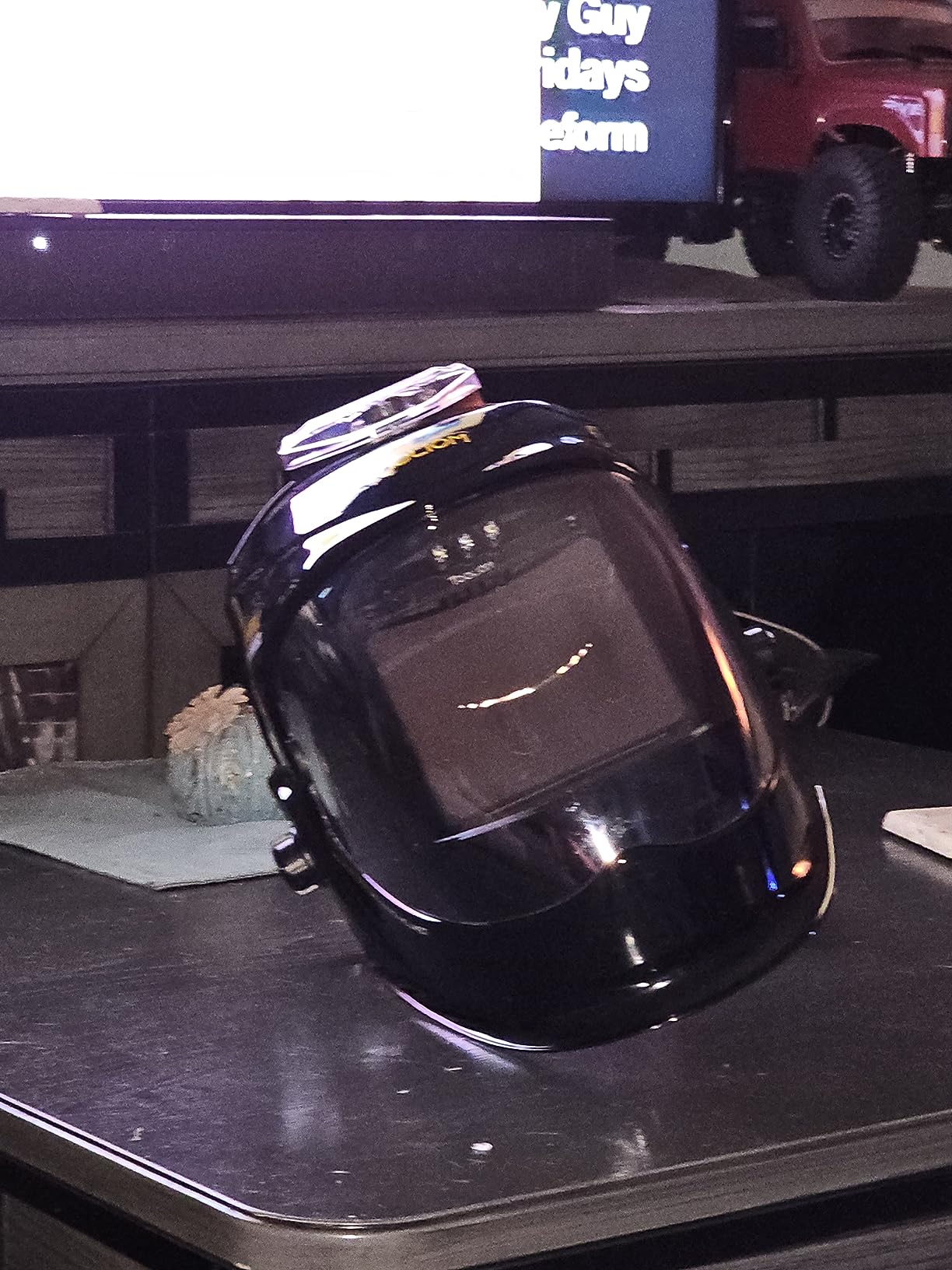
The box contents matter for a shop. You get a replaceable battery, two replacement outer lenses, one replacement inner lens and a manual, so consumables are covered on day one. It is ANSI Z89.1 compliant, and the shell weighs 0.58 kg.
The compromises are durability and retention. A strap closure is less secure than ratchet or pivot headgear over a long production day, the plastic shell has the least impact protection in this group, and the 12.9 square inch window is a little smaller than the 3.94 by 3.66 inch units further up this list. Brand recognition is low, which means fewer verified multi year shop duty reports.
Forum discussions about shop welding helmets generally describe them as acceptable for occasional spot welds and not recommended for daily production. Excellent first hood or spare hood, or a second unit for a welder who rotates stations.
Why the TL-M800D makes sense as a shop-wide secondary helmet
Rotating a crew across stations means some welders spend more time setting up and grinding than welding. A spare hood that lives on the bench for those tasks takes the wear off the premium unit and costs a fraction of it.
The separate weld, cut and grind shade ranges matter for that role, since you are switching between tack and dressing work all shift without pausing to think about a mode dial.
Where it falls short
Do not make this the primary helmet for a full-time production welder. The strap closure and thin plastic shell are the two things that end up irritating after week six, and impact resistance matters in a fabrication bay where helmets get knocked.
It is also a single-model investment. If the brand disappears, replacement lenses become harder to source than Lincoln or Hobart lenses.
5. ARCCAPTAIN HSH-G999 – Best Lightweight Large View Helmet
ARCCAPTAIN Auto Darkening Welding Helmet, 3.94″X3.66″ Large Viewing Screen
3.93 x 3.66 inch large screen
1/1/1/1 true color
2.27 pound shell
ANSI Z87.1 EN 379 CSA Z94.3
Pros
- Full size 3.93 x 3.66 inch screen on a light 2.27 pound shell
- Automatic UV and IR protection up to DIN 16
- ANSI Z87.1 EN 379 and CSA Z94.3 listed
- Breathable padded headgear
Cons
- Only a 180 day warranty
- Newer listing with a shorter review history
- Shade and sensitivity set through internal controls
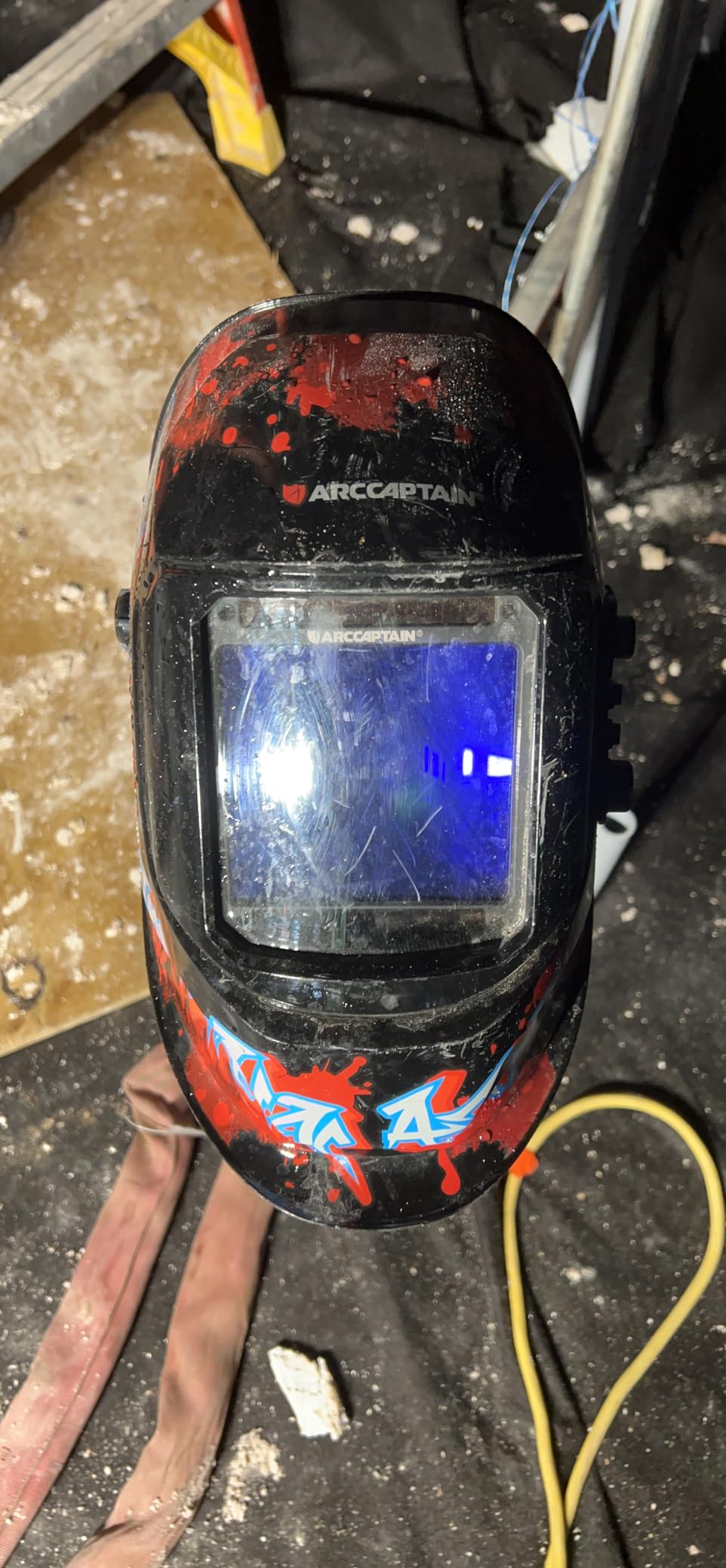
The single most common complaint about large view helmets is weight, and this ARCCAPTAIN is the direct answer. At 2.27 pounds it carries a full 3.93 by 3.66 inch true color screen while staying well under the mass of the heavier shells in this group. For a fabricator doing overhead work with a big window, that difference is the whole feature.
The filtering is thorough. You get 1/1/1/1 optical clarity with true color technology, DIN 4 light state, DIN 5-9 and 9-13 dark state, and automatic UV plus IR protection up to DIN 16 in the light state. Four premium arc sensors handle detection, and the construction is shock and flame resistant PP and polyamide.

It is also one of the few budget units here with full certification stated: ANSI Z87.1, EN 379 CE and CSA Z94.3. Shops under a safety programme that checks certification paperwork will care about that more than the graphic style, and there are more than ten shell graphics to match site PPE.
The headgear adjusts dynamically with breathable padding for extended wear, and power is a solar cell plus a replaceable CR2450 lithium battery. The package includes a storage bag, a spare battery and two replacement lenses.
The reservations are contractual rather than physical. The warranty is 180 days, the shortest stated term in this roundup and a real problem if you are standardising on it across a crew. It is also a newer listing with a shorter review history than the established models, and shade and sensitivity are set through internal controls rather than external dials, so you need the helmet in hand to adjust.
Why low mass matters more than extra screen area
Owners of large view helmets in shop forums describe the pattern clearly: the biggest field of view is not the one that gets retired first, the heaviest one does. Neck load scales with how far the mass sits from the pivot of your neck, and a large shell front-heavy on the brow is the worst case.
This model gives up a fraction of a square inch against the very largest windows and gains roughly half a pound of head load. Over a ten hour shift that trade is usually the better one.
Where it falls short
A 180 day warranty is short enough to plan around. If the electronics fail in month five you are back at the same decision, and internal controls mean no glove-friendly shade changes during fit-up.
Treat it as a good value for a solo fabricator or a second station, not as a fleet standardiser unless you are comfortable with the coverage term.
6. YESWELDER BW-10MAXTRI – Best for Digital Control and Panoramic Coverage
YESWELDER Auto-Shade Welding Helmet, Internal Digital Control, 180° View
8.89 x 3.23 inch panoramic view
5 arc sensors
Internal digital display
Smart Auto Adjustment
Pros
- Panoramic layout with dedicated side windows
- Internal digital readout for shade sensitivity and delay
- Smart Auto Adjustment tracks arc brightness
- 5 arc sensors for low amp TIG
- Gradient control reduces eye fatigue
Cons
- Heaviest model in this section at 2.79 pounds
- Sensitivity locks when Smart Auto is on
- Internal controls need the helmet in hand
- Newer model with a shorter track record
This is the feature-forward pick: pro-style digital control without a pro-brand price. Total viewing area is 8.89 by 3.23 inches, built from a 4.25 by 3.23 inch main view plus two 2.87 by 2.32 inch side views, giving a 180 degree field of vision at 1/1/1/1 true color.
The internal digital display is the part that changes daily work. Instead of guessing at analog knobs, you read the current shade, sensitivity and delay and set them precisely. Smart Auto Adjustment tunes shade and delay to arc brightness within a plus or minus 9 level range, which helps when you move between setups, materials or positions mid-task.
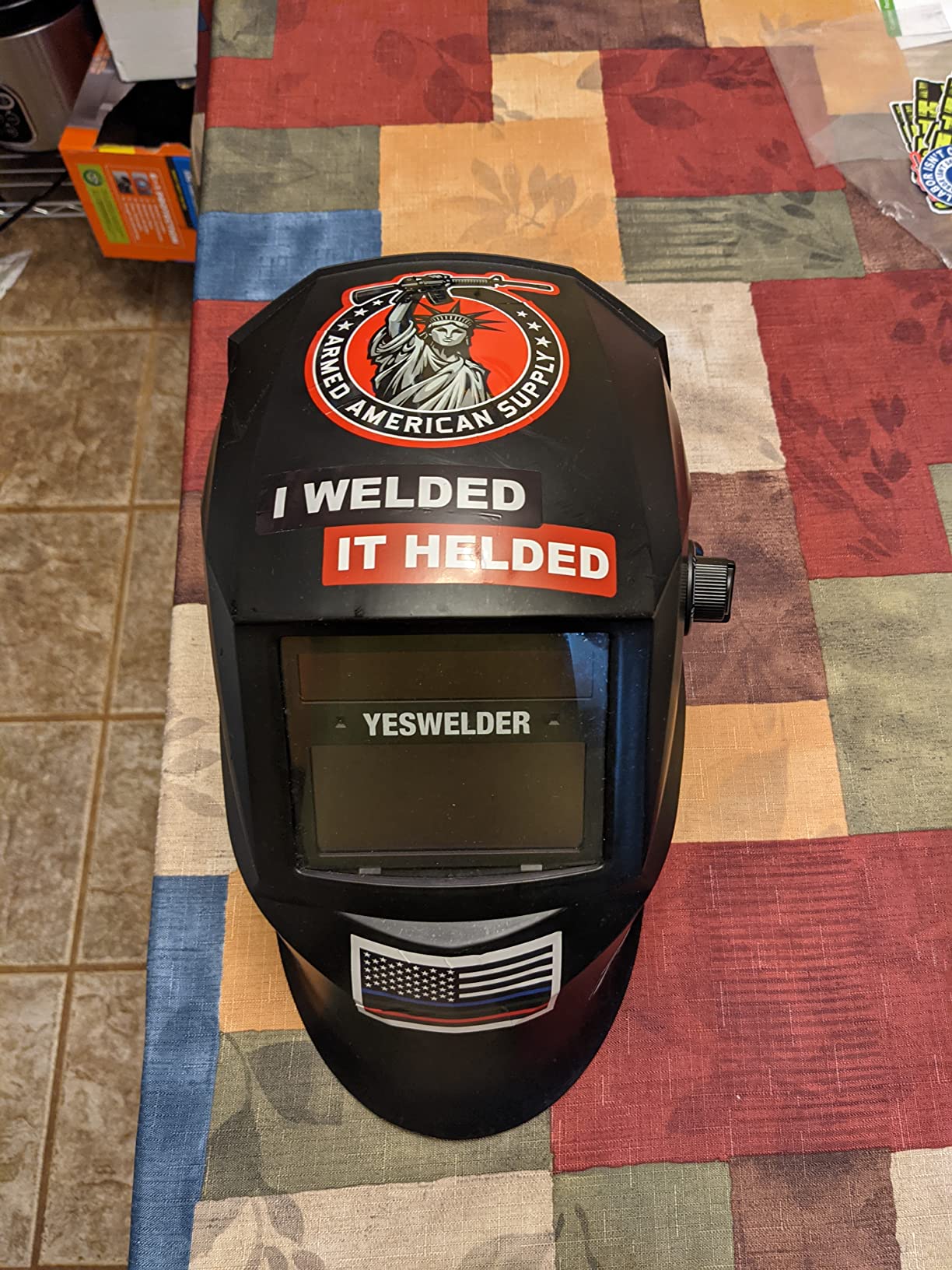
Five arc sensors and 1/30,000 second switching give dependable detection on low amperage TIG, where a two sensor helmet often never triggers. The shade range of 3/4-8 and 9-14 covers MIG, TIG, stick, tack, grind and cut, and gradient control smooths the transition as the arc strikes and fades.
Construction is impact resistant polyamide, and the shell weighs 2.79 pounds. That makes it the heaviest option in this part of the price range, and weight is the trade-off you are making for the digital interface and the wide panoramic layout.
Three things give owners pause. Sensitivity is fixed once Smart Auto Adjustment is enabled, which removes a control you may want for TIG. Internal controls mean you cannot fine tune shade without the helmet in hand. And as a newer model it has a shorter long-term record than the classic M800H.
Why digital shade control pays off on multi-process work
Analog knobs are fine when you run one process with one material. They become a nuisance when a fabricator moves between MIG on mild steel, TIG on stainless and grinding on the same assembly, because you cannot recall which combination the knob is sitting at.
A digital readout with stored settings removes that guesswork, and Smart Auto handles the transition when the arc brightness changes as you move around the joint. For a shop welder who constantly changes setups, that is a measurable time saving.
Where it falls short
Weight, plainly. At 2.79 pounds it is the heaviest model in this section of the list, and the weight versus viewing area tradeoff is the number one complaint we found about large view helmets. If your shift is overhead work, test this one for a full day before committing.
Losing manual sensitivity control when Smart Auto is enabled is a design choice you either love or fight.
7. Hobart 770890 – Best Pro Brand Large View Helmet
Hobart 770890 Auto-Darkening Welding Helmet, Large, Black
9.3 inch widescreen viewing area
PureColor optics
4 arc sensors
1.25 pound shell
Pros
- Widescreen view larger than most budget units
- PureColor lens with accurate colour
- Light shell at 1.25 pounds
- Analog knobs work with gloves on
- Weld to grind mode switching
- Two year warranty
Cons
- Analog controls less precise than digital rivals
- Widescreen is wide rather than tall
- No published clarity rating or switching speed
- Only a protective lens kit included
Hobart is a core pro welding brand, and the 770890 is the version of a large view helmet you can defend in a shop that buys from the same catalogue as its welders and plasma cutters. The viewing area is a 9.3 inch widescreen, which is meaningfully larger than the 3.94 by 3.66 inch budget units in this roundup.
Optics come from Hobart’s PureColor lens technology, which gives an accurately coloured view of the weld and the surrounding shop, and four independent arc sensors detect quickly. Auto-on and auto-off power control triggers at arc strike, so there is no startup routine to forget before the first weld of the day.
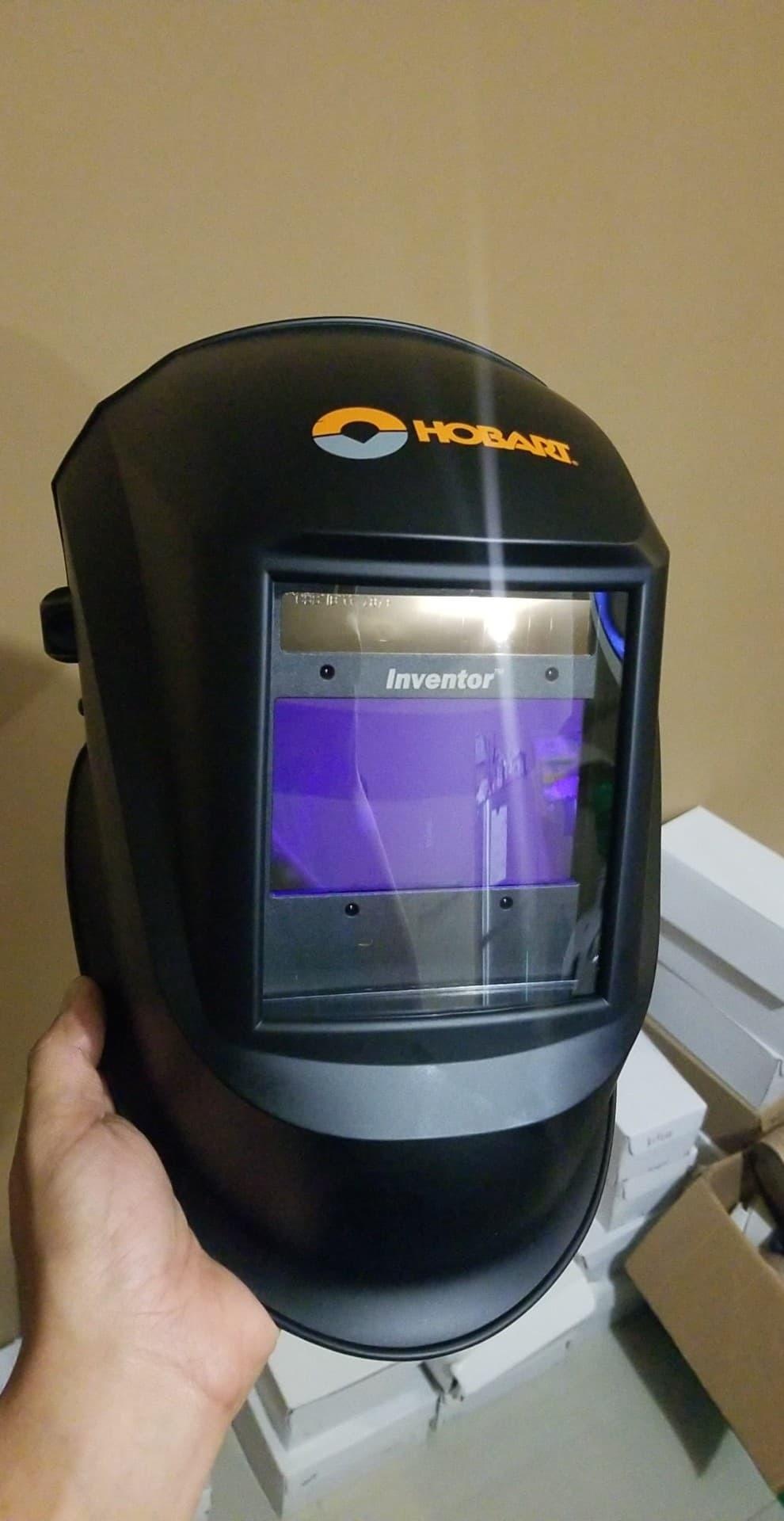
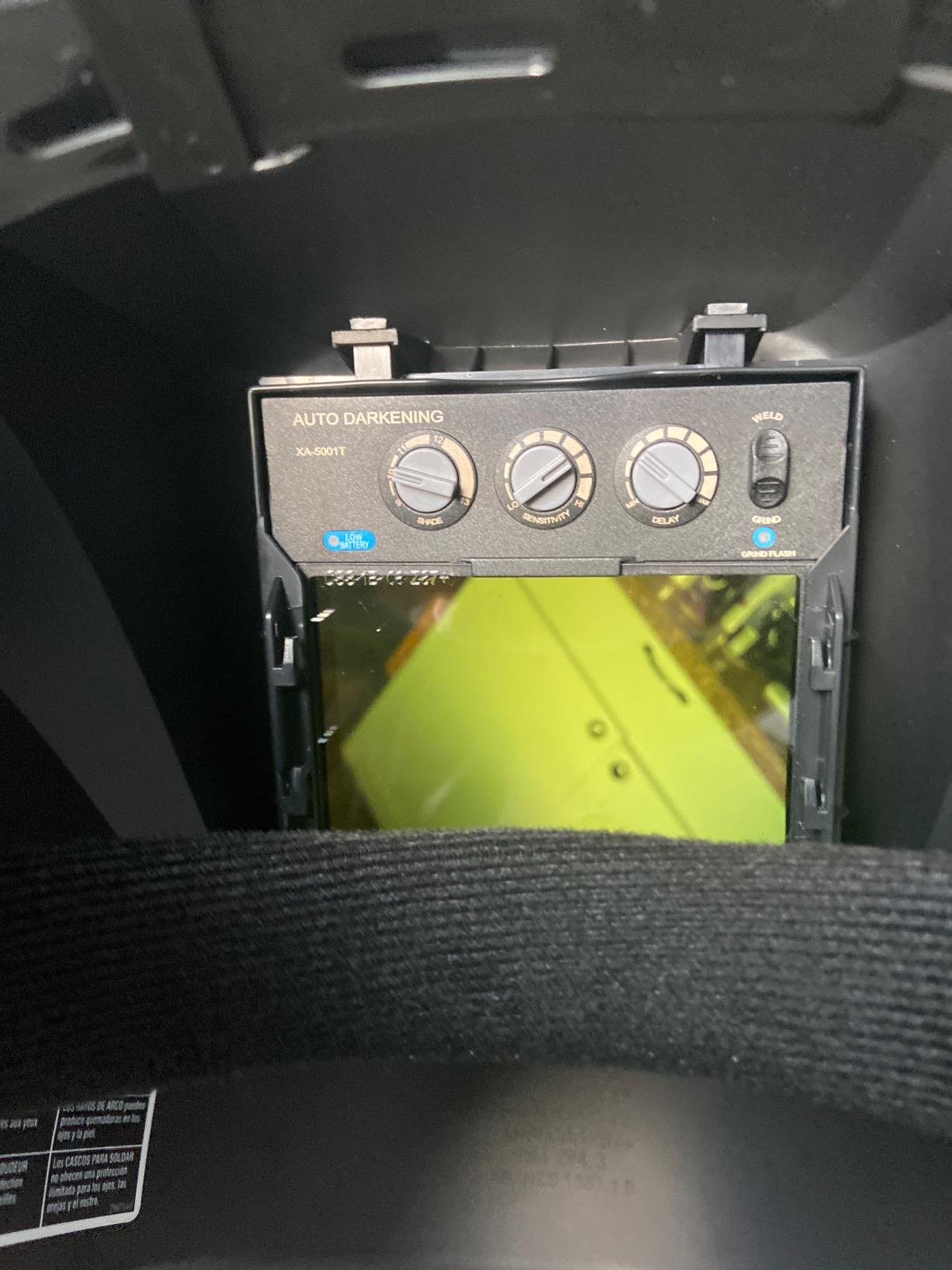
The shell is polyamide nylon at 1.25 pounds, the lightest among the recognised pro brands here, and that low mass is the quiet advantage of this model. A CR2 lithium battery is included and mode switching from weld to grind happens without changing helmets.
Controls are analog shade, sensitivity and delay knobs. That is a deliberate choice, not a cost cut, and glove-friendly tactile knobs still have their place when you want to set a value by feel and move on. One-handed grind mode switching is convenient between passes.
The limitations are documentation and geometry. No true color rating or switching speed is published, so optical performance is less documented than on rivals with an EN 379 classification. The widescreen is wide rather than tall, which makes overhead work less comfortable than on a tall-viewport design. And the only included accessory is a protective lens kit, with a two year limited warranty behind it.
Why a pro brand matters for a shop fleet
Replacement lenses are the real long-term cost of any helmet. Pro brands publish part numbers and keep cover lenses available for years, which means a shop can hold consumables instead of chasing listings every time a lens gets spattered.
A two year warranty plus a known brand also simplifies a fleet purchase. When something fails you are not debugging an unknown electronics board, you are replacing a known part.
Where it falls short
The widescreen geometry is the honest limitation. If your work is predominantly overhead, a 9.3 inch wide window that is not especially tall will still ask you to move your head more than the tall-viewport models in this list.
The lack of published optical specifications makes it harder to compare on paper. Test the lens yourself if colour-critical TIG work is part of the job.
8. MIGVAN H-21 – Best for Dim Shops and Low Light Work
MIGVAN Welding Helmet Auto Darkening True Color Large Viewing, Welding Hood Solar/Replaceable Battery Powered, Wide Shade 4/5-13 with 4 Arc Sensor, Optical Clarity Welding Mask for TIG MIG ARC Grind
True color golden lens
4 arc sensors at 1/10,000s
Solar plus rechargeable battery
ANSI and CE
Pros
- Golden true color lens gives a natural view of the puddle
- Solar plus rechargeable battery for dim shops
- Four sensors with 1/10000s response
- Two inner and two outer spare lenses included
- Buckle pivoting headgear with padding
Cons
- No published warranty term
- Slower 1/10000s switching than leading models
- Generic listing with less documented optics
- Single colour option in this variant
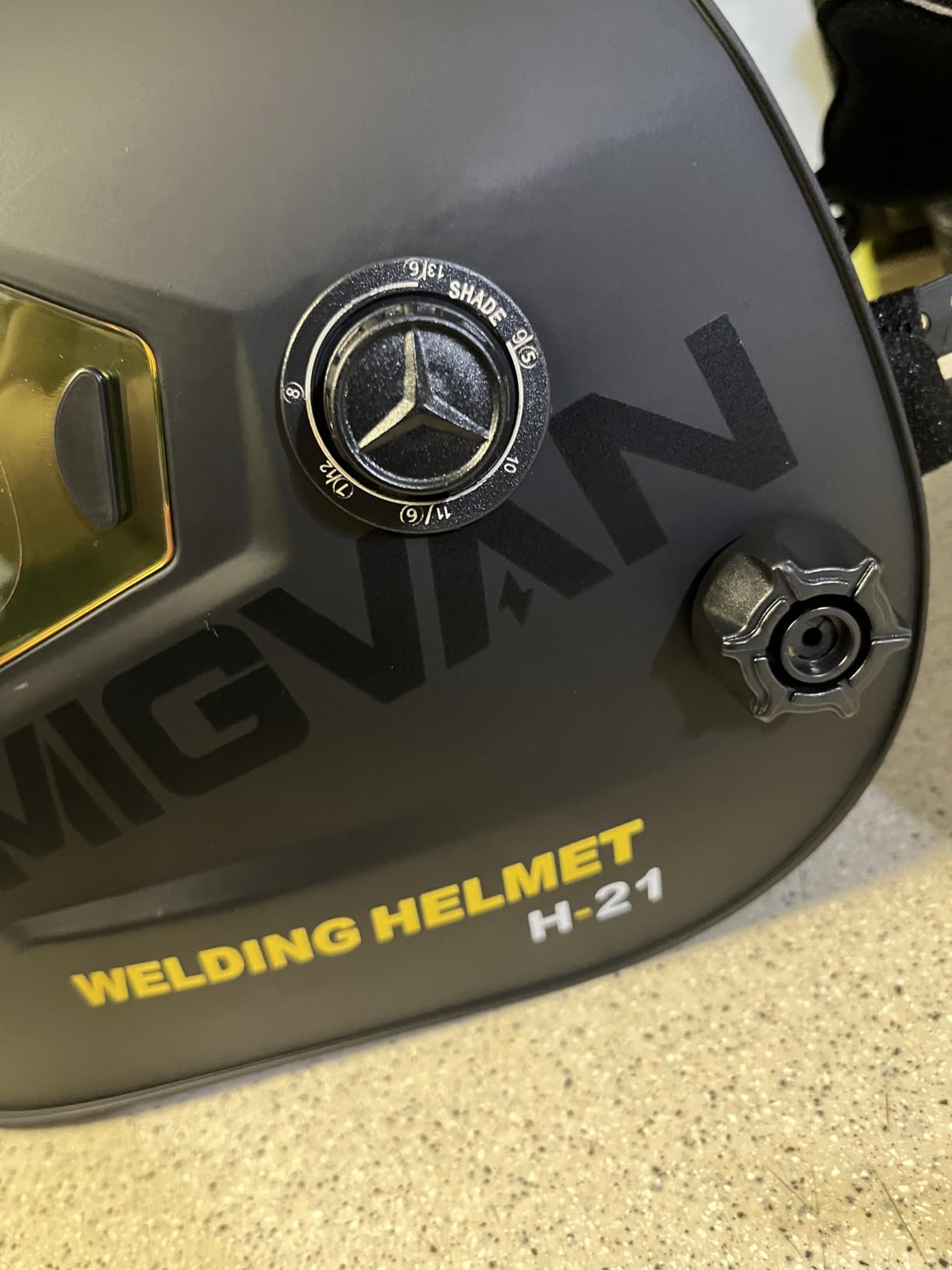
Dim indoor shops cause a specific failure in solar-only auto-darkening helmets. The panel has nothing to charge from between arcs, and the filter starts darkening late or not at all. The MIGVAN H-21 runs solar plus a rechargeable CR2450 battery, which is the pairing we look for when the booth lighting is poor.
The lens is a golden true color variant, and owners single it out for a lifelike view of the weld pool and the workpiece rather than a filtered or greenish image. Four premium arc sensors with a 1/10,000 second response cover TIG, MIG, stick, cutting and grinding, and the shade range of 4 and 5-13 comes with sensitivity controls.
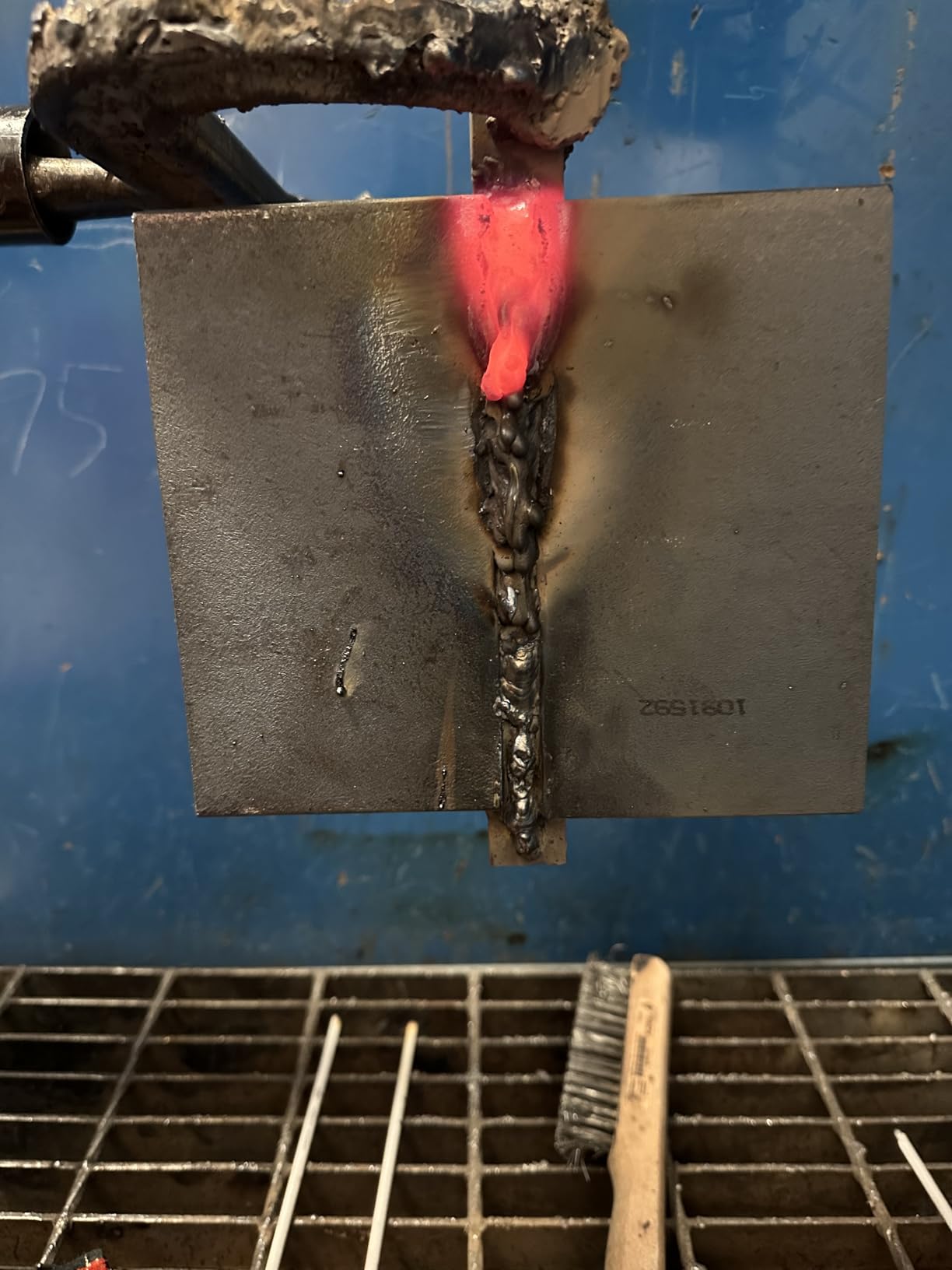
An outer yellow filter lens provides the UV and IR protection, and the unit is listed as ANSI and CE compliant. The pivoting headgear has breathable padding to reduce neck strain on long runs, and the shell weighs 1.09 kg. Consumables are generous for the price tier: two inner lenses, two outer lenses and a heavy duty storage bag.
The honest problem is the warranty. None is stated, and for a tool expected to survive daily shop abuse that provides no published coverage, which is a real risk for a tool expected to survive daily shop abuse. Switching speed at 1/10,000 second is slower than the 1/30,000 second on several models in this list, which shows most on short-arc work. The listing is generic, so optical performance is less documented than an established brand would offer, and the reviewed variant comes in one colour only.
Why dual power matters more in an enclosed booth
Auto-darkening filters are electronics, and electronics need charge. In a bright shop with an open door the solar panel has something to work with. In a dim booth with extraction running, it does not, and the first sign of a problem is a helmet that does not darken fast enough at strike.
A replaceable rechargeable cell removes that variable entirely. It is a boring feature that decides whether a helmet works in your specific bay.
Where it falls short
No published warranty is the blocker for fleet purchases. A shop manager cannot budget for a failure with no coverage, and forum buyers consistently put warranty length on their shortlist alongside lens clarity.
The 1/10,000 second response is adequate for most shop work but is the slowest among the modern units here, which is visible on thin material and low amperage TIG.
9. ESAB Sentinel A60 – Best for Tight Spaces and Respirator Work
ESAB® Sentinel™ A60 Welding Helmet, Black Low-Profile Design, High Impact Resistance Nylon, Large Viewing Area 4.65 in x 2.80 in
4.65 x 2.80 inch ADF view
OpTCS True Color lens
Memory for 9 profiles
16 ounce shell
Pros
- Clarity praised by professional ironworkers
- Exceptionally light and well balanced shell
- Low profile rounded shell works with a respirator
- Stiff grind buttons resist accidental triggers
- 0.08 millisecond switching with 4 sensors
- Stores up to 9 setting profiles
Cons
- Cover lenses scratch easily
- Flip up lock nuts do not hold the raised position
- Headgear ratchet feels cheap when overtightened
- OEM consumables cost more than third party
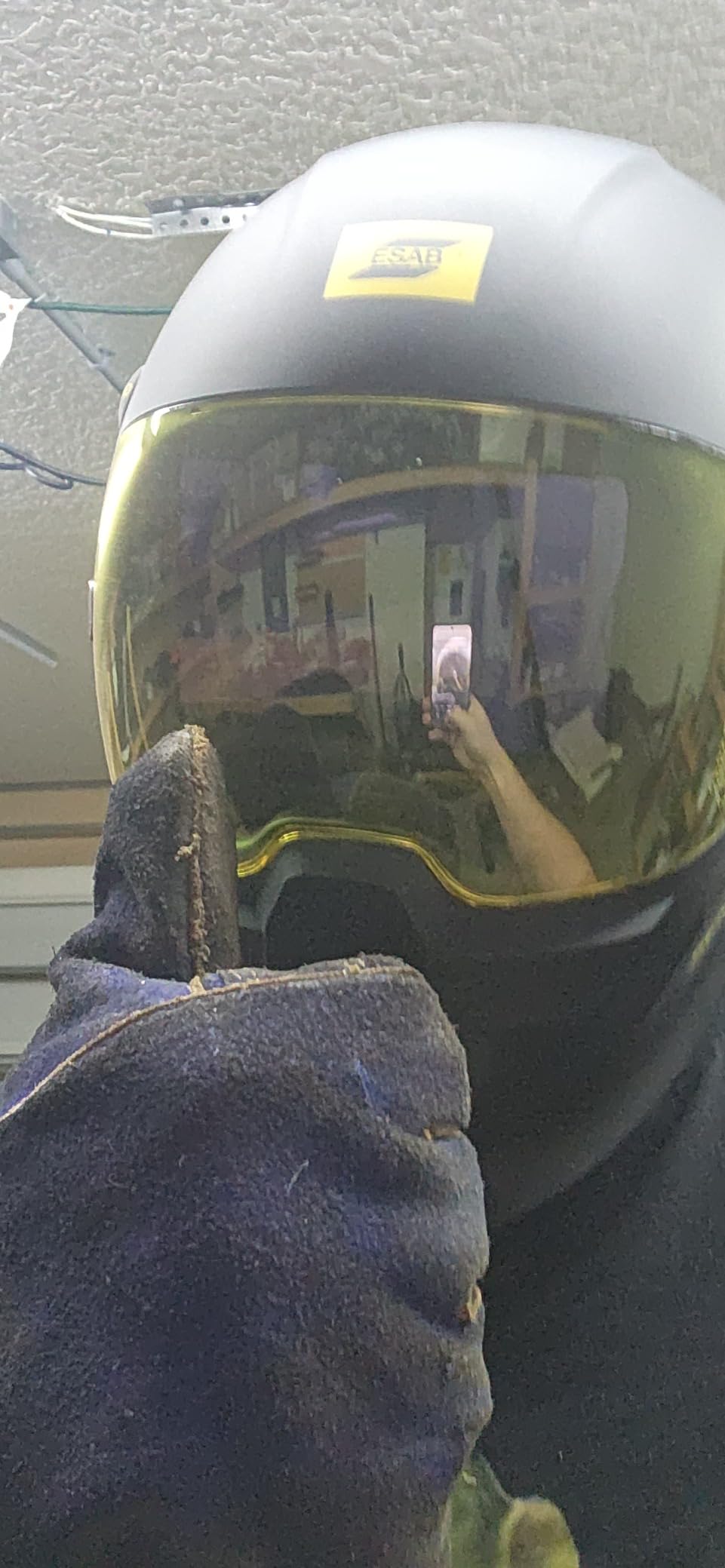
We should be straight about this one: the ESAB Sentinel A60 is not a large view helmet by the definition we use at the top of this guide. Its auto-darkening filter area is 4.65 by 2.80 inches. It is here because fabricators keep asking about it, and because it solves a problem the big-window models do not.
That problem is respirator fit. The low-profile rounded shell sits close to the face, which professional ironworkers using this model say beats the clearance on bigger hoods. A short shell also reduces the gap where flash can leak under the edge, and in a confined bay that matters more than square inches.
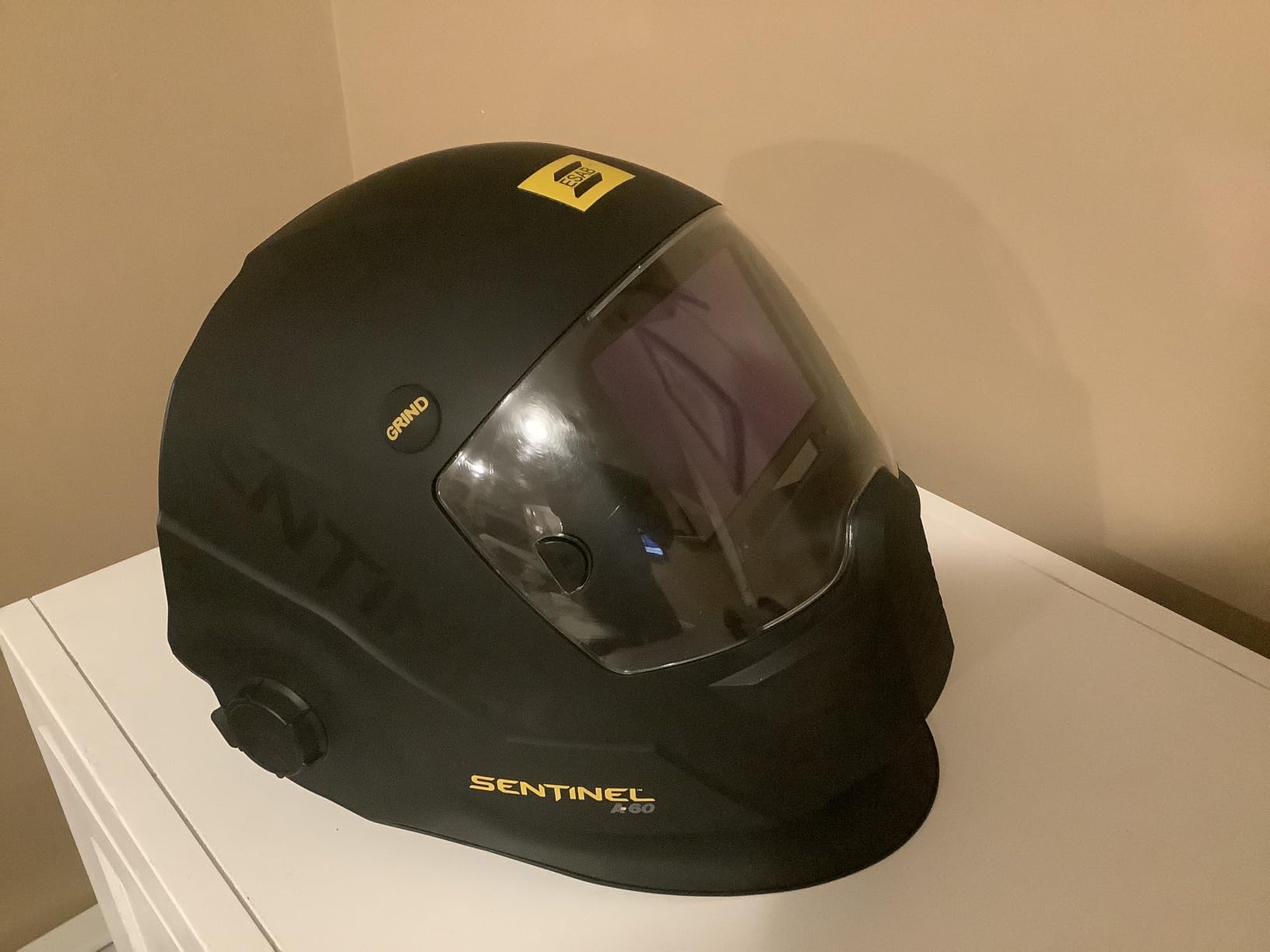
The optic is ESAB OpTCS True Color technology, and fabricators who upgraded to it from other brands report crispness they had not previously found, including from users moving off a 3M Speedglas. Weight is 16 ounces, centred over the head, which is the lowest listed weight of any model here and directly addresses the fatigue complaint.
Controls are internal for sensitivity and delay, with a shade range of DIN 3/5-13 adjustable in 0.5 increments plus a shade lock. Four arc sensors and a 0.08 millisecond switching time give dependable detection on MIG and stick. On-board memory stores up to nine setting profiles, which is genuinely useful for a shop switching between jobs, and LED indicators flag low battery, grind mode and shade lock. The grind buttons are stiff enough that they rarely trigger by accident in tight spots.
The drawbacks are consistent across owners. Cover lenses scratch easily, so keep a spare. The flip-up lock nuts do not reliably hold the helmet in the raised position even when tightened. The headgear ratchet feels cheap and should not be overtightened. And OEM consumables are pricey, which makes third-party cover lenses the better value.
Why fit over a respirator beats a bigger window
If your site requires a tight-fitting respirator, the helmet has to seat without lifting the face seal. Large shells with deep front-to-back profiles tend to ride up on the seal as you tilt your head, which breaks the seal and makes the respirator useless.
A low profile shell with a 16 ounce weight lets you work with a facepiece on and your head in the position the job requires. In a regulated fabrication environment that is a safety decision, not a comfort preference.
Where it falls short
It does not deliver on a large view brief, and we will not pretend otherwise. If your bottleneck is seeing the joint on an overhead fit-up, this is the wrong tool.
The flip-up retention issue and scratch-prone covers are the two real quality complaints, and the cheap-feeling ratchet is the third.
10. TGR Extra Large View 4 x 3.65 Inch – Best Tall Viewport for Overhead Work
TGR Extra Large View True Color Auto Darkening Welding Helmet – 4″W x 3.65″H (Anime)
4 inch wide by 3.65 inch tall true color view
4 arc sensors
ARC MIG and TIG capable
Buckle closure nylon shell
Pros
- Tall 3.65 inch viewport aids overhead and out of position welds
- True color optics below pro brand pricing
- Includes spare outside and inside lenses
- Lightweight nylon shell
- 4.6 rating
Cons
- Smallest review base in the group at 248 ratings
- Low sales rank means limited long term data
- Only one graphic offered
- Four arc sensors is the lower end for TIG
- Buckle closure is less secure for all day wear
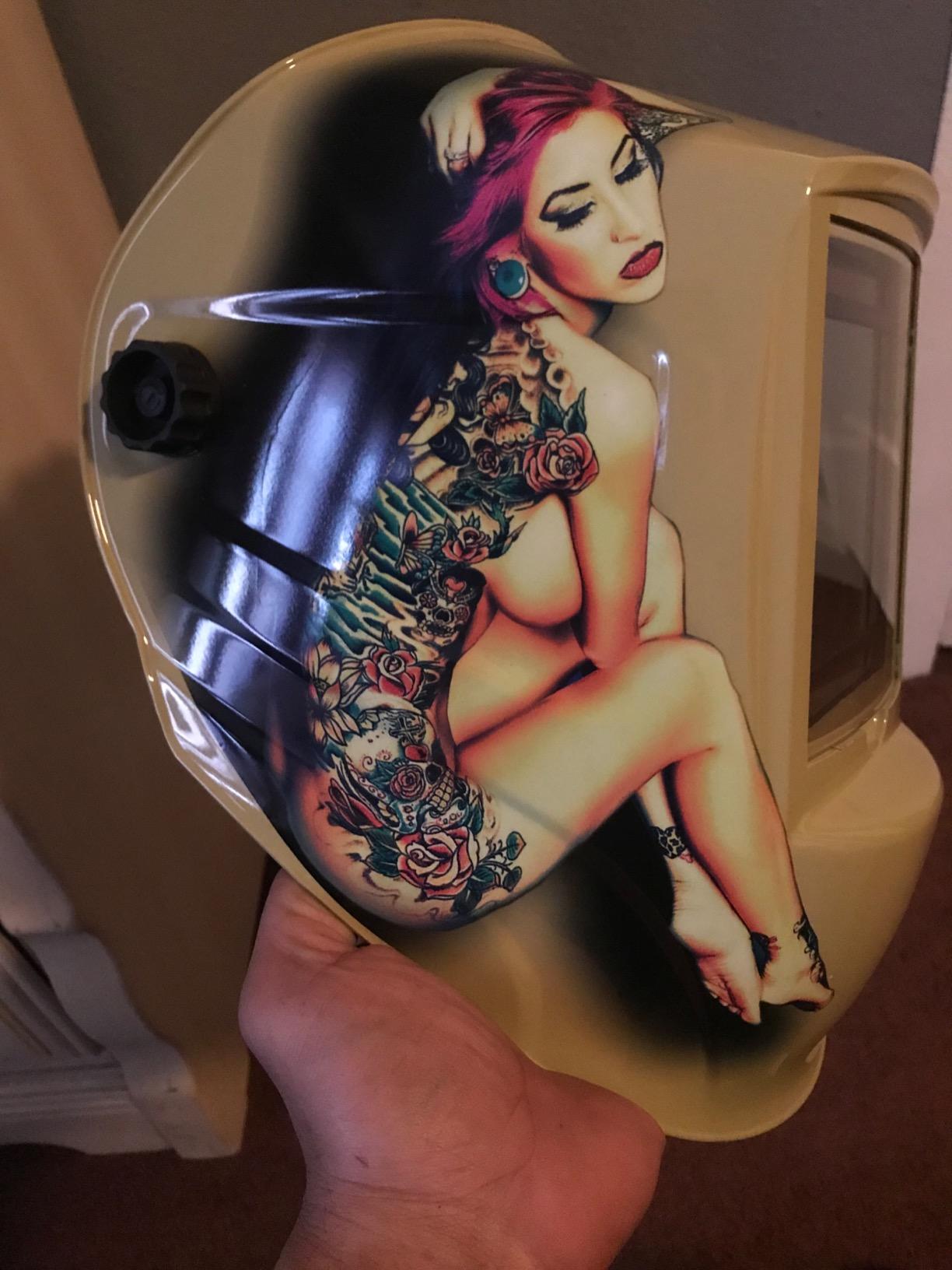
Almost every large view window on the market is wider than it is tall, because manufacturers copy the same shape. This one is 4 inches wide by 3.65 inches high, and that vertical dimension is the entire point. For overhead and out-of-position welds, a tall window means you can see down past the top of the joint without craning your neck.
Optics are true color, with lens sensitivity controls and suitability for arc, MIG and TIG welding. The shell is nylon with a buckle closure, and the box includes two spare outside lenses and one spare inside lens, which is generous for a model at this level.
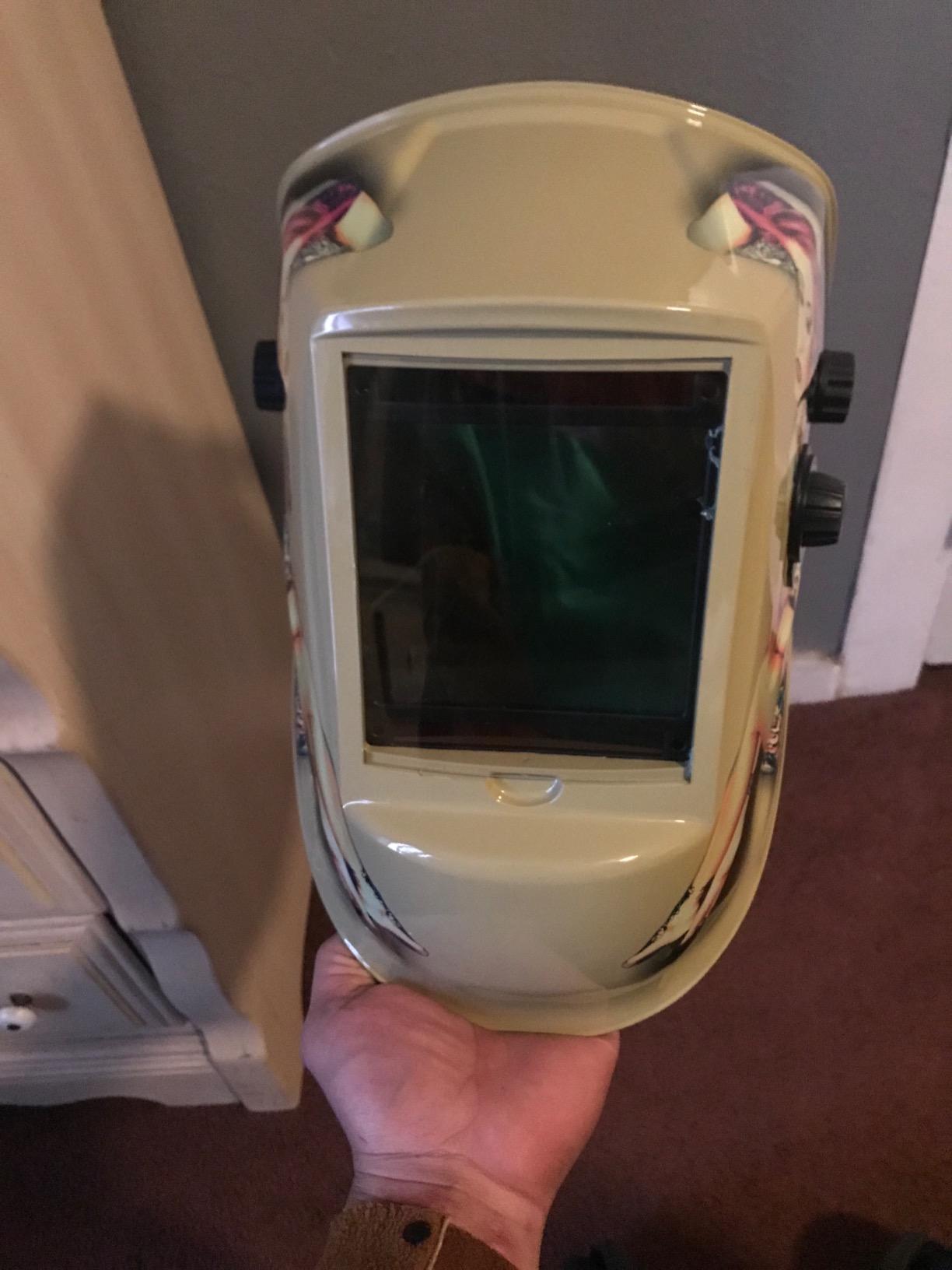
Owners value exactly what the shape promises: better sight lines on overhead and out-of-position work, with true color clarity available well below the pro brands. At a 4.6 rating it scores above most budget large view helmets.
The caveats are mostly about evidence. With 248 ratings it has the smallest review base in the group, so long-term durability data is thin, and its sales rank is low compared with the rest of this list. Four arc sensors sits at the lower end of what we recommend for low amperage TIG, where detection can be inconsistent. Only the Anime graphic is offered, and the buckle closure is less secure than ratchet or pivot headgear for all-day wear.
If you cannot find a tall-viewport design from a pro brand, this is the one to try. Wear it for a full shift before standardising, since buckle retention is the deciding factor.
Why viewport height beats viewport width overhead
When the gun is above your head, your line of sight to the joint runs downward and slightly behind you. A wide, short window shows you the sides of the joint and clips the bottom edge. A taller window keeps the puddle and the leading edge in view with less head movement.
That saved head movement is what reduces neck fatigue over a shift of overhead work, which is the complaint that ends up retiring large view helmets in real shops.
Where it falls short
Thin evidence is the main problem. A 248 rating history does not tell you what happens to the headgear buckle or the lens pivot after a year of daily use, and shops depend on that kind of data.
Four sensors also means low amperage TIG can be hit and miss. If TIG on thin stainless is your main process, budget for a spare pilot arc test before you commit the crew.
11. ARCCAPTAIN LY800J – Best Panoramic Helmet for Positioning and Tacking
ARCCAPTAIN Welding Hood, 180° Panoramic View Auto Darkening Welding Helmet
3.94 x 7.06 inch total field of view
3.94 x 3.66 inch main screen
Dual solar panels
2.55 pound shell
Pros
- Widest total field of view with wraparound side windows
- Non auto-darkening DIN 5 side windows for layout
- Adjustment knobs usable with gloves on
- Dual solar panels plus two CR2450 batteries
- Rearranged interior shell fits the head better
Cons
- Widest 1 star share in the group at 8 percent
- 1/25000s switching slower than 1/30000s rivals
- Heavier at 2.55 pounds than most alternatives
- Periodic coin battery replacement still needed
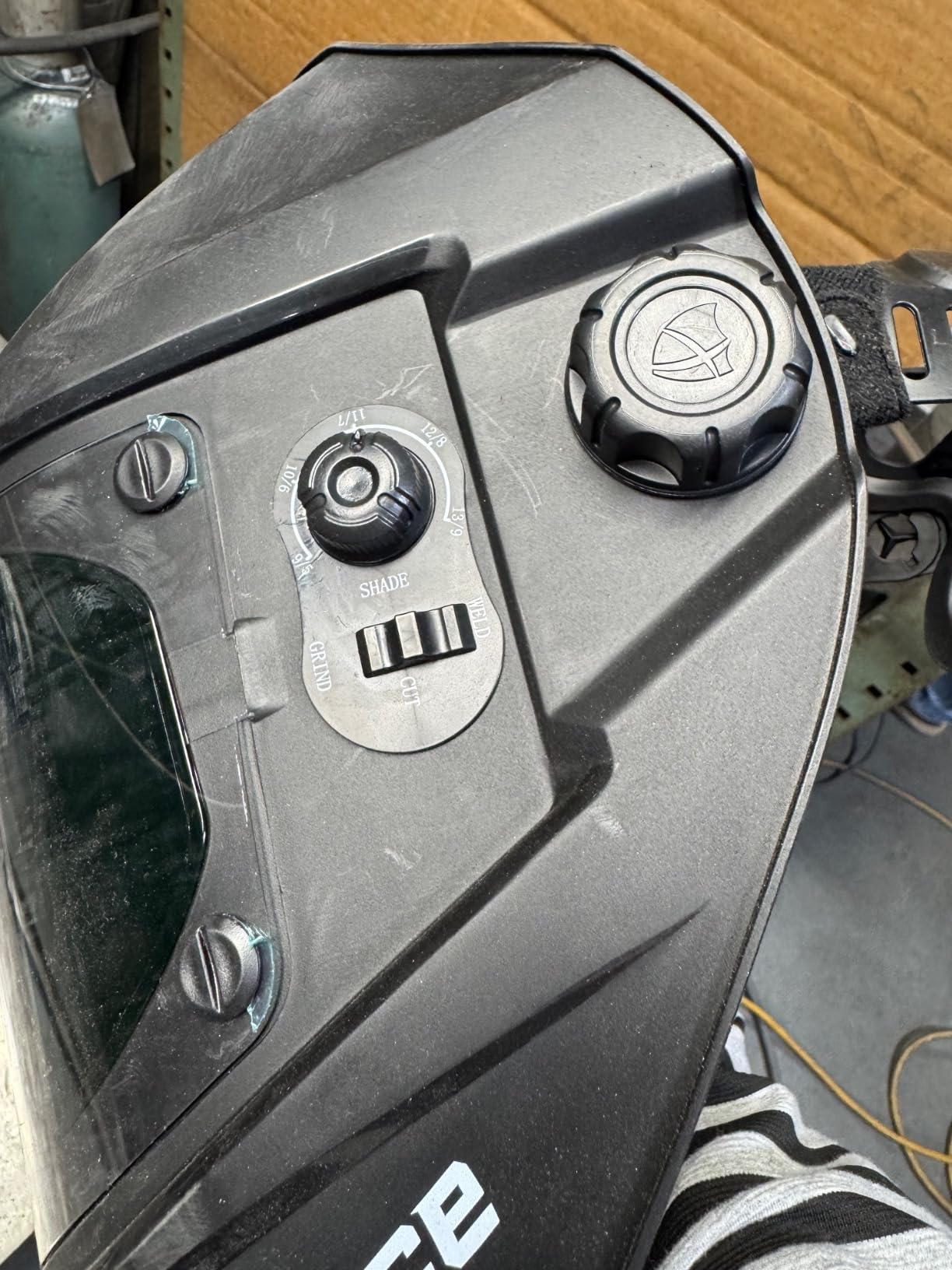
The LY800J answers a different large view question than the rest of this list. Its total field of view is 3.94 by 7.06 inches, built from a 3.94 by 3.66 inch auto-darkening main screen and two 3.94 by 1.70 inch non auto-darkening side views at DIN 5. No other helmet in this list wraps that far around the head.
Those side windows are the reason to buy it. During positioning and tacking, when there is no arc to darken against, you keep peripheral context on both sides: your layout lines, your clamps, your hands. Operators doing fit-up on large assemblies describe it as the difference between checking a part and repeatedly lifting the helmet.
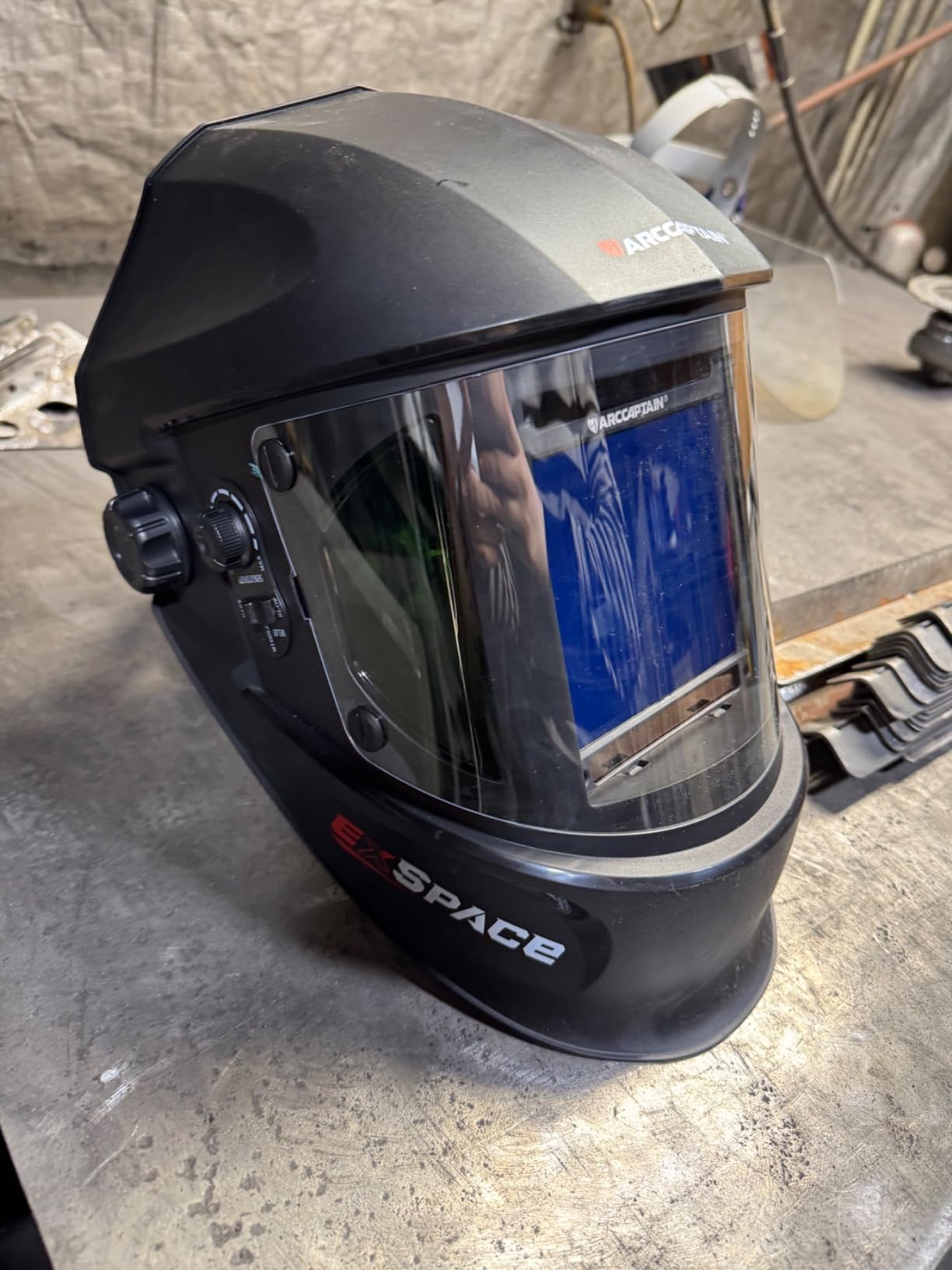
Mechanically it is well thought out for shop work. The upgraded knob section is adjustable while wearing gloves, which matters during fit-up, and the interior shell was rearranged to fit the head better for extended wear. Power is two solar panels plus two CR2450 lithium batteries, supporting multi-year service life. The 12-in-1 smart filter gives automatic DIN 16 UV and IR protection, and the operating range is minus 5C to 55C.
The main screen runs 4 arc sensors with 1/25,000 second switching, slightly slower than the 1/30,000 second on several YESWELDER models. The shell is 2.55 pounds, on the heavy side for this group, and the ratings show the widest spread between delighted and disappointed buyers of anything we looked at, with 8 percent one star feedback. Solar charging supplements the batteries rather than replacing them, so periodic coin cell changes remain.
Why a panoramic layout beats a taller single window
Fabrication work is not only welding. It is measuring, marking, clamping, checking alignment and verifying a joint before you commit an arc. A panoramic helmet with two DIN 5 side windows keeps you in work mode for all of it instead of cycling between welding and inspecting.
That is also why the panoramic category has almost no coverage in competing guides. If your day is half positioning and half welding, this layout does more for you than another half inch of darkening window.
Where it falls short
Weight and inconsistency. At 2.55 pounds it is heavier than most alternatives, and the same wide panoramic area that helps positioning adds mass you carry all day. The 8 percent one star share suggests some buyers are not happy with that balance.
Choose it for layout-heavy work. If you weld vertical seams all day in a small booth, you are paying for side windows you will barely use.
12. Miller Classic Series ClearLight – Best Pro Brand Filler Helmet
Miller Classic Series Welding Helmet, ClearLight™, Shade 8-13, Black
6 square inch viewing area
ClearLight optics
Digital controls
3.0 light state
Pros
- ClearLight optics from a top pro brand
- Very bright 3.0 light state allows working hood down
- Digital shade delay and sensitivity controls
- Ratchet headgear holds a secure fit
- Three year warranty and ANSI Z87.1 CSA CE
- Auto-on power control
Cons
- 6 square inch view is the smallest in this roundup
- Only two arc sensors struggles on very low amp TIG
- 1/23000s switching slower than leading models
- Shade range starts at 8 so light state is dimmer
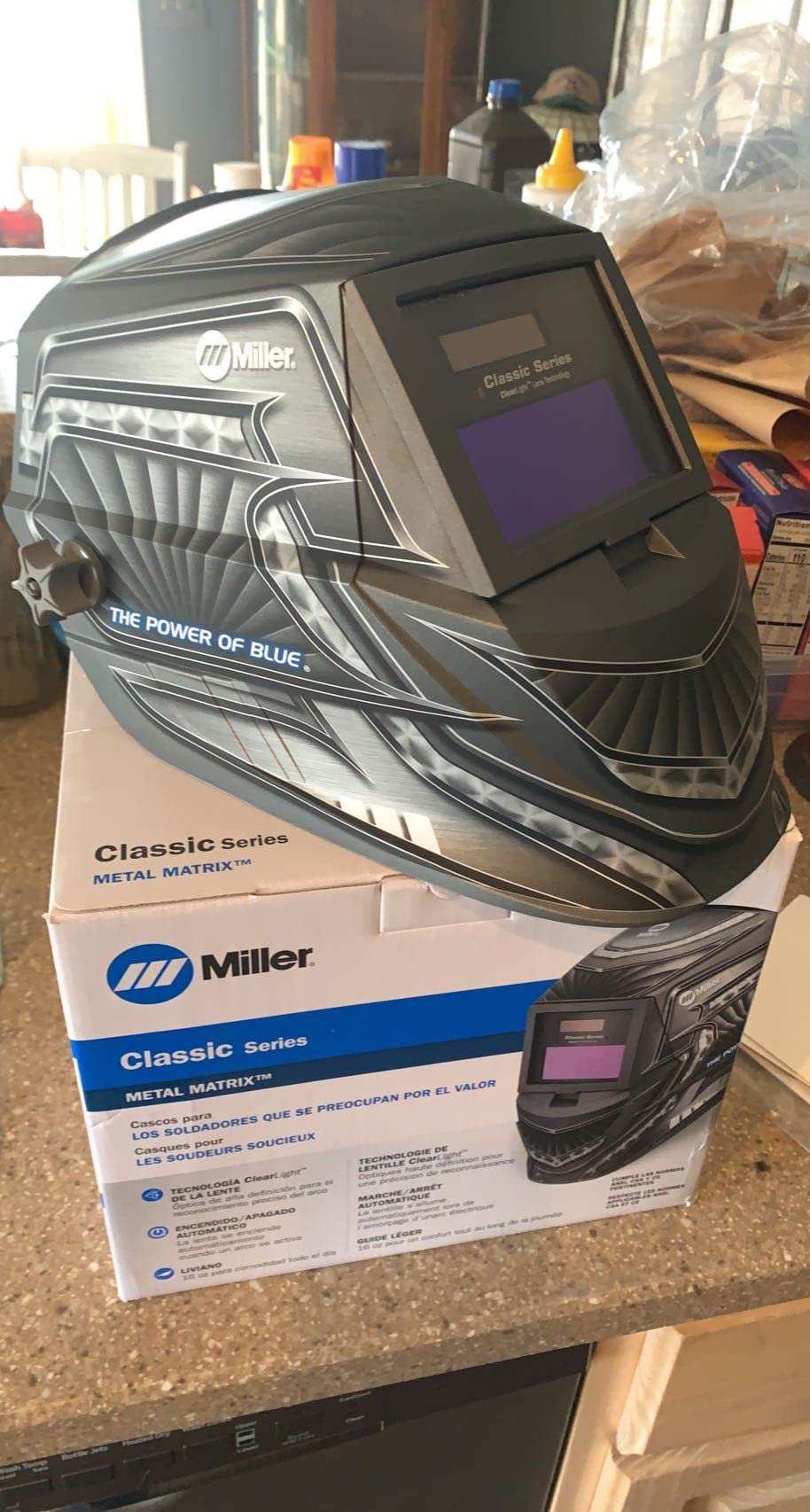
We are including the Miller Classic Series as a deliberate exception. At 6 square inches it does not qualify as a large view helmet, and we would not list it as one. What it does qualify for is being a shop-duty filler helmet from a brand that will still sell you a replacement lens in five years.
The optic is Miller ClearLight high definition technology, and it is rated for welding at five amps or below, which is unusual and useful for thin material and low amperage TIG work. Controls are digital for shade, delay and sensitivity, with weld shades 8-13, cut shades 5-8 and grind shade 3, and the ratchet headgear holds a secure fit over long sessions.
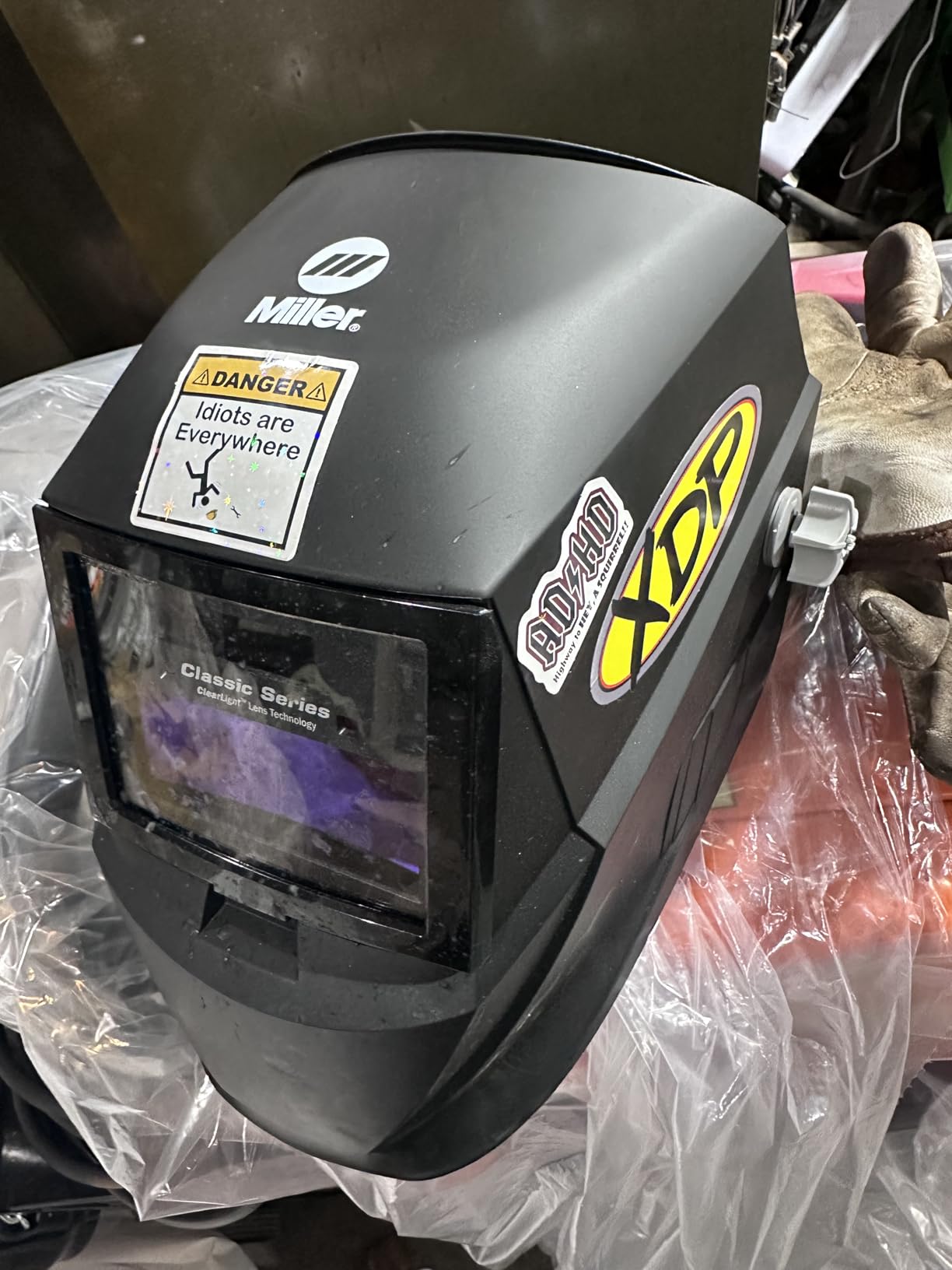
The detail that changes a production day is the 3.0 light state. It is bright enough that you can keep the hood down between welds rather than flipping it up and down constantly, which on a fit-up and tack cycle saves a lot of repeated movement. Auto-on power control activates at arc strike, so there is no startup guesswork.
Coverage is solid on paper: ANSI Z87.1+, CSA and CE compliant, with a three year warranty. The shell is nylon at 989 g.
Where it does not fit a large view brief: the 6 square inch window is the smallest in this group, two arc sensors is the lowest count here and can struggle on very low amperage TIG, and 1/23,000 second switching is slower than the leading units. Starting the shade range at 8 also means the light state is dimmer than a DIN 4 helmet, which undercuts the hood-down benefit on the brightest settings.
Why a shop still needs a second helmet type
Standardising a crew on large view helmets for every task is convenient but not always right. For fit-up, tacking and light inspection work, a compact hood with a very bright light state is faster because you are not waiting on a big filter or fighting a heavy shell.
Keeping one or two of these on the bench means the premium large view units stay in the booth with the welding, and the wear and tear of grinding and chipping happens somewhere else.
Where it falls short
It is not a large view helmet and does not pretend to be one. Two sensors is the real limitation for any TIG work at very low amperage, and fabricators doing stainless tube should test before committing.
Buy it as a companion hood, not as the answer to the question this guide is answering.
Large View Welding Helmet Buying Guide for Fabricators
Viewing area tiers: what large view actually means
Standard hoods sit around 3.5 to 4 square inches of filter area. That is workable for flat, downhand work with the part directly in front of you.
Large view tier starts near 9 square inches, which is where the 3.93 by 3.66 inch window and the 9.3 inch widescreen belong. You get roughly double the area and noticeably fewer head movements between passes.
The extra large tier sits at 12.5 square inches and above, which is where the Lincoln 3350 and the TOOLIOM window fall. Extra height and width together is what makes overhead work practical rather than merely possible.
Panoramic is a different category rather than a larger number. Instead of one bigger window you get a main auto-darkening screen plus non auto-darkening side views, which is the ARCCAPTAIN LY800J layout. The gain is peripheral awareness during positioning rather than brightness during welding.
Optical clarity ratings and why 1/1/1/1 matters
The 1/1/1/1 classification under EN 379 rates light transmission, chromatic aberration and UV plus IR filtering. Most large view helmets in this guide carry that rating, so it is close to table stakes at this tier, though the Hobart publishes no classification and the TGR model is described only as true color.
A 1/1/1/2 lens drops the chromatic aberration score. On stainless and aluminum that shows up as a faint colour fringe at the edge of the weld pool, which matters when you are judging whether a bead is clean or whether a TIG arc is wandering on thin wall.
True color technology is a separate feature from the rating. It affects how naturally the workpiece looks through the lens, and it is the difference between judging a fit-up colour by colour and guessing.
Arc sensors and out-of-position welding
Arc sensors are photocells that detect the arc and trigger the filter to darken. The number of them determines how reliably that happens when your head is not square to the arc.
Two sensors, as on the Miller Classic Series, work when the arc is directly ahead of you and fail more often when the gun blocks the sensing area. Four sensors is the practical floor for overhead and out-of-position work, and five gives margin on low amperage TIG where the arc is dim.
Switching speed is published on most of these units. One 1/30,000 second is the fast end in this group. The MIGVAN at 1/10,000 second and the ARCCAPTAIN LY800J at 1/25,000 second are adequate for shop work but slower on short-arc tasks.
Headgear, weight and neck fatigue over a full shift
This is where large view helmets are won or lost, and it has nothing to do with the lens. Published weights across this group range from 1.25 pounds on the Hobart to 2.79 pounds on the YESWELDER BW-10MAXTRI, with a few models stating their weight in kilograms instead.
The relevant number is not shell weight alone but how far the mass sits from your neck pivot. X6 style multi-point headgear, as on the Viking 3350, spreads load across the skull instead of hanging it from a brow band.
Retention type matters as much as weight. Ratchet and pivot headgear that hold the helmet in the raised position beat a strap or buckle for anyone flipping up and down all shift. The cheap flip-up retention complaints we found cluster around exactly that point.
Welding over a respirator or under a hard hat
A large shell sits further from your face, and that is a problem when you wear a tight-fitting respirator. The shell can ride up on the face seal as you tilt your head, breaking the seal. Low profile shells such as the ESAB Sentinel A60 are the ones fabricators report working over a respirator.
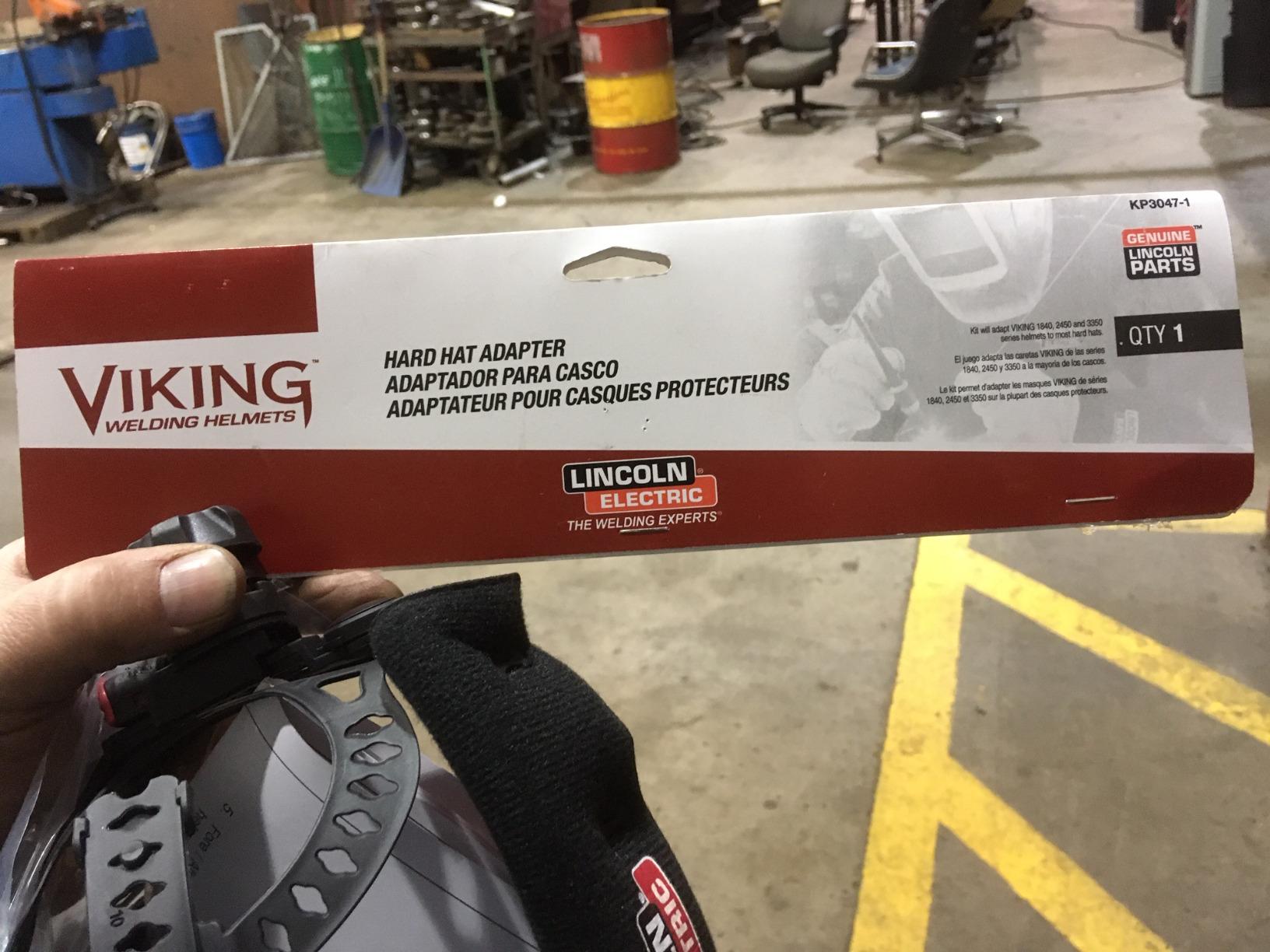
For hard hats, the practical approach is a low profile shell plus a suspension adapter, and to check that the hat brim does not foul the helmet in the raised position. Test both before you standardise a crew.
Clearance lens versus shade lens for outdoor fabrication
Indoors, the light state of an auto-darkening filter is bright enough to keep the hood down between welds. Outdoors that stops being true, and a welder working in daylight usually ends up wearing a clear or clearance lens instead of a shade lens when fitting up.
The side windows on panoramic models are effectively clearance lenses, DIN 5 in the case of the two ARCCAPTAIN models here. That is why they suit outdoor and field layout work as much as indoor shop positioning.
For outdoor fabrication, choose a helmet you can wear down for measurement, or accept that you will be lifting it constantly and buy a model whose flip-up position actually holds.
Power source, consumables and warranty length
Solar plus a replaceable coin cell is the combination we recommend for dim indoor booths, because a solar-only filter loses charge when there is no daylight or arc to harvest. A CR2450 lithium cell is the common format, and the CR2 in the Hobart is also a lithium primary cell.
Cover lens supply is the hidden running cost. The Lincoln 3350 uses standard non proprietary covers, which keeps replacement simple and cheap for a shop spattering lenses constantly. Other models need OEM parts that cost more.
Warranty length varies enormously across this group, from 180 days on one model to five years on another, with two models stating no term at all. For a tool that sits on a welder’s head for eight hours a day, treat warranty length as a durability signal. Our hobbyist helmet guide covers cheaper options if your duty is occasional rather than daily.
Common Mistakes When Buying a Large View Welding Helmet
1. Buying screen size and ignoring shell weight. A 13 square inch window on a heavy shell is worse over a full shift than a 9 square inch window on a light one. Check both numbers before you commit.
2. Assuming a wide window is a tall window. Most large view helmets are wider than they are tall. If you weld overhead, check the height in inches, not just the area in square inches.
3. Buying a two sensor helmet for out-of-position work. The gun blocks the sensing area and the filter does not darken. Four sensors is the floor for overhead and side work.
4. Ignoring flip-up retention. Test whether the helmet holds the raised position with gloves on. If it creeps down, you will be adjusting it dozens of times a shift.
5. Standardising on a short warranty. Warranty terms in this category run from 180 days to five years. A short term tells you how the manufacturer expects the electronics to age.
6. Buying a panoramic model for pure welding time. Side windows help layout and positioning. If your day is almost entirely vertical welding, that extra shell mass buys you little.
7. Forgetting the lens consumables. Confirm that inside and outside cover lenses are available in standard sizes, and price a replacement set before you outfit several welders.
8. Skipping the full-shift trial. Comfort problems appear at hour five, not hour one. If a supplier allows it, wear any candidate for a full production day before standardising the shop on it.
Frequently Asked Questions
What welding helmet has the largest viewing area?
By window dimensions, the TGR extra large view model has the biggest single pane at 4 inches wide by 3.65 inches tall, and the TOOLIOM publishes the largest square inch figure at 12.9. The Lincoln Electric Viking 3350 is close behind on its 12.5 square inch extra large lens. If you count side windows rather than just the main pane, the ARCCAPTAIN LY800J offers the widest total field of view at 3.94 by 7.06 inches.
Which welding helmet has the best clear view?
Clarity is a combination of optical classification and colour rendering. The Lincoln Electric Viking 3350 pairs 4C lens technology rated 1/1/1/1 across all four categories with the largest lens in the roundup. YESWELDER, ARCCAPTAIN, TOOLIOM and MIGVAN large view models also carry 1/1/1/1 ratings, while the Hobart 770890 uses PureColor optics without a published clarity classification.
Which welding helmet has the best visibility?
For welding visibility, the Viking 3350 wins on window size combined with a bright resting shade near DIN 4, which keeps the shop visible between passes. For visibility while positioning and tacking, the panoramic models are better, with the ARCCAPTAIN LY800J providing a 3.94 by 7.06 inch total field of view. Visibility outside the arc depends on light state brightness rather than window size alone.
What is the best welding helmet for a large head?
Fit depends on headgear range and shell depth more than screen size. The Lincoln Viking 3350 fits hat sizes 6.5 through 8 and its X6 headgear spreads load rather than pinching. The ARCCAPTAIN models are lighter, which helps larger heads on long shifts. If you wear a respirator, choose a low profile shell such as the ESAB Sentinel A60 so the seal is not lifted.
What is the best welding helmet for outdoors?
Outdoor work calls for peripheral vision during layout rather than a larger darkening window. The ARCCAPTAIN LY800J and YESWELDER LYG-Q800D both add non auto-darkening DIN 5 side windows that stay usable in daylight. If you weld outside more than you fit up, a helmet whose light state is bright enough to keep the hood down, such as the Viking 3350 or the Miller Classic Series, saves repeated lifting.
Final Verdict on the Best Large View Welding Helmets for Fabricators
For most fabrication shops in 2026, the Lincoln Electric Viking 3350 is the pick. It pairs a 12.5 square inch extra large lens with 1/1/1/1 4C optics, a bright resting shade, X6 headgear, standard non proprietary cover lenses and a five year warranty at 1.4 pounds. That combination is what makes the best large view welding helmets for fabricators a safe default rather than a gamble.
If budget is the constraint, the YESWELDER LYG-M800H gives up nothing optical: a 3.93 by 3.66 inch true color window, four sensors at 1/30,000 second and external controls. For positioning and tacking, the ARCCAPTAIN LY800J wraps the view around to 3.94 by 7.06 inches. For digital shade control, the YESWELDER BW-10MAXTRI reads settings on an internal display. And if your work is confined and you wear a respirator, the ESAB Sentinel A60 beats bigger helmets on fit.
Whichever you choose, wear it for a full shift before you standardise the crew. Comfort, retention and neck load only show up at hour five.