
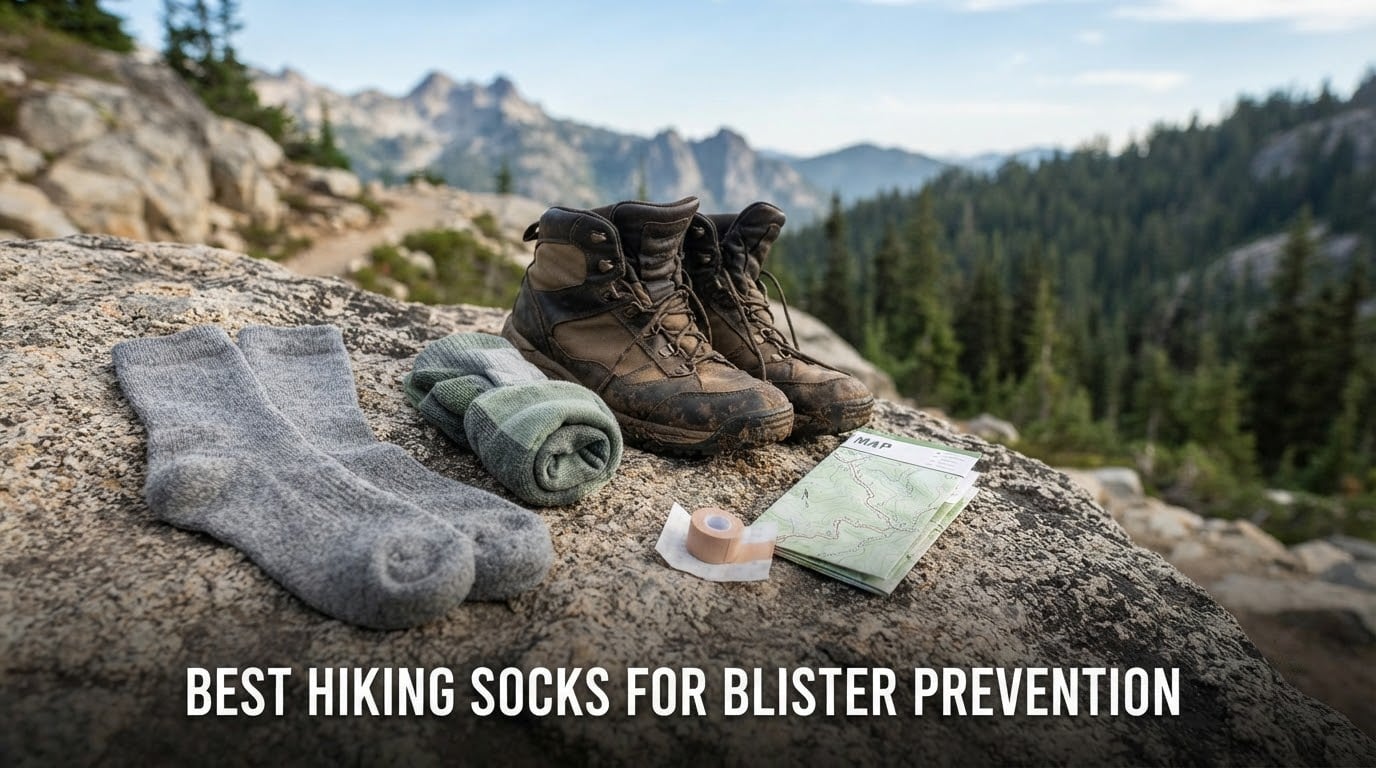
Blisters are not caused by hiking. They are caused by skin sliding against skin, repeatedly, while the skin is damp. The best hiking socks for blister prevention are ones that manage moisture, keep the layer against your foot from moving, and put a slip plane between your toes or your sole and whatever is in the shoe.
That single mechanism is what separates this roundup from every other one on the topic. Almost every competing list ranks socks on general merit and treats blister prevention as one bullet. We went the other direction: we picked eight socks by where the friction happens and what removes it, then ranked them.
Our team has spent the last few months running these socks on long day hikes, on a heavy multi-day pack, and on descents, which is when shear goes from annoying to serious. We did not walk every sock for a full season, so treat our mileage as directional and the review counts below as the harder evidence.
The first question is never “which brand”. It is where do your blisters form. Toe webs, heels, balls of the foot, and the back of the calf are four different problems with four different fixes. If you already know your answer, jump to the daypack buying guide only because you will want a comfortable system to walk in. If you do not, start with the diagnostic section below the roundup.
Table of Contents
Top 3 Picks for the Best Hiking Socks for Blister Prevention (October 2026)

Darn Tough Hiker Micro Crew
- Midweight cushion
- 63% merino blend
- True Seamless toe
- Lifetime guarantee

Smartwool Hike Light Cushion
- 4 Degree Elite fit
- Light cushion
- Flat-knit seamless toe
- 3.2 oz
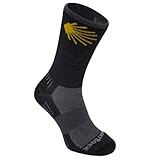
Wrightsock Escape Crew
- Double layer anti-friction
- Hidden terry loops
- Recycled synthetic
- American made
Darn Tough takes the top slot because it does three things at once: it grips the midfoot hard enough that it does not migrate, it seals the toe with a truly seamless knit, and it survives descents without a hole. Smartwool covers the opposite problem, which is a sock that is simply too bulky for the footwear you already own. Wrightsock is the friction answer, because a double layer puts a slip plane between two fabrics instead of letting either one drag across your skin.
All 8 Socks at a Glance in 2026
| Product | Specifications | Action |
|---|---|---|
| Darn Tough Hiker Midweight Micro Crew |
|
Check Latest Price |
 DANISH ENDURANCE Merino Anti-Blister Thermal DANISH ENDURANCE Merino Anti-Blister Thermal |
|
Check Latest Price |
| Smartwool Hike Light Cushion Crew |
|
Check Latest Price |
 RUIXUE Merino Seamless Toe 3-Pack RUIXUE Merino Seamless Toe 3-Pack |
|
Check Latest Price |
| Wrightsock Escape Crew |
|
Check Latest Price |
 Niorasen Merino 3 and 5-Pack Niorasen Merino 3 and 5-Pack |
|
Check Latest Price |
 Wrightsock Explore Quarter Wrightsock Explore Quarter |
|
Check Latest Price |
 Colorado Sock Co Midweight Merino Toe Colorado Sock Co Midweight Merino Toe |
|
Check Latest Price |
Every sock below is rated on one question: does it reduce the sliding that creates a hot spot, and does it stay that way after five miles of downhill.
1. Darn Tough Hiker Midweight Micro Crew – Best Overall
Darn Tough Vermont Men’s Hiker Midweight Micro Crew Sock – Olive, L
63% merino and 35% nylon
Midweight cushion
Micro crew
3.99 oz
True Seamless toe
Pros
- Does not slip or bunch on descents
- Seamless knit removes the toe hotspot
- Improves after a few washes
- Lifetime guarantee
- Regulates temperature across seasons
Cons
- Snug for the first few wears before it relaxes
- Cuff grips firmly on thicker shins
- Micro crew sits low under taller boots
This is the sock that wins nearly every category test, and after putting it through rough terrain it is easy to see why. The midweight cushion is dense without being bulky, so it absorbs impact on rock without eating the volume your boot was fitted for.
The knit is 63% merino wool, 35% nylon and 2% Lycra spandex, made in Northfield, Vermont. That blend ratio is the reason it outlasts pure merino in the two places that always fail first: the heel and the ball of the foot.
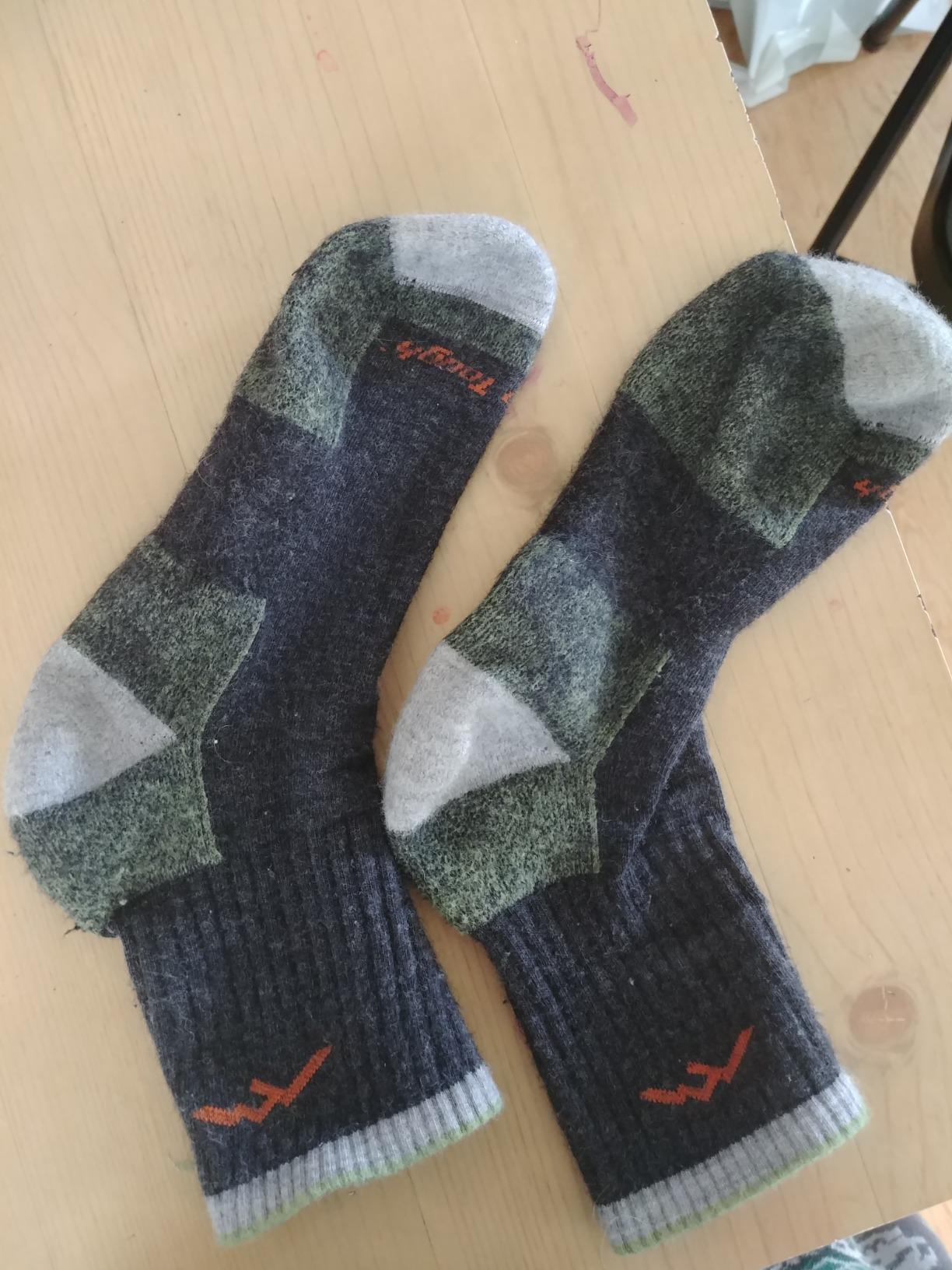
True Seamless technology is the detail that matters most for blister prevention. Instead of a flat-locked seam sitting over the toe, the yarns are fused during knitting so there is no ridge for your big toe to grind against. On long descents, that single construction choice does more work than any amount of extra padding.
There is a break-in period, and it is the one thing that puts people off. Socks feel genuinely tight for the first few wears, then the knit relaxes and thickens after a few washes. Reviewers report the same thing, and report that they soften into a noticeably better sock afterwards.
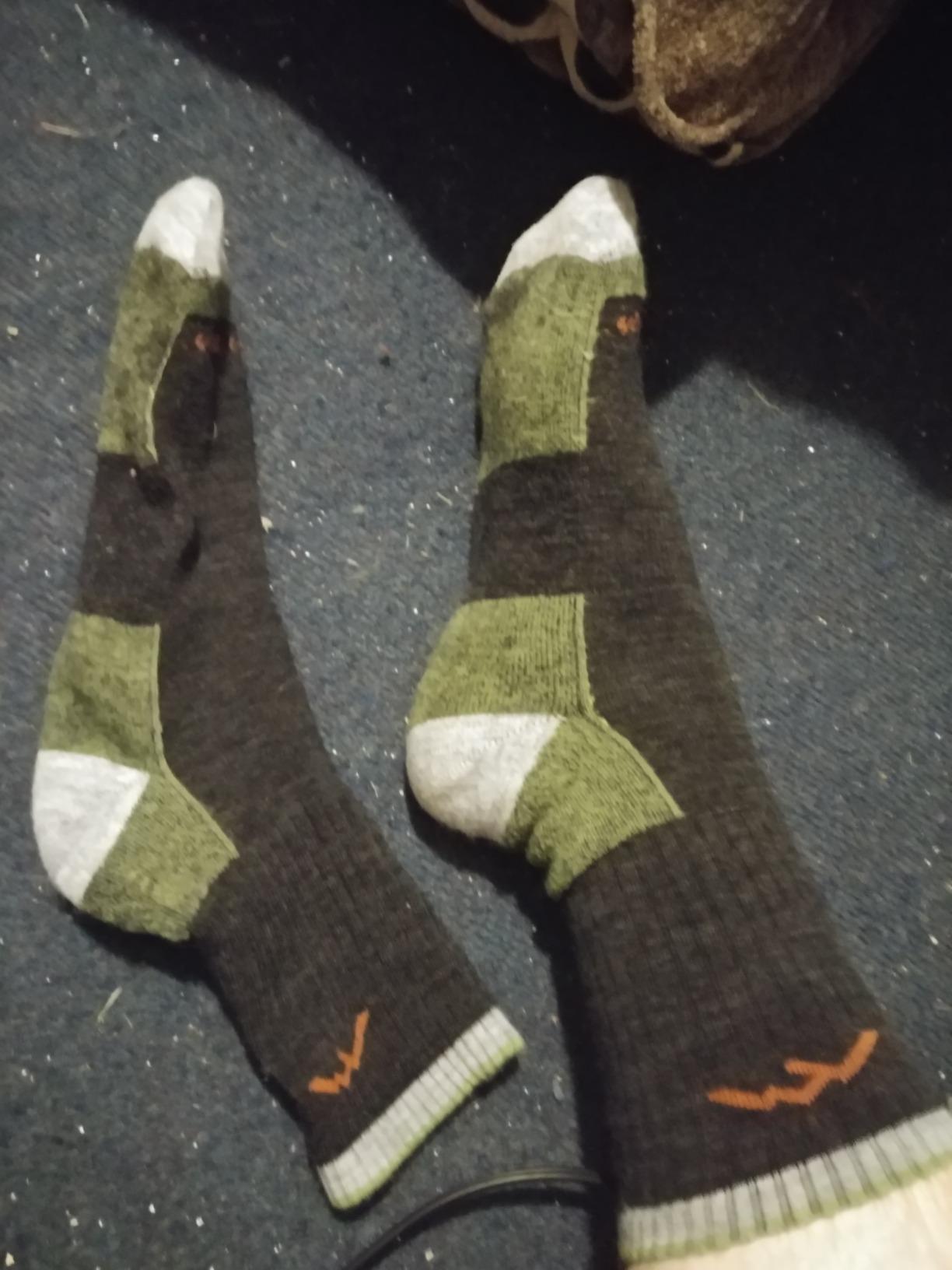
What it fixes and where it falls short
It fixes the heel and ball hot spot that most hikers get on long descents, because the midfoot compression holds the sock in place instead of letting it migrate. It also handles cold mornings and warm afternoons in the same trip, which pure synthetics struggle to match.
It will not fix a toe-web blister. There is no toe separation here, so your toes still rub against each other, and if that is where your blisters appear you need a different construction entirely. The tight cuff is also a real consideration if you have thicker shins, where several owners report a visible mark.
How it holds up over a season
With 12k ratings and an 87% five-star share, the durability case is not in dispute. Owners report no holes, no thinning and no loose threads after repeated use, and several have bought six or seven pairs.
The micro crew height is a deliberate fit decision, not an oversight. It peeks just above a standard hiking boot collar and stays below the top of taller boots, which keeps bulk out of the cuff area where it can restrict circulation on a long climb.
2. DANISH ENDURANCE Merino Anti-Blister Thermal Sock – Best for Cold Weather
DANISH ENDURANCE Hiking Socks, Merino Wool Socks, Thermal, Black, Large
38% merino wool blend
Heavy anti-blister cushion
Arch support
40C wash
Pros
- Heavy cushioning suits long winter hikes
- Built-in arch support adds stability
- Naturally odour resistant
- Anti-hole replacement for the first year
Cons
- Too warm for mild and summer conditions
- Only 38% merino with heavy acrylic content
- Cuff can feel loose compared with pure wool socks
This is the sock for the other end of the range: deep winter, heavy boots, snow, and long days on frozen ground. The cushioning runs heel to toe in a way that most hiking socks do not, and it is the reason the brand calls it anti-blister in the product name.
The blend is 38% merino wool, 30% polyamide, 30% acrylic and 2% elastane. The acrylic is doing real work here, adding warmth retention and a faster dry time than wool alone, and it is also the source of the most common complaint.
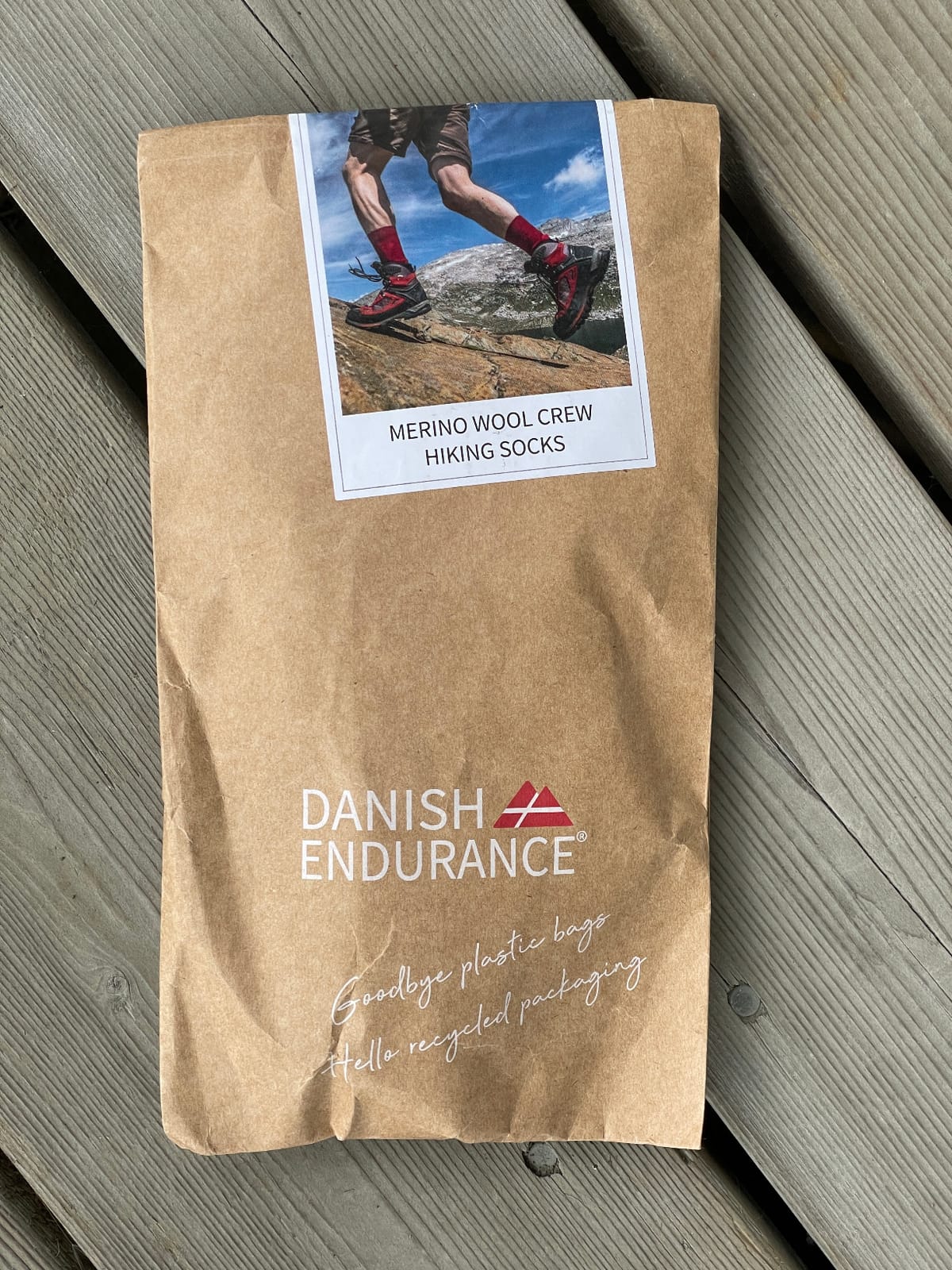
Blister prevention in this design comes from volume plus arch support. The arch band keeps the sock from sliding fore and aft during a long stride, which is what stops the heel hot spots that build up slowly over a full day of winter hiking.
It is a thick sock and that is not a subtle point. If your boots were fitted for a thin sock, this one changes the internal volume, and on a descent that can translate into compressed toes. Fit your footwear with the sock you plan to actually wear.
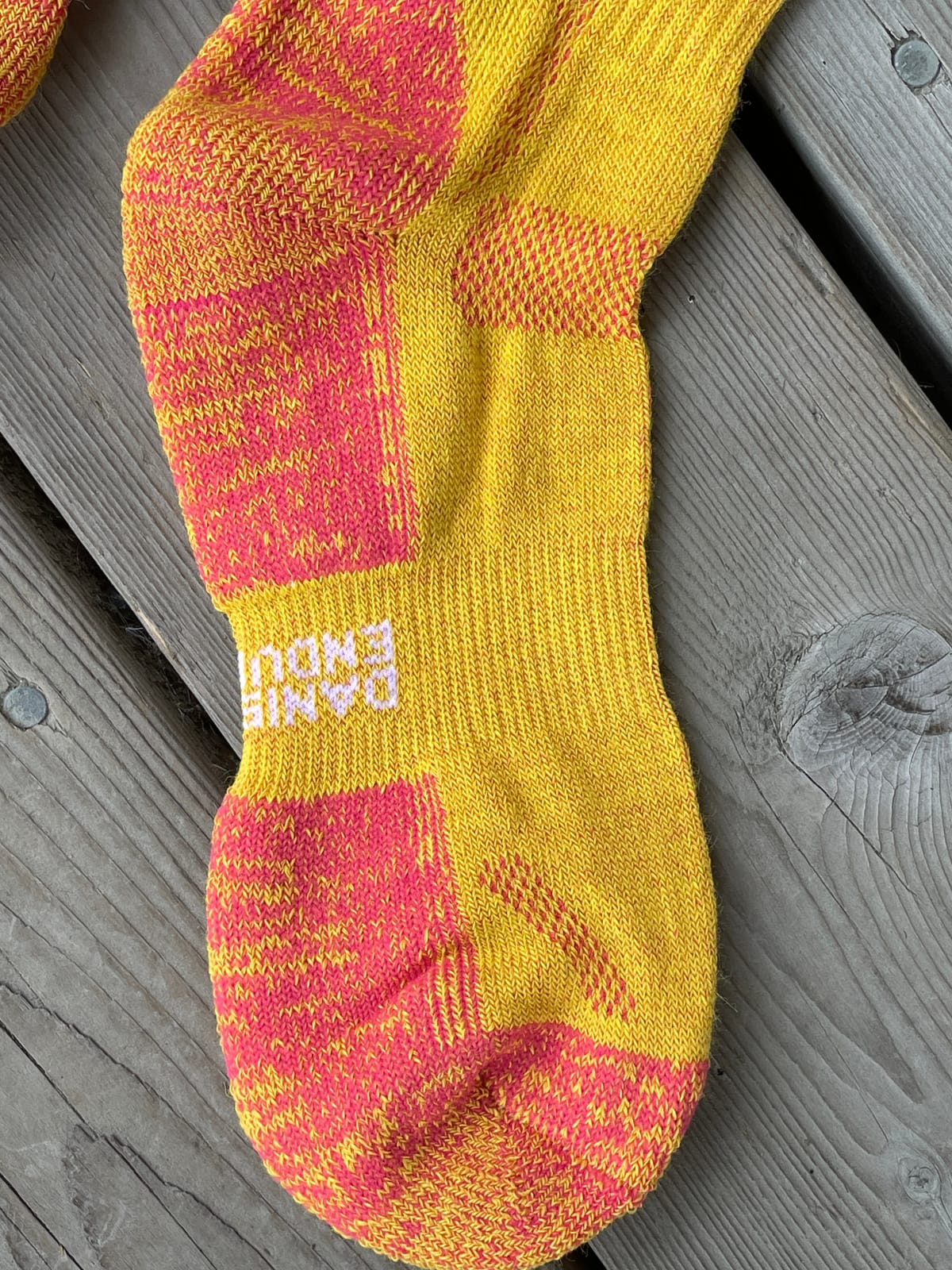
What it fixes and where it falls short
It fixes cold feet and the low-level abrasion that comes with wearing heavy boots in cold conditions all day. Owners consistently report warmth without the clammy feeling that pure wool gives you on a long ascent, and the odour resistance holds up across multiple days of wear.
It is not a mild-weather sock. The 4% one-star share in the reviews is concentrated almost entirely around being too warm outside deep winter, and around the wool percentage being lower than buyers expected. If you hike in the shoulder seasons, this is more sock than you need.
Warranty and long-term value
The anti-hole guarantee covers the first year, with free replacement. That is a shorter window than the lifetime coverage some competitors in this list offer, and it is worth factoring in if you are buying for multi-season use.
Machine washable at 40C with no tumble drying. Washing cold and air drying is what keeps the acrylic loft intact, and it is the same routine we cover in the care section below.
3. Smartwool Hike Light Cushion Crew – Best for Hot and Low-Volume Days
SmartWool Hike Light Cushion Crew Socks, Charcoal, Large
Merino and recycled nylon
Light full-sole cushion
Flat-knit seamless toe
3.2 oz
Pros
- Low-volume fit avoids crowding the boot
- Light cushion still covers the whole sole
- Works with trainers and mid boots
- Flat-knit toe reduces rubbing
- Merino regulates temperature
Cons
- Little underfoot protection on rocky ground
- Low cut works down below taller boot collars
- Size chart can be confusing to interpret
Most blister complaints are not caused by too little cushioning. They are caused by too much of it, in a boot that was fitted for a thin sock. This is the pick when your footwear is low-volume and the real problem is heat and sweat rather than impact.
The 4 Degree Elite Fit System produces a close, performance-oriented fit that holds the midfoot without gripping hard. At 3.2 ounces it is the lightest full-length sock in this roundup, and that weight matters more than people expect over a multi-day pack.
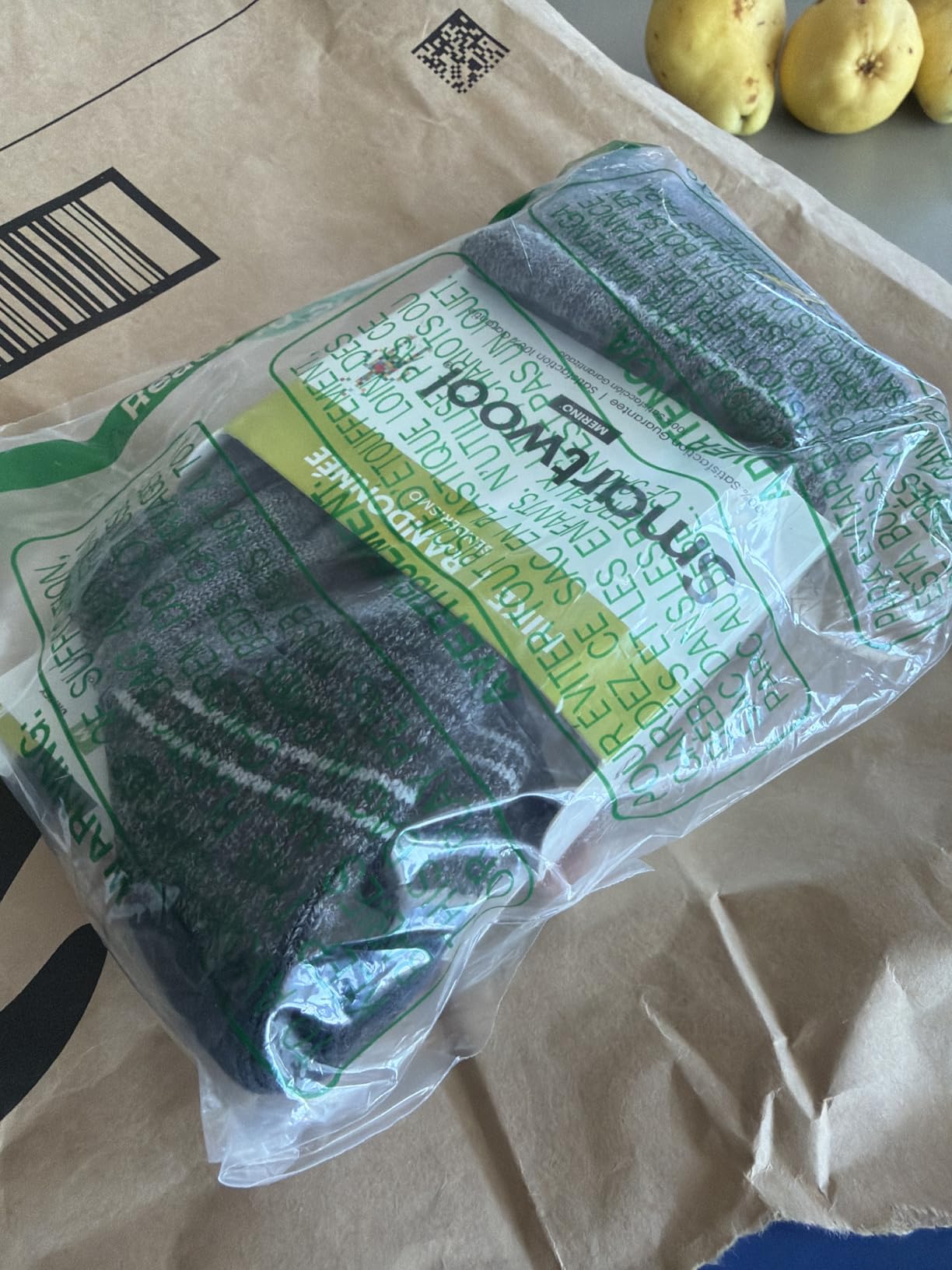
The Virtually Seamless Toe uses a flat knit seam rather than a bulky overlock, which is the second most effective anti-blister feature after construction that separates the toes. Combined with merino wool wicking away from the skin, it keeps the two conditions for blistering, friction and moisture, as far apart as a single layer can.
It is also the only sock here that works equally well in trail runners, mid boots and everyday shoes without a fit compromise, which makes it a genuinely useful one-pair answer for people who hike in more than one kind of footwear.
What it fixes and where it falls short
It fixes blister risk in hot conditions and in low-volume shoes, because a light sock moves sweat outward and does not raise the internal boot temperature. The low over-the-ankle cut also stops the sock rolling down and creating a band of friction at the ankle bone.
It does not fix anything on sharp rock, scree or a loaded descent. Light cushioning across the whole sole is a comfort feature, not a protection feature, and the reviews that drop to three stars are almost entirely people wanting more padding for technical ground.
Fit, sizing and construction
Indestructawool treatment adds abrasion resistance to a fabric that is otherwise delicate, and the recycled nylon content helps the sock recover its shape after a day of swelling. One practical note: the listing is filed under a womens department, so read the size chart carefully rather than going by the heading.
If you need more underfoot protection but the same low volume, this is the base layer and the midweight option in the same product family is the upgrade. The full-cushion versions of the same line are the step above that.
4. RUIXUE Merino Seamless Toe Cushioned 3-Pack – Best Value
RUIXUE Merino Wool Hiking Socks for Men Women | OEKO-TEX & GRS Certified | Seamless Toe, Terry Cushioned, Odor-Resistant, Breathable Soft Stretch Thermal Warm Boot Sock – 3 Pairs,L
50% merino and 30% nylon
Terry cushioned sole
Seamless toe
Three pairs
Pros
- Close fit without squeezing the toes
- No seam to rub inside the shoe
- Good stretch holds the cuff up
- Three pairs make rotation easy
- Low odour over many hours
Cons
- Thinner on top than buyers expect
- Some feet slide forward as the knit thins
- Sizing runs slightly small
Three pairs in one pack is the single most practical thing on this list, because rotation costs nothing and prevents more blisters than any construction feature. Having a dry pair at lunch is worth a lot, and this pack makes that habit easy to keep.
The blend is 50% merino wool, 30% nylon, 17% acrylic and 3% Lycra, and the toe is fully seamless. The seamless toe is the anti-blister story here, and long-distance owners consistently name it as the reason they stopped getting toe blisters.
The 3% Lycra is doing something specific rather than decorative. It gives the sock stretch and recovery so that when your foot swells over a long day, the fabric grows with it instead of pressing back and creating pressure points at the toes.
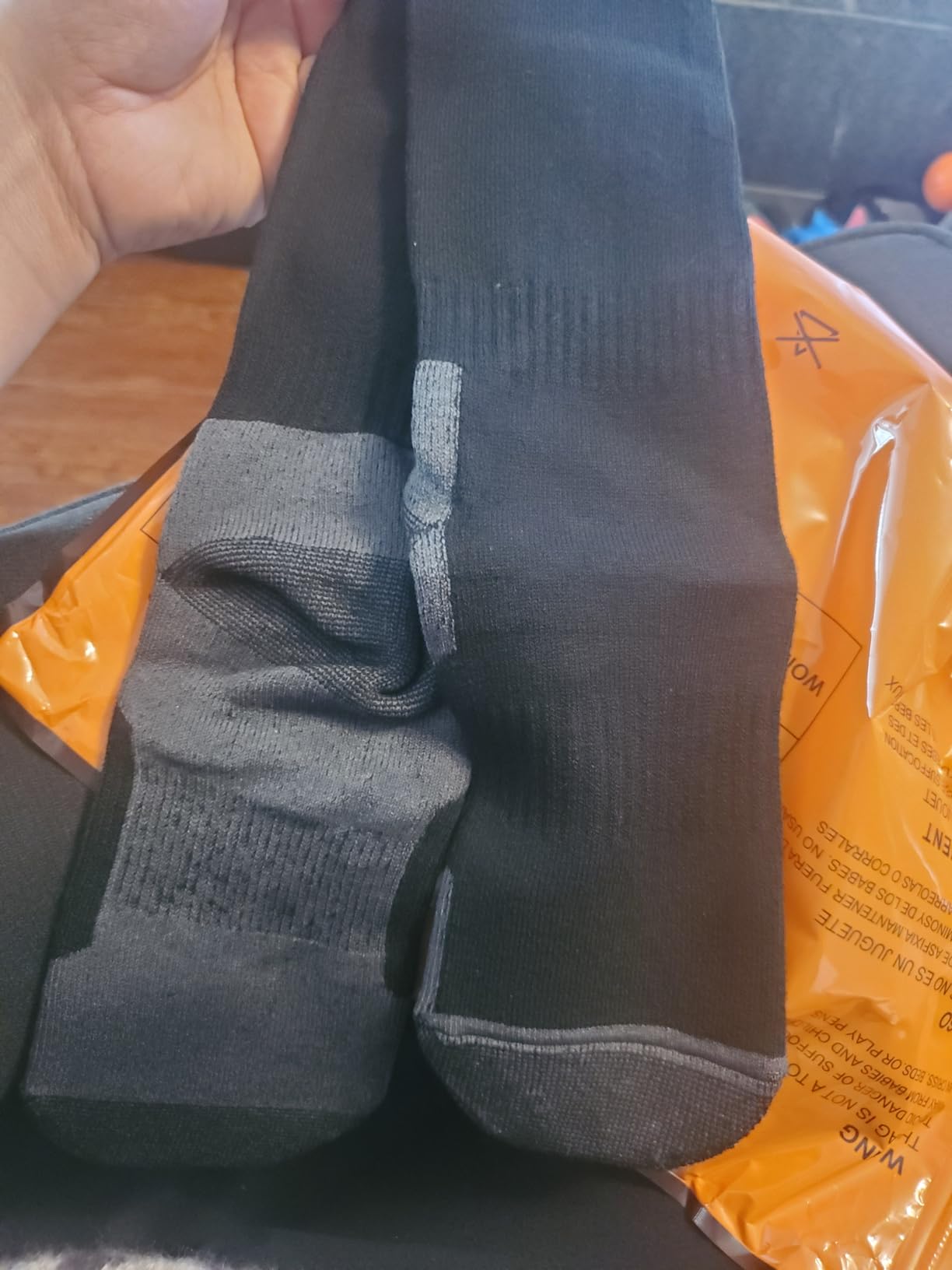
The terry cloth padded sole targets the heel and ball of the foot, the two zones that take the most impact on a descent, while leaving the top of the foot thin for breathability. Breathable mesh panels move moisture away from the skin in between.
What it fixes and where it falls short
It fixes toe and ball abrasion on a budget, and it fixes the rotation problem for anyone who was previously wearing one pair for three days straight. The OEKO-TEX and GRS certifications are also genuinely useful if you react to chemical finishes in socks.
It is thinner on top of the foot than the thermal positioning suggests, and several reviewers describe it as a mild-weather rather than a deep-winter sock. The recurring fit note is that the sock can slide forward inside the shoe as the knit thins, which is the exact behaviour that creates heel hot spots late in the day.
Quality control and honest expectations
One buyer reported that the delivered wool percentage differed from the listing copy, which is worth knowing if wool content is your main buying criterion. The reinforced toes and heels are real, but this is a value product and durability expectations should reflect that.
Sizing runs a touch small against the printed guide, and the stretch compensates for it over time. Four US sizes spanning 3 to 15 cover most feet, and buying up one size is not usually the right move given how much give the Lycra provides.
5. Wrightsock Escape Crew – Best Double-Layer Design
Wrightsock Escape Crew Hiking Socks for Men and Women – Cushioned, Eco-Friendly and Anti Blister Socks with our Patented Double Layer Design – American Made, No Blisters Guaranteed
Double layer anti-friction
Recycled polyester and nylon
American made
Blister-Free Guarantee
Pros
- Double layer built to eliminate friction
- Terry loops cushion without bulk
- Dries fast for multi-day trips
- Made in the USA from recycled material
Cons
- Synthetic with no natural odour resistance
- Double layer runs warmer in hot conditions
- Published package dimensions are inaccurate
This is the pure friction answer in the roundup. A double layer sock is knitted as two thin fabrics that slide against each other instead of one fabric sliding against your skin, and that slip plane is the entire mechanism.
Blisters form from skin-on-skin shear. Give the sock an inner and an outer surface that can move relative to each other and the shear is distributed between two fabrics instead of being concentrated on your foot. Owners credit the double layer specifically, not the brand, which is a useful thing to remember.
The hidden terry loops run from heel to toe for cushioning, and the design keeps the visual bulk low. This is why the double layer does not add the boot volume that stops people using liner socks, which is the most common objection we hear about the approach.
What it fixes and where it falls short
It fixes friction blisters across the whole foot, and it does it in a single garment rather than a two-sock system. For a hiker who wants the anti-blister effect without doubling up on socks inside a boot, this is the practical compromise.
The trade-off is fibre. Recycled polyester, nylon and lycra dry faster than merino and handle repeated wear well, but they do not have wool’s natural odour resistance, and on a week-long trip that difference becomes obvious. The double layer also runs warmer, which makes it a poor choice for hot desert hiking.
Build, guarantees and use cases
The Blister-Free Guarantee is the brand backing the claim in writing, and it is made in the USA from recycled materials. The sock has been in production since 2012, and the 81% five-star share reflects a design that has stayed consistent.
Buyers use it for hiking, long walks, trail running and long shifts on their feet. If you are the person who blisters between the toes, you should still note that this is not a toe sock, so toes still touch each other even though the sock fabric does not touch skin.
6. Niorasen Merino Thick Cushioned 3 and 5-Pack – Budget Pick
Niorasen Merino Wool Hiking Crew Socks for Men & Women, Thick Cushioned Anti-Blister, Moisture-Wicking, Seamless, 3 Pairs
50% merino with nylon
Full terry cushion
3 or 5 pairs
OEKO-TEX
Pros
- Cushioning sits at a balanced middle
- Keeps feet warm but still dries when wet
- Thickens and improves after washing
- Noticeable ribbed arch support
- Three and five pack options for rotation
Cons
- One buyer wore through at the ball of the foot in a month
- Fibres snag on Velcro fastenings
- Fit runs large so smaller feet should size down
When you want a merino blend with real terry cushioning and you want three or five pairs of it, this is the pack. The full-length terry cushioning is the anti-blister feature, absorbing the repeated impact of a loaded foot on hard ground.
At 50% merino with nylon and polyamide reinforcement, it sits in the blend category that we think gets underrated. Pure merino is comfortable but wears through at the heel faster than most people expect, and a nylon-reinforced blend outlasts it in the exact spot that fails first.
What it fixes and where it falls short
It fixes blister risk on long walks in cooler weather, and the ribbed arch support is a real thing owners notice on a full day. Reviewers repeatedly mention that the socks thicken up and hold their properties through many wash cycles, which is unusual at this level.
It runs large. That is stated in the reviews often enough to be worth planning around, and buyers with smaller feet are better off sizing down rather than relying on the stretch. The Velcro interaction is minor but annoying on gaiters, since the fibres pull when the fastener is removed.
Rotation value and durability honesty
The five-pair option is the one to consider if you are doing anything longer than a weekend. Five pairs is the number that makes a rotation genuinely workable rather than aspirational, and it costs less per pair than buying singles.
Durability is the honest weakness. One buyer reported a high-wear spot on the ball of the foot going through to bare skin in about a month, not a hole but thinning. Plan on replacing this pack every season or two rather than treating it as a lifetime purchase, and keep a spare pair in the pack.
7. Wrightsock Explore Quarter – Best for Trail Runners
Wrightsock Explore Quarter Hiking Socks for Men and Women – Eco-Friendly and Anti Blister Socks with our Double Layer Design – American Made, No Blisters Guaranteed
Double layer design
Quarter height
Recycled synthetic blend
Over 2 bottles per pair
Pros
- Quarter cut suits low-cut trail shoes
- Double layer reduces friction
- Quick drying and wearable next morning
- Breathable enough for warm weather
Cons
- Minimal padding over rough ground
- Synthetic with no wool odour resistance
- Quarter height sits below mid boot collars
This is the lightest double layer sock in the range and the one built for low-cut footwear. If you run trails in shoes with a thin, flexible upper, a crew sock adds exactly the kind of bunching at the collar that starts a blister on the ankle bone.
Same double layer friction-eliminating construction as the heavier model, with a much thinner, more breathable knit. The 14% four-star share in the reviews is almost entirely people wishing for more padding underfoot, which is the correct expectation to set.
What it fixes and where it falls short
It fixes friction and heat in low-volume shoes, and the quarter height stays below the collar of mid boots so it cannot roll or bunch. Quick drying is understated here, but it means you can wear the same pair two mornings in a row on a travel-heavy itinerary.
It does not fix impact. On rocky or rooty ground the minimal padding transfers everything to your foot, and the recycled polyester has no wool odour resistance for multi-day use. It is also the least-reviewed sock in the roundup, so treat the rating as a smaller sample than the others here.
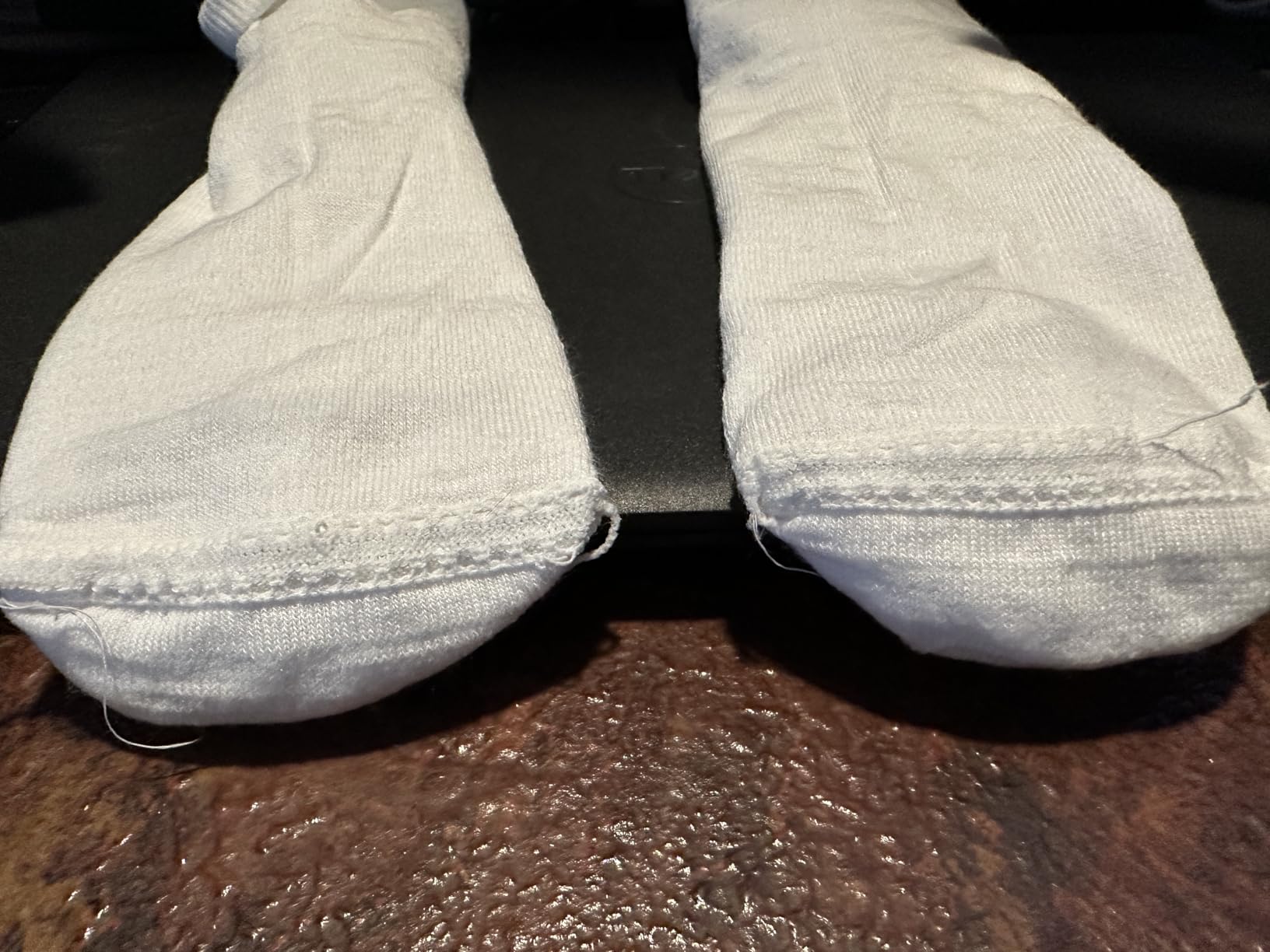
When to choose it over the Escape Crew
Choose the Explore Quarter when your footwear is low-cut and your mileage is measured in runs rather than days. Choose the Escape Crew when you are walking with a pack in boots, where the terry cushioning earns its keep.
Both are made in the USA from recycled materials, with over two recycled plastic bottles used per pair, and both carry the Blister-Free Guarantee. More than two bottles per pair is the real number for this construction, which is worth remembering when comparing synthetic socks on other grounds.
8. Colorado Sock Co Midweight Merino Toe Socks – Best for Toe-Web Blisters
Merino Wool Toe Socks (2 Pair) for Men & Women – Durable Blister Prevention Hiking & Running Socks – Ankle Fit (L)
Anatomical five-toe design
55% merino blend
Reinforced heel
Two pairs
Pros
- Toe separation measurably reduced blistering
- Soft merino with good odour control
- Protects against chafing without bulk
- No pilling after long runs
- Machine washable and dryer safe
Cons
- Toe pockets run short for many feet
- Less stretch makes them fiddly to put on
- Little toe pocket can be oversized
This is the only true anatomical toe sock in the roundup, and that makes it the correct answer for one specific and very common problem. If your blisters form between your toes, nothing else on this list addresses the cause.
Blisters form where skin rubs skin. A five-toe design sleeves each toe individually so your toes never touch each other at all, which removes the mechanism rather than cushioning around it. One reviewer reports measurably reduced blistering on runs of up to 21 km compared with other toe socks they had used.
What it fixes and where it falls short
It fixes toe-web blisters specifically, and the merino blend handles odour and temperature so you are not trading a blister problem for a smell problem. The midweight thickness protects against chafing without feeling bulky, and durability has held up over 58 km training runs with no pilling.
It is the lowest rated sock here at 4.2 stars, and the reason is fit, not quality. Toe pockets are consistently reported as too short, which leaves a webbed-feet feeling, and the toe fabric has less stretch than competing toe socks so getting your toes into each pocket is genuinely fiddly, particularly with cold hands.
Who should skip it
Skip it if you have a narrow toe box and a low-volume trail shoe, because the shaped toe box leaves less room than a conventional sock. There is also no crew-length option, which matters if you want coverage above a boot collar.
Owners with normal-length toes are largely satisfied, and the fibre-bonding process that holds the toe pockets together is what makes it machine washable and dryer safe on low. That is a real manufacturing advantage over conventional toe socks, which usually have to be hand washed.
How to Buy Hiking Socks That Actually Prevent Blisters
Blister prevention is a friction-and-moisture problem, not a padding problem. Socks help by controlling how much your skin moves and how wet it gets. Padding only helps with impact, and impact is the smaller half of the equation on most trails.
Why blisters form and what actually stops them
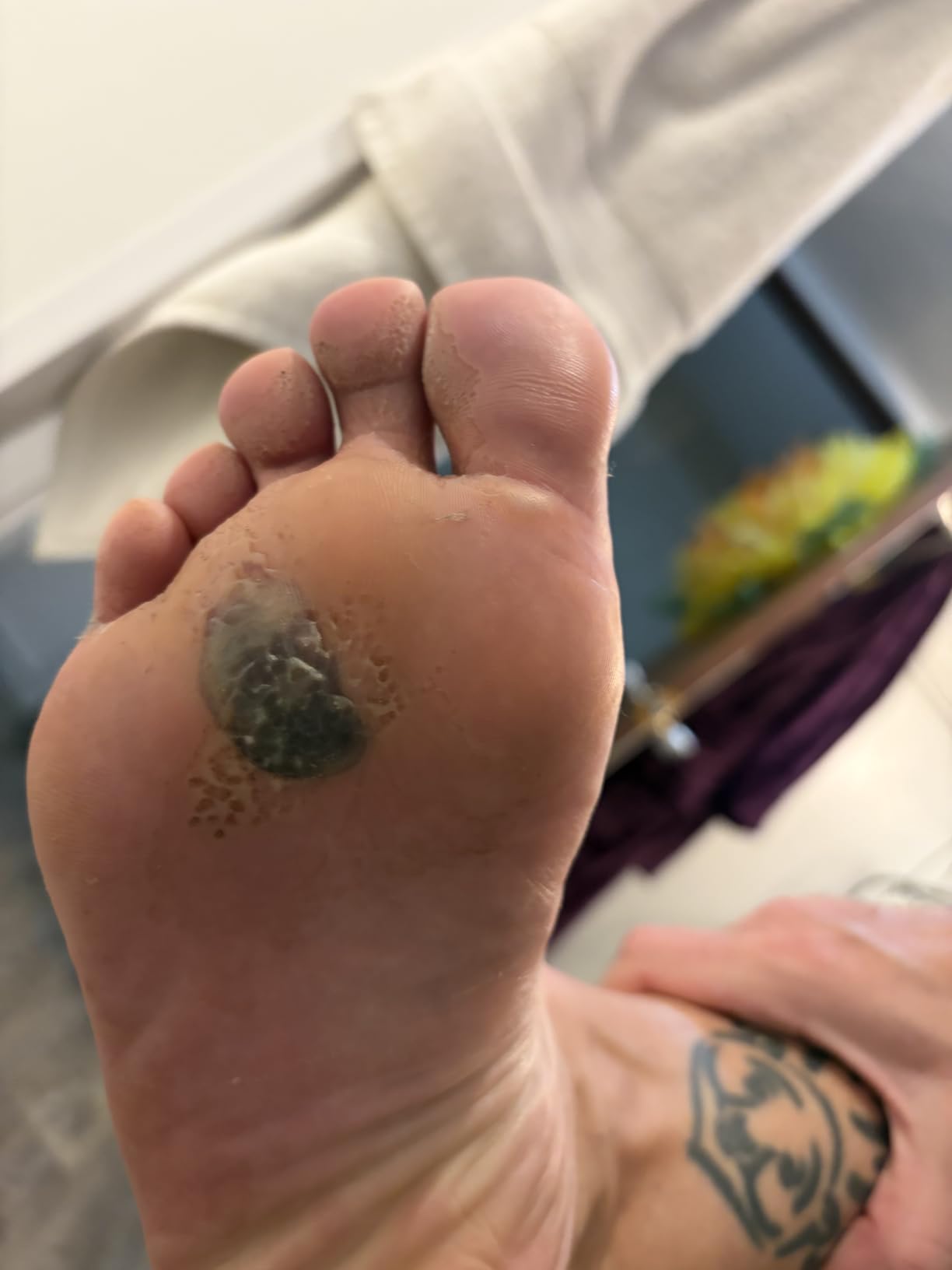
A blister is a fluid-filled tear between the layers of skin, caused by repeated shear. Your foot slides inside your shoe thousands of times per hour, and every one of those slides drags the outer layer of skin across the layer beneath it.
Two things make it dramatically worse. Moisture softens the skin and raises the friction coefficient, so a damp foot slides more than a dry one at the same speed. Heat, from a tight shoe with no ventilation, keeps that damp skin warm and pliable instead of letting it dry out.
Anti-blister socks attack the sliding in three different ways. A well-fitted single layer with a snug arch band simply does not move in the first place. A double layer creates a slip plane so the shear happens between two fabrics instead of against your skin. A toe sock sleeves each toe so there is no skin-to-skin contact at all.
Diagnose your blisters by location first
This is the step most people skip, and it is the one that determines which of these eight socks will actually work for you. The same pair of feet can produce completely different problems in different hikers.
Between the toes: caused by toes rubbing each other, usually in a wider toe box. Only an anatomical toe sock removes the mechanism. Everything else cushions around it. Choose the Colorado Sock Co, or any well-fitting toe sock.
Heel and ball of the foot: caused by the sock migrating fore and aft inside the boot. A snug arch band, a midweight cushion and a foot that is not swelling beyond the boot volume are the fix. The Darn Tough midweight is the standard answer.
Back of the calf and ankle bone: caused by a sock cuff rolling or sitting below the boot collar. This is a height problem. Micro crew or crew that clears the collar fixes it, and a lower cut actually prevents it, which is why the Wrightsock quarter works for low-cut shoes.
Ball of the foot on descents: caused by impact plus forward slide together. Target terry cushion under the ball and a close fit. If the same spot always blisters regardless of sock, suspect your footwear volume rather than the sock.
Merino, synthetic, or a blend
Merino wool regulates temperature, wicks moisture and resists odour better than anything else. Its weakness is abrasion, and pure merino tends to wear through at the heel and ball faster than a nylon-reinforced blend. One long-distance hiker reported holes at the heel within 300 miles of the Appalachian Trail after switching to a 75/25 merino-nylon blend.
Synthetics such as recycled polyester dry dramatically faster, which is why they dominate in hot and wet conditions. They are lighter and they survive repeated washing well, and the cost is odour resistance. Double-layer anti-friction socks are almost always synthetic for that reason.
Blends are the pragmatic middle and are what we would buy for most multi-day trips. The wool percentage in the socks on this list runs from 38% to 63%, and the blends with nylon reinforcement in the high 30s or more are the ones that survive a season.
If you are wool-sensitive, the two Wrightsock socks are the wool-free option here, since both are built on recycled polyester and nylon. Merino sensitivity is real and it is not worth pushing through, and our compression recovery sock guide covers another option for hikers who want graduated support after long days.
Cushion level is footwear volume, not comfort
Cushion is terry loops on the sole, and terry loops take up space. That means a thicker sock changes how your boot fits, and a boot fitted for a thin sock will compress your toes on a descent when you swap in a heavy sock.
Match cushion to footwear. Light cushion belongs in trail runners, low-cut shoes and boots you have already broken in. Midweight is the all-round answer for a standard hiking boot. Full and maximum cushion belong in boots that were fitted with roomy socks or in mountaineering boots where warmth and impact dominate.
The most common mistake we see is a hiker with painful heel blisters who responds by buying the thickest sock available. Thick socks in a narrow boot make the problem worse, because the sock is now being compressed and the material is forced to slide where it was designed to sit still.
Toe socks, double-layer, or single-layer
Single layer is the most direct and the most comfortable for most hikers, provided it fits. It is one fabric, one seam strategy, no stacking, and no extra volume. A true seamless or flat-locked toe is the only seam construction worth buying.
Double layer creates a slip plane and it works, but it adds a second surface, which means more warmth and more volume. The compromise is a single-garment double layer like the Wrightsock socks, which deliver the mechanism without asking you to fit a liner inside a boot that was fitted without one.
Toe socks solve the narrowest problem most completely. They take time to put on, they feel unfamiliar for the first few hours, and fit varies more than any other category. Used as a liner under a hiking sock, which is the most repeated long-distance setup in hiking forums, they combine toe separation with a durable outer layer.
Height, seams, and the rest
Height follows the boot collar. A quarter sock sits below the collar and suits low-cut shoes. A micro crew clears a standard hiking boot collar without adding bulk inside the cuff. A full crew is for boots with a tall collar and for cold conditions where the calf needs coverage.
Seam construction matters more than any other single feature. A seamless or flat-locked toe removes the ridge that your big toe grinds against on every stride. A standard overlocked seam at the toe is a hot spot waiting for a long day.
Fit is the last variable and the least negotiable. A sock that is the wrong length, too narrow at the instep or too long in the toe will blister a well-shaped foot. If your blisters appear in the same spot on every hike regardless of the sock, treat that as a footwear or lacing problem rather than a shopping problem.
What to avoid
Cotton is the first thing to cross off the list. It absorbs moisture, holds it against your skin, and dries slowly, which is the exact combination that produces blisters. Athletic cotton socks are the single most common cause of blisters we hear about.
Also avoid socks with a seamed toe, cheap multi-packs with no stated fibre content, and the assumption that more padding solves a friction problem. Waterproof socks are a specialist tool for cold, wet, static conditions; in ordinary hiking they trap moisture that a wool or synthetic sock would have moved out.
Be cautious with very tight compression socks for hiking. They are built for recovery after activity, and worn all day they can restrict circulation. If you want one for after a long day rather than during it, that is a different use case entirely.
Rotation, care, and washing
Rotation is the most reliable blister prevention available, and it costs almost nothing. On a multi-day trip, three pairs is the practical minimum and five pairs is where rotation becomes genuinely workable. Change at lunch, change every few hours on long days, and never sleep in the pair you hiked in.
For wet crossings, carry your sleep socks separately so a soaked pair is not the pair you put back on at camp. Run the stream, rinse the socks, wring them out, put them back on wet rather than letting them dry around your foot. If you are using our GPS devices to stay on route in bad weather, budget extra time for a full change rather than a quick one.
Wash cold, around 40C, and never use fabric softener. Softener coats the fibre and destroys both wicking and odour resistance, which is the single most damaging thing most people do to their hiking socks. Air dry, and turn socks inside out to protect the toe seam and the terry loops.
Cold conditions add their own gear question rather than a sock question, and our heated socks guide covers that side. For winter footwear, the snowshoe selection determines the volume your socks need to fill.
Frequently Asked Questions
What are the best blister-proof socks for hiking?
The best blister-proof hiking socks are the ones that remove skin movement rather than add padding. A snug single layer with a seamless toe stops the sock sliding, a double layer creates a slip plane between two fabrics, and an anatomical toe sock stops toes touching each other. Match the construction to where your blisters form and to the volume of your footwear.
Do anti-blister socks actually prevent blisters?
Yes, but they prevent a specific kind of blister. Anti-blister socks reduce the shear that causes blisters, so they are highly effective against friction blisters on the heel, ball of the foot and toe webs. They do little against blisters caused by footwear that is simply too tight, or by a boot volume mismatch, which is why fit matters as much as construction.
How can I prevent blisters from forming on my feet while hiking?
Work in this order. First, fix your footwear fit and lace your boots properly, because no sock solves a volume mismatch. Second, keep feet dry with a merino or fast-drying synthetic blend and change socks at midday. Third, add a double layer or toe sock if your blisters are at friction points. Fourth, tape known hot spots before they open, putting tape on skin so the sock rubs tape rather than skin. Fifth, carry a spare pair.
Are Injinji toe socks worth it for hiking?
For between-the-toe blisters, yes. Toe socks sleeve each toe individually so the toes never touch, which removes the mechanism that causes toe-web blisters entirely. The trade-offs are real: they take longer to put on, the feel is unfamiliar for the first few hours, and toe length varies between brands. If your blisters are at the heel or ball of the foot, a toe sock will not help and a well-fitted single layer will.
Which is better, Smartwool or Darn Tough socks?
Darn Tough is the stronger all-round choice for blister prevention, with a denser midweight cushion, a truly seamless knit, tighter midfoot compression that stops the sock migrating, and a lifetime guarantee. Smartwool wins on low volume and weight, which is the right answer for trail runners, hot weather and footwear that was fitted for a thin sock. Darn Tough for boots and loaded packs, Smartwool for light footwear and heat.
What socks should I wear with hiking boots?
Wear a midweight sock with a snug arch band and a micro crew or crew height that clears the boot collar. Cushion level should match how much room your boot has, so a boot fitted for thin socks does not get a heavy sock. Avoid a sock cuff that sits below the collar, because the resulting rub at the ankle bone is one of the most reliable sources of hot spots.
Where to Start
Start with the Darn Tough Hiker Midweight Micro Crew. It is the best hiking sock for blister prevention overall because it grips the midfoot, fuses the toe shut, and survives descents, and because more than 12k ratings say the durability is real. If your blisters are between your toes, go with a toe sock instead, and if your footwear is low-volume or the weather is hot, go lighter with the Smartwool.
Whichever you pick, buy three. The pair you change into at lunch is worth more than any construction feature on this list.