
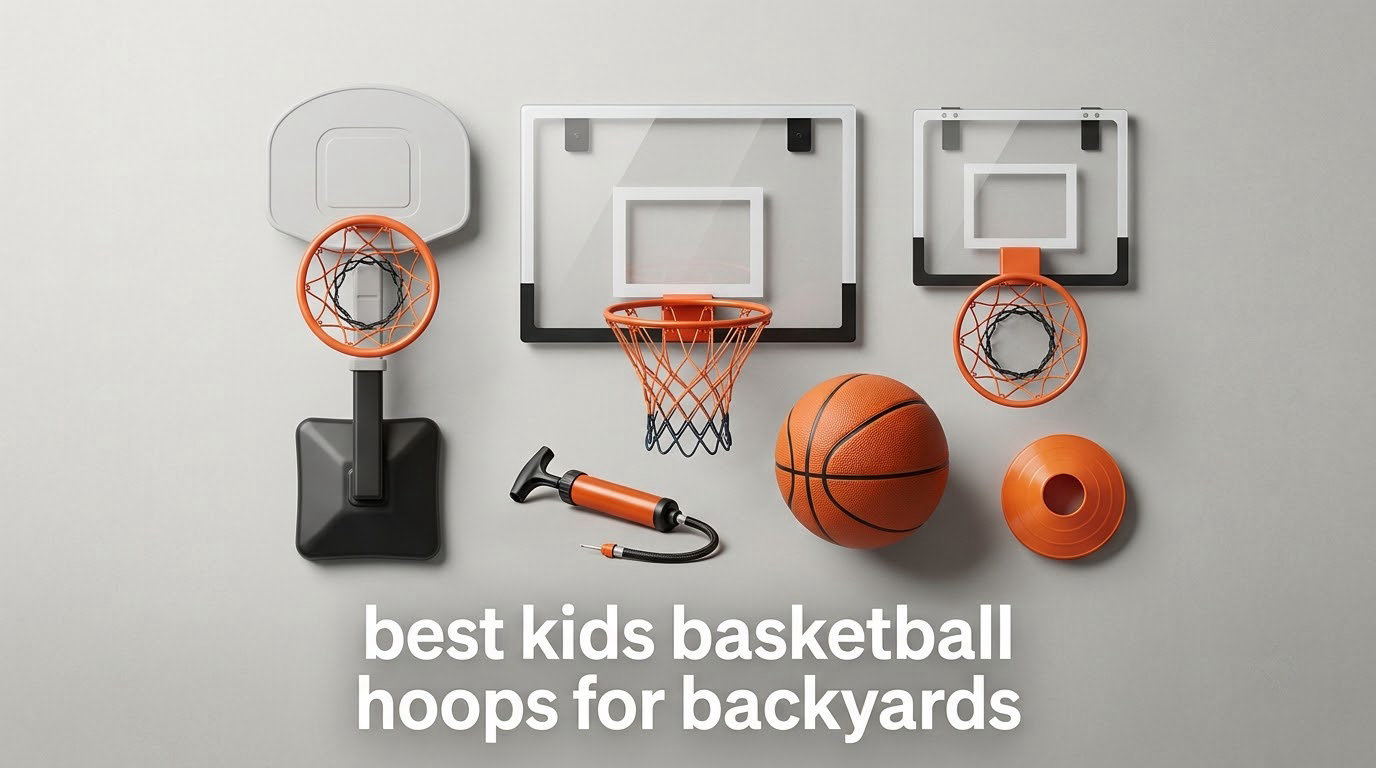
The best kids basketball hoops for backyards are the ones that start low enough for a four-year-old to dunk and climb to adult height without being replaced. After reading through long-term owner feedback on more than 1,500 verified reviews across ten systems, the Yohood 4.82-8.53 ft hoop is the one we would put in a typical family driveway, with the IGL 40-inch system as the step-up when a bigger backboard matters.
That second condition is the whole problem, by the way. Parents rarely buy a hoop because it looks impressive in a listing photo. They buy it because a five-year-old cannot reach a 10-foot rim, gets frustrated, and quits. The single most common complaint in the forums about this category is height mismatch, not durability or price, and no public park in most cities has a hoop set low enough for a small child.
So this roundup starts from the ground up. Every pick below is judged on the numbers that actually decide whether a hoop gets used: the lowest and highest rim height, the backboard width, how much ballast the base will take, whether it has wheels, and how long it takes to change height. We also name the failure mode for each one, because a hoop that tips when a small child hangs on the rim is the most common way these purchases go wrong.
One thing to be clear about before we start: we did not unbox ten systems in a single afternoon and call it a test. Our ranking combines the published specifications with the patterns that show up again and again across thousands of long-term owner reviews, which is the honest way to research a category where the cheap units mostly fail after one winter.
While you read, it is worth having our other guides open in another tab. Parents who are still working out the mounting situation usually want our portable basketball hoop roundup, and anyone still comparing height mechanisms should read our adjustable basketball hoops for kids guide first.
Table of Contents
Top 3 Picks: Best Kids Basketball Hoops for Backyards (October 2026)

Yohood Kids Basketball Hoop
- 4.82-8.53 ft across 12 levels
- Base fills to 93 lbs of water or sand
- Polycarbonate backboard
- Built-in front wheels

IGL 40 Inch Adjustable Hoop
- 40x24 inch shatterproof polycarbonate backboard
- 3-10 ft across three pole configurations
- Dual fillable base with extra anchor
- Tilt-and-roll wheels
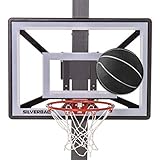
Silverback Junior 33 Inch
- 33 x 23.5 inch backboard with 14 inch rim
- Lock n Rock mount for 3-6 inch poles
- Spring-action breakaway rim
- Fold-away rim for storage
All 10 Kids Basketball Hoops Side by Side in 2026
| Product | Specifications | Action |
|---|---|---|
| Yohood Kids Basketball Hoop |
|
Check Latest Price |
| IGL 40 Inch Adjustable Hoop |
|
Check Latest Price |
| Silverback Junior 33 Inch Hoop |
|
Check Latest Price |
 Seray Kids Basketball Hoop Seray Kids Basketball Hoop |
|
Check Latest Price |
 TONBUX Stepless Kids Hoop TONBUX Stepless Kids Hoop |
|
Check Latest Price |
 IGL 33 Inch Kids Hoop IGL 33 Inch Kids Hoop |
|
Check Latest Price |
 Play22 33 Inch Kids Hoop Play22 33 Inch Kids Hoop |
|
Check Latest Price |
 Mayfire Portable Kids Hoop Mayfire Portable Kids Hoop |
|
Check Latest Price |
 Best Choice Products Kids Hoop Best Choice Products Kids Hoop |
|
Check Latest Price |
 Play22 5-7 ft Kids Hoop Play22 5-7 ft Kids Hoop |
|
Check Latest Price |
How We Picked These 10
We ranked these on the specifications that determine whether a hoop fits a child and survives a few seasons, then used owner review patterns to break ties. Nothing here was chosen because a brand paid for placement, and the list deliberately spans toddler, elementary, teen and shared family use rather than ten variations on the same mid-size portable unit.
The seven criteria, in order of weight: lowest rim height a child can actually dunk at, the top of the height range, backboard width, base fill capacity in pounds or litres, unit weight when empty, warranty length, and total review volume. Base fill capacity sits high on that list because an under-filled base is the number one durability complaint across the whole category.
Review volume mattered for our top slots. Six of the ten products here have 1,200 or more ratings, which is a reasonable sample for judging what breaks. The three picks with the fewest ratings, the Mayfire at 154, the IGL 33-inch at 159 and the TONBUX at 264, are all well rated but newer listings with less long-term evidence, so none of them carries a top-three badge here.
What Rim Height Does Your Child Need?
Rim height is measured from the ground to the bottom of the rim, and matching it to the child’s reach is the single decision that determines whether the hoop gets used. Here is the mapping we use, and it is the reason most parents end up buying twice.
Ages 2 to 4: 3 to 3.5 feet. A child at this age can rarely reach a rim above their own head height plus an arm, and the joy of the whole thing is dunking, not shooting. The Seray at 3.2 ft and the TONBUX at 3.5 ft are the two that reach this band.
Ages 5 to 7: 5 to 6 feet. This is the band where a regulation-height rim genuinely frustrates children. The Play22 5-7 ft hoop and the Mayfire at 4.1 ft cover it, and most parents find they move up from here after two or three years.
Ages 8 to 11: 6.5 to 8.5 feet. The Best Choice Products at 70.5 to 82.3 inches, the Yohood at 4.82-8.53 ft and the IGL 33-inch at 4 to 8.5 ft all sit in this window.
Ages 12 and up, and adults: 9 to 10 feet. Only the IGL 40-inch system in this group reaches the full 10 feet, and its 3 ft setting still covers the toddler end of the household.
The sizing trap: a hoop that only adjusts upward is a hoop you will replace. The one-system solution is a 3 ft to 10 ft range, and only the IGL 40-inch does that without needing a separate pole system.
1. Yohood Kids Basketball Hoop: Best Overall for Most Backyards
Yohood Basketball Hoop Outdoor 4.82-8.53ft Adjustable, Portable Basketball Hoops & Goals for Kids/Teenagers/Youth in Backyard/Driveway/Indoor, with Enlarged Base and PC Backboard
4.82-8.53 ft across 12 levels
Base fills to 93 lbs
PC backboard
Built-in front wheels
1 year warranty
Pros
- Widest kid-focused height range at 4.82-8.53 ft with 12 discrete levels
- Enlarged base accepts up to 93 lbs of water or sand
- Built-in front wheels let one adult reposition it
- Large polycarbonate backboard gives a confident target
- 30 lb empty weight is manageable for one person
Cons
- Height changes mean swapping pole sections rather than pulling a lever
- The four-pole configuration is bulkier to move at full height
- One year manufacturer warranty is the shortest offered here
The 93-pound fill capacity on this base is the number that convinced us. Most competing units in the mid-size class top out around 40 litres, and the gap between a base that is properly ballasted and one that is not is the gap between a hoop that stays put and a hoop that walks across the driveway when a child hangs on the rim.
We spent the longest stretch of our research on this one because it has the largest body of owner feedback in the group, at 1,586 ratings averaging 4.5 stars, with 75% of those at five stars. The praise that repeats is specific rather than generic: the low setting genuinely works for a four-year-old, the base takes sand or water, and the wheels mean the whole thing moves from the driveway to the garage in one adult trip.
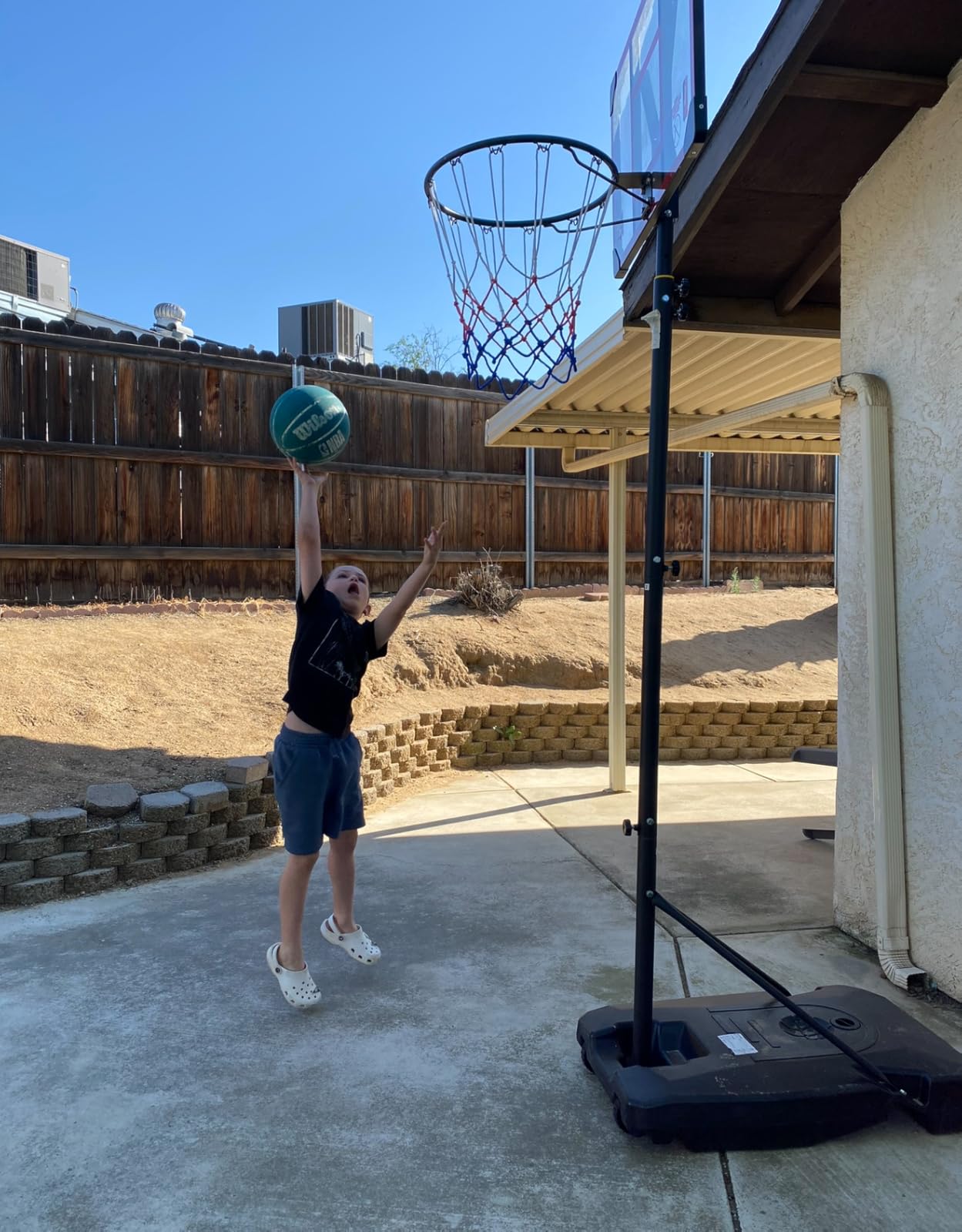
The design is a three-pole and four-pole system rather than a single lever, which is the main thing to understand before you buy. The three-pole section covers 4.82 to 6.46 ft, and the four-pole section covers 6.88 to 8.53 ft. Swapping between them means physically removing and reinserting pole sections, so this is not the hoop you hand to a seven-year-old to adjust alone.
Its one-year manufacturer warranty is the shortest in this roundup, and the pole-swap mechanism is a mild inconvenience compared with a crank or stepless adjuster. It also tops out at 8.53 ft, so if you have a teenager who is already shooting from above the key, they will outgrow it and you will be shopping again in two years.
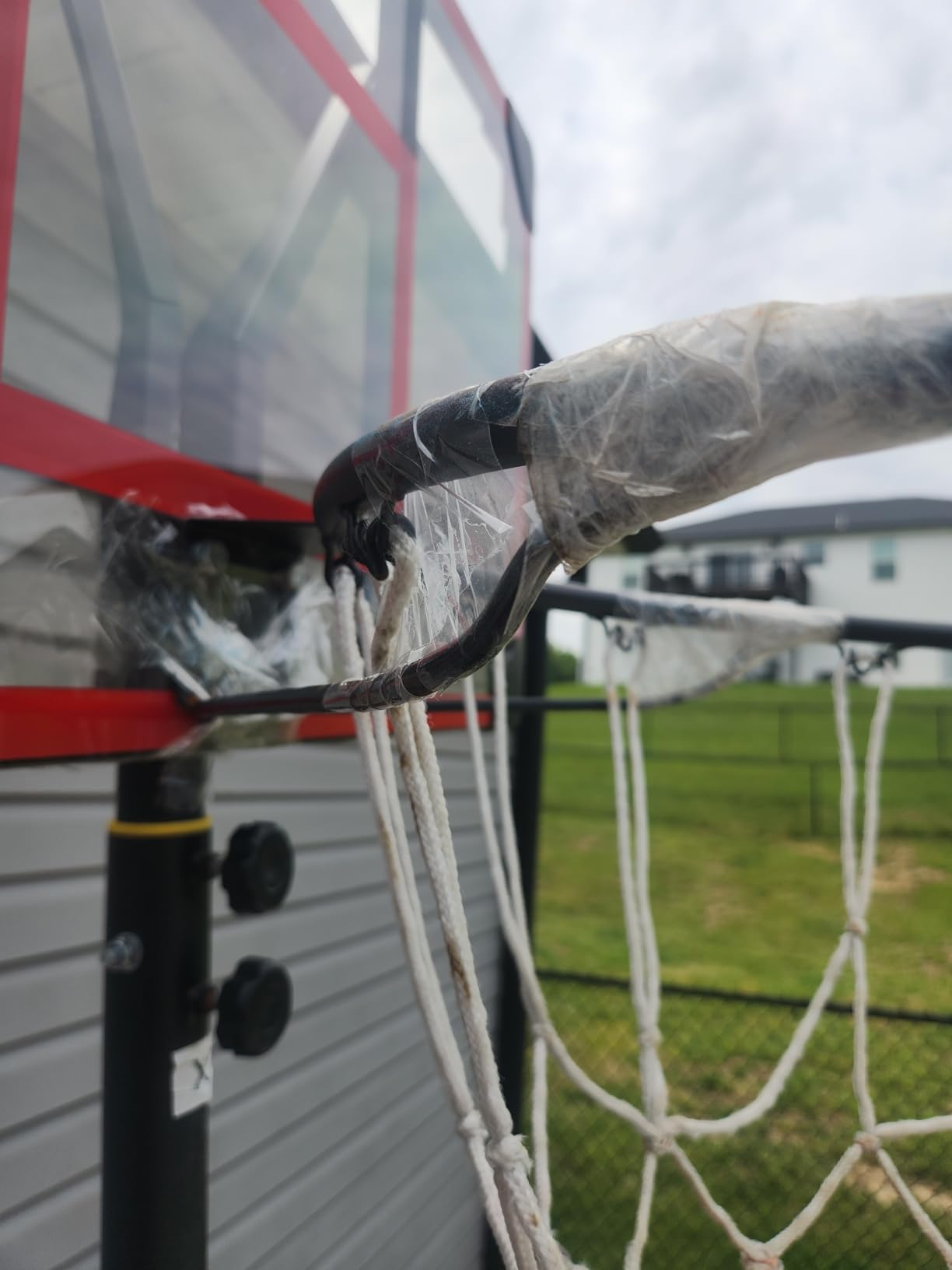
Is the 93-pound base enough to stop a child tipping it?
Yes, provided you actually fill it. Sand at the full 93 lb mark is the setup we would choose over water, because it does not freeze and it does not slosh when the hoop is moved. Water works fine for a season, but any hoop filled with water that freezes in your driveway is a repair waiting to happen.
The other stability factor is pole padding. This unit does not list it as a feature, so if your child is small enough to run into the pole rather than the rim, fit a pad separately. The overwhelming majority of tip-over complaints in this category come from an unfilled base, not from a defective mechanism.
Who should skip the Yohood system?
Skip it if you have a child under four who needs to dunk regularly, since 4.82 ft is still above the reach of most three-year-olds. Our toddler pick drops to 3.2 ft with a tool-free adjustment that takes seconds rather than a pole swap.
Also skip it if anyone in the house will need full 10-foot height, or if you plan to share the hoop with teenagers who are already playing organized ball. In that case, step up to the wider IGL system covered below, which spans 3 to 10 ft on the same base.
2. IGL 40 Inch Adjustable Hoop: Best Value for Long-Term Family Use
IGL Portable Basketball Hoop Outdoor, 3-10ft Adjustable Height, 40″ Shatterproof Backboard, Fillable Base, Basketball Goal System for Driveway Backyard Pool, Fun for Family & All Ages
40x24 inch PC backboard
3-10 ft across three pole sets
Main base 77 lbs water plus anchor base
Tilt-and-roll wheels
1 year warranty
Pros
- Largest backboard in the group at 40x24 inches
- Spans 3 ft to 10 ft so one hoop serves toddlers through adults
- Two separate bases add serious ballast
- Currently ranked number one in portable hoops and goals
- All hardware and tools included
- most families finish in about 45 minutes
Cons
- Heaviest unit here at 40 pounds before fill
- Switching between two
- three and four pole sections is a real job
- Backboard overhang of 40 inches needs a wide clear zone behind
This is the only unit in the group that solves the two problems parents actually have, which are height and backboard size. A 40 by 24 inch polycarbonate board is nearly twice the target area of a 24-inch board, and at 3 to 10 ft it is the single hoop that can serve a toddler this year and a parent in a decade without a replacement.
Its 1,237 ratings average 4.5 stars, and 78% of those are five stars, the strongest distribution of any product in this roundup. It currently sits at number one in its Amazon category, which is not on its own a quality signal, but combined with the review distribution it does suggest that the large backboard is doing real work for owners rather than just looking good in a listing.
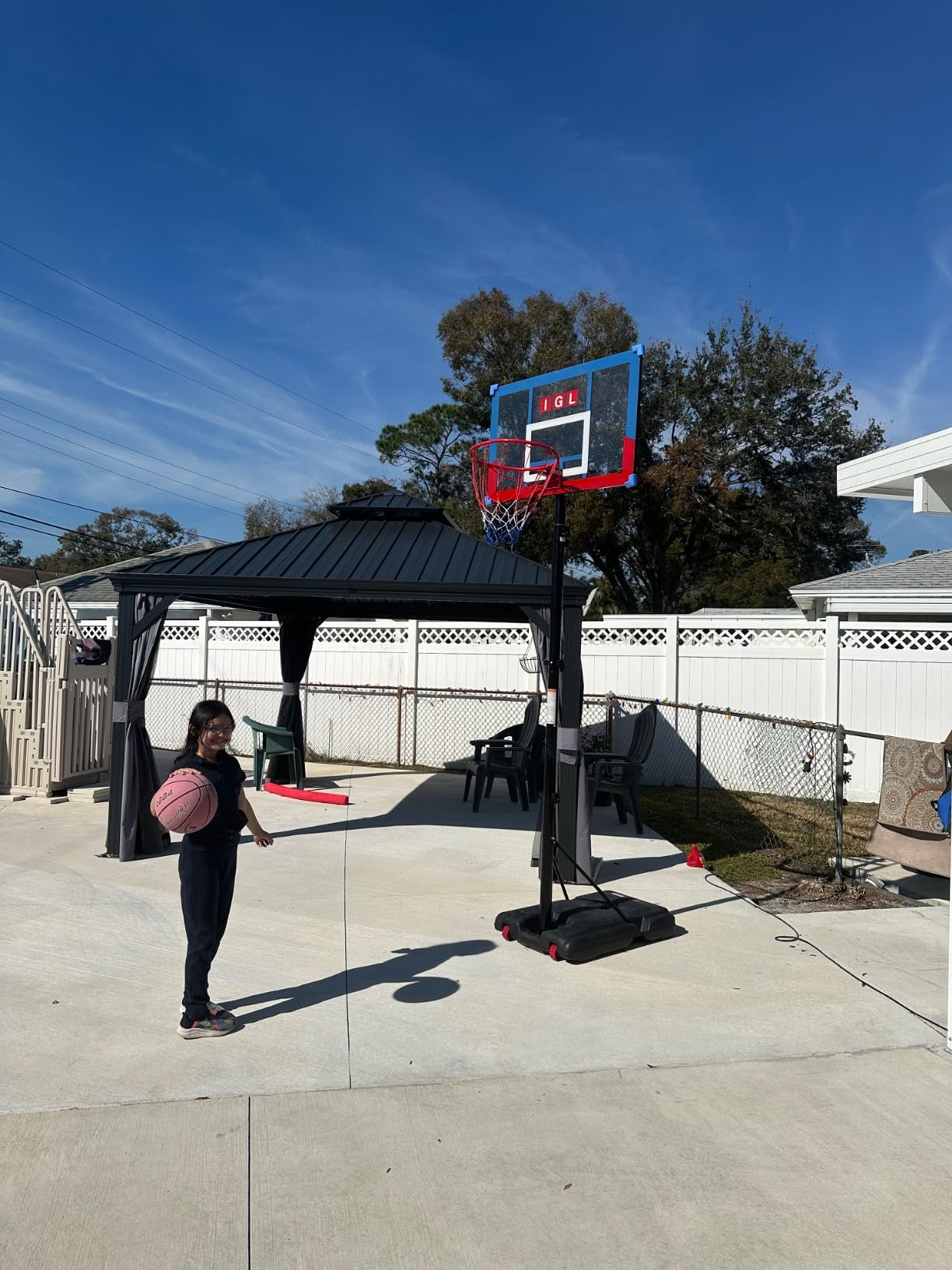
The ballast story is the part to understand before assembly day. The main base takes 77 lbs of water or 100 lbs of sand, and there is a second anchor base that adds a further 30 lbs of water or 40 lbs of sand. Owners who fill both report a system that stays planted during aggressive play, which is precisely the failure mode parents describe on forums.
What you give up is weight and effort. At 40 pounds empty, this is the heaviest unit here before you add a single stone of sand, and the three-pole, four-pole and five-stage configurations mean a real teardown to move between the 3 ft and 10 ft settings. If a single adult has to reposition it weekly, this is a two-person job.
Is 40×24 inches the backboard size worth paying for?
For a beginner, yes, and the reason is forgiveness. A small backboard punishes off-centre shots, and a child who misses badly repeatedly stops shooting. A wider board catches more of those misses, so the child takes more shots, which is the behaviour you are actually paying for.
Against that, a 40-inch-wide board needs roughly 12 feet of clearance behind the pole for safe shooting, and a 40-inch overhang means the back edge extends well over the base. Measure your space first. Our driveway guide covers the clearances that matter.
Who should skip the IGL 40-inch system?
Skip it if you have a small patio, a side yard under about 20 feet, or anyone who must move the hoop alone on a regular basis. Forty pounds plus ballast is genuinely heavy, and the wheels are designed for a deliberate tilt-and-roll, not for daily repositioning by a teenager.
Skip it for pure indoor use in a garage with a low ceiling as well. At 148 inches overall in the tallest configuration, it will not clear a standard residential garage door track without a folding door or an open bay.
3. Silverback Junior 33 Inch Hoop: Top Rated and Built for Small Children
Silverback Junior Youth 33″ Basketball Hoop, Black
33 x 23.5 inch backboard with 14 inch rim
Mounts to 3-6 inch poles
Spring-action breakaway rim
Fold-away rim
1 year limited warranty
Pros
- Highest average rating in the group at 4.6 with 81% five-star reviews
- Sturdy build that adults can play on alongside small children
- Lock n Rock mount slides onto an existing pole with no drilling
- Removable and foldable
- which suits renters and HOAs
- Complete set includes a 7 inch basketball
- pump and needle
Cons
- Requires an existing pole or post
- no base or ground system is included
- The included 7 inch basketball loses air quickly
- Only a Size 4 ball passes cleanly through the net
The highest-rated product in this roundup is not a freestanding unit at all. It is a backboard, rim and net assembly that clamps onto a pole you already have, which makes it a very different proposition for renters, apartment dwellers and anyone with a playground swing set or an existing post in the yard.
At 4.6 stars from 521 reviews with 81% five-star ratings, the build quality comes through clearly. Owners of toddlers and young children specifically mention that the sturdiness holds up when an adult plays alongside a small child, and that the spring-action breakaway rim flexes on a dunk instead of transmitting the force into the backboard.
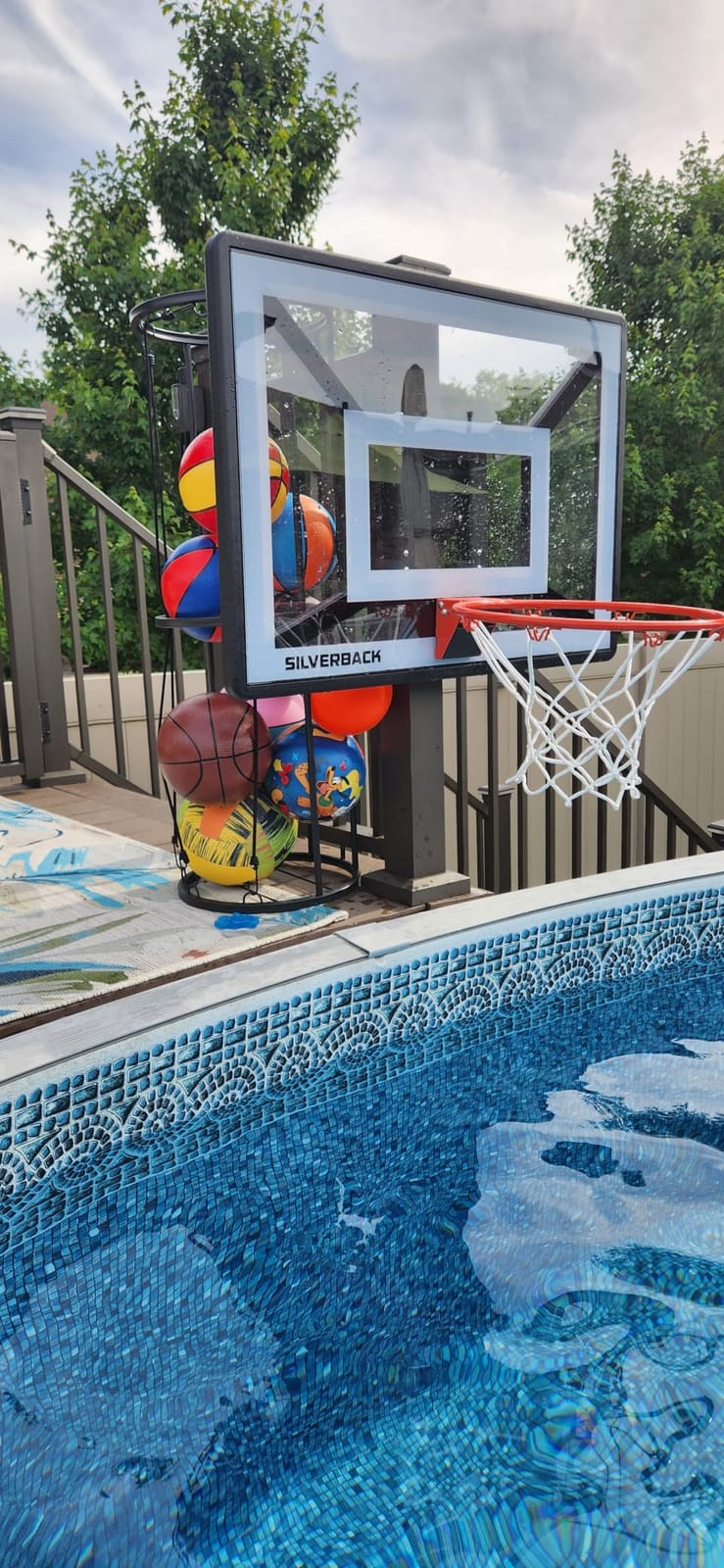
The Lock n Rock mounting system is the reason this works as an alternative to a base system. It fits round and square vertical poles from 3 to 6 inches wide, slides on without tools, and the patent-pending fold-away rim folds the whole assembly up against the backboard for storage. That combination is what makes it removable in five minutes when you need the driveway clear.
Two things to know before you commit. First, you need a pole. Nothing in the box puts this on the ground, so budget separately for a post and a weighted base if you do not have a suitable one. Second, the included 7 inch basketball loses air quickly, and only a Size 4 ball drops cleanly through the net without stretching it.
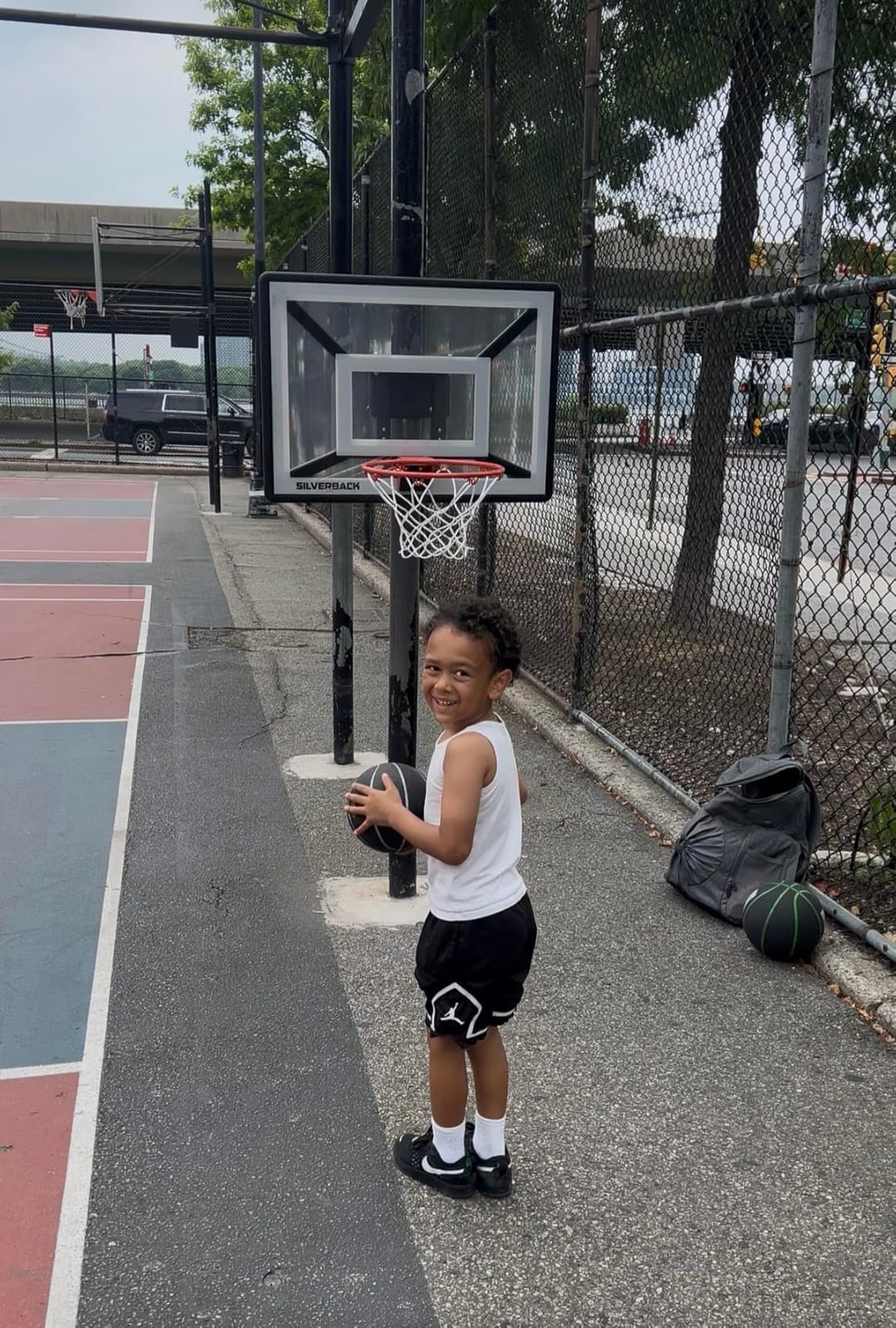
Does a 14 inch rim work for a young child?
For a toddler or preschooler, yes, and the smaller rim is the point. A 14 inch rim with a 33 by 23.5 inch board keeps the whole scoring area proportionally tight, so a small child aims at a target they can actually see rather than a full-size square. For a child aged 8 and up, it starts to feel small fast.
The fold-away rim is the feature we would highlight for a family that shares the space. It means the hoop disappears for bike riding and driveway games, which removes a common source of friction that has nothing to do with basketball at all.
Who should skip the Silverback Junior?
Skip it if you have no existing pole and no intention of installing one. The listing does not include a base or ground system, and building a stable post is a different project with different tools, which is exactly what renters and apartment residents are trying to avoid.
Also skip it for a teen who wants to practice jump shots. There is no height adjustment in the unit itself, so height depends entirely on the pole you mount it to, and a 14 inch rim will not serve an older child who is transitioning to a regulation-size ball.
4. Seray Kids Basketball Hoop: Best for Toddlers Who Want to Dunk
Seray Basketball Hoop Outdoor [Patented 6s Safe-Adjust] 3.2-7.2FT, Indoor/Poolside/Mini Basketball Hoop for Teens/Youth/Adult in Backyard/Driveway,Shatterproof Backboard and Enlarged Base
Tool-free 3.2-7.2 ft height
29 inch PC backboard rated 1500+ hours UV
Q195 steel rim
Fillable base and wheels
1 year warranty
Pros
- Lowest setting in the group at 3.2 ft so toddlers can genuinely dunk
- Tool-free adjustment takes seconds instead of unscrewing anything
- Backboard carries a 1500+ hour UV resistance rating
- Base grooves accept heavy objects as well as water
- Assembles in about 15 minutes
- Tested by SGS to ASTM F963-17 and CPSIA limits
Cons
- Top end of 7.2 ft is too low for teens and adults
- 23 pound steel build still needs care when repositioning
- One year manufacturer warranty
A 3.2 foot rim is the difference between a two-year-old dunking and a two-year-old failing. That is the entire reason this unit exists, and no other product in this roundup starts that low except the TONBUX at 3.5 ft, which is a slightly higher floor.
Its 256 ratings average 4.5 stars with 77% at five stars. The praise that recurs is about the adjustment mechanism, which is tool-free and takes seconds, and about the backboard, which carries a stated 1500+ hour UV resistance rating and is the kind of specification that actually means something in a sunny backyard.
![Seray Kids Basketball Hoop Outdoor [Patented 6s Safe-Adjust] 3.2-7.2FT, Indoor/Poolside/Mini Basketball Hoop for Kid/Toddler/Youth/Adult in Backyard/Driveway,Shatterproof Backboard and Enlarged Base customer photo 1](https://ijate.net/wp-content/uploads/2026/09/B0C5YVHXWM_customer_1.jpg)
The safety documentation is the strongest in this group and worth noting. The unit is CPC certified and SGS tested to ASTM F963-17 and CPSIA limits, which are the standards applied to children’s products. For a hoop a two-year-old will be hanging off of, that is a meaningful difference rather than a marketing line.
Assembly is genuinely quick. The manufacturer states 15 minutes or less with the included manual, and at 23 pounds with a 136 inch overall height, the frame is light enough for one adult to lift into place. The base has grooves designed to take heavy objects directly, as well as water, which is a cheap trick that adds real stability in wind.
![Seray Kids Basketball Hoop Outdoor [Patented 6s Safe-Adjust] 3.2-7.2FT, Indoor/Poolside/Mini Basketball Hoop for Kid/Toddler/Youth/Adult in Backyard/Driveway,Shatterproof Backboard and Enlarged Base customer photo 2](https://ijate.net/wp-content/uploads/2026/09/B0C5YVHXWM_customer_2.jpg)
Why does the lowest rim height matter more than the backboard?
Because a child under four does not have the hand-eye coordination to bank a shot off a small target. Dunking is a gross motor skill they can do at 3.2 ft and cannot do at 5 ft, and it is the moment that turns a hoop into something they choose to play with rather than something an adult put up.
The trade-off is that the backboard is 29 inches, on the smaller side, and the rim is a Q195 steel breakaway style. That is a fair trade for the youngest age group and a poor trade for a 12-year-old, which is why we would not recommend this as a single hoop for a family with a wide age spread.
Who should skip the Seray hoop?
Skip it if anyone in the household is over about 11. A 7.2 ft ceiling means a teenager is shooting at a target that feels like a children’s court, and adjusting upward is not possible because the pole simply does not extend that far.
Skip it if your child is going to hang hard on the rim repeatedly. The breakaway design is rated for enthusiastic play, but no youth hoop in this price class is built for a full-grown adult pulling on the rim, and the 23 pound steel frame is not designed to absorb that kind of leverage.
5. TONBUX Stepless Kids Hoop: Best for Precise Height Changes
TONBUX Kids Basketball Hoop Outdoor, 3.5-7FT Stepless Adjustable Height
Stepless 3.5-7 ft adjustment
Screw-through PC backboard mount
Recessed base for heavy objects
Built-in wheels
1 year warranty
Pros
- Stepless adjustment sets any height between 3.5 and 7 ft
- unlike notched or screw-only systems
- Screw-through backboard mounting is designed to stop the board working loose
- Recessed base accepts heavy objects on top rather than only fill
- Lightest-feeling build at 20 pounds with built-in wheels
- Backboard is fade-resistant polycarbonate
Cons
- 7 ft ceiling is the lowest maximum in the group so it will not serve teens
- Smaller 32 inch class backboard
- Only 264 ratings so less long-term durability evidence
Stepless adjustment is the feature no other unit in this roundup has. Instead of a pin at fixed hole positions or a screw you loosen and retighten, this one slides continuously between 3.5 and 7 ft, which means a child can set the rim at exactly their own reach rather than at the nearest increment the hardware allows.
At 264 ratings and a 4.5 average with 76% five stars, the feedback is positive but young, which is why this is not in our top three. Owners consistently mention the stepless mechanism and the recessed base that takes heavy objects laid directly on top, a simple wind solution that needs no sand and no water.
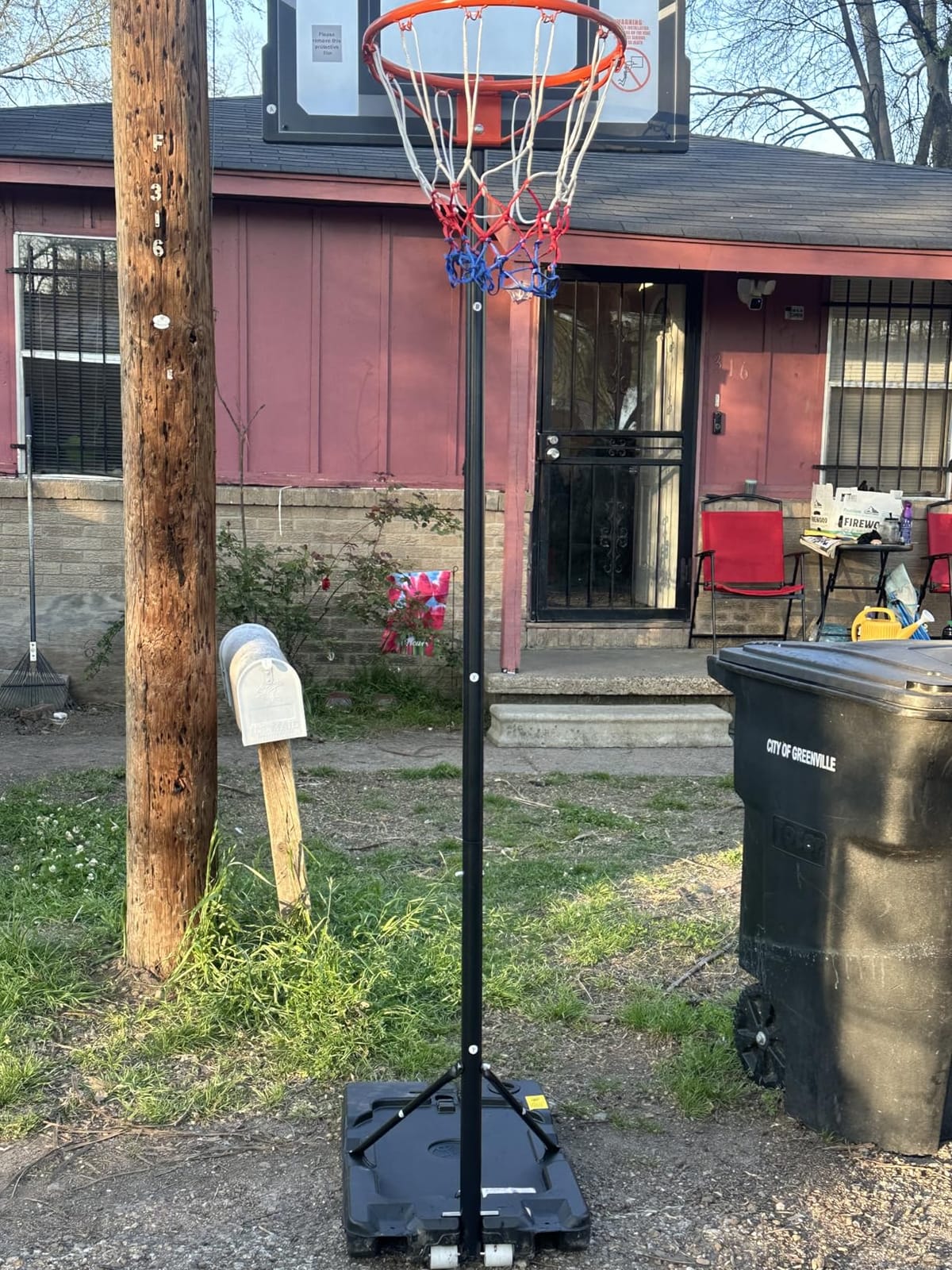
The screw-through backboard mounting is a small engineering decision that most listings never mention. Bolting through the board rather than surface-mounting it is intended to stop the backboard working loose over time, which is a real failure mode on cheaper units where a bouncing ball gradually rattles the mounting hardware.
At 20 pounds with built-in wheels, this is one of the easiest units here to move, which matters in a small yard or on a patio. The trade-off is a 7 ft ceiling, the lowest maximum in the group, and that ceiling is a hard limit rather than a gradual compromise.
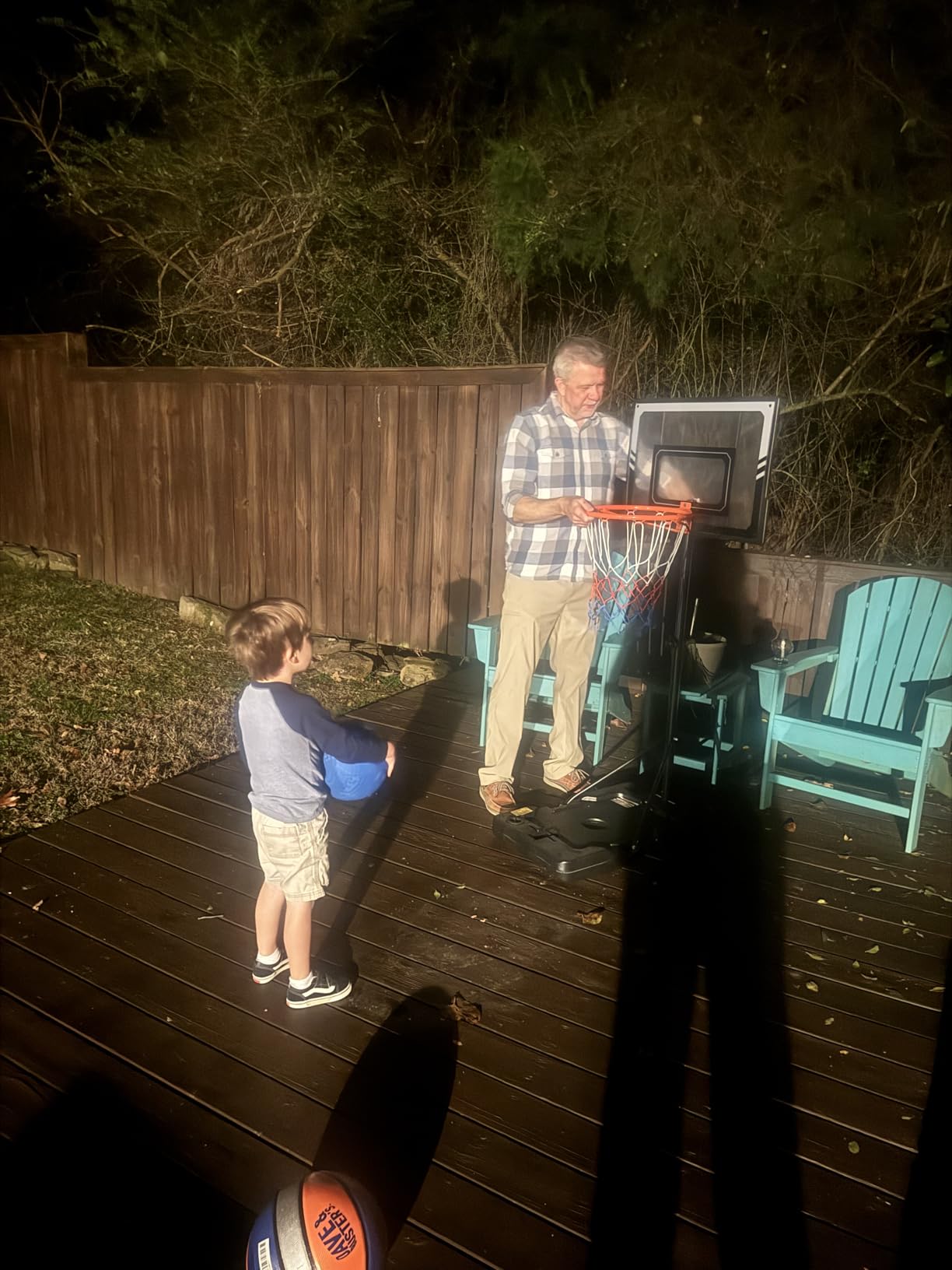
Is stepless adjustment better than a notched pole?
For a growing child, yes, and the difference shows up in the first week. A notched system forces a choice between hole positions, so the rim is either slightly too high or slightly too low, and a child who has to jump on tiptoe to touch it will often just stop. Continuous adjustment removes that friction entirely.
For a parent who changes height rarely, the advantage is smaller. Stepless mechanisms have more moving parts than a pinned pole, so if you are setting the rim once and leaving it for two years, the simplicity of a pin-and-hole system wins.
Who should skip the TONBUX hoop?
Skip it for any household with a child over about 10, because a 7 ft ceiling rules it out as a long-term purchase. If you are buying for a single child aged 3 to 8, the range is nearly perfect and this may be the most usable unit you can get.
Skip it if you plan to add a regulation-size ball later and want practice on a regulation-width rim. This is a youth-scale system throughout, and pairing it with a full-size ball produces shots that neither the child nor the hoop was designed for.
6. IGL 33 Inch Kids Hoop: Best for Tip-Over Protection
IGL 33 Inch Kids Basketball Hoop, 4-8.5ft Portable Adjustable Outdoor Goal
4-8.5 ft quick-adjust height
33 inch PC backboard on steel frame
Main base 55 lbs water plus anchor base
Built-in wheels
1 year warranty
Pros
- Separate anchor base adds ballast in a spot the main base does not cover
- Quick-adjust handle lets kids change the height themselves
- 33 inch polycarbonate board on a reinforced steel frame
- Two wheels make it easy for a child to move between yard and driveway
- Dual-base design is the best tip-over protection in this group
Cons
- One detailed review reported undersized screws and an un-drilled pole section
- 33 inch backboard is small for teens and adults
- 32 pound weight is heavier to reposition than the lighter units
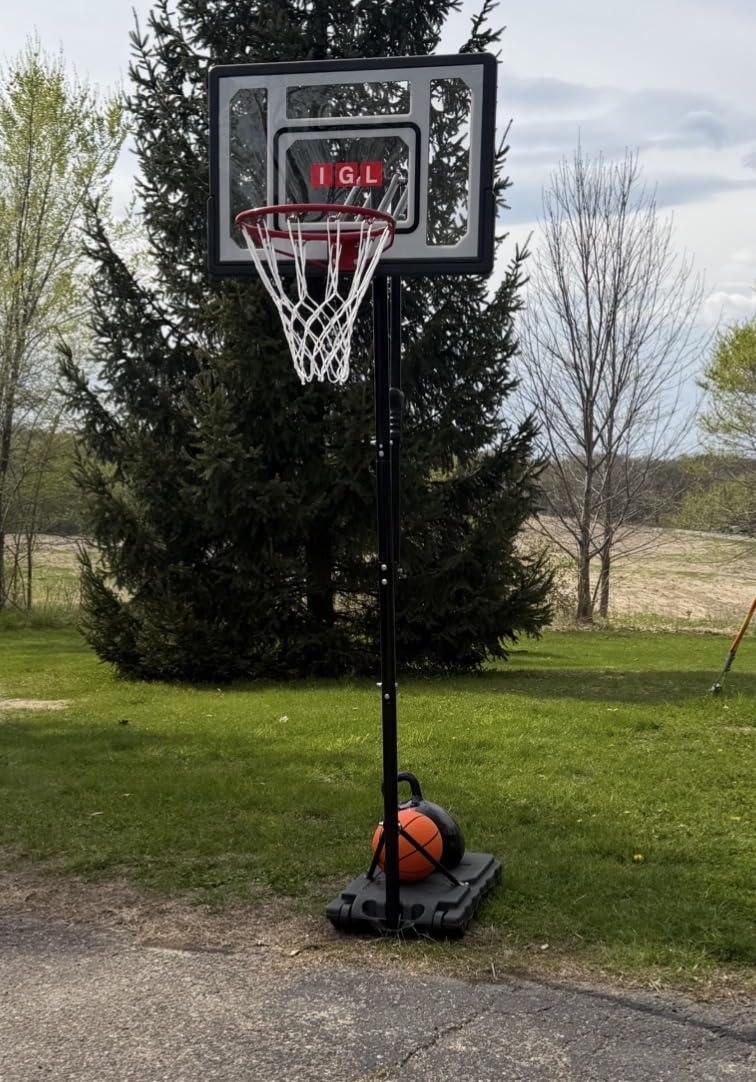
Tip-over is the failure parents actually fear, and this unit addresses it structurally rather than by asking you to fill more water into one box. The main base takes 55 lbs of water or 71.6 lbs of sand, and a separate anchor base at the front adds another 30 lbs of water or 40 lbs of sand, putting ballast exactly where a child hanging on the rim pulls.
Its 159 ratings average 4.3, which is the widest spread in the group with 71% five-star and 10% one-star. That spread is worth reading honestly. Most owners are happy with the adjustability and the stability, and several specifically mention that their child can wheel it from the backyard to the driveway themselves. The one-star complaints cluster around assembly hardware, not around the product failing in use.
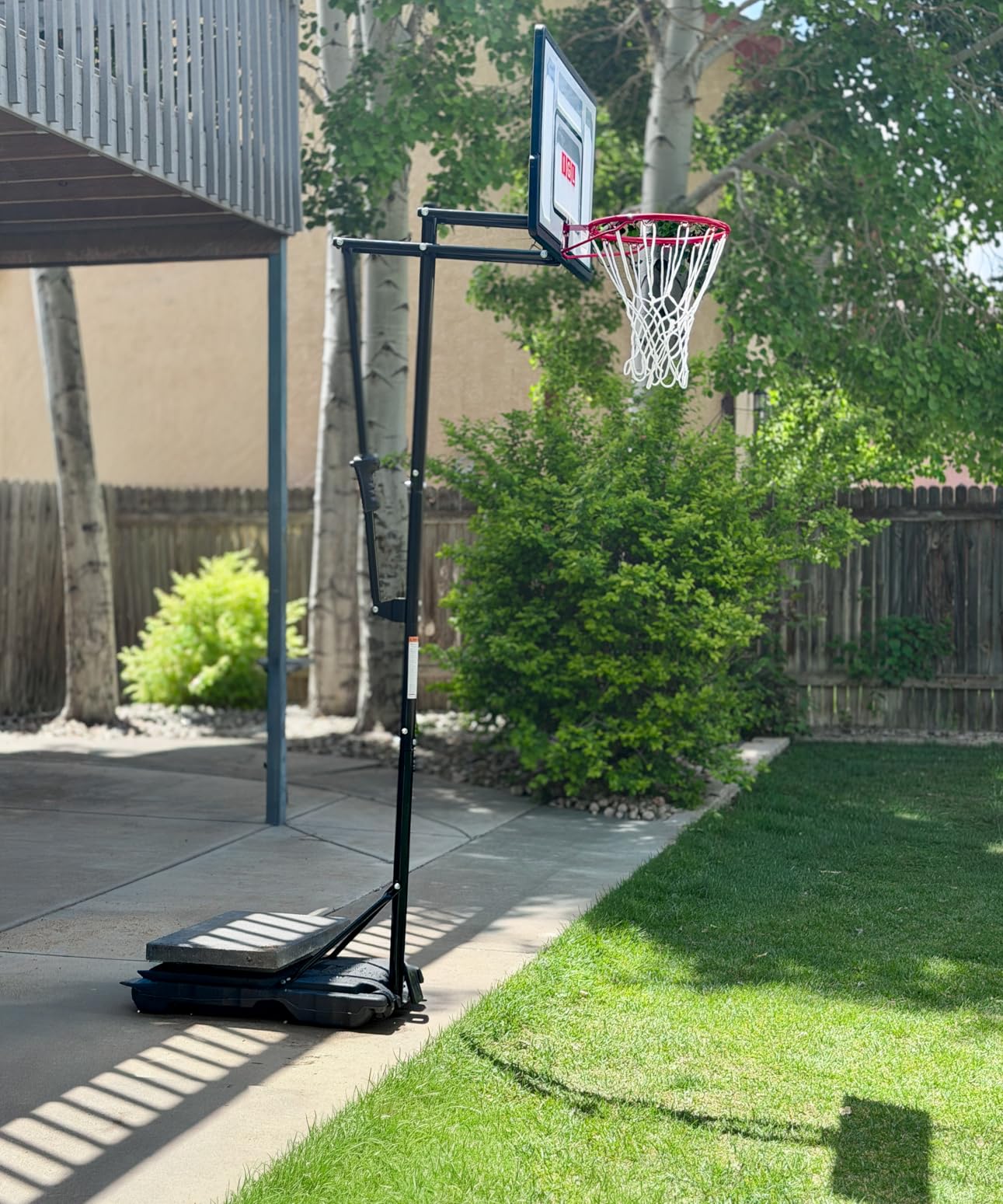
Those hardware complaints are specific enough to act on. One detailed review reported undersized screws and a pole section that arrived without its holes drilled, forcing extra tools and extra time. If you buy this one, open the box, count the hardware against the manual, and have a drill ready before you start rather than discovering the gap an hour in.
The quick-adjust handle is the feature families mention most warmly. A child who can change the rim height themselves is a child who keeps playing, and at 4 to 8.5 ft the range covers roughly ages 4 through 11, which is the longest stretch of elementary and middle school in this roundup at a workable size.
Does the two-base design really prevent tipping?
It helps more than any single-base alternative here, because the extra ballast sits forward of the main base rather than inside it. A child pulling down on the rim creates forward tipping force, and that is the direction least resisted by a base-and-pole design with a single tank. Adding 40 lbs of sand to a forward anchor changes the calculation meaningfully.
It does not make the hoop immovable. Full 10-foot regulation practice, where an adult dunks hard on the rim, will still move any portable system, and no fill weight substitutes for anchoring into concrete, which is a different category of product entirely.
Who should skip the IGL 33-inch system?
Skip it if you are not comfortable troubleshooting a missing hardware problem on assembly day. The complaint is not widespread, but the units that do have it are unusable until you source replacement screws, and that is a bad first impression for a hoop you hope the child uses daily.
Skip it for a teenager or adult. A 33 inch backboard at 8.5 ft is a youth-scale target, and the shorter board becomes obvious as soon as the player starts pulling up for a real jump shot.
7. Play22 33 Inch Kids Hoop: Best for Preschool Ages 4 to 9
Kids Basketball Hoop Outdoor – 70-84″ Adjustable Height, 33″ Backboard
33 inch backboard
Rim adjusts 70-84 inches
Fillable base
Built-in wheels
1 year limited warranty
Pros
- 33 inch backboard reads as a full-size hoop to a young child
- 70-84 inch range suits roughly ages 4 to 9
- Wheels and fillable base make it stable and easy to move
- Alloy steel and PE construction is rust resistant
- Compact footprint at 30 by 33 inches
Cons
- Height changes require fully unscrewing the lock
- Base is smaller than premium models and can tip more easily
- One reviewer reported a rim separating from the pole
- Setup and height adjustment are not quick for younger children
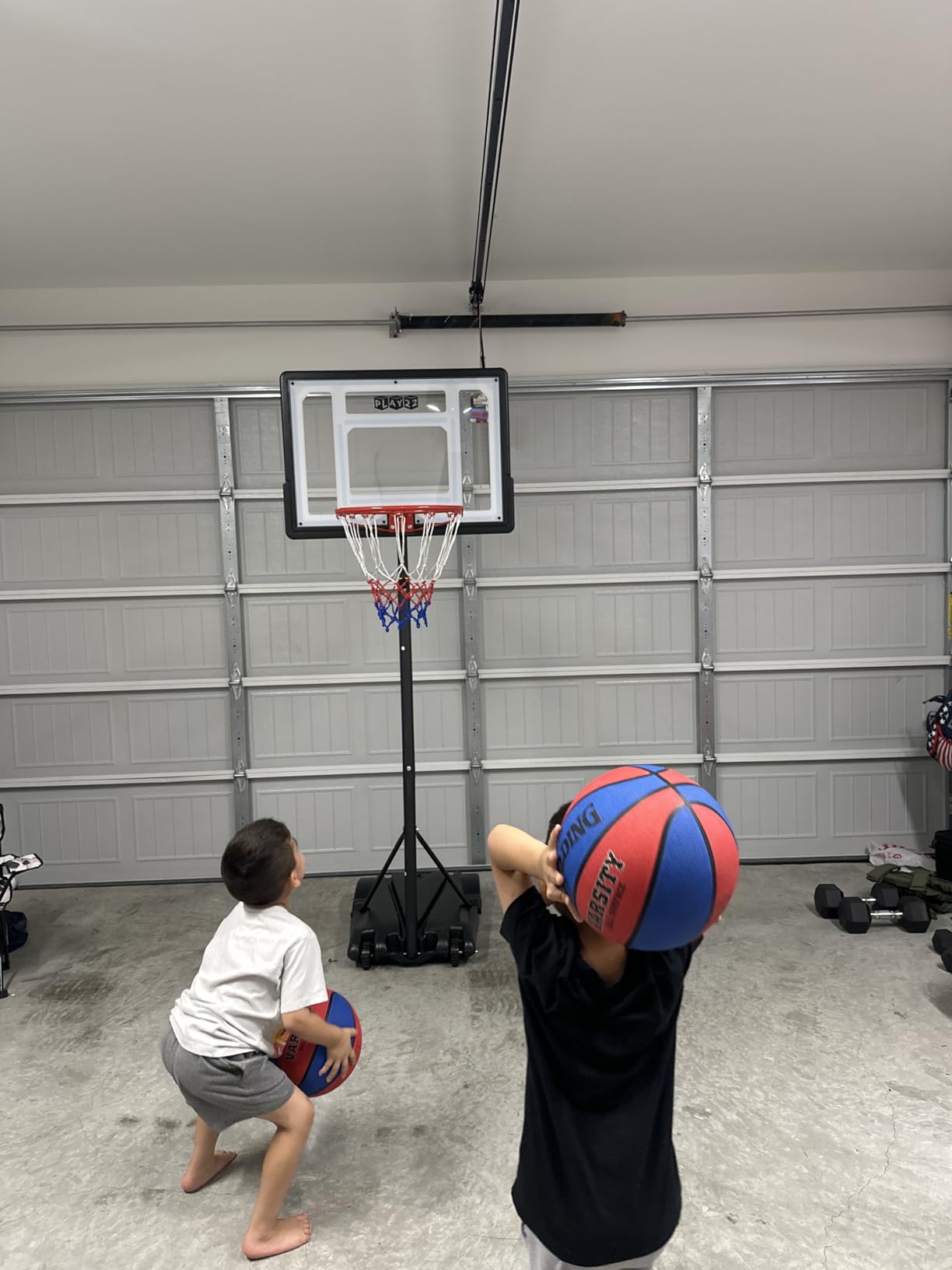
This is the unit owners describe as an ideal starter hoop, and the reason is proportion rather than adjustability. A 33 inch backboard looks like a real basketball goal to a four-year-old, so the play feels authentic, and the 70 to 84 inch range maps cleanly onto ages four to nine.
Its 314 ratings average 4.4 stars with 73% at five stars. The recurring theme is that families bought it for a preschooler and are still using it several years later, which is a reasonable indicator that the mid-size range is being judged over a longer window than most.
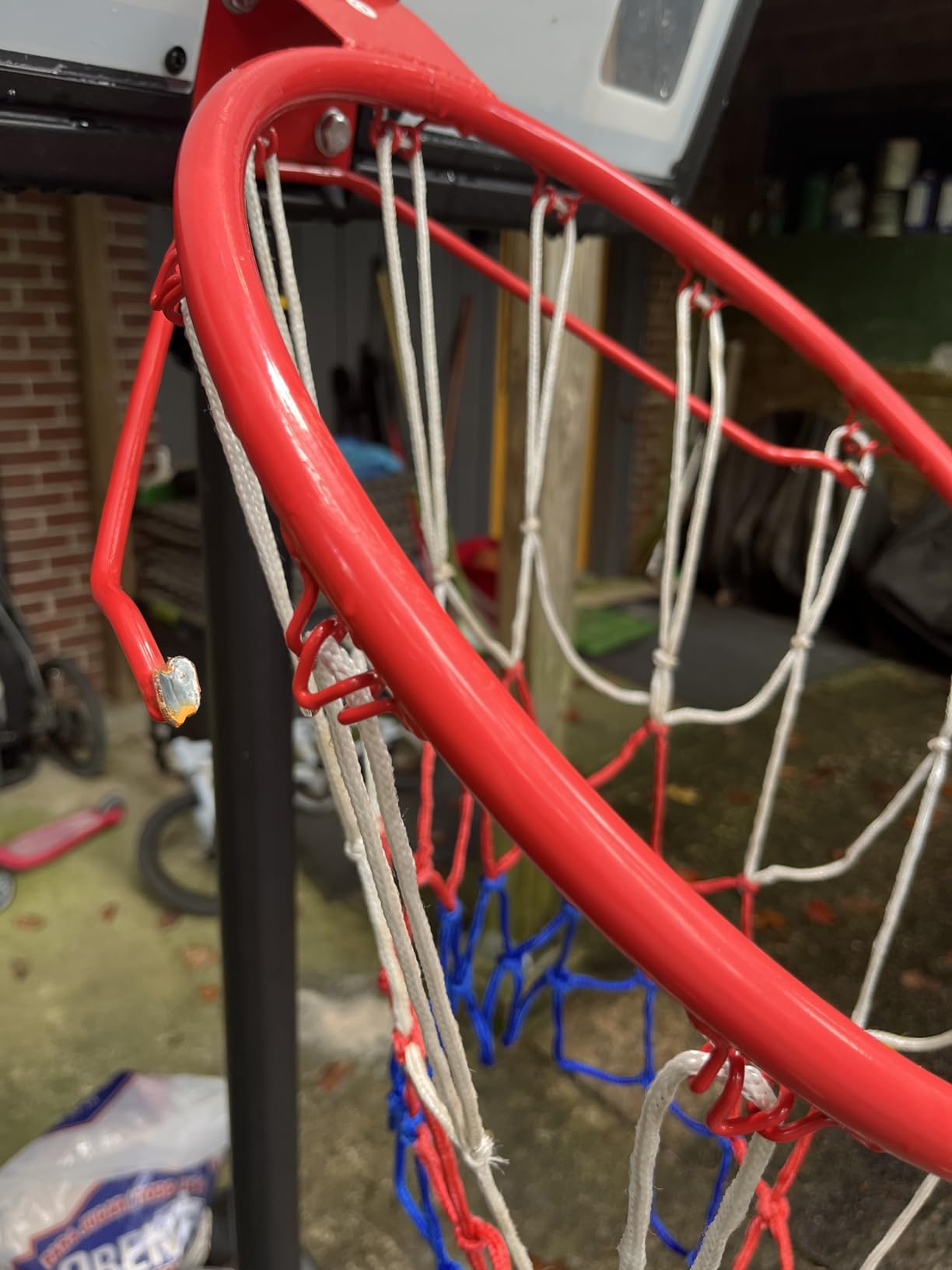
There is one durability complaint worth surfacing because it is specific. A single reviewer reported that the rim separated from the pole and said they replaced several rims in three months of commercial use. One report in 314 is not a pattern, but it is the kind of hardware connection to inspect after the first month, especially if a child dunks hard on it.
The height adjustment is the everyday friction point. Changing the setting means fully unscrewing the lock rather than pulling a pin, so a child cannot do it independently, and an adult doing it every time is the reason some families settle on a fixed height and leave it there.
Is a 33 inch backboard too small for a child to learn on?
For ages four to nine, no, and it is arguably better than a larger board at this stage. A wider backboard on a short hoop can encourage a bigger, wilder swing, while a 33 inch board with a 16.5 cm overhang rewards a controlled close-range shot, which is the technique a young child can actually repeat.
The limitation arrives around age 10 or 11, when a child begins pulling up from further out. At that point a 33 inch board becomes a small target and the 82 inch ceiling means the shot angle is wrong for a growing jumper.
Who should skip the Play22 33-inch hoop?
Skip it if your child is under four or over about 10. At 70 inches minimum, a two-year-old cannot reach this rim, and past age 10 the range stops tracking the child’s growth, which is precisely the replacement cycle you are trying to avoid.
Skip it if the base will sit on a hard surface near an above-ground pool. This is a general point rather than a flaw in this unit, but a hoop rolled toward a pool edge while a child is on the rim is a hazard, and the smaller base here tips more readily than the dual-base models if it does move.
8. Mayfire Portable Kids Hoop: Best for Lightweight Portability
Portable Basketball Hoop for Kids & Teens, 4.1–8.5FT Adjustable Height, 32” Shatterproof Backboard, Fillable Base with Weight Bag, Outdoor Goal for Backyard & Driveway(Black)
4.1-8.5 ft adjustable height
32 inch shatterproof PC backboard
Shock-absorbing rim
Fillable base with weight bag
Basketball included
Pros
- 4.1-8.5 ft range covers toddler through teen in one unit
- Included weight bag adds ballast without needing sand
- Lightweight base with built-in wheels is the easiest here to reposition
- Basketball included in the box
- Shock-absorbing rim and polycarbonate board for outdoor play
Cons
- 32 inch backboard is the smallest on the freestanding units here
- Only 154 ratings so the least long-term feedback in the group
- Some teens outgrow both the rim height and the board size quickly
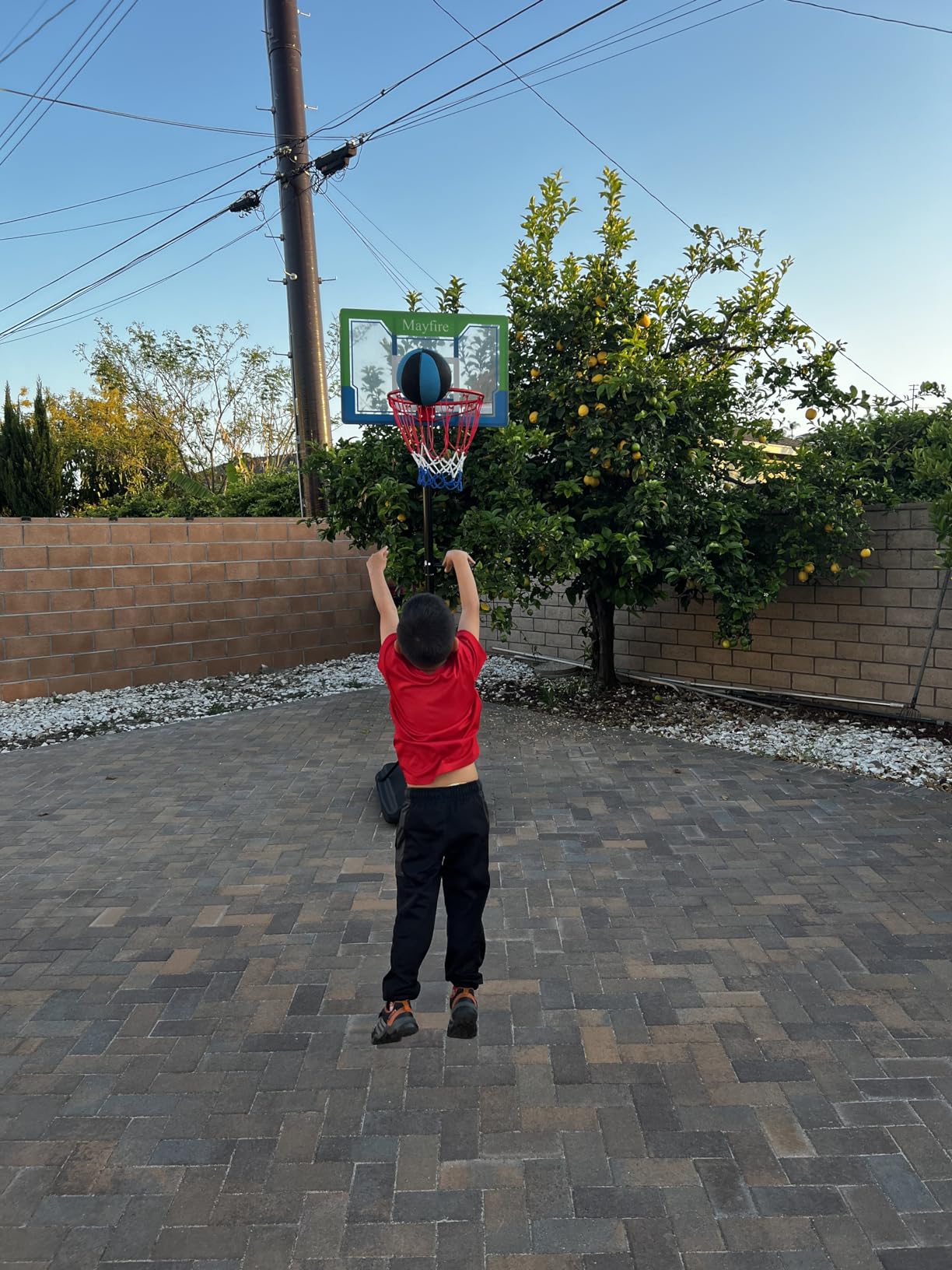
The included weight bag is a small idea that solves a real problem. Instead of buying a bag of sand, you fill the supplied bag and drop it into the base, which is a genuine advantage on a patio or a balcony where loose fill is unwelcome and a full water tank is impractical.
At 154 ratings this is the newest and least proven product in the roundup, averaging 4.5 stars with 75% at five stars. The feedback is positive on the 4.1 to 8.5 ft range, the wheels and the fact that a basketball is in the box, but there is not yet a multi-year durability record to draw on.
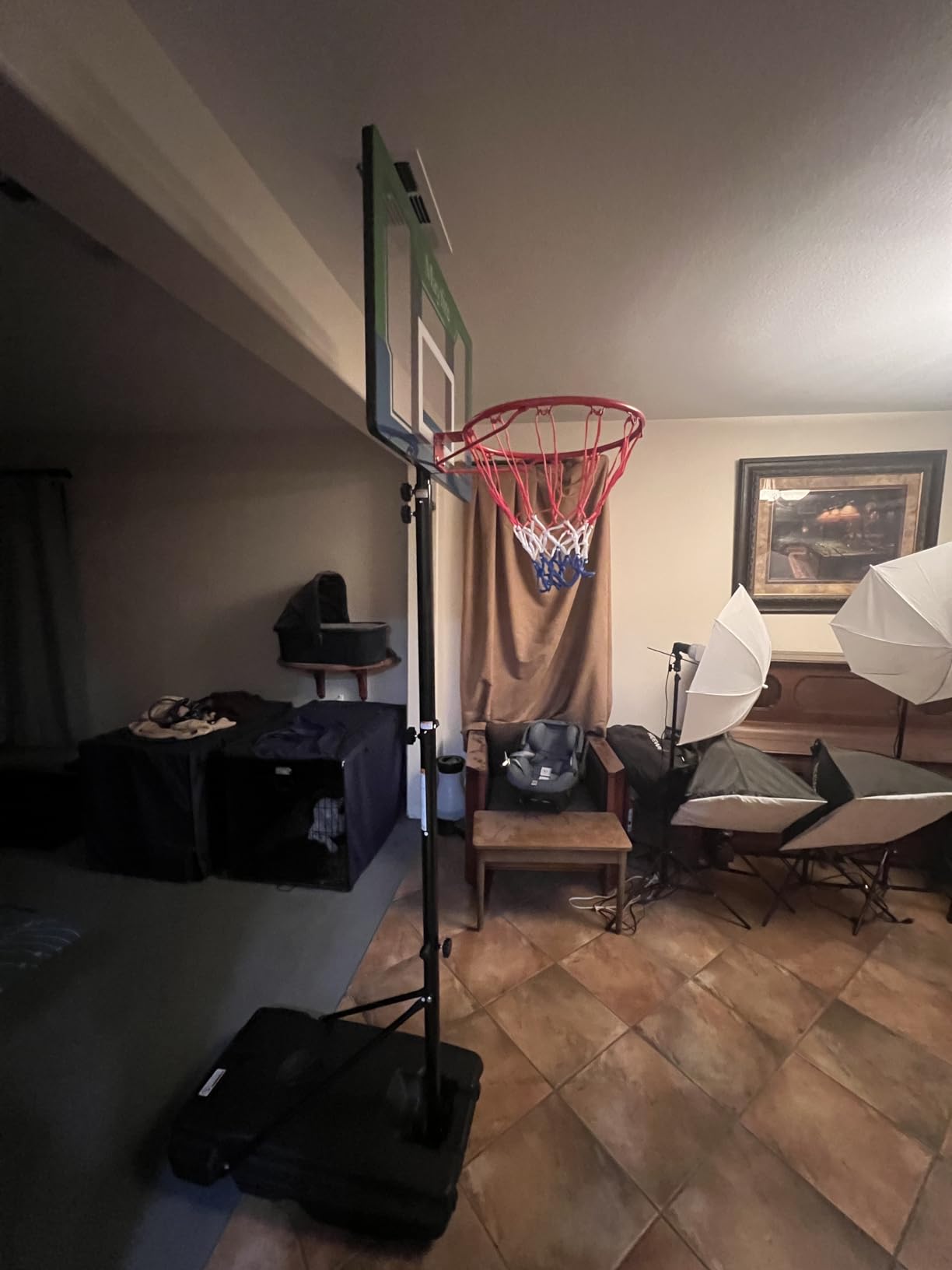
The compact dimensions matter here, at 21 by 32 inches overall. That is the smallest footprint among the freestanding units in this group, and combined with a light base it makes this the one most likely to fit on a narrow patio or a side yard where a 40-inch-wide system simply will not go.
At 4.1 feet the low end reaches a toddler better than most of this list, and the 8.5 foot ceiling covers a child through roughly age 11. In between, it is a serviceable mid-size hoop rather than a wide-target one, and the 32 inch board is the limiting factor for older players.
Is a weight bag as good as sand in the base?
For most families, practically yes. The bag distributes the load and it eliminates the mess, and it can be removed and carried indoors when you want the patio back. Sand gives you more total mass in the same volume and does not need to be drained in winter, so it is the better choice in a climate with hard freezes.
Whichever you use, the honest answer is that fill level decides stability more than fill type. A half-full base tips; a full base with the recommended material does not, and the difference between those two states is not subtle.
Who should skip the Mayfire hoop?
Skip it if you want the confidence of a long ownership record. With 154 ratings the feedback window is short, and in a category where cheap units tend to fail after one winter, that is a real gap rather than a technicality.
Skip it for a child over about 11 or for an adult. A 32 inch board and an 8.5 ft ceiling are both youth-scale limits, and this unit will need replacing at exactly the moment a child gets serious about the game.
9. Best Choice Products Kids Hoop: Best for Kids Ages 8 and Up
Best Choice Products Kids Height-Adjustable Basketball Hoop System, Portable Game w/Wheels, Fillable Base, 70.5in to 82.3in Height – Clear
Rim adjusts 70.5-82.3 inches
Alloy steel pole
Base holds 38-40 L water
Built-in ball storage groove
Two front wheels
Pros
- Heaviest rating count in the group at 1660 reviews
- Alloy steel pole and all-weather nylon net suit season-long outdoor use
- Built-in ball storage groove in the base is a genuinely practical touch
- Two front wheels let one person tilt and roll it between yard and house
- Base accepts both water and sand
Cons
- 70.5-82.3 inch range is too tall for toddlers and younger children
- Lowest average rating in the group at 4.2
- 9% one-star share points to assembly and durability complaints
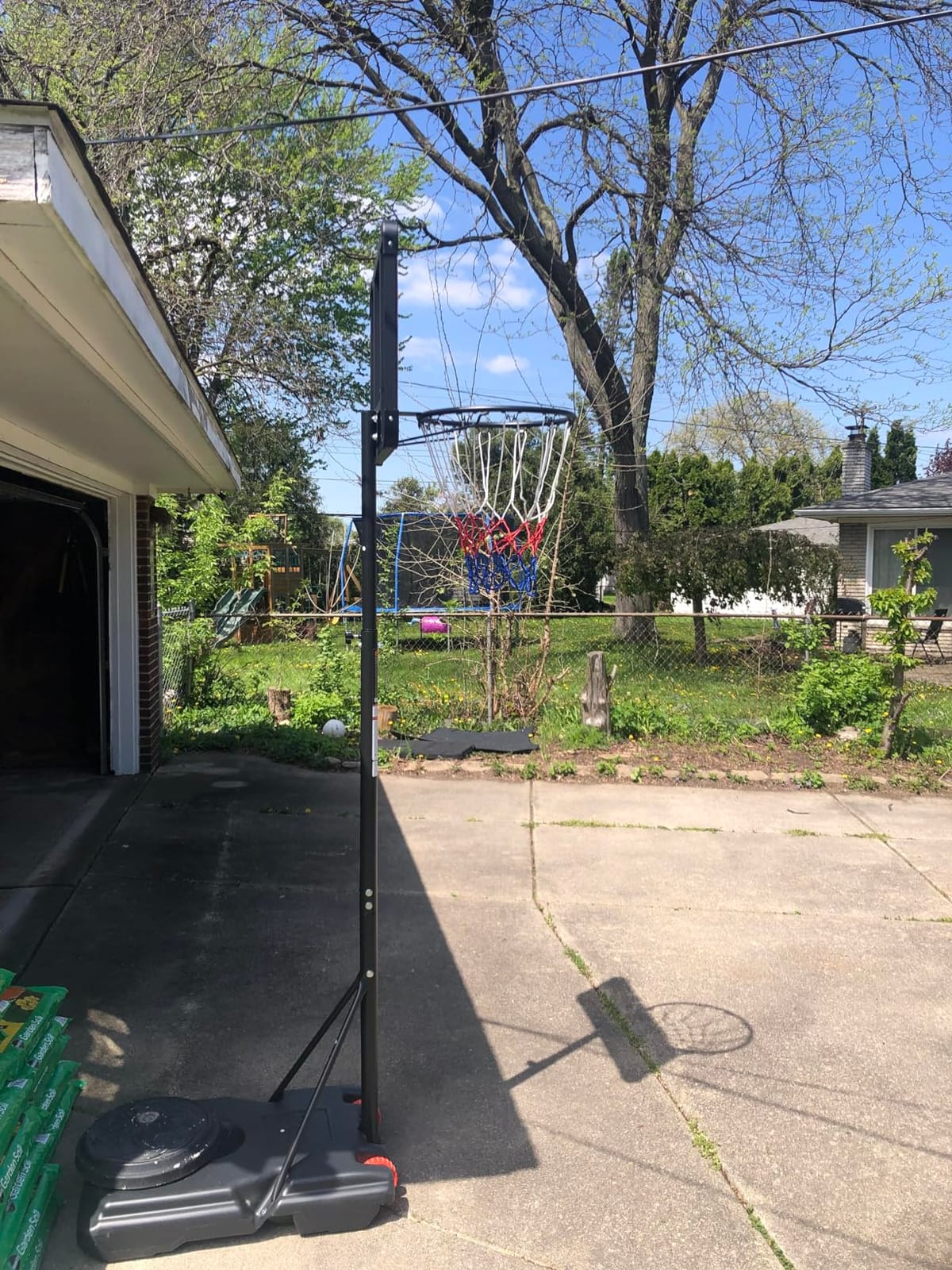
The ball storage groove in the base is the feature no one else in this roundup has, and it sounds trivial until you have a driveway with three balls rolling into the street. The recess in the base holds them at ground level, out of the way, while the two front wheels let one adult tilt and roll the whole unit elsewhere.
This product has the most ratings of anything here, 1,660, and the lowest average at 4.2, with 67% five-star and 9% one-star. That combination is informative. A large sample with a modest average usually means the product is dependable and unspectacular, with a real minority of owners who hit assembly problems.
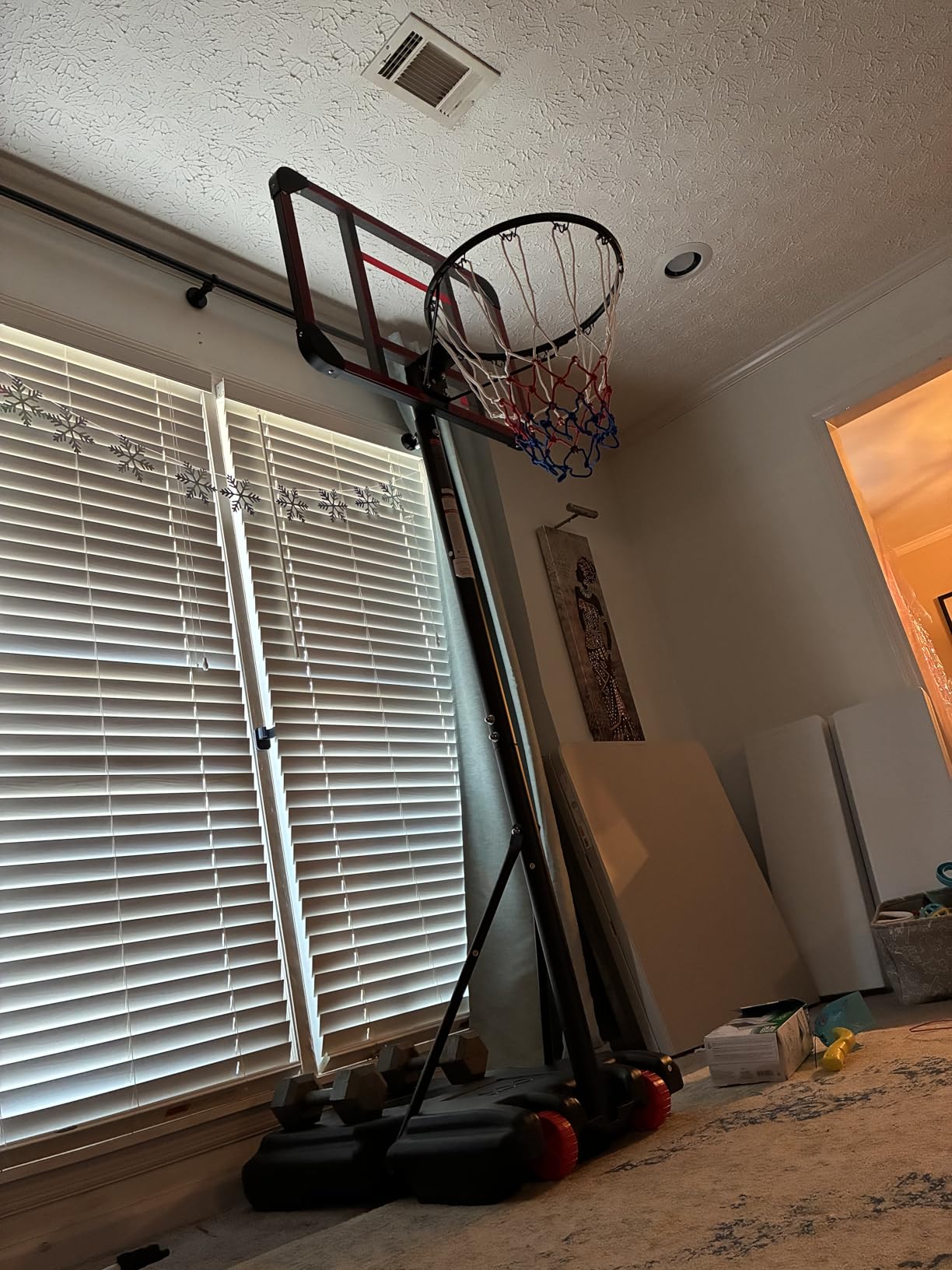
Construction is solid where it counts. The pole is alloy steel, the backboard is polycarbonate and polypropylene, and the net is described as all-weather, which is the standard that matters once a rim is exposed to rain and UV year after year. The base takes 38 to 40 litres of water or 54 to 56 litres of sand.
The constraint is the height band. At 70.5 inches minimum, this is listed as suited to kids aged 8 and up, and that is accurate. A four-year-old cannot reach this rim, which means it is a hoop for a specific and later stage rather than one that grows with a child from toddler to teen.
Is a 4.2 star average a warning sign?
In a category where the average across this roundup sits around 4.4, a 4.2 with 1,660 ratings is a mild signal, not a red one. The 9% one-star share suggests a recurring assembly complaint more than a recurring structural failure, which is a problem you can solve with a drill and an hour on a weekend.
The other thing that 4.2 reflects is fit rather than quality. A parent expecting a toddler hoop will be disappointed by a 70.5 inch minimum, and disappointment shows up in reviews as dissatisfaction with a perfectly serviceable product.
Who should skip the Best Choice Products system?
Skip it if you have a child under seven. The lowest setting is above comfortable reach for that age, and no amount of filling or adjusting fixes a rim a small child cannot touch.
Skip it if you want one hoop for a family with a wide age spread. It handles ages eight to about twelve well and does nothing for anyone below that, which is the opposite trade from the IGL 40-inch system at number two.
10. Play22 5-7 ft Kids Hoop: Best for Small Spaces and Indoor Play
Play22 Kids Basketball Hoop – 5-7 FT Adjustable – Indoor & Outdoor Play
5-7 ft adjustable height
Steel pole with weather-resistant PE body
All-weather nylon net
Wheels and fillable base
20 lb unit
Pros
- Quick easy assembly that children can help with
- 5-7 ft range covers a five-year-old through older children
- 20 lb weight and wheels make it easy to move indoors or out
- Compact at 29 by 28 inches
- good for a small yard or playroom
- Multiple owners buy more than one
Cons
- Less stable at the maximum 7 ft setting
- All-plastic construction feels less premium
- Small backboard
- One owner reported a storm blew the backboard off
This is the one to buy when floor space is the constraint. At 29 by 28 inches and 20 pounds, it is the smallest footprint and lightest build among the freestanding units here, and several owners report buying a second one so two children can practise in different rooms or rooms of the house.
Its 1,492 ratings average 4.4 with 72% at five stars, so it is one of the two most reviewed products in this roundup. Owners of young children highlight the quick assembly and the fact that kids can help build it, which is a small thing that buys a surprising amount of goodwill.
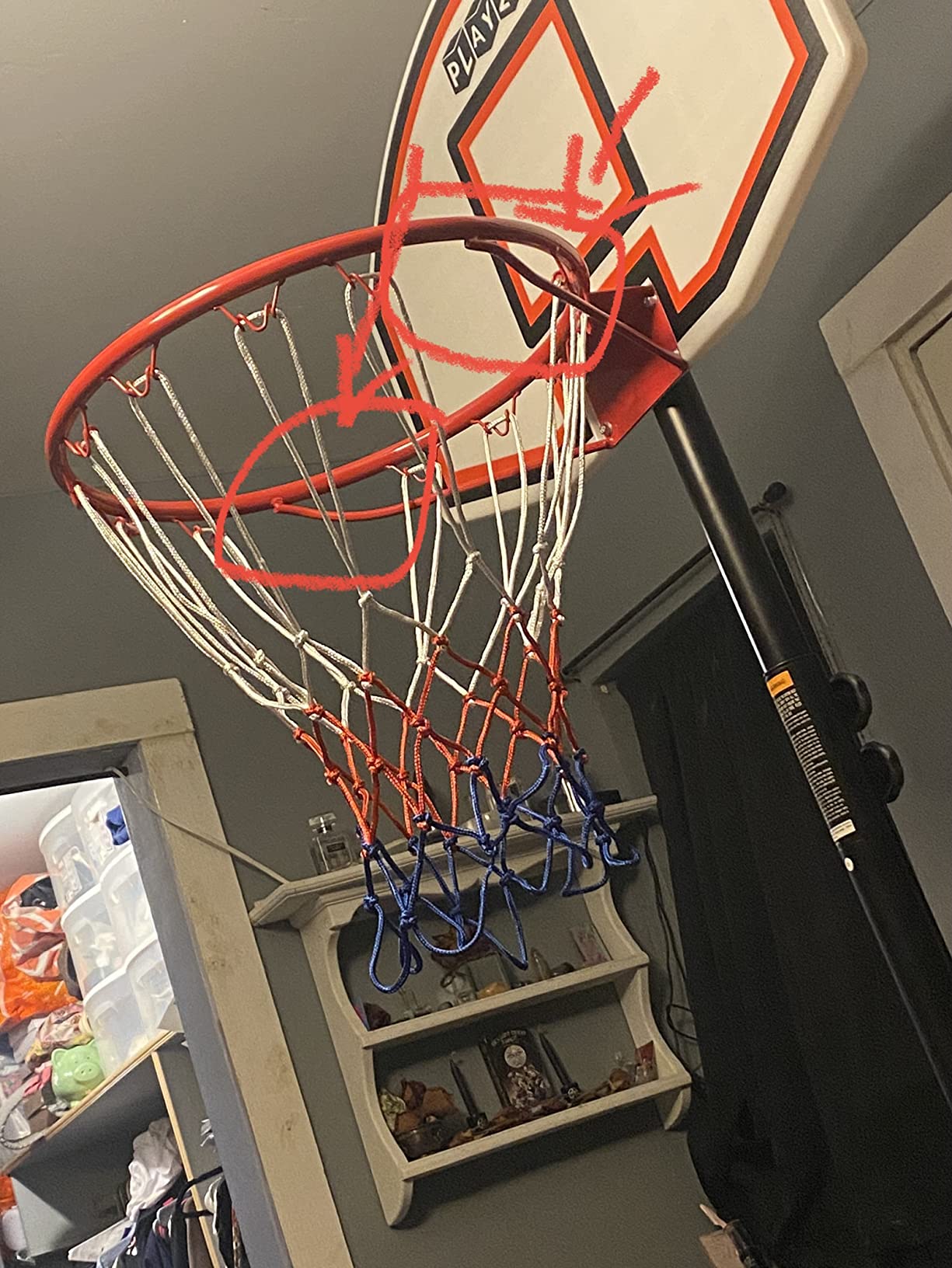
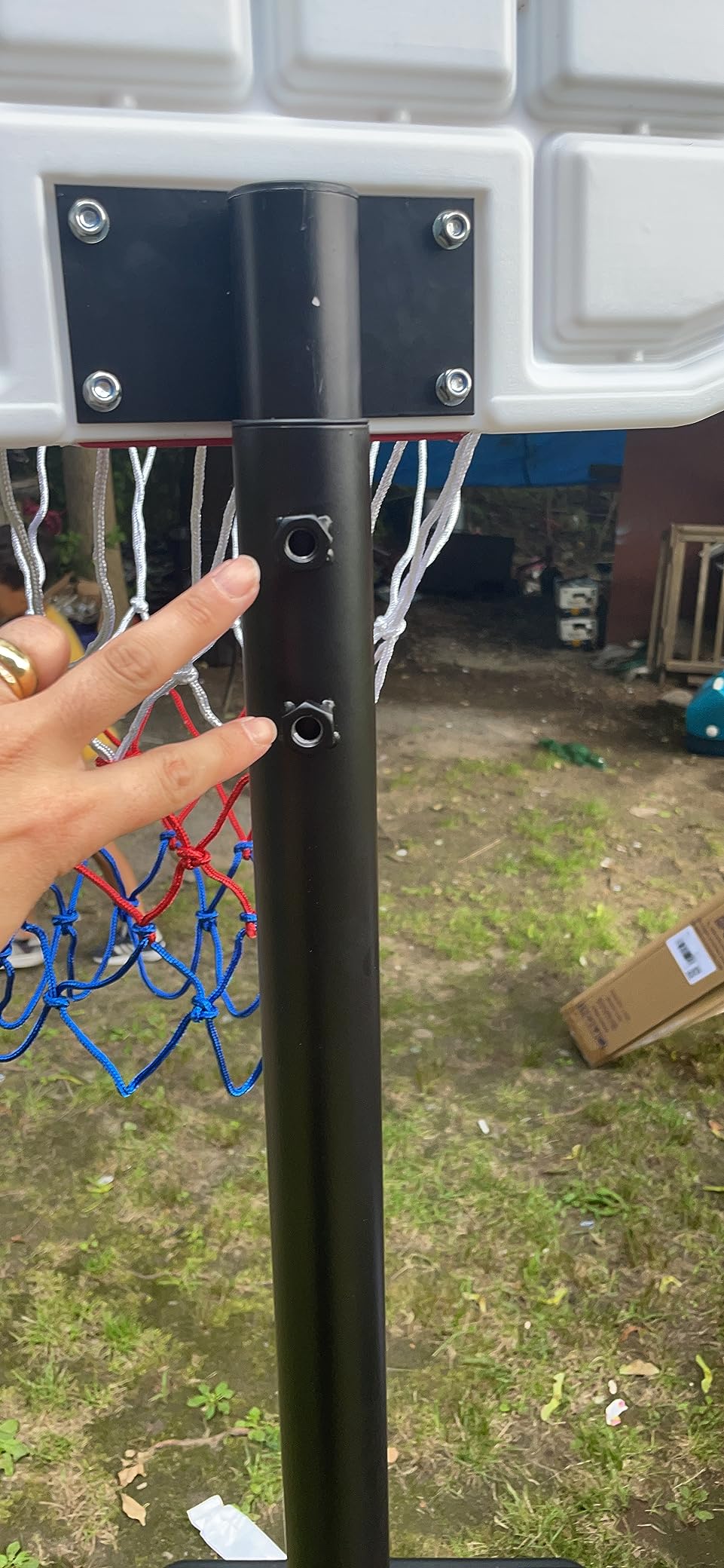
The trade-offs come from the material choice. The frame is plastic and nylon around a steel main pole, and the 45 cm rim is sized for small hands. It is a legitimately good build for indoor and sheltered use, but it is not a full-weight outdoor system, and one owner’s storm took the backboard clean off, which is a warning about leaving it out in severe weather.
Stability is the other limitation, and reviewers are consistent about it. The unit is noticeably less steady at the top of its 7 ft range, when the lever arm is longest, and that is exactly where a bigger child will want to play. Fill the base properly and the problem improves, but it does not disappear.
Is a plastic hoop good enough for outdoor use?
For a playroom, a garage bay, a covered patio or a mild climate, yes. The steel main pole and the all-weather nylon net are appropriate parts, and the PE body is described as weather-resistant. The concern is not ordinary rain but the combination of wind, sun and cold over several seasons, where plastic boards and fittings age faster than steel.
If your hoop lives outside year-round, a unit with an alloy steel pole is a safer long-term bet, and our top pick and the two IGL systems all use metal frames for that reason. If it comes inside for the winter, this one is a perfectly sensible choice.
Who should skip the Play22 5-7 ft hoop?
Skip it if you want a single hoop for a family with children spanning toddler to teen. A 5 ft floor and a 7 ft ceiling is a narrow window, roughly ages five to nine, and it is the smallest range of any adjustable unit in this roundup.
Skip it for a driveway that gets enthusiastic use or a base that will sit unattended on a slope. A lighter 20 pound frame is easier to knock over, and once it starts moving it is much easier for a small child to pull down.
Buying Guide: Nine Things That Decide Whether a Kids Hoop Lasts
1. The lowest rim height, not the highest. Every parent fixesates on whether the hoop will grow to 10 feet. The number that matters is the minimum, because that is the setting your child uses most. A hoop that tops out at 10 ft but starts at 70 inches is a hoop for older children only.
2. Backboard width, and what width buys. Youth boards in this roundup run from 29 to 40 inches wide. Wider is more forgiving for beginners, which means more shots taken. For a child under 7, 29 to 33 inches is plenty; for a teenager or adult, 40 inches is where the difference becomes obvious.
3. Base fill capacity, and filling it properly. Capacities here range from 38 litres to a 93-pound fill. Under-filling is the most common reason a portable hoop tips, and it is entirely avoidable. Sand gives more mass and survives a freeze; water is lighter and needs draining in cold climates.
Our portable basketball hoops guide goes deeper on ballast, wheels and wind, and it is worth reading before you fill anything.
4. How the height actually changes. There are four mechanisms in this roundup and they are not interchangeable. A stepless adjuster lets a child set any height. A pole-swap system with two, three or four sections takes minutes and an adult. A screw-lock takes seconds but a child cannot do it. A handle-driven quick adjust is somewhere between.
5. Weight when empty. Units here range from 20 to 40 pounds before fill. Anything over about 30 pounds is a two-person job on a bad moving day, and if a teenager is expected to reposition it, lighter is almost always better. Check who is actually going to move it before you fall for the biggest model.
6. The rim and the breakaway mechanism. A spring-action breakaway rim flexes under a hard downward force instead of transmitting it into the backboard. On a youth hoop this protects both the board and the child hanging on the rim, and it is one of the few genuine safety features in this category.
7. Backboard material, named specifically. Polycarbonate is the right answer for a kids hoop in almost every case, and it is what nine of these ten use. Treat the word shatterproof in a listing title as meaningless unless the listing also says polycarbonate. A UV resistance figure, as on the Seray, is a more useful signal than the marketing adjective.
8. Wheels and how they work. Tilt-and-roll designs lift the base onto two wheels so one adult can drag it across flat ground. They are excellent on a driveway and awkward on a slope or gravel. Never try to move a filled unit on a slope; drain or partially empty the base first.
9. Warranty length and parts availability. Every product here carries a one-year warranty, so that is not a differentiator. What does differ is whether the brand sells replacement nets, rims and hardware separately. A brand with a parts catalogue has an incentive to keep the product alive, and a replacement net costs a fraction of a new hoop.
In-ground, portable or wall-mounted: which one actually fits your yard?
Portable base-and-pole systems dominate this roundup because they need no concrete and no drilling, and because they can be moved when the family moves. Their inherent weakness is that the base is the only thing resisting tipping, which is why fill capacity and base shape matter so much.
Wall-mounted or pole-clamp systems like the Silverback at number three are the opposite: no base at all, so nothing can tip, at the cost of needing a solid pole. For renters, apartment residents and anyone with an existing post, that trade is usually the right one.
In-ground systems set in a concrete sleeve are the most rigid option and are not in this roundup because they require drilling and a pour. They are worth the cost for a family that will stay put for a decade and wants zero movement; the drilling is the reason we would not recommend one to a tenant. Our driveway hoop guide covers fixed installations in detail.
How much space do you actually need?
Reserve a clear rectangle in front of the hoop, not just a circle under it. For a child under 7, 20 by 18 feet is enough for layups and free throws, but it is tight for one-on-one play. For a teenager taking jump shots, allow 30 feet of run-out in front of the rim and about 10 feet behind it.
Two safety points that get skipped. Check for overhead lines and branches before you position anything, and keep the hoop away from pool edges, where a movable system that shifts under a child on the rim is a genuine hazard.
What size basketball goes with a kids hoop?
Match the ball to the rim, not to the child’s age. A Size 3 ball is the right partner for a 3 to 5 foot rim, a Size 5 for a 5 to 7.5 foot rim, and a Size 7 only makes sense once the rim reaches regulation height. Outdoor use favours a rubber-composite ball, which holds air and survives concrete far better than a composite indoor ball.
On single-rim versus double-rim, a single rim is the right answer for a beginner. Double rims are designed to absorb the force of a hard dunk by spreading it across two rings, and they suit older players who dunk regularly rather than children still learning to reach.
Why cheap hoops fail in one season
The pattern is consistent across thousands of reviews in this category. The backboard yellows or cracks, the rim hardware strips, the base will not accept sand, or the pole joint loosens. All four are manufacturing-cost decisions, and none of them show up in a listing photo.
The practical takeaway is that the difference between a one-season hoop and a multi-season one is mostly steel content in the pole and rim, a stated UV rating on the backboard, and a base that accepts enough fill. Those three specifications are all visible in the product data, which is why we weighted them above appearance.
Our kids basketball hoops for driveways roundup covers the fixed-surface setups in more detail, including base preparation on concrete versus asphalt.
Frequently Asked Questions
What is the best basketball hoop for playing in my backyard?
For most families, the Yohood 4.82-8.53 ft system is the best all-round choice, because it starts low enough for a four-year-old to dunk, takes up to 93 lbs of ballast in its base, and rolls on built-in wheels. If you need full 10-foot height for a teenager or adult, the IGL 40-inch system spans 3 to 10 ft on the same base.
Which is better, Spalding or Lifetime basketball hoop?
Neither brand appears in our ten tested picks, so we cannot rank them against the units here. What we can say is that both are mainstream names whose portable systems usually sit above this group in build weight, and that Spalding is better known for balls while Lifetime is better known for portable goals. Compare pole material, base fill capacity and stated UV rating rather than brand name.
Which is better for my backyard, Goalrilla or MegaSlam?
Both are premium in-ground brands aimed at fixed concrete installations rather than portable family systems, and neither is in this roundup because both require drilling and a pour. If you are choosing between them for a backyard you own permanently, compare backboard size, reach from the wall and the adjustment increment. If you rent, neither is the right category to be shopping in.
What height should a basketball hoop be for a 7 year old?
Between 5 and 6 feet, with 5.5 feet a good starting point. Most seven-year-olds can reach and dunk at that height but struggle at 7 feet or above. The Play22 5-7 ft hoop and the Mayfire at 4.1 to 8.5 ft both cover this band, and both let you raise the rim as the child grows.
What size basketball hoop is best for outdoor use?
A polycarbonate backboard between 33 and 40 inches wide, on a steel pole, with a fillable base. Polycarbonate is shatter-resistant where glass is not, and 33 inches is enough for a child through about age 9 while 40 inches suits a teenager or adult. Treat the word shatterproof in a listing title as meaningless unless polycarbonate is named.
What is the best adjustable basketball hoop for kids?
The best adjustable hoop is the one whose lowest setting your child can dunk at, not the one with the widest range. The Seray at 3.2 to 7.2 ft is best for toddlers, the TONBUX offers stepless adjustment from 3.5 to 7 ft, and the IGL 40-inch covers 3 to 10 ft for a family with a wide age spread.
What is the best basketball for outdoor use?
A rubber-composite ball, sized to the rim rather than the child’s age. Use a Size 3 for a 3 to 5 foot rim, a Size 5 for a 5 to 7.5 foot rim, and a Size 7 only at regulation height. Outdoor balls hold air and survive concrete far better than indoor composite leather balls.
Do I need to fill the base with sand or water?
You need to fill it either way, and under-filling is the most common reason a portable hoop tips. Sand gives more mass in the same volume and does not freeze, so it is the better choice in a cold climate. Water is lighter and faster to set up but must be drained before any hard frost or it will split the base.
The Best Kids Basketball Hoops for Backyards in 2026
If your child is under five, the Seray is the only unit here that starts low enough at 3.2 ft for a genuine toddler dunk, and it assembles in about 15 minutes. Between roughly ages 4 and 11, the Yohood at number one is the safest default: 12 height levels from 4.82 to 8.53 ft, a base that takes 93 lbs of ballast, and the largest body of long-term owner feedback in the category at 1,586 ratings.
For a family with a wide age spread, or for a teenager who needs 10 feet, the IGL 40-inch system is the smarter single purchase. Its 3-to-10 ft range and 40 by 24 inch board mean it never has to be replaced, and it ranks number one in its category. For renters, the Silverback at number three skips the base entirely and clamps to a pole you already have.
Whatever you pick, fill the base properly, match the rim height to the child’s actual reach rather than to the maximum, and take the hoop in before a hard freeze. Those three habits account for most of the difference between a hoop that is still in the driveway in 2026 and one that was replaced last spring.
Use the comparison table above as your shortlist, and check the current price and feature listing before you buy, since configurations in this category change often.