
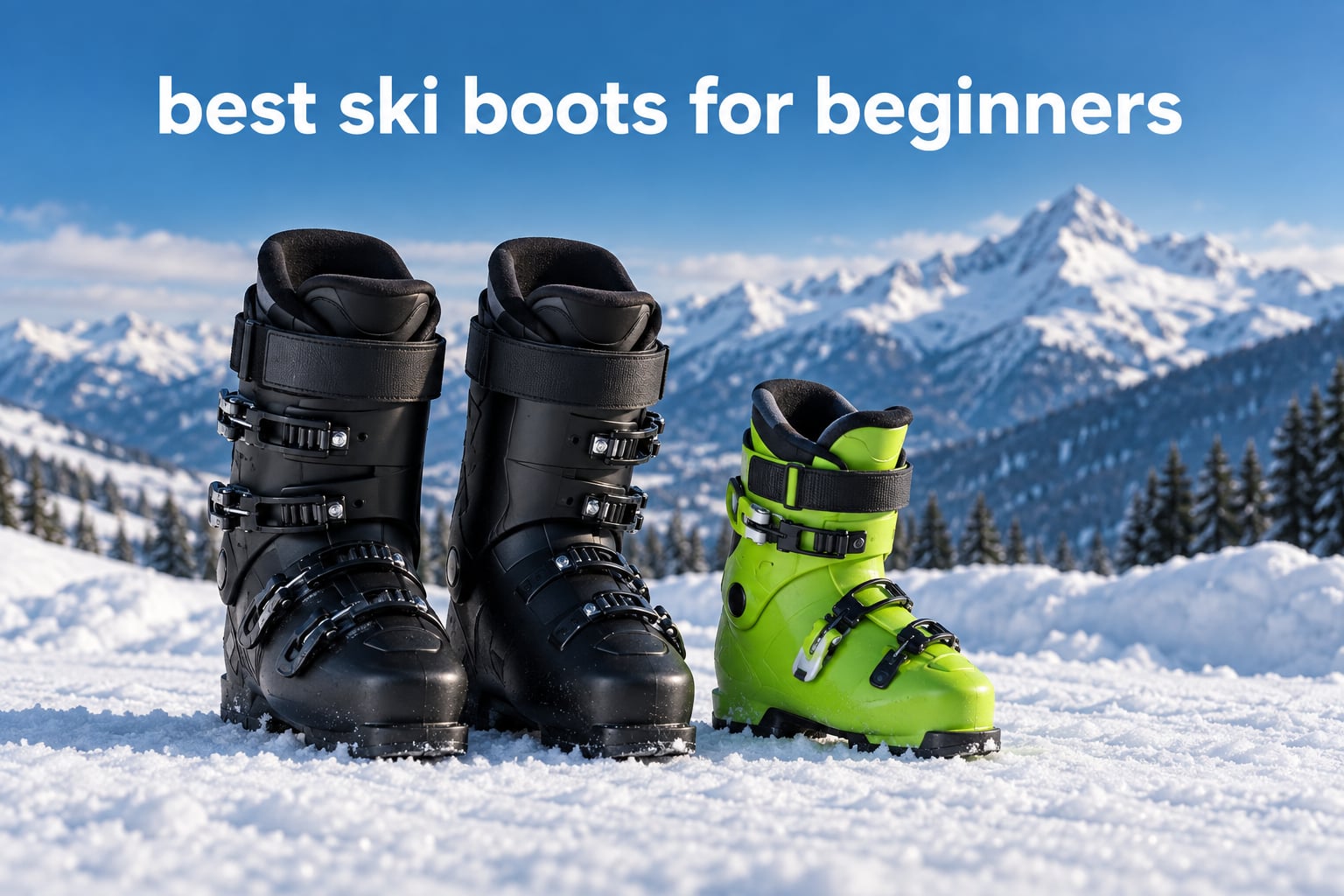
The fastest way to find the best ski boots for beginners is to ignore brand loyalty and start with three numbers: flex rating between 60 and 80, a last width of roughly 100mm or roomier, and a closure you can open without using both hands. Beginners who shop on height and weight end up with boots they cannot flex, and that mismatch is the single biggest reason new skiers quit in their first season.
Our lineup of 10 covers both junior and adult beginner boots, so you can jump straight to the pair that matches your household. We compared flex, last width, entry mechanics, liner design and reported comfort across every model, then organized the results by who each boot actually suits. If your only goal is cardio work at altitude, our ski ergometer picks for home cardio are a different, cheaper habit.
One verdict up front: if you are getting three to five days a year and have never owned boots, rent for a season. Buy only when you know you will be on snow a dozen-plus days, because boots need a bootfitter, and a bad fit is not fixed by returning the box. The boots below are the ones worth a fitting appointment.
Last updated for the 2026 season.
Table of Contents
Top 3 Picks: Best Ski Boots for Beginners in September

Roces Idea Up Adjustable Ski Boots
- Expandable shell spans size 22.5 to 25.5
- Three buckles plus power strap
- Sole length stays constant as the boot expands

Rossignol Evo 70 Relaxed Fit
- Relaxed 104mm last
- Custom fit liner with heel support
- Sensor Matrix shell keeps weight down
Our top rated adult pick is the Rossignol Evo 70, which carries the highest star rating in the lineup and a genuinely roomy last. If you are buying for a child who is still growing, the Roces Idea Up is the only expandable boot here and the most-reviewed model by a wide margin. Head Edge LYT RX HV is the one we point wide-footed adults toward, because the high volume last removes the forefoot squeeze that causes most early-season hot spots.
All 10 Beginner Ski Boots Compared in 2026
| Product | Specifications | Action |
|---|---|---|
| Roces Idea Up Adjustable Ski Boots |
|
Check Latest Price |
 Nordica The Cruise Nordica The Cruise |
|
Check Latest Price |
 Nordica Men Cruise 70 Nordica Men Cruise 70 |
|
Check Latest Price |
| Rossignol Evo 70 |
|
Check Latest Price |
 Head Edge LYT RX HV Head Edge LYT RX HV |
|
Check Latest Price |
 Rossignol Speed 80 HV+ Rossignol Speed 80 HV+ |
|
Check Latest Price |
 Rossignol Kelia 50 Rossignol Kelia 50 |
|
Check Latest Price |
 Nordica Cruise S W Nordica Cruise S W |
|
Check Latest Price |
 Atomic Hawx Magna 75 Atomic Hawx Magna 75 |
|
Check Latest Price |
 K2 BFC 90 K2 BFC 90 |
|
Check Latest Price |
1. Roces Idea Up Adjustable Ski Boots: The Expandable Junior Pick
ROCES IDEA Up Adjustable Youth Ski Boots – White/Red/Black | Size 19.0–22.0 | Dual Micro-Adjustable Buckle Kids Ski Boots for Growing Feet
Expands size 22.5 to 25.5
Three buckles plus power strap
Sole length stays constant
2.6 kg listed weight
Pros
- Expandable fit lasts multiple seasons as feet grow
- Constant sole length means bindings are never re-mounted
- Three micro-adjustable buckles plus a power strap for a secure fit
- Most-reviewed boot in the lineup by a wide margin
Cons
- Plastic shell runs warmer and less supportive than a padded adult boot for full days
- Youth sizing stops in the mid-20s so older teens outgrow it quickly
We put this boot at the top of the list for a specific reason: it removes the most common beginner buying mistake for families, which is sizing a growing child wrong in year one. The shell expands across roughly three sizes, so the same boot can follow a child from a first ski lesson through several seasons. That single feature saves money that would otherwise go into a new boot every twelve months.
The fit system is more serious than the plastic suggests. Three micro-adjustable buckles plus a power strap let a bootfitter dial the shell in properly, which matters more for a child whose foot shape changes week to week than any internal technology. Ski schools use boots like this because they can be adjusted between groups in a single morning.
The detail that convinced us is the constant sole length. When the shell expands, the sole does not change, so a pair of bindings stays mounted correctly across the whole adjustment range. In a conventional boot, growing a size means a new boot and a remount, and the remount alone can cost as much as the discount you saved.
What you give up is warmth and long-day support. A plastic shell with no adult-grade insulation will feel tired by late afternoon on a cold mountain, so treat these as lesson and holiday boots rather than all-day boots. Older teens will also outgrow the top of the size range faster than the expansion setting suggests, so plan a second purchase for the 15-and-up crowd.
Who should buy these junior boots
Any family with a child aged roughly four to twelve who is starting lessons. The expansion range means one purchase usually covers two to three seasons, and the buckles can be adjusted at the start of each trip to match the current foot. Instructors at ski schools tend to favor this style of boot for the same reasons.
They are also the practical choice if more than one child is learning at once, because a wrong first guess on size costs you a return rather than a small child stuck in a boot that pinches. Check the expansion range against your child’s measured foot length before you order, not the age on the box.
Who should skip them
Anyone who will ski full days in cold conditions on a rigid plastic shell, and any child who has already reached the top of the size range. Adults should also skip this model entirely. If you are reading this as an adult beginner, jump to the Rossignol Evo 70 or the Head Edge LYT RX HV instead.
One more caution: plastic shells do not break in the way a foam or composite liner does. Comfort comes from the buckle adjustment and a good liner fit, so a fitter session matters even more here. If you cannot get fitted, measure carefully and expect to spend time dialing the buckles yourself.
2. Nordica The Cruise: Roomy Last With a Wide-Open Throat
Nordica The Cruise Men’s Comfort Fit All Mountain Alpine Ski Boots (Black/White/Red, 31.5)
104mm last
Dual soft-flap instep opens the throat wide
Instep Volume Control plus or minus 4mm
Infrared pressure point mapping
Pros
- Soft-flap instep opens the throat exceptionally wide for step-in entry
- Instep Volume Control raises or lowers the fit height by 4mm
- Comfortable for wide feet without squeezing
- Infrared system identifies pressure points before the fit is finished
Cons
- Some owners report the buckle hardware feels cheap and does not last
- Fit is not universal and a minority of reviewers changed brands
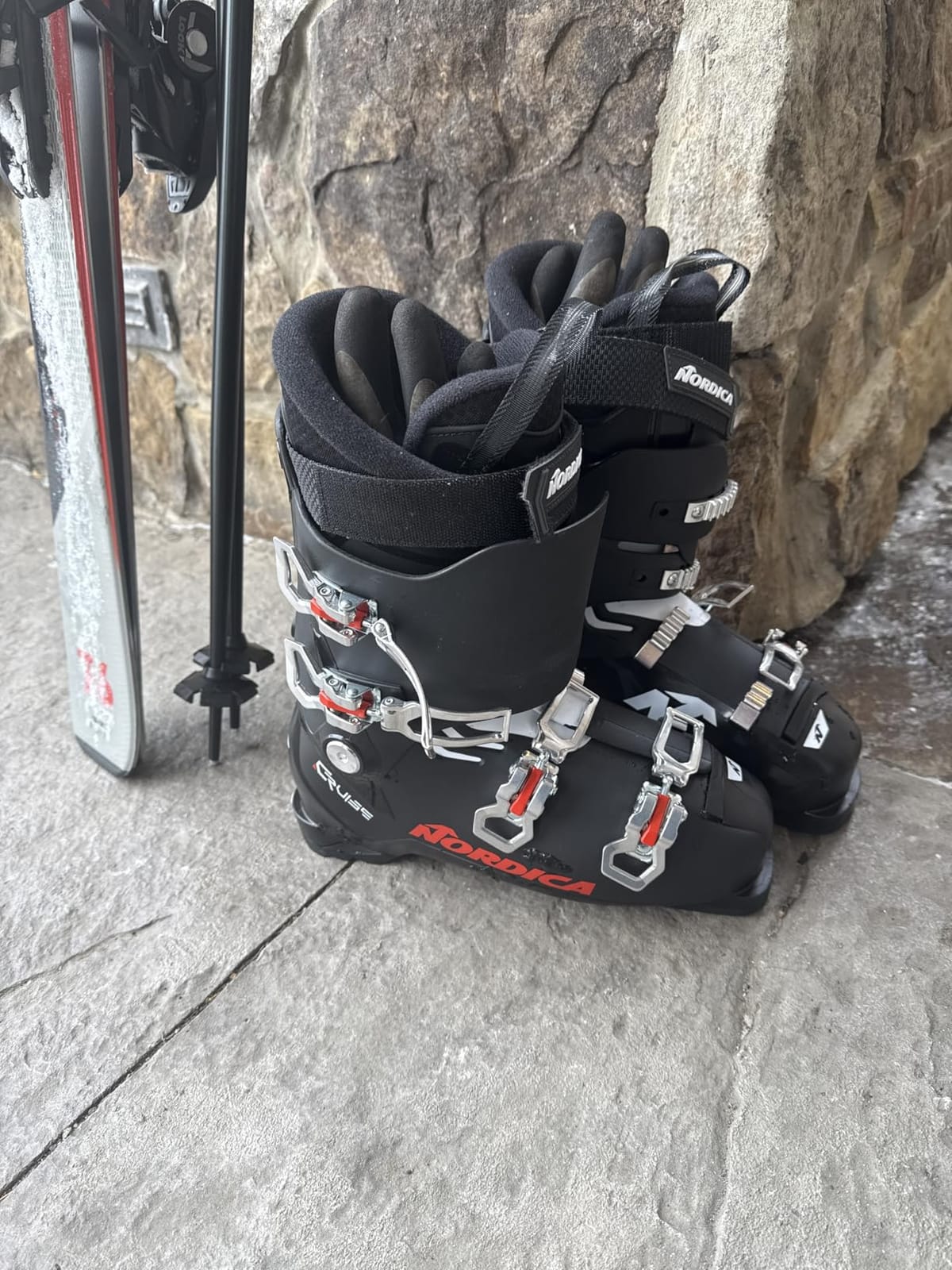
This is the boot we would put a wide-footed beginner in without hesitating. The 104mm last is genuinely roomy across the forefoot, and the dual soft-flap instep opens the throat wide enough that you can step in rather than fight your way in. For a new skier who has never buckled a boot before, that entry difference is bigger than any spec on the label.
The Instep Volume Control insert is the sleeper feature. Rotating it changes the height of the boot board by plus or minus 4mm, which lets a fitter tune the fit for a high instep without changing shells. Most adults have a high instep, and it is the reason so many beginners end up with pain across the top of the foot in boots that are technically the right size.
It is listed for beginners and intermediates, and owners frequently note that the boot feels stiffer than that label suggests. For a first-season adult who wants some response as they improve, that is a feature. For someone who genuinely wants the softest possible flex on the mountain, the Cruise 70 in slot three is the softer option.
The infrared pressure point system is worth understanding before you buy. You heat the liner over the area that is pressing, then use the suction cup to relieve it before refitting, which is a cheap way to pre-empt a hot spot. Reviewers do raise one recurring complaint: some feel the buckle hardware is cheaper than the rest of the boot, so treat the buckles as replaceable service items rather than forever parts.
Why the 104mm last matters most
Last width is the number that decides whether a boot fights your foot, and 104mm sits at the roomy end of the beginner range. A roomy last does not automatically make a boot sloppy, because the liner holds your foot in place while the shell stops hitting your toes. The pain in a badly fitting boot comes from compression, not from wiggle room.
If you have ever had to take your boots off at every lift, that is almost always a width or instep problem rather than a flex problem. Skiers on r/ski describe exactly that pattern with pain at the first and fifth metatarsals, and the fix is a wider boot before it is anything else.
Where it falls short
The cheap-buckle reports are consistent enough to plan around, and the fit is not universal. A minority of owners found the shape wrong for their foot entirely and moved to another brand, which tells you the last is forgiving but not magic. If your foot is narrow and low-volume, a roomy 104mm last can leave your heel lifting.
It is also worth knowing these are a single listing with a limited spread of sizes, so a poor size match means a return rather than an easy swap. Get measured, or measure yourself carefully, before ordering.
3. Nordica Men Cruise 70: The Softer, Lighter Cruise
Nordica Men Cruise 70 Boots, Color: Black/White/Red, 25.5
Soft plastic throat inserts
Instep Volume Control insert
Custom fit
Polyurethane shell and sole
Pros
- Lightweight and comfortable enough for long runs once broken in
- 104mm last suits wide feet and low calves
- Sizing runs true to the published size chart
- Easy step-in and step-out via soft throat inserts
Cons
- Some owners want a softer flex than the boot delivers
- Throat could open wider for faster entry
- Listed item weight is not accurate for this model
The Cruise 70 is the softer-flexing, lighter version of the boot above, and that difference is the whole point of it. Reviewers repeatedly ask for a flex softer than this boot delivers, which tells you it already sits at the forgiving end of what a 70-rated boot can do. If you are a cautious beginner who wants help turning, that is a good place to be.
Entry is handled the same way, with soft plastic inserts integrated into the throat that let you step in without wrestling the buckles. The Instep Volume Control insert lives in the wedge and is visible from the heel, and rotating it shifts the fit volume by plus or minus 4mm. For high insteps that is a meaningful adjustment rather than a cosmetic one.
It is a polyurethane shell and sole with a custom fit, and owners describe it as light on the foot and comfortable across long runs once broken in. A lower-calf skier benefits from the 104mm last in a particular way: the room is distributed rather than stacked in the cuff, so you are not being pushed up onto a narrow shin section.
The recurring request is for a wider throat opening so the foot goes in faster. That is a genuine limitation for anyone with limited knee or hip mobility, and if easy entry is your main concern, read the Cruise S W in slot eight instead. The listed weight on the packaging is also wrong for this model, so do not use the listed figure to judge how it feels underfoot.
Best for lighter skiers and long days
This is the pick for a smaller or lighter adult who wants a low-calf-friendly 104mm last and a flex they can actually bend. A lighter skier does not need a stiffer boot to get a response, and buying up in flex is a common mistake for smaller adults in particular.
It also suits skiers who will spend real time walking for lift access, because the shell is light and does not fight you on the flat. For grippier walking on hard snow, our winter traction cleat picks pair well with any boot in this list.
Where the softness becomes a limit
If you are already linking turns confidently and want to progress quickly, a 70 flex will start to feel vague once your technique firms up. That is the correct reason to outgrow this boot, and it is a reason to move up rather than a fault in the boot itself.
Also budget for a genuine break-in. The liner needs heat molding before it stops feeling tight, and a first-day attempt on a cold mountain is how people end up convinced the boot was wrong when it was simply unmolded.
4. Rossignol Evo 70: Our Top Rated Adult Pick
Rossignol EVO 70 HV+ – Ski Boots for Men and Women – Black
Relaxed 104mm last
Custom fit liner with heel support
Sensor Matrix shell
GRIPWALK compatible
Pros
- Highest star rating in the lineup at 4.8 with 87 percent five-star reviews
- Relaxed 104mm last with wider forefoot toe box and ankle
- Custom fit liner with heel support and softer ankle padding
- Sensor Matrix shell reduces weight while keeping direct power transfer
Cons
- Listed as not water resistant so wet conditions can be a concern
- Rockered toe and rubber tread need separate GRIPWALK soles for walking grip
This is the boot we would put an adult beginner in without much deliberation. It has the highest star rating in the lineup, a relaxed 104mm last with a wider forefoot and toe box, and a Sensor Matrix shell that trims weight without turning mushy. In plain terms it is a forgiving boot that still moves your power to the ski when you want it.
The liner is where the day-long comfort comes from. It is a custom fit liner with a heel pocket and deliberately softer padding through the ankle and instep, which is exactly where pressure builds when a boot is too stiff or too tight. Softer padding in those two zones is a beginner feature, not a downgrade.
Entry is handled by an easy-opening boot overlap, so you are not levering your foot past a hard shell edge before the liner is even in place. Combined with the roomy last, that means most people can get into this boot without a fight, which is a meaningful part of why the ratings sit where they do.
The Sensor Matrix shell design is the quiet advantage. It reduces overall boot weight and delivers direct-to-ski energy transfer, so on a long beginner day with tired legs you are not hauling extra mass up every lift. The one thing to know before you buy is that the boot is listed as not water resistant, so slush and wet snow are its weak point.
Why we rated it the top adult pick
It balances the two things beginners actually need: room to move without losing your footing, and a shell that still responds when you start skiing better. Reviewers note that it stays comfortable all day while still transferring power, and almost no two-star feedback appears in the reviews, which is unusual at this rating level.
The relaxed last is the quiet hero. A wider forefoot and toe box eliminates the compression that causes metatarsal hot spots, and the custom liner holds your foot in the middle of that room so you do not swim. If you are moving up from rentals, this is the boot that stops feeling like a boot.
When to choose something else
Choose a different boot if you ski in wet spring conditions and care about waterproofing, or if you spend most of your day walking on ice. The rubber tread and rockered toe are designed for on-snow use, and the separate GRIPWALK sole system is what turns them into walking boots.
If you have a very narrow foot or a low heel, the roomier fit may leave your heel lifting more than you would like. In that case a fitted liner is the answer, and a bootfitter can add one.
5. Head Edge LYT RX HV: Lightest Shell and the Roomy Fit
Head Edge LYT RX HV Alpine Ski Boots, Anthracite/Black, 26.5
High volume fit
E-width last
3 pound listed shell weight
Beginner skill level
Pros
- High volume fit adds room through the forefoot and instep
- E-width last suits skiers who need more space across the foot
- Lightweight shell at 3 pounds reduces fatigue on early learning days
- Rated 4.7 stars from 71 reviews with 85 percent five-star ratings
Cons
- Listings cover only a limited spread of sizes which can restrict availability
- The wide high volume fit can feel loose for narrow feet
The name says it all: high volume. This is the boot we send wide-footed beginners to when nothing else has worked, because the extra room runs through the forefoot and instep rather than sitting as a single pool of space at the toe. For anyone who has been told they have wide feet, this is a fitting-first recommendation.
Weight is the other story. The listed shell weight is 3 pounds, which is light for an adult alpine boot, and light boots are a genuine beginner advantage. A beginner is already using muscles they have never used before, and every pound carried up a lift costs you at the end of a long day. Less mass means less fatigue means more runs before the legs give out.
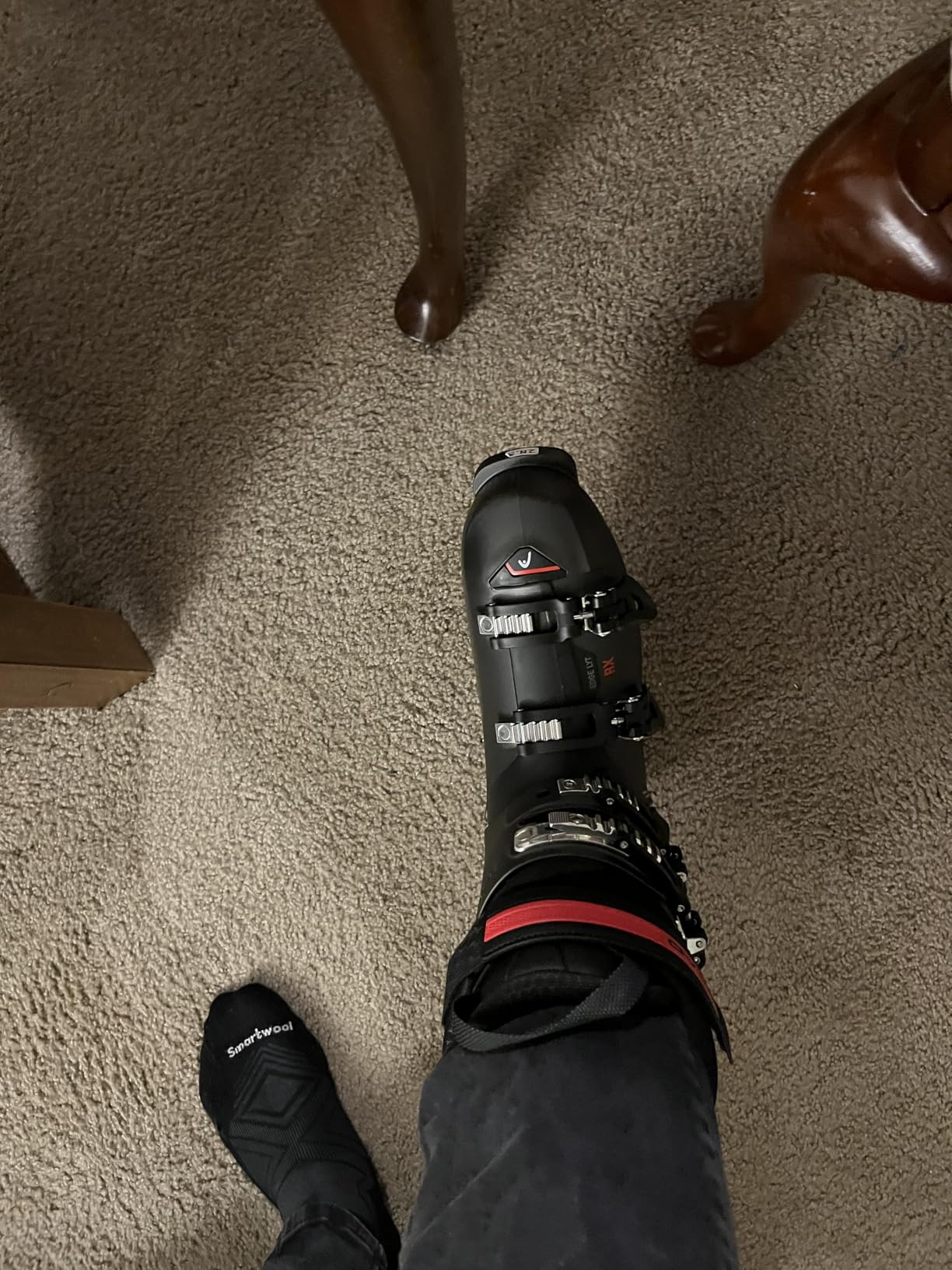
It is listed for beginner skill level with a polyurethane shell, which is the forgiving construction a new skier wants. Reviews describe it consistently as a roomy, lightweight beginner boot, and the 4.7 rating with 85 percent five-star scores reflects how few problems people report.
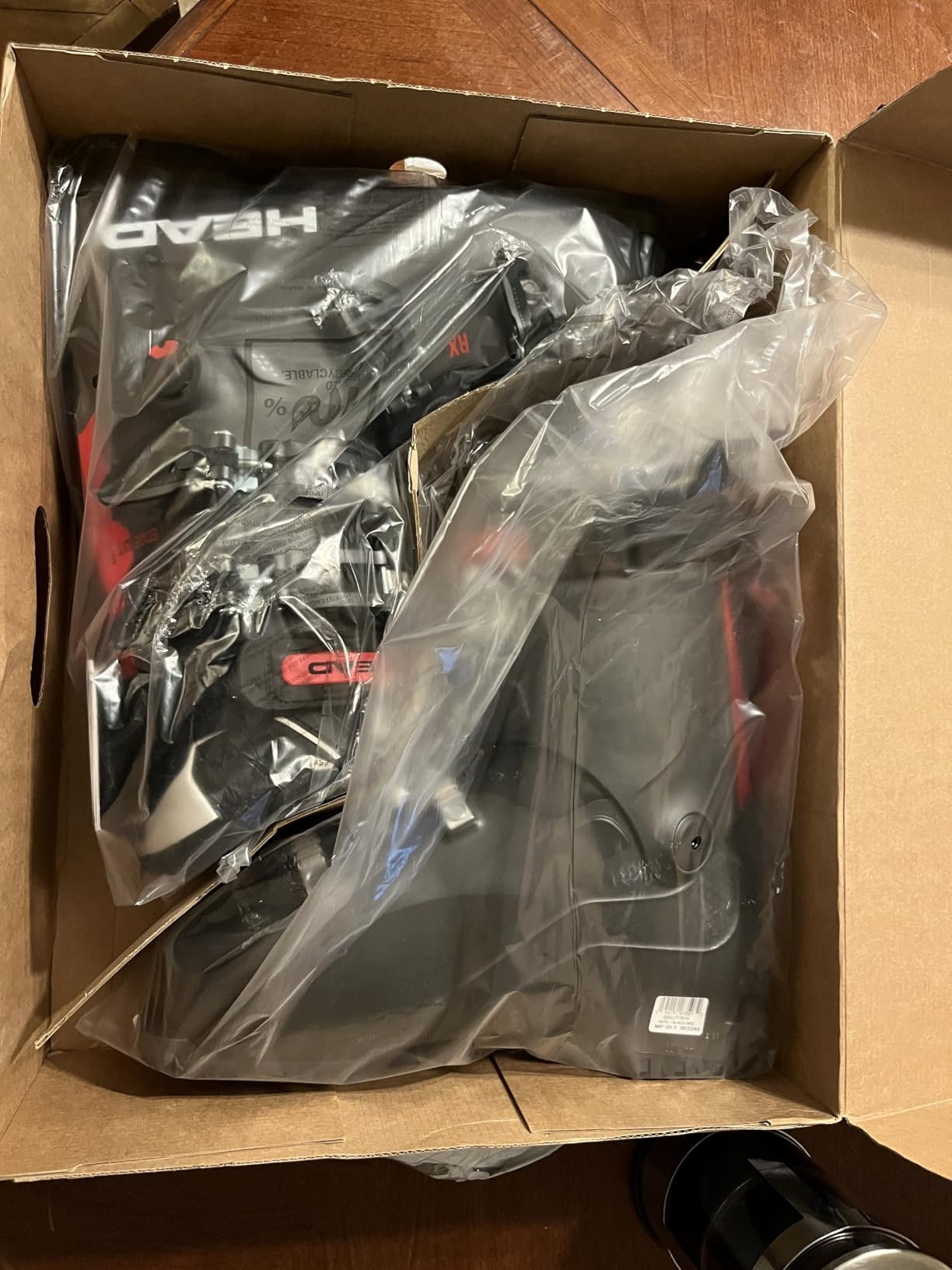
The trade-off is the same one the last creates. If you have narrow feet, a high volume fit can feel baggy, and the room across the foot may leave your foot moving inside the liner. It is also one of the listings with a more limited size spread, so check availability before you plan a trip around it.
Best for wide feet and heavy days
Wide feet, high insteps, and anyone who has been bashing their shins in a narrower boot. The high volume construction gives the toe box and instep genuine space, which is where beginner hot spots concentrate, and the light shell keeps the fatigue down on learning days.
It is also a strong pick for adults returning to the sport after years away. Coming back means your legs are beginner legs regardless of your history, and a light, forgiving boot is the right tool for rebuilding confidence on the mountain.
Where the extra room becomes a problem
Narrow or low-volume feet will feel the difference immediately. There is a limit to how much room a boot can have before your foot starts moving inside it, and a bootfitter can address that with a custom liner or an insole that fills the forefoot.
The limited size spread is the practical risk here. If your size is not offered, the alternative is another high volume boot rather than this one, and high volume shells vary more between brands than narrow ones do.
6. Rossignol Speed 80 HV+: Warm and Ready for Longer Days
Rossignol Speed 80 HV+ – Ski Boots for Men – Relaxed Fit Snow Ski Boots – Black
Relaxed 104mm last
Sensor Matrix shell
Custom liners
Buckle closure
Pros
- Comfortable all day with warm feet on cold days
- Relaxed 104mm last with wider forefoot toe box and ankle areas
- Soft plastic around the instep makes the boot easy to get on and off
- Custom liners add internal fit customization
Cons
- Listed in a single size so a poor size match can force a return
- The wide relaxed fit may not suit narrow feet
The Speed 80 is the step-up for a beginner who has decided to keep skiing past the first season. Owners describe warm feet on cold days and all-day comfort, and the number 80 puts it at the firmer end of the beginner range. That is a deliberate choice for someone who wants progress to feel like progress.
The construction shares the Rossignol family traits: a relaxed 104mm last with a wider forefoot, toe box and ankle area, plus the Sensor Matrix shell that cuts weight while keeping direct power transfer. Soft plastic around the instep handles entry, so the overlap opens smoothly instead of fighting you.
Custom liners are the detail that separates this from a plain comfort boot. They can be adjusted internally to shape the fit around your foot, which is what you want when you plan to be on snow for a full day rather than a couple of runs. The 4.4 rating with 65 reviews reflects a solid performer rather than a flawless one.
The main complaint is sizing. This listing is offered in a single size, so a mismatch means a return rather than a quick size change, and at least one buyer had to send it back. Get measured properly, and if you cannot, measure your foot length and instep at home before ordering.
Who it suits beyond the first season
Anyone who has already put a full season on rental boots and knows the sport is sticking. A slightly firmer flex is useful once you are linking turns and starting to hold an edge, because it gives feedback through the boot instead of letting your leg sink into the liner.
It is also a good fit for weekend skiers who go out on cold days and value warmth over a featherweight shell. The relaxed 104mm last still handles roomier feet, so this works as a progression rather than a different direction.
Where it frustrates beginners
A true first-season skier will often find an 80 flex more than they can use. The extra stiffness takes real leg strength to press through, and forcing it is how people end up leaning back and building bad habits, or ending a season with shin pain.
The single-size listing is the other real friction. Buy this one measured, not guessed. If you are between sizes and cannot be measured, the Rossignol Evo 70 in slot four is a safer place to start.
7. Rossignol Kelia 50: The Women’s Fit That Eases Shin Pressure
Rossignol Kelia 50 – Downhill Ski Boots for Women – Black/White
Women's relaxed 104mm last
Tulip-shaped cuff
Three-buckle forgiving flex
Water resistant
Pros
- Women's specific relaxed 104mm last with a tulip-shaped cuff
- Tulip cuff relieves pressure on shin and calf for better circulation
- Soft plastic around the instep keeps entry easy in cold temperatures
- Customizable liners add support warmth and precision
Cons
- GRIPWALK soles are a separate purchase for off-snow walking
- Sensor Matrix shell feels stiffer than an entry-level foam boot
Women who switch from a men’s boot to a women’s last usually notice the difference on the first run, and that is exactly what the Kelia 50 is designed around. The last is a relaxed 104mm with a tulip-shaped cuff built to female anatomy, which spreads pressure across the shin and calf instead of digging a ridge into it.
That cuff is the most cited benefit in reviews, and it pairs well with the three-buckle shell and forgiving flex. A softer flex on a smaller frame matters more, not less, because a stiff boot sized to a small frame still asks the same amount of forward pressure. Beginners on a 50 flex can actually flex it.
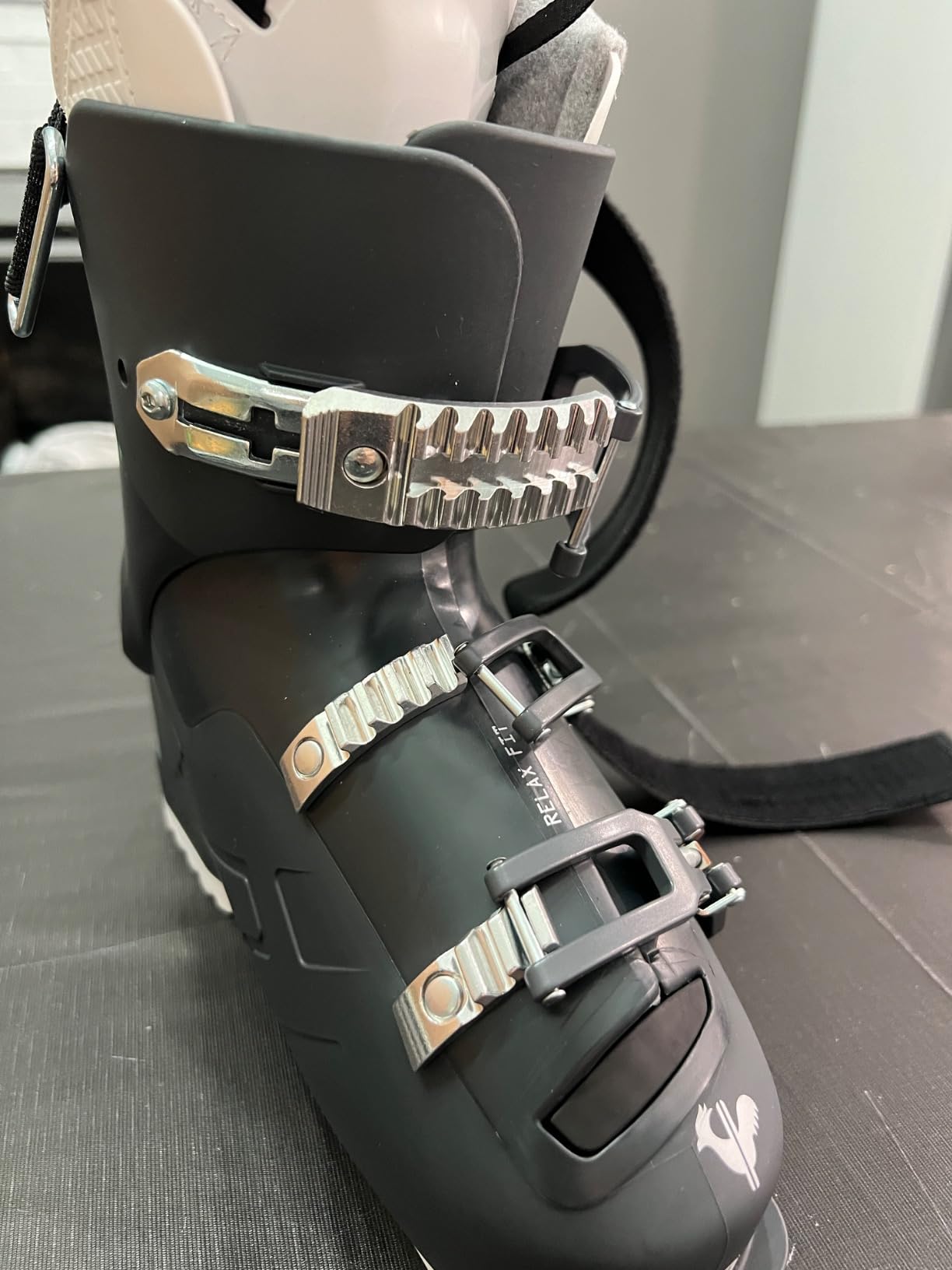
Entry is handled with soft plastic around the instep so the boot opens easily even as temperatures drop, and the shell is water resistant with a thermo-adjustable synthetic lining. Customizable liners let a fitter shape the internal fit, which is where warmth and precision both come from.
One thing to plan for: the Sensor Matrix composite shell feels stiffer to some wearers than an entry-level foam shell, and the GRIPWALK soles are a separate purchase if you walk on hard surfaces. We have covered fit and sizing for women in more detail in our hiking boot fit guide, which covers the same last-width logic.
Why a women’s last is not a marketing trick
A women’s last is not simply a smaller men’s boot. The foot shape differs in ways that matter on a hard surface, most notably a narrower heel and a different forefoot shape, and a boot built on a men’s last can pinch exactly where a woman is most vulnerable on a ski edge.
The tulip cuff here also changes how the boot interfaces with your lower leg. A straight cuff on a smaller calf can create a pressure point that gets worse all day, and pressure points that never go away are how ski boot syndrome starts.
Where it falls short
The composite shell is the main adjustment. Skiers who want the absolute softest possible flex may find the Sensor Matrix construction firmer than a foam shell, even at a 50 flex rating. The flex number and the perceived flex are related but not identical.
Be realistic about warmth versus weight. This is a warm, water-resistant boot that suits most days, but a smaller shell wraps heat faster in deep cold. A proper thermal layer inside the liner handles the difference better than a stiffer boot does.
8. Nordica Cruise S W: The Easiest-Throat Women’s Boot to Get Into
Nordica Cruise S W Women’s Comfort Fit All Mountain Alpine Ski Boots (Black/White/Mauve, 25.5)
104mm high volume last
Dual soft-flap instep
Micro-adjustable aluminum buckles
Waterproof
Pros
- Dual soft-flap instep opens the throat very wide for easy step-in and step-out
- 104mm high volume last with a streamlined anatomical shape
- Micro-adjustable aluminum shell and cuff buckles for precise tensioning
- Waterproof construction with soft synthetic lining for warmth
Cons
- Needs a break-in period before it stops feeling tight
- Sizing runs small for some with at least one buyer returning the boot
If easy entry is your top priority, this is the boot in the lineup. The dual soft-flap instep opens the throat exceptionally wide, so the foot goes in without the awkward half-lean and heel-lift that people fight through in a stiffer shell. Owners moving up from rentals report the fit is comfortable for a first owned boot, and that is a specific and meaningful compliment.
The chassis underneath it is solid. It uses a 104mm high volume last with a streamlined anatomical shape aimed at control and response, and the shell and cuff buckles are micro-adjustable aluminum, which gives finer tensioning than plastic hardware. For an older skier or anyone with knee or hip limits, that combination of a wide throat and fine adjustment is the whole point.
It is also waterproof with a soft synthetic lining, which makes it a sensible pick for anyone skiing in weather rather than on a groomed bluebird morning. Owners highlight value for money and true-to-size fit for intermediate skiers, and the rating sits at 4.6.
Two cautions. It needs a break-in period before it stops feeling tight, which matches the experience of r/Skigear buyers who had to heat mold before their boots worked. And the sizing runs small for some, with at least one purchase returned, so measure rather than assume.
Best for older skiers and stiff joints
Anyone whose knees, hips or back make a deep squat difficult. The wide-opening throat means you can get the boot on in a more upright position, and micro-adjustable buckles let you set tension precisely once the foot is in place instead of fighting a fixed lever.
It is also a good choice for a first-season skier who already knows they will ski in poor weather. The waterproof construction and soft lining remove two reasons a beginner might cut a day short.
Where the tight first impression comes from
Boots that open wide can still feel tight once the liner and buckles are on. That is the break-in, and it is where most disappointed first-time owners in the forums went wrong. They judged the boot in the shop rather than after molding.
The sizing complaint is a separate issue from fit. A boot can be the right shape and the wrong length, so measure your foot length and check it against the published chart before ordering.
9. Atomic Hawx Magna 75: Widest Size Range and Real Adjustability
Atomic HAWX Magna 75 Women’s Alpine Ski Boots, Black/Gold, W25/25.5 MY25
Beginner skill level
Polypropylene shell and cuff
1644 g per boot at size 24-24.5
Medium width
Pros
- Very comfortable over extended wear with owners skiing a full week without foot fatigue
- Widest size range in the lineup from size 23 up to 27.5
- Adjustable fit allows fine tuning of the boot to the foot
- Good value once broken in
Cons
- Presses at first and needs a break-in period before conforming
- Forward flex adjustment does not always hold or work as expected
- Lowest average rating in the lineup at 4.0
Atomic builds the Hawx Magna 75 around adjustability, and that is its strongest argument. It is a beginner-rated boot with a polypropylene shell and cuff that respond well to heat molding, and the size range runs from size 23 through 27.5, the widest in this lineup. If you are between standard adult sizes, having the option matters.
The comfort reports are strong. Owners describe skiing a full week without foot fatigue, which is not a small claim for a beginner boot, and they credit the adjustable fit for fine tuning the shell to their particular foot. The 1644 gram per-boot weight at size 24 to 24.5 keeps it in reasonable territory for a heat-moldable shell.
It presses at first. That is the most common note in the reviews and it matches what r/Skigear posters describe about Atomic boots, which were so tight at purchase that some could not ski a first run and only worked after molding. If you buy this, budget for heat molding and give it a day before judging it.
The rating here is 4.0, the lowest in the lineup, and the reasons are mostly the break-in and the forward flex adjustment not always holding where it was set. One owner also reported receiving a damaged used boot, which is a fulfilment issue rather than a product one.
Why we still recommend it for some beginners
The size range and the moldable polypropylene shell are real advantages for specific feet. If you have a foot that sits between sizes or needs a generous mold to conform, this boot gives a fitter more to work with than a boot that arrives already fixed in its shape.
It is also a reasonable pick for a skier who plans to keep the boot for many years and expects to dial it in over time. Adjustability that works reliably over time is worth more than a slightly better out-of-the-box impression.
When the break-in goes wrong
The problem with this boot is entirely about timing. Buy it, do not ski in it on day one, and get it molded. Skiers who heat molded this boot report it fits fine afterwards, and skiers who did not report the opposite with equal force.
If you cannot access a bootfitter, this is not the boot to experiment with. Start with a simpler, more forgiving shell from slot four or slot five and come back to a moldable boot once you know what a good fit feels like.
10. K2 BFC 90: Wide-Foot Comfort With Full Heat Molding
K2 BFC 90 Men’s Ski Boots (Black, 28.5)
TPU shell with PP cuff
Fully heat moldable
High volume last
Two year limited warranty
Pros
- Fully heat-moldable liner lets the boot be custom-fitted to the foot
- High volume last is praised by owners with very wide feet
- Comfortable fit across a range of sizes
- Backed by a two-year limited manufacturer warranty
Cons
- Buckles feel cheaper than higher-end models and one came loose
- Advertised hands-free entry did not deliver and owners still needed both hands
- Sizing can run small with at least one owner ordering a size up
The K2 BFC 90 is the one to buy if your foot is genuinely difficult to fit. The fully heat-moldable liner lets a fitter shape the boot around your foot rather than the other way around, and owners with very wide feet call it among the most comfortable boots they have skied. The high volume last is doing a lot of the work here, with the mold handling the shape.
Construction is a TPU shell with a polypropylene cuff, which is a durable, serviceable combination that bootfitters work with without drama. A two-year limited manufacturer warranty also makes it a safer commitment than most, and the fit was described as comfortable across a range of sizes rather than only at one.
There are two honest warnings in the reviews. The hands-free entry that the listing advertises did not deliver in practice, and owners still needed both hands to get the boot on. And the buckles were reported to feel cheaper than higher-end models, with one owner having a buckle come loose within days.
Sizing can also run small, with at least one owner ordering a size up and getting a better result. Note that a 90 flex is at the top of the beginner range, so this is a boot for a heavier or more aggressive beginner, or for someone coming back to the sport who already has leg strength.
Best for difficult-to-fit feet
Wide feet, high arches, or a foot that ordinary lasts never seems to match. The full heat mold is what makes this one work, because it lets the boot conform to the foot after the last has already given it room.
It is also a good boot to buy with intention and keep. A two-year warranty and a fully moldable liner suit an owner who plans to keep the same boot for a decade rather than replace it every season.
Where the marketing oversells
Hands-free entry did not hold up for the people who bought it, so judge this boot on the buckle and shell rather than on that claim. If easy entry is what you need, the Nordica Cruise S W in slot eight is the honest answer.
The 90 flex is also the caution. It is fine for a strong beginner, but a cautious first-timer will struggle to press through it. A softer boot, molded properly, will always outperform a stiff boot that fits badly.
How to Choose Beginner Ski Boots Without Overbuying
Beginners should buy ski boots rated 60 to 80 flex. Flex is the pounds of force needed to bend the boot forward at the shin, so a lower number bends more easily, lets you ski with less leg strength, and cuts shin fatigue. Stay at or below 80 unless you are a strong, confident skier, and never buy up in flex because of your height or weight.
That last warning is worth repeating. Skiers on r/ski describe being handed 100 and 110 flex boots based on being tall and heavy, and experienced users push back hard: flex is a function of ability, not body size. A tall beginner in a stiff boot will lean back, ski badly, and hurt their shins, all at once. Rentals give beginners the softest flex on the mountain for exactly this reason.
There is honest disagreement on forums, and it is worth hearing both sides. Some experienced skiers argue a stiffer boot is fine if you align correctly and ski with your shoulders flexed forward, meaning posture matters more than the flex number. That is true, but alignment is a coaching outcome, and a beginner has to learn it in a boot they can actually press through.
What flex rating should a beginner buy?
Aim for 60 to 80. Below 60 you give up response and control as your technique develops, and above 80 you are asking your legs to do work they have not been trained to do yet. Most of the beginner-rated boots in our lineup sit in that band, which is not a coincidence.
If you are heavier, the temptation is to go stiffer. The better answer is to stay at the softer end of 60 to 80 and add a custom footbed, because a boot that fits properly does more for control than a stiffer shell that fights your foot. If you are a very light skier, stay low. A 70 flex is plenty responsive at any weight.
How snug should a ski boot fit?
A properly fitted boot is snug, with a light pull on the toe area, a heel that stays put when you lift the toe, and shin contact that begins once you close the cuff buckle. If you need to pull the heel up off the sole of the foot, the shell is too big, no matter how it feels in socks.
Expect two different sensations, and this is where most returns happen. Before heat molding, a well-fitted boot feels noticeably tight, particularly at the instep and around the heel, and some skiers cannot comfortably finish a first run. After molding, the same boot conforms and feels snug rather than painful. Judge the boot after the mold, never before.
Do not confuse snug with painful. Numbness, sharp pain at the first or fifth metatarsal, and pain across the top of the foot are all signs the boot is too tight and need a wider last, not a tighter liner. The recovery boots we cover separately help after a day, not during one.
Should you size up or size down in ski boots?
Stay close to your measured size. Because a ski boot shell is made of rigid plastic, you cannot go up a full size the way you do in a running shoe, and sizing down in a boot means your toes jam into the front of the shell. A boot that is too small cannot be fixed, and a boot that is one full size too large means your foot swims and you lose control.
Boot sizes follow the Mondo scale in centimeters rather than a shoe size in inches, and a boot size is not your shoe size. Skiers on r/COsnow who were buying their first pair are advised to measure foot length, arch and bridge at home, and to treat manufacturer sizing as a rough guide. The general rule is that you can lose a quarter to a half size in length because a boot should not touch your toes, but only if the fit around the foot is right.
What flex, last and closure should beginners prioritize?
Last width is the number most beginners ignore and the one that decides comfort. A beginner should look for 100mm or wider, with 104mm a good target, because a roomy last eliminates forefoot compression while the liner still holds your foot in the middle of the shell. Wide feet or high insteps should go to a high volume model such as the Head Edge LYT RX HV.
Then think about closure. Traditional buckles are fine if your hands work, and micro-adjustable aluminum buckles are better because you can set tension precisely. Soft-flap or soft-instep constructions, which appear on both Nordica Cruise models and the Rossignol Speed 80, open the throat wide and are noticeably easier for beginners, older skiers, and anyone with limited mobility. Ignore hands-free claims you have not seen tested.
Shell construction comes last. Overlap shells are lighter and warmer, and three-piece shells are more moldable and forgiving, which is why expensive adult boots use them. At beginner level, a quality molded shell with a moldable liner is enough, and paying more does not buy comfort that a good fit does not already deliver.
Should Beginners Rent or Buy Ski Boots?
Rent for your first season if you are unsure. Rental boots are intentionally soft and forgiving, which is the right tool for learning, and the cost of a bad purchase is far higher than a season of daily rentals. The decision point is days on snow, not enthusiasm: if you expect fewer than ten to twelve days a year, renting keeps your money flexible and your legs happier.
Buying has one advantage that cannot be rented, and it is a big one. Rental boots get heat molded around someone else’s foot every time you pick them up, and a shell that fits a stranger rarely fits you well. On r/skiing, skiers describe rentals leaving them with pressure points they assumed was just the sport, and the fix is always a properly fitted owned boot.
The cost of owning also includes the fitting. Forum skiers are consistent that a good bootfitter at a reputable shop matters more than the brand or what you paid, and that advice is repeated everywhere in the research. If you have no local shop, buy from a retailer that will heat mold, and consider getting fitted in a shop near your resort before ordering a different size online.
How many ski days before you need real boots?
Most regular skiers are ready for their own boots somewhere around their second season, or once they are comfortably linking turns without a wedge. The honest test is not the day count but the frustration: if you are taking your boots off at every lift to relieve a hot spot, you have outgrown rentals.
A useful middle path is to rent all day and then spend twenty minutes in a shop trying on owned boots. It costs nothing beyond the trip and tells you your true size and last far more accurately than a size chart ever will.
Ski Boot Syndrome: Symptoms and What to Do
Ski boot syndrome is the name given to a cluster of symptoms that follow skiing in badly fitting boots: numb toes, burning pain at the base of the toes, pain across the top of the foot, cold spots, and lower-leg fatigue that does not settle. It is not an injury in the usual sense, and it is not something you should push through, because it comes from a boot that is the wrong shape or the wrong length for your foot.
The symptoms in the forums follow a consistent pattern. Pain concentrates at the first and fifth metatarsals, the bones at the ball of the foot, and skiers end up taking their boots off at every lift rather than riding the lift. That specific location is a useful diagnostic: pressure at the metatarsals almost always means the boot is too tight across the foot, and the answer is a wider last, not a tighter liner or a smaller size.
Pain across the shin with fatigue in the lower leg usually means the opposite problem, a boot that is too stiff for the skier’s ability, and it often shows up after the first few days of a season as technique breaks down. If you feel that, move down in flex before you try anything else.
Prevention is simple and it happens at purchase. Get measured, ask for a beginner-flex boot in a 100mm or wider last, and have it heat molded before you judge it. If symptoms appear in a boot that was fitted properly, treat a fitted liner or a footbed as the first fix, and if pain persists, see a doctor rather than another season of rental boots. No boot fixes a bad fit, and a warmer one certainly does not.
Frequently Asked Questions
What is the best ski boot for a beginner?
The best ski boot for a beginner is a soft-flex model rated 60 to 80 that uses a roomy last of 100mm or wider and an easy-entry closure. A 104mm high volume last is the most forgiving starting point, because it removes forefoot pressure while the liner keeps your foot centred. Avoid 100 flex and above unless you are already a strong skier.
What flex rating should a beginner buy?
Beginners should buy ski boots rated 60 to 80 flex. Flex measures the force needed to bend the boot forward at the shin, so a lower number is easier to press through and produces less shin fatigue. Do not buy a stiffer boot because you are tall or heavy. Ability, not body size, should set the flex.
How snug should a ski boot fit?
A correctly fitted ski boot is snug, not painful: light pull at the toe area, a heel that stays down when you lift the toe, and shin contact once the cuff is closed. Before heat molding a good boot feels noticeably tight. If you feel numb or sharp metatarsal pain, you need a wider last rather than a tighter boot.
Are the easiest ski boots to get on and off the best for beginners?
Often, yes. Boots with a soft-flap or soft-instep construction open the throat very wide, so you step in rather than levering your foot past a hard shell edge. That matters most for older skiers and anyone with limited knee or hip mobility. Traditional buckle closure is fine if your hands work and the flex is soft enough to open.
Is it better to size up or size down in ski boots?
Stay close to your measured size. A rigid plastic shell cannot take a full size up the way a running shoe can, and sizing down means your toes jam into the front of the shell. Boot sizes follow the Mondo scale in centimetres and are not shoe sizes, so measure foot length rather than converting from your street shoe.
Should beginners rent or buy ski boots?
Rent for your first season if you are unsure. Rental boots are intentionally soft and forgiving, and are heat molded to a different foot every time. Buy once you expect ten to twelve or more days a year, and buy fitted, because a good bootfitter matters more than the brand. Persistent metatarsal pain in rentals is the clearest sign it is time to own a pair.
What is ski boot syndrome?
Ski boot syndrome describes the symptoms that follow skiing in badly fitting boots: numb toes, burning pain over the first and fifth metatarsals, pain across the top of the foot, and lower-leg fatigue. Pressure at the metatarsals means the boot is too tight across the foot and you need a wider last. Shin pain with fatigue usually means the flex is too stiff for your ability.
How long does it take to break in new ski boots?
Most new ski boots need heat molding plus a few days of skiing before they feel right. A boot fitted well feels tight before the mold and snug after it, and that difference is why so many beginners wrongly return boots on day one. Give the boot a molding session and one full day of gentle skiing before judging the fit.
Bottom Line: Which Beginner Ski Boots to Buy in 2026
Our Editor’s Choice is the Roces Idea Up, and the reason is narrow and specific: it is the only expandable boot in the lineup and the most-reviewed model here by a wide margin, so a family buying a first pair for a child gets a boot that follows growing feet for two or three seasons and never needs a binding remount. For adults, the Rossignol Evo 70 is the pick we would book a fitting for, with the highest star rating in the lineup, a relaxed 104mm last, and a liner soft where beginners need it soft.
If you have wide feet or a high instep, go straight to the Head Edge LYT RX HV and skip the narrow options. Women should start with a women’s last, and the Rossignol Kelia 50 is the pick there because the tulip cuff spreads pressure that a straight cuff concentrates. If entry is the hardest part of the whole picture, the Nordica Cruise S W opens the throat the widest in this group.
Whatever you choose, buy the boot that fits your foot rather than the one that feels right in a shop while you are standing in socks. Get measured, stay in the 60 to 80 flex band, ask for heat molding before you leave, and give the boot a full day on the hill before you judge it. That last step is where most beginner returns are avoided and where the best ski boots for beginners actually start to feel like yours.