
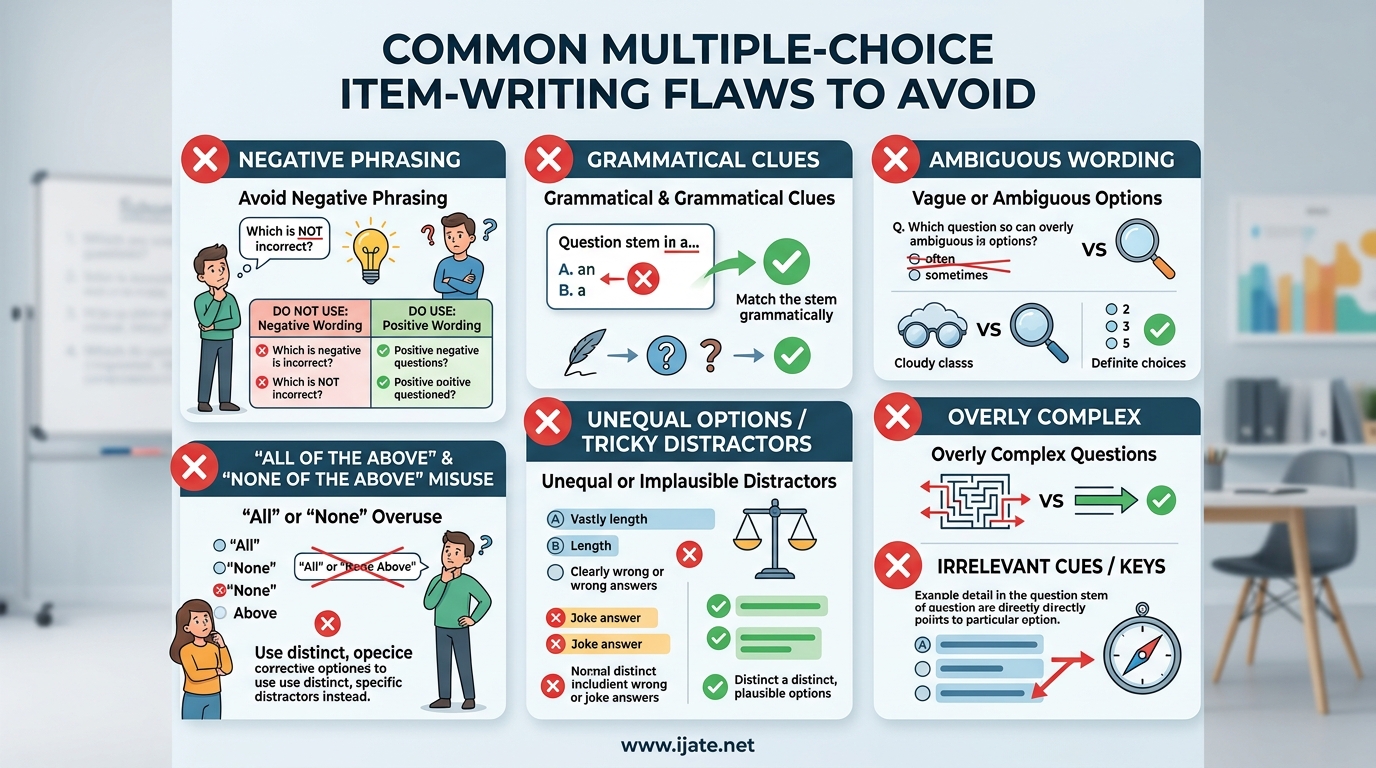
Every educator who writes multiple-choice questions has accidentally left the front door unlocked for test-wise students. A single grammatical cue or an overly long correct answer can hand points to someone who never studied the material. These defects, known as multiple-choice item-writing flaws, quietly undermine assessment validity and produce scores that misrepresent what learners actually know.
In this guide, I will walk you through the most common multiple-choice item-writing flaws to avoid, explain why each one damages your assessment, and show you exactly how to fix it. Each flaw comes with a before-and-after example so you can see the problem and the repair side by side.
Whether you write classroom quizzes, certification exams, or compliance tests, catching these flaws before items reach your students makes the difference between an assessment that measures learning and one that rewards guesswork.
Table of Contents
What Are Multiple-Choice Item-Writing Flaws?
Multiple-choice item-writing flaws are structural or design defects in test questions that allow students to identify the correct answer using test-taking strategies rather than actual content knowledge. Instead of measuring mastery, flawed items reward testwiseness, the ability to exploit patterns in how questions and answers are constructed.
These flaws matter because they introduce noise into your measurement. A student who scores 80 percent on a flawed exam may have mastered 60 percent of the content and guessed the rest using cues you never intended to leave behind. That score does not reflect true ability, and decisions based on it, whether grading, certification, or placement, become unreliable.
Before diving into specific flaws, let me define a few terms I will use throughout this article. The stem is the question statement or prompt. The keyed response is the correct answer. The distractors are the incorrect options designed to attract students who do not know the material.
A well-constructed item starts with a clear construct, the specific knowledge or skill the item is meant to measure. Writing an item intent statement before you write the item itself keeps you anchored to that construct and prevents most of the flaws described below.
Grammatical Cues and Mismatches
Grammatical cues happen when the stem and the correct answer fit together grammatically, but the distractors do not. A student who notices that only one option agrees with the stem in number, tense, or article usage can pick the keyed response without knowing the content.
This flaw is one of the easiest for test-wise students to exploit because grammar creates a visible pattern. If the stem ends with the article “an,” any option starting with a consonant sound is immediately eliminated.
Flawed example:
“The body’s primary defense against invading pathogens is an _____.” Options: A) antibody, B) red blood cell, C) nerve impulse, D) hormone.
Only “antibody” fits grammatically after “an.” Students can eliminate the other three options in seconds.
Fixed example:
“What is the body’s primary defense against invading pathogens?” Options: A) Antibodies, B) Red blood cells, C) Nerve impulses, D) Hormones.
The stem now reads as a complete question, and every option fits the same grammatical slot.
How to fix it: Read the stem aloud followed by each option as a single sentence. If any option sounds grammatically wrong, rewrite it or rewrite the stem so all options fit equally well.
Unequal Option Length (Longer Correct Answer)
The keyed response tends to be longer than the distractors because item writers add qualifiers to make the correct answer unambiguously right. Test-wise students know this pattern and select the longest option when they are unsure.
Faculty Focus identifies this as one of the most exploitable flaws in their analysis of testwiseness. Students describe it as the “too long to be wrong” heuristic, and it works disturbingly often.
Flawed example:
“Which planet has the largest moon in the solar system?” Options: A) Mars, B) Jupiter, which has 95 known moons including the largest, Ganymede, C) Venus, D) Mercury.
Option B is noticeably longer and more detailed, practically announcing itself as correct.
Fixed example:
“Which planet has the largest moon in the solar system?” Options: A) Mars, B) Jupiter, C) Venus, D) Mercury.
All options are now single-word answers of equal length. The item measures whether the student knows that Ganymede orbits Jupiter, not whether they can spot the longest option.
How to fix it: Make all options similar in length and structure. If the correct answer needs a qualifier, add qualifiers to the distractors as well, or move that detail into the stem.
Implausible or Trivial Distractors
Implausible distractors are wrong answers so obviously incorrect that no student who has any exposure to the content would choose them. When three of four options are trivially wrong, the item effectively becomes a true-or-false question.
Instructors on the r/Professors subreddit consistently name distractor generation as the most painful part of MCQ creation. Creating three plausible distractors per question takes real effort, and the temptation to fill slots with throwaway options is strong.
The best distractors come from common student misconceptions, partially correct ideas, or answers that would be right under slightly different conditions. These are the distractors that actually discriminate between students who know the material and those who do not.
Flawed example:
“What is the capital of France?” Options: A) Paris, B) the Moon, C) a toaster, D) 1776.
Options B, C, and D are absurd. Any student who has heard of France will choose A.
Fixed example:
“What is the capital of France?” Options: A) Paris, B) Lyon, C) Marseille, D) Nice.
Lyon, Marseille, and Nice are all major French cities. A student who confuses the capital with the largest city or a cultural hub might genuinely choose one of these distractors.
How to fix it: Build distractors from the most common errors students make on the topic. Review student responses from open-ended questions, homework, or previous exams to identify misconceptions worth using as plausible wrong answers.
Absolute Terms (Always, Never, All, None)
Absolute terms like “always,” “never,” “all,” “every,” and “none” tend to appear in wrong answers because few real-world facts hold without exception. Test-wise students learn to eliminate options containing absolute language and gain an artificial advantage.
This flaw is especially common in health professions exams and compliance testing, where exceptions to rules are clinically meaningful. The presence of an absolute term often flags a distractor rather than the keyed response.
Flawed example:
“Which statement about cellular respiration is correct?” Options: A) It always produces 36 ATP per glucose molecule, B) It occurs in all living cells without exception, C) It converts glucose into usable energy, D) It never occurs in the presence of oxygen.
Options A, B, and D all contain absolute terms that are technically false, funneling students toward C by elimination alone.
Fixed example:
“Which statement about cellular respiration is correct?” Options: A) It produces approximately 36 ATP per glucose molecule, B) It occurs in most eukaryotic cells, C) It converts glucose into usable energy, D) It typically occurs without oxygen present.
No absolute terms remain. Students must know the content to distinguish between plausible options.
How to fix it: Use qualified language like “typically,” “usually,” or “in most cases” consistently across all options. If you must use an absolute term, use it in both correct and incorrect options so it does not function as a cue.
Negative Phrasing and NOT/EXCEPT Questions
Questions that ask students to identify the wrong answer using words like “NOT,” “EXCEPT,” or “LEAST” increase cognitive load and often measure reading comprehension rather than content knowledge. Students must hold a negation in mind while evaluating each option, which adds irrelevant difficulty unrelated to the construct.
The National Board of Medical Examiners guidelines recommend avoiding negative phrasing whenever possible. When negatives are necessary, the negative word should be emphasized with capital letters or bold text so students do not miss it.
Flawed example:
“Which of the following is not a characteristic of mammals?” Options: A) Hair or fur, B) Three middle ear bones, C) Lay shelled eggs, D) Mammary glands.
The student must process four statements and identify the one that does not belong, a reading task layered on top of a biology task.
Fixed example:
“Which of the following is a characteristic unique to birds, not found in mammals?” Options: A) Feathers, B) Hair or fur, C) Three middle ear bones, D) Mammary glands.
The stem is now positive. It asks what birds have, not what mammals do not have. The cognitive task is cleaner.
How to fix it: Rewrite negative stems as positive questions. If a negative is unavoidable, capitalize and bold the negative word (“NOT,” “EXCEPT”) so students notice it immediately, and avoid double negatives at all costs.
Convergence Strategy and Logical Cues
The convergence strategy is a test-taking trick where students identify the correct answer by finding the option that shares elements with other options. If two options mention concept X and two mention concept Y, and one option mentions both, the converging option is likely correct. This works because item writers sometimes build the keyed response by combining all the true elements into one option.
Logical cues also appear when options form a progression (low, medium, high, highest) and the answer tends to sit at an extreme or middle point. Students who recognize these patterns can narrow down answers without content knowledge.
Flawed example:
“What are the two main components of blood plasma?” Options: A) Water and protein, B) Water and carbohydrates, C) Protein and carbohydrates, D) Lipid and nucleic acids.
“Water” appears in A and B. “Protein” appears in A and C. The convergence of “water” and “protein” in option A signals it as the keyed response to a student using the convergence strategy.
Fixed example:
“What is the most abundant component of blood plasma by volume?” Options: A) Water, B) Glucose, C) Sodium chloride, D) Albumin.
Each option is now independent. No element repeats across options, so convergence is impossible.
How to fix it: Ensure each option stands on its own without sharing words or concepts with other options. If you must use options that overlap in structure, randomize which elements appear in which option so no convergence pattern emerges.
Position Bias and Answer Patterns
Position bias occurs when the keyed response appears in the same option position too frequently. If the correct answer lands on “B” or “C” in 60 percent of a 50-question exam, test-wise students will pick those letters when guessing and outscore their peers.
Research on testwiseness shows that item writers unconsciously favor middle positions, especially B and C, because they feel less conspicuous. Some writers also arrange answers alphabetically or by length, creating predictable patterns.
How to fix it: After writing an exam, count the number of times each letter appears as the keyed response. Distribute correct answers roughly equally across all positions. If you use test-generation software, check whether it randomizes answer positions automatically, and verify the output before printing.
A simple frequency check takes two minutes and eliminates one of the most easily exploitable flaws in any multiple-choice assessment.
Construct Misalignment and Irrelevant Difficulty
Construct misalignment happens when an item intended to measure one skill actually measures something else. A biology question written with unnecessarily complex vocabulary may measure reading ability rather than science knowledge. This is called irrelevant difficulty, and it disproportionately harms English language learners and students with reading disabilities.
The construct-first methodology addresses this problem at the root. Before writing any item, define exactly what the item should measure using an item intent statement: “This item measures whether the student can [specific cognitive task] related to [specific content area] at the [cognitive level] of complexity.”
Flawed example:
“Notwithstanding the ostensible inefficiency of antecedent pedagogical paradigms, the preeminent rationale for formative appraisal resides in its capacity to ____.” Options follow.
This stem measures vocabulary and reading stamina, not understanding of formative assessment principles.
Fixed example:
“What is the main purpose of formative assessment?” Options: A) To measure learning at the end of instruction, B) To provide feedback during instruction, C) To rank students against each other, D) To assign final grades.
The language is clear and direct. The item now measures knowledge of formative assessment, not reading comprehension.
How to fix it: Write an item intent statement for every item before drafting the stem. Match the reading level of the stem to the cognitive demand of the construct you intend to measure. If the construct is recall, the stem should be simple and direct. If the construct is analysis, complexity belongs in the content, not the vocabulary.
All-of-the-Above and None-of-the-Above Options
“All of the above” and “none of the above” reduce the discriminating power of an item. When a student recognizes that even one option is correct, they can select “all of the above” without verifying the remaining options. Similarly, “none of the above” rewards students who can identify a single wrong option without knowing whether the others are right.
Both options turn a four-option question into a simpler decision. They also encourage partial-knowledge guessing, which inflates scores for students who have not fully mastered the content.
How to fix it: Avoid “all of the above” and “none of the above” in most assessment contexts. If you use “none of the above” for computational questions where students must verify that no listed answer is correct, ensure that the keyed response is sometimes “none of the above” so students cannot dismiss it as always wrong.
Quick-Reference Item-Writing Checklist
Use this checklist to review every multiple-choice item before it enters your item bank or reaches students. Each point corresponds to a flaw described above.
- Does every option fit grammatically with the stem? (Fix grammatical cues)
- Are all options approximately the same length? (Fix length cues)
- Is every distractor plausible to a student with partial knowledge? (Fix implausible distractors)
- Have you removed absolute terms like “always” and “never” from wrong answers? (Fix absolute term cues)
- Can the stem be rewritten to avoid negative phrasing? (Fix negative phrasing)
- Do any options share words or concepts that enable convergence? (Fix logical cues)
- Are correct answers distributed evenly across positions? (Fix position bias)
- Does the stem measure only the intended construct without irrelevant difficulty? (Fix construct misalignment)
- Have you eliminated “all of the above” and “none of the above”? (Fix partial-knowledge gaming)
- Can you state the item intent in one sentence? (Confirm construct alignment)
Print this checklist, pin it next to your desk, and run every item through it. Instructors who adopt a review checklist report catching 80 percent of their item-writing flaws before pilot testing.
FAQs
What are some common mistakes to avoid when creating multiple choice questions?
Common mistakes include leaving grammatical cues in the stem, making the correct answer noticeably longer than distractors, using absolute terms like always and never in wrong answers, clustering correct answers in the same position, using all-of-the-above or none-of-the-above options, and writing implausible distractors that no student would choose.
What are common multiple choice mistakes?
The most common multiple choice mistakes are grammatical mismatches between the stem and options, unequal option length that makes the correct answer stand out, implausible distractors, negative phrasing that adds irrelevant reading difficulty, and predictable answer position patterns that reward testwise students.
What are some common issues with multiple choice questions?
Common issues include construct misalignment where items measure reading ability instead of content knowledge, convergence strategies where students identify answers by spotting overlapping words across options, and irrelevant difficulty caused by overly complex vocabulary or ambiguous stems.
What are some common problems with multiple choice questions?
Common problems stem from test-wise cues that allow students to exploit patterns instead of demonstrating knowledge. These include position bias where correct answers cluster at certain letters, absolute terms that flag wrong answers, and trivial distractors that reduce the item to a true or false question.
Conclusion
Multiple-choice item-writing flaws are preventable. Every flaw described in this guide, from grammatical cues to construct misalignment, has a straightforward fix that starts with awareness and ends with a simple review step. Writing strong multiple-choice items takes time, but the payoff is an assessment that actually measures what your students know.
Start by adopting the construct-first approach. Write an item intent statement before you write the stem. Build plausible distractors from real student misconceptions. Run each item through the quick-reference checklist. Then implement a peer review process and use item analysis statistics to catch flaws that slip through.
Understanding common multiple-choice item-writing flaws to avoid is the first step toward building fair, valid, and reliable assessments. Your students deserve items that measure their real learning, not their test-taking tricks.