
If you have ever collected assessment data, written a report, and then watched that report disappear into a committee folder, you already understand the problem this article addresses. Closing the loop in program assessment is the step that separates genuine improvement from paperwork. Yet it is also the step most programs skip, fumble, or fake.
In this guide, I will explain exactly what closing the loop means in program assessment, where it fits in the assessment cycle, why it matters, and how to actually do it. I will also cover double-loop analysis, the most common failure modes I see in practice, and best practices that turn assessment from a compliance ritual into a real engine for student learning.
Table of Contents
What Is Closing the Loop in Program Assessment?
Closing the loop in program assessment is the intentional use of assessment results to inform future actions, including decision-making, continuous quality improvement, and resource allocation. In plain terms, it means you collect evidence about student learning, analyze what that evidence tells you, make changes based on what you found, and then check whether those changes actually worked.
The phrase comes from systems thinking, where a “closed loop” is a cycle that feeds information back into itself. Open the loop and information flows in one direction with no return path. Close the loop and the results of your actions circle back to shape your next decisions.
UMBC’s Faculty Development Center offers a useful working definition. They describe closing the loop as the moment we “analyze and make meaning from learning evidence, identify potential interventions to improve learning, and implement those interventions.” I like this framing because it stresses three things: meaning-making, intervention, and implementation. Skip any one of those and the loop stays open.
One important distinction. Closing the loop is not the same as writing a report. A report documents findings. Closing the loop acts on them. Many programs conflate the two and assume that submitting an annual assessment report equals closing the loop. It does not. If no change follows the data, the loop is still open.
Where Closing the Loop Fits in the Assessment Cycle
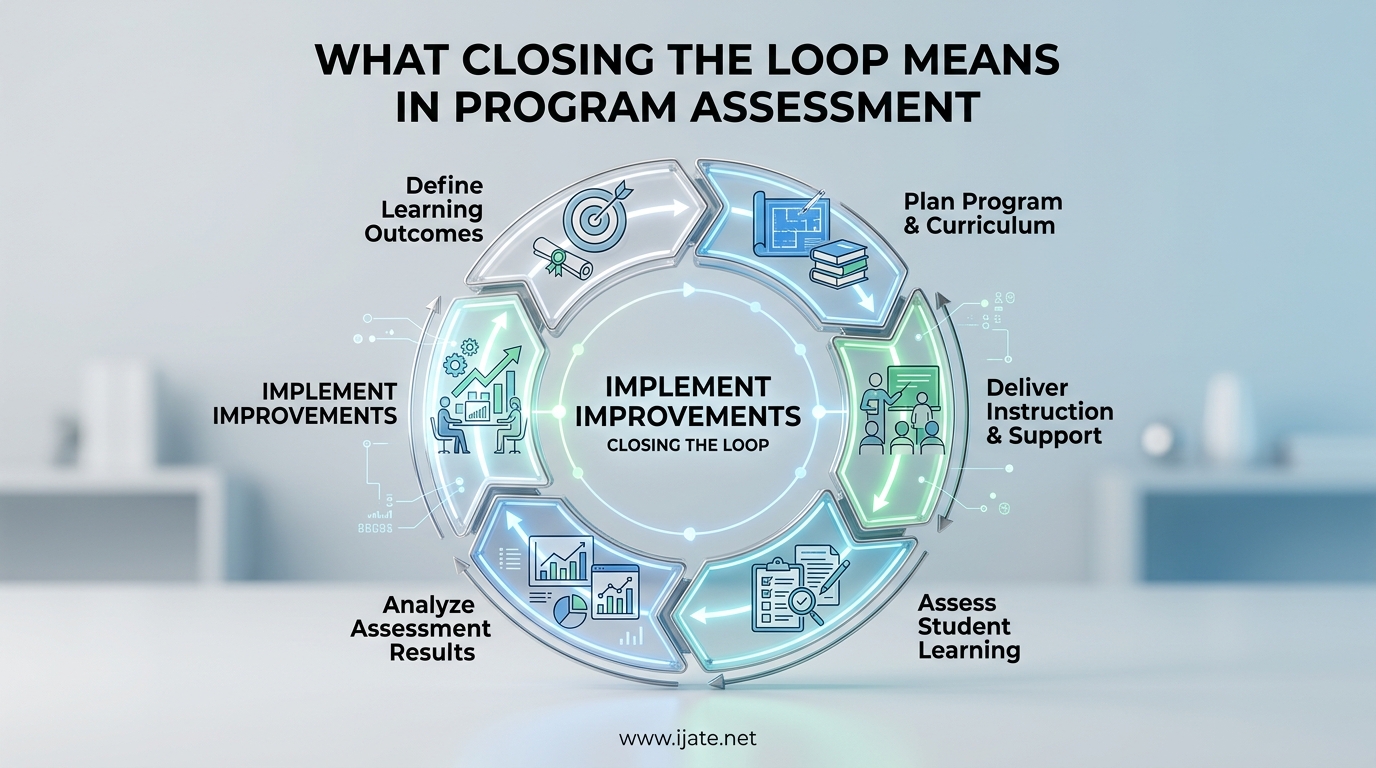
Closing the loop is the final and arguably most critical step in the assessment cycle, but it depends on everything that came before it. The typical cycle includes defining program learning outcomes, designing assessment measures, collecting data, analyzing results, and then closing the loop by acting on what you learned.
Think of the first four steps as building evidence. Closing the loop is what you do with that evidence. Without it, the earlier steps produce data that goes nowhere. With it, the cycle becomes a continuous improvement loop that strengthens the program over time.
Stony Brook’s Office of Educational Effectiveness calls closing the loop “the final and most critical step in the assessment process.” I agree with that framing, but I would add one caveat. It is only the most critical step if you actually complete it. Most programs stop at analysis.
Why Closing the Loop Matters
Closing the loop transforms assessment from a compliance exercise into a meaningful tool for continuous improvement. Without it, you are spending faculty time and institutional resources gathering data that no one uses.
Here is why that matters in concrete terms. Accreditation bodies increasingly want evidence that programs use assessment results to make changes, not just that they collect data. Regional accreditors and specialized program accreditors look for documented interventions followed by reassessment. If your assessment reports show years of data with no corresponding actions, that is a red flag.
Beyond accreditation, closing the loop is how programs genuinely improve student learning outcomes. When you act on evidence and measure the impact, you learn what works. Over multiple cycles, that compounds into real gains in learning, retention, and program quality.
There is also a cultural benefit. Faculty engagement with assessment drops sharply when they see no consequences from the data they help collect. Close the loop visibly and you give faculty a reason to invest in the process. Leave it open and assessment becomes busywork.
The Closing the Loop Process: Step by Step
The closing the loop process follows a clear sequence. I will walk through each step with practical detail so you can apply this directly to your own program.
Step 1: Analyze and Interpret Assessment Results
Start by making meaning from your data. Raw numbers do not close loops. You need to ask what the data tells you about where students are succeeding and where they are struggling.
Look at your program learning outcomes one by one. For each, ask whether students met the benchmark you set. If yes, what contributed to that success? If no, where exactly did the gap occur? Distinguish between direct measures like rubric-scored assignments and indirect measures like student self-reports. Direct measures carry more weight when identifying true learning gaps.
Step 2: Identify the Root Cause
This step is where most programs stumble. When results fall short, the temptation is to jump straight to a solution without understanding why the gap exists.
Forum discussions among educators reveal a common pattern. A STEM mentorship program improved student relationships but not academic performance, because the root cause was competence, not connection. The intervention addressed symptoms but missed the underlying issue.
To avoid that trap, ask diagnostic questions. Is the gap about curriculum design, instructional method, student preparation, assessment design, or something else? Talk to faculty who teach the relevant courses. Look at assignment-level data, not just aggregate scores. The more precisely you identify the cause, the more targeted your intervention can be.
Step 3: Design and Implement Interventions
Once you understand the root cause, design an intervention that directly addresses it. Stony Brook helpfully categorizes interventions into three types.
Curriculum interventions involve revising course content, sequencing, assignments, or learning activities. If students struggle with a particular skill, you might redesign the assignment that targets that skill or add scaffolded practice earlier in the curriculum.
Administrative interventions involve changing policies, processes, or structures. This could mean adjusting admissions criteria, revising prerequisite requirements, or changing how advising supports at-risk students.
Resource interventions involve allocating people, funding, or tools differently. You might fund tutoring for a struggling cohort, invest in faculty development for a specific teaching method, or adopt new technology that supports learning in a specific area.
Whatever you choose, document the intervention clearly. Note what you changed, why, when the change takes effect, and who is responsible.
Step 4: Reassess and Measure Impact
This is the step that truly closes the loop. After implementing your intervention, reassess using the same or comparable measures. Did student performance improve? By how much? Did the gap narrow or close entirely?
The University of South Carolina puts it well. Closing the loop means “examining whether or not the changes implemented as a result of a prior assessment have been effective.” If you skip reassessment, you have implemented a change but you have not closed the loop.
Be honest about the results. Sometimes interventions do not work. That information is valuable too, because it tells you to try a different approach in the next cycle. An intervention that fails is still data, as long as you measure and learn from it.
Step 5: Document and Repeat
Record what you did, what happened, and what you plan next. This documentation serves accreditation purposes, but more importantly it preserves institutional memory. Leadership turnover is a major reason loops fail to close over time. Good documentation ensures the next person can pick up where you left off.
Then repeat the cycle. Closing the loop is not a one-time event. It is a recurring process that builds improvement momentum across multiple assessment cycles.
Double-Loop Analysis: Going Deeper
Most closing the loop work operates at what theorists call single-loop level. You detect a gap, you fix it, you move on. Double-loop analysis pushes further by questioning the assumptions behind your goals and processes themselves.
In single-loop learning, you ask whether students are meeting the outcomes you set. In double-loop learning, you ask whether those outcomes are the right ones in the first place. Are your program learning outcomes still aligned with what graduates need? Are your assessment measures capturing the right evidence? Should your benchmarks be revised?
UMBC is one of the few sources that addresses this concept directly. I think it deserves more attention because it prevents programs from efficiently achieving the wrong goals. A program can close the loop perfectly at the single-loop level and still miss deeper issues that double-loop analysis would surface.
Practically, build double-loop questions into your periodic program review. Every few assessment cycles, step back and ask whether your outcomes, measures, and benchmarks still make sense. That is where double-loop analysis lives.
Common Closing the Loop Failures and How to Fix Them
LearnWell Projects identifies a pattern that resonates with what I hear from educators in forum discussions. They describe closing the loop at its best as transformative, and at its worst as “a ritual of reports that never spark renewal.” Here are the most common failure modes I see and how to address them.
Failure 1: The Loop Never Starts
Sometimes programs collect data and write reports but never move to action. The data sits in a dashboard that no one acts on. Reports get emailed and buried. This is the most basic failure, and it usually stems from unclear ownership. No one is responsible for moving from analysis to intervention.
Fix: Assign explicit responsibility. Name the person who will design and implement interventions after each assessment cycle. Build action planning into the assessment calendar with deadlines and accountability.
Failure 2: Solving the Wrong Problem
This is the mentorship program failure I mentioned earlier. The program invested in connection when the real issue was competence. The loop closed technically, but the underlying problem persisted.
Fix: Spend more time on root cause analysis before choosing interventions. Use assignment-level data and faculty conversations to diagnose accurately. Resist the urge to act quickly at the expense of acting correctly.
Failure 3: Tech Solutions That Look Good But Do Not Improve Learning
One real-world example from forum discussions involved an institution that invested heavily in dashboards and branding. Graduation rates moved from 28% to 29%. The technology looked impressive but did not address the actual barriers students faced.
Fix: Treat dashboards as tools, not solutions. A dashboard organizes data. It does not change practice. Pair any technology investment with concrete intervention plans and reassessment.
Failure 4: Compliance Theater
Programs sometimes go through the motions of closing the loop to satisfy accreditation requirements without genuine commitment to improvement. The reports say the right things, but nothing actually changes in classrooms or curricula.
Fix: Build an assessment culture where improvement, not compliance, is the visible goal. Celebrate interventions that worked. Acknowledge ones that did not. Make it safe for faculty to report honest results without fear that poor data reflects poorly on them.
Best Practices for Closing the Loop Effectively
Based on the research and the patterns I see across institutions, here are the practices that separate programs that close the loop well from those that struggle.
Start small. If your program is new to closing the loop, pick one outcome and one intervention rather than trying to overhaul everything at once. Build the habit before scaling the effort.
Involve faculty throughout. Assessment directors cannot close loops alone. Faculty who teach the courses understand the root causes better than anyone. Bring them into the analysis and intervention design stages.
Set realistic timelines. Interventions need time to take effect. Reassessing too quickly can produce misleading results. Align your reassessment schedule with the natural rhythm of your curriculum, which often means waiting a full academic year.
Document everything. Write down what you changed, why, what happened, and what comes next. Future you and your successors will thank you, especially during leadership transitions.
Be transparent about failures. An intervention that did not work is not a failure of your program. It is evidence. Share what you learned so the next cycle can build on it.
Closing the Loop at Different Levels
Closing the loop looks different depending on where you apply it. At the course level, interventions might involve changing assignments or teaching methods within a single class. The timeline is short and the feedback is immediate.
At the program level, interventions often involve curriculum sequencing, prerequisite structures, or shared assessment measures across multiple courses. The timeline stretches across semesters.
At the institutional level, closing the loop connects to strategic planning, resource allocation, and accreditation reporting. Interventions here can involve policy changes, faculty development investments, or new program initiatives. The timeline spans years.
No competitor I reviewed addressed these level differences explicitly. I think that is a missed opportunity, because the skills and structures needed at each level are distinct. A course-level closing the loop process run by an individual instructor looks very different from an institutional process involving deans and provosts.
FAQs
What does closing the loop mean in assessment?
Closing the loop in assessment means using assessment results to inform future actions, including decision-making, continuous quality improvement, and resource allocation. It is the step where data turns into change.
What is the closing the loop process?
The closing the loop process involves five steps: analyze and interpret assessment results, identify the root cause of any gaps, design and implement targeted interventions, reassess to measure whether the interventions worked, and document the process before repeating the cycle.
What is meant by a closed loop?
A closed loop is a cycle where the results of an action feed back into future decisions. In assessment, it means evidence about student learning directly shapes changes to curriculum, instruction, or resources, and those changes are then measured for impact.
How do you close the feedback loop?
You close the feedback loop by analyzing assessment data, diagnosing root causes, implementing a specific intervention, reassessing with comparable measures, and documenting the results. Without reassessment, you have made a change but you have not closed the loop.
Conclusion
Closing the loop in program assessment is the difference between collecting data and using it. It is the step where assessment results become improvements to student learning, curriculum design, and program quality. Without it, assessment is paperwork. With it, assessment becomes a genuine engine for continuous improvement.
The process is straightforward in principle: analyze results, find root causes, implement interventions, reassess, and document. The challenge is execution. Programs fail when they skip root cause analysis, chase flashy solutions, or treat closing the loop as a compliance ritual rather than a learning process.
If you take one thing from this guide, let it be this. Closing the loop is not about the report. It is about the change. Start small, involve your faculty, measure honestly, and build the habit one cycle at a time. That is how you turn what closing the loop means in program assessment from a concept into practice.