
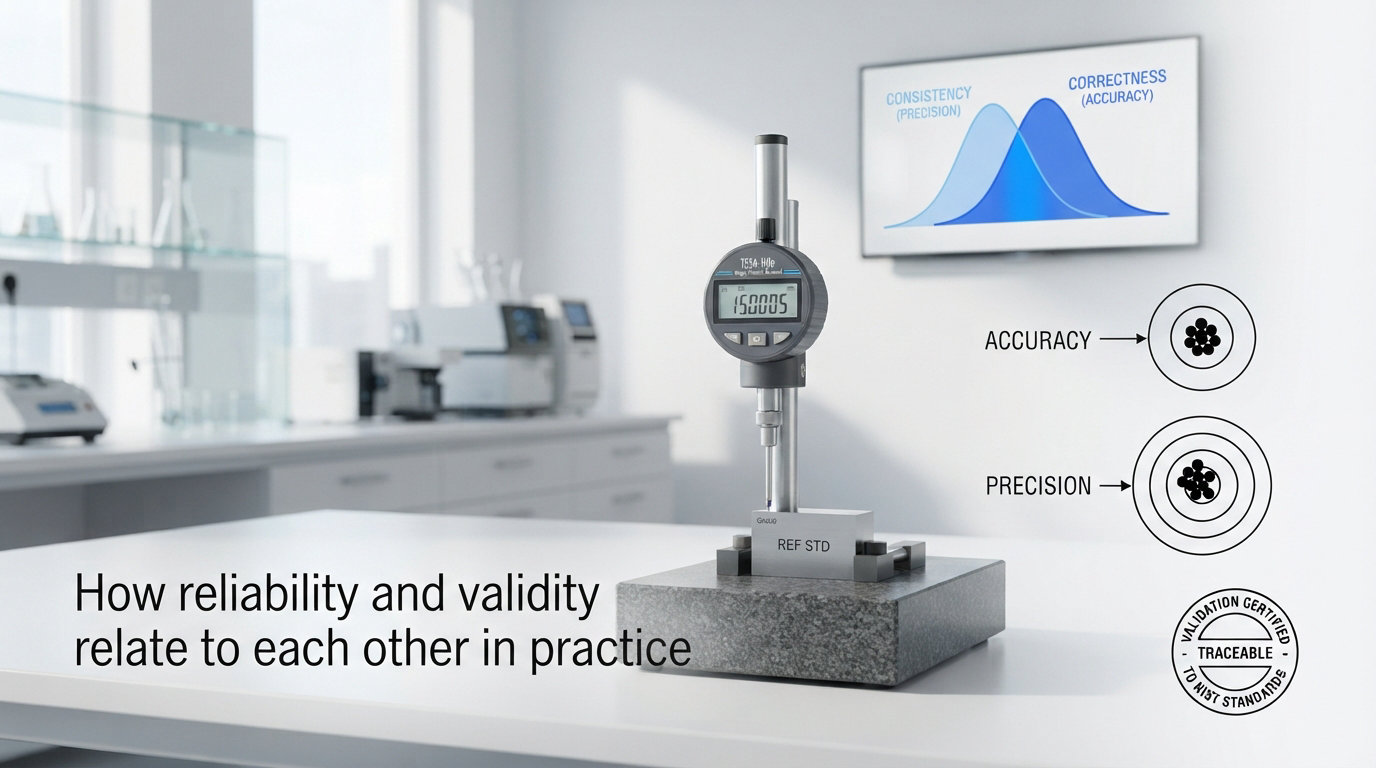
When I first started designing research studies, I could recite the textbook definitions of reliability and validity without hesitation. Reliability meant consistency. Validity meant accuracy. I thought I understood the relationship between the two until I actually tried to measure something myself and realized these concepts interact in ways that are not obvious from definitions alone. If you have ever wondered how reliability and validity relate to each other in practice, you are in good company. Students, researchers, and even experienced methodologists frequently grapple with this question because the answer shapes every decision in the research process, from instrument selection to data collection and interpretation.
Understanding the practical relationship between reliability and validity matters because it directly determines whether your research findings are trustworthy. A study with poor measurement quality produces findings that are inconsistent, inaccurate, or both. Reviewers, journal editors, and thesis supervisors routinely ask about both properties before accepting research for publication or graduation. Researchers in psychology, education, healthcare, and the social sciences encounter these concepts in every study they conduct or read.
This article explains the relationship in clear, practical terms with real-world examples and step-by-step guidance. I will walk through what reliability and validity each mean, the different types you will encounter, how they depend on each other, and what to do when one is present but the other is not. By the end, you will have a working understanding you can apply directly to your own research, whether you are designing a quantitative survey, developing a questionnaire, conducting a literature review, or writing the methodology section of a thesis or dissertation.
Table of Contents
What Is Reliability?
Reliability refers to the consistency of a measure. If you step on a bathroom scale five times in a row and get five different numbers, that scale is not reliable. In research, reliability means that a measurement tool produces similar results when applied repeatedly under consistent conditions. A reliable questionnaire gives roughly the same score when administered to the same person at different times. A reliable coding scheme produces similar classifications when different raters apply it to the same material.
I like to think of reliability as the foundation of good research. When you build any structure, the foundation must be solid before you can trust what sits on top of it. In the same way, reliability is a prerequisite for validity. You cannot have accurate results if those results are not stable and reproducible. A measurement tool that gives you a different answer every time you use it cannot be considered accurate, even if one of those answers happens to be correct by chance.
Researchers assess reliability through several statistical methods, each suited to a different type of consistency. Cronbach’s alpha is the most commonly used measure for internal consistency, and values above 0.80 are generally considered strong in social science research. Some guidelines accept a minimum threshold of 0.70 for exploratory research. Pearson’s correlation coefficient helps evaluate test-retest reliability, with values above 0.80 indicating strong consistency over time. Cohen’s kappa is used for inter-rater reliability, with values above 0.75 indicating excellent agreement between raters.
The importance of reliability extends beyond statistics and into the practical decisions researchers make every day. When you select a questionnaire for your study, you check whether it has demonstrated acceptable reliability in your target population. When you design an observation coding scheme, you pilot it with multiple raters to establish inter-rater reliability before beginning data collection. When reviewers evaluate your research design, they look at reliability evidence as one of the first indicators of study quality.
What Is Validity?
Validity refers to the accuracy of a measure. A valid measurement tool measures exactly what it claims to measure. A bathroom scale that consistently reads 10 pounds too heavy is reliable but not valid. In research, validity answers a fundamental question: are you actually measuring the construct you think you are measuring, and are the conclusions drawn from that measurement meaningful?
Validity is harder to establish than reliability because it requires judgment about what a measure should capture, not just whether it produces stable numbers. Reliability can be demonstrated with a single statistical coefficient. Validity requires multiple lines of evidence, including theoretical reasoning, comparison to established standards, and analysis of relationships with other variables. Researchers evaluate validity by checking whether their measure correlates with things it should correlate with, does not correlate with things it should not correlate with, and distinguishes between groups it should distinguish between.
In practical research settings, validity is what separates a useful instrument from a useless one. You might have the most consistent, reliable questionnaire ever created, but if it measures the wrong construct, your entire study is built on a faulty premise. For example, a depression questionnaire that consistently measures anxiety instead of depression will produce reliable but entirely invalid results. That is why validity receives so much attention in research methodology courses, thesis guidelines, and peer review processes. The accuracy of your measurement directly determines the accuracy of your conclusions and the credibility of your findings.
How Reliability and Validity Relate to Each Other in Practice
A test can be reliable without being valid. However, a test cannot be valid unless it is reliable. This sentence is the core answer to how reliability and validity relate to each other in practice, and it deserves careful unpacking because it has direct consequences for how you design and evaluate research.
Consider the bathroom scale example in detail. Imagine stepping on it five times in the morning. Each time, the scale reads exactly 172 pounds. You step off, step back on, and it reads 172 again. The results are perfectly consistent. The scale is highly reliable. But your actual weight, verified at the doctor’s office, is 158 pounds. The scale is miscalibrated. It reliably gives the wrong answer. This is the classic case of a measure that is reliable but not valid. The measurement is consistent, but it does not measure what it is supposed to measure.
Now flip the scenario. Can a measure be valid without being reliable? In practice, no. If a measurement tool gives wildly different results each time you use it, you cannot trust any single result to be accurate. A ruler that measures a table as three feet, four feet, and two feet across three separate measurements cannot be considered accurate even if one of those measurements happens to be correct by coincidence. A measurement tool that is not reliable cannot produce valid results because validity requires that the measurement is both accurate and stable. Without stability, you have no basis for claiming accuracy.
The practical relationship works like this in actual research. You first establish that your measurement is reliable. You calculate Cronbach’s alpha, check test-retest correlations, or assess inter-rater agreement. Once you know the tool produces consistent results, you investigate whether those consistent results are also accurate. You compare your measure to established instruments, test theoretical predictions, and examine whether the measure behaves as expected across different groups and contexts. This sequential approach is why most research methodology courses teach reliability assessment before validity assessment. You build reliability first, then you test validity.
In my experience, researchers who skip the reliability step often discover validity problems later that could have been caught earlier. A questionnaire with low internal consistency cannot be valid because the items are not measuring the same construct consistently enough for accuracy assessment to be meaningful. Spending time on reliability analysis upfront saves time on validity analysis downstream and produces stronger, more defensible research.
Types of Reliability
Reliability is not a single property. Researchers assess three main types of reliability, each addressing a different source of inconsistency in measurement. Understanding which type applies to your research design helps you select the right statistical methods and interpret your results correctly.
Test-Retest Reliability
Test-retest reliability measures the consistency of results over time. You administer the same test to the same group of people on two separate occasions and correlate the scores. A high correlation indicates that the test produces stable results across time. Pearson’s r is the standard statistic, and values above 0.80 suggest good test-retest reliability. This type of reliability is essential when you are measuring traits that should be stable, such as personality characteristics, baseline knowledge, or long-term attitudes.
The challenge with test-retest reliability is deciding how much time to allow between administrations. Too short, and participants may simply remember their previous answers, artificially inflating the correlation. Too long, and the trait itself may have genuinely changed due to development, learning, or life experience. A two-week interval is common in psychological testing, though the optimal interval depends on the specific construct being measured. For traits expected to change over time, shorter intervals may be more appropriate.
Inter-Rater Reliability
Inter-rater reliability measures the consistency of results across different observers or raters. This type of reliability matters whenever human judgment is involved in coding, scoring, or classifying data. If two researchers independently code the same set of interview responses, inter-rater reliability tells you whether they produce similar classifications. Cohen’s kappa is a common statistic for inter-rater reliability, though simple percent agreement is also used for simpler analyses.
In qualitative research, inter-rater reliability often takes the form of intercoder agreement. When multiple researchers code the same transcripts independently, high agreement indicates that the coding scheme is clear and consistently applicable. Low agreement suggests the coding categories need refinement or that researchers need additional training before coding begins. Establishing inter-rater reliability before full data collection is a standard quality control step in qualitative research methodology.
Internal Consistency
Internal consistency measures whether all items on a multi-item test or questionnaire measure the same underlying construct. Cronbach’s alpha is the standard statistic, and values above 0.80 are generally considered strong in social science research. Cronbach’s alpha is the most frequently reported reliability statistic in published research, which is why understanding how to calculate and interpret it is such a practical skill for students and researchers at every level.
When Cronbach’s alpha is low, it typically means one or more items on the questionnaire are not measuring the same construct as the others. The remedy is usually to remove the problematic items, rewrite them to better align with the intended construct, or sometimes to split the questionnaire into separate scales if the items genuinely measure different constructs. This process of refining a questionnaire based on reliability statistics is a standard step in scale development and instrument validation.
Types of Validity
Validity, like reliability, comes in several forms. Each type addresses a different aspect of whether a measurement tool actually measures what it claims to measure. No single type of validity is sufficient on its own. Strong research demonstrates multiple types of validity evidence.
Face Validity
Face validity is the most basic and intuitive type. It asks whether a measure appears to measure what it should measure, on the surface. A questionnaire about mathematical anxiety that asks questions about calculation fears, test stress, and classroom confidence has good face validity. A questionnaire about mathematical anxiety that asks about favorite colors, weekend plans, or food preferences does not. Face validity matters because participants who perceive a measure as irrelevant or nonsensical are less likely to engage seriously with it, which can introduce response bias and reduce data quality.
Content Validity
Content validity examines whether a measure covers the full range of the construct it is intended to measure. An algebra test with only addition problems has poor content validity because it does not cover subtraction, multiplication, division, or problem-solving. A self-efficacy scale that only asks about academic situations has limited content validity if it claims to measure general self-efficacy across life domains. Content validity is usually established through expert judgment, where subject matter experts review items and confirm that they represent the full domain of the construct.
Criterion Validity
Criterion validity assesses whether a measure correlates with an established standard or real-world outcome. It comes in two forms. Concurrent validity compares the new measure to an existing validated measure administered at the same time. Predictive validity checks whether the measure can predict future outcomes that theory says it should predict. A depression scale that accurately identifies people who will later experience a depressive episode has good predictive validity. A leadership assessment that correlates with supervisor ratings has good concurrent validity. Criterion validity is particularly important when you are developing a new instrument to replace or supplement an existing one.
Construct Validity
Construct validity is the most comprehensive and theoretically demanding type. It examines whether a measure behaves as the underlying theory predicts it should behave. This involves testing relationships between the measure and other variables, checking whether the measure distinguishes between groups it should distinguish between, and confirming that it correlates with measures of related constructs while not correlating with measures of unrelated constructs. Convergent validity and discriminant validity are subtypes of construct validity. Convergent validity means the measure correlates with similar constructs. Discriminant validity means it does not correlate with unrelated constructs.
Reliability vs Validity: A Practical Comparison
The differences between reliability and validity become clearer when you examine them side by side across key dimensions. Both are essential for quality research, but they serve different functions and require different assessment approaches and statistical methods.
| Dimension | Reliability | Validity |
|---|---|---|
| Core Definition | Consistency of a measure | Accuracy of a measure |
| Core Question | Does it produce stable, reproducible results? | Does it measure the right construct? |
| Primary Statistics | Cronbach’s alpha, Pearson’s r, Cohen’s kappa | Correlation with criteria, factor analysis, group comparisons |
| Prerequisite | No prerequisite | Reliability must be established first |
| Can exist alone? | Yes – reliable but not valid is possible | No – validity requires reliability |
| Assessment Order | First | After reliability is confirmed |
This comparison makes the relationship explicit and actionable. Reliability and validity are sequential partners in the research process, not interchangeable concepts. You establish consistency before you test accuracy, and you need the first before the second can mean anything. When researchers report both statistics in a published paper or thesis, they are showing reviewers that they followed this logical sequence and that their measurement quality has been systematically evaluated.
Can a Measure Be Reliable Without Being Valid?
Yes, and this scenario is more common than many researchers expect. A measure that is reliable but not valid produces consistent results that systematically miss the target. The bathroom scale that always reads 10 pounds too heavy is the simplest example, but this phenomenon appears in research contexts regularly.
Consider a study measuring mathematical anxiety using a questionnaire. The instrument asks about heart rate during tests, worry about failing, and difficulty concentrating under pressure. All the items correlate strongly with each other, producing excellent Cronbach’s alpha. The questionnaire is reliable. But here is the problem: the items measure general test anxiety, not mathematical anxiety specifically. Students with high mathematical anxiety but low general test anxiety would score low on this instrument, and students with high general test anxiety but no mathematical anxiety would score high. The instrument is measuring the wrong construct, and it is doing so consistently.
This kind of measurement error happens in several ways. It occurs when researchers adapt existing instruments without checking whether the adapted version still measures the intended construct. It happens when cultural context changes the meaning of items so that a measure validated in one population measures something slightly different in another. It also happens when items drift into adjacent but distinct constructs during the writing process. Applying reliability and validity in educational measurement, such as the development and validation of the Mathematics Teaching Anxiety Scale, demonstrates how researchers detect and correct these issues through careful pilot testing, expert review, and confirmatory factor analysis.
Detecting reliability without validity requires careful thinking about what your measure is actually capturing, not just whether it is stable. If you can clearly articulate what construct each item represents, and if those representations match your intended construct definition, you are on the right track. If items seem to drift into related but distinct territory, you may have a reliability-without-validity problem that needs correction before you proceed to full data collection.
Ensuring Both Reliability and Validity in Your Research
Bringing both reliability and validity together in practice requires a structured approach. Here is a step-by-step workflow that aligns with the standards reviewers and journal editors expect.
Step 1: Define your construct clearly. Before you write a single questionnaire item or design an observation scheme, write a detailed definition of what you are trying to measure. Specify the boundaries of the construct, what it includes, and what it excludes. A clear construct definition prevents the kind of scope drift that produces reliable but not valid instruments. This step takes time, but it saves significant revision work later.
Step 2: Design or select a measurement tool. If you are developing a new instrument, generate items that map directly to your construct definition and ensure they cover the full content domain. If you are using an existing instrument, verify that it has been validated in a population similar to yours in terms of age, culture, language, and context. Published scale development studies with demonstrated validity and reliability analysis provide strong starting points for instrument selection and adaptation.
Step 3: Pilot test for reliability. Administer your instrument to a small pilot sample before beginning full data collection. Calculate Cronbach’s alpha for multi-item scales. For behavioral observations or interview coding, assess inter-rater reliability by having multiple independent raters code the same materials. For single-item measures, assess test-retest reliability over an appropriate interval. If reliability statistics fall below acceptable thresholds, revise your instrument before proceeding with full data collection. Studies demonstrating reliability and validity in peer assessment show how pilot testing and revision strengthen instruments before large-scale deployment.
Step 4: Assess validity after reliability is confirmed. Once your instrument demonstrates acceptable reliability, evaluate its validity. For content validity, have subject matter experts review your items and rate how well each one represents the construct. For criterion validity, correlate your measure with an established standard or outcome measure. For construct validity, test whether your measure correlates with related constructs, does not correlate with unrelated constructs, and distinguishes between groups it should distinguish between. Factor analysis can help confirm that items load on the expected theoretical dimensions.
Step 5: Report your findings transparently. In your thesis or research paper, report both reliability and validity statistics in the methodology section. Specify which types of reliability and validity you assessed, the statistical methods you used, the thresholds you applied, and the actual results. Transparency about measurement quality allows reviewers to evaluate your findings and enables other researchers to replicate your work with confidence.
Scale development with validity and reliability analysis follows this same general pattern, though it typically involves more extensive pilot testing across multiple samples and multiple rounds of instrument refinement. Whether you are developing a new instrument or adapting an existing one, the principle remains the same: establish reliability first, then validate accuracy, then report everything transparently.
Common Mistakes and Misconceptions
Even experienced researchers make errors when working with reliability and validity. Understanding the most common mistakes helps you avoid them and produces stronger research.
Mistake 1: Treating reliability and validity as the same thing. They are not interchangeable. Reliability is about consistency. Validity is about accuracy. Confusing the two leads to sloppy methodology and findings that reviewers will reject. If a reviewer asks about validity and you respond with a reliability statistic, you have not answered the question. Knowing the difference and being able to explain it clearly is a fundamental research skill.
Mistake 2: Skipping reliability assessment because an instrument was validated before. Some researchers assume that if an instrument was validated in a previous study, it is automatically reliable in their study with their sample. This is not necessarily true. Reliability can vary across populations, settings, languages, and time periods. Always assess reliability with your own data, even when using a well-established instrument, and report the reliability statistics for your specific sample.
Mistake 3: Assuming validity evidence transfers across contexts. Validity is context-dependent. An instrument validated for adult learners may not be valid for adolescents. A measure developed in one cultural or linguistic context may not function the same way in another. Always verify that validity evidence applies to your specific research context, population, and purpose before relying on published validity claims.
Mistake 4: Ignoring reliability and validity in qualitative research. These concepts are not exclusively for quantitative studies. In qualitative research, trustworthiness criteria such as dependability and confirmability serve parallel functions to reliability and validity. Researchers conducting thematic analysis, grounded theory, or case study research benefit from transparent documentation of coding procedures, intercoder agreement checks, audit trails, and member checking. Dismissing reliability and validity concepts as irrelevant to qualitative work limits the rigor and credibility of qualitative findings.
FAQ: Frequently Asked Questions
How are reliability and validity related to each other?
Reliability is a prerequisite for validity. A measurement tool must produce consistent results before those results can be considered accurate. You can have reliability without validity, but you cannot have validity without reliability. In practice, researchers assess reliability first using statistics like Cronbach’s alpha and Pearson’s r, then evaluate validity once consistency is confirmed.
What are the 3 C’s of validity?
The 3 C’s of validity are: (1) Content validity – does the measure cover the full range of the construct? (2) Construct validity – does the measure behave as theory predicts? (3) Criterion validity – does the measure correlate with established standards? Some frameworks also include convergent and discriminant validity as subtypes within construct validity.
What is validity and how does it relate to reliability?
Validity is the accuracy of a measure – whether it measures what it claims to measure. It relates to reliability because validity depends on reliability as a foundation. A measurement tool must first produce stable, consistent results (reliability) before you can determine whether those results are accurate (validity). Reliability is necessary but not sufficient for validity.
What best describes the relationship between reliability and validity?
The relationship between reliability and validity is hierarchical and sequential. Reliability is a prerequisite for validity, meaning validity cannot exist without reliability. However, reliability alone does not guarantee validity. A measure can be reliable (consistent) without being valid (accurate), but a valid measure must always be reliable. Think of it as: reliable results are a necessary foundation, but not the final destination.
These questions appear constantly in research forums, classroom discussions, and thesis supervision meetings. The core answer always circles back to the same principle: reliability enables validity, but it does not guarantee it. If you can remember that hierarchy, you can answer most reliability and validity questions that arise during study design, data analysis, instrument development, or thesis writing. When students on research forums ask how to prove validity and reliability in qualitative studies, the answer involves applying dependability and confirmability criteria alongside transparent documentation procedures. When researchers debate whether reporting reliability and validity is mandatory for new questionnaires, the answer is that it depends on the research purpose, but demonstrating both properties always strengthens the credibility of findings.
Conclusion
Understanding how reliability and validity relate to each other in practice is one of the most important skills a researcher can develop, regardless of discipline or experience level. Reliability and validity work together as complementary quality controls, with reliability serving as the essential foundation. A measurement tool must produce consistent results before it can produce accurate ones. The types of reliability – test-retest, inter-rater, and internal consistency – each address different sources of inconsistency in measurement. The types of validity – face, content, criterion, and construct – each examine a different dimension of measurement accuracy.
The practical takeaway from this guide is straightforward and actionable. Assess reliability first using established statistical thresholds such as Cronbach’s alpha above 0.80 and Pearson’s r above 0.80. Confirm validity once reliability is established through multiple lines of evidence. Report both transparently in your methodology section, specifying the types assessed, methods used, thresholds applied, and results obtained. When you follow this sequence, your measurement quality is defensible and your findings are more likely to be trusted by reviewers, readers, and the broader research community.
The relationship between reliability and validity is not just an academic distinction that appears on exams. It directly shapes the quality of your research design, the strength of your data collection, the credibility of your analysis, and the trustworthiness of your conclusions. Whether you are conducting experimental research, developing a new questionnaire, writing a thesis, or evaluating someone else’s findings, asking whether a measure is both reliable and valid is the first and most important question you can ask about measurement quality. Apply these principles consistently, and your research will be stronger for it.