
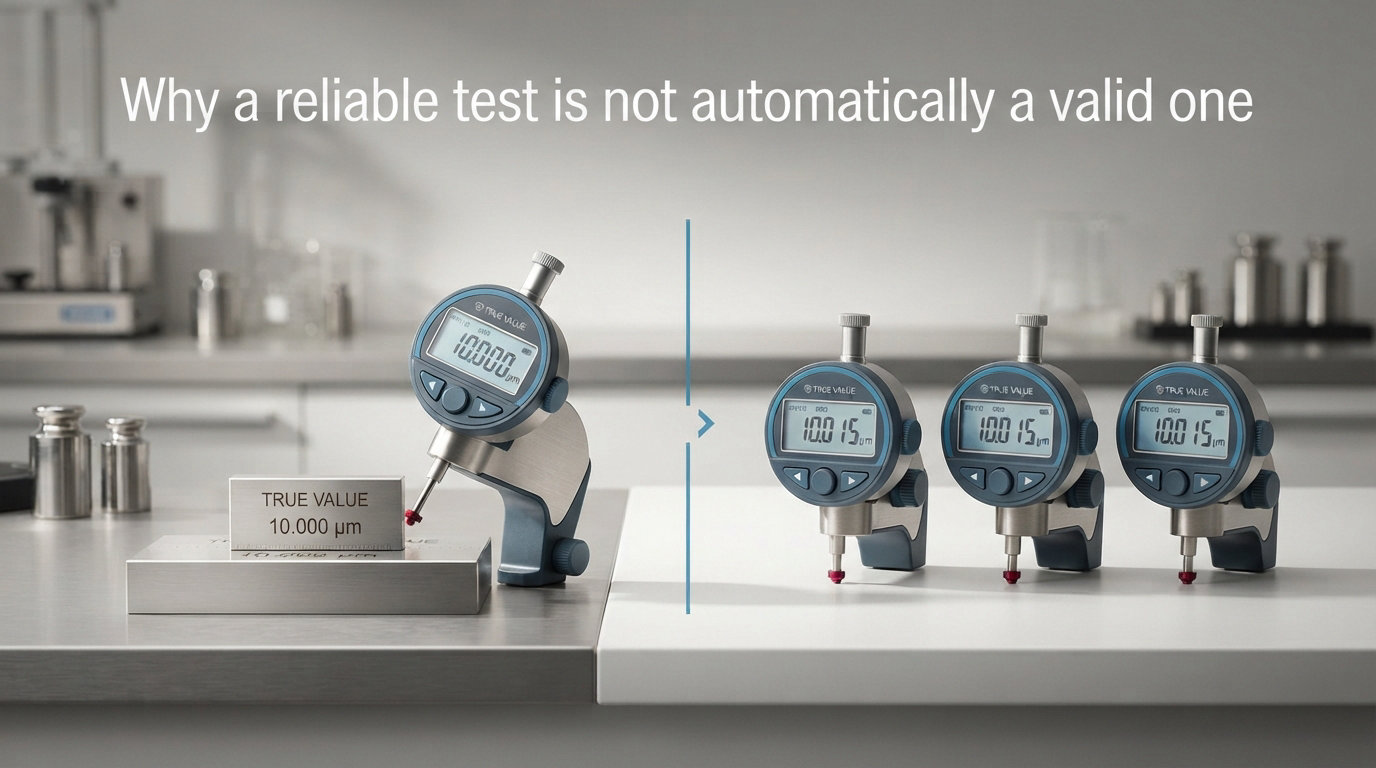
Imagine stepping on a bathroom scale that reads 170 pounds every single morning. Consistent, right? Now imagine discovering your actual weight is 165 pounds. The scale gives you the same number every time, but the number is wrong. That gap between consistency and accuracy is exactly why a reliable test is not automatically a valid one. Reliability means a test produces stable, repeatable results. Validity means those results actually measure what the test claims to measure. These are two separate properties, and having one does not guarantee the other.
This distinction trips up students, researchers, and professionals alike. Many people assume that if a test gives consistent results, it must also be accurate. That assumption is incorrect and potentially dangerous, especially when tests inform hiring decisions, clinical diagnoses, or educational placements. A scale development and validation research published in educational journals routinely demonstrates that establishing reliability is only the first step. The harder, more important question is whether the instrument measures the right thing at all.
In this guide, we will break down exactly why a reliable test is not automatically valid, using concrete examples, clear definitions, and a four-scenario matrix that shows every possible combination. Whether you are designing a survey, evaluating a standardized assessment, or studying for a research methods exam, this article will give you a working understanding of one of the most important concepts in psychometrics.
Table of Contents
What Is Reliability?
Reliability refers to the consistency of a measurement tool. A reliable test produces similar results under similar conditions across repeated administrations. If you take the same personality test three times in one month and get nearly identical scores each time, that test demonstrates strong reliability.
Think of reliability as the “steadiness” of a measurement. Every observation in research contains some degree of measurement error. Reliability is about minimizing random error, the unpredictable fluctuations that make scores bounce around from one testing occasion to another. A test with high reliability has very little random error relative to the true score you are trying to capture.
The classic illustration is that miscalibrated bathroom scale. If it reads exactly 5 pounds heavy every time you step on it, the scale is perfectly reliable. It gives you the same reading every measurement. The problem is not with consistency. The problem is accuracy. Reliability says nothing about whether the number on the display reflects reality.
Researchers quantify reliability using statistical coefficients. The most common measure is Cronbach’s alpha, which evaluates internal consistency, the degree to which all items on a test measure the same underlying construct. A Cronbach’s alpha of 0.80 or higher is generally considered acceptable for research purposes. Other approaches include test-retest correlation coefficients and Cohen’s Kappa for interrater agreement. Each method captures a different facet of consistency, but none of them address whether the test is measuring the right construct in the first place.
What Is Validity?
Validity refers to the extent to which a test actually measures what it claims to measure. A valid driving test accurately assesses a person’s ability to operate a vehicle safely. A valid mathematics exam evaluates genuine mathematical understanding, not just memorization of formulas or test-taking tricks. Validity is about accuracy and appropriateness of interpretation.
Unlike reliability, validity is never proven with a single statistic. It is established through accumulated evidence from multiple sources over time. Researchers gather content validity evidence by having experts review whether test items adequately sample the domain. They collect construct validity evidence through factor analysis and patterns of relationships with other measures. They build criterion validity evidence by showing that test scores predict meaningful outcomes.
This accumulation process is why validity is harder to establish than reliability. Reliability can be computed from a single dataset in minutes. Validity requires theoretical reasoning, expert judgment, longitudinal data, and ongoing scrutiny. As researchers on academic forums frequently emphasize, if a test instrument is not valid, there is no need to seek its reliability. An invalid test is useless regardless of how consistent its scores happen to be.
Consider a practical example from validity and reliability of psychological scales published in peer-reviewed research. When scholars develop a new attitude scale, they spend months gathering evidence that each item taps into the intended psychological construct. They correlate scores with established measures, run factor analyses, and check for cultural bias. Reliability coefficients are reported alongside this validity evidence, but the validity argument does the heavy lifting in justifying the instrument’s use.
Why a Reliable Test Is Not Automatically a Valid One
The short answer is that reliability and validity measure different things. Reliability measures consistency. Validity measures accuracy. A test can be perfectly consistent while consistently measuring the wrong thing. This is the heart of the problem, and it happens far more often than people realize.
Return to the bathroom scale example one more time, because it captures the concept perfectly. The scale reads 170 pounds every morning. It is reliable. But your true weight is 165 pounds. The scale has a systematic error, a consistent 5-pound bias baked into its mechanism. Random error is near zero, which is why reliability statistics look excellent. But the systematic error means every conclusion drawn from the scale is wrong by the same amount in the same direction.
Now consider an educational example. Suppose a teacher creates a reading comprehension test, but every question can be answered correctly by simply matching vocabulary words from the passage without actually understanding the text. The test might produce very consistent scores across administrations. Students who know the vocabulary get high scores every time. Students who do not get low scores every time. The test is reliable. But it is not measuring reading comprehension. It is measuring vocabulary recognition. The test is reliable but not valid for its intended purpose.
This happens because systematic error inflates reliability while destroying validity. Random error hurts both properties. Systematic error, a consistent bias in one direction, actually makes a test look more reliable because it adds a predictable component to every score. But that predictable bias means the scores systematically misrepresent the construct being measured. Validity requires freedom from both random and systematic error. Reliability only requires freedom from random error.
The dartboard analogy makes this visual. Imagine throwing darts at a target. Reliability is about whether your darts land close together. Validity is about whether they land near the bullseye. If all your darts cluster tightly in the upper-left corner, you are reliable but not valid. Your throws are consistent, but they consistently miss the mark. This is precisely the situation when a test has high reliability but low validity.
The relationship between these two properties is asymmetrical, and understanding this asymmetry is critical. Validity requires reliability. If a test produces wildly inconsistent scores, it cannot possibly be measuring anything accurately. You cannot hit the bullseye if your darts scatter across the entire board. So a valid test must also be reliable. But the reverse is not true. A reliable test need not be valid. You can throw tight clusters all day in the wrong corner of the board. This is why the phrase “a valid test is always reliable, but a reliable test is not necessarily valid” is one of the most important principles in measurement theory. You can see this principle applied in test difficulty and measurement validity research, which examines how validity threats can undermine even highly reliable instruments.
Types of Reliability
Reliability is not a single concept but a family of related ideas, each capturing a different aspect of consistency. Understanding these types helps clarify why reliability alone is insufficient for claiming a test measures what it should.
Test-retest reliability measures stability over time. You administer the same test to the same group on two different occasions and correlate the scores. High correlation means the test produces consistent results across time. This is important for traits that should be stable, like intelligence or personality. However, high test-retest reliability says nothing about whether the test captures the intended construct.
Interrater reliability measures consistency between different observers or scorers. Two graders score the same set of essays. If their scores agree closely, interrater reliability is high. Cohen’s Kappa is the standard statistic for categorical ratings. Strong interrater agreement means the scoring rubric is clear and unambiguous, but it does not confirm that the essay prompt itself measures the intended skill.
Internal consistency measures whether all items on a test are tapping the same construct. Cronbach’s alpha is the most widely used statistic here. If a 20-item anxiety scale has an alpha of 0.90, the items are highly intercorrelated and likely measure a single underlying dimension. But that dimension might not be anxiety. It could be negative emotionality, depression, or even response style. Internal consistency confirms that items hang together. It does not confirm what they measure.
Parallel forms reliability involves creating two equivalent versions of a test and correlating scores between them. This approach is common in standardized testing where security requires alternate forms. High correlation between forms means they are interchangeable, but again, both forms could be measuring the wrong construct with perfect equivalence.
Types of Validity
Validity also encompasses multiple types of evidence, each addressing a different question about whether a test measures what it claims to measure. Unlike reliability types, these are not interchangeable alternatives but complementary strands of evidence that together build a validity argument.
Content validity asks whether the test items adequately represent the full domain of interest. A math final that only covers algebra but claims to assess the entire semester’s curriculum, including geometry and statistics, has poor content validity. Expert review is the primary method for establishing content validity. Researchers document how items were selected, reviewed, and refined to ensure comprehensive coverage of the target domain.
Construct validity is the most fundamental and complex type. It asks whether the test actually measures the theoretical construct it intends to measure. Does an IQ test truly measure intelligence? Does a depression inventory truly measure depressive symptomatology? Construct validity is assessed through convergent validity, showing the test correlates with other measures of the same construct, and discriminant validity, showing it does not correlate with measures of unrelated constructs. Factor analysis is another key tool, revealing whether the underlying structure of test items matches theoretical expectations.
Criterion validity asks whether test scores predict or relate to an external outcome. Predictive validity examines whether scores forecast future performance, such as whether SAT scores predict college GPA. Concurrent validity examines whether scores correlate with a criterion measured at the same time, such as whether a new depression scale correlates with a clinician’s diagnosis. Criterion validity provides some of the most practically useful evidence because it demonstrates real-world relevance.
Face validity is the weakest form, referring to whether a test appears to measure what it claims on the surface. Face validity matters for test-taker acceptance and motivation, but it is not a substitute for rigorous validity evidence. A test can look perfectly appropriate and still fail to measure the intended construct. Many employment personality tests have high face validity but questionable construct validity, which is one reason job applicants often feel these tests are disconnected from actual job requirements. You can see how researchers approach this challenge in studies on authentic assessment reliability and validity in educational settings.
The Four-Scenario Matrix: Reliability and Validity Combined
To fully grasp the relationship between reliability and validity, it helps to examine all four possible combinations. Only two of these scenarios are realistic, and understanding why the others are problematic clarifies the concept further.
Scenario 1: Not reliable and not valid. The test gives inconsistent results and does not measure the intended construct. This is the worst possible situation. An example would be a poorly written survey with ambiguous questions and no clear theoretical basis. Scores bounce around unpredictably and mean nothing useful. Most researchers would discard such an instrument immediately.
Scenario 2: Reliable but not valid. The test produces consistent scores but measures the wrong thing. This is the central focus of this article. The miscalibrated bathroom scale is the classic example. Another would be a hiring assessment that consistently identifies candidates who are good at taking tests rather than candidates who will perform well on the job. The consistency creates false confidence. Organizations may rely on the results for years without realizing they are systematically selecting for the wrong qualities.
Scenario 3: Not reliable but valid. This scenario is theoretically impossible in practice. If a test cannot produce consistent results, it cannot accurately measure anything. Recall the dartboard analogy: if your darts scatter randomly across the board, they cannot cluster around the bullseye. Low reliability places an upper limit on validity. The maximum possible validity coefficient is the square root of the reliability coefficient. A test with a reliability of 0.50 can never achieve a validity coefficient higher than approximately 0.71, no matter how well-designed the items are.
Scenario 4: Both reliable and valid. This is the goal. The test produces consistent results and measures the intended construct accurately. Achieving this requires careful test design, thorough piloting, expert review, and ongoing validation research. It takes time, resources, and commitment to measurement quality. This is the standard that professional testing organizations, licensing boards, and academic researchers strive for, though perfect reliability and validity are never fully attainable.
Real-World Implications and Misconceptions
The distinction between reliability and validity has far-reaching consequences beyond academic theory. Online IQ tests provide a perfect illustration. Many free IQ tests on the internet produce highly consistent scores across repeated attempts. They are reliable. But whether they validly measure intelligence in the way that professionally administered, peer-reviewed IQ tests do is highly questionable. Users on psychometrics forums regularly debate this gap, noting that a test’s consistency does not confirm it captures genuine cognitive ability rather than pattern recognition skills or familiarity with test formats.
Employment psychometric testing raises similar concerns. Companies spend millions on personality and cognitive assessments for hiring. These tests often demonstrate strong reliability in technical reports. But forum discussions among job applicants reveal deep skepticism about whether the tests measure constructs relevant to actual job performance. A test might reliably identify candidates who are agreeable and conscientious on paper, but if the items are culturally biased or if the construct measured does not predict job success for a particular role, the test is reliable but not valid for that hiring decision.
Cultural and linguistic bias is one of the most common threats to validity. A test developed and normed in one cultural context may produce reliable scores when administered in a different context, but those scores may systematically misrepresent the intended construct due to language barriers, cultural assumptions embedded in items, or unfamiliarity with the testing format. The test remains reliable because the bias is systematic and consistent. But validity suffers because the scores no longer reflect the same construct across cultural groups. This is why validation research must include diverse populations and why culturally adapted assessment instruments require their own validity evidence.
Another common misconception is that a high reliability coefficient proves a test is good. A Cronbach’s alpha of 0.95 sounds impressive, and it might lead administrators to trust the instrument without further scrutiny. But that coefficient only confirms internal consistency. It says nothing about content coverage, construct appropriateness, or criterion relevance. This overreliance on reliability statistics is a recurring theme in discussions about web-based assessment reliability and digital testing platforms, where technical convenience can overshadow rigorous validation.
Perhaps the most dangerous misconception is treating face validity as a substitute for construct validity. A test that looks right, has items that seem relevant, and uses professional formatting can still fail to measure the intended construct. Test-takers, administrators, and even some researchers may be lulled into accepting surface plausibility as evidence of measurement quality. This is particularly problematic in high-stakes contexts like clinical diagnosis, where an invalid but reliable instrument could lead to consistent but incorrect treatment decisions.
FAQs
Why is it possible for a test to be reliable but not valid?
A test can be reliable but not valid because reliability and validity measure different properties. Reliability measures consistency of results, while validity measures whether the test assesses the intended construct. A bathroom scale that consistently reads 5 pounds heavy is reliable but not valid. The test produces stable scores but systematically misrepresents what it claims to measure due to systematic error that does not affect reliability statistics.
Why does reliability not guarantee validity?
Reliability does not guarantee validity because reliability only accounts for random error, not systematic error. A test can be free of random fluctuations while containing a consistent bias that makes every score wrong in the same direction. Validity requires freedom from both random and systematic error, so a test can meet the reliability requirement while still failing the validity requirement.
Can an experiment be reliable but not valid?
Yes, an experiment can be reliable but not valid. If a study produces consistent results across replications but has a design flaw that systematically biases outcomes, such as a confounding variable or an invalid measurement instrument, the experiment is reliable but not valid. The findings are reproducible but do not accurately reflect the causal relationship the researcher claims to study.
Can a test be reliable but not valid True or False?
True. A test can be reliable but not valid. This is a well-established principle in psychometrics. A valid test must always be reliable, because inconsistent results cannot be accurate. However, a reliable test does not have to be valid, because consistent results can consistently measure the wrong construct.
Conclusion
Understanding why a reliable test is not automatically a valid one comes down to one core principle: consistency and accuracy are separate properties. Reliability ensures a test gives you the same answer repeatedly. Validity ensures that answer is actually correct. A test can achieve the first without ever achieving the second, and that gap is where measurement errors turn into real-world consequences.
If you are designing a test, evaluating an assessment instrument, or simply trying to judge whether a published score means what it claims to mean, start by asking two questions. Is this test reliable? And separately, is this test valid? Do not let an impressive reliability coefficient substitute for a genuine validity argument. The most dangerous test is not the one that gives inconsistent results. It is the one that gives consistent wrong results with confidence.