
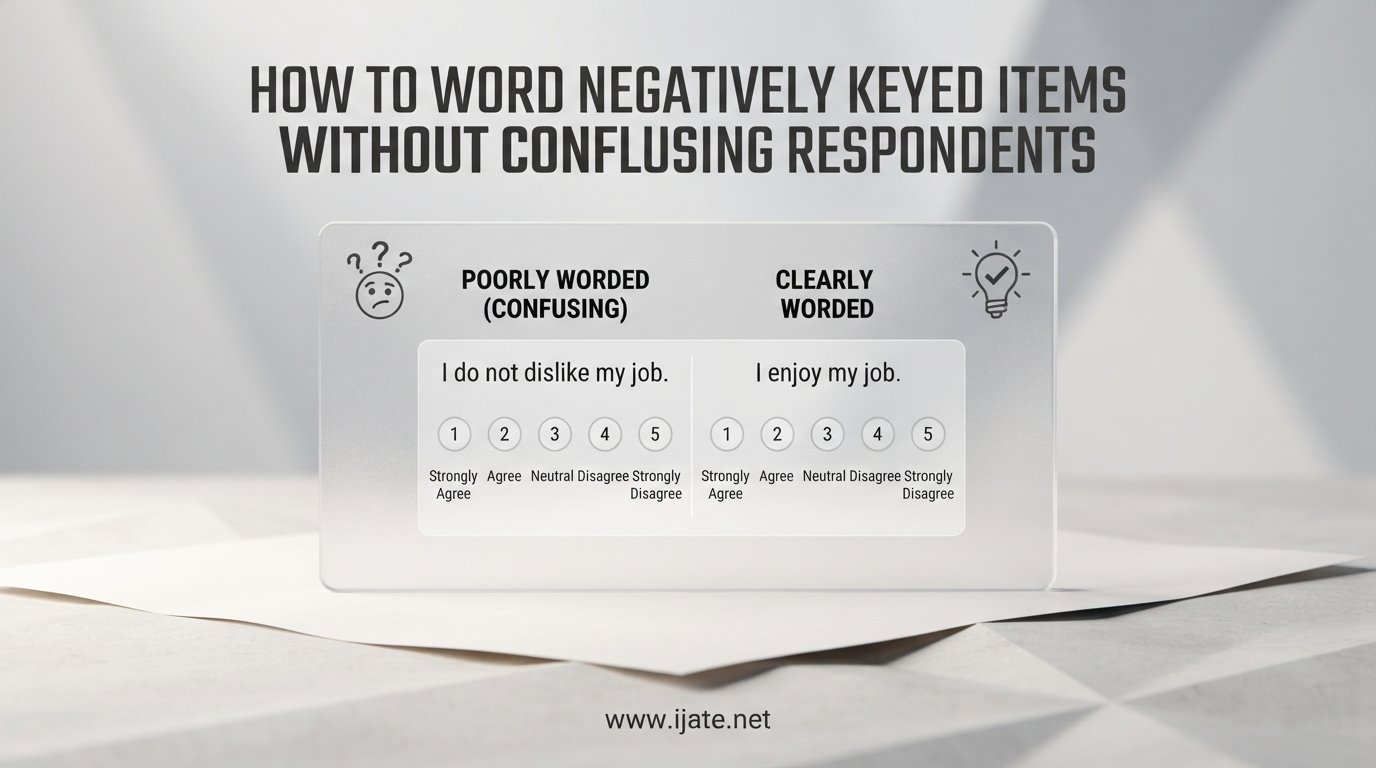
You sit down to review your survey results, and something looks off. Respondents who rated your product highly on “I enjoy using this product” also agreed strongly with “I find this product frustrating to use.” The data contradicts itself, and you are left wondering whether people actually read the questions.
This scenario plays out constantly with negatively keyed items. These reverse-worded survey questions are designed to catch careless responding and acquiescence bias, but they often create more problems than they solve. Respondents misread them, forget to flip their mental scale, or get frustrated enough to disengage entirely.
If you need to use negatively keyed items in your questionnaire, the wording matters enormously. This guide breaks down exactly how to word negatively keyed items without confusing respondents, drawing on survey methodology research and real-world experience from survey designers who have dealt with the fallout.
You will learn what negatively worded items are, why they cause confusion, how to spot the warning signs of respondent frustration, and practical strategies for writing clear reverse-worded questions. We also cover reverse coding best practices and alternatives that may eliminate the need for negative items altogether.
Table of Contents
What Are Negatively Keyed Items?
Negatively keyed items are survey questions worded so that agreement indicates the opposite of the construct being measured. A positively keyed item like “I feel confident using this software” becomes a negatively keyed item like “I feel confused when using this software.” The respondent who agrees with the negative version is expressing the opposite stance from someone who agrees with the positive version.
In a typical Likert scale survey, most items measure the target construct in the same direction. A job satisfaction scale might include “I look forward to coming to work” and “I feel valued by my team.” A negatively keyed version would add “I dread coming to work” or “I feel unappreciated by my team.” During analysis, the researcher must reverse score those negative items so all responses point in the same direction.
Reverse scoring means flipping the numeric values. If your scale runs from 1 (strongly disagree) to 5 (strongly agree), a response of 1 on a negative item becomes a 5 after reverse coding. A 2 becomes a 4, a 3 stays a 3, and so on. This mathematical reversal is straightforward for analysts but invisible to respondents, who must mentally navigate the direction change while answering.
Here is a side-by-side comparison to make the distinction clear:
Positive item: “The training materials were easy to follow.” (Agreement = positive evaluation)
Negative item: “The training materials were difficult to understand.” (Agreement = negative evaluation, requires reverse coding)
Both items measure the same underlying construct, but the negative version forces respondents to shift their mental framework. That shift is where confusion creeps in.
Why Survey Designers Use Negatively Keyed Items
The primary reason survey designers include negatively worded items is to combat acquiescence bias. This is the tendency some respondents have to agree with statements regardless of their content. If every item on your survey is positively worded, a respondent who clicks “strongly agree” down the line will produce a high score regardless of their actual opinions.
Negatively keyed items act as a built-in check against this pattern. A respondent who agrees with “I love my job” should disagree with “I hate coming to work.” If they agree with both, you have evidence of acquiescence bias or careless responding. This diagnostic function is valuable for data quality assessment.
Survey designers also use negative items to break response sets. When respondents see the same direction of questioning repeated, they can fall into a rhythm of selecting the same answer option without reading each item carefully. Mixing in reverse-worded items forces them to pause and read, theoretically improving engagement and data quality.
Some questionnaire designers view negatively keyed items as attention checks. If a respondent gives the same answer to both “My manager supports my growth” and “My manager blocks my development,” you can flag that response as potentially invalid. This filtering mechanism has legitimate value in large-scale surveys where data cleaning is essential.
Historically, psychometric textbooks recommended including a mix of positive and negative items as standard practice. Many established instruments, including the System Usability Scale (SUS) and the Rosenberg Self-Esteem Scale, were built with mixed wording. This precedent gave the approach legitimacy that persists today, even as newer research questions its effectiveness.
The Problems: Why Negatively Keyed Items Confuse Respondents
Despite their intended benefits, negatively keyed items introduce well-documented problems. Research by Podsakoff and colleagues on method biases in behavioral research found that mixing positive and negative item wording can create as many measurement issues as it solves. The cognitive burden on respondents is the most immediate problem.
Negative wording increases cognitive load. When a respondent encounters “I do not feel supported by my supervisor,” they must process the negation, mentally reverse the scale direction, and select an answer that reflects their true opinion. This extra mental step takes time and introduces opportunities for error. Respondents who are fatigued, distracted, or rushing through a survey are particularly vulnerable to misinterpreting negatively worded items.
Reading comprehension failures compound the problem. Double negatives are especially dangerous. An item like “I am not dissatisfied with the new policy” requires respondents to process two negations, leaving many unsure whether agreement means they are satisfied or unsatisfied. Even single negations trip people up under time pressure or when survey fatigue sets in.
Negatively keyed items also introduce method bias, a type of systematic error that inflates or deflates correlations between items based on their wording direction rather than their content. When positive and negative items load onto separate factors in factor analysis despite measuring the same construct, method bias is the likely culprit. This distortion threatens construct validity and makes your scale appear to measure two different things when it should measure one.
Research published in Performance Improvement by Chyung and colleagues provided evidence-based recommendations against mixing positive and negative items. Their analysis found that the threats to validity and reliability from mixed wording frequently outweigh the benefits of acquiescence bias control.
Cronbach’s alpha, the statistic most commonly used to report internal reliability, can also be artificially inflated or deflated by negative items. When respondents answer negative items inconsistently due to confusion rather than genuine disagreement, the reliability coefficient may spike or drop in ways that do not reflect true scale performance. Researchers who do not examine item-level statistics may miss this distortion entirely.
Forum discussions on Reddit communities like r/UXResearch and r/ProlificAc reveal the real-world impact. Survey designers report that respondents frequently comment on confusing negative items after completing a study. One common complaint: respondents realize they answered a negative item incorrectly only after submitting their responses, with no opportunity to correct the mistake. Others report that participants establish response patterns early and fail to notice when the wording direction shifts mid-survey.
Organizations face a different consequence. When leaders review survey results, confusing items lead to questions about data trustworthiness. If an employee engagement survey contains contradictory-seeming results because of poorly worded negative items, leadership may lose confidence in the entire dataset. The time and cost of running a survey are wasted if the results cannot be trusted.
Extreme response bias can also interact with negatively keyed items in unpredictable ways. Some respondents gravitate toward scale endpoints regardless of question content, and the direction shift of negative items can amplify this tendency rather than counteract it.
Warning Signs Your Respondents Are Confused
Catching respondent confusion early can save your survey from producing invalid data. The first warning sign is inconsistent response patterns. If a respondent rates “I feel motivated at work” as a 5 (strongly agree) and also rates “I feel unmotivated at work” as a 5, they are either confused by the negative wording or responding carelessly.
Item-total correlations offer a statistical early warning system. When you compute the correlation between each item and the total scale score, negatively keyed items that correlate negatively with the total (before reverse coding) or fail to correlate at all may indicate comprehension problems. In a well-functioning scale, reverse-coded items should correlate positively with the total score at levels comparable to positively worded items.
Factor analysis provides another diagnostic tool. If your exploratory factor analysis produces a two-factor solution where all positive items load on one factor and all negative items load on another, method bias is likely driving the split. A scale measuring a single construct should produce a single dominant factor, regardless of item wording direction.
Completion time anomalies can also signal confusion. If your survey platform tracks time per question, look for items where respondents spend significantly longer than average. Negatively worded questions that take 50% longer to answer than positively worded ones suggest respondents are struggling with comprehension or direction reversal.
Open-ended feedback is the most direct indicator. If your survey includes a free-text comment field at the end, watch for remarks about confusing or contradictory questions. Respondents who took the time to note difficulty with specific items are giving you valuable diagnostic information. Even brief comments like “some questions seemed repetitive but worded differently” can point to negative item confusion.
Data cleaning becomes more labor-intensive when negative items confuse respondents. You may need to implement careless responder screening, flag inconsistent pairs, or exclude cases with extreme response patterns. Each of these steps reduces your usable sample size and can introduce selection bias if confused respondents share characteristics that differ from the full sample.
How to Word Negatively Keyed Items Without Confusing Respondents
If you decide to use negatively keyed items, careful wording can minimize respondent confusion. The strategies below come from survey methodology research and practical experience in questionnaire design.
1. Keep Negations Simple and Direct
Use a single, clear negation per item. “I rarely use this feature” is straightforward. “I do not often avoid using this feature” is a double-negative nightmare that will confuse almost everyone. Read each negatively keyed item aloud and count the negations. If you hear more than one, rewrite it.
Direct negative statements work better than negated positive statements. “The interface is confusing” is clearer than “The interface is not intuitive.” The first version tells respondents exactly what to evaluate. The second forces them to process a negation before forming a judgment.
2. Avoid Double Negatives Entirely
Double negatives are the most common source of confusion in negatively keyed items. Phrases like “not uncommon,” “not unnecessary,” or “not without merit” require respondents to hold multiple negations in their working memory simultaneously. Most people fail at this task, especially under time pressure.
Instead of “It is not uncommon for me to miss deadlines,” write “I frequently miss deadlines.” The meaning is identical, but the cognitive processing required is dramatically reduced. Every double negative has a simpler single-negative or direct-statement alternative.
3. Match Reading Level to Your Audience
Negatively keyed items should never use more complex vocabulary than their positive counterparts. If your positive item uses everyday language, the negative item must do the same. Technical jargon combined with negation creates a comprehension barrier that excludes respondents with lower reading levels or those for whom the survey language is not their first language.
Aim for a reading level appropriate to your audience. For general population surveys, that means roughly a 6th to 8th grade reading level. Employee surveys may support slightly more complex language, but the negation itself already adds difficulty. Keep everything else simple.
4. Test Items Before Full Deployment
Cognitive interviewing is the gold standard for pre-testing negatively keyed items. Sit down with 5 to 10 members of your target audience and ask them to think aloud as they answer each question. Listen for hesitation, rereading, or verbalized confusion. If participants cannot explain what a negatively keyed item means in their own words, rewrite it.
Pilot testing with a small sample can also surface problems. Run your survey with 50 to 100 respondents and examine item-level statistics before the full launch. Look for negative items with low item-total correlations, unusual response distributions, or excessive completion times. Fix or remove problematic items before they contaminate your full dataset.
5. Group Negative Items Strategically
Some survey designers cluster all negatively keyed items together in one section, arguing that respondents adapt to the negative direction after the first few items. Others interleave negative items throughout the survey to prevent pattern responding. Research does not strongly favor either approach, but clustering may reduce the mental switching cost for respondents.
If you cluster negative items, add a brief instruction before the section. Something like “The next few questions are phrased differently. Please read each one carefully” can prime respondents to pay attention without explicitly explaining the reverse-scoring mechanism.
6. Use Conversational, Natural Language
Negatively keyed items that sound like something a real person would say are easier to understand than items that sound like questionnaire boilerplate. “I sometimes skip important steps in this process” reads more naturally than “I am not always thorough in following this process.” Conversational phrasing reduces cognitive friction and helps respondents answer based on their actual experience rather than their interpretation of the question.
7. Avoid Ambiguous Qualifiers
Words like “rarely,” “sometimes,” “often,” and “frequently” mean different things to different people. When combined with negation, the ambiguity compounds. “I do not often feel stressed” could mean “I rarely feel stressed” or “I feel stressed frequently but not often enough to be a problem.” Use specific, concrete language instead.
Here is a quick comparison of poorly worded versus well-worded negatively keyed items:
Poor: “I am not always dissatisfied with the communication from leadership.” (Double negative, ambiguous qualifier)
Better: “I am frequently frustrated by communication from leadership.” (Direct, clear)
Poor: “The system is not without usability issues.” (Double negative, vague)
Better: “The system is difficult to navigate.” (Direct, concrete)
Poor: “I do not feel that training was unnecessary.” (Double negative, confusing)
Better: “I found the training valuable.” (This is positive, but if you need a negative version: “The training was a waste of my time.”)
The pattern is clear. Every confusing negatively keyed item has a simpler, more direct version that says the same thing. Your job as a survey designer is to find that simpler version every time.
Reverse Coding Best Practices
Reverse coding is the analytical step that makes negatively keyed items usable. After data collection, you transform the scores on negative items so they align directionally with positive items. On a 5-point scale, the conversion is: 1 becomes 5, 2 becomes 4, 3 stays 3, 4 becomes 2, and 5 becomes 1.
For a 7-point scale, the conversion follows the same logic: 1 becomes 7, 2 becomes 6, 3 becomes 5, 4 stays 4, 5 becomes 3, 6 becomes 2, and 7 becomes 1. The formula is (maximum value + 1) minus the observed score. Program this conversion in your statistical software before computing scale scores.
Document which items need reverse coding before you begin analysis. Create a coding sheet that lists every item, its wording direction, and whether it requires reverse scoring. This documentation prevents errors during data cleaning and makes your analysis reproducible. Schmitt and Stults provided foundational guidance on reverse coding practices in their research on item wording effects, and their recommendations remain relevant.
A common mistake is forgetting to reverse code before computing reliability statistics. If you calculate Cronbach’s alpha with uncorrected negative items, you will get artificially low reliability estimates because the negative items correlate in the wrong direction with the total score. Always apply reverse coding before any reliability or validity analysis.
Another error is reverse coding the wrong items. If you accidentally reverse code a positive item, you introduce the exact problem the negative item was supposed to prevent. Double-check your coding map against the actual survey instrument before running any analysis.
Finally, label reverse-coded variables clearly in your dataset. Use a naming convention like “item5_R” or “item5_reverse” to indicate that the variable has been transformed. This prevents confusion during collaborative analysis and makes it easier to audit your data pipeline.
Alternatives to Negatively Keyed Items
Given the well-documented problems with negatively keyed items, many survey methodology experts recommend alternatives. The simplest approach is using all positively worded items. This eliminates cognitive load from direction switching and removes the risk of method bias from mixed wording. The tradeoff is that you lose the ability to detect acquiescence bias through item wording alone.
Dedicated attention check items can replace the careless-responding detection function of negative items. An instruction like “Please select ‘somewhat agree’ for this question” embedded periodically throughout the survey identifies respondents who are not reading carefully without introducing direction confusion into your substantive items. These checks are direct and unambiguous.
Speed bumps are another option. These are items that require respondents to slow down and process information before answering. A question like “In the past 30 days, how many times have you contacted customer support?” forces respondents to recall specific information rather than simply agreeing or disagreeing. This breaks response patterns without the cognitive burden of negative wording.
When might negatively keyed items still be appropriate? If you are using a validated, published instrument that was developed with mixed wording, changing the item structure may compromise the psychometric properties of the scale. In these cases, follow the original scoring instructions and document any concerns about item wording effects in your limitations section.
Long surveys with 50 or more items may also benefit from occasional negative items to break monotony, provided the wording is simple and well-tested. The risk of confusion from a single, clearly worded negative item in a long survey is lower than the risk in a short survey where that item represents a larger proportion of the total.
Negatively keyed items may also be appropriate when the construct itself is negative. Measuring “workplace conflict” or “burnout symptoms” with negatively worded items is natural because the construct is naturally negative. The confusion risk is lower because respondents are not reversing a positive expectation; they are answering in the direction the construct already points.
FAQs
What does ‘negatively keyed’ mean?
Negatively keyed means a survey item is worded so that agreement indicates the opposite of the construct being measured. For example, on a job satisfaction scale, ‘I dread coming to work’ is negatively keyed because agreement indicates low satisfaction. These items require reverse scoring during data analysis so all responses align in the same direction.
What are reverse code negatively worded items?
Reverse code negatively worded items are survey questions written in the opposite direction of the construct being measured, requiring their scores to be mathematically flipped before analysis. On a 5-point scale, a response of 1 becomes 5, 2 becomes 4, 3 stays 3, and so on. This ensures all items contribute to the scale score in the same direction.
What is the purpose of negatively worded questions on a survey?
Negatively worded questions are designed to detect acquiescence bias, break response patterns, and check whether respondents are reading carefully. If someone agrees with both ‘I love my job’ and ‘I hate my job,’ the negative item reveals careless responding. However, research shows these benefits are often outweighed by confusion and data quality issues.
What is an example of a negatively worded question?
A negatively worded question phrases the statement in the opposite direction of the construct. Examples include ‘I find this software difficult to use’ (on a usability scale), ‘My manager does not support my growth’ (on a leadership scale), or ‘I rarely feel motivated at work’ (on an engagement scale). Each requires reverse coding before analysis.
Why does it matter if survey questions are poorly worded?
Poorly worded survey questions produce invalid data. Respondents who misinterpret questions give answers that do not reflect their true opinions, which leads to flawed conclusions and misguided decisions. In organizational settings, bad survey data can result in wasted initiatives, lost trust in leadership, and missed opportunities to address real problems.
How do I know if respondents are confused by negative items?
Look for inconsistent response patterns, low item-total correlations on negative items, factor analysis showing separate positive and negative factors, unusual completion times, and open-ended feedback mentioning confusing questions. Any of these signs warrant a closer look at how your negatively keyed items are performing.
Conclusion
Learning how to word negatively keyed items without confusing respondents comes down to respecting the cognitive demands you place on the people answering your survey. Every negation, every direction shift, and every double negative adds friction that can degrade data quality.
The strategies in this guide give you a practical framework. Keep negations simple and direct, eliminate double negatives entirely, test items before deployment, group negative items strategically, and use natural conversational language. When the risks outweigh the benefits, consider alternatives like all-positive wording, dedicated attention checks, or speed bumps.
If you apply these principles, your negatively keyed items will serve their intended purpose without becoming a source of respondent frustration. Start by auditing any existing negatively worded items in your current surveys using the comparison examples above. Then commit to pre-testing every new item before full deployment. Your respondents and your data will both be better for it.