
If you have ever stared at a blank document trying to write a learning objective that actually means something, you are not alone. Most educators and instructional designers I have worked with struggle with the same issue: their objectives sound good on paper but fail when it comes time to measure them. That is exactly why learning how to write measurable learning objectives using Bloom’s taxonomy is a skill worth mastering.
Bloom’s Taxonomy gives you a structured framework for choosing the right verbs, hitting the right cognitive level, and producing objectives you can actually assess. Whether you are designing a university course, a corporate training module, or continuing education content, this framework keeps your instruction focused and your outcomes observable.
In this guide, our team walks you through the taxonomy itself, the action verbs that make objectives measurable, a step-by-step writing process, and real before-and-after examples. By the end, you will have a repeatable system for writing objectives that hold up under any curriculum review.
Table of Contents
What Is Bloom’s Taxonomy?
Bloom’s Taxonomy is a hierarchical classification system for learning objectives, organized from lower-order thinking skills to higher-order thinking skills. It was originally published in 1956 by Benjamin Bloom and a committee of educators, then revised in 2001 by Lorin Anderson and David Krathwohl.
The 2001 revision changed the category names from nouns to verbs and reordered the top two levels. The original “Evaluation” sat at the peak, but the revised version placed “Creating” at the top instead. This change reflected a growing consensus that generating new ideas and products represents a higher cognitive demand than judging existing ones.
The taxonomy covers three domains: cognitive (knowledge-based), affective (attitude-based), and psychomotor (skill-based). When educators talk about Bloom’s Taxonomy in relation to measurable learning objectives, they are almost always referring to the cognitive domain. That is the focus of this guide.
The Six Levels of Bloom’s Taxonomy
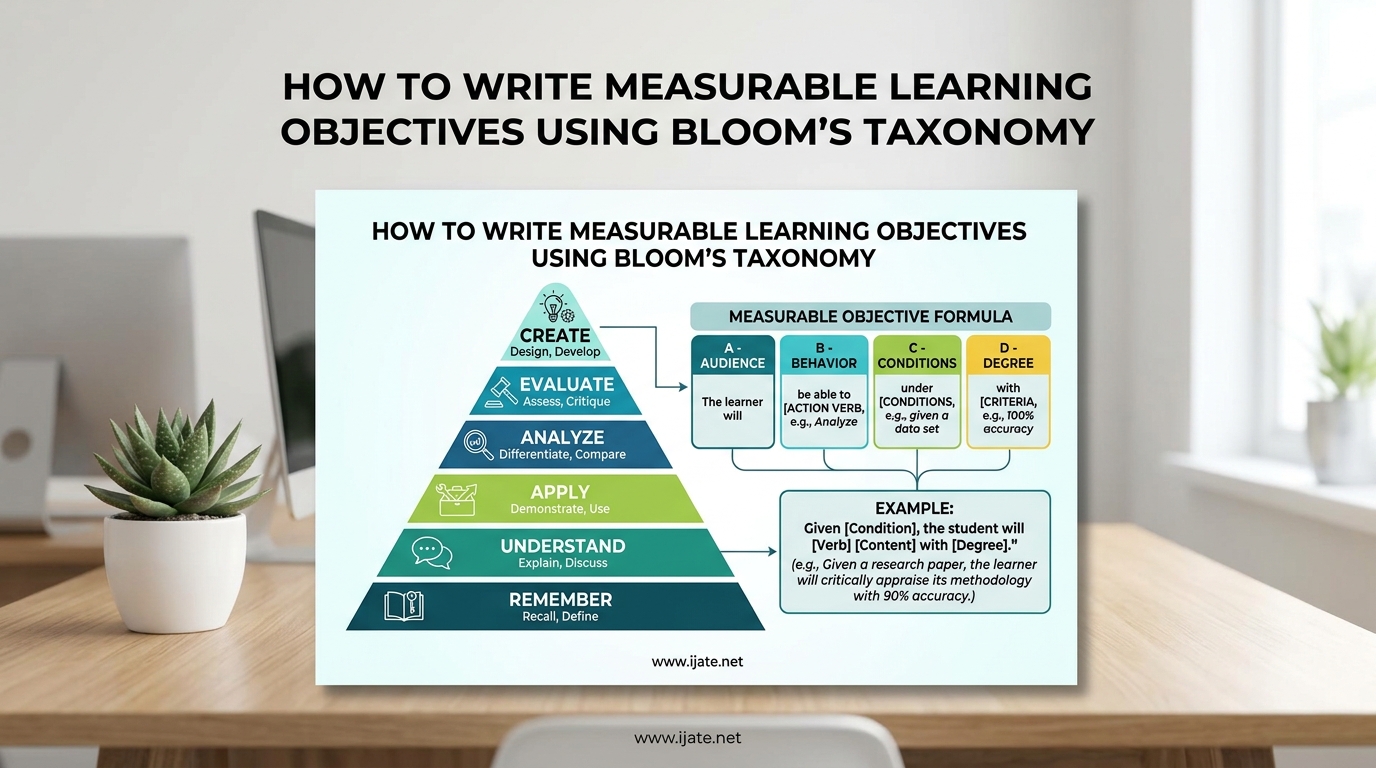
The revised cognitive domain has six levels arranged in increasing complexity. Each level builds on the one below it, though that hierarchy is not always strict in practice.
1. Remember
This is the foundation. Learners retrieve, recognize, and recall relevant knowledge from memory. Think memorizing vocabulary, listing dates, or labeling parts of a cell. The verbs here describe rote recall tasks.
2. Understand
Learners construct meaning from information. They can explain concepts in their own words, summarize texts, or interpret data. This level goes beyond memorization because the learner must demonstrate comprehension rather than just parrot facts back.
3. Apply
At this level, learners carry out or use procedures in given situations. They take what they understood and put it to work. Solving a math problem with a learned formula or demonstrating a lab technique are good examples.
4. Analyze
Learners break material into parts and determine how the parts relate to one another. Comparing, contrasting, organizing, and attributing all live here. The key shift is that learners must examine structure and relationships, not just apply a known procedure.
5. Evaluate
Learners make judgments based on criteria and standards. They critique, recommend, defend, or test ideas against established benchmarks. This requires a clear set of criteria, which is why evaluation objectives often specify what the learner is judging against.
6. Create
The highest level has learners putting elements together to form a coherent or functional whole. They design, construct, plan, or produce something new. Creating involves reorganizing parts into patterns or structures that did not exist before.
Action Verbs for Each Bloom’s Taxonomy Level
Selecting the right verb is the heart of writing measurable objectives. Each Bloom’s level has its own set of observable action verbs. The table below organizes the most useful ones.
Remember: define, list, name, recall, identify, label, state, recognize, reproduce, retrieve
Understand: explain, summarize, paraphrase, interpret, classify, compare, describe, discuss, estimate
Apply: demonstrate, calculate, solve, illustrate, implement, carry out, use, employ, operate
Analyze: differentiate, compare, contrast, categorize, distinguish, examine, investigate, organize, attribute
Evaluate: critique, justify, defend, argue, assess, recommend, appraise, judge, prioritize
Create: design, develop, formulate, construct, plan, produce, devise, assemble, compose
Verbs to Avoid
Some verbs sound professional but are impossible to measure directly. These are the culprits I see most often in poorly written objectives.
Avoid: know, understand, learn, comprehend, appreciate, be aware of, be familiar with, grasp, study, think.
None of these describe an observable behavior. You cannot see a student “understand” something, but you can watch them explain, summarize, or demonstrate it. Always swap vague verbs for an action you can actually see or grade.
How to Write Measurable Learning Objectives Using Bloom’s Taxonomy: Step by Step
Here is the process our team uses with educators and instructional designers. It works for single lessons, full courses, and continuing education programs alike.
Step 1: Identify Your Learning Goal
Start broad. What should learners be able to do after completing the unit, module, or course? Write the goal in plain language first, without worrying about format.
Example goal: “Students should be able to use data analysis techniques to make business decisions.”
This is your starting point. The next steps convert this fuzzy goal into a precise, measurable objective.
Step 2: Choose the Right Bloom’s Level
Ask yourself what type of thinking the task truly demands. If students only need to recall facts, the objective belongs at Remember or Understand. If they must break information down, you are at Analyze.
Match the level to the actual cognitive demand, not to what sounds impressive. An introductory course that jumps straight to Create without building foundation skills usually frustrates learners and produces poor results.
Step 3: Select a Measurable Action Verb
Use the verb lists above to pick a specific, observable verb that matches your chosen Bloom’s level. One objective, one verb. Combining verbs muddies the objective and makes alignment harder.
If your goal is for students to “understand the water cycle,” your verb might become explain (Understand level) or diagram (Apply level), depending on what you actually want them to do.
Step 4: Add Condition and Degree Using the ABCD Method
The ABCD approach turns a basic verb statement into a complete objective. Each letter stands for a component.
A — Audience: Who is performing the behavior? Usually “the student,” “the learner,” or “the participant.”
B — Behavior: What observable action will they perform? This is your Bloom’s verb.
C — Condition: Under what circumstances? Examples: “given a case study,” “using a calculator,” “without reference materials.”
D — Degree: How well must they perform? Examples: “with 80% accuracy,” “in under five minutes,” “according to APA style.”
Put it together: “Given a business case study (condition), the student (audience) will analyze the financial data (behavior) and recommend a cost-saving strategy with supporting calculations (degree).”
Step 5: Test for Measurability
Before finalizing the objective, ask three questions. Can I observe this behavior? Can I measure whether it happened? Does the assessment I have planned actually test this exact behavior?
If you answer no to any of these, revise the verb or add a clearer degree statement. This final check catches the vague, unmeasurable objectives that derail curriculum reviews.
Examples of Good vs Bad Learning Objectives
Real examples make the difference clearer than any theory. Here are before-and-after pairs at different Bloom’s levels.
Remember Level
Weak: Students will know the major causes of the Civil War.
Strong: Given a list of historical events, the student will identify the three primary causes of the Civil War with 100% accuracy.
Understand Level
Weak: Students will understand photosynthesis.
Strong: Without reference materials, the student will summarize the photosynthesis process in a 200-word explanation that includes all four key stages.
Apply Level
Weak: Students will be able to use Excel formulas.
Strong: Given a raw dataset, the student will apply VLOOKUP and pivot table functions in Excel to produce a summary report matching the provided rubric.
Analyze Level
Weak: Students will analyze a research paper.
Strong: Given a peer-reviewed research article, the student will differentiate between the methodology and findings sections and critique the validity of the conclusions in a written review.
Evaluate Level
Weak: Students will appreciate different leadership styles.
Strong: Using a provided rubric of leadership criteria, the student will evaluate three real-world CEOs and rank their effectiveness with written justification for each ranking.
Create Level
Weak: Students will create a marketing plan.
Strong: Working in teams of four, students will design a complete digital marketing campaign for a fictional product, including target audience analysis, channel strategy, and a budget allocation of at least six line items.
Course-Level vs Lesson-Level Objectives
One common source of confusion is the difference between course-level and lesson-level objectives. They serve different purposes and live at different scales.
Course-level objectives describe what students should be able to do by the end of the entire course. There are usually four to eight of them. They tend to sit at higher Bloom’s levels because they represent cumulative achievement.
Lesson-level objectives describe what students should accomplish in a single session or module. There are typically three to five per lesson. These often sit at lower Bloom’s levels because they build toward the course-level outcomes.
A course-level objective like “design a research study” might be supported by lesson-level objectives at the Remember, Understand, Apply, and Analyze levels throughout the term. Each lesson adds a piece until students can perform the higher-order task.
How to Align Objectives With Assessments
Writing the objective is only half the job. The other half is making sure your assessment actually measures it. This is where alignment comes in, and it is the most common weakness I see in course reviews.
The rule is simple: your assessment task must require the same cognitive behavior as the verb in your objective. If your objective says “analyze,” your assessment cannot be a multiple-choice quiz that only asks students to recall definitions.
In continuing education and professional development, this alignment often connects to a practice gap. The practice gap identifies what professionals currently do versus what they should do. Your objectives should close that gap, and your assessments should confirm the gap closed.
Frameworks like Quality Matters use this alignment as a core standard. Standard 2 in Quality Matters specifically requires that learning objectives are measurable and that assessments measure the stated objectives. If your verb and your assessment do not match, you fail that standard.
Common Mistakes to Avoid
After reviewing hundreds of course syllabi and training modules, the same errors come up repeatedly. Here are the ones to watch for.
Using multiple verbs in one objective. “Students will list, describe, and analyze…” creates confusion about which behavior is actually being assessed. Split it into three separate objectives instead.
Choosing verbs above the actual cognitive demand. If students only need to recall facts, do not write an “evaluate” objective just to sound rigorous. The mismatch shows up immediately when the assessment does not fit.
Forgetting the condition and degree. Without these, the objective has no boundaries. Assessors cannot tell whether partial performance counts as success.
Treating Bloom’s hierarchy as rigid. The levels overlap in practice. A student might analyze and evaluate in the same task. Pick the dominant level for your objective and let the assessment capture the rest.
A Quick Reference Checklist
Before you finalize any learning objective, run through this checklist:
- Does the objective use one measurable Bloom’s verb?
- Does that verb match the intended cognitive level?
- Is there a clear condition describing the circumstances?
- Is there a degree statement defining the standard of performance?
- Does the assessment actually measure this exact behavior?
If every answer is yes, you have a measurable learning objective that will hold up in any review.
FAQs
What are examples of measurable learning objectives?
Measurable learning objectives use observable verbs and include a condition and degree. Example: Given a data set, the student will calculate the standard deviation with 90% accuracy. Another: After reading a case study, the learner will identify three ethical violations and justify each using the provided code of conduct.
What is Bloom’s taxonomy of measurable verbs?
Bloom’s taxonomy of measurable verbs organizes action verbs by cognitive level. Remember uses define and list. Understand uses explain and summarize. Apply uses demonstrate and solve. Analyze uses compare and differentiate. Evaluate uses critique and justify. Create uses design and construct. These verbs describe observable behaviors you can assess.
What is Bloom’s taxonomy for instructional objectives?
Bloom’s taxonomy for instructional objectives is a six-level hierarchy that helps educators classify learning goals by cognitive complexity. It guides the selection of measurable verbs so objectives describe observable behaviors rather than internal mental states like understanding or knowing.
How are objectives measurable?
Objectives are measurable when they describe an observable behavior, a specific condition under which it occurs, and a degree of performance that defines success. If you can design an assessment that directly tests the stated behavior, the objective is measurable.
How do you write a learning objective using Bloom’s taxonomy?
First identify your broad learning goal. Then choose the Bloom’s level that matches the cognitive demand. Select one measurable verb from that level. Add the condition and degree using the ABCD method. Finally, test the objective by confirming you can observe, measure, and assess the stated behavior.
Conclusion
Learning how to write measurable learning objectives using Bloom’s taxonomy is not about memorizing verb lists. It is about building a repeatable system: pick the right cognitive level, choose an observable verb, add condition and degree, and verify your assessment matches.
The six levels give you a map for matching difficulty to intent. The ABCD method gives you a template for completeness. The measurability test gives you a quality check before you publish. Together, these tools turn vague intentions into objectives that students, reviewers, and accreditors can trust.
Start with one objective. Run it through the steps above. Then apply the same process to your next module. Within a few practice rounds, writing measurable objectives becomes second nature.