
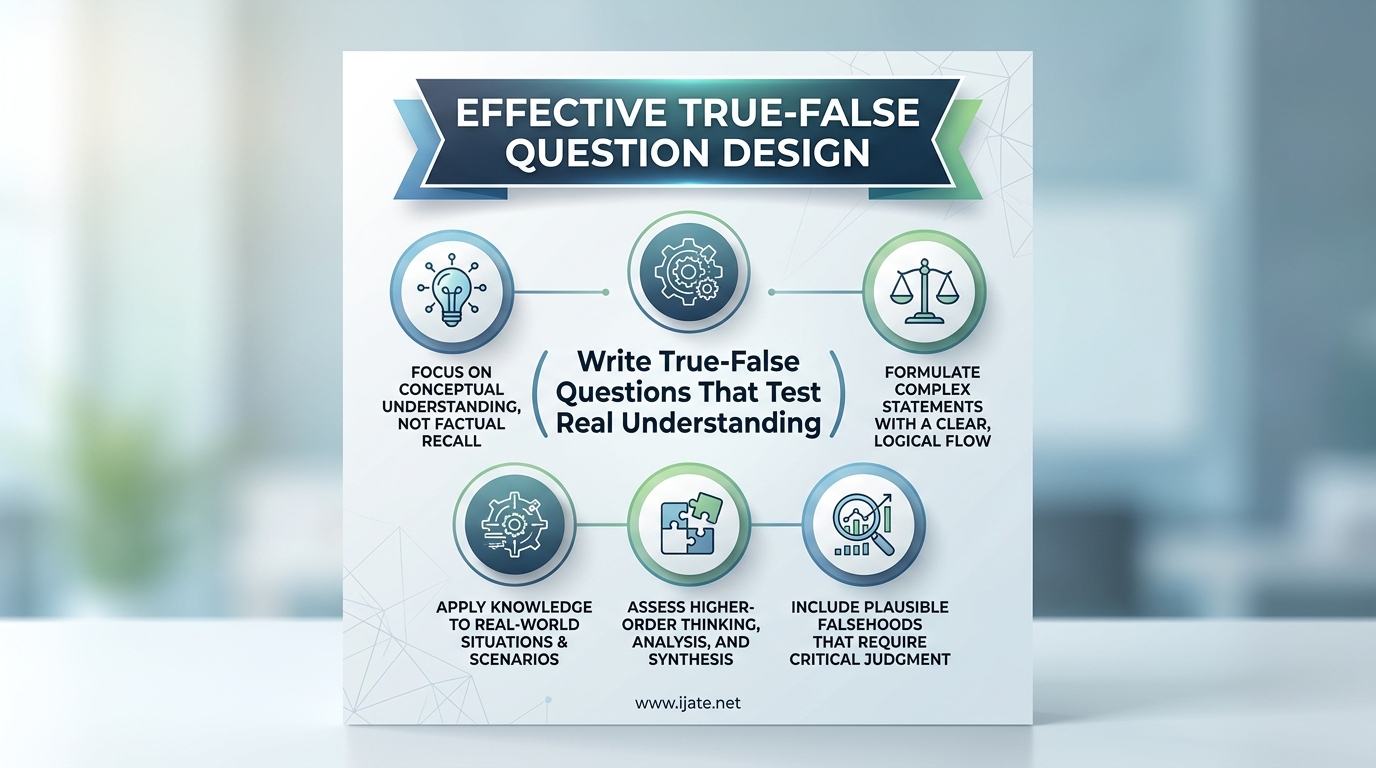
True-false questions look deceptively simple to write. You draft a statement, slap a “T or F” next to it, and move on. But if you have ever taken a test where two answers felt equally correct, you already know the problem: poorly constructed true-false questions measure test-taking strategy, not actual understanding.
I have spent years building assessments for online courses, compliance training, and classroom exams. Along the way, I learned that writing strong true-false items is one of the most underrated skills in assessment design. Done well, they identify misconceptions, surface knowledge gaps, and give you fast, scannable data on learner comprehension.
This guide walks through everything from basic structure to advanced scoring techniques. Whether you teach 30 students or build training for 5,000 employees, these strategies will help you write true-false questions that test real understanding rather than reward lucky guessing.
Table of Contents
What Are True-False Questions and Why Use Them
True-false questions are assessment items that present a single statement the learner must judge as either true or false. They are binary-choice questions, which means the learner has a 50% chance of answering correctly by guessing alone.
Despite that limitation, they remain one of the most widely used formats in education and corporate training. Their popularity comes down to efficiency. You can write more true-false items in less time than multiple-choice or essay questions, and learners can answer them quickly. That speed lets you cover a wide range of content in a single assessment.
Instructional designers use true-false questions for formative knowledge checks, pre-course baseline assessments, misconception identification, and quick comprehension verification after a lesson. They work best when you need broad coverage of factual content rather than deep analysis of a single concept.
Advantages of True-False Questions
True-false questions pack serious value when written correctly. Here is why experienced educators and trainers keep reaching for them.
First, they are fast to write and fast to grade. A well-crafted stem takes minutes to draft, and automated grading makes results available instantly. That combination makes them ideal for frequent, low-stakes checks throughout a course.
Second, they cover wide content areas. Because learners answer quickly, you can include 30 to 50 items in the time it would take to answer 10 multiple-choice questions. That breadth gives you a fuller picture of what learners do and do not understand.
Third, true-false items are excellent at surfacing misconceptions. When you write a false statement that reflects a common misunderstanding, a learner who holds that misconception will mark it true. That response pattern tells you exactly where to focus remediation.
Finally, they reduce reading load compared to paragraph-length question types. Learners spend less time parsing complex question structures and more time recalling and evaluating the actual content.
Disadvantages and Limitations
Honest assessment design means acknowledging the trade-offs. True-false questions carry real limitations that affect how you should use them.
The biggest issue is the guessing factor. With only two options, a learner has a 50% chance of being right by chance. Forum discussions on assessment design consistently highlight test-taker anxiety around this exact problem. Students worry that their genuine knowledge gets masked by coin-flip outcomes.
True-false questions also struggle to measure higher-order thinking. They work well for recall and comprehension, but they are weaker for analysis, synthesis, and evaluation. If your learning objectives require application or critical thinking, you need to pair them with other formats.
Ambiguity is another persistent challenge. A statement that feels crystal clear to the writer may read differently to a learner. The result is a question that measures interpretation skill rather than content knowledge.
Finally, true-false items provide limited diagnostic detail. When a learner gets it wrong, you know they missed the concept, but you do not always know which part confused them. Multiple-choice questions with carefully written distractors offer richer diagnostic data.
How to Write True-False Questions That Test Real Understanding
This is the core of the process. The following practices separate surface-level items from questions that genuinely reveal what learners understand. Follow these steps and your assessments will measure knowledge, not guesswork.
1. Write One Idea Per Statement
Every true-false item must test a single concept. When you pack two ideas into one statement, you create a double-barreled question where a learner can be half right. That ambiguity makes the question ungradeable in any meaningful sense.
Poor version: “Photosynthesis occurs in plant cells and requires oxygen.”
This statement is half true. Photosynthesis does occur in plant cells, but it produces oxygen rather than requiring it. A learner who knows the first part but is unsure about the second has no way to express that partial knowledge. They are forced into a binary choice that misrepresents their understanding.
Improved version: “Photosynthesis produces oxygen as a byproduct in plant cells.”
Now the statement tests one clean concept. The answer is unambiguously true, and the learner’s response accurately reflects their knowledge.
2. Use Precise, Unambiguous Language
Every word in a true-false statement needs a clear meaning. Vague qualifiers create interpretation gaps between you and the learner. Words like “sometimes,” “usually,” “often,” “generally,” and “frequently” sound specific but actually mean different things to different people.
A statement that reads “Managers usually approve remote work requests” is open to wide interpretation. How often is “usually”? Sixty percent of the time? Ninety percent? The learner is left guessing at your intent rather than demonstrating knowledge.
Replace subjective qualifiers with concrete terms. “Under the 2026 company policy, managers must approve remote work requests submitted 48 hours in advance” leaves no room for ambiguity. Either the policy says that or it does not.
3. Avoid Absolute Words Unless the Answer Is False
Words like “always,” “never,” “all,” “none,” and “every” are powerful signals. Test-wise learners recognize that absolute statements are almost always false, because few rules hold without exception. If you use absolutes in true statements, you inadvertently teach learners to spot the pattern rather than recall the content.
This does not mean you should never use absolutes. If a rule genuinely has no exceptions, an absolute word in a true statement is accurate. But use them sparingly and mix the pattern so learners cannot game the test.
4. Keep True and False Statements Similar in Length
Research on item writing shows that learners subconsciously associate longer statements with truth. When your true statements run longer than your false ones, test-takers pick up the cue. Keep both types roughly the same length to avoid leaking the answer.
This length-bias problem comes up repeatedly in language testing literature. Item writers for high-stakes exams pay close attention to word count balance between true and false stems.
5. Randomize the Order of True and False Answers
Never let your answer key fall into a predictable pattern. Learners notice when answers alternate T-F-T-F or cluster in groups. Randomize the sequence so no test-taking strategy gives an advantage. Better yet, randomize differently for each learner if your LMS supports it.
Balancing the overall ratio matters too. Aim for roughly equal numbers of true and false statements, ideally between 40% and 60% for each. A test that is 80% true feels different from one that is 80% false, and learners adjust their guessing accordingly.
6. Align Every Item to a Learning Objective
If a statement does not map to a specific learning objective, cut it. Every true-false item should test something you intended to teach. Random trivia questions feel like filler and they muddy your assessment data. When every item ties to an objective, your results tell a clear story about what worked in your instruction and what did not.
7. Write Stands-Alone Statements
Each item must make sense without reference to other questions. Avoid chains where question 5 only makes sense if you remember the context of question 4. Independent statements ensure that one missed question does not cascade into multiple wrong answers.
Common Mistakes to Avoid
Even experienced item writers fall into traps. Knowing the most frequent mistakes helps you catch them during your review process. Here is a breakdown of common pitfalls and how to fix them.
Mistake: Double negatives that confuse the learner. A statement like “It is not uncommon for managers to withhold approval” forces the learner to decode the grammar before they can judge the content. Rewrite to remove stacked negatives: “Managers sometimes withhold approval.”
Mistake: Trivia that tests memorization over understanding. Asking whether a specific date was March 14 or March 15 tests recall of an arbitrary fact. Ask whether the event happened before or after a meaningful milestone instead.
Mistake: Clues hidden in grammar. A false statement might use inconsistent verb tense or singular-plural mismatches that tip off careful readers. Proofread every stem as if you were trying to catch the answer from surface cues alone.
Mistake: Opinion stated as fact. “Customer satisfaction is the most important metric for business success” is debatable, not true or false. Stick to verifiable statements or frame opinions explicitly within a referenced framework.
Mistake: Using “Not Given” without clear rules. Some item writers add a third option for statements where the information is not covered in the source material. This format, common in language testing, can work but only with crystal-clear instructions. Without them, learners guess what counts as “not given.”
Examples: Well-Written vs Poorly Written Questions
Concrete examples make the difference obvious. Here are side-by-side comparisons that show the gap between weak and strong true-false items.
Poor: “Water boils at high altitudes.”
Improved: “Water boils at a lower temperature at higher altitudes due to reduced atmospheric pressure.”
The poor version is vague. “High altitudes” is undefined, and the statement implies a binary without specifying what changes. The improved version names the specific relationship and the cause.
Poor: “The company is doing well and growing fast.”
Improved: “The company reported a 12% year-over-year revenue increase in its 2025 annual report.”
The poor version combines two ideas and uses subjective language. The improved version tests one verifiable fact.
Poor: “All managers must always approve time-off requests immediately.”
Improved: “Under the current handbook, managers must respond to time-off requests within five business days.”
The poor version stacks absolutes, making the answer obviously false to anyone who notices the pattern. The improved version tests a real policy detail.
Advanced Techniques for Deeper Assessment
Once you master the basics, several advanced strategies push true-false questions beyond simple recall. These approaches help you test deeper understanding without abandoning the efficient format.
True-False Correction Format
In this variation, learners mark statements as true or false and then rewrite any false statement to make it true. The correction step reveals exactly what the learner misunderstood. If someone marks a statement false but cannot fix it accurately, you know their understanding is incomplete.
This format takes more time to grade but produces far richer diagnostic data. It works especially well for formative assessments where the goal is learning, not ranking.
Confidence-Based Scoring
Confidence-based scoring asks learners to rate how confident they are in each answer. You then weight scores by confidence. A correct answer with high confidence earns full points. A correct answer with low confidence earns less. A wrong answer with high confidence actually deducts points.
This approach exposes learners who guess correctly and penalizes overconfidence. It is one of the strongest tools for distinguishing real understanding from lucky guessing. Studies referenced in assessment forums consistently show that confidence-weighted scoring improves the diagnostic value of true-false items.
Testing Higher-Order Thinking
True-false questions can reach beyond recall when you write stems that require application. Instead of asking whether a definition is correct, ask whether a specific scenario correctly applies that definition.
For example: “When a 200g object accelerates at 5 m/s², the net force acting on it is 1000 N.” This requires the learner to apply Newton’s second law, not merely recall the formula. The calculation step adds cognitive depth without changing the simple answer format.
Scenario-based true-false items are particularly effective in compliance training and professional certification. They test whether learners can apply rules to real situations, not just recite them.
Balancing Your Test: Quantity, Ratio, and Order
Test construction matters as much as item quality. Even well-written statements produce unreliable results if the overall test structure is flawed.
Aim for at least 20 true-false items per assessment to counteract the guessing factor. With 20 items, the probability of scoring 70% or higher by pure chance drops below 1%. More items mean more reliable results, but watch for test fatigue. Beyond 50 items, learner attention starts to drop and careless errors increase.
Keep the true-false ratio close to 50-50. Avoid the temptation to make most items true because true statements are easier to write. A balanced ratio prevents learners from defaulting to one answer when unsure.
Randomize question order for each learner when possible. Many learning management systems support this out of the box. Randomization defeats answer-sharing between test-takers and reduces pattern-based guessing.
Using Technology to Improve True-False Assessments
Modern LMS platforms and AI tools have changed how we build true-false questions. Used carefully, technology speeds up creation and improves quality control.
AI-powered question generators can draft stems from your source material in minutes. The drafts still need human review for ambiguity and accuracy, but they cut the blank-page problem significantly. Feed the AI your learning objectives and source content, then refine the output against the best practices in this guide.
Question-level analytics from your LMS reveal which items perform well and which need revision. Look for items with low discrimination indices, meaning learners who scored well overall missed them frequently. Those items likely suffer from ambiguity or trick wording.
Automated randomization, instant feedback delivery, and confidence-rating features are now standard in many platforms. Use them. Manual test construction cannot match the reliability and security that randomized digital delivery provides.
FAQs
How to write good true false questions?
Write one idea per statement, use precise language without vague qualifiers, avoid absolute words unless the answer is genuinely false, keep true and false statements similar in length, balance the ratio close to 50-50, randomize answer order, and align every item to a specific learning objective.
What is an example of a true false question?
A clear example is: Water boils at a lower temperature at higher altitudes due to reduced atmospheric pressure. This statement tests a single concept, uses precise language, and has one unambiguous answer without relying on vague qualifiers or absolutes.
How to construct a true or false test?
Start by listing your learning objectives. Write at least 20 items so the guessing factor does not skew results. Balance true and false answers close to 50-50. Randomize question order. Proofread for grammar clues and length bias. Pilot the test with a small group and revise items that perform poorly.
How to format a true or false question?
Present a single declarative statement followed by clear instructions to mark it true or false. Keep statements concise, avoid double negatives, use the same sentence structure for true and false items, and provide consistent formatting across all questions so learners focus on content rather than decoding layout.
Conclusion
Writing true-false questions that test real understanding takes more effort than most people assume. The format is simple, but the craft behind each stem determines whether you measure knowledge or guesswork. Single-idea statements, precise language, balanced ratios, and randomized order form the foundation.
Advanced techniques like correction format, confidence-based scoring, and scenario-based stems push the format well beyond basic recall. When you combine strong item writing with smart test construction and modern LMS analytics, true-false questions become a powerful tool for identifying misconceptions and guiding instruction.
Start by auditing your existing assessments against the practices in this guide. Fix the double-barreled statements, remove the vague qualifiers, and balance your true-false ratio. Then experiment with one advanced technique at a time. Small changes compound, and your learners get clearer, fairer, more meaningful assessments as a result.