
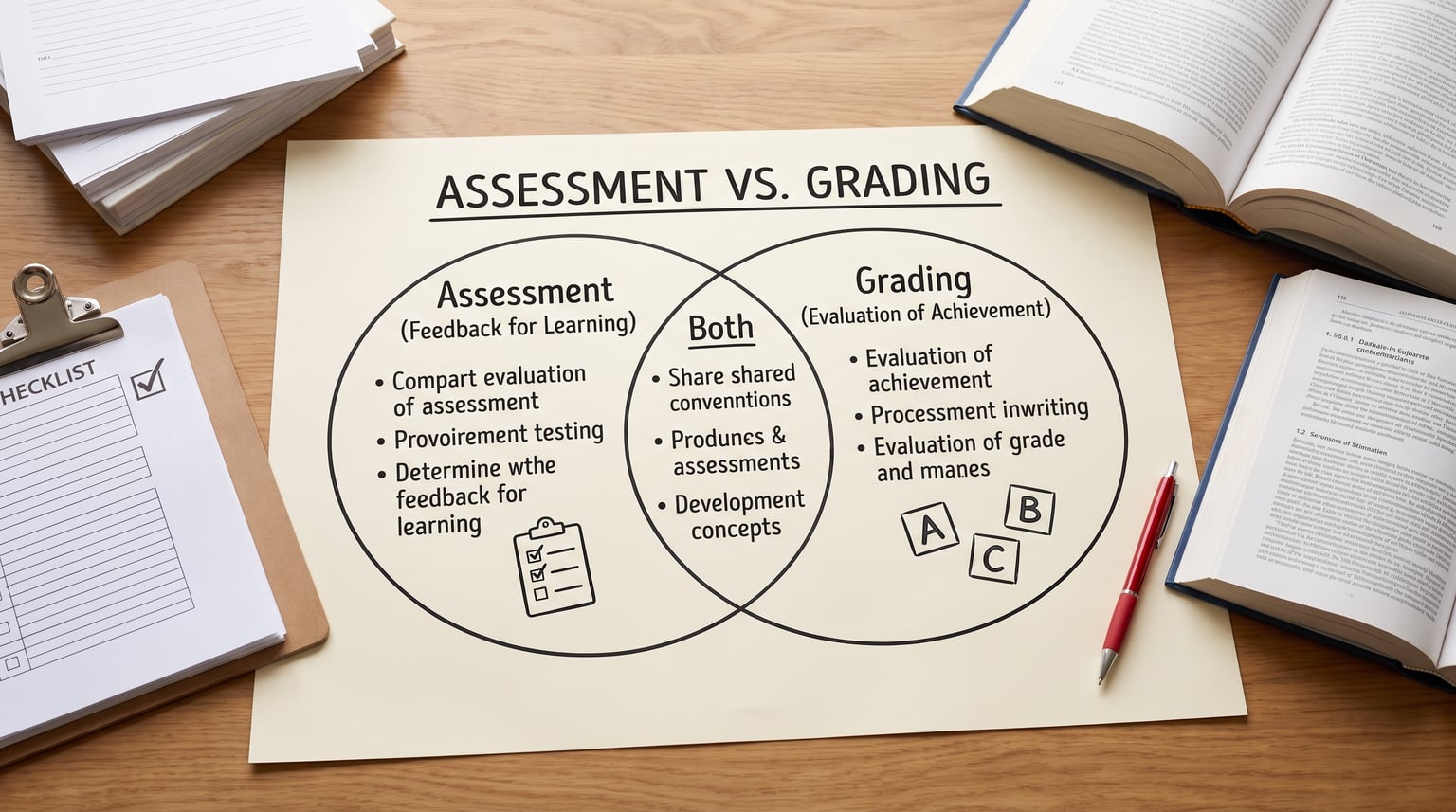
Assessment is the systematic process of gathering and analyzing evidence to evaluate and improve student learning, while grading is the summative judgment of a student’s achievement in a specific course, typically expressed as a letter or number. Assessment focuses on improving learning through ongoing feedback. Grading focuses on certifying performance at the end of a learning period.
If you have ever wondered how to distinguish assessment from grading in higher education, you are not alone. Faculty, instructional designers, and academic administrators regularly conflate these two concepts, and the confusion is understandable. Both involve evaluating student work. Both produce data about performance. Both appear in course syllabi and institutional reports side by side.
But treating them as interchangeable creates real problems. Students who receive only grades without meaningful assessment feedback tend to focus on points rather than learning. Faculty who treat every assignment as a graded event miss opportunities to help students improve before high-stakes evaluations. Institutions that rely on grades as their sole measure of program effectiveness lose the richer data that proper assessment provides.
In this guide, we break down exactly what separates assessment from grading, why that separation matters for student outcomes, and how educators can put both to work in complementary ways. We draw on frameworks from the Carnegie Mellon Eberly Center, Eastern Michigan University’s assessment office, and the work of Walvoord and Anderson, along with assessment instruments developed through published educational research.
Whether you are redesigning a single course or overhauling an institution-wide evaluation system, understanding this distinction is the foundation for everything that follows. Our team has spent years analyzing assessment practices across institutions, and the patterns are consistent: programs that clearly separate assessment from grading produce stronger learning outcomes, more satisfied students, and more meaningful accreditation evidence.
Table of Contents
What Is Assessment in Higher Education?
Assessment in higher education is the systematic process of collecting, analyzing, and interpreting evidence about student learning to improve teaching and learning outcomes. It asks one fundamental question: are students actually learning what we intend, and how can we help them learn better?
The Carnegie Mellon Eberly Center defines assessment as a process oriented toward improvement rather than judgment. Assessment gathers data about what students know, what they can do, and where they struggle. That data then drives changes in instruction, curriculum design, and student support strategies.
Assessment happens continuously, not just at the end of a term. It includes quizzes, classroom discussions, concept maps, exit tickets, peer review sessions, portfolios, and even informal observations during class. Some of these activities are graded. Many are not. The grading status is irrelevant to whether they function as assessment.
This is a point that catches many people off guard. An ungraded think-pair-share activity at the start of a lecture is assessment. A graded final exam can also serve as assessment data. What makes something assessment is not the presence or absence of a score but the purpose for which the information is used.
Assessment operates at multiple levels. Course-level assessment tracks learning within a single class. Program-level assessment examines whether students are meeting broader learning outcomes across a degree program. Institutional assessment looks at campus-wide effectiveness and feeds into accreditation reviews. Each level uses different tools but shares the same improvement-oriented goal.
Well-designed assessment systems share several characteristics. They are aligned with clearly stated learning objectives. They use multiple methods to triangulate findings rather than relying on a single data source. They involve faculty in interpreting results rather than treating data as something that belongs only to administrators. And they close the loop by connecting findings to concrete changes in teaching practice.
One common misconception is that assessment is something imposed on faculty by accreditation bodies. In reality, the most effective assessment systems are faculty-driven. When instructors own the assessment process, they use the data to make real-time adjustments that benefit their students. External reporting becomes a byproduct of good practice rather than the primary purpose.
What Is Grading in Higher Education?
Grading is the process of evaluating completed student work against established criteria and assigning a summary mark that represents a student’s level of achievement. It answers the question: how well did this student perform on this specific task, in this specific course, at this specific point in time?
Where assessment looks forward and asks how to improve, grading looks at what has already been completed and renders a judgment. A grade is a snapshot, not a feedback mechanism. It tells students where they landed relative to a standard but does not, on its own, tell them how to get better.
Grading in higher education typically follows one of two major approaches. Norm-referenced grading compares students to one another, often producing a curve where a fixed percentage receives each grade. Criterion-referenced grading measures students against predetermined standards, meaning every student who meets the standard can receive a high grade regardless of how peers perform.
Walvoord and Anderson, in their influential work on effective grading, argue that grades serve three primary functions: certifying achievement, motivating students, and providing feedback. The problem is that grades do the first function well but are weak vehicles for the second and third. Research on grading fairness measurement reinforces that grades carry significant stakes for students and need to be both valid and reliable to serve their certificatory purpose.
Grades appear on transcripts, determine GPA calculations, influence scholarship eligibility, and factor into graduate school admissions. They carry institutional weight that assessment data does not. This is why grading accuracy, consistency across faculty, and alignment with stated learning objectives matter so much.
The grading landscape in higher education has been shifting. Traditional percentage-based systems are increasingly supplemented or replaced by alternative approaches. Standards-based grading tracks mastery of specific competencies. Specifications grading uses pass-fail thresholds for each assignment. Contract grading lets students choose the grade they want by agreeing to complete a specified volume of work. Portfolio-based systems replace single-assignment grades with holistic evaluations of growth over time.
Each of these alternatives attempts to address a limitation of traditional grading. But none of them eliminates the need for assessment. Even the most innovative grading system still requires a parallel assessment process to generate the data that drives teaching and learning improvements.
How to Distinguish Assessment from Grading: Key Differences
The clearest way to distinguish assessment from grading is to examine them across five dimensions: purpose, timing, audience, feedback type, and scope. Each dimension reveals a fundamental difference in what these processes are designed to accomplish.
Purpose: Improvement vs Certification
Assessment exists to improve student learning. Grading exists to certify student performance. This is the single most important distinction, and every other difference flows from it.
When you assess, you are collecting information that will help you and your students make better decisions about teaching and studying. When you grade, you are producing a formal record of achievement that will be used by external parties, from registrars to employers.
A single activity can serve both purposes, but the design choices you make depend on which purpose you prioritize. A formative quiz designed primarily for assessment might use open-ended questions and detailed rubrics. The same quiz designed primarily for grading might use multiple-choice items for faster scoring consistency. Neither approach is wrong, but each optimizes for a different goal.
Timing: Ongoing vs Endpoint
Assessment is continuous. It happens before, during, and after instruction. Diagnostic assessment occurs before a unit to gauge prior knowledge. Formative assessment happens during instruction to monitor progress. Even summative assessment, which occurs after instruction, feeds into program-level improvement.
Grading is endpoint-oriented. While individual graded assignments happen throughout a semester, each grade is a final judgment on that specific piece of work. Grades are not revised based on later improvement unless a course explicitly uses a reassessment policy.
The timing difference has practical consequences for course design. If all graded events cluster at the end of the term, students have no opportunity to learn from early mistakes. If assessment activities are spread throughout but grades are reserved for key milestones, students get feedback when they can still use it and certification when they have had time to develop competence.
Audience: Internal vs External
Assessment data is primarily for internal use. Faculty use it to adjust their teaching. Students use it to adjust their studying. Departments use it to refine curricula. Assessment conversations happen between people who are directly involved in the learning process.
Grades are for external audiences. They appear on official transcripts that go to employers, graduate programs, licensing boards, and families. The audience for a grade extends far beyond the classroom in which it was earned.
This audience difference explains why grades are subject to formal appeals processes, institutional policies, and legal scrutiny, while assessment feedback is not. A student can challenge a grade through a formal grievance. They cannot file a formal complaint about the feedback they received on a formative exercise. The external stakes of grades demand a level of procedural rigor that assessment does not require.
Feedback Type: Rich vs Condensed
Assessment produces rich, detailed feedback. A formative assessment might generate written comments, suggested revision strategies, peer observations, and a follow-up discussion. The feedback is specific, actionable, and intended to guide next steps. Research on assessment reliability shows that well-calibrated feedback produces measurable gains in student performance.
Grades condense complex performance into a single symbol. An A, a B-minus, or a 78 tells students something about how they did, but it does not tell them what to do next. This is why educators who rely solely on grades for feedback consistently report frustration with students who repeat the same mistakes.
Scope: Individual vs Systemic
Grading is inherently individual. Each student receives their own grade based on their own work. While class-level grade distributions can reveal patterns, the unit of analysis for grading is the individual student.
Assessment can operate at the individual level but is equally powerful at the course, program, and institutional levels. A department might assess whether all seniors can conduct independent research, regardless of which sections they took. This program-level data cannot be derived from individual grades alone.
The Third Term: Where Does Evaluation Fit?
Eastern Michigan University’s assessment office makes a valuable contribution by introducing a third term: evaluation. In their three-tier framework, assessment gathers data about learning, grading certifies individual student achievement, and evaluation uses both assessment and grade data to make judgments about programs, curricula, and institutional effectiveness.
Understanding all three terms prevents the common error of using grades as proxies for program quality. Grades tell you about individual students. Assessment tells you about the learning process. Evaluation tells you whether your educational system is working.
For accreditation purposes, this distinction is critical. Accrediting bodies want to see evidence of continuous improvement at the program level. Grade distributions alone do not provide that evidence. Assessment data, aggregated and analyzed across cohorts, provides the evidence that accreditation reviews require.
Types of Assessment Every Educator Should Know
Assessment in higher education is not a monolith. Different types serve different purposes, and understanding the landscape helps educators choose the right approach for each learning situation. The four most commonly discussed types are formative, summative, diagnostic, and authentic assessment.
Formative Assessment
Formative assessment occurs during the learning process. Its purpose is to monitor student understanding and provide feedback that students and instructors can act on while there is still time to make changes. Think of it as a GPS that recalculates the route when you take a wrong turn.
Common formative assessment techniques include minute papers, muddiest-point reflections, concept checks, low-stakes quizzes, think-pair-share discussions, and draft submissions with peer review. None of these need to be graded, and many work best when they are not.
Forum discussions among university faculty consistently highlight a tension here. Educators recognize the value of formative assessment but struggle with the workload of providing individualized feedback to large classes. The solution is not to abandon formative assessment but to design scalable approaches: automated quiz feedback, structured peer review protocols, and rubric-guided self-assessment.
The research is clear on the payoff. Students in courses with regular formative assessment outperform students in courses that rely primarily on summative grading, even when the final graded events are identical. The improvement comes from the feedback loop, not from the act of assessment itself.
Summative Assessment
Summative assessment occurs after a learning period and evaluates what students have achieved. Final exams, capstone projects, term papers, and comprehensive portfolios are all summative assessments. They often overlap with graded assignments, which is one source of the assessment-versus-grading confusion.
The key distinction is that summative assessment is designed to measure learning against outcomes, while grading assigns a mark to that measurement. A department can review summative assessment results across multiple sections to determine whether students are meeting program goals, even if it never looks at the actual grades assigned.
Summative assessments are most valuable when they are designed to produce data that serves dual purposes: certifying individual student achievement and informing program-level improvement. A well-constructed rubric, applied consistently across sections, makes this dual-purpose design possible.
Diagnostic Assessment
Diagnostic assessment happens before instruction begins. It gauges students’ prior knowledge, identifies misconceptions, and helps instructors calibrate their teaching to the actual needs of their students. Pre-tests, self-assessment surveys, and diagnostic interviews all fall into this category.
Diagnostic assessment is one of the most underused types in higher education. Many faculty assume students arrive with a standard knowledge base, only to discover mid-semester that critical gaps exist. A simple diagnostic at the start of a course can prevent weeks of instruction built on faulty foundations.
In courses with prerequisite chains, diagnostic assessment becomes even more important. If students in a 300-level course lack foundational skills from the 200-level prerequisite, the instructor needs to know that on day one, not after the first major assignment reveals the gap.
Authentic and Performance-Based Assessment
Authentic assessment asks students to apply their learning to real-world or simulated tasks rather than answering multiple-choice questions. Case studies, simulations, client projects, lab practicals, and performance-based assessment tasks all fall into this category.
Authentic assessment aligns closely with the skills employers and graduate programs actually value. It also tends to be more resistant to academic integrity issues because the tasks are context-specific and difficult to outsource.
The trade-off is that authentic assessment is harder to design and evaluate than traditional testing. Rubrics must account for creativity and context-dependent factors. Inter-rater reliability becomes a concern when multiple evaluators are involved. But the learning benefits and integrity advantages make this investment worthwhile for high-stakes courses.
Self and Peer Assessment
Self-assessment asks students to evaluate their own work against criteria, building metacognitive awareness. Peer assessment asks students to evaluate classmates’ work, which develops critical analysis skills while distributing the feedback workload. Published research on peer-assessment practice in higher education demonstrates that well-structured peer review can produce feedback quality comparable to instructor feedback.
Both approaches work best when students receive clear rubrics and calibration training. Without structure, peer assessment can produce inconsistent or superficial feedback that undermines rather than supports learning.
Why the Distinction Between Assessment and Grading Matters
Understanding the difference between assessment and grading is not an academic exercise. It has direct consequences for student motivation, curriculum quality, educational equity, and academic integrity. When institutions confuse the two, students and faculty both pay the price.
Impact on Student Motivation and Learning
Research by Thomas Guskey and others has shown that students who receive grades without accompanying feedback tend to lose interest in the learning process itself. They focus on the grade, choose the easiest path to earning points, and engage with material superficially rather than deeply.
Forum discussions among faculty reinforce this finding. Professors report that students who are graded on every assignment start asking what will be on the test rather than exploring ideas. The grade becomes the goal, and genuine curiosity disappears.
Assessment-heavy courses, where feedback is rich and frequent but stakes are managed, produce a different pattern. Students take risks, revise their work, ask substantive questions, and develop skills that transfer beyond the course. The distinction is not between courses that grade and courses that assess. It is between courses that balance the two effectively and courses that rely on grading alone.
Real classroom experience bears this out. Faculty who have experimented with ungraded formative work, revision-friendly policies, and feedback-only drafts consistently report higher student engagement and deeper learning. The same students who coasted through grade-focused courses become active participants when the assessment structure rewards growth over snapshot performance.
Curriculum Design Implications
When assessment and grading are confused, curriculum design suffers. Departments that treat grades as their primary assessment data often miss systemic patterns. If 40 percent of students earn below a C on a key assignment, the grade data tells you there is a problem. Assessment data, gathered through item analysis, student surveys, and follow-up discussions, tells you what the problem is and how to fix it.
Well-designed assessment systems inform course sequencing, prerequisite structures, and instructional choices. They reveal which topics students consistently struggle with, which teaching strategies produce the strongest gains, and where the curriculum has gaps or redundancies.
Departments that invest in systematic assessment can identify problems early. A curriculum committee reviewing assessment data might discover that students in Section A consistently outperform students in Section B on the same learning outcome, pointing to a teaching effectiveness issue. Or they might find that a particular topic creates persistent difficulty across all sections, suggesting a curricular redesign rather than an instructional problem.
Equity in Education
Traditional grading practices can disadvantage students who arrive with fewer academic resources. Norm-referenced grading pits students against one another, rewarding those who started ahead. Criterion-referenced grading, combined with strong formative assessment, gives every student a genuine opportunity to reach mastery.
Equitable grading practices are gaining traction in higher education. These include minimum-grading floors, reassessment opportunities, standards-based grading, and specifications grading frameworks like the one Linda Nilson describes. All of these approaches depend on a clear separation between assessment for learning and grading for certification.
The equity argument is not about lowering standards. It is about ensuring that grades reflect what students have learned rather than how quickly they learned it or what resources they had at the starting line. When assessment is robust, every student gets the feedback and support they need to reach the standard. Grading then becomes a meaningful measure of achievement rather than a sorting mechanism.
AI and Academic Integrity Implications
The rise of generative AI tools has made the assessment-versus-grading distinction more urgent than ever. Assignments that can be completed by AI and graded by traditional methods provide almost no meaningful assessment data. Students can submit AI-generated work, receive a grade, and move on without learning anything.
Robust assessment practices, by contrast, are harder to circumvent. Authentic tasks tied to specific course contexts, multi-draft processes with instructor checkpoints, oral defenses, and in-class demonstrations all produce evidence of learning that AI cannot easily replicate. The future of assessment in higher education will depend on designing for learning rather than designing for grading efficiency.
Institutions that continue to rely on traditional assignment types, grade them quickly, and treat the resulting grades as sufficient evidence of learning are particularly vulnerable. The same assessment practices that improve learning outcomes also happen to be the ones that resist AI-mediated academic dishonesty. Investing in good assessment is therefore both a pedagogical and an integrity strategy.
Practical Strategies for Balancing Assessment and Grading
Knowing the difference between assessment and grading is necessary but not sufficient. The real work happens when educators translate that knowledge into course design and daily teaching practice. Here is a practical framework for putting both concepts to work.
Step 1: Map Your Course Around Learning Outcomes
Start by identifying what students should know and be able to do by the end of the course. These learning outcomes become the standard against which both assessment and grading are aligned. Every assessment activity and every graded assignment should connect to at least one outcome.
If you cannot explain which outcome an assignment serves, it probably belongs in a different course. Outcomes-first design prevents the common problem of assigning grades that do not actually measure intended learning.
Step 2: Build Formative Assessment Into Every Unit
Each unit should include at least one low-stakes or no-stakes formative assessment activity. This could be a brief quiz, a discussion prompt, a draft submission, or an in-class concept check. The goal is to generate data about student understanding before the graded event.
For large classes, use technology to manage the workload. Learning management systems can auto-grade multiple-choice checks. Peer review tools can distribute feedback among students. Rubric-guided self-assessment can develop metacognitive skills while reducing instructor load.
Many faculty worry that adding formative assessment will increase their workload. In practice, the opposite often happens. When students receive early feedback, they make fewer major errors on graded work. This reduces the time faculty spend grading revised or appeals, and it reduces the number of students who need intensive end-of-semester interventions.
Step 3: Separate Feedback From Grades When Possible
One of the strongest findings in educational research is that students who receive feedback and grades simultaneously tend to ignore the feedback and focus on the grade. Consider providing feedback on drafts without grades, then assigning grades only on revised versions.
This approach requires careful course design, but it pays off in student learning. It also models the real-world process of iteration and improvement that students will encounter in professional environments.
Step 4: Use Specifications Grading for Clarity
Linda Nilson’s specifications grading framework offers a structured way to separate assessment from grading. In this system, each assignment has detailed specifications that describe what acceptable work looks like. Students who meet the specs earn a passing grade. Higher achievement levels require additional work, not additional quality on the same task.
This approach reduces grade disputes, makes expectations transparent, and frees faculty time for substantive feedback rather than fine-grained score calibration. It also creates natural opportunities for reassessment without undermining standards.
Step 5: Use Program-Level Assessment Data for Continuous Improvement
Individual faculty members cannot see the full picture from their own courses. Department-level assessment coordination is essential. Collect assessment data across sections and courses, analyze patterns, and use the results to drive curricular changes.
This is where the three-tier framework pays off. Grading stays at the individual level. Assessment operates at the course and program level. Evaluation happens at the institutional level. Each feeds into the next, creating a system that supports both student certification and educational improvement.
Step 6: Close the Feedback Loop With Students
Assessment data is only useful if students see it and act on it. Build time into your course for discussing assessment results with students. Show them patterns you noticed. Explain how you are adjusting instruction based on what the data revealed. Invite them to reflect on what the assessment tells them about their own learning strategies.
When students see that assessment data leads to real changes, they take assessment activities more seriously. When they see that their feedback disappears into a void, they disengage. Transparency about how assessment works builds trust and increases participation.
FAQs
What is the difference between grading and assessment?
Grading is the process of evaluating individual student work and assigning a summary mark that certifies achievement. Assessment is the systematic process of gathering and analyzing evidence about student learning to improve teaching and learning outcomes. Grading focuses on judgment and certification; assessment focuses on feedback and improvement.
What are the 4 types of assessments in education?
The four main types of assessment are formative assessment (ongoing feedback during learning), summative assessment (evaluation of learning after instruction), diagnostic assessment (pre-instruction measurement of prior knowledge), and authentic or performance-based assessment (real-world application of skills). Each type serves a distinct purpose in the learning cycle.
What distinguishes the assessments in a standards-based grading system from those of a traditional grading system?
In a standards-based grading system, assessments measure student mastery of specific learning standards, and grades reflect how many standards a student has met regardless of when mastery occurs. In a traditional grading system, assessments accumulate points over time, and grades average early and late performance together, penalizing students who needed time to reach mastery.
What is assessed vs graded?
Assessed work is evaluated to provide feedback and inform instructional decisions, whether or not it receives a formal grade. Graded work receives a formal mark that appears on a transcript and contributes to a student’s academic record. Some work is assessed but not graded, some is both assessed and graded, and some is graded without generating meaningful assessment data.
Conclusion: Putting the Distinction to Work
Learning how to distinguish assessment from grading in higher education changes the way you design courses, evaluate student work, and think about educational quality. Assessment is about improvement, feedback, and the continuous process of helping students learn. Grading is about certification, accountability, and producing a formal record of achievement.
Both are necessary. Neither is sufficient on its own. The strongest courses and programs use assessment to guide learning throughout the term and use grading to certify what students have achieved by the end. When you separate these two functions deliberately, students get better feedback, faculty make better instructional decisions, and institutions produce graduates whose grades genuinely reflect what they know and can do.
Start with one change. Add a formative assessment activity to your next unit. Separate feedback from grades on one assignment. Review your program-level assessment data with colleagues. Small shifts in how you balance assessment and grading can produce significant gains in student learning outcomes.