
Every teacher faces the same moment: staring at a stack of essays, projects, or presentations, wondering how to grade them fairly without spending the entire weekend on it. The tool you choose, your rubric, shapes how fast you grade, how useful your feedback is, and how consistently you score across students. Get it wrong, and you end up with confused students, inconsistent marks, and a lot of wasted time.
That is exactly why understanding the difference between analytic and holistic rubrics matters so much. These two rubric types approach evaluation from opposite directions, and each one shines in different situations. One breaks everything down into detailed components. The other looks at the whole picture and assigns a single score.
In this guide, our team breaks down both types with real examples, honest pros and cons, and a practical decision framework you can use today. Whether you are grading 30 essays or 300 lab reports, you will leave knowing exactly which rubric fits your assignment. We also cover the single-point rubric as a third option that many educators overlook.
Table of Contents
What Is a Holistic Rubric?
A holistic rubric assigns a single overall score to a piece of student work based on a general impression of quality. Instead of evaluating individual components separately, you look at the entire submission and match it to one of several broad performance levels. Think of it as grading the forest, not the trees.
Most holistic rubrics list three to five performance levels, each accompanied by a description of what that level looks like. A four-level scale might include descriptors like “Excellent,” “Proficient,” “Developing,” and “Beginning.” The teacher reads or observes the full submission, then selects the level that best captures the overall quality.
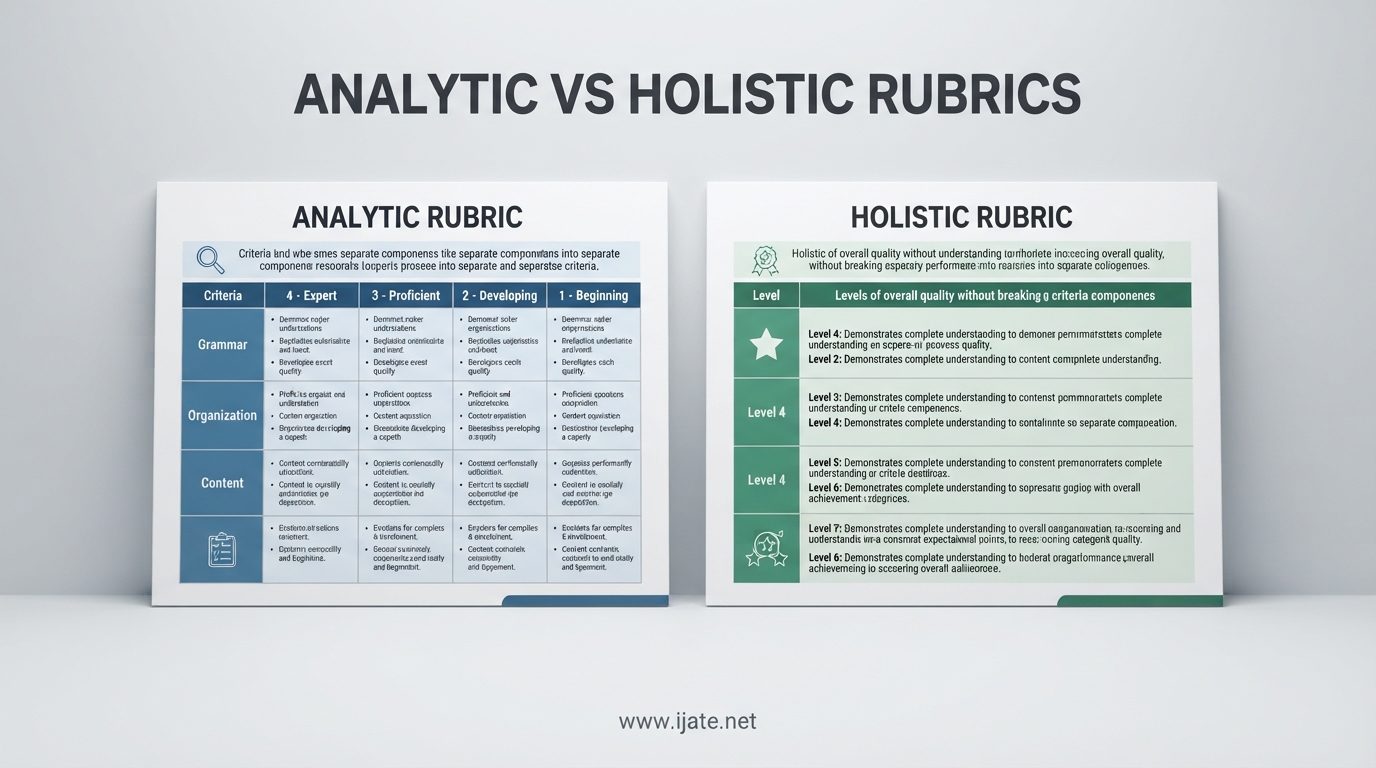
Here is a simple example of what a holistic rubric for an essay might look like:
- 4 – Excellent: The essay has a clear thesis, well-organized paragraphs, strong evidence, and minimal errors. The writing flows naturally and engages the reader.
- 3 – Proficient: The essay has a thesis and logical structure with adequate evidence. Minor errors are present but do not interfere with meaning.
- 2 – Developing: The thesis is unclear or the organization is hard to follow. Evidence is thin or only loosely connected to the argument.
- 1 – Beginning: The essay lacks a discernible thesis, has significant structural problems, and contains frequent errors that disrupt understanding.
Notice how each level describes the whole essay at once. There are no separate scores for grammar, organization, or content. You get one number, and that number reflects your overall judgment as the grader.
What Is an Analytic Rubric?
An analytic rubric breaks an assignment into separate criteria and evaluates each one individually. Instead of one score, a student receives multiple scores, one for each dimension of the work. If a holistic rubric grades the forest, an analytic rubric grades every tree, the soil, and the walking path.
The structure looks like a grid. Rows list the criteria being assessed, and columns show the performance levels. Each cell contains a descriptor explaining what that level of performance looks like for that specific criterion. The grader works through each row, assigns a score, and then combines the individual scores into a final grade.
Here is an example of an analytic rubric for the same essay, broken into four criteria:
- Organization (4 points): 4 = Clear intro, body, conclusion with smooth transitions. 3 = Logical structure with minor gaps. 2 = Weak organization, hard to follow. 1 = No discernible structure.
- Content and Evidence (4 points): 4 = Strong, relevant evidence supports the thesis. 3 = Adequate evidence with some gaps. 2 = Evidence is thin or off-topic. 1 = Little to no supporting evidence.
- Grammar and Mechanics (4 points): 4 = Virtually error-free. 3 = Minor errors, no disruption to meaning. 2 = Frequent errors, some confusion. 1 = Errors severely disrupt readability.
- Citation Format (4 points): 4 = All sources correctly cited. 3 = Minor citation errors. 2 = Multiple citation problems. 1 = Citations missing or incorrect throughout.
With this structure, a student might score a 4 on content but a 2 on grammar. That kind of targeted information is the biggest strength of analytic scoring. The student knows exactly where they excelled and where they need work.
Research backs this up. A study on analytic rubric effectiveness and rater consistency found that analytic rubrics produce greater consistency between graders compared to holistic scoring. When multiple teachers grade the same assignments, analytic rubrics help them reach more aligned scores because everyone evaluates the same specific components.
The Difference Between Analytic and Holistic Rubrics: Side-by-Side
Now that you have seen both types in action, let us put them head to head. The core difference comes down to granularity. Analytic rubrics break work into pieces and score each piece. Holistic rubrics look at the whole and assign one number.
Here are the key differences laid out clearly:
- Scoring approach: Analytic gives separate scores per criterion. Holistic gives one overall score.
- Feedback detail: Analytic tells students exactly which areas to improve. Holistic gives general feedback tied to the overall performance level.
- Time to create: Analytic rubrics take longer to build because you must write descriptors for every cell in the grid. Holistic rubrics need only one descriptor per level.
- Time to grade: Holistic is significantly faster. You make one decision per student instead of several.
- Consistency across graders: Analytic rubrics improve consistency because every grader evaluates the same defined criteria. Holistic rubrics leave more room for personal interpretation.
- Handling mixed-quality work: Analytic handles a paper that is strong in argumentation but weak in grammar naturally, giving separate scores. Holistic forces a judgment call on which overall level best fits a mixed bag.
- Best for: Analytic suits formative assessment, skill-building, and detailed feedback. Holistic suits summative assessment, large grading volumes, and quick overall judgments.
One way to think about it: if you want to diagnose specific problems, go analytic. If you want a fast, reliable overall grade, go holistic.
Advantages and Disadvantages of Holistic Rubrics
Holistic rubrics have a loyal following among educators who handle large grading loads. Their speed is unmatched. When you are grading 120 final exams in a weekend, making one scoring decision per paper instead of five can save hours.
Here are the main advantages of holistic rubrics:
- Fast grading: One decision per student means you move through stacks quickly.
- Simple to create: You write one descriptor per level, not a full grid.
- Easy for students to understand: A single score and a broad description is immediately clear.
- Good for overall judgment: Some assignments, like creative writing or art portfolios, resist being broken into components. Holistic scoring respects the work as a whole.
- Less paperwork: Shorter rubrics are easier to print, share, and attach to submissions.
But holistic rubrics come with real trade-offs:
- Limited feedback: A student who scores a 2 on a holistic rubric knows they are “developing” but may not know whether the problem is organization, evidence, or grammar.
- Subjectivity risk: Without defined criteria for each component, two graders might disagree more often on borderline cases.
- Mixed-quality problem: When a paper is excellent in one area and poor in another, the single score cannot capture that split. The grader must make a judgment call that may feel arbitrary.
- Harder to track growth: Because you are not scoring individual skills, it is difficult to show students their progress in specific areas over time.
Reddit educators in r/Professors frequently mention that holistic rubrics work best when they already know their students’ baseline abilities. The single-score approach rewards graders who have context, which makes it harder for new or substitute teachers to use consistently.
Advantages and Disadvantages of Analytic Rubrics
Analytic rubrics are the go-to choice when feedback quality matters more than grading speed. They shine in formative settings where the goal is to help students improve specific skills over time.
Here are the main advantages of analytic rubrics:
- Targeted feedback: Students see exactly which criteria they met and which need work.
- Higher grader consistency: Research published in the National Library of Medicine found that analytic rubrics yield greater consistency in marking compared to holistic marking, especially when multiple graders are involved.
- Better for skill tracking: Because each criterion is scored separately, you can track student growth in specific areas across multiple assignments.
- Fairer for mixed work: A student who writes a brilliant argument with sloppy grammar gets credit for the argument and feedback on the grammar, rather than a single middling score that punishes both.
- Self-assessment friendly: Students can use the rubric to evaluate their own drafts before submitting, which builds metacognitive skills.
The disadvantages are just as real:
- Time-consuming to create: Writing descriptors for every cell in a grid takes significantly longer than writing level descriptions for a holistic rubric.
- Slower grading: Making multiple decisions per student adds up fast, especially with large classes.
- Weighting confusion: If criteria carry different point values, students and teachers alike can struggle to understand how the final grade is calculated.
- Over-prescription risk: Highly detailed analytic rubrics can feel like checklists, which some educators worry stifles creativity and originality.
Forum discussions on r/teaching reveal that the weighting problem is one of the most common frustrations. Teachers frequently ask how to convert weighted analytic scores into final letter grades without confusing students. Our advice: keep your weighting transparent. Show students the math upfront, and provide a simple conversion chart.
When to Use Each Rubric Type
Choosing between analytic and holistic rubrics comes down to your goal, your class size, and the type of assignment. Here is a practical decision guide based on what each type does best.
Use a holistic rubric when:
- You are grading a large volume of work and speed is essential.
- The assignment is summative, meaning the grade matters more than detailed feedback.
- The work is creative or subjective, where breaking it into components would feel forced or reductive.
- You want a quick snapshot of overall performance for reporting purposes.
- You are working with experienced graders who share a common understanding of quality.
Use an analytic rubric when:
- You are doing formative assessment and want students to improve specific skills.
- Multiple graders will score the same work and consistency is important.
- The assignment has clearly distinguishable components that should be evaluated separately.
- Students will use the rubric for self-assessment or peer review.
- You need to document student growth in specific skill areas over time.
Handling the mixed-quality dilemma: This is where the two rubric types diverge most sharply. If a student submits a project with outstanding research but terrible presentation, a holistic rubric forces you to pick one overall level. An analytic rubric lets you give a high score for research and a low score for presentation, painting a more accurate picture.
Course-level considerations: Introductory courses often benefit from analytic rubrics because students are still learning what each component of good work looks like. Upper-level courses, where students have internalized the components, can shift toward holistic scoring for efficiency.
Single-Point Rubrics: A Third Option
Many educators do not realize there is a third option that sits between analytic and holistic. The single-point rubric, popularized by Jennifer Gonzalez at Cult of Pedagogy, lists only the criteria for proficiency. It leaves the columns for “below expectations” and “above expectations” blank, so the teacher writes individualized comments instead of selecting from pre-written descriptors.
Here is why single-point rubrics are gaining traction:
- Less overwhelming to create: You write one column instead of a full grid.
- More personalized feedback: Teachers write specific comments rather than pointing students to generic descriptors.
- Flexible for all levels: The blank columns accommodate work that does not fit neatly into predefined boxes.
- Student-friendly: Students see exactly what proficiency looks like and get targeted notes on where they exceeded or fell short.
The trade-off is that single-point rubrics require more writing per student than selecting a number from a grid. They work best for assignments where personalized feedback adds real value and class sizes are manageable.
Common Mistakes and Tips from Educators
After combing through teacher forums on Reddit and educational communities, a few recurring mistakes stand out. Avoiding these will save you headaches and improve your students’ experience.
Mistake 1: Vague descriptors. The most common problem across both rubric types is language that could mean anything. “Good organization” means nothing without specifics. Write descriptors that a substitute teacher could apply without asking you for clarification.
Mistake 2: Too many criteria. Analytic rubrics with 10 or more criteria become unwieldy for both grader and student. Stick to four to six criteria that capture the most important dimensions of the work.
Mistake 3: Ignoring the rubric until grading time. The best rubrics are shared with students before the assignment begins. When students see the criteria upfront, they self-direct their work toward the targets. Many professors on r/Professors report that students rarely read rubrics handed out after the fact.
Mistake 4: Confusing point values with grades. If your analytic rubric gives 4 points per criterion across 5 criteria, the maximum is 20 points. Students need to know how that 20-point scale maps to a letter grade. Always provide a conversion chart.
Mistake 5: Never revising the rubric. After grading a batch, take five minutes to note what confused you or your students. Did two graders interpret a descriptor differently? Did students consistently miss a criterion you thought was clear? Iterate. You can also explore approaches to teaching critical thinking with rubrics to deepen how your rubrics support higher-order skills.
Tip for student engagement: Have students self-assess using the rubric before submitting. This single step dramatically increases how carefully they read and internalize the criteria. It also gives you insight into where their self-perception diverges from reality, which is a powerful teaching moment.
FAQs
What is the difference between analytical and holistic?
An analytical rubric breaks an assignment into separate criteria and scores each one individually, giving students detailed feedback on specific areas. A holistic rubric looks at the work as a whole and assigns a single overall score based on a general impression of quality. Analytic rubrics provide more detail but take longer to grade, while holistic rubrics are faster but offer less specific feedback.
Which advantage does a holistic rubric have over an analytic rubric?
The main advantage of a holistic rubric is speed. Because you make one scoring decision per student instead of several, you can grade large volumes of work much faster. Holistic rubrics are also simpler to create since you write one descriptor per performance level rather than filling out a full grid. They work especially well for summative assessments and creative work that resists being broken into components.
What is an example of an analytic rubric?
An analytic rubric for an essay might have four criteria: Organization, Content and Evidence, Grammar and Mechanics, and Citation Format. Each criterion is scored on a 4-point scale with specific descriptors for each level. A student receives four separate scores that are combined into a final grade, showing exactly where they excelled and where they need improvement.
What are the four types of rubrics?
The four main types of rubrics are holistic, analytic, single-point, and developmental (or progress rubrics). Holistic rubrics give one overall score. Analytic rubrics score separate criteria individually. Single-point rubrics list only proficiency criteria with blank space for personalized feedback above and below expectations. Developmental rubrics track student growth over time across multiple assessment points.
Conclusion
Understanding the difference between analytic and holistic rubrics gives you control over your grading process and the quality of feedback your students receive. Analytic rubrics break work into components, deliver targeted feedback, and improve consistency across graders, but they cost time to create and use. Holistic rubrics are fast and simple, ideal for large volumes and summative judgments, but they sacrifice detail. The single-point rubric offers a flexible middle ground worth exploring.
Our recommendation: match the rubric to the assignment’s purpose. Use analytic for formative work where growth matters. Use holistic when speed and overall judgment are the priority. Share your rubric before the assignment begins, keep your criteria count manageable, and revise after each grading cycle. The right rubric, used well, transforms grading from a chore into a tool for real learning.