
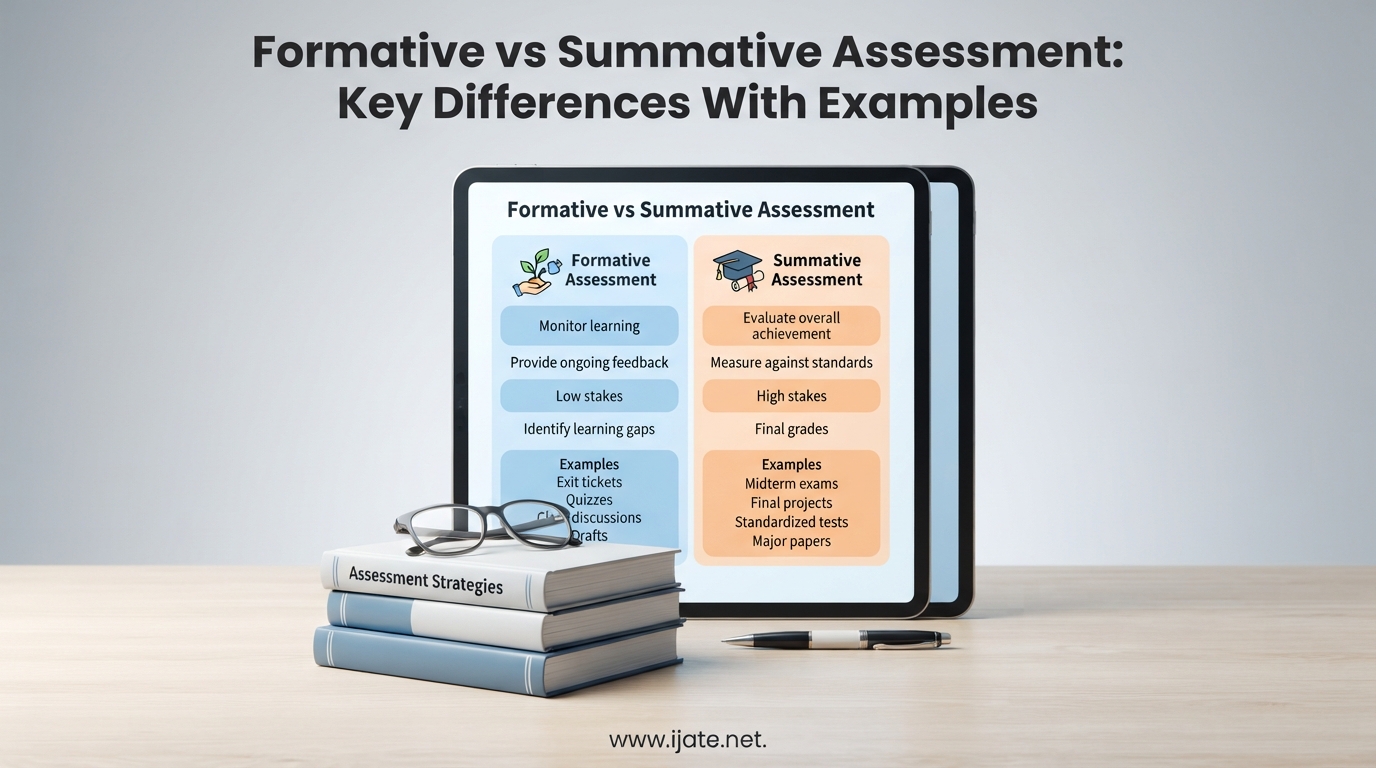
Every teacher I have worked with has asked the same question at some point: what really separates formative assessment from summative assessment? The difference between formative and summative assessment with examples is one of the most searched topics in education, and for good reason. Understanding these two assessment types changes how you plan lessons, deliver instruction, and measure student growth.
Formative assessments happen while learning is still taking place. They are the checkpoints that tell you whether students are grasping the material so you can adjust your teaching in real time. Summative assessments, on the other hand, happen at the end of an instructional period. They measure how much students have learned after the teaching is done.
In this guide, I will walk you through clear definitions of both types, a side-by-side comparison table, at least eight examples of each, common misconceptions that confuse even experienced teachers, and practical strategies for balancing both in your classroom. Whether you are a new teacher building your first unit or a veteran looking to refine your assessment system, you will find actionable, classroom-ready information here.
Table of Contents
What Is Formative Assessment?
Formative assessment is the ongoing evaluation of student understanding that takes place during the learning process. Its primary purpose is to monitor student progress toward learning objectives and give teachers the information they need to adapt instruction before a unit ends.
Think of it as a GPS for your classroom. Just as a GPS recalculates your route when you take a wrong turn, formative assessment tells you when students have gone off track so you can redirect them immediately. Education researchers often call this “assessment for learning” because the data is used to improve the learning process rather than judge it.
Formative assessments are typically low-stakes, meaning they carry little to no grade weight. Students can make mistakes freely, and teachers use the results to identify misconceptions, spot knowledge gaps, and decide which topics need reteaching. The feedback loop is fast, sometimes within the same class period.
Common characteristics of formative assessment include frequent administration, immediate or near-immediate feedback, focus on specific learning objectives, and results that directly influence the next instructional steps. A quick poll, a thumbs-up check for understanding, or a three-question exit ticket can all serve as formative assessments.
What Is Summative Assessment?
Summative assessment is the final evaluation of student learning that occurs at the conclusion of an instructional period. Its primary purpose is to measure overall proficiency and determine whether students have met the intended learning outcomes.
If formative assessment is the GPS, summative assessment is the destination. It tells you whether students arrived where the curriculum intended them to go. Researchers often refer to this as “assessment of learning” because it evaluates the end result rather than the process.
Summative assessments are usually higher-stakes than formative assessments. They contribute significantly to report card grades, inform decisions about placement or promotion, and provide data that administrators and policymakers use to evaluate school effectiveness. Examples include final exams, end-of-unit tests, term papers, and standardized state assessments.
Key characteristics of summative assessment include administration at specific milestones (end of unit, semester, or year), formal grading with established rubrics, comprehensive coverage of the material taught, and results that are shared with students, parents, and school leaders. The feedback comes after the learning is complete, so it cannot change the current instructional cycle but can inform future planning.
The Difference Between Formative and Summative Assessment
The core difference between formative and summative assessment comes down to timing, purpose, and how the results are used. Formative assessment happens during learning to guide instruction, while summative assessment happens after learning to evaluate mastery. Both are essential, but they serve completely different roles in the classroom.
Below is a detailed comparison that breaks down every key dimension. I have found that having this contrast laid out clearly helps teachers decide which type to use and when.
| Feature | Formative Assessment | Summative Assessment |
|---|---|---|
| Timing | During instruction, ongoing throughout the unit | At the end of a unit, course, or instructional period |
| Purpose | Monitor progress and adapt instruction | Evaluate learning and assign grades |
| Stakes | Low-stakes, often ungraded or minimally weighted | High-stakes, contributes significantly to final grades |
| Frequency | Daily or weekly, sometimes multiple times per lesson | Periodic, tied to the end of units or terms |
| Feedback Timing | Immediate or within the same class period | Days or weeks after the assessment |
| Role of Grades | Grades are secondary or absent | Grades are the primary outcome |
| Teacher Action | Adjust lessons, reteach, differentiate instruction | Record scores, report to stakeholders, plan next unit |
| Also Known As | Assessment for learning | Assessment of learning |
One way I like to explain this to parents and new teachers is with a cooking analogy. Formative assessment is tasting the soup while you cook it. You can still add salt, adjust the heat, or start over. Summative assessment is the food critic tasting the finished dish. The cooking is done, and now the meal is being judged.
Formative Assessment Examples
Formative assessments can take dozens of forms, from quick verbal checks to structured written tasks. The best ones are fast enough to use regularly without eating into instructional time. Here are eight practical examples that work across grade levels.
1. Exit Tickets are short written responses students complete in the last three to five minutes of class. A typical prompt asks students to name one thing they learned, one question they still have, and one concept that felt confusing. Teachers read these after class and use the patterns to plan the next day’s lesson.
2. Think-Pair-Share is a discussion strategy where students think about a question individually, discuss their answer with a partner, and then share with the whole class. As the teacher walks around and listens to pairs, you get an immediate sense of who understands the concept and who does not.
3. Bell Ringers are short tasks students complete at the start of class while you take attendance or set up materials. A single review question on the board gives you a snapshot of what students retained from the previous lesson before you move forward.
4. Quick Writes ask students to write for two to three minutes in response to a prompt. For example, after teaching a science concept, you might ask students to explain it as if they were teaching a younger sibling. The responses reveal misconceptions that a multiple-choice question would miss.
5. Dry-Erase Board Responses involve every student holding up a small whiteboard with their answer to a problem or question. In a math class, this lets you scan the room in seconds and see exactly who needs help. It works equally well for vocabulary, dates, or true/false checks.
6. Polls and Digital Quizzes use tools like Kahoot, Nearpod, or Google Forms to collect instant data from the entire class. These platforms grade responses automatically and generate visual reports that show which questions students struggled with most. For elementary students, simple hand signals (thumbs up, sideways, down) accomplish the same goal without technology.
7. Peer Feedback Sessions give students a structured rubric to evaluate each other’s work during a draft stage. While students review partners’ essays or projects, you circulate and listen. The feedback students give reveals their own understanding of the criteria, giving you two layers of formative data at once.
8. Observation Checklists let you track specific behaviors or skills during a lesson or activity. During a science lab, you might note which students successfully measured liquids, which used the correct vocabulary, and which needed prompting. This type of formative assessment requires no extra class time because it happens while students are already working.
Summative Assessment Examples
Summative assessments cap off a learning period with a comprehensive measure of what students know and can do. They come in many formats beyond the traditional multiple-choice test. Here are eight common examples, along with notes on when and why each is used.
1. End-of-Unit Tests cover all the material taught in a specific unit, typically over one to three weeks. A unit test on fractions, for example, might include comparing fractions, adding with unlike denominators, and solving word problems. Results show whether the class as a whole mastered the objectives and which students need additional support.
2. Midterm Exams assess learning from the first half of a semester or term. In high school and college courses, midterms often cover six to twelve weeks of material and account for a significant portion of the semester grade. They force students to consolidate learning and give teachers data at the midpoint of the course.
3. Final Exams are comprehensive tests administered at the end of a course. They cover the full scope of the curriculum and are often the highest-weighted single assessment in a grading period. Final exams serve as a summative checkpoint for course completion and may determine whether a student earns credit.
4. Final Essays and Research Papers evaluate students’ ability to synthesize research, construct arguments, and apply writing skills learned over a unit or semester. A history research paper demonstrates mastery of source analysis, citation, and historical reasoning all at once. Teachers grade these using rubrics that break down the assessment into specific criteria.
5. Portfolios are curated collections of student work gathered over time. An art portfolio might include sketches, finished pieces, and artist statements spanning a full semester. Portfolios are summative because they represent the student’s best work at the end of a learning period, but they also document growth in a way that a single test cannot.
6. Presentations and Performances require students to demonstrate their learning in front of an audience. A science fair project, a debate, a musical performance, or a capstone presentation all fall under this category. These assessments evaluate both content knowledge and communication skills.
7. Standardized State Assessments are mandated tests administered to all students at specific grade levels. Examples in the United States include state accountability tests, the ACT, and the SAT. These are high-stakes summative assessments used by districts and states to compare schools, track trends, and meet accountability requirements.
8. Culminating Projects tie together everything students have learned in a unit or course. A middle school social studies class might end a government unit with a mock legislature where students draft, debate, and vote on bills. These projects assess both individual knowledge and collaborative skills.
Benefits of Each Assessment Type
Both formative and summative assessments bring distinct value to the classroom. Formative assessment benefits teachers by providing real-time data that drives instructional decisions. When you spot a misconception during a quick write, you can address it that same day instead of discovering it on the unit test two weeks later.
Students also benefit from formative assessment because it reduces the anxiety of being surprised by a major test. Regular low-stakes checks give them multiple opportunities to practice and self-correct before anything counts for a grade. This builds confidence and metacognition, the ability to think about their own learning.
Summative assessment benefits teachers by providing the data needed for report cards, parent conferences, and curriculum evaluation. A well-designed final exam shows whether the instruction worked and where it fell short. Administrators use this data to make decisions about resource allocation, teacher support, and program effectiveness.
For students, summative assessments offer a sense of closure and accomplishment. A strong performance on a final project validates the effort they put in over weeks or months. Even when results are disappointing, the feedback helps students understand where they stand and what to focus on going forward.
How to Balance Both Types in Your Classroom
The most effective teachers use formative and summative assessments together as part of a coherent system. A good rule of thumb I share with colleagues is the 70-30 ratio: roughly 70% of your assessment activity should be formative and 30% summative. This keeps the focus on learning while still generating the grade data you need.
Start each unit with a plan for both types. Map out which formative checks you will use each week and which summative assessment will cap off the unit. Build formative assessments into your daily routine so they become a natural part of instruction rather than an interruption. Exit tickets, bell ringers, and quick writes work well because they fit into existing transition times.
The transition from formative to summative happens when you have gathered enough evidence that students are ready to demonstrate mastery. If your formative data shows widespread gaps, slow down and reteach before administering the summative. This approach respects the purpose of each type: formative informs your teaching, and summative confirms the results.
Common Misconceptions About Formative and Summative Assessment
Even experienced teachers sometimes blur the line between these two assessment types. Addressing these misconceptions head-on helps clarify when and how to use each one.
Misconception 1: Formative assessments are never graded. This is false. While many formative assessments carry no grade weight, some teachers do include small participation or completion grades. The defining feature is not the absence of grades but the purpose: the data is used to adjust instruction. A graded homework assignment can still be formative if the teacher uses the results to plan the next lesson.
Misconception 2: Summative assessments are always high-stakes tests. Not necessarily. A summative assessment is any evaluation that measures learning at the end of an instructional period. A short end-of-chapter quiz, a small group presentation, or a one-page reflection can all be summative if they evaluate final learning outcomes rather than guide ongoing instruction.
Misconception 3: The two types are mutually exclusive. In practice, the same assessment tool can serve both purposes depending on how the results are used. A midterm exam is summative for the first half of the course, but the results can also be formative for the second half if the teacher adjusts instruction based on what students missed. Context and data use determine the type, not the assessment format itself.
Misconception 4: Formative assessment takes too much time. Many of the most effective formative strategies take under five minutes. Exit tickets, thumbs-up checks, and dry-erase board responses fit into existing class routines without adding to the daily schedule. The time investment pays off because teachers spend less time reteaching content that students never learned in the first place.
Frequently Asked Questions
What is an example of a formative and summative assessment?
A formative assessment example is an exit ticket where students write one thing they learned and one question they still have at the end of a lesson. A summative assessment example is a final exam at the end of a unit that covers all the material taught and contributes to the student’s report card grade.
What are three examples of formative assessments?
Three examples of formative assessments are exit tickets (brief end-of-class written responses), think-pair-share discussions (students discuss answers with a partner before sharing with the class), and dry-erase board responses (every student holds up their answer on a small whiteboard for instant scanning).
Which comes first, summative or formative?
Formative assessment always comes first because it occurs during instruction, while summative assessment occurs at the end. You use formative assessments throughout the unit to monitor progress and adjust teaching, then administer the summative assessment once the instructional period is complete to evaluate final learning.
What are examples of a summative assessment?
Examples of summative assessments include end-of-unit tests, midterm and final exams, research papers, portfolios, presentations and performances, standardized state tests (such as the ACT or SAT), and culminating projects. All of these evaluate student learning at the conclusion of an instructional period.
Can an assessment be both formative and summative?
Yes. The same assessment can serve both purposes depending on how the results are used. A midterm exam is summative for the first half of the course but formative for the second half if the teacher uses the results to adjust instruction going forward. The purpose and data use determine the type, not the assessment itself.
Conclusion
Understanding the difference between formative and summative assessment with examples gives you a complete toolkit for measuring student learning at every stage. Formative assessments are your ongoing checkpoints during instruction, helping you adapt lessons and catch gaps before they grow. Summative assessments are your final measures of mastery, providing the data needed for grades, accountability, and curriculum evaluation.
The best classrooms use both types intentionally and in balance. Start by choosing two or three formative strategies to build into your weekly routine this 2026, then make sure each unit ends with a well-designed summative assessment. Your students will learn more, your instruction will be sharper, and your grading will be more defensible.