
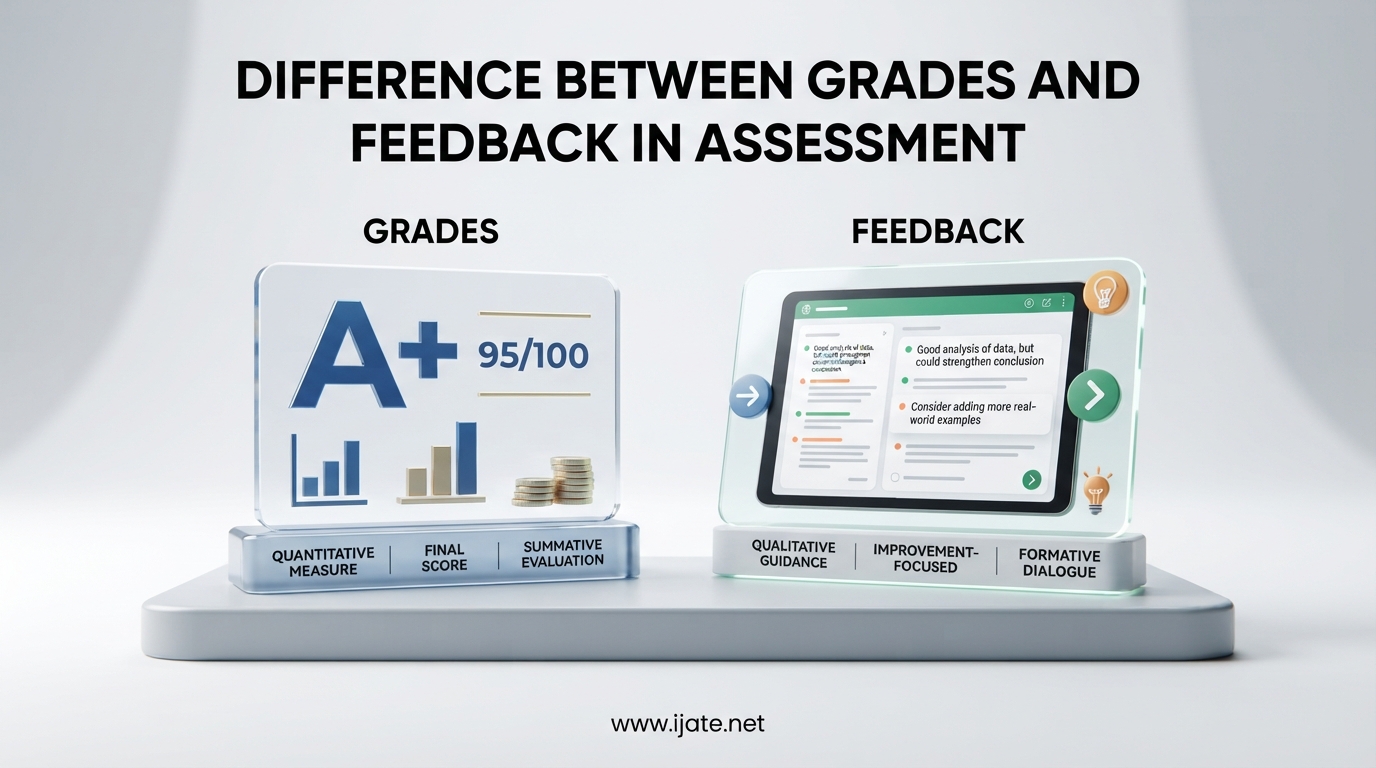
Every teacher faces this moment: a student walks to the desk, flips through the returned assignment, and asks “What did I get?” before they have read a single word of the comments you spent forty-five minutes writing. That moment reveals something essential about educational assessment. The difference between grades and feedback in assessment matters deeply for how students learn, how teachers teach, and what a classroom culture values. Understanding that difference is not just an academic exercise. It changes how educators design assignments, how they communicate progress, and how students develop the capacity to improve. It affects grading policies, classroom assessment strategies, and the entire arc of a student’s academic journey. This article breaks down the distinction with research evidence, practical examples, and actionable strategies that any teacher can apply.
Our team has spent considerable time reviewing assessment research from leading educational journals, talking to educators about their classroom experiences, and analyzing what actually helps students grow. What we found is that grades and feedback serve fundamentally different purposes, and the most effective educators know how to leverage both without confusing one for the other. The following guide draws on that research to give you a clear, practical understanding of these two pillars of educational assessment.
Table of Contents
What Are Grades in Assessment?
A grade is a summary judgment. It is a letter, number, or symbol that represents a teacher’s evaluation of student performance against a set of criteria. In most schools, grades appear on report cards, populate the gradebook, and determine whether a student passes or fails a course. The familiar A through F scale, or the 100-point numerical system, has been the standard in education for over a century.
Grades function primarily as a form of summative assessment. They capture a snapshot of achievement at a specific moment in time. When a teacher enters a B-plus into the gradebook, that single symbol encodes multiple judgments about accuracy, completeness, effort, and compliance. The problem is that none of those judgments are visible to the student. A student who earned an 82 sees a number, but they do not see the four percent gap between their work and the next letter grade level. They do not see which specific skills need strengthening.
The purpose of grades in educational measurement has always been twofold. First, grades provide accountability. They inform students, parents, and institutions about academic performance. Second, grades serve as a motivator, at least in theory. Students work harder when they know a mark is at stake. Research suggests that grades do motivate, but they often motivate in directions that educators do not intend. Students may choose easier assignments, avoid risk, or focus on compliance rather than genuine understanding. Studies on grading policies consistently show that an overreliance on letter grades can shift student attention away from learning objectives and toward the score itself.
Competency-based education represents an alternative model that challenges many assumptions about traditional grading. Rather than averaging performance across all assignments, competency-based systems require students to demonstrate mastery of specific skills before moving forward. This approach aligns more closely with how learning actually works. A student who struggles with one aspect of a unit can receive additional instruction and try again. The grade reflects what the student can actually do, not how quickly they learned it. However, even competency-based systems must eventually translate mastery into some form of grade reporting for transcripts and college applications.
Standards-based grading represents another evolution in how schools think about grades. Instead of a single letter grade, standards-based systems break performance down by specific learning objectives. A student might be “proficient” in algebraic equations but “developing” in geometric proofs. This approach provides more granular information than a traditional gradebook entry. However, even standards-based grades still function as evaluations rather than guides. They tell students where they stand, but they do not always show them how to move forward.
Teacher evaluation of student work through grades also carries a subjective element that few educators acknowledge openly. Two teachers grading the same essay using the same rubric may arrive at different scores. That variability is not necessarily a flaw, but it does mean that grades represent an interpretation of performance rather than an objective measurement. Educational measurement scholars have long warned against treating grades as precise scientific instruments. They are professional judgments, and like all judgments, they reflect the grader’s priorities, expectations, and context.
What Is Feedback in Assessment?
Feedback in assessment is information provided to a learner about their performance relative to a goal. Unlike a grade, which is a final mark, feedback describes what the learner did well, what needs improvement, and how to make that improvement happen. Effective feedback bridges the gap between current performance and desired performance.
Research on feedback in education, particularly the work of scholars like John Hattie and Helen Timperley, has established that feedback is one of the most powerful influences on student learning when it is done well. Good feedback is timely, specific, and actionable. It tells a student not just that an essay is a C-plus, but that the thesis statement needs a clearer argument, that the supporting paragraphs need transitions, and that the conclusion should restate the main claim in new words.
Feedback serves multiple functions in the classroom. Feedback for improvement tells students how to get better. Feedback for motivation builds confidence and encourages persistence. Assignment feedback explains the relationship between the work submitted and the criteria used to judge it. Peer feedback, where students review each other’s work, adds another layer of perspective. Peer assessment has been shown to improve both the reviewer’s understanding and the recipient’s learning outcomes.
The four levels of feedback, as described by educational researchers, provide a useful framework. Task-level feedback addresses the specific content of an assignment. Process-level feedback guides how the student approached the task. Self-regulation feedback helps students develop metacognitive skills like planning and checking their own work. And feedback at the self-level addresses the learner’s confidence and sense of agency. Each level serves a different purpose, and skilled teachers move between them depending on what a student needs most at any given moment.
Narrative feedback, written as comments rather than scores, tends to produce better learning outcomes than grades alone. When teachers write “Your introduction sets up the topic well, but your argument would be stronger if you included evidence from Chapter 3,” students know exactly what to do next. That specificity is what makes feedback a tool for growth rather than simply a record of past performance. Descriptive feedback of this kind also supports the development of self-assessment skills, which are essential for lifelong learning.
Effective feedback strategies also account for individual differences. Personalized feedback that responds to a student’s specific mistakes and learning style produces stronger results than generic comments. A teacher who notices that a student consistently rushes through calculations and writes “Slow down and show each step on your next attempt” is providing targeted feedback that addresses a known pattern. Over time, students who receive this kind of individualized input develop stronger self-regulation and become more independent learners.
The quality of feedback matters enormously. Feedback quality depends on specificity, relevance to the learning objective, and tone. Comments that are vague, critical without being constructive, or unrelated to the assignment criteria can actually harm student motivation and learning. Research on feedback quality consistently shows that students who receive constructive, criterion-referenced comments make larger learning gains than students who receive only praise or generic annotations.
What Is the Difference Between Grading and Assessment?
Grading and assessment are related but distinct activities. Assessment is the broader process of gathering evidence about student learning. It includes everything from observing a student during a classroom discussion to analyzing a final exam. Grading is one specific type of assessment activity. It is the act of assigning a value or score to that evidence. You can assess without grading, and you can grade without meaningful assessment. The best educators use assessment to inform instruction, then use grades to communicate results. When grading replaces assessment entirely, the process becomes perfunctory. Students stop seeing assessment as a learning tool and start seeing it as an obstacle to overcome.
Formative assessment and summative assessment represent two ends of the assessment spectrum. Formative assessment happens during learning. It is ongoing, informal, and designed to provide feedback that shapes future instruction. A teacher who circulates during independent reading and notices that three students are struggling with inference is conducting formative assessment. Summative assessment happens after learning. It measures what students have mastered and assigns a grade. Both are necessary, but they serve different functions, and conflating them leads to poor instructional decisions.
Assessment for learning and assessment of learning are terms that help clarify this distinction further. Assessment for learning is formative by nature. It happens while students are still developing understanding, and its primary purpose is to help them improve. Assessment of learning is summative. It happens after instruction and documents what students have achieved. Grades belong primarily in the assessment of learning category. Feedback belongs primarily in the assessment for learning category. When teachers mix them up, they end up grading formatively, which means students receive judgments before they have had a chance to revise.
Instructional strategies that prioritize assessment for learning create classrooms where feedback is continuous and grades are delayed until learning has stabilized. This approach requires teachers to resist the pressure to assign scores on every assignment. It also requires explaining the rationale to students and families who expect immediate grades. But the results are worth the effort. Classrooms that separate assessment for learning from assessment of learning produce students who are more reflective, more resilient, and more willing to take intellectual risks.
Key Differences Between Grades and Feedback
The distinction between grades and feedback is not a matter of preference. It is a structural difference that affects every part of the learning process. The following comparison table lays out the key dimensions side by side. Our team found that no major educational resource currently presents this information in a clean, accessible format, which is why we created this table.
Grades vs Feedback: A Side-by-Side Comparison
| Grades | Feedback |
|---|---|
| Evaluative judgment of completed work | Descriptive information about performance relative to goals |
| Summative — delivered after work is finished | Formative — delivered during or immediately after work |
| Norm-referenced — compares students to each other | Criterion-referenced — compares performance to a standard |
| Final and fixed — difficult to revise | Ongoing and revisable — adapts as learning progresses |
| Minimal actionability — tells you the result, not how to improve | Highly actionable — provides specific next steps for improvement |
| External motivation — driven by reward or punishment | Internal motivation — driven by mastery and growth goals |
| Static snapshot of performance at one point | Dynamic process that tracks learning over time |
| Focuses on product — the finished assignment | Focuses on process and product — how the work was created and the final result |
| Reduces complexity to a single symbol or number | Preserves complexity through detailed narrative |
| Used for accountability — report cards, transcripts, eligibility | Used for improvement — learning progress, skill development |
Purpose and function represent the sharpest divide. Grades exist to evaluate. They answer the question “How good was this work?” Feedback exists to guide. It answers the question “How can this work get better?” A grade closes a chapter. Feedback opens the next one.
The timing of delivery is equally important. Grades typically arrive days or weeks after an assignment is submitted. By the time a student sees a C-minus on an essay, they have moved on to new material. The window for applying that evaluation to improve their writing has closed. Timely feedback, delivered while the learning is still active, keeps the improvement loop open. Research on feedback loops in education consistently shows that feedback is most effective when it arrives within the same instructional context as the work being assessed.
Actionability is where the real-world consequences of this difference become visible. A grade tells a student where they ended up. Feedback tells them how to get where they want to go. A student who receives an 85 on a research paper knows they performed well, but they do not know whether their thesis was strong, their sources were credible, or their citations were correct. Descriptive feedback on each of those elements gives the student a roadmap for the next assignment. That roadmap is what drives student improvement over time.
The impact on student mindset deserves particular attention. Grades, especially when overemphasized, tend to promote a fixed mindset. Students come to believe that their ability is a fixed trait, reflected in a letter. A B student is a B student. Feedback, when delivered constructively, promotes a growth mindset. It frames challenges as opportunities and mistakes as information. Carol Dweck’s research on mindset and motivation demonstrates that students who receive process-focused feedback develop greater resilience and take on more challenging work than students who are primarily grade-driven.
The Role of Each in Student Learning
Both grades and feedback play roles in education, but those roles are not interchangeable. Understanding how each influences student motivation, academic performance, and learning progress helps educators use them more effectively.
How Grades Influence Academic Performance
Grades have a measurable effect on student behavior. Studies of grading practices show that grades increase effort on simple tasks but decrease effort on complex, creative tasks. When students know they are being graded, they tend to choose safer approaches and avoid risks that might cost them points. This is not a failure of student character. It is a predictable response to the incentive structure that grades create.
Grades also influence self-assessment. Students who receive only grades without feedback often develop inaccurate judgments about their own abilities. A student who consistently receives A-minuses may believe they have mastered a subject when they have actually developed surface-level strategies to earn points. Without narrative feedback, that student never discovers the gaps in their understanding. Conversely, a student who receives D-pluses may underestimate their capability and disengage entirely.
Parent communication is another area where grades dominate. Report cards are the primary mechanism through which schools communicate student progress to families. The gradebook has become a proxy for the parent-teacher relationship. While this system provides a convenient summary, it often obscures the nuanced picture that feedback provides. A student might be progressing well in reading comprehension but struggling with writing mechanics. A single language arts grade hides that distinction. Effective parent communication requires more than a letter. It requires descriptive feedback that helps families understand where their child is strong and where additional support would help.
Student self-reflection is another area where grades fall short. When all students see is a score, they have little incentive to think critically about their own learning process. They do not ask themselves which study strategies worked, which concepts confused them, or how they approached the assignment. Feedback invites that kind of reflection. A comment like “You made the same error on problems 3 and 7. Try drawing a diagram next time” encourages the student to think about their process, not just their result. Over time, that habit of reflection becomes one of the most valuable skills a student can carry forward.
How Feedback Drives Learning Improvement
Feedback operates through a different mechanism. Instead of ranking students, feedback improves the gap between current performance and learning goals. John Hattie’s meta-analyses of educational interventions place feedback among the most powerful factors influencing student achievement. The effect size is substantial, particularly when feedback is paired with clear learning intentions and success criteria.
Effective feedback strategies share several characteristics. Good feedback is specific. It names the exact element that needs attention. “Your argument needs more evidence” is vague. “Your second paragraph would be stronger if you added a statistic from the CDC study we discussed” is specific. Good feedback is also timely. The shorter the delay between work and response, the more likely students are to act on it. In online learning environments, digital platforms have made it easier than ever to provide rapid feedback, though the quality of that feedback still depends on the teacher’s skill and time.
Peer feedback extends the feedback loop beyond the teacher. When students review each other’s writing, they learn to apply grading criteria themselves. That process deepens their understanding of what good work looks like. Research on peer assessment in education shows that students who give and receive peer feedback develop stronger metacognitive skills than students who work in isolation. The ijate.net journal has published multiple studies on peer assessment platforms, including research on peer assessment approaches that demonstrate measurable improvements in student learning outcomes when structured effectively.
Authentic assessment represents another dimension of effective feedback. When assignments mirror real-world tasks, feedback becomes more meaningful because it connects directly to skills students will use beyond school. A student who receives feedback on a real client project, a community-based research study, or a portfolio of creative work engages with that feedback differently than a student who receives comments on a disconnected worksheet. Authentic assessment aligns well with feedback-driven instruction because both prioritize the learning process over the final score.
Can Grades Be an Effective Form of Feedback?
This is one of the most debated questions in educational assessment. The short answer is: sometimes, but rarely on their own. A grade can function as feedback when it is accompanied by information that helps the student interpret it. A B-plus on a lab report with a note that “your methodology was excellent but your data analysis needs work” gives the student something to act on. Without that accompanying information, the grade is just a number.
Researchers including Thomas Guskey have studied the relationship between grades and feedback extensively. Guskey’s work on classroom assessment suggests that grades are most effective when they are separated from the feedback process. He advocates for a model in which teachers provide detailed feedback first, then assign a grade once the student has had a chance to revise. This approach treats grading as the final step in a learning cycle rather than the starting point. It also reduces the anxiety that students feel when they know every assignment is immediately scored.
Some educators have experimented with eliminating grades entirely in favor of written feedback. These approaches, often called feedback-only or narrative assessment, have shown promising results in specific contexts. Students in feedback-only classrooms often demonstrate deeper engagement and more persistent effort. However, the transition is challenging. Students who have been conditioned to care about grades need time to adjust. Parents and administrators accustomed to traditional report cards need convincing. A study of middle school mathematics teachers’ opinions on feedback found that while educators recognize the value of feedback, institutional pressures make it difficult to reduce the emphasis on grades.
Practical Classroom Examples
Theory becomes clearer when you see it in action. Here are three scenarios that illustrate how grades and feedback operate differently in real classrooms.
Scenario 1: The Writing Assignment. A tenth-grade English teacher assigns a persuasive essay. Option A is to grade each essay using a rubric, enter the scores in the gradebook, and return the papers with a letter grade at the top. Option B is to use a two-stage process. First, the teacher provides written feedback on each essay without a grade. Students revise their work based on the comments. Then the teacher assigns a grade based on the revised version. Research consistently favors Option B. Students who receive feedback before grading produce stronger final work and develop better self-editing skills. They also report lower anxiety about writing. For written assignments specifically, this two-stage approach transforms assessment from a judgment into a conversation.
Scenario 2: The Math Quiz. A middle school math teacher gives a quiz on fractions. Returning the quizzes with only a percentage score tells students how many problems they got right, but not which types of fraction problems they misunderstand. Adding a simple feedback column changes everything. “Check your work on improper-to-mixed conversions” points the student directly to the skill that needs practice. This type of targeted feedback is the foundation of effective progress monitoring. When students see patterns in the feedback they receive over time, they begin to self-diagnose errors before turning in work.
Scenario 3: The Science Lab Report. A high school science teacher uses a three-part feedback system. Peer feedback: students exchange lab reports using a simplified rubric and identify strengths and questions for the author. Teacher feedback: the teacher writes comments on the same rubric, noting specific improvements. Grade: the final grade comes after students have incorporated both sets of feedback. This approach builds classroom assessment strategies that align with best practices in both formative and summative assessment. It also reduces the teacher’s grading load over time, as students learn to catch errors before the final evaluation.
Scenario 4: Online Learning Discussion Posts. An online learning environment adds complexity to the grades versus feedback dynamic. In a discussion-based course, a teacher might assign a grade for participation based on the number of posts a student submits. That grade tells the student whether they participated enough. But it does not tell them whether their contributions were thoughtful, whether they engaged with peers’ ideas, or whether they deepened the discussion. Adding a brief feedback comment on a few posts each week addresses these gaps. Teacher evaluation of discussion quality, even for a subset of posts, gives students a much clearer picture of what good participation looks like. Students who receive this kind of targeted feedback on their discussion contributions produce richer, more analytical posts in subsequent weeks.
Best Practices for Combining Grades and Feedback
The goal is not to eliminate grades. The goal is to use each tool for what it does best. Here are evidence-based strategies that help teachers integrate feedback into grading routines without sacrificing the accountability that grades provide.
Integrating Feedback into Grading Routines
Start by separating feedback from the grade. When students see a grade at the top of an assignment, they stop reading comments. Their eyes go straight to the number, and the feedback you wrote becomes invisible. Many teachers have solved this problem by handing back assignments with feedback only. Students read the comments, make revisions, and then receive the grade. This simple change dramatically increases the likelihood that students will engage with the feedback you provide.
Use a assessment practices approach that aligns with clear grading criteria. When students understand the rubric before they begin an assignment, they can use feedback more effectively. A student who knows that organization accounts for 30% of the essay grade can focus feedback on that element. Rubrics make both grading and feedback more transparent. They also support self-assessment, as students can check their own work against the published criteria before submission. Clear criteria benefit both teacher evaluation of student work and student self-reflection on their own learning.
Keep feedback concise and focused. Research on feedback quality suggests that three to four targeted comments are more effective than a page of general praise. Identify the most important area for improvement and one or two strengths. This approach respects both the teacher’s time and the student’s attention span. It also aligns with the four levels of feedback framework, which emphasizes moving students toward self-regulation rather than depending on the teacher for every correction.
Building a Classroom Culture That Values Feedback
The most effective feedback strategies fail when students are conditioned to care only about the grade. Building a classroom culture that values improvement over scores requires deliberate instructional choices. Start by discussing the difference between grades and feedback with your students. Explain that the grade is not the point. The point is what they learn from the process. Model this behavior by sharing examples of your own learning journey where feedback, not a score, made the difference.
Student self-reflection exercises help reinforce this culture. At the end of an assignment, ask students to write a brief self-assessment before they see their grade. “What do you think you did well on this assignment? What would you change if you could do it again?” This practice builds metacognitive skills and shifts attention from the score to the learning process. Over time, students who regularly engage in self-assessment become more independent learners and less dependent on external evaluation to understand their own progress.
Types and Levels of Feedback
Understanding the different types of feedback helps teachers match their response to each student’s needs. Feedback for improvement addresses specific errors or gaps. Feedback for motivation builds confidence and encourages continued effort. Assignment feedback connects the work to the grading criteria and learning objectives. Task-level feedback focuses on what the student did. Process-level feedback addresses how the student approached the task. Self-regulation feedback helps students develop planning and monitoring skills. And self-level feedback addresses the learner’s emotional response and sense of agency. Effective teachers move fluidly among these types based on the student and the situation.
Using Digital Tools for Effective Feedback
Technology has transformed what is possible in classroom assessment. Learning management systems allow teachers to leave audio comments on assignments, which students report are more personal and easier to understand than written notes. Google Docs enables real-time commenting during the drafting process, turning feedback into a conversation rather than a postscript. These tools support timely feedback at scale, which was previously impossible in classes with large enrollment. The key is to use technology to make feedback faster and more personal, not to automate it out of existence.
Online learning environments present both opportunities and challenges for feedback. The distance between teacher and student can make feedback feel less immediate. But digital platforms also allow for more frequent, lower-stakes check-ins. Weekly quizzes with automatic feedback on each question keep students informed about their progress without requiring the teacher to grade every response by hand. The goal is to create a feedback loop that runs continuously throughout a course, not just at the midpoint and endpoint.
Frequently Asked Questions
What is the difference between grading and feedback?
Grading is the act of assigning a score or letter to evaluate student performance, while feedback is descriptive information that helps students understand their strengths and areas for improvement. Grades are summative and evaluative; feedback is formative and instructional. Grades tell students where they stand; feedback tells them how to get better.
What is feedback in assessment?
Feedback in assessment is information provided to a learner about their performance relative to a specific goal or standard. Effective feedback is timely, specific, and actionable. It describes what the learner did well, what needs improvement, and how to make that improvement happen. Research shows that quality feedback is one of the most powerful influences on student learning when delivered correctly.
Can grades be an effective form of feedback?
Grades alone are not effective feedback because they lack the specificity students need to improve. A grade tells a student where they ended up but not how to get where they want to go. However, grades can become more effective when paired with descriptive comments that explain the reasoning behind the score. Research by Thomas Guskey and others supports separating feedback from grading: provide comments first, then assign the grade after the student has had an opportunity to revise.
What are the 4 levels of feedback?
The 4 levels of feedback, developed by educational researchers including John Hattie and Helen Timperley, are: Task-level feedback, which addresses the specific content of an assignment. Process-level feedback, which guides how the student approached the task. Self-regulation feedback, which helps students develop planning, monitoring, and self-evaluation skills. Self-level feedback, which addresses the learner’s confidence and emotional response to the work. Skilled teachers use all four levels depending on what each student needs most.
What is the difference between grading and assessment?
Assessment is the broad process of gathering evidence about student learning through observations, quizzes, projects, discussions, and exams. Grading is one specific activity within that process: assigning a numerical or letter value to the evidence collected. You can assess without grading, as when a teacher observes a student during a discussion and adjusts instruction accordingly. But grading without meaningful assessment produces scores that may not accurately reflect what students actually know and can do.
Conclusion
The difference between grades and feedback in assessment comes down to purpose. Grades exist to evaluate and communicate results. Feedback exists to guide and improve learning. Neither tool works well in isolation. The educators who get the best results from their students understand this balance intuitively. They use grades to provide accountability and motivation, and they use feedback to drive the daily process of learning improvement. They know that a gradebook entry without descriptive feedback is an incomplete story, and that feedback without grades can leave students and families without a clear sense of progress. The goal is not to choose between grades and feedback. It is to understand what each one does, what each one cannot do, and how to combine them in ways that serve student learning above all else.
If you are a teacher looking to improve your assessment practices, start small. Add one sentence of specific feedback to each assignment you return this week. Ask your students what they find most helpful in the comments you write. Read the research on effective feedback strategies and try one new approach. Over time, these small changes add up to a classroom culture where students care less about the grade on the paper and more about what the paper teaches them. That shift is the real difference that understanding grades versus feedback can make.