
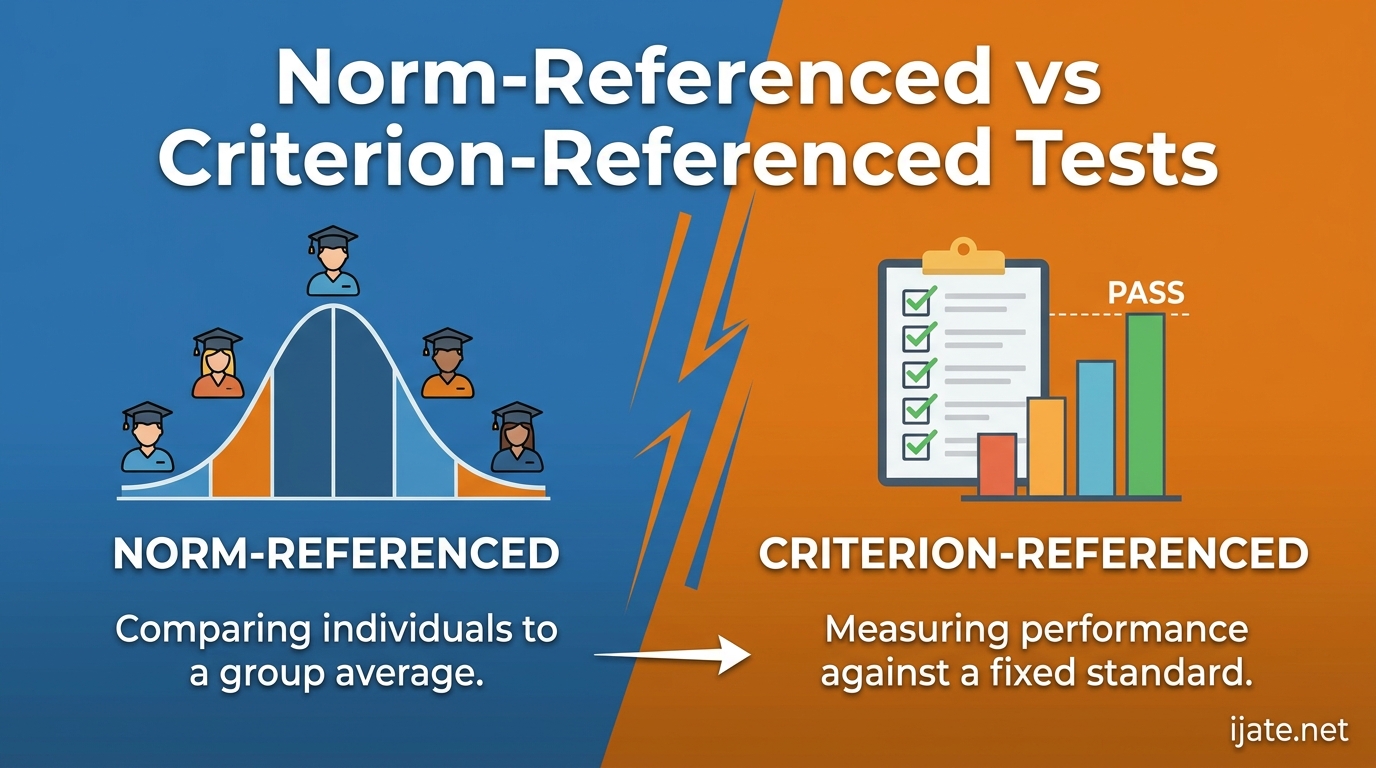
Norm-referenced tests compare a student’s performance to that of a peer group, ranking them using percentile ranks or standard scores. Criterion-referenced tests measure performance against a fixed standard or learning goal, determining whether the student has mastered specific content regardless of how peers performed.
If you work in education, assessment, or any field that involves testing, you have probably encountered these two terms dozens of times. And you have probably wondered whether the distinction really matters in practice. After spending years working with assessment data across K-12 classrooms, clinical settings, and certification programs, our team can tell you that it absolutely does.
Understanding the difference between norm-referenced and criterion-referenced tests changes how you design assessments, interpret scores, and make decisions about students. A score of 85 means something fundamentally different depending on which type of test produced it. On one type, that score might place a student in the top 15% of their peers. On the other, it might mean they have not yet met the minimum standard for proficiency.
This guide breaks down the difference between norm-referenced and criterion-referenced tests in plain language. We cover definitions, real-world examples, a side-by-side comparison table, a decision framework for choosing the right approach, and answers to the most common questions educators ask. Whether you are a classroom teacher, school psychologist, curriculum coordinator, or assessment specialist, you will walk away with a clear understanding of how these two assessment types work and when to use each one.
Table of Contents
Norm-Referenced vs. Criterion-Referenced Tests at a Glance
Before we get into definitions and theory, here is the quick comparison most educators are looking for. This table summarizes the core differences across the dimensions that matter most in practice.
| Dimension | Norm-Referenced Tests | Criterion-Referenced Tests |
|---|---|---|
| Purpose | Compare student performance to a peer group | Measure mastery against a fixed standard |
| Score Meaning | Percentile rank, standard score, stanine | Pass or fail, proficiency level, percentage correct |
| Comparison Basis | Other students (norming group) | Predefined criteria or learning objectives |
| Score Distribution | Designed to spread scores across a bell curve | Designed to cluster scores (most should pass) |
| Question Design | Mix of easy, medium, and hard items for ranking | Items matched to specific learning objectives |
| Typical Use Cases | Universal screening, placement, selection, IQ testing | Mastery checks, state assessments, certification exams |
| Examples | SAT, ACT, MAP Growth, ITBS, IQ tests | State accountability tests, AP exams, driver’s test |
| Best For | Answering “How does this student compare to peers?” | Answering “Has this student mastered the content?” |
The simplest way to remember the distinction: norm-referenced tells you where a student stands relative to everyone else. Criterion-referenced tells you what a student can actually do. Both are valuable, but they answer completely different questions.
What Are Norm-Referenced Tests?
A norm-referenced test compares a test-taker’s performance to a reference group called the norming group. The norming group is a large, representative sample of students who have already taken the same test. When your student takes the test, their score is compared to that group’s scores to determine where they rank.
Think of it like a baby growth chart at the pediatrician’s office. When the doctor says your baby is in the 75th percentile for weight, they are not saying your baby weighs a specific amount that is objectively good or bad. They are saying your baby weighs more than 75% of babies the same age. The comparison group is what gives the number meaning.
Norm-referenced tests work the same way. A percentile rank of 85 means the student scored higher than 85% of students in the norming group. A standard score, such as a scaled score or T-score, works similarly but uses statistical transformations to place the student on a standardized scale.
Key Characteristics of Norm-Referenced Tests
Norm-referenced assessments share several defining features that set them apart from other test types:
- Relative scoring: Scores only have meaning in relation to the performance of others. The same raw score could yield different percentile ranks on different administrations depending on the norming group.
- Bell curve distribution: Test items are deliberately selected to produce a spread of scores across a normal distribution. If everyone got a high score, the test would fail to discriminate between different ability levels.
- Ranking purpose: These tests are built to rank test-takers from highest to lowest. They excel at identifying who is performing above or below average relative to peers.
- Norm-referenced score types: Results are typically reported as percentile ranks, stanines, standard scores, z-scores, T-scores, or normal curve equivalents.
- Item difficulty spread: Questions range from very easy to very hard. The goal is to maximize score variance, not to have everyone answer correctly.
How Norm-Referenced Score Interpretation Works
When you receive norm-referenced test results, you will usually see several score types. A percentile rank tells you what percentage of the norming group scored below this student. A stanine converts the percentile scale into nine bands, with 4-6 being average. A standard score, like a RIT score on NWEA’s MAP Growth, uses an equal-interval scale that allows you to track growth over time.
The norming group is critical to accurate interpretation. If a student is compared to a nationally representative sample, their percentile rank means something very different than if they are compared only to students in their own school district. Always check which norming group a test uses before interpreting scores.
What Are Criterion-Referenced Tests?
A criterion-referenced test measures a student’s performance against a predetermined standard, learning goal, or set of criteria. The student’s score reflects what they know or can do in absolute terms, not how they compare to other students.
The driver’s license road test is the classic example. When you take your driving test, the examiner is not comparing you to other people who took the test that day. They are checking whether you can perform specific skills (parallel parking, stopping at stop signs, using turn signals) at an acceptable level. If everyone in your testing group is a skilled driver, everyone can pass. If everyone is terrible, everyone can fail.
That is the hallmark of criterion-referenced assessment. The standard is fixed. Your peers’ performance is irrelevant. What matters is whether you can demonstrate the required knowledge or skills.
Key Characteristics of Criterion-Referenced Tests
Criterion-referenced assessments have their own set of defining features:
- Absolute scoring: Scores reflect how much of the target content the student has mastered. A score of 80% means the student answered 80% of items correctly.
- Fixed standards: Performance levels (such as below basic, basic, proficient, and advanced) are defined before testing begins. Cut scores determine which category each student falls into.
- Mastery purpose: These tests answer whether a student has learned what they were supposed to learn. They identify specific strengths and gaps in knowledge.
- Criterion-referenced score types: Results are reported as raw scores, percentages, performance levels, mastery labels, or pass/fail designations.
- Objective-matched items: Every test question maps to a specific learning objective or content standard. This allows for detailed diagnostic feedback.
How Criterion-Referenced Score Interpretation Works
Criterion-referenced results are usually reported as performance categories. Most state assessments, for example, use four levels: below basic, basic, proficient, and advanced. A student scoring “proficient” has met the expected standard for their grade level in that subject area.
The cut scores that separate these categories are set through a standard-setting process. Panels of educators and content experts review test items and determine what a proficient student should be able to answer correctly. These cut scores are not based on how students actually perform. They are based on professional judgment about what constitutes acceptable performance.
This means that criterion-referenced scores provide actionable information. If a student scores below proficient in fractions, the teacher knows exactly which content area needs intervention. This diagnostic power is one of the biggest advantages of criterion-referenced assessment.
The Difference Between Norm-Referenced and Criterion-Referenced Tests
Now that we have defined both types, let us examine the difference between norm-referenced and criterion-referenced tests in detail. The distinction comes down to five key areas.
1. What the Score Compares Against
This is the fundamental difference. Norm-referenced scores compare a student to other students. Criterion-referenced scores compare a student to a fixed standard. Everything else flows from this single distinction.
Imagine a student scores 70% correct on a math test. On a norm-referenced test, that 70% might translate to an 85th percentile if most students in the norming group scored lower. On a criterion-referenced test, that 70% might mean the student has not yet reached proficiency if the cut score is set at 75%. Same raw score, completely different interpretation.
2. How Test Items Are Designed
Norm-referenced tests intentionally include questions with a wide range of difficulty. The goal is to spread students out along a continuum so that ranking is possible. If every question was easy, everyone would score high and the test could not discriminate between ability levels. Items that everyone gets right or everyone gets wrong are typically removed because they do not contribute to ranking.
Criterion-referenced tests include questions that directly reflect the learning objectives being assessed. If the objective is “can add fractions with unlike denominators,” every question targeting that objective should be a fair representation of that skill. There is no need to include artificially hard or easy questions to spread scores out.
3. Score Distribution and What It Tells You
On a norm-referenced test, scores are expected to form a normal distribution (the bell curve). Most students cluster around the average, with fewer students at the high and low ends. This distribution is by design. If scores cluster at the top or bottom, the test is not doing its job of differentiating between students.
On a criterion-referenced test, score distribution is irrelevant to the test’s purpose. If instruction was highly effective, most students might score at the proficient or advanced level. That is a good outcome, not a sign the test was too easy. If most students score below basic, that signals a problem with instruction, not with the test.
4. Reliability and Validity Considerations
Reliability and validity look different for each test type. For norm-referenced tests, reliability is often measured using internal consistency metrics like Cronbach’s alpha, which depends on score variance. These tests are designed to maximize variance, so they tend to show high reliability coefficients.
Criterion-referenced tests can be reliable too, but the metrics are different. Because scores may cluster at the high or low end, traditional reliability coefficients may appear lower. Assessment specialists use methods like decision consistency (the proportion of students classified into the same performance category across two administrations) and kappa statistics to evaluate criterion-referenced reliability.
Both types can be highly reliable when properly constructed. The key is using the right psychometric methods for each approach. Item response theory, or IRT, can support both norm-referenced and criterion-referenced score interpretations when applied correctly.
5. How Each Fits Into MTSS and Intervention
In a Multi-Tiered System of Supports (MTSS), both test types play important but different roles. Norm-referenced tests are excellent for universal screening because they identify which students are performing below their peers and may need intervention. They efficiently flag students who need a closer look.
Criterion-referenced tests are better for determining whether a specific intervention is working. After a student receives Tier 2 or Tier 3 support, a criterion-referenced assessment can tell you whether they have mastered the specific skills that were targeted. This diagnostic precision is what makes criterion-referenced assessment the go-to for progress monitoring and mastery checks.
Common Misconceptions About Norm-Referenced and Criterion-Referenced Testing
Several persistent myths cause confusion even among experienced educators. Let us clear up the most common ones.
Misconception 1: The label describes the test itself. Many sources argue that “norm-referenced” and “criterion-referenced” describe score interpretations, not the tests. The same test can support both types of interpretation. What matters is how the scores are used and what comparison is being made.
Misconception 2: Criterion-referenced tests are always informal. Teachers on forums frequently ask whether criterion-referenced means the same thing as informal assessment. It does not. State accountability tests are criterion-referenced, highly formal, and strictly standardized. Exit slips can also be criterion-referenced, but so can high-stakes certification exams.
Misconception 3: Norm-referenced tests are better because they are standardized. Both types can be standardized. Standardization refers to how the test is administered and scored, not what the scores compare against. Criterion-referenced state tests are standardized to the same degree as norm-referenced published tests.
Misconception 4: One approach is inherently superior. Neither type is better. They answer different questions. Using a norm-referenced test to determine mastery of a specific skill is like using a thermometer to measure weight. The tool is fine. You are just asking the wrong question.
Examples of Norm-Referenced and Criterion-Referenced Tests
Concrete examples make the distinction much easier to grasp. Let us look at real tests that most people recognize.
Norm-Referenced Test Examples
The following well-known assessments are norm-referenced. Their scores are interpreted by comparing students to a norming group:
- SAT and ACT: College entrance exams compare each test-taker to all other test-takers. A score in the 90th percentile means the student outperformed 90% of the reference group.
- IQ tests (WISC, WAIS, Stanford-Binet): Intelligence quotient tests compare cognitive performance to age-based norms. An IQ score of 100 represents the median of the norming population.
- NWEA MAP Growth: Uses the RIT scale to measure student achievement and compares results to a nationally representative norming sample. MAP Growth also provides criterion-referenced connections to state standards.
- Iowa Tests of Basic Skills (ITBS): A nationally standardized achievement battery that ranks students by grade-level and age-based percentile ranks.
- Gates-MacGinitie Reading Test: A norm-referenced reading assessment that compares reading vocabulary and comprehension to national norms.
Criterion-Referenced Test Examples
These assessments measure performance against fixed standards rather than peer performance:
- State accountability assessments: Tests like the STAAR (Texas), MCAS (Massachusetts), and FSA (Florida) measure whether students meet state academic standards. Performance levels (below basic, basic, proficient, advanced) are criterion-based.
- Advanced Placement (AP) exams: AP tests use a fixed scale (1-5) with predetermined cut scores. Scoring a 3 or above is typically considered passing, regardless of how other students perform.
- Driver’s license test: The road test evaluates specific skills against a fixed standard. Your peers’ driving ability is irrelevant to whether you pass.
- Nursing certification exams (NCLEX): Uses computerized adaptive testing to determine whether candidates meet the minimum competency standard for safe nursing practice.
- Classroom mastery checks: Teacher-created quizzes, end-of-unit tests, and exit tickets that measure whether students have learned specific content objectives.
Can a Test Be Both Norm-Referenced and Criterion-Referenced?
Yes, and this is one of the most important points to understand. The same assessment can produce both types of score interpretations. NWEA’s MAP Growth is a prime example. It provides RIT scores that are norm-referenced (comparing students to a national sample) and also connects those scores to state proficiency standards, which is criterion-referenced.
As one teacher observed on a discussion forum, “It seems that the label you use for the assessment depends upon what you are going to do with the results.” That insight is correct. The same test data can be interpreted in both ways depending on the question you are trying to answer.
This dual interpretation is more common than many people realize. State tests are primarily criterion-referenced, but states often publish norm-referenced interpretations as well, allowing districts to compare their students to national samples. The key is knowing which interpretation is appropriate for your decision-making context.
Norm-Referenced vs. Criterion-Referenced in Occupational Therapy and Clinical Settings
The distinction matters beyond K-12 education. In occupational therapy, speech-language pathology, and behavioral therapy, practitioners use both types of assessment. Norm-referenced tools like the Peabody Developmental Motor Scales compare a child’s performance to age-based norms, helping clinicians determine whether a delay exists.
Criterion-referenced tools like the Goal Attainment Scaling measure whether a child has met specific therapy objectives. Both types play essential roles in diagnosis, goal-setting, and progress monitoring.
Clinical practitioners have raised valid concerns about cultural fairness in norming groups. If the norming sample does not represent diverse populations, including BIPoC communities, norm-referenced scores may carry cultural bias. This is an important consideration when selecting assessment tools for clinical or special education use.
Which Approach Should Educators Use?
The answer depends entirely on what question you are trying to answer. Here is a practical decision framework.
Use Norm-Referenced Tests When You Need To
- Screen for at-risk students: Universal screening tools compare students to peers to quickly flag who may need additional support. Norm-referenced scores efficiently identify students performing below grade-level expectations.
- Make placement or selection decisions: Gifted program identification, private school admissions, and scholarship selection all require ranking students against one another. Norm-referenced tests are designed for this purpose.
- Track growth over time: Norm-referenced scales like the RIT score use equal-interval measurement, making it possible to track academic growth across multiple years and compare growth to typical growth norms.
- Compare students to national or state norms: When stakeholders want to know how local students stack up against the broader population, norm-referenced data provides that comparison.
Use Criterion-Referenced Tests When You Need To
- Assess mastery of specific learning objectives: After teaching a unit on fractions, you want to know which skills each student has mastered and which need reteaching. Criterion-referenced assessment provides that diagnostic detail.
- Monitor intervention progress: In MTSS Tier 2 and Tier 3, you need to know whether a specific intervention is working for an individual student. Criterion-referenced measures directly target the skills being taught.
- Report proficiency to stakeholders: State standards define what students should know at each grade level. Criterion-referenced tests communicate whether students have met those standards, which is what parents, school boards, and policymakers need to know.
- Make certification or licensure decisions: Professions that require demonstrated competency (nursing, teaching, engineering) use criterion-referenced certification exams with fixed passing standards.
Communicating Results to Parents and Students
One of the biggest practical challenges educators face is explaining test results in ways that parents and students can understand. Forum discussions reveal that teachers often struggle to translate percentile ranks and proficiency levels into meaningful feedback.
For norm-referenced scores, use plain language. Instead of saying “your child scored in the 65th percentile,” try “your child is performing better than 65 out of 100 students at the same grade level.” This makes the comparison concrete and relatable.
For criterion-referenced scores, focus on what the student can and cannot do. Instead of saying “your child scored basic in math,” try “your child can add and subtract multi-digit numbers but is still working on understanding fractions.” This connects the score to specific skills and next steps for learning.
The most effective score reports combine both interpretations. Tell parents where their child stands relative to peers and also what specific skills their child has mastered. This dual perspective gives a more complete picture of student performance.
The History and Future of Assessment Types
A Brief History of the Distinction
The terms “norm-referenced” and “criterion-referenced” were introduced by psychologist Robert Glaser in 1963. Glaser was working on programmed instruction and individualized learning when he recognized that different testing approaches served fundamentally different purposes. His paper, published in the American Psychologist, drew the distinction that still guides assessment theory today.
In the decades that followed, researchers like W. James Popham expanded on Glaser’s work. Popham championed criterion-referenced assessment as a way to make testing more instructionally relevant. He argued that tests should tell teachers what students can do, not just how students rank against each other.
The No Child Left Behind Act of 2001 pushed criterion-referenced testing into the spotlight by requiring states to assess whether students met grade-level academic standards. This accountability focus made criterion-referenced assessment the dominant model in K-12 state testing, while norm-referenced tests continued to dominate college admissions and ability testing.
Modern Applications: AI, Adaptive Testing, and the Future
Assessment technology has evolved dramatically since Glaser’s time. Computerized adaptive testing (CAT) uses item response theory to tailor test difficulty to each student’s ability level in real time. The NCLEX nursing exam was an early adopter of CAT, and many large-scale assessments now use it.
Adaptive testing blurs the line between norm-referenced and criterion-referenced in interesting ways. The same adaptive engine can produce norm-referenced scores (comparing ability estimates to a norming sample) or criterion-referenced classifications (comparing ability estimates to a cut score). The technology serves both purposes equally well.
Artificial intelligence is pushing assessment further. AI-powered tools can now generate test items, score open-ended responses, and provide real-time diagnostic feedback. As these tools mature, they promise to make criterion-referenced assessment more granular and personalized while also improving the precision of norm-referenced ability estimates.
One emerging trend is the integration of both approaches in single assessment platforms. Modern assessment systems increasingly provide criterion-referenced proficiency reports alongside norm-referenced growth data, giving educators both perspectives in a single score report. This dual-reporting approach reflects the reality that both questions matter.
Limitations and Criticisms of Each Approach
Neither approach is without its critics, and understanding these limitations makes you a more informed assessment user.
Norm-referenced tests face criticism on several fronts. The ranking design means that someone must always be below average, which can be demoralizing in contexts where the goal is universal mastery. Norming samples may not represent all student populations, raising fairness concerns. And the focus on ranking can obscure what students actually know or can do.
Criterion-referenced tests have their own limitations. Setting cut scores involves subjective judgment, and different standard-setting methods can produce different proficiency levels for the same test. Criterion-referenced tests can narrow instruction if teachers focus only on tested objectives. And without norm-referenced context, it can be hard to know whether performance is improving relative to broader expectations.
The best assessment programs acknowledge these limitations and use both approaches together. Norm-referenced data tells you where students stand relative to peers. Criterion-referenced data tells you what students have actually learned. Used in combination, they provide a richer picture than either could alone.
FAQ’s
What is a norm-referenced and criterion-referenced test?
A norm-referenced test compares a student’s performance to a peer group or norming sample, producing scores like percentile ranks that show where the student stands relative to others. A criterion-referenced test measures performance against a fixed standard or set of learning objectives, showing whether the student has mastered the required content regardless of peer performance.
What is the difference between norm-referenced assessment and criterion-referenced assessment?
The core difference is the comparison basis. Norm-referenced assessments compare students to each other using percentile ranks or standard scores. Criterion-referenced assessments compare students to a predetermined performance standard, classifying them as proficient, below basic, or advanced. Norm-referenced answers how a student ranks among peers. Criterion-referenced answers whether a student has mastered specific content.
Why would a professional choose a norm-referenced test instead of a criterion-referenced one?
Professionals choose norm-referenced tests when they need to rank students, identify those performing below peers, make selection or placement decisions, or compare results to national norms. Criterion-referenced tests are chosen when the goal is to determine mastery of specific skills, monitor intervention progress, or report proficiency against academic standards. The choice depends on what decision the assessment data will inform.
Are criterion-referenced tests reliable?
Yes, criterion-referenced tests can be highly reliable when properly constructed. They use different reliability metrics than norm-referenced tests, such as decision consistency and kappa statistics, because their scores may cluster at the high or low end. With sound test design, clear learning objectives, and appropriate psychometric methods, criterion-referenced assessments achieve strong reliability and validity.
Is an IQ test norm-referenced or criterion-referenced?
IQ tests are norm-referenced. They compare an individual’s cognitive performance to age-based norms from a representative sample. An IQ score of 100 represents the median of the norming population, and scores above or below 100 indicate performance relative to that reference group. IQ tests are designed to rank individuals along a distribution of cognitive ability.
Is the SAT norm-referenced or criterion-referenced?
The SAT is primarily norm-referenced. Scores are scaled so that each student’s result can be compared to other test-takers. A percentile rank tells you how a student performed relative to the college-bound population. However, the SAT also incorporates some criterion-referenced elements by reporting college-readiness benchmarks, which are fixed cut scores indicating readiness for college-level work.
What is an example of a criterion-referenced test?
Common examples of criterion-referenced tests include state accountability assessments (such as STAAR in Texas or MCAS in Massachusetts), Advanced Placement exams with their 1-5 scoring scale, nursing licensure exams like the NCLEX, driver’s license road tests, and classroom mastery checks. All of these measure performance against fixed standards rather than comparing students to one another.
What is an example of a norm-referenced assessment?
Norm-referenced assessment examples include the SAT, ACT, IQ tests like the WISC and WAIS, NWEA MAP Growth, the Iowa Tests of Basic Skills, and the Gates-MacGinitie Reading Test. Each of these compares individual performance to a norming group and reports scores as percentile ranks, standard scores, or similar relative measures.
Can a test be both norm-referenced and criterion-referenced?
Yes. Many experts argue that norm-referenced and criterion-referenced describe score interpretations, not tests themselves. NWEA MAP Growth, for example, provides norm-referenced RIT scores that compare students to a national sample and criterion-referenced connections to state proficiency standards. The same test data can support both interpretations depending on the question being asked.
Bringing It All Together
The difference between norm-referenced and criterion-referenced tests comes down to one simple distinction. Norm-referenced tests compare students to each other. Criterion-referenced tests compare students to a fixed standard. Neither approach is inherently better. They answer different questions, and both are essential in a well-rounded assessment program.
When you need to rank students, screen for at-risk learners, or compare performance to national norms, reach for norm-referenced tools. When you need to assess mastery, monitor intervention progress, or report proficiency against academic standards, criterion-referenced assessment is the right choice. Many modern assessments support both interpretations, giving you the flexibility to answer whatever question matters most.
Our recommendation for educators and assessment specialists is to develop assessment literacy around both approaches. Understand the strengths and limitations of each. Use them in combination whenever possible. And always match the assessment type to the decision you are trying to make. The right question, answered with the right type of assessment data, leads to better outcomes for every student.
If there is one thing to take away from this guide, it is this: never interpret a test score without knowing whether it is norm-referenced or criterion-referenced. That single piece of context determines what the number means and what you should do with it. Understanding the difference between norm-referenced and criterion-referenced tests is the foundation of assessment literacy, and it is worth getting right.