
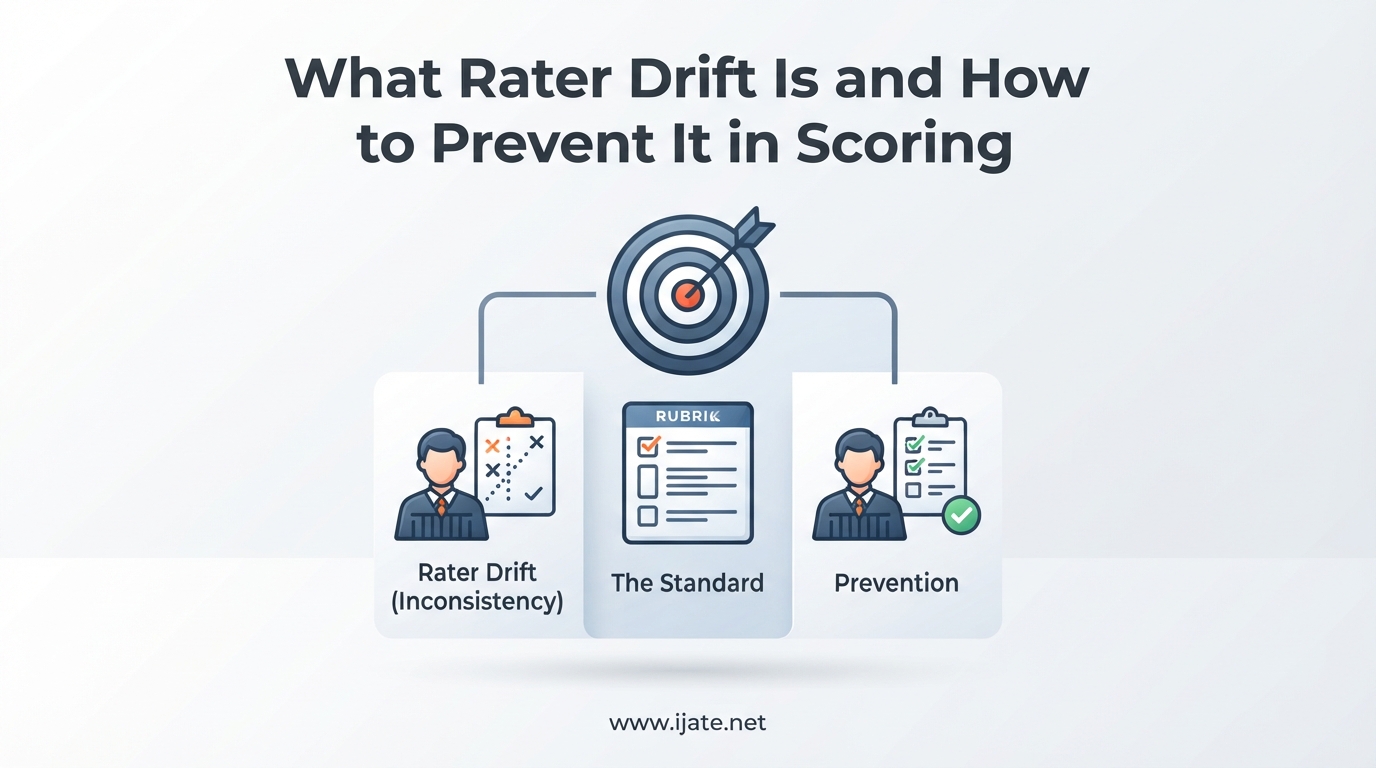
Rater drift is the gradual shift in an evaluator’s scoring standards over time that causes their ratings to deviate from the original criteria and from other raters. It is one of the most significant threats to score quality in any system that relies on human judgment, from educational assessment to clinical trials. Research suggests that 29 to 72 percent of score variability can be attributed to the rater rather than the person being rated.
If you manage a scoring operation, run performance assessments, or oversee constructed response scoring, understanding what rater drift is and how to prevent it in scoring is essential. Drift silently erodes data quality, undermines fairness, and can invalidate months of work.
In this guide, I will walk you through exactly what rater drift is, what causes it, how to detect it early, and most importantly, how to prevent it. I will cover practical strategies you can implement before, during, and after scoring operations to keep your rater accuracy where it needs to be.
Table of Contents
What Is Rater Drift?
Rater drift refers to the phenomenon where evaluators change their interpretation or application of scoring criteria over time or across different scoring contexts, resulting in diminished inter-rater reliability. Put simply, a rater who started the project applying the rubric one way begins applying it differently weeks or months later, often without realizing it.
Think of it like a compass that slowly loses its calibration. On day one, it points true north. By week eight, it points slightly northeast. The rater still believes they are scoring consistently, but their internal standard has shifted. This is what makes rater drift so dangerous. It is invisible to the person doing it.
Drift typically takes one of two forms. Severity drift happens when a rater becomes either more lenient or more harsh over time. Concept drift occurs when a rater’s understanding of what constitutes a passing response gradually shifts, even if their overall harshness stays the same. Both forms reduce rating consistency and threaten score validity.
In educational assessment, rater drift can mean the difference between a student passing or failing a high-stakes exam. In clinical trials, particularly in CNS eCOA studies, drift can compromise drug efficacy data and derail multi-million-dollar research programs. In any context, drift introduces measurement error that inflates or deflates scores unfairly.
Rater Drift vs Rater Bias: What Is the Difference?
People often confuse rater drift with rater bias, but they are distinct problems. Rater bias is a consistent tendency to score in a particular direction, such as always rating too leniently or always favoring certain response styles. Drift is a change over time. A rater can be perfectly calibrated on day one and still drift significantly by week ten.
Bias is relatively easy to detect and correct because it is stable. Drift is harder to catch because it develops gradually and the rater themselves does not perceive the change. This is why ongoing monitoring matters more than one-time calibration checks.
What Causes Rater Drift?
Understanding what causes rater drift is the first step toward preventing it. Drift does not happen because raters are careless or unqualified. It happens because human judgment is inherently subject to cognitive and contextual pressures that build over time.
Common Rater Errors That Contribute to Drift
Several specific rater errors tend to accumulate over a scoring project and contribute to drift:
Leniency and severity errors occur when a rater systematically scores higher or lower than the rubric warrants. Over time, a rater who started calibrated may become more lenient as they grow familiar with responses and unconsciously lower their threshold for what counts as proficient.
Centrality error happens when a rater avoids the extreme ends of a scale and clusters scores around the middle. As fatigue sets in, raters often default to safe middle-ground scores rather than making fine distinctions between response quality levels.
Halo effect occurs when a strong impression on one dimension of a response bleeds into scoring on unrelated dimensions. A well-organized but substantively weak essay might score higher than it should because the rater is influenced by the polished presentation.
Order effects emerge when raters are influenced by the quality of previously scored responses. After scoring ten weak responses, a mediocre one may suddenly look strong by comparison. This is particularly problematic in constructed response scoring where raters process hundreds of items.
Cognitive Fatigue and Time Pressure
Scoring constructed responses is mentally demanding. Research shows that rater accuracy declines after approximately two to three hours of continuous scoring. As cognitive fatigue builds, raters rely more on mental shortcuts and less on careful rubric application. Time pressure compounds this effect, pushing raters to score faster than they can maintain quality.
Our team has seen scoring operations where the last 20 percent of responses in a daily batch showed measurably lower agreement with calibration standards than the first 20 percent. That gap is drift in action.
Rubric Ambiguity
When scoring criteria are vague or open to interpretation, raters fill the gaps with their own judgment. Over time, those individual interpretations evolve independently of one another. Two raters reading the same ambiguous rubric will diverge more the longer they score without recalibration.
The rater effect, which refers to the systematic influence a specific rater has on scores independent of the response quality, becomes stronger when rubrics lack specificity. Well-constructed rubrics with clear descriptors, exemplar responses, and decision rules give raters less room to drift.
Lack of Ongoing Calibration
Most scoring operations begin with a robust training and certification process. Raters demonstrate high agreement at the start. Then the project moves into production, and calibration sessions stop. Without regular touchpoints to realign with the standard, individual raters slowly develop their own scoring norms that diverge from the group.
How to Prevent Rater Drift in Scoring
Preventing rater drift requires a systematic approach that spans the entire scoring lifecycle. You cannot solve it with a single training session or a one-time reliability check. The most effective programs address drift before, during, and after scoring through layered prevention strategies.
Here are seven proven strategies to prevent rater drift in scoring operations.
1. Build Specific, Anchored Rubrics
The single most effective prevention measure is a well-designed rubric. Generic rubrics with vague descriptors like “demonstrates adequate understanding” leave too much room for interpretation. Instead, anchor each score level with specific descriptors and exemplar responses that show exactly what a response at that level looks like.
Include decision rules for common edge cases. If a response partially meets the criteria for two score levels, what should the rater do? When does a minor error become a major one? The more specific your rubric, the less room raters have to develop their own idiosyncratic standards.
2. Conduct Rigorous Initial Training and Certification
Before scoring begins, every rater should complete a structured training program that includes guided practice on representative responses and a qualifying set they must score to a specified agreement threshold. Do not certify raters who fail to meet your reliability benchmark. Certification is your first line of defense.
Training should go beyond reading the rubric. Raters should practice applying it, discuss borderline cases as a group, and receive individualized feedback on their scoring tendencies before they ever touch a live response.
3. Hold Regular Calibration Sessions
Calibration is not a one-time event. Schedule recurring calibration sessions throughout the scoring project, ideally daily at the start of each session and at least weekly for longer projects. In these sessions, all raters score the same response independently and then discuss any disagreements.
Daily calibration takes 15 to 20 minutes and pays for itself in improved consistency. It gives raters a shared reference point and catches drift before it compounds. If you are scoring in a clinical trial context, these sessions should follow the protocol defined in your rater training plan.
4. Use Seeded Responses for Ongoing Monitoring
Seeded responses are pre-scored items that you insert into each rater’s live queue without their knowledge. Because you know the correct score, you can track each rater’s agreement with the standard in real time. If a rater begins missing seeded items they previously scored correctly, that is an early warning sign of drift.
Seed at least 5 to 10 percent of each rater’s daily volume. Rotate the seeded items so raters cannot identify them. Use a mix of score levels to detect whether the rater is drifting on high, middle, or low responses specifically.
5. Monitor Inter-Rater Reliability Continuously
Do not wait until the end of the project to calculate agreement statistics. Track inter-rater reliability daily or at least several times per week. Use multiple statistics because each captures different aspects of agreement. Percent agreement tells you how often raters assign the same score. Cohen’s kappa adjusts for chance agreement. The kappa statistic is particularly useful for determining whether agreement is meaningfully above what random scoring would produce.
Set predetermined thresholds. If a rater’s agreement drops below your threshold for two consecutive monitoring periods, trigger a recalibration conversation. Addressing drift early costs far less than discovering it during final data analysis.
6. Limit Scoring Sessions and Manage Workload
Because cognitive fatigue directly contributes to drift, manage how long raters score without breaks. Cap continuous scoring sessions at two to three hours. Build in mandatory breaks. Avoid asking raters to score beyond their capacity, even when deadlines loom.
If you are running a large-scale operation, consider rotating raters across different item types to reduce monotony. Variety helps maintain engagement and reduces the mental shortcutting that leads to drift.
7. Provide Individualized Feedback
Raters cannot correct drift they do not know about. Provide each rater with regular reports showing their agreement statistics, comparison to the group, and specific areas where they tend to diverge. When a rater shows signs of drift, schedule a one-on-one session to review specific responses and realign with the rubric.
Feedback should be specific and actionable. Rather than telling a rater their scores are inconsistent, show them three responses where they scored higher or lower than the consensus and walk through the rubric together. This targeted retraining is more effective than repeating the entire initial training.
How to Detect Rater Drift
Even with strong prevention measures, you need detection systems to catch drift that slips through. Detection methods range from simple agreement checks to sophisticated statistical models. The right approach depends on your operation size and the stakes involved.
Track Inter-Rater Reliability Over Time
The most straightforward detection method is plotting inter-rater reliability metrics across scoring sessions or days. If agreement is high at the start and trends downward over time, that pattern is a strong indicator of drift. Look at both overall agreement and individual rater agreement to isolate which raters are drifting.
To calculate interscorer reliability, you can use percent agreement for a quick check, but for formal reporting use kappa or an intraclass correlation coefficient. These statistics account for the fact that some agreement will occur by chance, especially on scales with few points.
Use Seeded Response Tracking
Beyond preventing drift, seeded responses are your best detection tool. Plot each rater’s seeded item accuracy over time. A rater who scored 95 percent of seeds correctly in week one and 78 percent in week four has drifted, even if their overall output volume and speed look fine.
Set statistical control limits on seeded accuracy, similar to quality control charts in manufacturing. When a rater’s accuracy falls outside the control limits, flag them for review before they score another batch of live responses.
Apply Statistical Detection Models
For large-scale operations, many-faceted Rasch measurement (MFRM) allows you to model rater severity as a separate parameter from response quality. By estimating each rater’s severity and tracking it over time windows, you can detect when a rater’s severity shifts significantly relative to the group.
Other approaches include hierarchical rater models, generalizability theory, and IRT-based drift detection. These models are more resource-intensive but provide more precise detection than simple agreement statistics. They are particularly valuable in high-stakes contexts like large-scale educational assessment or pivotal clinical trials where the cost of undetected drift is substantial.
Watch for Early Warning Signs
Before the statistics confirm drift, certain behavioral signs can tip you off. A rater whose scoring speed suddenly increases may be relying on shortcuts. A rater whose score distribution narrows toward the center of the scale may be experiencing centrality drift. A rater who stops asking questions about borderline cases may have stopped engaging deeply with the rubric.
How to Mitigate Rater Drift After It Occurs
If detection reveals that drift has already occurred, you have two broad options: correct the rater or correct the scores. In practice, you usually need both.
Retrain Affected Raters
When a rater shows significant drift, remove them from live scoring temporarily and run a targeted recalibration. Focus on the specific score levels or item types where the drift is occurring. Use the seeded items they missed as discussion starters. Recertify the rater on a qualifying set before returning them to production.
For clinical trial raters, document the remediation in your rater training log. Sponsors and auditors will want to see that drift was detected and addressed systematically.
Apply Statistical Score Adjustments
When drift has already affected live scores, statistical corrections can partially mitigate the damage. MFRM allows you to estimate the severity of each rater and adjust scores accordingly. If rater A was two severity units more lenient than the group average, their scores can be statistically adjusted to reflect what they would have been at the group average severity.
These adjustments are not a substitute for prevention. They reduce measurement error but cannot fully eliminate it, and they introduce their own assumptions. Use them as a safety net, not as your primary strategy.
Flag and Rescore Affected Responses
In some cases, the cleanest solution is to identify the responses scored during the drift period and have them rescored by calibrated raters. This is costly but may be necessary in high-stakes contexts where score accuracy is non-negotiable. If you have good documentation of when drift began and which rater was affected, you can scope the rescoring effort precisely.
Prevention vs Detection: A Cost Comparison
Preventing rater drift is significantly cheaper than detecting and correcting it after the fact. A 20-minute daily calibration session costs a fraction of what rescoring hundreds of responses costs. Investing in rubric development before scoring begins eliminates problems that no amount of statistical correction can fully fix later.
The most effective programs treat prevention as the primary strategy and detection as a backup layer. If your detection systems are constantly catching drift, that is a sign your prevention measures need strengthening.
FAQs
What is rater drift?
Rater drift is the gradual change in how an evaluator applies scoring criteria over time, causing their ratings to deviate from the original standard and from other raters. It reduces inter-rater reliability and introduces measurement error into scores.
How to score inter-rater reliability?
Inter-rater reliability is scored using statistics like percent agreement for a quick check, Cohen’s kappa to account for chance agreement, or intraclass correlation coefficients for continuous scales. Calculate it by having two or more raters score the same set of responses and comparing their agreement using the appropriate statistic for your data type.
What does rater mean?
A rater is a person who evaluates and assigns scores to responses, performances, or behaviors using a defined set of scoring criteria. Raters work in educational assessment, clinical trials, performance evaluation, and any context where human judgment is used to score constructed responses.
What are the common rater errors?
The most common rater errors are leniency error (scoring too high), severity error (scoring too low), centrality error (avoiding scale extremes), halo effect (letting one impression influence all dimensions), and order effects (being influenced by previously scored responses). These errors accumulate over time and contribute to rater drift.
How to calculate interscorer reliability?
To calculate interscorer reliability, have multiple raters score the same set of responses, then apply a statistical measure: percent agreement for simple checks, Cohen’s kappa for two raters on categorical scales, Fleiss’ kappa for three or more raters, or intraclass correlation for continuous data. The formula you choose depends on your scale type and number of raters.
What is the rater effect?
The rater effect is the systematic influence an individual rater has on scores independent of the actual quality of the response being evaluated. It reflects each rater’s unique severity level, interpretation tendencies, and scoring patterns. The rater effect is what statistical models like many-faceted Rasch measurement attempt to isolate and adjust for.
Conclusion
Understanding what rater drift is and how to prevent it in scoring comes down to one principle: consistency requires ongoing effort, not one-time training. Drift is inevitable when human judgment is involved, but it is manageable when you build prevention into every stage of your scoring operation.
Start with a strong rubric. Train and certify your raters rigorously. Calibrate daily. Monitor continuously. Provide feedback early and often. Layer your prevention strategies so that if one fails, the next catches the problem. The cost of prevention is always lower than the cost of discovering drift after your scores are final.