
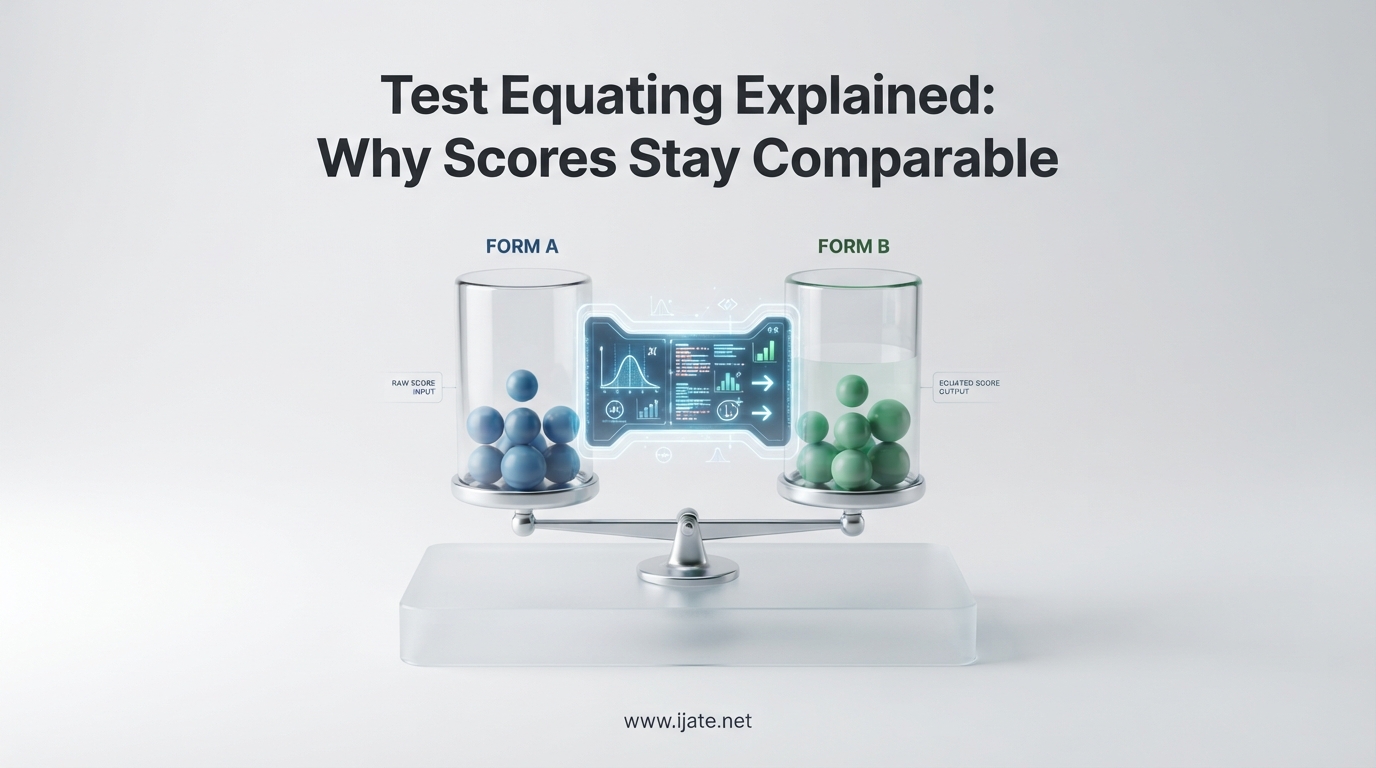
Test equating is the statistical process of placing scores from different forms of the same exam onto a single common scale so they can be used interchangeably. Without it, a student who happened to receive a slightly harder SAT form would be unfairly penalized, and scores from one year could not be meaningfully compared to scores from another. In this guide, I break down what test equating is, the three primary methods testing organizations use, and exactly why your scaled score stays fair whether you test in October or March.
Whether you are a student trying to understand why your ACT score shifted, a psychometrics student diving into score comparability, or an educator explaining fairness in standardized testing, this article covers the full picture. I will walk through the major equating methods, clear up the persistent myth that equating is the same as grading on a curve, and explain how College Board and ACT put these principles into practice every single testing cycle.
Table of Contents
What Test Equating Is (Definition)
Test equating is a statistical procedure that determines equivalent scores on different forms of an exam so that the resulting scores are interchangeable. When a testing organization creates multiple versions of the same test, each form will inevitably differ slightly in difficulty. Equating adjusts for those differences and produces scaled scores that represent the same level of ability regardless of which form a student received.
The key idea is score comparability. If Form A is slightly easier than Form B, a student answering 50 questions correctly on Form A should receive a lower scaled score than a student answering 50 questions correctly on Form B. Equating produces the conversion table that makes that adjustment mathematically sound.
Several properties must hold for a procedure to qualify as true equating rather than a weaker form of score linking. The equating relationship should be symmetric, meaning the conversion from Form A to Form B is the reverse of the conversion from Form B to Form A. It should also be invariant across subpopulations, so the same conversion applies whether the test-taker is a high achiever or a struggling student. These requirements distinguish equating from related but weaker procedures like linking and concordance, which I cover later in this article.
The field of psychometrics has formalized these requirements over decades. Kolen and Brennan, widely regarded as the leading authorities on the subject, outline the mathematical and practical conditions that must be satisfied before two score scales can be called truly equated. Their work remains the standard reference for testing professionals at ETS, ACT, and College Board.
Why Test Equating Is Needed
Every standardized test that is administered more than once faces the same problem: no two test forms are exactly equal in difficulty. Even with careful item writing, extensive review, and pretesting, small variations in item difficulty accumulate across a full exam. A 50-question math form might end up marginally harder or easier than the form used the previous month.
Without equating, those minor differences would produce unfair outcomes. Students who happened to receive a harder form would earn lower scores for the same underlying ability. A college admissions officer comparing two applicants would have no reliable way to know whether a 620 on one test date truly outperformed a 610 from another date.
Equating solves this by anchoring every form to a single reporting scale. The SAT, for example, reports scores from 400 to 1600 regardless of test date. The ACT reports composite scores from 1 to 36. Those numbers only carry consistent meaning because the raw-score-to-scaled-score conversion has been adjusted for the specific difficulty of each form through equating.
This is also why scores stay comparable across years. Testing organizations maintain a stable reporting scale by equating each new form back to previous forms through a chain of anchor items. A student scoring 1200 on the SAT in 2026 demonstrates roughly the same level of achievement as a student who scored 1200 five years earlier, even though the specific questions have been completely replaced.
Score comparability matters beyond college admissions. Licensure exams for doctors, nurses, and lawyers depend on the same principle. Certification bodies and state education departments rely on equated scores to ensure that passing standards remain consistent over time. Without it, the credibility of every large-scale assessment program would collapse.
The Three Main Test Equating Methods
Testing organizations use three primary equating methods, each with distinct statistical properties and sample size requirements. The choice of method depends on data availability, test design, and the level of precision required for score reporting.
Linear Equating
Linear equating assumes that the score distributions on the two forms differ only in their mean and standard deviation. The method converts a raw score on Form A to the raw score on Form B that has the same z-score, meaning it sits at the same relative position in its distribution.
Linear equating is simple to implement and works well when the two forms have similar distribution shapes. However, it breaks down when the forms differ in skewness or when score distributions are far from normal. It also requires reasonably large sample sizes, typically 400 or more test-takers per form, to produce stable estimates.
Equipercentile Equating
Equipercentile equating converts a raw score on one form to the raw score on the other form that corresponds to the same percentile rank. If a raw score of 45 on Form A falls at the 70th percentile, equipercentile equating finds the raw score on Form B that also falls at the 70th percentile.
This method is more flexible than linear equating because it does not assume anything about the shape of the distributions. It can handle skewed scores, ceiling effects, and floor effects. The trade-off is that it requires larger sample sizes, often 1,000 or more per form, because it estimates the entire conversion function rather than just two parameters.
Pre-smoothing is commonly applied before equipercentile equating to reduce irregularities in the score distributions caused by sampling error. Post-smoothing may also be applied to the final conversion function. These smoothing steps improve stability but add complexity to the implementation.
Item Response Theory Equating
Item response theory, or IRT, takes a fundamentally different approach. Instead of equating observed scores directly, IRT estimates the properties of individual items, such as difficulty and discrimination, and places those item parameters onto a common scale. Once the items are calibrated, ability estimates for test-takers become automatically comparable across forms.
IRT equating is the method of choice for computerized adaptive testing, where each student receives a unique set of items tailored to their ability level. It also underpins the equating of large-scale programs like NAEP and is widely used by ETS for the GRE and TOEFL.
The statistical machinery is more involved. Common IRT equating techniques include mean-sigma, mean-mean, Stocking-Lord, and Haebara methods, each of which transforms item parameters from the new form onto the reference scale. Sample size requirements are substantial, often exceeding 1,500 test-takers, because each item parameter must be estimated precisely.
The comparison below summarizes the key differences.
- Linear equating: Fast and simple, assumes similar distributions, needs around 400+ test-takers per form.
- Equipercentile equating: Flexible and distribution-free, handles irregular score patterns, needs around 1,000+ test-takers per form.
- IRT equating: Most precise for adaptive and large-scale testing, requires item-level calibration, needs 1,500+ test-takers per form.
Test Equating vs Grading on a Curve
One of the most common misconceptions I see in student forums, especially on the SAT and ACT subreddits, is the belief that standardized tests are graded on a curve. They are not. Equating and curving are fundamentally different processes with opposite goals.
Grading on a curve adjusts scores based on the performance of the specific group that took the test. If everyone in your class scored poorly, a curve might raise everyone’s grade. Your score depends on who else tested alongside you. Equating does exactly the opposite. It adjusts for the difficulty of the test form itself, not the performance of the group, so your score reflects your ability independent of when and with whom you tested.
This distinction matters because it directly addresses a frequent student frustration. Someone might study harder, retake the SAT, and see their score stay flat or even drop. The temptation is to blame a harsh curve. In reality, the score reflects genuine ability as measured against the established reporting scale. Equating does not penalize strong cohorts, and it does not reward weak ones.
The confusion is understandable. Both concepts involve adjusting raw scores, and testing organizations use the term conversion table, which sounds similar to a curve. But the underlying logic is entirely different. Equating protects fairness across forms. Curving ranks students against each other within a single administration.
If you have ever wondered whether taking the SAT in a month with stronger test-takers will hurt your score, the answer is no. Equating is specifically designed to make that irrelevant.
Equating vs Linking vs Concordance
Testing professionals distinguish between three related but unequal procedures. Understanding these distinctions helps clarify what equating can and cannot do.
Equating is the strongest form of score connection. It requires that the two forms measure the same construct, are built to the same content and statistical specifications, and are administered under identical conditions. When those requirements are met, equated scores are interchangeable.
Linking is a weaker connection. It applies when two tests measure similar but not identical constructs, or when they were not built to shared specifications. A linked score relationship lets you estimate what a score on one test might correspond to on the other, but the scores are not interchangeable. Linking is often used when connecting assessments from different publishers or different grade levels.
Concordance is the weakest of the three. A concordance table, such as the SAT-to-ACT concordance published jointly by College Board and ACT, shows the relationship between scores on two different tests taken by different populations. It is useful for admissions officers comparing applicants who submitted different tests, but it does not imply that the scores measure exactly the same thing.
The hierarchy matters. Calling a concordance an equating would overstate the comparability of the scores. Calling an equating a concordance would undersell the careful design work that went into building the forms to be interchangeable.
How SAT and ACT Use Test Equating
The SAT and ACT are the most visible examples of test equating in practice, and both programs invest heavily in the process to protect score fairness.
College Board pretests every item before it appears on an operational SAT form. Items are embedded as unscored field-test questions in earlier administrations, and their statistical properties are estimated using IRT. When a new operational form is assembled, items are selected to match a target difficulty profile. After the form is administered, the raw-to-scaled-score conversion is finalized using equating results based on anchor items that connect the new form to the established SAT scale.
The ACT uses a similar approach but adds a step that students sometimes notice. Certain test dates are designated as equating tests, meaning the equating process for those dates is treated with extra rigor and score release may take slightly longer. This is not a penalty. It is a quality-control measure that ensures the conversion table for that form is as accurate as possible.
Here is a concrete example of how equating affects reported scores. Suppose Form X of the SAT math section turns out slightly harder than Form Y after administration. A student answering 48 of 58 questions correctly on Form X might receive a scaled score of 730, while the same number of correct answers on Form Y might produce a scaled score of 720. The difference reflects form difficulty, not student ability.
Anchor items, sometimes called common items or equator items, are the mechanism that makes this possible. These are a small set of questions that appear on both the new form and a previous form. Because the items are identical, any difference in performance on them can be attributed to the group of test-takers rather than the items themselves. That information anchors the equating conversion.
Common equating designs include the randomly equivalent groups design, the single-group design, and the nonequivalent groups with anchor test, or NEAT, design. The NEAT design is by far the most widely used in operational testing because it accommodates the reality that different administrations draw different populations of test-takers.
Pre-Equating vs Post-Equating
Equating can happen at two points in the testing pipeline, and the choice has practical implications for score release timing and fairness.
Pre-equating happens before the test is administered. Because all items have been pretested and calibrated using IRT, the raw-to-scaled-score conversion table can be computed in advance. This allows for rapid score release, sometimes within days. The risk is that if the live administration reveals different item behavior than the pretest predicted, the pre-equated conversion may be slightly off.
Post-equating happens after the test is administered. The operational data is used to estimate the equating relationship, producing a conversion tailored to how the form actually performed. This is more accurate but requires time for scoring and analysis, which is why post-equated score releases take longer.
Most large-scale programs use a combination of both. Pre-equating enables quick preliminary scores, and post-equating confirms or adjusts the final reported scores.
FAQs
What is equating test scores?
Equating test scores is the statistical process of adjusting raw scores from different test forms so they represent the same level of ability on a single common scale, making the scores interchangeable.
What is test equating?
Test equating is a psychometric procedure that places scores from different versions of the same exam onto one reporting scale so that a given scaled score means the same thing regardless of which form a student took or when they tested.
What are the three types of standardized tests?
In the context of equating, the three main methods are linear equating, equipercentile equating, and item response theory (IRT) equating. Each method adjusts for form difficulty using different statistical techniques and sample size requirements.
How have test scores changed over time?
Equating keeps reported score scales stable over time even though specific test items change every administration. A scaled score from one year represents approximately the same ability level as the same scaled score from a different year because each new form is equated back to the established scale.
Is test equating the same as grading on a curve?
No. Equating adjusts for differences in test form difficulty so your score reflects your ability independent of who else tested with you. Grading on a curve adjusts scores based on the performance of the specific group, meaning your score depends on your peers.
How does equating affect my SAT or ACT score?
Equating ensures your scaled score is fair regardless of form difficulty. If your form was slightly harder, fewer correct answers may still produce the same scaled score as more correct answers on an easier form. This protects you from being penalized for receiving a tougher version.
Conclusion
Test equating is the statistical foundation that keeps standardized test scores fair, comparable, and trustworthy across different forms and different years. Without it, every SAT, ACT, and licensure exam score would be meaningless outside the specific form a student happened to receive.
Understanding what test equating is, how the three main methods work, and why it differs from curving gives you a clearer picture of why your scaled score looks the way it does. The next time you see a score that surprises you, remember that equating is working behind the scenes to make sure that number means the same thing for every student, every administration, every year.