
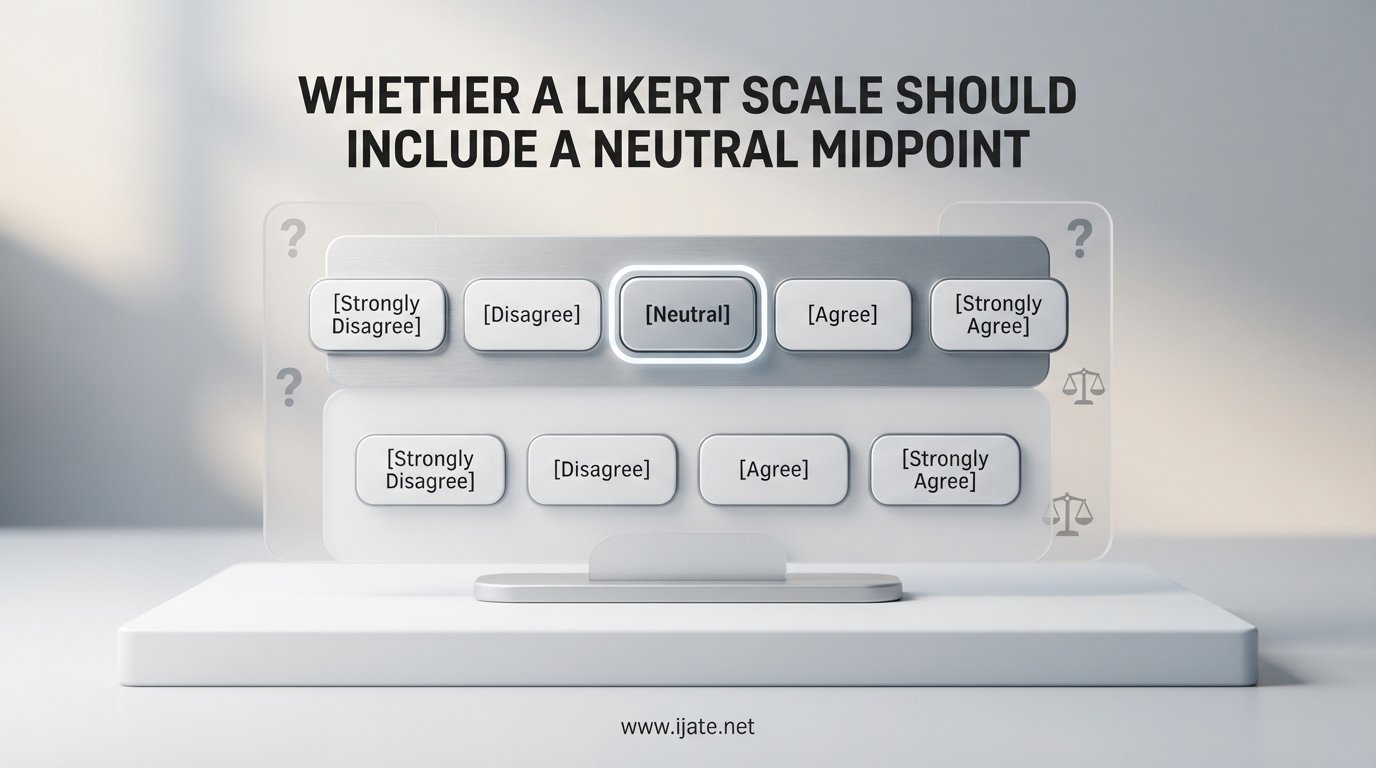
Whether a Likert scale should include a neutral midpoint depends on your survey goals, the type of construct you are measuring, and how you plan to analyze the data. In most cases, including a neutral midpoint (such as “Neither agree nor disagree”) is the safer default because it lets respondents who genuinely hold no opinion express that honestly rather than being forced into an inaccurate directional answer. However, when your goal is to force a decision or when you suspect respondents will overuse the midpoint to avoid committing, excluding it through a forced-choice (even-numbered) scale can produce cleaner directional data.
The neutral midpoint debate has divided survey researchers for decades. Some argue it improves data quality by capturing true neutrality. Others worry it becomes a dumping ground for respondents who are confused, unmotivated, or trying to speed through the survey. Both positions have merit, which is why context matters so much.
In this guide, our team breaks down exactly when to include or exclude the Likert scale midpoint, what research evidence says, and how to make a defensible choice for your specific survey type. Whether you are designing an employee engagement survey, a customer satisfaction questionnaire, or an academic research instrument, you will find clear decision criteria below.
The keyword for this article is the Likert scale neutral midpoint question, and we cover it from every angle: definition, problems, benefits, statistical implications, and practical recommendations by industry. By the end, you will have a framework you can apply to any future survey design decision.
Table of Contents
What Is a Likert Scale Neutral Midpoint?
A Likert scale neutral midpoint is the middle response option on an odd-numbered agreement scale, typically labeled “Neither agree nor disagree.” It sits exactly between the negative anchors (Strongly Disagree, Disagree) and the positive anchors (Agree, Strongly Agree). On a 5-point Likert scale, it is position 3. On a 7-point Likert scale, it is position 4.
The midpoint exists to represent a genuine neutral stance. Some respondents truly have no opinion, feel equally positive and negative, or lack enough information to lean one way. Without a midpoint, those respondents have no accurate option to select.
It is important to distinguish the neutral midpoint from other non-directional options. A midpoint implies the respondent is at the center of a bipolar continuum. Options like “Don’t know,” “No opinion,” or “Not applicable” serve a different purpose: they indicate the respondent cannot or should not answer the question at all. We cover those distinctions later in this article.
Whether a Likert Scale Should Include a Neutral Midpoint
Whether a Likert scale should include a neutral midpoint is one of the most frequently debated questions in survey design, and the honest answer is that it depends on several factors. The decision hinges on whether genuine neutrality is a plausible respondent state, whether you need directional data, and whether midpoint overuse is a realistic risk for your audience.
Research from Johns (2005) and Worcester and Burns (1975) suggests that when a midpoint is removed, respondents who would have chosen neutral tend to distribute themselves across nearby options. Roughly half shift toward the agree side and half toward the disagree side, but the redistribution is not always even. This means excluding the midpoint can introduce systematic bias, especially if your respondent pool has a cultural or personality tendency toward agreement (acquiescence bias).
On the other hand, including a midpoint can inflate the neutral category. Some respondents select it not because they are truly neutral but because they want to avoid taking a position, are unsure what the question means, or are rushing through. This is what researchers call the dumping ground effect.
The best approach is to treat the midpoint decision as a trade-off between two types of error. Including the midpoint risks capturing fake neutrality. Excluding it risks forcing genuinely neutral respondents into directional answers that distort your data. You need to decide which error is more costly for your specific project.
Why the Midpoint Becomes a Dumping Ground
The dumping ground problem is the most common argument against including a Likert scale midpoint. When respondents select “Neither agree nor disagree,” they may not actually feel neutral. Instead, they use the midpoint as a shortcut or escape hatch for several different reasons.
Some respondents choose the midpoint because they do not understand the question. Rather than admitting confusion, they pick the option that feels safest. Others select it because they do not care about the topic and want to move through quickly. Still others use it as a socially acceptable way to avoid revealing their true opinion, especially on sensitive topics.
Research cited by ATD (td.org) shows that midpoint usage tends to spike when questions are long, complex, or emotionally charged. This is a signal that the midpoint is being used as a refuge rather than a genuine expression of neutrality. If you see 30 percent or more of your respondents clustering on the midpoint across many questions, that is a red flag.
The dumping ground effect is also more common in certain populations. Respondents from cultures that value harmony and conflict avoidance may prefer the midpoint to express disagreement indirectly. Employees giving upward feedback to managers may default to neutral out of fear of consequences. In these contexts, the midpoint may mask real sentiment.
To mitigate this problem, you can improve question clarity, reduce cognitive load, and ensure anonymity. You can also add a separate “Don’t know” or “No opinion” option so that confused respondents have a place to go other than the midpoint. This helps preserve the meaning of the midpoint as a true measure of neutrality.
Problems With Excluding the Midpoint (Forced Choice)
Excluding the midpoint creates what survey methodologists call a forced-choice scale. Every respondent must pick a side, either positive or negative. This sounds appealing if you want decisive data, but it introduces its own set of problems.
The biggest issue is that genuinely neutral respondents are forced to lie. If someone truly has no opinion, making them choose “Agree” or “Disagree” produces data that does not reflect their actual attitude. This inflates the appearance of strong sentiment in your results and can lead to bad decisions based on false directional signals.
Forced-choice scales also increase respondent frustration. When people feel they cannot accurately represent their views, they may abandon the survey entirely or start answering randomly. This hurts your completion rates and data quality at the same time.
Statistically, removing the midpoint shifts the distribution of responses. The Johns (2005) redistribution study found that removing the midpoint does not cleanly split neutral respondents 50-50 between agree and disagree. Factors like acquiescence bias (the tendency to agree) and response style differences mean the split is often uneven. This can make your data look more positive or more negative than reality.
For longitudinal studies, switching from a midpoint scale to a forced-choice scale (or vice versa) creates a serious comparability problem. You cannot cleanly compare averages across waves if the scale structure changed mid-stream. If you are tracking employee engagement or customer satisfaction over time, consistency in scale structure matters more than the specific number of points.
Odd vs Even Likert Scales Explained
The midpoint question is really a question about odd-numbered versus even-numbered scales. Odd scales (5-point, 7-point) have a midpoint by definition. Even scales (4-point, 6-point) do not, which makes them forced-choice by design.
Odd-numbered scales are the traditional choice. The 5-point Likert scale is the most widely used agreement scale in the world, and the 7-point scale is common in academic research. Both provide a neutral center that captures respondents who genuinely sit in the middle of the attitude continuum.
Even-numbered scales, particularly the 4-point Likert scale, are used when researchers want to force a directional response. Without a midpoint, every respondent must lean positive or negative. This is useful in voting scenarios, satisfaction decisions, or any context where sitting on the fence is not meaningful.
Here is a quick comparison of how the two approaches differ:
Odd scales (with midpoint): Better for measuring the full range of attitudes including neutrality. Risk: midpoint dumping. Best for exploratory research, attitude measurement, and academic studies.
Even scales (forced choice): Better for forcing decisions and producing directional data. Risk: forcing false directional answers. Best for satisfaction tracking, voting, and decision-oriented surveys.
Some researchers compromise by using a 6-point scale, which removes the midpoint but still offers enough granularity to differentiate between mild and strong agreement or disagreement. This is increasingly popular in employee engagement surveys where organizations want directional data but still need nuance.
Ordinal vs Interval Data Treatment
Another factor in the midpoint debate is whether you treat Likert scale data as ordinal or interval. This affects how you analyze and interpret the midpoint specifically.
Strictly speaking, Likert scales produce ordinal data. The categories have a meaningful order, but the distances between them are not necessarily equal. The psychological distance between “Disagree” and “Neither agree nor disagree” may not be the same as the distance between “Neither agree nor disagree” and “Agree.”
In practice, many researchers treat Likert scales as if they produce interval data, calculating means and standard deviations rather than relying solely on medians and modes. This is especially common in applied settings like employee engagement surveys and market research. The midpoint plays a special role here because it is often coded as the numerical center of the scale, which makes it look like a true midpoint in an interval sense.
If you treat your data as ordinal, the midpoint is just another category. If you treat it as interval, the midpoint becomes the numerical pivot point for averages. This matters because excluding the midpoint changes both the number of categories and the assumed range of the scale, which can shift means and make comparisons across studies difficult.
The Worcester and Burns (1975) study addressed this by examining how respondents perceive distances between scale points. Their findings suggested that people do roughly perceive the midpoint as equidistant from the positive and negative anchors, which lends some support to treating odd Likert scales as quasi-interval. However, this perception breaks down when questions are complex or emotionally loaded, which circles back to the dumping ground problem.
When to Include the Midpoint
You should include a neutral midpoint in your Likert scale when genuine neutrality is a plausible and meaningful response state. This applies to the majority of attitude measurement scenarios, especially in exploratory research.
Include the midpoint when respondents may legitimately have no strong opinion. This is common in surveys about topics they have not thought deeply about, new initiatives they have not experienced yet, or questions where balanced positive and negative feelings are realistic.
Include the midpoint when you are measuring attitudes on a bipolar continuum. Bipolar constructs have natural opposite ends (like satisfaction versus dissatisfaction), and a neutral center represents the absence of leaning. The midpoint makes conceptual sense here.
Include the midpoint when data accuracy matters more than forcing decisions. If your goal is to understand what people actually think, you need to let them tell you they are neutral. Forcing them to pick a side produces numbers that look more decisive but are less truthful.
Include the midpoint when you are conducting longitudinal tracking and your previous waves used a midpoint. Consistency in scale structure is critical for meaningful trend analysis. Changing the number of scale points mid-study introduces noise that can obscure real changes.
Include the midpoint when your audience is likely to be honest rather than avoidant. In anonymous surveys with engaged respondents who care about the topic, midpoint usage tends to reflect genuine neutrality rather than laziness or avoidance.
When to Exclude the Midpoint
You should exclude the neutral midpoint when forcing a directional response produces better data for your specific purpose. This is appropriate in fewer scenarios than people think, but there are legitimate use cases.
Exclude the midpoint when sitting on the fence is not a meaningful outcome. If you are asking customers whether they would recommend a product, you need to know which direction they lean. A neutral option lets them avoid answering the real question.
Exclude the midpoint when you suspect heavy dumping ground behavior. If past surveys showed 30 percent or more of respondents clustering on neutral across most questions, a forced-choice scale can reduce that noise. Pair it with a “Don’t know” option so confused respondents have an outlet.
Exclude the midpoint in decision-oriented surveys where the goal is to force a choice. Employee engagement pulse checks, voting scenarios, and satisfaction tracking often benefit from forced-choice scales because the organization needs to know if sentiment is positive or negative, not whether it is perfectly balanced.
Exclude the midpoint when you are using unipolar constructs. Unipolar scales measure the presence or absence of a single quality (like “How satisfied are you?” from “Not at all” to “Completely”). A neutral midpoint does not have the same meaning on a unipolar scale as it does on a bipolar agreement scale.
Exclude the midpoint when you have strong evidence that your audience uses it to avoid giving honest feedback. This is common in upward feedback, 360-degree reviews contexts, or cultures where expressing disagreement is socially discouraged. In these cases, the midpoint hides rather than reveals the truth.
Decision Criteria: Include vs Exclude Midpoint
Use these criteria to decide whether your Likert scale should include a neutral midpoint. We have organized them into clear categories so you can work through them quickly.
Include the midpoint if: your construct is bipolar, genuine neutrality is plausible, data accuracy matters more than forcing decisions, you are doing longitudinal tracking, your respondents are likely honest, and your questions are clear enough that midpoint usage reflects real attitudes.
Exclude the midpoint if: your construct is unipolar, forcing a direction is the goal, you have evidence of dumping ground behavior, you are running decision-oriented surveys, the topic is sensitive and respondents may hide behind neutral, or you can pair the forced-choice scale with a separate “Don’t know” option.
Consider adding additional response options regardless of your choice. A “Don’t know” or “No opinion” option gives confused respondents a place to go. A “Not applicable” option prevents respondents from answering questions that do not apply to them, which would otherwise distort your data.
Document your rationale. If stakeholders question your scale choice, being able to explain why you included or excluded the midpoint, based on your construct type, audience, and analysis goals, builds credibility. This is one of the most common pain points survey designers report: defending their scale decisions to non-researchers.
Test before launching. If you are unsure, run a small pilot with both scale versions and compare the distributions. You will quickly see whether removing the midpoint creates meaningful directional data or just produces noise from frustrated respondents.
Industry-Specific Recommendations
Different research contexts call for different approaches to the midpoint question. Here are our team’s recommendations for the most common survey types.
Employee engagement surveys: Include the midpoint by default. Engagement is a bipolar construct, and genuine neutrality is meaningful. However, watch for dumping ground behavior. If neutral rates are unusually high, investigate whether anonymity concerns or question clarity are driving it. Many organizations use 5-point or 6-point scales here. A 6-point scale forces direction while keeping granularity, which is why it has grown in popularity for engagement pulse surveys.
Customer satisfaction measurement: Lean toward excluding the midpoint or using a unipolar scale. CSAT and NPS-style questions are decision-oriented. You want to know if customers are satisfied enough to recommend or repurchase. A forced-choice or 0-10 unipolar scale serves this purpose better than a 5-point agreement scale with a midpoint.
Training evaluations: Include the midpoint. Participants may genuinely feel neutral about certain aspects of a training session. Forcing them to agree or disagree with statements about content relevance or instructor effectiveness produces less useful feedback than letting them express genuine uncertainty.
Market research surveys: It depends on the question type. For brand perception and awareness surveys, include the midpoint because consumers often have no strong opinion about brands they barely know. For purchase intent or preference questions, exclude it because you need directional signals.
Academic research instruments: Include the midpoint unless you have a specific psychometric reason not to. Academic scales are often validated with specific point counts, and changing the structure can affect reliability and validity statistics. Follow the original instrument design unless you are conducting your own validation study.
360-degree feedback: Exclude the midpoint or use a forced-choice scale. Feedback contexts are prone to social desirability bias, and raters often hide behind neutral to avoid giving negative feedback. A forced-choice scale with behavioral anchors produces more honest and actionable feedback.
UX research: Include the midpoint for attitude questions (like SUS or usability perception scales). Exclude it for task-oriented questions where you need to know whether the experience was positive or negative. UX researchers on Reddit frequently debate this, and the consensus leans toward matching the scale to the specific question type rather than applying one rule across the entire survey.
How to Handle Neutral Responses in Analysis
Once you have collected data with a midpoint, you need a plan for analyzing those neutral responses. This is a practical concern that many guides skip but survey practitioners raise constantly.
The simplest approach is to treat neutral as its own category. Report the percentage of respondents who chose neutral alongside the percentages who agreed or disagreed. This preserves the information without forcing you to make assumptions about what neutrality means.
If you are calculating means (treating the scale as quasi-interval), neutral typically gets coded as the middle value (3 on a 5-point scale, 4 on a 7-point scale). Be transparent about this choice and acknowledge that it assumes equal intervals between scale points.
The Top 2 Box method is popular in market research and customer satisfaction work. It reports the percentage of respondents who chose the top two positive categories, ignoring neutral and negative responses. This focuses attention on the proportion of strongly positive sentiment but discards the neutral signal entirely.
For longitudinal tracking, keep your scale structure consistent across waves. If you must change it, document the change and avoid comparing averages across the transition point. Consider running both versions simultaneously for one wave to establish a calibration baseline.
When reporting to stakeholders, explain what the midpoint represents. Non-researchers often assume neutral means “bad” or “disengaged.” Clarify that neutral respondents may genuinely have no strong opinion, and discuss what that means for the business decision at hand.
Should a Likert scale have a midpoint?
A Likert scale should include a midpoint when genuine neutrality is a plausible response, the construct is bipolar, and data accuracy matters more than forcing a directional choice. You should exclude it when forcing a decision is the goal, the construct is unipolar, or you have evidence that respondents overuse neutral as a dumping ground. Most attitude measurement surveys benefit from including the midpoint.
Should a Likert scale have a neutral option?
Yes, a Likert scale should have a neutral option in most cases because it lets respondents who genuinely hold no opinion express that honestly. Without it, neutral respondents are forced to pick agree or disagree, which produces inaccurate directional data and can introduce systematic bias if respondents lean toward agreement.
What is the neutral point on a Likert scale?
The neutral point on a Likert scale is the middle response option, typically labeled Neither agree nor disagree. On a 5-point scale it is position 3, and on a 7-point scale it is position 4. It represents a stance where the respondent holds no leaning toward either agreement or disagreement.
Should I use the middle position in the Likert scale?
Use the middle position when you are measuring bipolar attitudes where neutrality is meaningful, when accuracy matters more than forcing decisions, and when your respondents are likely to answer honestly. Skip it for decision-oriented surveys, unipolar constructs, and contexts where respondents tend to hide behind neutral to avoid giving real feedback.
Conclusion
The question of whether a Likert scale should include a neutral midpoint does not have a single universal answer, but it does have a clear framework. Include the midpoint when you are measuring bipolar attitudes, genuine neutrality is plausible, and data accuracy is your priority. Exclude it when you need forced directional responses, are working with unipolar constructs, or have evidence of dumping ground behavior.
Our team recommends starting with a midpoint (odd-numbered scale) as the default for most attitude measurement surveys. Only move to a forced-choice design when you have a specific reason grounded in your construct type, audience behavior, or analysis goals. Document that reasoning so you can defend it to stakeholders.
Remember that the midpoint question is just one part of good survey design. Question clarity, response anchor quality, scale length, and analysis method all interact with the midpoint decision. Treat it as a design choice that should serve your research objectives, not as a rule to follow blindly.
Now that you have a clear framework for whether a Likert scale should include a neutral midpoint, apply it to your next survey project. Pilot both versions if you are unsure, examine the distributions, and let your data guide the final decision.