
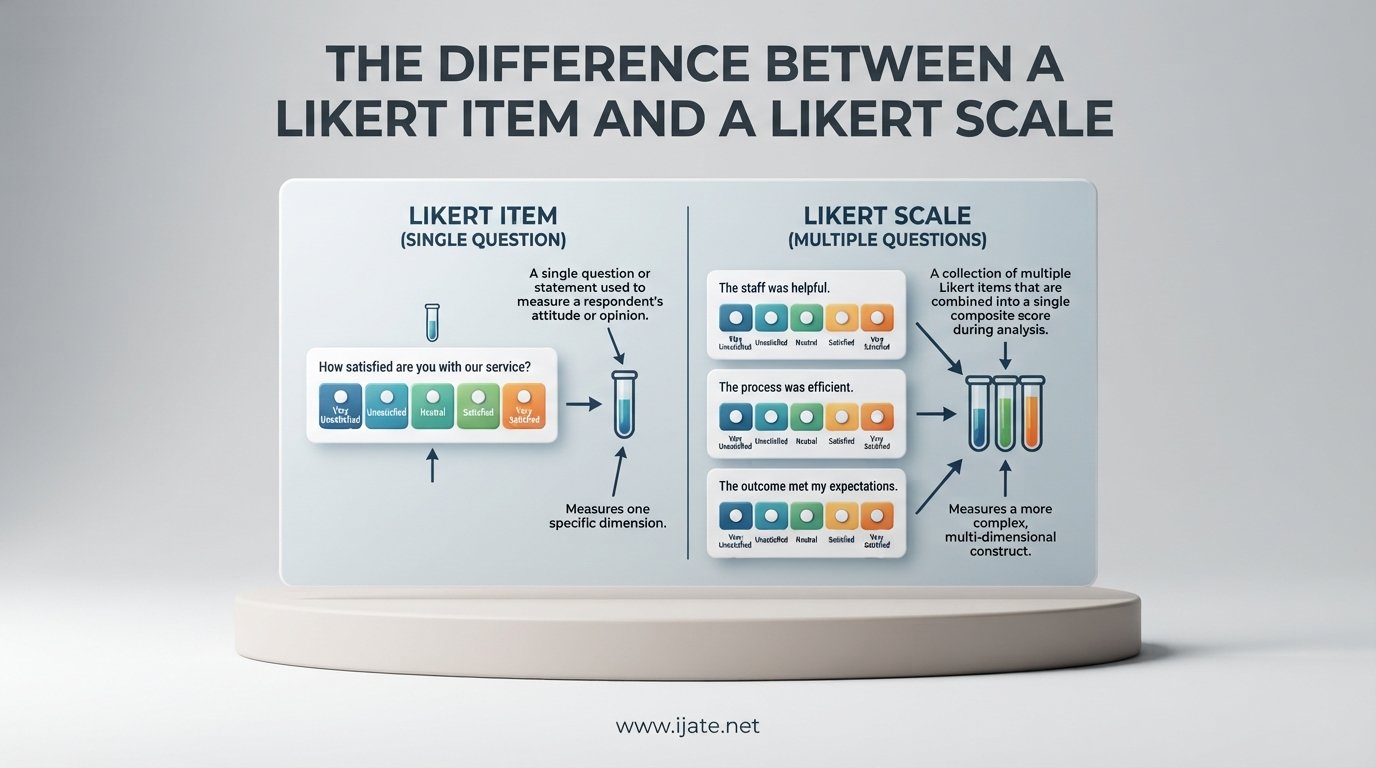
A Likert item is one single survey question that uses an ordered response format (such as “Strongly Disagree” to “Strongly Agree”), while a Likert scale is the composite score produced when you sum or average several related Likert items together. That single distinction is the heart of the difference between a Likert item and a Likert scale, and it changes how you design surveys, score responses, and run statistics on the results.
Our team has spent years building and reviewing questionnaires, and the same confusion shows up in nearly every research team we work with: people call a single agreement question a “Likert scale” when it is really just one Likert item. Once that mistake creeps into a report, it spreads into the analysis, the conclusions, and the decisions made from the data. This guide breaks the two concepts apart in plain language so you can use each term correctly, score your data the right way, and avoid the statistical mistakes that come from mixing them up.
The principles here line up with studies that used Likert scales across attitude and opinion research, and they apply whether you are running academic research, customer satisfaction surveys, employee engagement polls, or product feedback forms. By the end of this guide you will know exactly what to call each piece of your survey, how to combine items into a scale, and which statistical tests are appropriate for each level of data.
Table of Contents
What Is a Likert Item?
A Likert item is a single statement paired with an ordered set of response options that let a respondent show their level of agreement. The statement is usually declarative, such as “I feel confident using this software,” and the response options run along a graded continuum from negative to positive. Each respondent reads the statement, picks the single option that best reflects their stance, and moves on.
Here is a concrete example of one Likert item:
“The training session was easy to follow.”
1 – Strongly Disagree
2 – Disagree
3 – Neither Agree nor Disagree
4 – Agree
5 – Strongly Agree
Notice that the item is just one question with five fixed choices. The respondent picks exactly one option, and that single answer is a Likert item response. It is the smallest building block of the broader Likert scale. By itself, it tells you one narrow thing about the respondent’s view of one narrow statement.
A few traits define a true Likert item. The response options are symmetric around a neutral midpoint, so positive and negative sides mirror each other. The options are ordered, meaning each step represents more agreement than the one before it, not just a different category. The focus is on intensity of agreement rather than frequency, quantity, or ranking.
This format is what makes Likert items different from simple yes/no questions, multiple-choice questions, or open-ended prompts. A yes/no question forces a binary choice with no nuance. A Likert item, by contrast, captures the strength of the respondent’s position, which is why it became so popular for measuring attitudes.
It is also worth noting that a Likert item is technically a response format, not a measurement scale on its own. That distinction sounds pedantic until you try to run statistics on the data and realize the format determines which tests are valid. We will return to that point in the scoring section.
What Is a Likert Scale?
A Likert scale is a composite measure made up of multiple related Likert items that all tap into the same underlying construct. Instead of one question, you have a set of items (often 8 to 10, sometimes more) that each capture a slightly different angle of the same attitude, belief, or perception. The scale score is the combined result, not the answer to any one question.
Once a respondent answers every item, you sum or average their responses to produce a single overall score. That overall score is the actual Likert scale score. The scale is the combined instrument, not any single question inside it. This is the part most people miss, and it is the reason the term gets misused so often.
For example, if you wanted to measure “employee engagement,” you would not rely on one Likert item. You would write several items about pride in the company, willingness to recommend it as a workplace, focus at work, intention to stay, and so on, then combine the responses into a total engagement score. That multi-item composite is the Likert scale, and it follows the same scale development procedures used in published psychometric research.
Using multiple items improves reliability because random noise in any one question gets averaged out. If a respondent misreads one item or answers carelessly, the other items in the scale help absorb the error. A single item has no such buffer, which is why single-item measures are almost always less reliable than multi-item scales that measure the same construct.
Multiple items also widen the range of possible scores, which gives you more statistical power than a single 1-to-5 response ever could. With ten 5-point items, scores can range from 10 to 50, which gives finer discrimination between respondents and makes it easier to detect real effects in your analysis.
The Difference Between a Likert Item and a Likert Scale
The cleanest way to state the difference between a Likert item and a Likert scale is this: an item is the question, and the scale is the combined score from many questions. Confusing the two leads to weak surveys and wrong analysis, which is why this distinction matters in practice and not just in theory.
Here is a side-by-side comparison:
- Unit: Item = one question. Scale = many items combined.
- Score range: Item usually yields a 1-to-5 (or 1-to-7) response. A scale yields a much wider range, such as 10 to 50 for ten 5-point items.
- Reliability: A single item is less reliable. A multi-item scale is more reliable because errors average out across items.
- Statistical treatment: Single item data is strictly ordinal. Scale totals are often treated as interval-level data, which unlocks more statistical tests.
- Terminology: “Likert item” describes the response format. “Likert scale” describes the composite measure Rensis Likert introduced in 1932.
- What it measures: An item measures one narrow facet. A scale measures the broader construct that all the items share.
A helpful analogy: a Likert item is a single brick, and a Likert scale is the wall you build by stacking and cementing many bricks together. One brick on its own is not a wall, just as one agreement question on its own is not a Likert scale. You need the structure that comes from combining many bricks to get something strong enough to rely on.
This is exactly where most people slip up. Surveys, blogs, and even textbooks routinely label a single 5-point agreement question as a “Likert scale.” Strictly speaking, that is a Likert item, not a scale. The misuse is so common that many practitioners accept it, but if you want to analyze your data correctly, you need to know which one you actually have.
The practical consequence is real. If you treat one item as a scale, you may run a t-test on what is really ordinal data from a single question. That can produce p-values and confidence intervals that look precise but rest on shaky ground. If you treat a true multi-item scale total as ordinal-only data, you may discard statistical power you actually have. Knowing the difference lets you make the right call either way.
How to Score a Likert Scale (Step by Step)
Scoring a Likert scale is straightforward once you treat it as a composite rather than a single question. Follow these steps to turn raw item responses into a defensible scale score.
Step 1: Write and identify reverse-coded items.
Some items in your scale are worded in the opposite direction so respondents have to read carefully. For example, “I feel lost when using this software” is the reverse of “I feel confident using this software.” Before scoring, flip the response values of reverse-coded items so that a higher number always means more of the construct you are measuring. Skipping this step is one of the most common scoring errors in survey research.
Step 2: Sum or average the item responses.
For each respondent, add up (or average) their answers across all the items in the scale. That total is the respondent’s Likert scale score. If you have ten items scored 1 to 5, the scale total ranges from 10 to 50. Averaging instead of summing keeps the score on the original 1-to-5 scale, which some researchers find easier to interpret.
Step 3: Check internal consistency.
Before trusting the scale score, run a reliability check such as Cronbach’s alpha. This statistic tells you whether the items in your scale actually hang together and measure the same construct. A common rule of thumb is that alpha should be at least 0.70 for research purposes and higher for applied decisions. Low alpha is a signal that some items do not belong and should be dropped or rewritten.
Step 4: Interpret the scale score.
Higher totals mean more of the construct (more engagement, more satisfaction, more anxiety, depending on what the scale measures). You can compare groups, track changes over time, or correlate the scale score with other variables. Because the score has a wider range than any single item, you can detect smaller differences between groups.
Step 5: Choose the right statistical test.
This is where the item-versus-scale distinction pays off. Single Likert items produce ordinal data, so use medians and non-parametric tests like Mann-Whitney or Kruskal-Wallis. Likert scale totals, because they sum many items, are usually treated as interval data, which means means, standard deviations, t-tests, and ANOVA are generally acceptable. This matches a question we see constantly from students and researchers on statistics forums who are unsure whether parametric tests are appropriate for Likert data. The short answer: usually no for single items, usually yes for properly built multi-item scale totals.
Types of Likert Response Formats
Although the classic Likert item uses five response options, the format can vary. The number of points changes how finely respondents can express their level of agreement, and researchers have studied which formats work best for different purposes.
5-point format. The most common version: Strongly Disagree, Disagree, Neutral, Agree, Strongly Agree. It is easy to understand, works in most cultures, and offers a neutral midpoint. For most attitude measurement, the 5-point format is the default choice.
7-point format. Adds finer gradations (for example, “Slightly Disagree” and “Slightly Agree”). Research suggests 7-point formats can improve reliability slightly because respondents have more room to differentiate their feelings. The trade-off is that the scale takes a little longer to read.
Forced-choice (even) formats. A 4-point or 6-point format removes the neutral midpoint, forcing respondents to lean one way or the other. This reduces central tendency bias but can frustrate people who genuinely feel neutral. Forced-choice formats work best when you specifically want to push respondents off the fence.
Bipolar vs unipolar. Bipolar formats run from negative to positive (Disagree to Agree). Unipolar formats measure intensity in one direction only (Not at all Satisfied to Completely Satisfied). True Likert items are bipolar and centered on agreement, so a unipolar satisfaction scale is technically a rating scale rather than a Likert item.
10-point format. Sometimes used in customer satisfaction work, this format mimics a 0-to-10 rating scale. It is technically not a classic Likert item because it lacks ordered verbal labels at every point, but it is often grouped under Likert-type response formats. Use it when respondents are familiar with 0-to-10 conventions, such as in Net Promoter Score contexts.
Common Misconceptions and Biases
Most misuse around this topic comes from one source: treating a single Likert item as if it were a Likert scale. The misuse shows up in survey templates, dashboard reports, and academic papers. Once you know the difference, you start spotting it everywhere.
Misconception 1: “A 5-point agreement question is a Likert scale.”
It is a Likert item. A Likert scale requires multiple items summed into a single composite score. Calling one item a scale leads researchers to analyze ordinal data with statistics that assume interval measurement, which can produce misleading results. This is the single most common error we see in survey reports.
Misconception 2: “Likert data is always ordinal, so you can never use means.”
This is half true. Single item responses are ordinal, so means and t-tests are technically inappropriate for them. But Likert scale totals, which combine many items, are widely treated as interval data and analyzed with parametric statistics. The distinction matters, and these item analysis methods help confirm whether your scale behaves the way you expect.
Misconception 3: “More response options are always better.”
Not necessarily. Beyond 7 points, respondents struggle to differentiate between adjacent options, and reliability gains level off. Five to seven points usually hit the sweet spot between precision and ease of use.
Misconception 4: “A neutral midpoint is always required.”
Classic Likert items include a neutral midpoint, but forced-choice formats deliberately remove it. The right choice depends on your research goal. If you want to measure intensity of opinion, force a choice. If you want honest measurement including genuine neutrality, keep the midpoint.
Central tendency bias.
Respondents tend to cluster around the neutral midpoint, especially on sensitive topics. This shrinks variance and weakens your ability to detect real differences. Forced-choice formats, anonymous responses, and clearly worded items can reduce the bias.
Acquiescence bias.
Some respondents agree with statements regardless of content. Mixing positively and negatively worded items (and reverse-coding the negatives) exposes and partially corrects this tendency. If a respondent agrees with both directions of the same idea, the inconsistency shows up in the data.
Social desirability bias.
Respondents may pick the answer they think looks good rather than the one that reflects their true view. Anonymous surveys, neutral wording, and assurance of confidentiality help. This bias is especially strong for items about workplace behavior, ethics, or socially charged topics.
Response fatigue.
Long surveys with dozens of Likert items lead to patterned answering, where respondents pick the same column down the page. Keep scales focused, group related items, and limit total length. If respondents get tired, your data quality drops regardless of how well designed your scale is.
Practical Examples: Item vs Scale in Action
To make the item-versus-scale distinction concrete, consider a short “Customer Satisfaction with Support” instrument. Each line below is one Likert item:
1. The support agent was knowledgeable.
2. The support agent responded quickly.
3. My issue was resolved to my satisfaction.
4. The support process was easy to navigate.
5. I would contact support again if needed.
6. The support agent was courteous.
7. I felt my problem was taken seriously.
8. The solution provided was clear.
Each item is scored 1 (Strongly Disagree) to 5 (Strongly Agree). Individually, each item tells you something narrow about one facet of the support experience. Item 1 alone does not measure overall satisfaction any more than one photo measures an entire vacation.
But when you sum all eight items, you get a total score from 8 to 40 that reflects overall satisfaction with the support experience. That total is the Likert scale score. It is more reliable than any single item, it has a wider score range, and it can be analyzed with parametric statistics that give you more power to detect real effects.
Notice what happens if a respondent misreads item 4. Their answer to that one item may be off, but the other seven items pull the total back toward the respondent’s true level of satisfaction. This built-in resilience is the main practical reason multi-item scales beat single-item measures for anything important.
Pronunciation and Origin (Rensis Likert, 1932)
The scale is named after Rensis Likert, the American psychologist who published the method in his 1932 doctoral dissertation at Columbia University. He wanted a way to measure attitudes that was more reliable than a single question but still simple enough for respondents to answer quickly. His approach caught on because it solved a real problem: attitudes are slippery, and one question rarely captures them well.
Pronunciation matters more than people expect. Likert himself said his name rhymes with “tickle,” so the correct pronunciation is LICK-ert, not LIKE-ert. Saying it correctly is a small detail that signals you actually know the method, and it tends to come up in research methods courses and academic settings where precision matters.
Frequently Asked Questions
What is the difference between a Likert item and a Likert scale?
A Likert item is a single question with an ordered agreement response format, while a Likert scale is the composite score created by summing or averaging multiple related Likert items. The item is one question; the scale is the combined total.
What is an example of a Likert item?
An example is the statement u0022The training session was easy to followu0022 paired with five options: Strongly Disagree, Disagree, Neither Agree nor Disagree, Agree, and Strongly Agree. The respondent picks one option, and that single response is the Likert item.
What is an item in a Likert scale?
An item in a Likert scale is one individual statement (along with its response options) that makes up the larger multi-item scale. A typical Likert scale contains 8 to 10 such items, each measuring a slightly different facet of the same construct.
What is a 5 point Likert item?
A 5 point Likert item is a single question that offers five ordered response options, usually Strongly Disagree, Disagree, Neutral, Agree, and Strongly Agree. It is the most common Likert item format because it is easy for respondents to understand and provides a neutral midpoint.
Conclusion
The difference between a Likert item and a Likert scale comes down to one versus many. A Likert item is the single agreement question. A Likert scale is the composite score you get by combining many related items, and that composite is what unlocks reliable measurement and richer statistical analysis. Once the distinction clicks, it changes how you read surveys, build them, and defend your results.
Next time you build or review a survey, label each piece correctly: call the question a Likert item and reserve the term Likert scale for the multi-item composite. If you are designing a new instrument, plan at least 8 related items per construct, reverse-code where needed, check internal consistency, and pilot the scale before you trust the totals. Doing this small amount of groundwork up front pays off every time you report a result.