
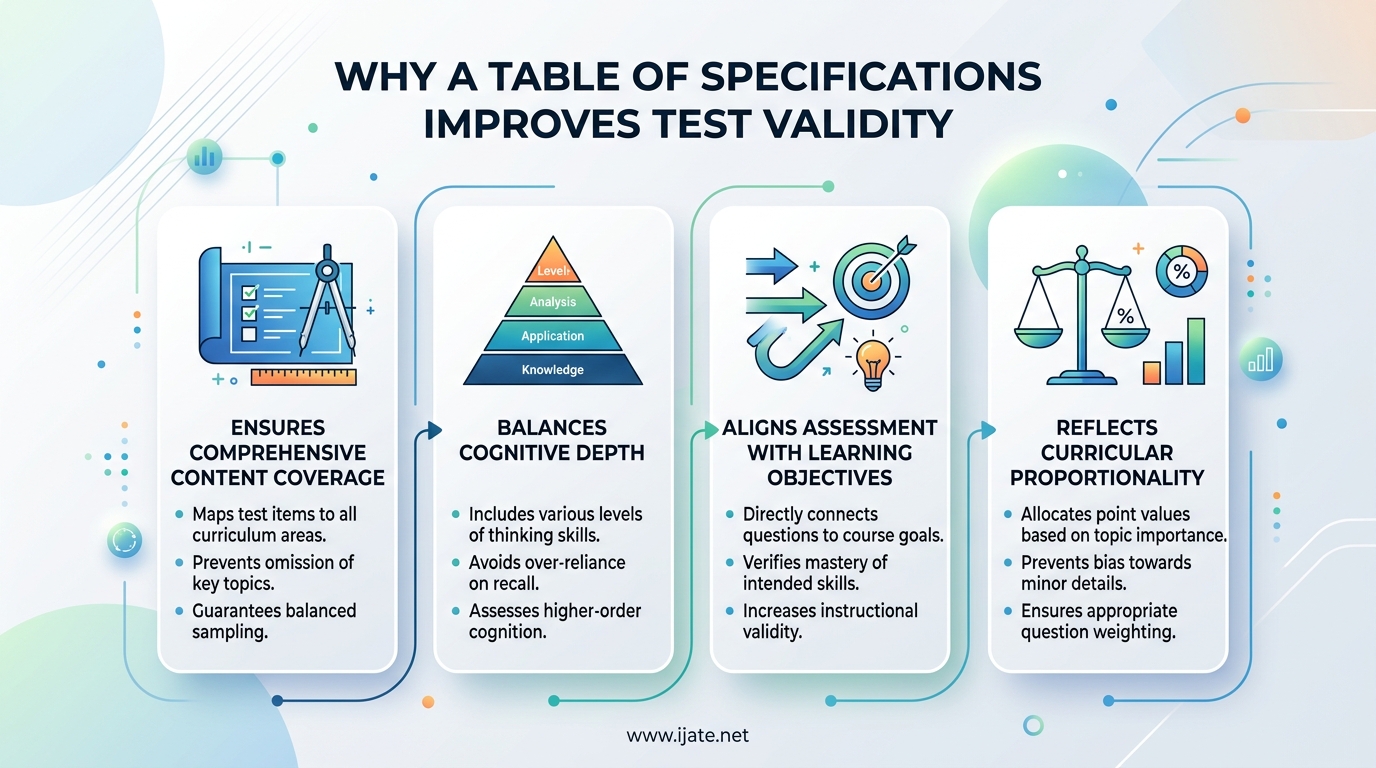
Every teacher has faced the moment after grading a test where a student asks, “Did we even cover this in class?” That uncomfortable question strikes at the heart of test validity. When assessment items drift away from what was actually taught, the scores stop meaning what we think they mean. A table of specifications (TOS) is the single most practical tool educators have to prevent that drift and defend the judgments they make about learners.
In this guide, our team breaks down exactly why a table of specifications improves test validity, walks through the components that make it tool work, and shows you how to build one for your own classroom or program. Whether you teach middle school math, run nursing licensure prep, or design corporate certifications, the principles here apply directly to your assessments.
We have pulled insights from peer-reviewed research indexed by ERIC, the SAGE Encyclopedia of Educational Research, and the lived experience of educators who post in teaching forums about their assessment struggles. By the end of this article, you will understand the mechanism behind TOS-driven validity gains and walk away with a repeatable process you can apply to your next exam.
This topic matters more than many educators realize. Forum research suggests that a significant share of lecturers lack awareness of the TOS as a planning tool, and an even smaller share use it consistently when building assessments. That gap between evidence and practice is one reason test validity problems persist at the classroom level. This guide exists to close that gap with plain language and a process you can follow tonight.
Table of Contents
What Is a Table of Specifications?
A table of specifications is a two-way chart that maps the content areas of a course against the cognitive skills students are expected to demonstrate. Each cell in the chart tells you how many test items should target a specific topic at a specific thinking level. Think of it as the architect’s blueprint for an assessment before a single question gets written.
The concept has roots in mid-twentieth century measurement theory, when researchers first formalized the idea that tests should sample both content and cognitive process in proportion to their instructional emphasis. The SAGE Encyclopedia of Educational Research, Measurement, and Evaluation describes the TOS as a tool used to ensure that an assessment measures the content and thinking skills the test developer intends it to measure. That dual focus on content and cognition is what separates a TOS from a simple list of topics.
Teachers sometimes use the terms interchangeably, but a TOS is distinct from a study guide or a syllabus. A study guide tells students what to review. A TOS tells the test maker what to write. That distinction matters because the TOS exists to protect the validity of inferences drawn from scores, not to scaffold student revision.
In practice, a finished TOS looks like a grid. Down the left side you list the content areas taught in the unit. Across the top you list cognitive levels, often drawn from Bloom’s Taxonomy. Inside each cell you record the number of items, the point value, or the percentage of the total test that should target that combination. Once the grid is complete, you have a defensible plan for what the test should and should not contain.
The beauty of the TOS is its simplicity. It requires no special software, no proprietary framework, and no advanced statistical training. A teacher with a spreadsheet, a piece of graph paper, or even a whiteboard can build one. What the tool demands is not technical expertise but the discipline to plan before writing and the honesty to weight content by what was actually taught rather than by what is easiest to test.
Why a Table of Specifications Improves Test Validity
A table of specifications improves test validity primarily by strengthening content validity, which is the degree to which a test samples the knowledge and skills it is supposed to measure. Without a TOS, item writers tend to favor the topics they find easiest to write questions about, the chapters they enjoy teaching, or the material most recently covered. The result is a test that feels comprehensive but actually over-samples some content and ignores other content entirely.
When you build a TOS first, you force yourself to allocate items proportionally to instructional time and learning priority. A topic that consumed three weeks of class gets more items than a topic covered in a single session. That proportional sampling is the mechanical heart of content validity. It is also the evidence you can show to a department chair, accreditation reviewer, or parent who questions whether the test was fair.
Beyond content validity, a TOS also strengthens face validity. Face validity is the perception, held by students and other stakeholders, that a test looks like it measures what it claims to measure. When students can see that the exam reflects the topics and thinking levels they practiced, their anxiety drops and their motivation to prepare the right material increases. Forum discussions among nursing board candidates and medical students show that test takers actively seek TOS-based study plans because they trust assessments built on a transparent blueprint.
The TOS also supports construct validity, which concerns whether a test truly measures the underlying ability it targets rather than something incidental. If your course goal is critical thinking in history, but 80 percent of your items ask for date recall, your test is measuring memorization, not historical reasoning. A TOS makes that mismatch visible before the test goes live, giving you a chance to rebalance cognitive levels before students ever see the exam.
Finally, a TOS indirectly bolsters reliability. When two forms of a test are built from the same specifications table, they sample the same content at the same cognitive depth. That consistency across forms is what allows you to compare scores fairly between different class sections, different semesters, or different years. Without a shared blueprint, parallel forms drift apart and score comparisons become unreliable.
It is worth pausing here to distinguish these validity types, because the TOS contributes to each one differently. Content validity is the most direct beneficiary, because the TOS literally defines the content domain and the sampling plan. Face validity benefits through increased transparency and student trust. Construct validity benefits because the cognitive axis exposes whether the test targets the intended mental processes. Reliability benefits indirectly, through the consistency that blueprint-driven form assembly produces. No other single classroom tool touches all four of these psychometric properties at once.
Key Components of a Table of Specifications
A functional TOS contains several non-negotiable components. Understanding each piece helps you build a table that actually serves its validity-protecting purpose rather than becoming a box-checking exercise.
Content areas. These are the topics, units, or skill clusters taught during the instructional period. They go down the left column of the grid. Each content area should map back to a specific learning objective so the test stays anchored to what was taught.
Cognitive levels. Across the top of the grid, you list the thinking skills each item should demand. Most educators borrow directly from Bloom’s Taxonomy: remember, understand, apply, analyze, evaluate, and create. Some programs use revised or simplified frameworks, but the principle is the same. Every test item should have a clearly intended cognitive demand.
Item counts or weightings. Inside each cell, you record how many items or what percentage of total points should fall at the intersection of a given content area and cognitive level. These numbers come from instructional emphasis, not from guesswork. A topic taught for two weeks with a stated objective of application-level mastery should carry more application items than a topic introduced in a single lecture.
Total row and column. A well-built TOS includes totals so you can verify at a glance that the row sums match your intended content weighting and the column sums match your intended cognitive distribution. If the column totals reveal that 70 percent of items sit at the remember level, you have an early warning that the test under-samples higher-order thinking.
Item types and point values. Many TOS templates add columns for item format, such as multiple choice, short answer, or essay, alongside the point value per item. Including format information helps you confirm that the assessment method is appropriate for the cognitive level being measured. An essay question is better suited to evaluation than a true-false item, for example.
Time estimates. Some advanced TOS versions include the time students are expected to spend on each section. Time data helps ensure the test is completable within the allotted period and that time pressure does not become a contaminating variable that distorts the validity of the scores.
Alignment notes. The strongest TOS templates include a column or annotation linking each content area to the specific learning objective or standard it serves. This addition turns the TOS from a planning tool into a piece of curriculum documentation that survives personnel changes and program reviews.
How to Create a Table of Specifications
Building a TOS is a linear process. Once you have done it two or three times, the workflow becomes second nature. Here is the step-by-step approach our team recommends, refined from the practical guides published by Kansas State University and the University of Massachusetts Practical Assessment, Research, and Evaluation journal.
Step 1: List your content areas. Pull out your syllabus, unit plan, or list of learning objectives. Write down every distinct topic you taught during the instructional period. Be specific enough that each topic maps to a teachable chunk of material, not so granular that your table becomes unmanageable.
Step 2: Assign instructional weight to each area. Estimate the relative emphasis you gave each topic, using class time, reading load, or stated objective priority as your guide. If Photosynthesis took up three of ten instructional hours, it deserves roughly 30 percent of the test items. These percentages become the row targets in your table.
Step 3: Choose your cognitive framework. Most teachers use Bloom’s Taxonomy, but you can also use Webb’s Depth of Knowledge or any framework your district or program mandates. List the cognitive levels across the top of your grid.
Step 4: Decide the cognitive distribution. Decide what percentage of items should target each cognitive level. A common starting point for a comprehensive exam is roughly 30 percent remember and understand, 40 percent apply and analyze, and 30 percent evaluate and create. Adjust based on the level of your course and the stated objectives.
Step 5: Fill in the cells. Multiply your total item count by each content percentage, then distribute those items across the cognitive columns based on your cognitive distribution targets. Round to whole numbers and check that row and column totals match your plan.
Step 6: Write items to match the blueprint. Only now do you begin drafting questions. Each item should map to a specific cell in the TOS. As you write, tag every item with its content area and cognitive level so you can verify coverage at the end.
Step 7: Audit and adjust. Once items are written, count them by content area and cognitive level and compare the actual distribution to your TOS targets. If a cell is short, write more items for that combination. If a cell is overweight, trim items until the actual matches the plan.
Step 8: Document and store the TOS. Save the finished TOS alongside the test so you can reuse the blueprint for future forms, share it with co-teachers, or produce it as validity evidence during program review. A TOS that lives only in your head does not protect validity for anyone but you.
A quick example makes this concrete. Imagine a 50-item biology unit test covering Cell Structure (20 percent of class time), Photosynthesis (30 percent), Cellular Respiration (30 percent), and Cell Division (20 percent). Using the steps above, you would allocate 10 items to Cell Structure, 15 each to Photosynthesis and Respiration, and 10 to Cell Division. Within each content area, you would then distribute items across Bloom levels based on your cognitive targets. The result is a grid where every cell has a planned number, and every test item has a planned home.
Bloom’s Taxonomy and the Table of Specifications
Bloom’s Taxonomy and the TOS are natural partners because both frameworks focus on aligning instruction and assessment across cognitive complexity. Bloom gives you the vocabulary for thinking levels; the TOS gives you the structure for distributing test items across those levels. Used together, they prevent the most common cognitive bias in test writing, which is the tendency to default to recall questions because they are fastest to write.
Research noted in the ERIC database shows that without a TOS, teacher-made tests cluster heavily at the knowledge and comprehension levels of Bloom’s original taxonomy, even when course objectives call for application and analysis. The TOS forces you to plan for higher-order items before you start writing, which means you allocate cognitive real estate intentionally rather than by accident.
A practical tip from experienced item writers is to color-code your TOS cells by Bloom level. Remember items might sit in a light cell, while create items sit in a dark one. When you step back and look at the grid, the visual pattern tells you instantly whether your test is balanced or skewed toward low-level recall. That quick visual check has saved many teachers from shipping a test that accidentally measured memorization when the goal was critical thinking.
For courses that emphasize problem solving, like nursing, engineering, or mathematics, the Bloom-aligned TOS is especially valuable. These disciplines live and die by application and analysis. A test that mostly asks students to define terms is not measuring clinical judgment or engineering reasoning. The TOS makes that mismatch impossible to ignore.
One nuance worth noting is that Bloom’s levels do not always map cleanly to difficulty. An application question can be easy, and a remember question can be hard, depending on how the item is constructed. The TOS protects cognitive coverage, which is about thinking type, not difficulty. If you also want to control difficulty distribution, you can add a difficulty axis to your TOS or run a separate item difficulty analysis after piloting the test.
Common Mistakes When Using a Table of Specifications
Even educators who know about the TOS sometimes undermine its validity-protecting power by making predictable errors. Here are the pitfalls we see most often in forums and faculty development sessions, along with how to avoid them.
Building the TOS after the test is written. The most common mistake is drafting all the test items first, then reverse-engineering a TOS to match. This defeats the entire purpose. The TOS is a planning tool, not an audit tool. If you have already written the items, you have already baked in whatever biases shaped your writing. Build the TOS first, then write to it.
Using vague content areas. Listing “Chapter 1” as a content area is too broad to be useful. A content area should describe the actual knowledge or skill targeted, such as “Cell membrane transport mechanisms” or “Linear equations in two variables.” Vague labels make it impossible to verify that items truly match the intended content.
Ignoring cognitive levels. Some teachers build a one-dimensional TOS that lists only content areas and item counts. Without the cognitive dimension, the table cannot protect against the recall-question bias that Bloom-aligned planning is designed to prevent. Always include the cognitive axis.
Failing to revisit the TOS after item writing. Plans drift. You write an item, realize it fits a different cell than intended, and quietly move on without updating the table. By the end, the actual test may look nothing like the blueprint. Always do a final audit and update the TOS to reflect what is actually on the test.
Treating the TOS as a one-time exercise. A TOS is most powerful when it is reused across test forms. If you rebuild a brand new table for every exam, you lose the consistency that lets you compare scores across semesters. Maintain a master TOS for each course and revise it incrementally as the curriculum evolves.
Over-weighting what was recently taught. Recency bias leads many teachers to pile items onto the final unit of a course, leaving earlier material under-tested. The TOS counters this by forcing you to assign weights based on total instructional emphasis, not on what happened last week.
TOS vs Test Blueprint: What’s the Difference?
The terms table of specifications and test blueprint are often used interchangeably, and in many contexts they mean the same thing. Both refer to a planning document that maps content against cognitive demand before items are written. The subtle distinction, where one exists, is one of scope.
A TOS is typically associated with classroom-level tests, where a single teacher builds an end-of-unit or end-of-course exam. The table tends to be compact, covering one course’s content and one or two cognitive frameworks. A test blueprint, by contrast, is more commonly used in large-scale standardized assessment, licensure examinations, and certification programs. Blueprints often include additional layers such as item format specifications, passing score methodology, and form assembly rules.
Functionally, the two serve the same purpose. Both protect content validity by ensuring the assessment samples the intended domain at the intended depth. Whether you call yours a TOS or a blueprint, the validity logic is identical. Use whichever term your institution prefers and focus your energy on building the document well.
If you are working in a licensure or certification context, expect the blueprint to carry additional requirements such as job task analysis linkage, cut score justification, and statistical reporting on item performance. Those layers build on the same content-by-cognition foundation that a classroom TOS provides. Understanding the simpler classroom tool first makes the more complex blueprint frameworks easier to grasp.
Research Evidence on TOS Effectiveness
The academic literature on TOS is consistent and clear. The widely cited paper “Classroom Test Construction: The Power of a Table of Specifications,” published in Practical Assessment, Research, and Evaluation and indexed by ERIC, argues that a TOS provides a strategy for teachers to improve the validity of the judgments they make about their students from test responses. That claim has held up across decades of replication in classroom and licensure contexts.
The Kansas State University professional development resource on validity makes a complementary point. It notes that using a TOS helps instructors avoid one of the most common mistakes in classroom tests, namely writing all items at the knowledge level regardless of what the objectives actually demand. This practical observation aligns with the broader measurement literature on content validity evidence.
Despite the evidence, adoption remains uneven. Surveys referenced in faculty development literature suggest that a significant percentage of lecturers lack awareness of the TOS as a tool, and even fewer use it consistently when building assessments. That gap between evidence and practice is one reason test validity problems persist in classroom settings. Closing the gap starts with making the TOS accessible, simple, and routine.
Forum data reinforces the demand side of this equation. Students preparing for nursing board exams in the Philippines, medical students sharing study plans, and teacher candidates studying for licensure all actively seek TOS information to guide their preparation. When the blueprint is transparent, students study more efficiently and report higher confidence that the exam will match what they learned. That confidence is itself a validity signal, because it reflects alignment between instruction, assessment, and learner expectations.
The research also points to a second benefit that is rarely discussed. Teachers who use a TOS consistently report faster item writing over time, because the blueprint removes the decision fatigue of figuring out what each question should cover. Once the cell targets are set, writing becomes a focused task rather than an open-ended creative exercise. That efficiency gain is part of why seasoned item writers refuse to build tests any other way.
Digital Tools for Building a Table of Specifications
The TOS does not require specialized software, but digital tools can speed up the process and make the resulting table easier to share and reuse. A simple spreadsheet in Google Sheets or Microsoft Excel is enough for most classroom teachers. Set the content areas as rows, the cognitive levels as columns, and use formulas to total rows and columns automatically so you can verify balance at a glance.
For educators who want templates, several universities and assessment-focused organizations publish free TOS templates online. Look for templates that include both the content and cognitive axes, automatic totals, and space for alignment notes. Avoid templates that reduce the TOS to a one-dimensional list of topics, because those lose the cognitive dimension that makes the tool effective.
Learning management systems increasingly support blueprint-style planning at the module or quiz level. If your LMS lets you tag items by topic and cognitive level, you can generate a live TOS report from the item bank itself. That report becomes a continuous validity check, because it shows you the actual distribution of items you have authored, not just the distribution you planned.
For larger programs, assessment management platforms can link the TOS directly to curriculum mapping, accreditation standards, and program-level learning outcomes. These enterprise tools are beyond what a single classroom teacher needs, but they are worth knowing about if you move into a coordination or assessment director role.
Using TOS Across Different Subject Areas
The TOS framework is subject-agnostic, but the way you populate it shifts depending on what you teach. In mathematics and the sciences, content areas tend to map cleanly to skills or problem types, and the cognitive axis often emphasizes application and analysis. In the humanities, content areas may be thematic, and the cognitive axis may lean toward evaluation and synthesis.
In performance-based subjects like music, physical education, or art, the TOS can be adapted to map skills or repertoire pieces against performance criteria rather than cognitive levels. The two-way structure still holds. What changes is the vocabulary on each axis.
In professional and licensure contexts, the TOS typically links back to a job task analysis or scope of practice document. Content areas become job domains, and cognitive levels become the reasoning complexity required to perform each task safely. This linkage is what gives licensure exams their legal defensibility.
The common thread across all subjects is intentionality. Whatever you teach, the TOS forces you to decide in advance what the test should cover and at what depth. That decision, made before items are written, is what protects validity regardless of discipline.
FAQs
How does a TOS improve test validity?
A TOS improves test validity by ensuring the test samples content and cognitive skills in proportion to instructional emphasis. It strengthens content validity through proportional sampling, supports face validity by making the test feel fair to students, bolsters construct validity by exposing cognitive mismatches, and indirectly aids reliability by enabling consistent parallel test forms.
What are the advantages of a table of specifications?
The main advantages are improved content coverage, balanced cognitive demand across Bloom levels, defensible validity evidence for accreditation or review, better alignment between instruction and assessment, reusable blueprints across test forms, and increased student trust in the fairness of the exam.
What is the purpose of using a table of specifications?
The purpose is to plan a test before writing items so that the assessment samples the intended content areas at the intended cognitive levels in the intended proportions. This protects the validity of inferences drawn from the resulting scores.
What is a table of specification in teaching?
In teaching, a table of specifications is a two-way grid that maps course content areas against cognitive levels (often Bloom’s Taxonomy), with each cell showing how many test items or what percentage of points should target that combination of topic and thinking skill.
How do you make a table of specifications for an exam?
List your content areas, assign instructional weights to each, choose a cognitive framework such as Bloom’s Taxonomy, decide the cognitive distribution, fill in the cells with item counts, write items to match the blueprint, audit the actual distribution against the plan, and store the finished TOS as validity evidence.
What information should be included in a table of specifications?
A complete TOS includes content areas mapped to learning objectives, cognitive levels across the top, item counts or weightings in each cell, total rows and columns for verification, item types and point values, and optionally time estimates per section.
Conclusion: Why This Matters for Your Next Test
A table of specifications improves test validity because it forces alignment between what you taught, what you intended students to learn, and what you actually measured. Without that alignment, scores are opinions dressed up as data. With it, scores become defensible evidence you can stand behind in front of students, colleagues, and accreditors.
The mechanism is straightforward. The TOS samples content proportionally, distributes cognitive demand intentionally, surfaces mismatches before they reach students, and creates a reusable blueprint that holds parallel forms together over time. That is why researchers at Kansas State, the SAGE Encyclopedia, and the ERIC-indexed literature all converge on the same conclusion: the TOS is the single most accessible tool classroom educators have for protecting the validity of their assessments.
Our recommendation is simple. Build the TOS before you write a single item. Treat it as a planning tool, not an afterthought audit. Store it, reuse it, and revise it as your curriculum evolves. The teachers who do this consistently produce tests that students trust, reviewers accept, and scores that genuinely reflect what learners know and can do. That is the practical payoff of understanding why a table of specifications improves test validity, and it is a payoff available to any educator willing to spend fifteen extra minutes planning before they write.
If you take only one idea from this guide, let it be this: validity is not a property of a test. It is a property of the inferences you draw from test scores. The TOS protects those inferences by making the link between instruction and assessment explicit, defensible, and repeatable. Start with your next exam, and you will wonder how you ever built a test without one.