
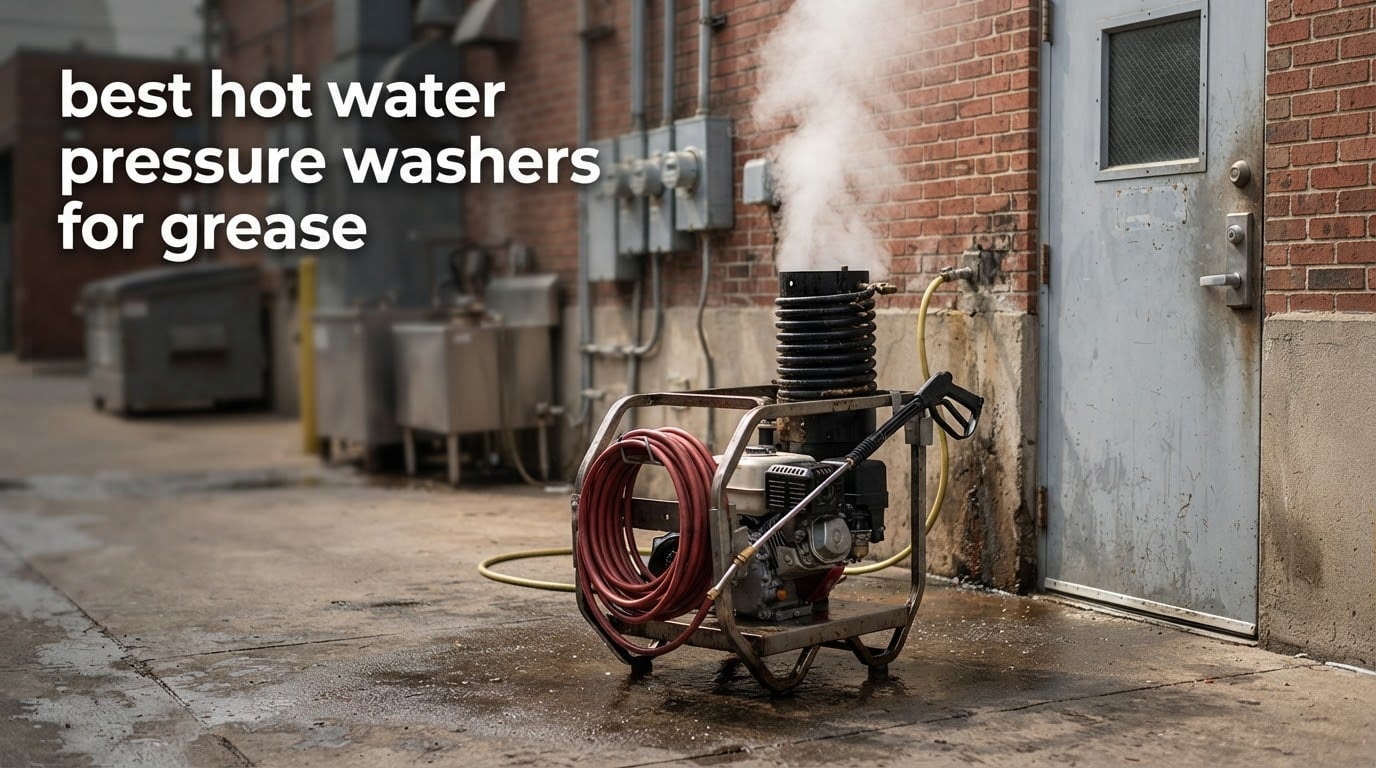
The best hot water pressure washers for grease are the machines that heat water to roughly 150F or above before it reaches the spray tip, because heat is what turns a hard film of oil into something pressure alone can strip off. Our pick at the top is the MechMaxx HPW40H, a 4000 PSI Honda GX390 unit that reaches 200F and has the only verified owner feedback in this group.
That matters more than raw pressure. Grease re-solidifies the instant cold water touches it, so a cold washer spreads a slick around the concrete instead of lifting it. Heat drops the viscosity of the grease, a degreaser can emulsify it, and the rinse runs it to the drain.
We compared 12 heated units on pressure, flow, water temperature at the nozzle, burner fuel, pump type and engine pedigree. Twelve machines, one frame each, and a lot of spec sheets that contradict themselves. What follows is what we found after reading every one of those sheets and weighing them against real grease work.
One warning before we start. Almost none of these machines have owner reviews yet. Only two carry verified customer feedback, so treat the rest as spec-led picks rather than proven workhorses, and confirm the flow and temperature figures with the manufacturer before you commit.
Table of Contents
Why Hot Water Pressure Washers for Grease Beat Cold Water Every Time
A hot water pressure washer for grease is simply a pressure washer with an onboard burner. Cold water enters the pump, gets pressurised, passes through a heating coil fed by a diesel or propane burner, and leaves the gun at a low flow rate and a high temperature. The hot alkaline water breaks grease into an emulsion that rinses away.
Grease is not a dirt that sits on a surface. It is a polymer that bonds to porous concrete, penetrates seams and settles into the texture of steel and diamond plate. The only things that remove it are heat, chemistry and agitation, in that order.
Here is the difference that shows up on a real job. Cold water at 4000 PSI will move fresh oil. On baked-on kitchen grease, the same nozzle and the same pressure will leave a grey haze, and you will chase it across the floor until the pad wears out. Water at 200F changes that: the grease thins, the degreaser reaches the whole deposit at once, and the rinse leaves bare concrete.
Heat also cuts the amount of chemical you need. Degreaser works faster and at lower concentration when the water is hot, which matters on a food-service job where the rinse has to go down a drain without upsetting a grease interceptor.
There is a catch. Hot water near painted surfaces, electrical panels, some plastics and asphalt can soften or lift coatings. Operators in pressure washing forums repeatedly flag this, and it is why we pair every machine in this list with a spot test on an out-of-sight area first.
So who should buy one? Restaurant and commercial kitchen operators, food truck and delivery fleet owners, mobile pressure washing contractors and heavy-duty shops that hit baked-on grease regularly. If you only need patios, siding and vehicles cleaned, a cold washer is the better purchase, and our guide to the best pressure washers for home use covers that case properly.
Top 3 Picks: Best Hot Water Pressure Washers for Grease (October 2026)

MechMaxx HPW40H Honda GX390
- 4000 PSI at 4.0 GPM
- Water to 200F
- Honda GX390 electric start
- 13 inch pneumatic tires

NorthStar 2750 PSI Wet Steam
- Wet steam up to 250 degrees
- 2750 PSI at 2.5 GPM
- 230V corded electric
- Total Start Stop control
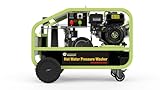
Green-Power America GNHW3530E
- 3500 PSI at 3.0 GPM
- Water up to 212F
- Compact 39 inch frame
- 2 year warranty
The MechMaxx takes the top slot on component pedigree and the only clean owner report in the set. The NorthStar reaches the highest temperature figure anywhere in this roundup and runs on electricity, which no other machine here does at that heat. The Green-Power America is the smallest, simplest and least expensive way into heated water without giving up the ability to shift grease.
Quick Overview: 12 Hot Water Pressure Washers for Grease Compared
| Product | Specifications | Action |
|---|---|---|
| MechMaxx HPW40H Honda GX390 |
|
Check Latest Price |
 KoreJetMetal AM4000 KoreJetMetal AM4000 |
|
Check Latest Price |
 Powerhorse 4000 PSI Diesel Heater Powerhorse 4000 PSI Diesel Heater |
|
Check Latest Price |
 BILT HARD 4 GPM 4000 PSI BILT HARD 4 GPM 4000 PSI |
|
Check Latest Price |
 DIGMIGHT PW4000 DIGMIGHT PW4000 |
|
Check Latest Price |
 MechMaxx HPW40KBT Skid Mount MechMaxx HPW40KBT Skid Mount |
|
Check Latest Price |
 Easy-Kleen EZO4035G-K Easy-Kleen EZO4035G-K |
|
Check Latest Price |
 AIVOLT PW-G40S-UA0 AIVOLT PW-G40S-UA0 |
|
Check Latest Price |
| Green-Power America GNHW3530E |
|
Check Latest Price |
 Dapper Supply DP-CPW11392.0 Dapper Supply DP-CPW11392.0 |
|
Check Latest Price |
| NorthStar 2750 PSI Wet Steam |
|
Check Latest Price |
 American Pressure Inc. BE Power American Pressure Inc. BE Power |
|
Check Latest Price |
Read the flow column before the pressure column. Four thousand PSI on 3.0 GPM moves less contamination per minute than 3500 PSI on 4.0 GPM, and on grease the second job finishes sooner.
1. Best Overall Hot Water Pressure Washers for Grease: MechMaxx HPW40H (Honda GX390)
MechMaxx Honda GX390 389CC 11.7HP E-Start Engine 4000 PSI 4 GPM Hot Water Pressure Washer with Hose Reel, HPW40H
4000 PSI at 4.0 GPM
Water up to 200F
Honda GX390 389cc 11.7 HP
Hose reel, lift hook, 13 in tires
Pros
- Honda GX390 electric start needs no cord pull
- Water to 200F from a diesel fired heating system
- Integrated hose reel keeps the 50 in hose organised
- Lift hook and handlebar make loading straightforward
Cons
- 462 pounds is heavy for a portable unit
- Only one customer review so far
The MechMaxx HPW40H is the unit we would put on a truck for general grease work, and the reason is component pedigree rather than any single spec. A Honda GX390 with electric start, a triplex plunger pump and a diesel-fired heating system is a combination that service technicians already know.
The owner feedback we found describes exactly the use case we care about. A farm operator runs it over tractors and heavy equipment and reports the hot water cutting through grease and mud far faster than the cold washer it replaced, plus the push-button start removing the daily cord pull.
That report also flags the honest drawback: 462 pounds. The 13-inch pneumatic tires and the handlebar make it rollable, but this is a two-person lift into a truck bed, not a machine one person wrestles over a curb.
The integrated control panel is worth noting for grease specifically. Operators working through a cook line want a stable pressure and a repeatable temperature rather than a machine that wanders as the burner cycles, and that panel is built for repeatable output.
Because it is gasoline powered, it works anywhere a water supply exists. No generator, no 30 amp circuit, no site power. For a mobile operator rolling between restaurants that is often the deciding factor, and our roundup of the best gas pressure washers for contractors covers the wider cold-side setup.
What to check before you commit on this class of machine
Ask the dealer to demonstrate temperature at the nozzle with the burner running, not a burner rating on a spec sheet. Rated input tells you the burner capacity, not what arrives at the spray tip under load.
Confirm the pump is a true triplex plunger unit with an oil-bath crankcase and a thermal relief valve. Those two features decide whether the pump survives a long day of hot water, and they are the parts most often left out of budget machines.
Where this unit is the wrong choice
Skip it if you are working indoors. A gasoline engine in an enclosed restaurant kitchen or garage is a ventilation problem you do not need, and no hose length fixes it.
Also skip it if you need to move it alone regularly. At 462 pounds with a lift hook, you are planning around two people every time it goes in or out of a vehicle.
2. KoreJetMetal AM4000 4000 PSI Gas Washer for Farm and Construction Grease
KoreJetMetal 4000 PSI Hot Water Pressure Washer, 4.0 GPM, 420cc Gas Engine with AR Pump, Commercial Heavy-Duty Power Washer for Trucks, Machinery, Concrete, Industrial Grease Removal
4000 PSI at 4.0 GPM
185F in 2 minutes
420cc gas with Italian AR pump
347.6 pounds
Pros
- Reaches 185F in 2 minutes
- Italian AR pump with cast iron sleeve and brass manifold
- Oil Sentry shutdown and thermal pump protector
- 33 ft hose plus four nozzles included
- 5 gallon fuel tank for long runs
Cons
- 347.6 pounds without wheels is awkward to reposition
- No dedicated soap tip in the listed nozzles
The KoreJetMetal AM4000 is built for the least glamorous and most common hot water job there is: rolling up to a greasy tractor, a loader or a concrete yard and cutting the film off. It delivers 4000 PSI at 4.0 GPM and reaches 185F in about two minutes, which is fast enough that you are not waiting on the burner between passes.
The pump is the headline here. An Italian AR pump with a cast-iron cylinder sleeve and brass manifold is a continuous-duty design, and the Oil Sentry low-oil shutdown plus a thermal pump protector cover the two failure modes that kill pumps on hot work: running dry and running hot.
The 5-gallon fuel tank matters for a farm or construction schedule where you are a long way from a pump. On a city job it is less relevant, but on a site with rough ground and long distances it keeps the engine from becoming the constraint.
The included kit is sensible for that work: a 33 foot 3/4 inch hose and four quick-connect nozzles covering 0, 15, 25 and 40 degrees. There is no soap nozzle listed, which means applying degreaser means running a separate injector or carrying a foam cannon.
How it handles baked-on versus fresh grease
At 185F this unit sits in the band that softens cooking grease and kitchen film without pushing into wet steam territory. For a hood filter, a fryer surround or a bay floor with days of buildup, that is the right amount of heat.
For carbonised deposits welded onto steel, you will still be relying on dwell time and chemistry more than on temperature. Plan for a longer chemical soak at this setting than you would at 200F.
Where this unit is the wrong choice
The 347.6 pound all-metal frame is listed without wheels, and that is the detail we would call out to any buyer. All-metal construction is durable, but it also means every reposition is a two-person job.
It is also a bare-bones package. If you need onboard detergent, a hose reel or a surface cleaner, none of that is in the box.
3. Powerhorse 4000 PSI Diesel-Heated Gas Washer for Contractors Starting Out
Powerhorse Gas Hot Water Pressure Washer with Diesel Heater, 4,000 PSI
4000 PSI at 4 GPM
Water to about 150F
Triplex plunger pump
407 pounds
Pros
- Diesel heater delivers hot water within minutes
- Triplex pump with thermal protection and low oil shutdown
- Straightforward setup and mobility for its class
- Lowest entry point in this selection
Cons
- About 150F is cooler than several rivals reach
- Listing copy mixes 4000 PSI 4 GPM with 3600 PSI 2.6 GPM details
- Not available for delivery in California
The Powerhorse is the honest budget entry into heated water. It gives you a diesel-fired heater, a triplex plunger pump and 4000 PSI at 4 GPM on the headline spec, which is the core of what grease work needs. The temperature is the compromise, and it is a real one.
About 150F is the low end of the useful band for grease. It softens cooking grease, mobilises fresh oil and makes a cold washer pointless on a kitchen floor, but it will not do anything to a carbonised deposit that a 200F machine would shift.
If your work is mostly fresh oil on trucks, drip trays, yard stains and equipment that gets washed weekly, 150F is genuinely enough. If you are opening hoods, filters and fryer lines, spend the difference.
One thing to sort out before anything else: the listing copy mixes 4000 PSI at 4 GPM headline figures with engine details referring to 3600 PSI at 2.6 GPM. That is a specification inconsistency, not a small difference. Flow rate decides how much area you cover per minute, so get the real figure in writing.
What first-time owners should verify
Confirm the actual output temperature at the nozzle and the burner fuel capacity in hours, not tank size. A small burner on a small tank turns into a lot of refuelling stops across a working day.
Ask about parts availability for the burner coil and the ignition components in your region. On hot water machines, the coil is the part most likely to need replacement and the one most often shipped from a single source.
Where this unit is the wrong choice
Do not buy it for baked-on hood and fryer work. The temperature gap is the whole reason heated washers exist, and 150F leaves money on the table.
It is also not available for delivery in California, so check that before you plan a purchase out of state.
4. BILT HARD 4 GPM 4000 PSI Washer with LED Temperature Control
BILT HARD 4 GPM 4000 PSI Gas Hot Water Pressure Washer with Electric Start 420cc Engine, Triplex Plunger Pump Power Washer for Farms, Construction Sites & Commercial Use, 49-State Certified
4000 PSI at 4 GPM
185F in 2 min, up to 200F
420cc 15 HP OHV electric start
6.34 gallon diesel tank
Pros
- 185F in 2 minutes adjustable up to 200F
- LED panel tracks temperature and flags faults
- 6.34 gallon diesel reservoir for long jobs
- 50 ft hose with five tips including a soap nozzle
- Puncture proof solid tires for unpaved ground
Cons
- 49 state certified so not approved for California
- Spiral coil and digital panel add complexity
The BILT HARD is the machine for an operator who wants to know the water temperature rather than guess at it. It reaches 185F in two minutes and adjusts up to 200F, with a digital control panel and LED readout that tracks temperature and pushes fault notifications in real time.
On grease work that control is worth more than it looks. Fresh cooking grease, hardened cooking grease and baked-on carbon all want different temperatures, and being able to dial a specific figure instead of cycling a burner on and off is the difference between consistent results and a lot of trial and error.
Underneath is a 420cc 15 HP four-stroke OHV engine with electric and recoil ignition driving a triplex plunger pump that holds 4000 PSI at 4 GPM. Dual ignition means you are not stuck if the electric starter fails on a cold morning at an unheated site.
The 6.34 gallon diesel reservoir and the multi-layer spiral coil heat exchanger are both built for long duty cycles. The coil design is what delivers even heat transfer quickly, and on a full day of hood work that shows up as fewer cold patches on the second pass.
Why the panel and the hose matter most
Fault notifications cover the failure you cannot see while working: a burner that is not firing, a coil temperature climb or low pump oil. On a night job with no one else on site, that alert is the difference between finishing and coming back.
The 50 foot hose with five quick-coupling tips including a soap nozzle is the most complete nozzle package in the portable group, and it lets you apply degreaser and rinse from the same machine without an injector hose.
Where this unit is the wrong choice
The spiral coil heat exchanger and the digital panel add complexity relative to a simpler hot water unit. If you are buying your first heated washer and you want the fewest things to fail, this is not the low-maintenance choice.
It is also 49-state certified, so it is not approved for sale in California.
5. DIGMIGHT PW4000 Diesel-Heated Washer Running to 212 Degrees
DIGMIGHT 4000PSI 4GPM Hot Water Pressure Washer, Diesel Heater (100°C), 13.5HP Gasoline Engine, 15L/min Flow, for Heavy-Duty Cleaning, Car Washing, Industrial Use (Orange)
Water up to 100C / 212F
4000 PSI at 4 GPM
13.5 HP gasoline engine
28 L gas and 29.1 L diesel
Pros
- Diesel heater adjustable up to 212F
- 13.5 HP engine with 0.8 to 1.2 L per hour consumption
- 28 L gasoline and 29.1 L diesel tanks
- Compact 985 x 760 x 975 mm footprint
- EPA compliant emissions and accessible oil change point
Cons
- Includes a 1 square metre extension gun rather than a standard lance
- 10 m hose is shorter than the 50 ft hoses on rivals
The DIGMIGHT PW4000 pairs the joint-highest water temperature in this roundup with the fuel capacity to run all day. The diesel heater adjusts up to 100C, or 212F, and the gasoline and diesel tanks hold 28 litres and 29.1 litres respectively.
Those tank sizes are the story here. Most hot water machines in this group stop after a few hours of continuous burner work, and a 29.1 litre diesel tank means you are topping up far less often on a full day of hood, floor and equipment cleaning.
The engine is a 13.5 HP unit running at 3600 RPM with fuel consumption of 0.8 to 1.2 litres per hour. That figure matters for anyone running these machines as a business, because burner fuel plus engine fuel plus pump oil is the real operating cost of a heated washer.
The piston pump is rated to 4000 PSI at 15 litres per minute, which is 4 GPM in imperial terms. The machine footprint of 985 by 760 by 975 mm is compact for its output, and the oil change capacity of 0.95 litres is an accessible service point.
What the highest temperature actually buys you
At 212F you are at the point where thin grease films flash off concrete almost on contact, and where a black carbonised deposit starts to move given enough dwell time and the right chemistry. That is a genuinely different capability from a 150F unit.
The trade-off is caution. Water this hot softens paint, attacks some plastics and lifts asphalt sealcoat quickly. Test an out-of-sight area and keep the fan pattern wider than you think you need.
Where this unit is the wrong choice
The included water gun is a 1 square metre extension rather than a standard lance, which some buyers find unfamiliar to control. If you are used to a conventional wand, ask to handle it first.
The 10 metre hose is also shorter in reach than the 50 foot hoses supplied by several competing units. On a large yard or a long truck you will be moving the machine more often.
6. MechMaxx HPW40KBT Skid Mount with 245-Gallon Tank for Mobile Grease Work
MechMaxx 4000 PSI 4 GPM Kohler E-Start Engine Hot Water Pressure Washer Skid Mounted with 245 Gal Tank, Model HPW40KBT
4000 PSI at 4.0 GPM
Water to 200F
245 gallon onboard tank
Kohler CH440 Command Pro
Pros
- 245 gallon tank removes the need for a fixed water supply
- Skid frame with lift hook and forklift slots
- Kohler CH440 Command Pro electric start
- Water up to 200F from a diesel burner
Cons
- 81.5 by 40.6 by 52.7 in is the largest footprint here
- The 245 gallon tank is overkill where a hose connection exists
- Skid mounting means it cannot be rolled into position
The MechMaxx HPW40KBT is the mobile deployment version of the same idea as our top pick, and it solves the problem that actually stops a lot of grease jobs before they start: there is no water at the site.
A 245 gallon onboard tank means the machine can work a warehouse dock, an equipment yard or a remote lot with nothing but a drain nearby. For contractors chasing down fire damage, flood cleanup or fleet work away from a hydrant, that capability is worth more than another thousand PSI.
The engine is a Kohler CH440 Command Pro electric start, which is a different engine from the GX390 in the HPW40H. Both are widely serviced platforms with good parts support, and the Kohler is the one to look for when cold starts in cold weather are routine.
The skid frame with lift hook and forklift slots is built for truck beds, trailers and utility platforms. That is the correct mounting for a machine carrying this much water, and it is also the reason it cannot simply be rolled where you need it.
How to decide if off-grid capability is worth the footprint
Work out how many of your jobs have a reliable water source within about 50 feet of the work area. If most of them do not, the tank earns its size. If nearly all of them do, you are carrying several hundred pounds of water you never use.
Then check the loading side. A 245 gallon tank filled to the brim is roughly a ton of machine before you add the engine, so plan the trailer, the forklift access and the loading method before the purchase, not after.
Where this unit is the wrong choice
It is the wrong choice for a fixed shop or a restaurant with a dedicated supply. There you want the portable HPW40H and the reach its wheels give you.
It is also the wrong choice if you load and unload solo. A skid-mounted machine with a full tank is not a one-person operation.
7. Easy-Kleen EZO4035G-K CSA and ETL Certified Commercial Washer
Easy-Kleen 3.5GPM 4000PSI Commercial Hot Water Gas Pressure Washer
4000 PSI at 3.5 GPM
14 HP Kohler direct drive
120V oil fired burner
CSA and ETL certified
Pros
- CSA and ETL certified for code sensitive job sites
- 14 HP Kohler engine with a commercial triplex pump
- Schedule 80 seamless braced heating coil
- 50 ft hose is the longest supplied here
- Lifting bar and hose reel plate welded into the cage
Cons
- 3.5 GPM covers less area per minute than 4.0 GPM units
- 46 by 30 by 48 in is one of the largest portable builds
- 425 pounds with a 13 in pneumatic wheel set
The Easy-Kleen is the machine to buy when the site will not accept an uncertified unit. It carries CSA and ETL certification, and that single fact decides whether it can go on a commercial food-service or industrial site at all.
Several contractors describe insurance and site paperwork requirements as the real barrier on commercial grease work, not the cleaning itself. A listed machine removes an argument you would otherwise have on every job.
The build is serious underneath. A 14 HP Kohler gasoline engine with direct drive, a commercial-duty triplex plunger pump with an oil-bath crankcase, stainless steel valves and a brass manifold, plus a thermal pump protector for sustained duty.
The heating coil is the piece we would point out. A Schedule 80 seamless coil, elliptically wound and stretched, structurally braced, ceramic-blanket sealed and housed in stainless steel is a coil designed to survive heat cycling, which is the normal operating condition of a grease machine.
Why certification and coil construction matter together
Certification tells you the machine was evaluated as a complete unit, not just its parts. That matters when a client or inspector asks for documentation, and it is why two otherwise similar machines can cost differently.
Coil construction tells you the machine will still be doing this in five years. A structurally braced ceramic-sealed coil survives the repeated heat-up and cool-down cycles that a thin coil eventually fails on.
Where this unit is the wrong choice
At 3.5 GPM it has the second-lowest flow rate in this group, so you cover less area per minute than a 4.0 GPM machine. On a large floor with a wide surface cleaner, that difference shows in the hours.
It is also a heavy build at 425 pounds, and the 46 by 30 by 48 inch assembled size is large for a portable machine. Check your transport before you commit.
8. AIVOLT 4000 PSI Gas Washer with 20 Litre Diesel Tank
AIVOLT 4000PSI 4.0GPM Gas Hot Water Pressure Washer, 459cc Engine
4000 PSI at 4.0 GPM
Water to 212F
459cc OHV electric and recoil
20 L diesel and 5.5 L gas
Pros
- Diesel burner reaches up to 212F
- 20 L diesel tank plus 5.5 L gasoline tank
- Digital panel for temperature adjustment and fault alerts
- Five tips and a 50 ft hose included
- 13 in pneumatic wheels on a welded steel frame
Cons
- Listed dimensions of 10 by 12 by 20 in look wrong for a 459cc machine
- Rated flow of 3.7 GPM is below the 4.0 GPM headline
- 49 state compliant so not approved in California
The AIVOLT combines the joint-highest water temperature in this roundup with the second-largest fuel capacity, and adds the digital controls that make a heated machine easier to run consistently.
The 459cc OHV engine with electric and recoil start drives a professional triplex plunger pump, and the diesel burner heats water to up to 212F. A digital control panel gives precise temperature adjustment and real-time fault notifications, which on a multi-machine fleet is how you keep twelve washers producing the same result.
The 20 litre diesel tank with a 5.5 litre gasoline tank means fewer refuelling stops across a long day than most of the machines here. On a job with a fixed water supply and no fuel on site, that translates directly into more billable hours.
The kit is complete: five quick-connect spray tips including soap, a 50 foot commercial-grade hose, a stainless wand and 13 inch pneumatic wheels on a heavy-duty welded steel frame.
What to double-check on this listing
The listed dimensions of 10 by 12 by 20 inches do not match a skid-mounted washer built around a 459cc engine. Treat the size figures as wrong and ask for a drawing or a photo with a tape measure before you plan a transport.
Also note the rated flow of 3.7 GPM sits below the 4.0 GPM headline figure. The headline is a maximum; the rated figure is what you get on a continuous run, and the rated number is the one that decides your coverage rate.
Where this unit is the wrong choice
If you are buying to a tight budget, the largest fuel tanks buy you fewer stops, not better cleaning. The cleaning comes from the 4000 PSI, the flow and the heat.
Like several machines in this roundup, it is 49-state compliant and is not approved for sale in California.
9. Green-Power America GNHW3530E Compact Washer with 212 Degree Output
Green-Power America 3500 PSI 3 GPM Gas Hot Water Pressure Washer, Electric Start, Commercial Grade Portable Gasoline Engine, 49-State Compliant
3500 PSI at 3.0 GPM
Water up to 212F
223cc OHV electric start
39.4 in compact frame
Pros
- Lowest entry point among heated washers here
- Most compact frame at 39.4 by 22.1 by 28.3 in
- 2 year warranty plus 3 year pump and 1 year burner coverage
- Never flat 14 in and 8 in wheels
- Reaches 212F despite lower pressure and flow
Cons
- Lowest pressure and flow in the roundup at 3500 PSI and 3.0 GPM
- 223cc is the smallest engine here
- Not approved for sale in California
The Green-Power America is the budget pick, and the interesting part is that it still reaches 212F. You give up pressure and flow, not temperature, which means it will soften and shift grease that a cold machine could never touch.
It is also the smallest and lightest framed machine in the roundup by a wide margin, at 39.4 by 22.1 by 28.3 inches. That footprint is roughly a third of the skid-mounted MechMaxx, which means it fits in a van or a service closet where the bigger units simply do not go.
The pump is an AR brass triplex plunger pump, the RSV3G30, which is a respected commercial-grade component in its own right. The 223cc four-stroke OHV engine with electric start is modest, but electric start matters more than displacement when you are starting the machine forty times a day in a cold loading bay.
The warranty package is the best listed here: two years from the manufacturer, three years limited on the pump and one year on the burner. That coverage is worth real money on a machine whose coil is the most expensive part to replace.
How to make the low flow rate work for you
At 3.0 GPM, plan your nozzle strategy around cleaning units rather than maximum pressure. The 40 degree tip at lower pressure will cover more area and remove more grease per minute than the red tip at full pressure.
Pair it with a surface cleaner where the job allows. A surface cleaner is what converts low flow into coverage, and it is the single biggest throughput upgrade on a machine like this.
Where this unit is the wrong choice
It has the lowest pressure and the lowest flow in the roundup, so it is the slowest option here on stubborn build-up. A long shift of thick carbonised grease will test the 223cc engine’s recovery.
It is also not approved for sale in California, so plan accordingly if you are on the west coast.
10. Dapper Supply 2610 PSI Electric Washer for Indoor and Enclosed Work
Dapper Supply 2600 PSI Electric Hot Water Pressure Washer 4 0 GPM Commercial Hot Water Power Washer Diesel Heated Water Cooled Triplex Pump 50 ft Hose 120V 20A
2610 PSI at 4.0 GPM
194F from 204720 BTU burner
3 HP 120V 20A motor
Water cooled triplex pump
Pros
- Only electric powered unit here so it runs indoors
- Water cooled triplex pump reduces heat build up
- 70 dB is the quietest figure quoted
- 3 HP 120V 20A motor draws ordinary current
- 50 ft hose rated to 8700 PSI and 320F
Cons
- Lowest pressure here at 2610 PSI
- Hot water tops out at 194F
- Needs a 20A supply so not a 15A circuit
- 9.5 in solid wheels are rough on broken ground
The Dapper Supply is the only heated washer in this roundup that runs on electricity, and that single fact makes it the correct choice for indoor and enclosed work where a combustion engine is impractical or prohibited.
Restaurant back-of-house areas, equipment rooms, food processing interiors and covered kitchens are the cases where a gas engine stops being an option. A 3 HP 120V single-phase motor drawing ordinary current removes that barrier entirely.
It also has the quietest figure quoted at 70 dB, which matters when you are working inside a building with staff and customers nearby. The water-cooled direct-drive triplex plunger pump is built to reduce heat build-up during extended use, which is exactly what an indoor long job produces.
Safety is handled thoroughly for a machine of this type: a thermal relief valve, overheat protection and an emergency shutoff. The 50 foot hose is rated to 8700 PSI and 320F, the highest hose rating listed in the roundup, which matters because you are running hotter water through it than on any cold machine.
What 2610 PSI means for grease work
Pressure is not the deciding factor on grease. Flow and temperature are, and this machine has 4.0 GPM, which is tied for the highest flow here, and 194F, which is well into the useful band.
So the practical gap against a 4000 PSI machine is speed on hard concrete, not the ability to shift grease. On floors, equipment and vehicle work, the difference is far smaller than the number suggests.
Where this unit is the wrong choice
It requires a 20A supply, so it cannot run from a standard 15A household circuit. Confirm the circuit before you buy, or the machine becomes a job for an electrician.
The solid 9.5 inch wheels are also less smooth over broken ground than the 13 inch pneumatic wheels on rival units, and 194F is below the 212F reached by three other machines in this roundup.
11. NorthStar 2750 PSI Wet Steam Washer for the Hottest Grease
NorthStar Wet Steam/Hot Water Pressure Washer, 2,750 PSI, 2.5 GPM, 230V
Wet steam up to 250 degrees
2750 PSI at 2.5 GPM
230V corded electric
150 degree temperature rise
Pros
- Highest temperature figure in the roundup at 250 degrees
- 150 degree rise engineered to melt grease and oils
- Total Start Stop technology cuts idle runtime
- Built in storage for hose gun nozzles and cordset
- 4 wheel cart with vibration isolation
Cons
- Lowest flow rate here at 2.5 GPM
- Heaviest unit in the roundup at 464 pounds
- One owner reports the electric motor is extremely loud
- Reported arrival with a broken fuel pump needing a support call
The NorthStar is the hottest machine in this roundup and the only one that talks about wet steam. It delivers up to 250 degrees on a 150 degree temperature rise, and that rise is described as engineered to melt grease and oils away.
That temperature changes what the job looks like. At 250F a thin film of oil or grease on steel flashes off almost immediately, and even carbonised deposits move given dwell time. On a bay floor covered in years of drippings, this is the machine that changes the job from a project to a shift.
It is one of only two machines here with real customer feedback, at 4.0 stars across three reviews. The positive report confirms the machine works properly once a replacement fuel pump was shipped by support. The negative report is a two-star complaint about the electric motor being extremely loud.
Total Start Stop technology triggers the motor on trigger pull and shuts it off on release, which cuts idle runtime and energy use. For a shop running the machine in cycles all day, that is a meaningful running cost saving.
What the owner feedback does and does not tell you
Two of the three reviews relate to motor noise and a shipping damage issue rather than cleaning performance. That tells you something real about the machine and nothing at all about how well it strips grease.
It also tells you to check the fuel pump on arrival, before the burner is ever fired. A five-minute inspection at delivery saves a service call.
Where this unit is the wrong choice
At 2.5 GPM it has the lowest flow rate in the roundup by a distance, so coverage per minute is small. This is a machine for stubborn deposits, not for large open areas.
At 464 pounds it is also the heaviest unit here, and it needs a 230V supply. Plan the circuit and the moving method before the purchase.
12. American Pressure Inc. 4000 PSI Washer with Comet Pump and GX390 Engine
Hot Water Pressure Washer 4,000 PSI – 4.0 GPM with 389cc GX390 Gasoline Engine and Comet Triplex Pump, Diesel Fired Burner
4000 PSI at 4.0 GPM
Water to 200F
Comet triplex pump
GX390 389cc engine
Pros
- Comet triplex pump with stainless valves and ceramic pistons
- GX390 is a widely serviced platform with abundant parts
- Water reaches a maximum 200F
- 50 ft hose supplied
- Commercial grade frame on four wheels
Cons
- Heaviest machine in the roundup at 580 pounds
- Sparse listing with only five bullet points
- No detail on cooling
- burner input or fuel capacities
- Manufacturer field filled with generic text rather than a model identifier
The American Pressure Inc. machine is the shortest listing in the roundup and one of the strongest on paper. It pairs a Comet triplex plunger pump with stainless steel valves and ceramic pistons with a 389cc GX390 gasoline engine and a diesel-fired burner reaching 200F.
Comet pumps with ceramic pistons are premium components. Ceramic pistons hold their dimensional accuracy under pressure and chemical exposure better than the brass and alloy alternatives, and a Comet pump is a recognised name to service technicians.
The GX390 is the same engine platform as our top pick, which is a useful data point. It is one of the most widely serviced small commercial engines in the industry, with parts available from a large number of dealers.
At 4000 PSI, 4.0 GPM and 200F, the operating numbers sit right in the sweet spot for general grease work, and the commercial-grade frame on four wheels is appropriate for the class.
Why pump brand deserves more attention than most buyers give it
The pump is the most expensive replaceable component on a pressure washer and the one whose failure ends your day. Stainless steel valves and ceramic pistons resist the wear that comes from long hot runs and detergent, which is exactly the duty cycle of a grease machine.
Ask the seller for the pump model number and the service interval. A dealer who can name both is a dealer who will still answer the phone in year three.
Where this unit is the wrong choice
It is the heaviest machine in the roundup at 580 pounds. That is a permanent operational fact, not a one-off inconvenience, and you should plan for mechanical help every time it moves.
The listing is also sparse, with five bullet points and no detail on cooling, burner input or fuel capacities, and the manufacturer field carries generic text rather than a specific model identifier. Ask for those figures before you rely on them.
How to Choose Hot Water Pressure Washers for Grease: Flow, Heat and Burner Fuel
The single most common mistake in this category is buying on PSI. Pressure breaks the bond between grease and concrete, but flow is what carries the emulsified grease away. Every unit in this roundup sits between 3500 and 4000 PSI, so pressure barely separates them. Flow, temperature and burner endurance do.
Cleaning units, which are PSI multiplied by GPM, are a more honest number for grease work than pressure alone. The Dapper Supply pairs 2610 PSI with 4.0 GPM for a strong combined figure on the job despite being the lowest pressure here.
Our buying order, after PSI: water temperature at the nozzle, then flow rate, then burner fuel and endurance, then pump type, then engine brand. A machine that hits 200F reliably at 4.0 GPM will beat one that touches 212F briefly and then holds a lower average.
On pump type, a triplex plunger pump with an oil-bath crankcase and a thermal relief valve is what you want for continuous hot work. An axial cam pump is cheaper and fine for intermittent jobs, but it runs hotter and does not tolerate the long hot cycles a grease machine puts it through.
On engine brand, Honda GX390 and Kohler Command Pro are the two platforms with the deepest parts support in North America. That matters more than displacement when you are running a machine two shifts a day.
If you are still narrowing the field on the cold side, our guide to the best electric pressure washers covers the cases where heated water is not the constraint.
Water Temperature Thresholds by Grease Type
Here is where the money goes. Grease does not melt at one temperature; it changes behaviour in stages, and matching the stage to the deposit is what separates one pass from three.
Fresh and thin oil, roughly 120F: a drip stain or a wet film on a ramp responds to heat alone. Almost any of the machines in this roundup will move it, and so will a good cold washer with a strong degreaser. Do not over-invest here.
Cooking grease and kitchen film, roughly 150F: this is the threshold that matters most for restaurant work. It is where hardened cooking grease softens enough to emulsify, and it is exactly where the Powerhorse unit sits.
Baked-on grease and carbonised deposits, roughly 180F to 200F: layer after layer of cooking grease that has been heated and cooled repeatedly. This band is why the MechMaxx, BILT HARD, Easy-Kleen and American Pressure units all target 200F.
Wet steam territory, above 210F: the DIGMIGHT, AIVOLT and Green-Power America reach 212F, and the NorthStar reaches 250F. At this level thin films flash off on contact and carbonised steel starts to move with dwell time.
Beyond 200F you are past degreasing and into surface damage. Paint softens, some plastics warp and asphalt sealcoat lifts quickly, so the higher temperatures earn their keep on steel and concrete, not on anything coated.
Burner Fuel, BTU Output and Refuelling Logistics
Two fuel choices appear across this roundup: diesel burners, which are the majority, and one oil-fired burner on the Easy-Kleen. Both bring water to temperature; the difference is availability, cold-weather behaviour and how much you carry.
Diesel burners run on a fuel most contractors already have on site, in a tank separate from the engine. The DIGMIGHT carries a 29.1 litre diesel tank, the BILT HARD a 6.34 gallon reservoir, and the AIVOLT 20 litres. Those differences decide how many refuelling stops your day contains.
The Dapper Supply gives the clearest burner figure in the roundup at 204720 BTU, heating water to up to 194F. A BTU number tells you the burner capacity, which is what sets how fast the coil recovers temperature between passes.
The most important logistics question is not technical. It is whether you can refill the burner fuel where the job is. A hot water machine with a small burner tank and a remote job site becomes a machine that spends its day waiting for fuel deliveries.
Cold weather is the other one. Burner systems need winterization in freezing climates or they fail, and that is a recurring theme in operator forums. If you store a machine outside through winter, budget for the procedure, not just the season.
Degreaser Pairing and Chemical Compatibility
Heat alone gets you part of the way and chemistry finishes the job. An operator in r/pressurewashing described the combination that works as a mix of degreaser and lye, noting that together with hot water it makes grease come right off.
Alkaline degreasers are the general-purpose choice for animal and vegetable grease. They saponify the grease, which is exactly what hot water alone cannot do, and they work faster as temperature rises.
Lye-based degreasers cut faster and are the choice for heavy baked-on build-up, but they need strict dilution discipline and protective equipment. Citrus degreasers are the gentler option and suit surfaces where a harsh chemistry is a problem, at the cost of speed on thick deposits.
You can run degreaser through a pressure washer, with three conditions. Use a machine rated for detergent through the pump, use the soap nozzle or an injector rather than drawing it through the pressure side, and apply it at low pressure so it is not forced deep into the surface.
On method, the sequence that works is: preheat and rinse off loose soil, apply degreaser at low pressure, allow real dwell time, rinse with hot water while the grease is still soft, then sanitise if it is a food-contact surface. Skipping the dwell step is the most common reason a second pass becomes a fourth.
Safety: Burn Risk, PPE and Hot Water Discharge
Water at 200F will cause a burn injury on contact, and a pressure spray at that temperature cuts the burn deeper than the water alone would. Treat the gun as a hot tool even though you hold it like a cold one.
The protective equipment is unglamorous and non-negotiable: eye protection or a face shield, gloves rated for hot water and detergent, long sleeves, and closed footwear. Add a respirator when you are atomising degreaser, because the aerosol carries chemical into your breathing zone.
Check discharge rules before you start. Hot water going into a storm drain or a grease interceptor can raise the temperature of the whole system and disrupt how a grease trap separates, so confirm the local requirement and use a surface cleaner to control the flow rate.
Two more rules. Never point the wand at a person, and never run a hot machine with the trigger open and the burner lit, because that is how you cook the pump. Operators in pressure washing forums also warn about hot water near painted surfaces and electrical panels, so test out of sight first.
Maintenance and Winterization Schedule
Hot water machines have more to maintain than cold ones, and the schedule is short enough to follow if you write it down.
After every job: run clean water through the coil for a few minutes to flush detergent and grease, and let the machine cool before shutting the burner down. Residue left in a hot coil is what turns into a blockage.
Weekly: check the burner fuel level, inspect the hose and couplings for heat damage, and confirm the oil level in the pump crankcase. The thermal protection systems on these machines only work if the oil is where it should be.
Monthly in season: run the machine with the burner off until the pump is fully warm, then check pump oil for water, which indicates a failed seal. Replace pump oil on the maker’s interval rather than when it looks dirty.
Before winter storage: drain the burner fuel line, pump the antifreeze through the coil as the manual specifies, and protect the pump from freezing. Skipping this is the most common cause of burner systems failing over winter.
Rental or Buy for Occasional Grease Jobs
If you face grease two or three times a year, renting beats owning. You get 200F water and a burner you never maintain, and the cost is a fraction of the purchase plus the fuel and service you would have absorbed.
Owning makes sense once heated jobs are a regular part of your week. At that point the burner fuel, pump oil and winterization are running costs you have already budgeted, and the machine is paying for itself on the first job you would otherwise have subcontracted.
A common workaround appears across forums: run a cold gas pressure washer fed from an outdoor hot water faucet. One operator reported it worked well for grease. It is a legitimate budget approach for occasional kitchen work, and it is not a substitute for 200F on a schedule.
Frequently Asked Questions
What is the best hot water pressure washer for grease?
The best hot water pressure washer for grease is one that combines 4.0 GPM flow with water reaching roughly 200F at the nozzle and a triplex plunger pump with an oil-bath crankcase. Our pick is the MechMaxx HPW40H at 4000 PSI and 4.0 GPM with 200F output from a diesel-fired burner and a Honda GX390 electric-start engine. Flow and temperature do more for grease than pressure, because grease has to be softened and carried away rather than blasted off.
Who makes the best hot water pressure washers?
Honda and Kohler are the two engine platforms with the deepest parts support on hot water pressure washers, and Comet, AR and Easy-Kleen pumps are the components worth paying for. Mechanically the most proven combination in this roundup is a Honda GX390 or Kohler Command Pro driving a triplex plunger pump with a diesel-fired burner. The brand on the cabinet matters less than the engine, pump and burner brands inside it.
Can you run a degreaser through a pressure washer?
Yes, with three conditions. The machine must be rated for detergent through the pump, the chemical must be drawn through a soap nozzle or injector rather than the pressure side, and it must be applied at low pressure. On grease work the sequence that works is hot rinse, degreaser at low pressure, real dwell time, hot rinse to emulsify, then sanitise. Skipping the dwell step is why one pass turns into four.
How hot does water need to be to remove grease?
About 150F softens hardened cooking grease and makes it emulsify, which is the threshold that matters for restaurant kitchens. Baked-on grease and carbonised deposits need roughly 180F to 200F. Above 210F thin films flash off steel almost on contact, but that heat also softens paint and lifts some plastics, so it earns its keep on concrete and bare metal rather than on coated surfaces.
Is a hot water pressure washer worth it?
It is worth it when you hit baked-on grease regularly, because heat plus the right degreaser softens and emulsifies deposits that pressure alone smears across the surface. It is not worth it for fresh oil or for someone who only needs patios and vehicles cleaned. If grease is occasional, renting a heated unit costs far less than owning one and maintaining a burner through winter.
When should I use a hot or cold pressure washer?
Use hot water for grease, oil film, baked-on kitchen deposits and anything carbonised, because heat is what changes the grease’s behaviour. Use cold water for dirt, dust, algae, siding, vehicles and anything coated in paint or sealant, where heat can soften or lift the surface. A cold washer with a strong degreaser handles a surprising amount of fresh oil, which is worth testing before you buy heated equipment.
Which brand of hot water pressure washer is most reliable?
Reliability comes down to the components inside the machine rather than the badge on the frame. Look for a Honda GX390 or Kohler Command Pro engine, a triplex plunger pump with an oil-bath crankcase and a thermal relief valve, and a structurally braced heating coil. Also check that burner parts and coils are available in your region, since the coil is the most expensive part to replace on these machines.
What is the best commercial hot water pressure washer?
For commercial sites that will not accept an uncertified machine, the Easy-Kleen EZO4035G-K is the pick, with CSA and ETL certification, a 14 HP Kohler engine, a direct drive commercial triplex pump and a braced Schedule 80 heating coil. Certification matters because commercial grease work carries insurance and site documentation requirements that an unlisted machine can fail before it starts cleaning.
Verdict: Which Hot Water Pressure Washers for Grease Should You Buy?
Buy the MechMaxx HPW40H if you want one machine that does general grease work well. It has the strongest component combination here, 4000 PSI at 4.0 GPM with 200F water, and the only clean owner report in the group.
Buy the Easy-Kleen if certification decides whether you can work a site at all, and the NorthStar if you need the highest temperature and can work with 2.5 GPM. Buy the Green-Power America if you want heated water in the smallest package and the longest warranty listed.
Whatever you pick, verify the flow rate and the temperature at the nozzle in writing before you buy, because several listings in this category contradict their own spec sheets. And if grease is an occasional job for you, rent one before you buy.