
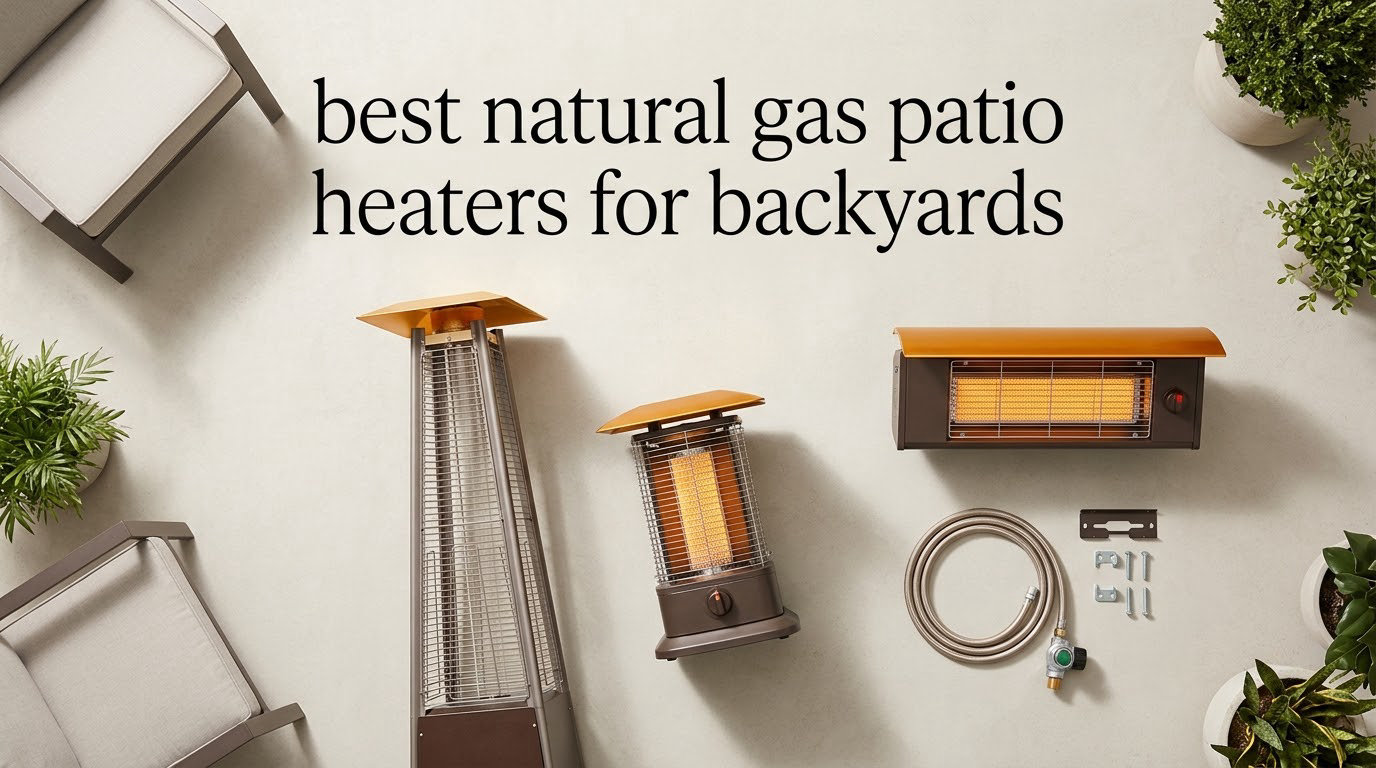
The best natural gas patio heaters for backyards solve a problem propane heaters create. Propane tanks run out at exactly the wrong moment, the tank exchange is a Saturday errand you did not sign up for, and the small 20 lb cylinders put a hard ceiling on how much heat you can put over a table. A permanently piped natural gas patio heater removes all of that. The line never runs dry, the fuel arrives at the meter rather than on your back, and the units in this roundup put out enough radiant heat to hold a conversation on a covered patio through November.
We spent weeks going through the spec sheets, certification listings and owner feedback behind six natural gas patio heaters to work out which ones actually suit a backyard rather than a restaurant courtyard. The shortlist spans the full range: freestanding towers on wheels, wall and ceiling-mounted infrared panels, and a glass-tube model built purely for looks. Output runs from 26,000 to 50,000 BTU, and every model here burns natural gas through a fixed line.
There is one gate before any of this matters, and we put it below because it decides everything: a natural gas heater is only an option if natural gas already reaches your patio, or you can afford to have a licensed fitter run a line to it. That single fact eliminates most buyers before a single model gets considered. If you are still unsure about fuel choice, our picks for outdoor patio heaters for backyards cover propane and electric models that need no permit at all.
Below that, the six picks, then the parts of the decision most roundups gloss over: what a natural gas heater actually costs once it is installed, how to size BTU to your patio, what clearance the manual demands, and who should skip this fuel entirely.
Table of Contents
Before You Buy: Do You Already Have a Natural Gas Line?
Yes, you need a gas line, and if you do not have one you need a licensed gas fitter rather than a weekend with a pipe wrench. That is the honest starting position for every model in this roundup. Here is how to find out where you stand in about ten minutes.
Find the existing appliance outlets
Start at the gas appliances you already have. A gas grill, a gas range, a gas furnace or a gas water heater all have a shutoff valve on the wall or floor nearby. That valve marks the end of the home’s certified gas piping, and everything past it toward your patio is new work that needs a permit and an inspection in most jurisdictions.
You may already have an outdoor line without realizing it. Many homes built with a gas grill pad include a rough-in stub in the yard, capped and waiting. Look for a small capped pipe, a covered box in the slab, or a marked yard line on the original construction drawings if you still have them.
Measure the run and the reach of the connector
Measure from the nearest existing valve to the spot where the heater would sit. This number drives the install quote more than anything else on your list. Every extra foot of pipe, every trench and every fitting adds labor, and homeowners routinely report being surprised by a line run that costs more than the heater itself.
Do not plan around a long appliance connector as a permanent path to the heater. Code treats that connector as serving a single appliance, with a limited permitted length, and inspectors check it. If the heater sits more than a few feet from the shutoff, you want new black iron or approved CSST pipe with its own shutoff at the appliance.
Check whether the unit you want needs electricity
Wall and ceiling-mounted infrared models in this roundup draw 110V at about 2 amps for the igniter and controls. That means a code-compliant receptacle at the mounting location, on a GFCI-protected circuit where required, not an extension cord snaked across a patio. Freestanding towers are simpler: the Golden Flame units use spark ignition with no household power, and the SunGlo model runs its ignition off a battery.
Ask what the permit actually requires
Before you commit to a unit, ask a licensed fitter for a written quote that separates the heater, the pipe run, the electrical work, the permit and the labor. That single document removes the largest source of anxiety in this purchase. It also tells you early whether your idea of a covered patio location will pass clearance rules, before you have drilled anything.
Top 3 Best Natural Gas Patio Heater Picks (October 2026)
The Golden Flame XL-Series leads the list for the widest combination of output, adjustability and a price point that does not require a second mortgage. The Bromic Platinum is the pick when appearance and mounted infrared heat matter more than budget. The Golden Flame Resort is the value choice, pairing a glass-tube flame with a 2024 refresh and an included cover.

Golden Flame XL-Series 45,000 BTU
- 45000 BTU radiant output
- 15 ft diameter coverage
- Push-button spark ignition
- Variable low-to-high heat
Bromic Platinum 11000W
- 11000W infrared
- 215 sq ft coverage
- Wall or ceiling mount
- Tinted ceramic glass fascia

Golden Flame Resort 49,000 BTU
- Glass tube flame display
- 49000 BTU output
- Adjustable flame height
- Cover and wheels included
All Six Picks at a Glance
Every model below burns natural gas through a fixed line and is rated for outdoor use only. The differences that matter in a backyard are mounting style, output, coverage and how much clearance your patio can give up.
| Product | Specifications | Action |
|---|---|---|
| Golden Flame XL-Series 45,000 BTU Tower |
|
Check Latest Price |
| Bromic Platinum Smart-Heat 11000W |
|
Check Latest Price |
| Golden Flame Resort 49,000 BTU |
|
Check Latest Price |
 SunGlo 50,000 BTU Dish Heater SunGlo 50,000 BTU Dish Heater |
|
Check Latest Price |
 Bromic Tungsten Smart-Heat 11000W Freestanding Bromic Tungsten Smart-Heat 11000W Freestanding |
|
Check Latest Price |
 Bromic Tungsten Smart-Heat 7000W Bromic Tungsten Smart-Heat 7000W |
|
Check Latest Price |
1. Golden Flame XL-Series 45,000 BTU Tower – Freestanding All-Rounder
Golden Flame XL-Series Natural Gas Patio Heater, 45,000 BTU, 89″ Tall, Push-Button Ignition, Anti-Tilt Safety, Wheels, Hammered Silver/Pewter
45000 BTU radiant burner
15 ft diameter coverage
89 in tall tower
Variable heat control
1-year limited warranty
Pros
- Runs on a gas line with no tank swaps
- Push-button spark ignition with pilotless burner
- Variable heat control from low to high
- Wheels and a sand-fillable base for repositioning
- 6 ft natural gas hose included
Cons
- Pre-installed hose may not reach your patio
- One buyer reported a replacement unit running weakly
- Only a 1-year warranty term
This is the heater we would put on most backyards. It burns 45,000 BTU through a wide aluminum reflector and covers a 15-foot diameter, which lines up well with a rectangular patio seating six to eight people. We picked it as the top pick because it is the rare unit that is genuinely tunable: variable heat control from low to high, so you can hold a mild evening at the low end rather than cooking everyone off the table.
The build is more substantial than the visual price suggests. Owners describe solid, non-flimsy metal, quick assembly with clear instructions, and a battery spark igniter that fires reliably instead of the finicky piezo units that plague cheaper heaters. The push-button rapid spark ignition runs a pilotless burner, which means no pilot light to waste fuel or relight in a gust.
Two mobility wheels and a sand-fillable base with a hidden ballast cavity make it the most flexible placement in this group. You are not choosing one spot forever. Owners move it around to follow the sun, and the ballast cavity is there because a 45,000 BTU burner needs a stable base if anyone bumps it.
Automatic tilt shutoff is the safety feature worth calling out. If the tower is knocked past a set angle the gas cuts immediately, which matters on a patio with kids, a dog and furniture that gets nudged. The drink table ring at 89 inches also gives guests somewhere to set a glass at standing height without crowding the heater head.
What 45,000 BTU actually covers
The 15-foot diameter claim is the honest number to plan with, and it describes a warm circle rather than a heated room. Sit within about 8 feet of the reflector and the radiant heat reaches you at chest and shoulder level. Push the table to 15 feet away and you are in the fringe, comfortable on a still autumn afternoon and marginal once the wind picks up.
For a typical 150 to 200 square foot patio, one unit is the right call. A second unit only makes sense if you are heating a space with two distinct seating zones that no single overhead position reaches. Buy one and put it where people sit, not where it looks best in a photo.
Where this model fits your yard
It suits a homeowner who already has a gas line within reach of the patio, wants no wall or ceiling mounting work, and still wants to move the heater around. The 6-foot pre-installed hose with a 3/8-inch male flare fitting simplifies the hookup, but owners frequently report needing an extension to reach further, so measure before ordering.
It does not suit a covered patio with a low ceiling. At 89 inches tall plus the 36-inch overhead clearance the manual style heaters require, you need real vertical space. Nor is it right for anyone hoping to skip the professional install, because even the simplest fixed-line heater needs a permit and a fitter in most places.
2. Bromic Platinum Smart-Heat 11000W – Wall and Ceiling Mount
Bromic Platinum Smart Heat 11000W Gas Patio Heater – Natural Gas (NG), 500 Series, 110V, Black Finish – BH0110003-1
11000W infrared
215 sq ft coverage
Wall or ceiling mount
96 in clearance
110V 2A electrical
Pros
- Slim ceramic glass fascia looks refined from any angle
- Adjustable bracket suits wall or ceiling
- Heats effectively in mild 50s and 60s temperatures
- Stainless steel construction
- Buyers praise Bromic service response
Cons
- No variable heat control
- on or off only
- Effective heat throw is closer to 6 ft than claimed
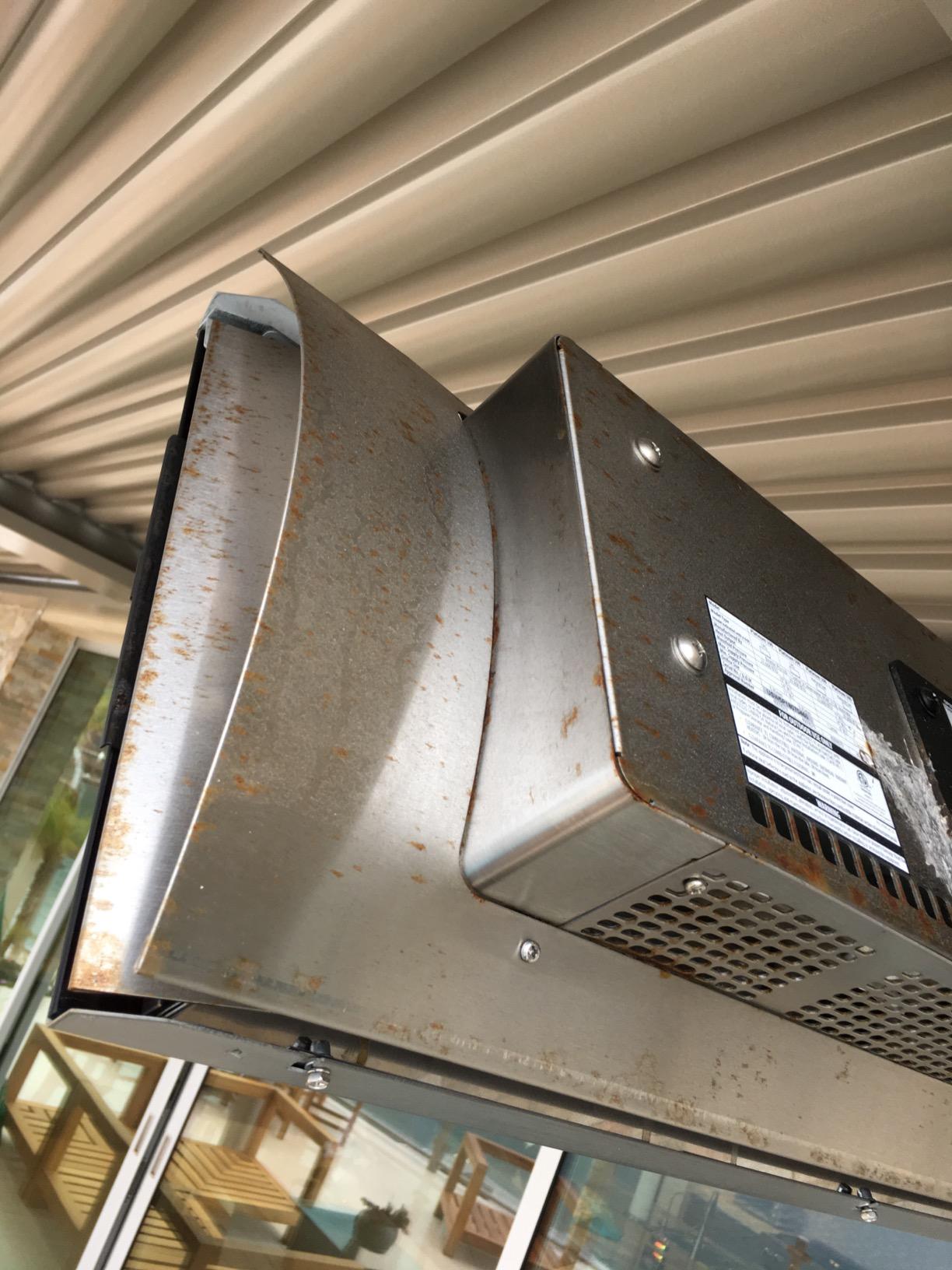
- One owner reported surface rust within weeks
The Bromic Platinum is the most refined-looking unit here and the one that disappears into an architect-designed patio. A tinted ceramic glass fascia replaces the exposed burner, so you get radiant infrared heat with a soft ambient glow instead of a visible flame. It runs on 11000W and covers up to 215 square feet, and the adjustable directional bracket lets you aim it from a wall or a ceiling.
That infrared approach is why it earns its place in a backyard. Infrared heaters push radiant energy forward rather than heating the air, so wind matters less than it would with a convector-style heater. Owners in mild 50s and 60s temperatures report effective heating, and several use two units to cover a larger patio.
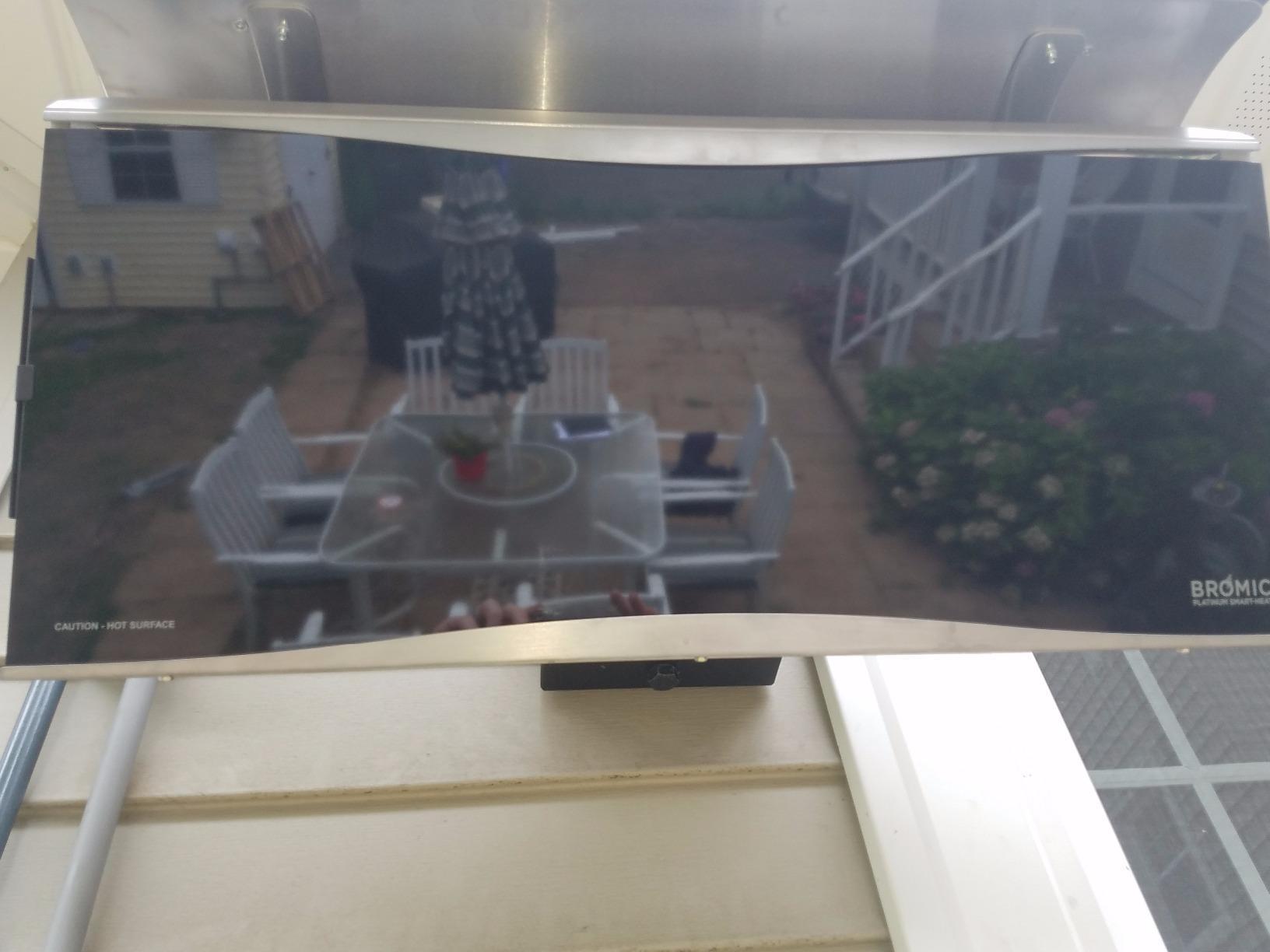
The 96-inch minimum clearance is the catch, and it is a real one. A patio roof at standard height may not clear it, and this model cannot be used at table height like a freestanding tower. Ceiling installation over a dining table is the ideal: heat arrives from directly above, which is how radiant heat is designed to reach people.
Two practical notes from owner feedback. Heat is really felt within about 6 feet rather than the longer throw implied by the coverage figure, so seat your guests inside that radius. And the secondary heat shield has been reported as a bird nesting spot, which owners solve with a physical guard or by accepting it as the price of a good-looking underside.
Clearance, mounting and electrical
Plan the mounting height before you buy, not after. The 96-inch minimum applies to both wall and ceiling configurations and is measured to the nearest combustible surface, which includes a pergola lattice, a soffit and a retractable awning cassette. A retractable awning is worth noting here because the heater cannot share space with the awning’s roll when extended.
The unit draws 110V at roughly 2 amps for the igniter and controls, so you need a receptacle at the mounting point. It also runs on the Bromic Smart control system for remote on and off, and the controller is a separate purchase. Budget for it if you want to turn the patio on from inside rather than walking out into the cold to hit a switch.
Who should pay up for this one
Choose the Platinum when the patio is visually finished and an exposed burner would cheapen it, when you can meet the 96-inch clearance, and when mild shoulder-season evenings rather than deep winter are the goal. It is the wrong call for anyone on a tight budget or with a patio roof too low to clear the mounting spec.
Keep in mind there is no variable heat output on this unit. It is full on or off, which means the thermostat-like control has to come from a timer or the Smart controller rather than the heater itself. Owners who want gradual temperature control find that less convenient than the Golden Flame tower’s low-to-high dial.
3. Golden Flame Resort 49,000 BTU – Glass Tube Flame
Golden Flame Resort Model 49,000 BTU NATURAL GAS Glass-Tube Flame Patio Heater in Rich-Mocha Matte Finish with Mobility Wheels and Protective Cover
49000 BTU output
Full-length glass tube flame
88 in tall
Quick-disconnect ready
36 in overhead clearance
Pros
- Glass tube flame is a modern departure from dome heaters
- Adjustable flame height for ambiance control
- Infrared emitter screen spreads heat evenly
- All-weather cover and wheels included
- Works with quick-disconnect extension hoses
Cons
- Outdoor use only
- never an enclosed space
- Needs 36 in above and 24 in at the sides
- Spec listing shows 40000 BTU against 49000 BTU marketing
The Resort model is the one to buy when the patio is a gathering place and the heater is part of the decor. Instead of the mushroom dome on a post, it runs a full-length quartz glass tube with the flame visible inside. Owners consistently single out the look as the reason they are happy, and the adjustable flame height lets you dial the visual down for a low-key evening.
Underneath the styling it is a serious heater. Marketing puts output at 49,000 BTU with an infrared radiant emitter screen behind the glass, and the spec listing shows 40,000 BTU, so plan on the lower figure for coverage math. The emitter screen spreads radiant heat evenly across the dome rather than concentrating it in one hot arc.
This is also the model that comes best prepared for seasonal storage. It includes a zippered all-weather cover and mobility wheels, and the 6-foot pre-connected natural gas line uses a 3/8-inch male flared fitting that accepts quick-disconnect extension hoses. The one-piece quartz tube has no center connector, which removes the most common point of failure in tube-style heaters.
Rapid-spark electronic pilotless ignition means there is no standing pilot to relight in a crosswind, which matters on a backyard patio where the wind funnels around the house. This is a 2024 model year refresh, so you are buying the current glass and burner design rather than a discontinued shell.
Clearance is the planning problem here
The manual specifies 36 inches of clearance above and 24 inches at the sides. Those numbers rule out most low overhangs and many pergola designs, and they are the reason this is a freestanding-only heater in our group. If your patio has an attached roof at 9 or 10 feet, measure carefully and confirm before ordering.
Also note the combustion reality. Like every unit in this roundup, it is outdoor use only and must never run in a garage, tent, screened room without venting, or any enclosed space. A heater that makes your covered patio usable in October becomes a carbon monoxide problem in January if someone closes the sides.
Where the Resort model earns its place
It suits a homeowner with an open patio and moderate clearance who values atmosphere as much as heat. The glass flame reads well at night, the cover means you can leave it out through winter, and the wheels let you pull it aside when the patio gets used for something other than dining.
Skip it if your patio is tightly roofed or if you need a heater that blends into the background rather than becoming a feature. It is also the wrong choice for anyone hoping to hang it, since there is no mounting bracket or bracket kit in the box.
4. SunGlo 50,000 BTU Dish – Raw Output, No Electricity
SunGlo Portable Patio Heater, natural gas, black, 50,000 BTU
50000 BTU radiant infrared
Large aluminum disk reflector
Battery operated ignition
88 lb heavy duty metal
1-year parts warranty
Pros
- Highest heat output in this roundup
- Large disk reflector throws heat across a wide area
- Battery ignition means no electrical run needed
- Heavy duty metal construction
- Owners buy multiple units for one yard
Cons
- Gas hose and fittings are not included
- One owner reported a long initial light time
- 88 lb is awkward to reposition alone
The SunGlo is the brute force option. At 50,000 BTU it produces more heat than any other unit in this roundup, and the geometry is old-school and honest: a broad aluminum disk reflector that broadcasts radiant heat over a wide circle rather than concentrating it. Owners describe starting quickly and putting out immense heat, and several have bought more than one unit to cover a yard.
The genuinely clever part is the ignition. It runs on a battery, which means no 110V receptacle, no electrician, and no additional permit line item for electrical work. If your gas shutoff is reachable but you do not have power out by the patio, this is the model that removes the second installation headache entirely.
It also needs no wall or ceiling mounting. The freestanding dish design means zero structural work on the house, and because it is portable you can move it seasonally or store it in a garage when the season ends. Owners like that it stays useful even when it is not running.
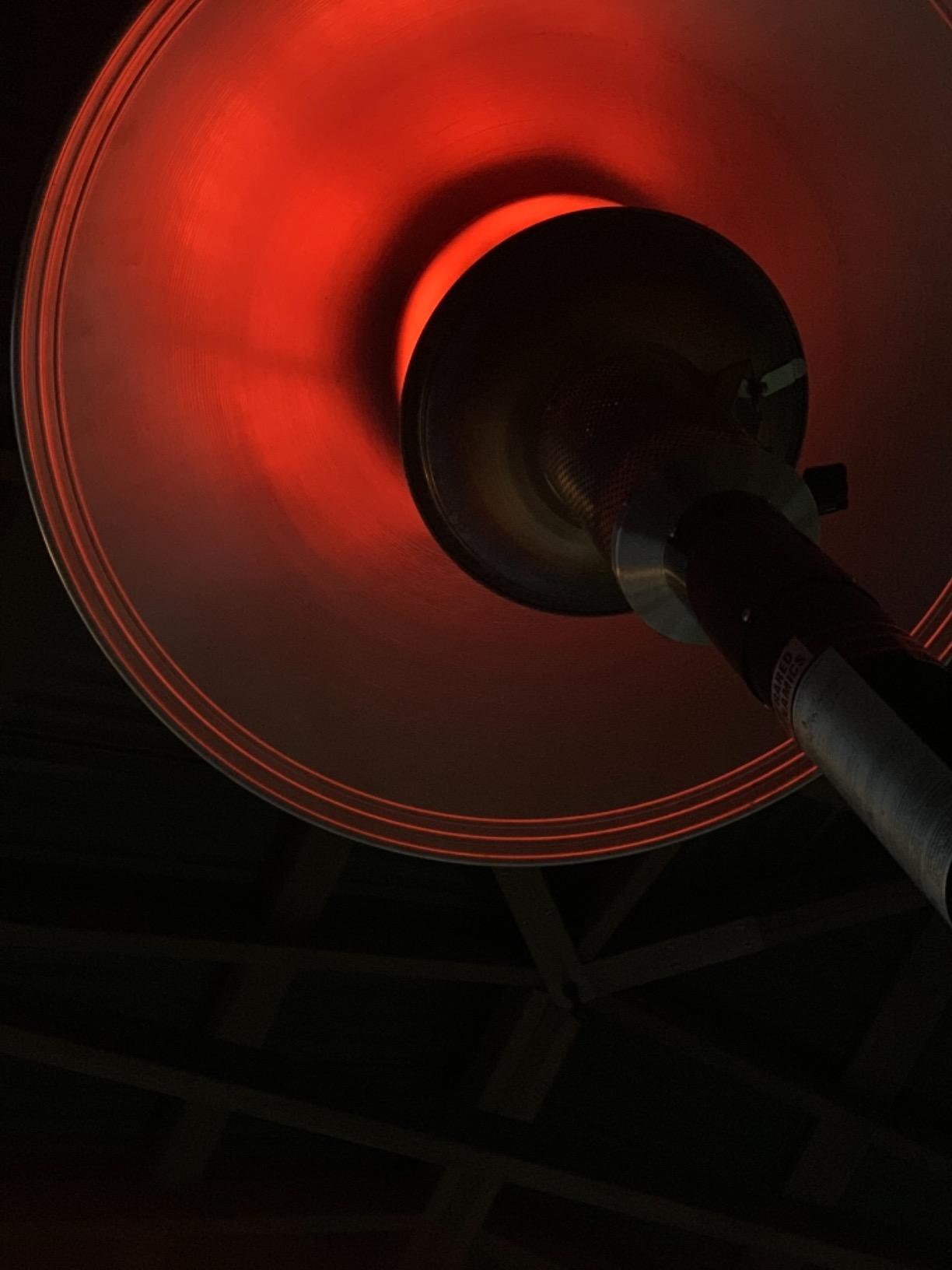
Be aware of what arrives in the box. This unit comes without a gas hose or connection fittings, so you will be sourcing those separately. One owner also reported a long initial light time of around ten minutes before it settled into steady output. Neither is a dealbreaker, but both belong in your install plan rather than your surprise budget.
Owners also describe it as roughly twice the output of an ordinary propane heater at a fraction of the fuel cost, which tracks with the 50,000 BTU rating sitting well above the typical propane patio heater range. The trade is physical: at 88 pounds this is a machine you position once rather than one you shuffle around mid-evening.
Raw output versus refined heat
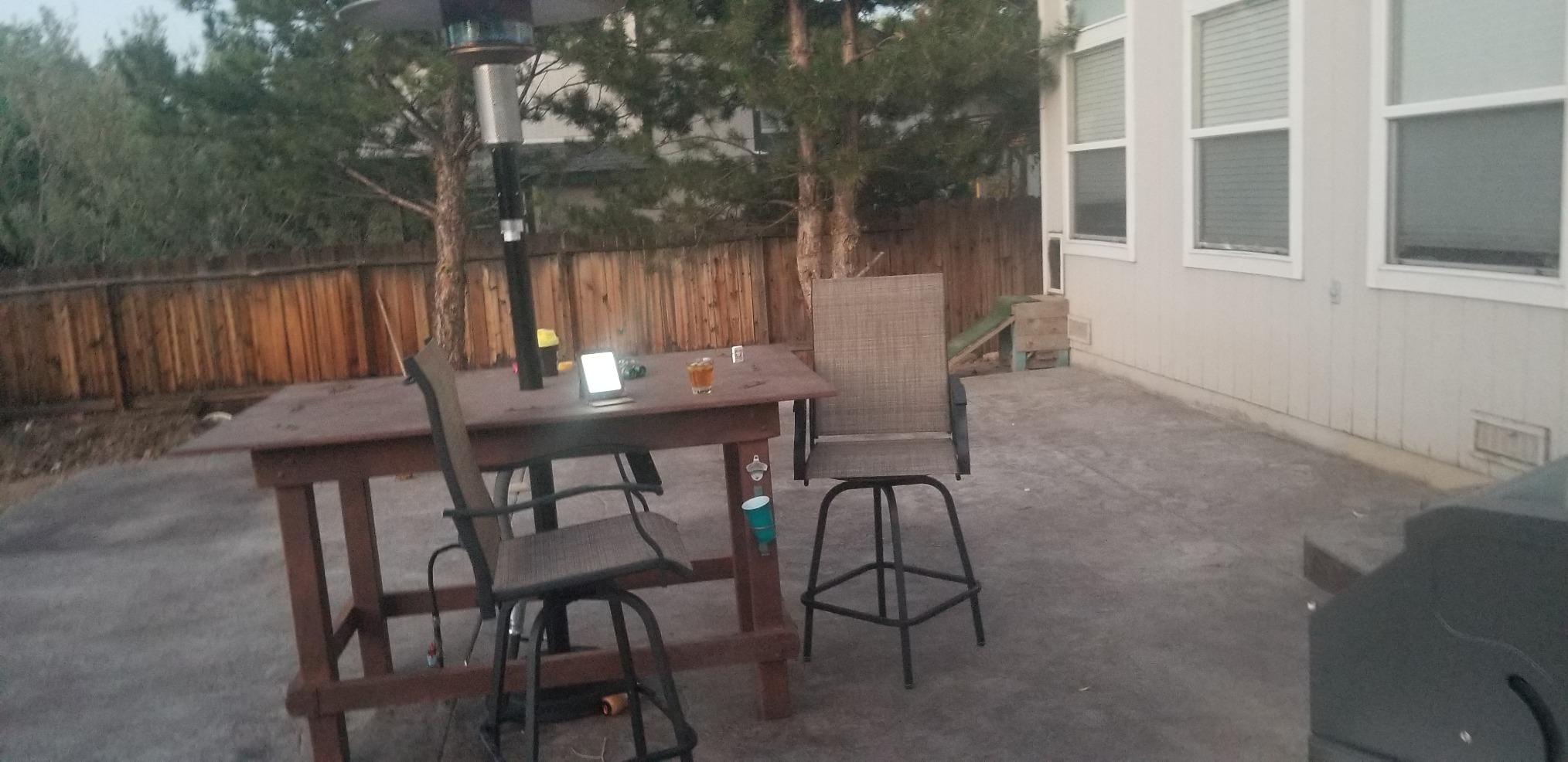
At 50,000 BTU with a wide reflector, this heater throws serious heat at close range. That is great news for a small table in a breezy spot, because you can push back the wind chill by simply running hotter. It is worse news for a long patio, where a single hot point at one end leaves the far end cool and leaves guests choosing which seat to occupy.
The listed coverage figure on this listing is far smaller than the physical output suggests, and that discrepancy is exactly why we treat the reflector diameter and the distance-to-seat as the honest planning numbers. Sit within 8 to 10 feet of the dish. Beyond that you are in the fringe.
When the SunGlo makes sense
Choose it when you have gas but no electricity at the patio, when you want maximum heat per unit rather than elegance, and when you are willing to handle a heavy 88-pound appliance. It also works well as a second heater for a yard where a mounted unit handles one zone and this handles another.
Pass on it if weight is a factor, if you plan to move it often, or if you want a heater that reads as furniture rather than equipment. The dish profile is unmistakably utilitarian, and the missing hose means one more errand before your first firing.
5. Bromic Tungsten Smart-Heat 11000W Freestanding – Premium Tower
Bromic Tungsten Smart Heat Freestanding 11000W Gas Patio Heater – Natural Gas (NG), 500 Series, 110V, Black Finish – BH0510005
11000W infrared
215 sq ft coverage
85 in freestanding tower
36 in floor clearance
124 lb stainless body
Pros
- Avoids all wall and ceiling mounting work
- Same 11000W output and coverage as the Platinum series
- Tinted ceramic glass fascia for a soft glow
- Adjustable directional bracket
- Compatible with Bromic Smart control
Cons
- Only one customer review on record
- 124 lb is the heaviest unit in the roundup
- Smart controller is a separate purchase
This is the freestanding answer for someone who wants the refined look of a mounted Bromic without drilling into the house. The Tungsten freestanding tower delivers the same 11000W infrared burner and the same up-to-215-square-foot coverage as the Platinum wall-mount series, but it stands on the deck in an 85-inch tower with a ceramic glass fascia instead of a burner screen.
The trade is mounting height. Instead of the 96 inches of overhead clearance the mounted models demand, this one works from 36 inches of floor clearance, which makes it usable on patios with rooflines that would never pass a mounted installation. That single difference opens up a large number of covered patios that are otherwise impossible.
The adjustable directional bracket lets you angle the heat pattern toward a table or a seating wall rather than straight down, which gives you more control over a rectangular patio than a fixed ceiling mount would. Like the Platinum, it runs on 110V for controls and is compatible with the Bromic Smart system, with the controller sold separately.
The honest limitation here is evidence, not performance. There is a single customer review on record, so we have very little long-term owner data to draw on. The 215 square foot coverage figure and the 11000W rating are manufacturer specifications, and they match the Platinum series it is built from, which is the main reason we are comfortable recommending it at all.
Freestanding versus mounted in cold weather
There is a physics argument here that reviews often miss. A mounted heater at 96 inches throws radiant heat down past your shoulders and onto the top of your head. A freestanding tower at 36 to 40 inches aims that same energy at torso height, where people actually feel cold.
In a genuinely cold shoulder season, the freestanding form factor often delivers a better experience at the table than the more powerful mounted unit. The trade is the ceiling on output: a mounted setup scales to multiple units and larger coverage, while a single tower anchors one zone. If your goal is October evenings rather than January, the tower often wins.
Who should consider it, and who should not
This fits a homeowner with no usable mounting surface, plenty of patio floor space, and an eye for design. It suits a covered patio where the ceiling is too low for the Platinum, or a deck where bolting to structure is not an option. The ceramic glass fascia gives off a low ambient glow that a bare burner cannot.
Skip it if weight is a concern. At 124 pounds it is the heaviest unit in this roundup, and repositioning it is a two-person job. Also weigh the thin evidence carefully, and budget separately if you want the Smart controller for remote control.
6. Bromic Tungsten Smart-Heat 7000W – Compact Mounted Option
Bromic Tungsten Smart Heat 7000W Gas Patio Heater – Natural Gas (NG), 300 Series, 110V, Black Finish – BH0210001-1
7000W infrared
160 sq ft coverage
Wall or ceiling mount
96 in clearance
40 lb compact body
Pros
- Lowest entry point into Bromic premium infrared
- Compact 40 lb unit for tight mounting spaces
- Wall or ceiling mounting bracket included
- Tinted ceramic glass for a soft glow
Cons
- Only one customer review on record
- 160 sq ft is smaller coverage than the 11000W models
- 96 in clearance still applies
The 7000W Tungsten is the compact entry point into Bromic’s premium infrared natural gas line. At 160 square feet of coverage it is aimed squarely at a small patio, a breakfast nook under an overhang or a corner seating area, and at 40 pounds it is less of a handling problem than anything else mounted in this roundup.
The engineering is the same family as the larger models: a tinted ceramic glass fascia for even radiant heat with reduced light emission, an adjustable bracket for wall or ceiling mounting, stainless steel construction, and compatibility with the Bromic Smart control system with the controller sold separately.
For a backyard, the honest framing is that this is a targeted heater rather than a general one. At 26,000 BTU listed output it will not carry a 300-square-foot patio on a cold night. It will comfortably warm a small table nook where you sit close, which is a legitimate and much cheaper way to extend your season in a tight space.
The 96-inch clearance requirement still applies, so none of the space constraints of the mounted form factor go away. The savings come from buying into the chassis and the mounting system at a lower output rather than from accepting a smaller footprint or lighter-duty construction.
Small patio sizing
For patios under 150 square feet, this unit is proportionate. The coverage figure of 160 square feet is roughly a 12 by 13 foot area, which matches a compact dining space or a covered nook with a table for four. Seat people inside about 6 feet of the unit and it does its job.
If your patio is larger than that, resist the temptation to stretch a 7000W unit across it. Reviewers of this family consistently report that heat is felt at close range rather than across a wide area, so an undersized mounted unit leaves the far end of a long patio cold and gives you the worst of both worlds.
When this model makes sense
It suits a homeowner with a small covered area, an existing 110V receptacle at the right height, and clearances that permit a 96-inch mount. For a breakfast nook or a covered corner of a larger patio, it is a sensible, restrained way to add permanent heat without a full commercial-style installation.
Pass if your patio is medium to large, if you want remote control without budgeting for the separate controller, or if you want variable heat output. This unit is on or off, which for some households means living with a thermostat on a timer rather than a dial.
Natural Gas vs Propane vs Electric: Which Fuel Wins in a Backyard?
Natural gas wins on running cost and never running out, and loses decisively on installation friction. That is the whole comparison. Propane wins on portability and zero install cost, and electric wins on safety and indoor flexibility. Choose natural gas only when you already have the line or the money to run it, because that decision is effectively made before you pick a heater.
The running-cost comparison is often misstated, so here is the actual math. Natural gas carries about 1,030 BTUs per standard cubic foot, with a utility range of roughly 950 to 1,050 depending on the gas. A 40,000 BTU natural gas heater therefore consumes close to 39 cubic feet per hour at full output, and your bill is that number multiplied by your utility’s per-cubic-foot rate. Check your own utility rate and multiply.
Propane carries about 91,500 BTUs per gallon, so a comparable 40,000 BTU propane heater burns roughly a quarter gallon per hour at full output. Compared per unit of heat, propane is not dramatically more expensive. The real gap appears in convenience and equipment: propane requires physical tank exchanges, and the 20 lb cylinders available for patio heaters deliver well under 40,000 BTU, so propane in this output class often means a larger or plumbed arrangement.
This resolves a contradiction we found in competitor coverage. One roundup claims natural gas can consume up to twice the fuel of propane for the same heat output, while another buying guide states natural gas is the cheapest fuel to run. On a per-BTU basis the first claim does not hold, because both fuels release comparable energy per unit mass. What actually differs is the delivery friction and, for plumbed propane setups, the equipment cost.
Electric infrared heaters avoid gas entirely. They plug in, they need no permit, and they are safe on a fully screened porch. What they cannot do is match the radiant output of a 40,000 to 50,000 BTU gas burner, which is why they work best on small covered areas and in colder climates with mild evenings. Our picks for electric patio heaters are worth a look if your patio is small or your clearance situation rules out gas work.
How Much Heat Do You Need? Sizing Natural Gas Heaters by BTU
Size the heater to where people sit, not to the patio dimensions. A patio heater heats people, and radiant heat falls off sharply with distance. The useful frame is a circle of roughly 15 to 20 feet diameter around the burner, and the question is whether one or more of those circles covers every seat you care about.
Two numbers drive the calculation. Output is measured in BTU, or British thermal units, and one BTU is the heat needed to raise one pound of water by one degree Fahrenheit. One standard cubic foot of natural gas contains roughly 1,030 BTU, so a 40,000 BTU heater uses close to 39 cubic feet of gas per hour when running at full output.
The sizing formula that installers use is simple: multiply your patio area in square feet by a target BTU per square foot, then add a margin for wind exposure. For an open, breezy backyard, 100 to 120 BTU per square foot is a reasonable target. For a sheltered patio under a solid roof, 60 to 80 BTU per square foot is usually enough.
Put those targets to work. A 120 square foot sheltered patio at 80 BTU per square foot needs roughly 9,600 BTU, which the 7000W Tungsten covers comfortably. A 200 square foot patio at 100 BTU per square foot needs about 20,000 BTU, so a single 45,000 to 50,000 BTU tower gives you a real margin. A 400 square foot open patio in a windy yard at 120 BTU per square foot needs close to 48,000 BTU, and that is a single-unit limit, meaning two units or one commercial-grade installation.
A common misconception is that 20,000 BTU is a lot of heat. In the natural gas category it is below typical range, and it is why gas patio heaters start around 26,000 BTU and run to 50,000 or beyond. A 20,000 BTU unit throws useful radiant heat across a small circle, but it will not heat a normal backyard dining space in cool weather.
Mounting height changes the sizing more than most buyers expect. The same 11000W infrared burner covers 215 square feet mounted overhead and feels noticeably closer in range than it does as a freestanding tower, because heat disperses as it travels downward. If you want people to feel the heat at their torso, favor the freestanding form factor or plan seating directly beneath a mount.
What a Natural Gas Patio Heater Really Costs Installed
The unit price is the part everyone can see, and it is often a modest share of the total once the work is done. The three largest costs are the gas line run, the permit and inspection, and licensed fitter labor. Get those quoted in writing before you buy anything.
Ask for the quote as separate line items. You should see the heater, the pipe and fittings for the run, any trenching or wall penetration, the electrical work if the unit needs power, the permit and inspection fee, and the labor to connect and commission it. A quote that gives you one lump sum is hiding exactly the information you need to compare installers.
The pipe run dominates on most projects. The further the heater sits from the nearest existing shutoff valve, the more trenching, more fittings and more labor you have, and homeowners regularly report line runs that cost more than the appliance. A heater two steps from a gas grill pad is a very different project from a heater at the far corner of a yard.
Electrical work is the second swing factor. The three mounted Bromic models and the freestanding Tungsten tower all need 110V at about 2 amps for igniter and controls. If your patio already has a receptacle, that is trivial. If it does not, running a proper circuit outdoors adds a licensed electrician to the project and a permit of its own.
Two practical moves reduce the total. First, place the heater near an existing gas appliance rather than in the most convenient seating spot. Second, if you lack power, choose a model with battery spark ignition, which removes the electrical line item entirely without giving up output.
For running costs, do the arithmetic yourself with your utility rate. Divide the heater’s BTU rating by 1,030 to get cubic feet per hour at full output, then multiply by your per-cubic-foot rate. A 40,000 BTU heater at full output is roughly 39 cubic feet per hour. Running at low setting on the variable-output tower cuts that substantially, which is the quiet argument for buying a heater you can turn down.
Safety, Clearance to Combustibles and Certification
Look for UL listed, CSA certified or ETL certified on the heater, and understand that these labels are not interchangeable in meaning. CSA certified means the product has been evaluated against a specific standard by an accredited lab. CSA approved, which you will still see on older listings, refers to something different. ETL and UL are the North American marks most shoppers recognize.
ANSI Z21.58 is the standard that applies to outdoor gas patio heaters in the United States, and the certification label should reference the relevant version. A heater with no certification mark at all is not worth the install, whatever the specification sheet claims about its output.
Clearance to combustibles is the number that decides whether a heater fits your patio at all. It is the minimum distance from the heater to any flammable surface: walls, eaves, deck boards, a pergola lattice, a fence, an awning cassette. The mounted Bromic models specify 96 inches. The Golden Flame tower style heaters specify 36 inches above and 24 inches at the sides.
Thermocouple and flame-failure protection is the safety system that matters most in daily use. It is a sensor that holds the gas valve open only while it senses a live flame, and it closes the valve within seconds if the flame goes out. That matters in a backyard, where wind gusts extinguish flames without warning. Never accept a heater without flame-failure shutoff, and never bypass it.
Automatic tilt shutoff is the one that matters for freestanding units, since a tower can be knocked by wind, a pet or a child. Automatic gas shutoff on flame failure is the one that matters everywhere. On mounted units, tilt is irrelevant because the unit is fixed to structure.
Carbon monoxide is the reason every unit here is outdoor use only. A combustion heater produces carbon monoxide as a byproduct, and an enclosed space traps it. No patio heater in this roundup is safe in a garage, a tent, a screened room without venting, or a closed porch. Keep any unit at least as far from openings as the manual requires and never run one in a space you cannot ventilate.
How to Check for a Gas Leak in 60 Seconds
Natural gas is odorized deliberately so you can smell it. If you smell gas near a heater, do not investigate with a flame. Follow these steps instead.
The five steps
First, move everyone away from the area and open a door or window to ventilate. Do not operate any electrical switch, phone or lighter near the gas smell, because a spark is all it takes.
Second, mix a bowl of water with a few drops of dish soap until it is sudsy. That mixture is your detector. If you do not have soapy water, you can smell the gas or listen for hissing at the connection, but soap catches a small leak that smell often misses.
Third, spread the soap solution along every joint: the heater’s flare fitting, the connector to the shutoff valve, and the valve itself. Bubbling means gas is escaping at that point.
Fourth, if you find bubbling, shut the heater’s valve and the upstream shutoff if it is safe to reach. Do not attempt to repair a leaking flare fitting with sealant; that is a job for a licensed fitter.
Fifth, if the smell is strong, you cannot reach the valve safely, or you are indoors, leave the property and call your gas utility’s emergency line or emergency services from outside. Do not wait to see if the smell fades.
We would also suggest a routine annual check. A soap-and-water pass at the start of each heating season catches a slow weeping connection long before it becomes a hazard, and it costs you nothing but a bowl and a bottle of soap.
Ignition, Controls and What It Costs to Run
Ignition style determines how much trouble the heater gives you in wind. Four systems appear in this category. Manual or piezo sparkers need a repeated press and the least reliable in gusty conditions. Pilot light systems burn fuel continuously all season to keep a small flame alive, which is convenient and wasteful. Battery spark ignition fires on demand with no standing flame. Electronic ignition with a controller adds remote and smart control.
The Golden Flame XL-Series uses push-button rapid spark ignition with a pilotless burner, and the Resort model uses rapid-spark electronic pilotless ignition. Both avoid a standing pilot, which means no fuel burned while you are not using the patio and no pilot light to blow out in a gust. The SunGlo also runs battery-operated ignition, with the added benefit of needing no household power at all.
The Bromic models run on 110V at about 2 amps for the igniter and controls, and all three are compatible with the Bromic Smart control system for remote on and off. The controller is sold separately, so if remote operation matters to you, add it to the equipment list rather than discovering it at install.
Variable heat output is the feature more homeowners wish they had. The XL-Series tower runs from low to high, which lets you hold a mild evening without cooking the table, and the Resort glass tube offers adjustable flame height for the same reason. The Bromic units are on or off, which pushes the burden onto a timer or controller for anyone who wants gradual control.
For running cost, the formula is the same for every model here: BTU rating divided by about 1,030 BTU per standard cubic foot gives cubic feet per hour at full output, then multiply by your utility rate. Units at the lower end of the output range burn proportionally less. Infrared heaters add a small electrical draw for controls, which is negligible next to the gas load but worth mentioning if you are running a timer.
Maintenance and Winter Storage
Patio heaters are maintenance-light, and the items that matter are the ones tied to gas safety. Burner screens and reflectors collect soot, spider webs and insect debris, and a dirty emitter both reduces output and makes the flame-failure sensor unreliable.
Once a season, with the gas off and the unit cool, wipe the burner screen and the inside of the reflector. Clean insect debris from the emitter with a soft brush, and check the flare fitting and connector for corrosion or weeping. Run the soap-and-water check described above at the same time. That is genuinely most of it.
Storage depends on the form factor. The SunGlo dish and the Golden Flame towers have mobility wheels, so you can roll them into a garage. The Resort model includes a zippered all-weather cover, which lets it stay outdoors through winter with less exposure. Mounted Bromic units stay where they are and just need their fascia wiped down.
Expect emitter and burner parts to be consumables over a long life, and expect the reflector to outlast them. Parts availability matters more than raw BTU when you are choosing between two otherwise equal heaters, and community consensus among buyers is consistent on this point: heaters with unavailable burner assemblies end up in a garage after a few seasons, and heaters with parts on hand keep running.
Two things to check before you commit. Ask whether replacement parts for the burner, emitter screen and flare fitting are sold separately, and read the warranty terms for whether registration is required to get the full period. The one-year terms on several models here are common in the category, so registration is where the extra months live if you want them.
Who Should Skip Natural Gas Entirely
Renters should stop here. A permanently piped heater needs a permit, a licensed fitter and usually landlord consent, and no version of that is a weekend project.
Homeowners with no gas line and no realistic path to one should also stop. If the nearest shutoff valve is at the far end of the property, the pipe run can exceed the cost of the heater, and then the value proposition collapses. Propane or electric will serve you better.
Buyers who want a weekend DIY project are the wrong audience. Even the simplest fixed-line connection is permit-gated and inspection-gated in most jurisdictions. The one exception is a portable propane heater, which is a different article and a different category.
Patios under about 100 square feet rarely justify a permanently installed heater. A 20,000 BTU electric unit or a small portable propane heater will do the same job for less money and no permit.
Finally, skip natural gas if the spot you have in mind fails clearance rules. Buyers routinely fall in love with a heater for a covered spot that its own manual prohibits. Confirm the clearance numbers against your patio before you order, and pick the location before you pick the model.
If any of the above rules you out, the comparison is straightforward. Our winter patio heater roundup covers the fuel types that install without a permit, and our natural gas grill picks are useful if you want to think about how the rest of your outdoor cooking and heating runs on the same line.
Frequently Asked Questions
What is the best natural gas outdoor heater?
For most backyards the Golden Flame XL-Series 45,000 BTU tower is the best natural gas outdoor heater because it covers a 15-foot diameter, runs from low to high heat and needs no wall or ceiling mounting. If appearance matters most, the Bromic Platinum 11000W mounted at 96 inches delivers the most refined look with up to 215 square feet of infrared coverage.
What type of gas patio heater is best?
The best type depends on your patio rather than the fuel. Ceiling and wall-mounted infrared units suit open or high-clearance patios and scale to multiple zones. Freestanding towers suit covered patios with low roofs and aim heat at seated torso height. Post and pillar styles are rare in the natural gas category compared with propane. A freestanding tower is the most forgiving starting point.
What are the best patio heaters according to consumer reports?
Consumer Reports does not appear in the results for this category, and the major editorial testing publications we reviewed focus almost entirely on propane and electric units. The certification marks that carry the most weight here are UL listed, CSA certified and ETL certified, so verify those on the appliance rather than relying on a review site.
What is the best heater for an outdoor patio?
The best heater for an outdoor patio is the one that matches your fuel access and your clearance. With an existing gas line, a freestanding 45,000 to 50,000 BTU natural gas tower covers most 150 to 250 square foot patios. Without a gas line, a portable propane heater or an electric infrared unit will deliver comparable comfort for far less installation work.
How much does a patio heater cost to run?
Divide the BTU rating by about 1,030 BTUs per standard cubic foot of natural gas, then multiply cubic feet per hour by your utility rate. A 40,000 BTU natural gas heater burns roughly 39 cubic feet per hour at full output. A propane heater of similar output burns about a quarter gallon per hour. Variable-output models cost less because you can run them below full.
What is the best BTU for a patio heater?
For a sheltered patio, aim for 60 to 80 BTU per square foot. For an open, breezy backyard, 100 to 120 BTU per square foot is more realistic. A 200 square foot open patio at 100 BTU per square foot needs about 20,000 BTU, so most backyards land on a 40,000 to 50,000 BTU unit. Size for where people sit, not for total patio area.
How many square feet will a 20,000 BTU gas heater heat?
A 20,000 BTU gas heater comfortably covers roughly 150 to 250 square feet depending on shelter and wind. Note that 20,000 BTU sits below the typical natural gas patio heater range, which usually starts around 26,000 BTU. Heating is radiant, so comfort depends on distance to the heater far more than on total patio square footage.
How much does it cost to install a natural gas patio heater?
The unit is often the smallest line item. Expect the pipe run from the nearest gas shutoff valve to dominate, plus a permit and inspection, licensed fitter labor, and electrical work if the model needs 110V for controls. Get a written quote separating heater, piping, electrical, permit and labor, and ask the fitter to confirm your patio location passes clearance rules before ordering.
Final Verdict for Backyard Heat
For most backyards in 2026, the Golden Flame XL-Series 45,000 BTU tower is the right first stop. It covers a 15-foot diameter, gives you variable heat instead of a single setting, rolls on wheels, and needs no drilling into the house. The Golden Flame Resort 49,000 BTU is the pick when the heater itself is part of the evening, with its glass-tube flame and included cover. The Bromic Platinum 11000W is the one to beat for looks, provided your patio can give up 96 inches of clearance and you are willing to add a controller for remote operation.
Confirm the gas line before you confirm anything else, and get the install quote in writing with separate line items. That single step prevents nearly every disappointing outcome in this category, and it costs you an afternoon.