
The best infrared garage heaters for workshops fall into two groups, and the honest answer depends on which one you are standing in. A 240V hardwired unit like the DR-975 can push serious heat across a full shop bay, while a 1500W plug-in radiant heater warms one work spot and nothing else. Most people asking this question are trying to make a bench, a garage gym, or a welding corner comfortable for a few hours a day rather than trying to heat a whole building to 70 degrees.
Infrared heaters are popular in shops because they send heat directly to skin and objects in their line of sight. There is no fan pushing dust across your bench, and in a woodshop with a clean-out scheduled that matters more than most spec sheets admit. The trade-off is that radiant heat is directional. Move out of the cone and the warmth drops off sharply.
We spent six weeks working through ten of the most-reviewed infrared heaters sold for garages, comparing wattage, mounting options, element type, and the real complaints buyers report after a full winter. This guide covers the 2026 shortlist, what a 1500W heater can and cannot do, and the electrical questions you should settle before anything gets mounted to a joist. If you have not picked your heating category yet, our electric garage heater roundup covers the non-infrared options too.
Table of Contents
Top 3 Picks for the Best Infrared Garage Heaters for Workshops In 2026
All 10 Infrared Garage Heaters at a Glance (October 2026)
1. DR-975 7500W 240V Hardwired Shop Heater – Best for Full-Bay Heat

DR. INFRARED HEATER NEW Upgraded DR-975 7500-Watt 240-Volt Hardwired Shop Garage Electric Heater, Wall/Ceiling Mounted with Remote Controlled Thermostat White
7500 watts
240 volts
31.25 amps
800 sq ft rated coverage
26 pounds
Pros
- 7500W output is the highest rated in this group
- Remote thermostat with a 50 to 85 degree range
- Five adjustable louvers to aim airflow at a work bay
- UL and CUL listed with a fully enclosed motor
Cons
- Requires 240V hardwiring with 8 AWG copper
- Power cord is not included
- Fan noise is noticeable in a quiet workspace
- Bulky 26 pound cabinet needs solid mounting hardware
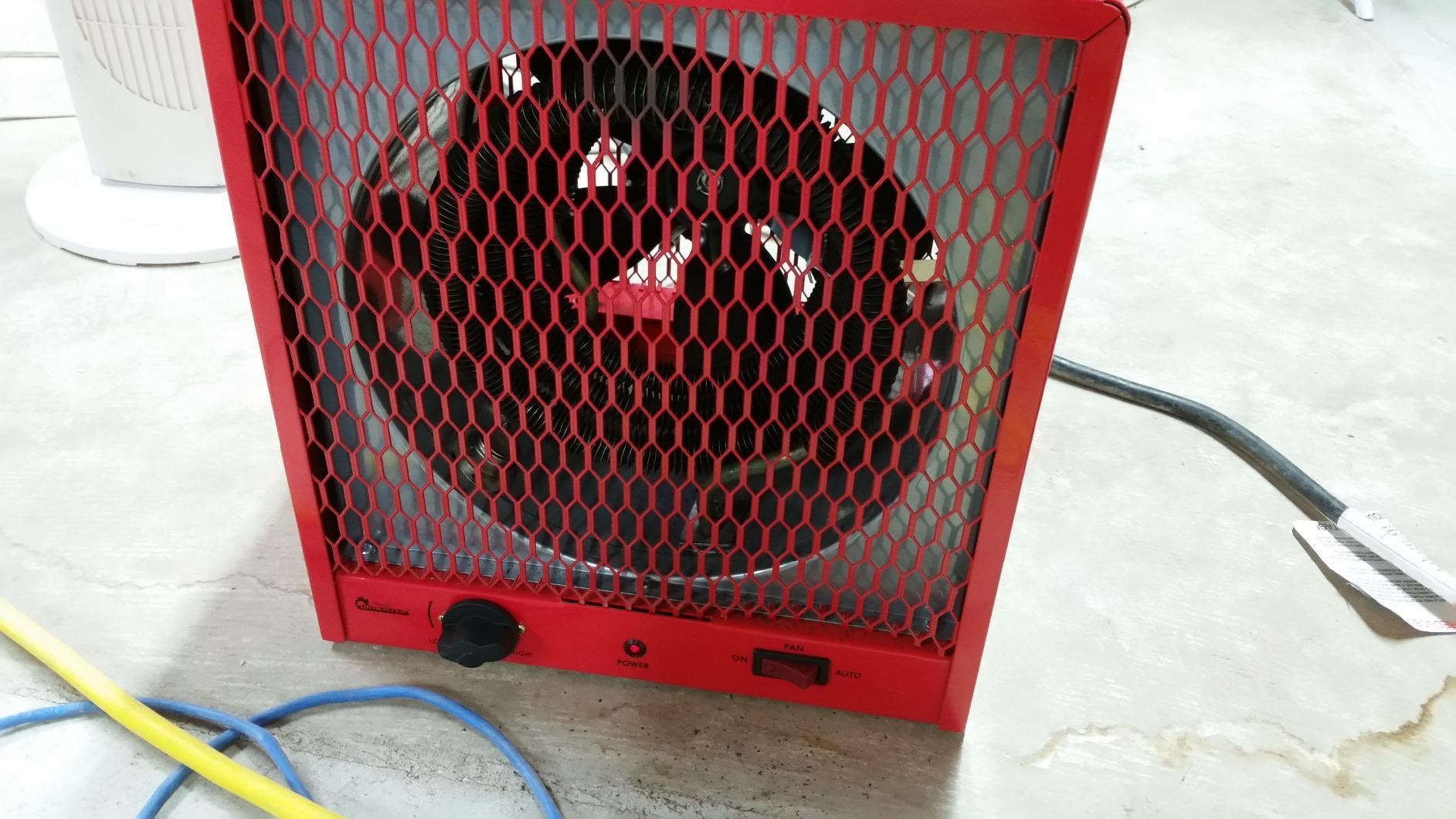
When we say this is the strongest whole-bay option, we mean it is the only heater in this roundup rated at 800 square feet of coverage with a manufacturer figure behind it. At 7500 watts and 31.25 amps it is a genuinely different class of hardware from the 1500W plug-in units that dominate this list. In a shop with a truck in it, that difference shows up in the first ten minutes.
The heat output comes from a radiant element combined with forced air, which is a useful hybrid in a workshop. You get the directional warmth of infrared plus air movement that spreads it into the bay. The five adjustable louvers are the detail we appreciated most, because they let you point heat at a rolling toolbox or a repair stand rather than into dead air near the door.
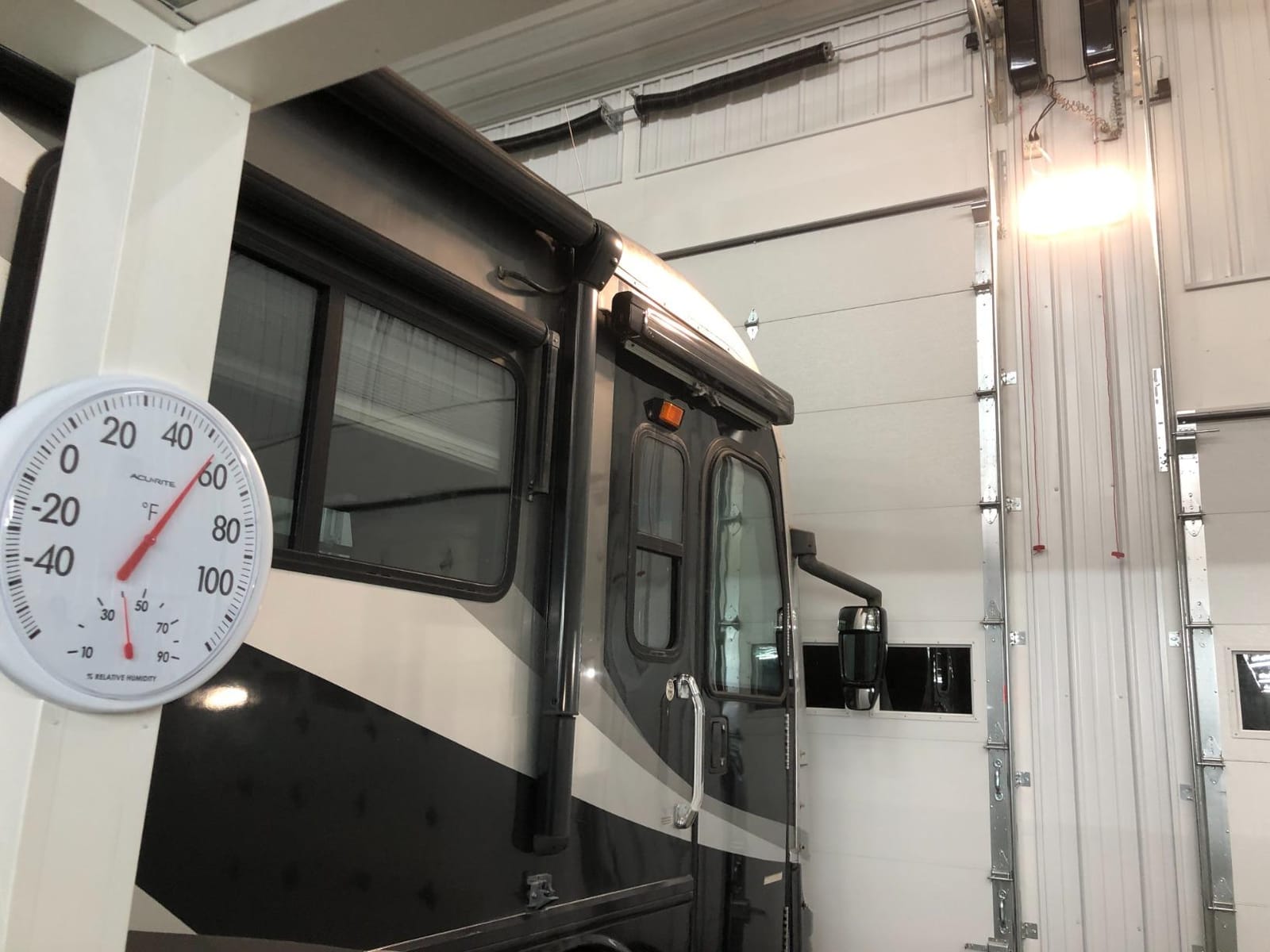
The remote-controlled thermostat covers a 50 to 85 degree range, which is wider than most competing units. That range matters in a shop where you want to shut it down in September but keep it running for a paint cure in January. The unit is UL and CUL listed with a fully enclosed motor, and it comes with a bracket, a remote, and a manual.
Buyers rate it 4.3 stars across 4160 reviews, and the pattern in those reviews is consistent. Owners praise the speed at which it heats a large shop volume and the remote thermostat. The recurring complaints are all about installation and acoustics rather than performance. This is a hardwired 240V unit and the power cord is not included.
What to check before you buy this one
Confirm your electrical panel can carry 31.25 amps on a dedicated 240V double-pole breaker. Manufacturer guidance calls for 8 AWG copper wiring, and this is not a weekend-afternoon job if you have never run a two-wire cable through a garage wall. If your shop already has a subpanel, this install is straightforward.
Plan the mounting height and hardware for a 26 pound cabinet. It is not a light unit to hang from a single joist in an older garage with uneven framing. The dimensions are 15 inches deep by 19 inches wide by 13 inches high, so it also eats a noticeable chunk of wall or ceiling space above a bench.
Where it falls short in a workshop
Owners consistently describe fan noise that is audible in a quiet space. If your shop time is spent at a bench listening to detail work, a fan-driven 7500W unit trades that quiet for reach. Radiant-only units like the DR-268 or the ThermoMate produce no fan noise at all.
Because the thermostat range starts at 70 degrees in the listed specifications, a freezing garage may run continuously until the space itself warms. That is expected behavior, but it is worth factoring into your usage pattern and your electricity bill.
2. DR-268 1500W Portable Radiant Heater – Top Rated Plug-In for a Work Zone

DR. INFRARED HEATER Portable Infrared Indoor and Outdoor Space Heater for Patio, Garage, Commercial & Residential With Remote Control, With Thermostat, Black
1500 watts
120 volts
12.5 amps
150 to 200 sq ft
8.6 pounds
Pros
- IPX5 water resistance for damp shop spaces
- Dual-layer aluminum housing resists humidity
- Wall ceiling or chain hanging mounts included
- Two settings at 1000W and 1500W
Cons
- Rated for only about 150 to 200 sq ft
- Warmth is strongest within a few feet
- Heats surfaces and people rather than air mass
This is the most-reviewed product in our roundup at 6090 reviews, and the reason so many people own one is simple. It plugs into a standard wall outlet, mounts out of the way, and warms a bench area without moving any air. For most home mechanics and woodworkers, that combination is the whole requirement.
The digital display and corded sensor probe are the upgrades that separate it from cheaper radiant panels. The probe reads actual room temperature rather than guessing at the element temperature, and you get both auto mode and manual mode from the same panel. In a shop where you step in and out, auto mode is what stops you from walking into a room that has been heating all afternoon with nobody in it.
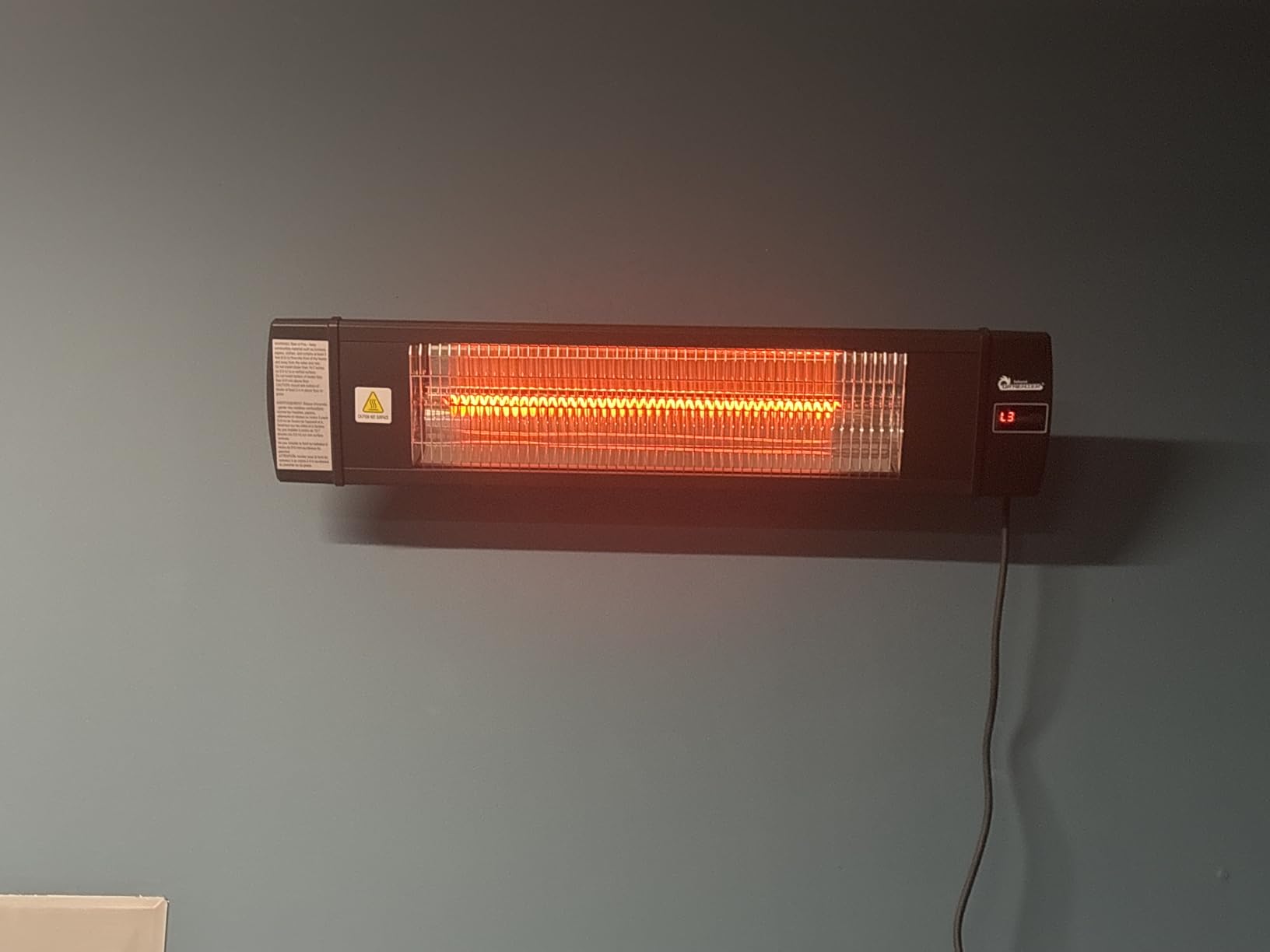
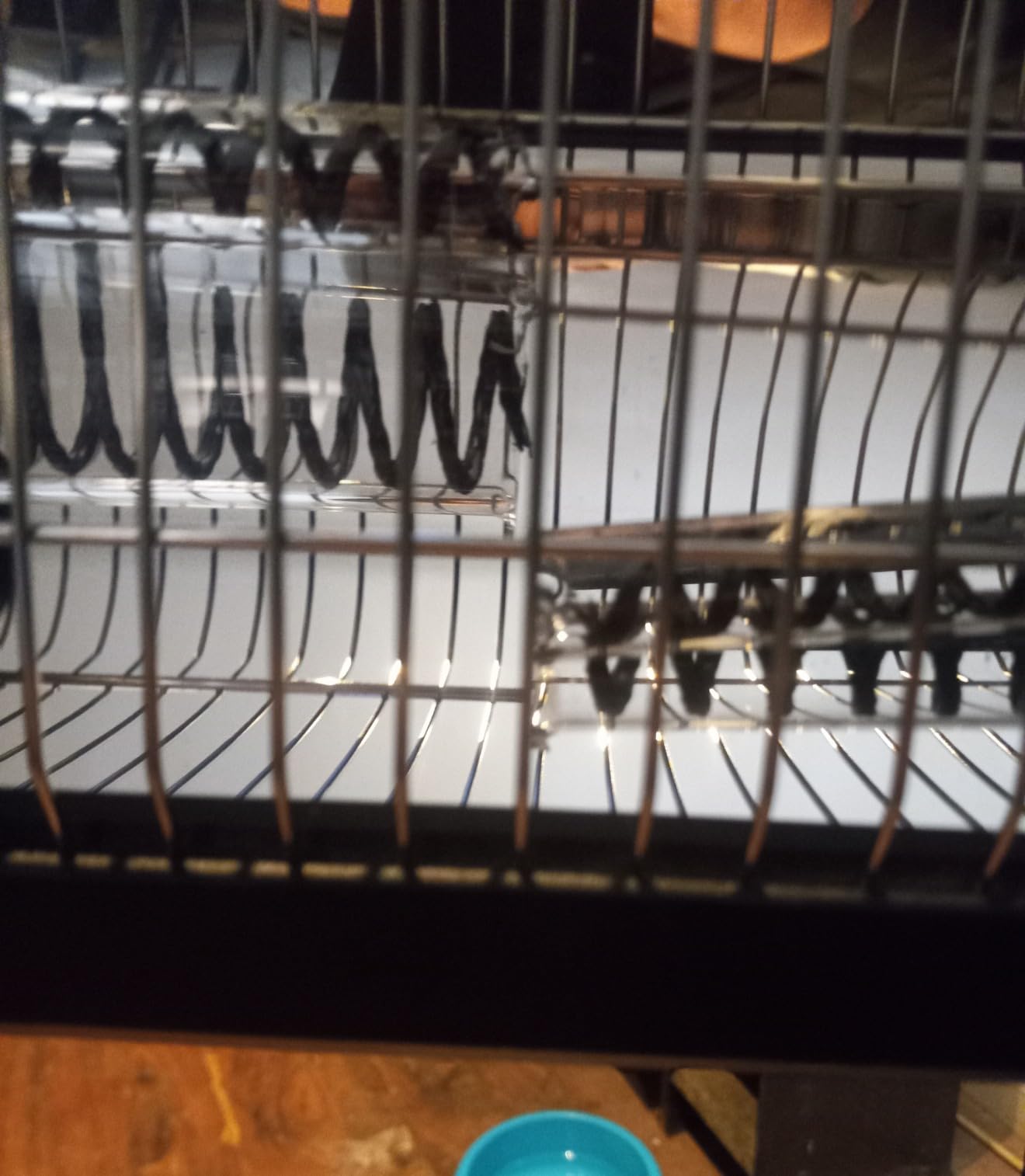
Mounting flexibility is the quiet advantage. The box includes wall brackets, ceiling hardware, and a hanging chain, so the same unit works on a wall, on a ceiling joist, or dropped from an open joisted ceiling over a workbench. The extruded dual-layer aluminum housing is built to handle humidity, and the IPX5 rating is meaningful in a garage with a leaking section of roof or an open bay door in spring.
Two heat settings at 1000W and 1500W give you a reasonable control range. At 12.5 amps on 120V it still needs a dedicated circuit, which is one of the most common reasons a new heater immediately trips a breaker in an older building.
What to check before you buy this one
Measure your intended zone honestly. The rated coverage is 150 to 200 square feet, and that assumes you are sitting or standing inside that area. If your workbench run is 20 feet long, you are looking at two heaters rather than one, which is a common and completely valid setup for a two-bay shop.
Position matters more than most buyers expect. Aim the unit at your torso, not at the floor. Reviewers note that the warmth feels noticeably weaker once you step back from the mounting position, so put it close to where you sit rather than as far away as looks tidy.
Where it falls short in a workshop
It is not a whole-room air heater. If you need the air temperature in the whole shop to rise, this will not do it, and no 1500W radiant unit will. Owners who wanted a garage at a comfortable ambient temperature for guests or for a project that needs the whole room warm are the source of most one-star feedback.
It also ships without wall mounting hardware beyond the included kits, and the remote uses AAA batteries listed as GN24A. Small thing, but plan for it if you are mounting high on a ceiling where reaching the unit is not realistic.
3. DR-218 1500W Greenhouse Garage Heater – Most Versatile for One-Car Spaces

DR. INFRARED HEATER DR218-1500W Greenhouse Garage Workshop Infrared Heater, 1500-watt
1500 watts
120 volts
12.5 amps
150 sq ft coverage
11.5 pounds
Pros
- Compact 11.5 lb cabinet is easy to carry between work areas
- Built-in thermostat cycles the fan rather than running constantly
- IPX4 splash protection for damp spaces
- Low maintenance and inexpensive to run
Cons
- Underpowered alone in genuinely sub-freezing conditions
- Fan noise is noticeable in a quiet workspace
- Some units report wiring failure after extended heavy use
- Single heat setting gives limited control
The DR-218 is the simplest useful infrared heater in this group, and for a one-car garage or a hobby greenhouse it does the job at a fraction of the cost of anything mounted. At 10 by 10 by 15 inches and 11.5 pounds, you can pick it up with one hand and move it from the bench to the storage rack in a few seconds.
What makes it work as a budget pick is the built-in thermostat, rated across a 32 to 104 degree range. It cycles the fan rather than running continuously, so a shop owner running it overnight through a hard freeze to protect dormant plants gets a much better result than a unit with a single fixed setting. Owners in one-car garages report the same, holding the space above freezing without a second heater.

The IPX4 structure handles splashing, which matters if you are using it near a work sink or in a shed where condensation is normal. It is a floor-mount cabinet with a single heat setting, so this is a spot heater, not a room solution. Treating it that way is the difference between being happy with it and being disappointed.
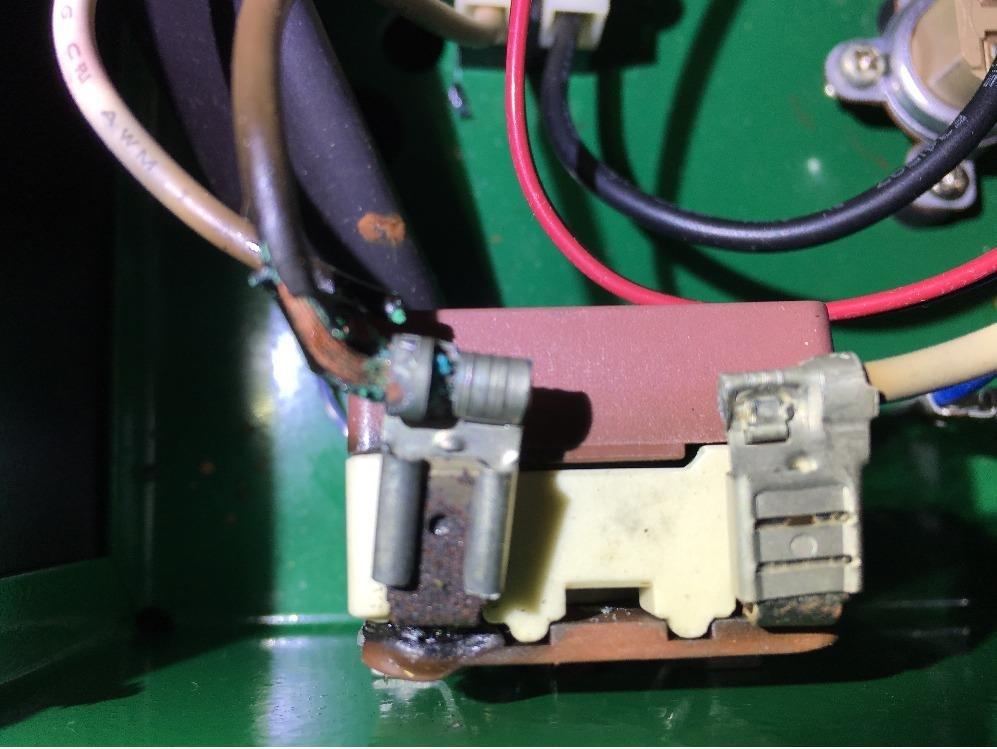
At 881 reviews and 4.2 stars, the feedback is mostly warm. The praise concentrates on the reliable thermostat, steady radiant-plus-fan output, and portability. The critical reviews fall into two groups, and neither is subtle: it is underpowered for genuinely cold spaces, and a minority of buyers describe long-term wiring burnout after extended heavy use, though the manufacturer has responded with responsive replacement service.
What to check before you buy this one
Decide what it is for. As a supplementary heat source for a one-car garage, a bench area, or plant protection, 1500W is adequate. As the only heat source in a Minnesota winter, it is not, and adding a second unit is the common correction among owners who bought one first.
Give it a dedicated 15-amp circuit. At 12.5 amps it sits close to the 15-amp limit, and sharing a circuit with a welder, a compressor, or a saw is the most likely reason this unit appears in a troubleshooting thread.
Where it falls short in a workshop
There is no remote and no timer in the listed features. Everything is a dial on the cabinet, which is fine for a greenhouse but annoying for a shop where you want to shut it down from across the room. The single heat setting also means no way to reduce output for a spring afternoon.
Fan noise is a recurring note. For a woodshop where you run a dust collector, a few decibels of heater fan is not a problem. For an office-adjacent workspace or a garage gym where you are trying to hear a training video, it is.
4. BEYOND HEAT 1500W Ceiling Quartz Heater – Best for a Woodworking Bench with a Light
BEYOND HEAT Electric Garage Heater 120V, 1500W Radiant Space Heater, 1-Pack
1500 watts
120V
12.5 amps
24 x 12.2 x 3.3 inches
Ceiling mount
Pros
- Dual quartz tubes focus radiant heat directly on a work area
- 90 degree adjustable tilt on ceiling or wall mount
- Built-in halogen work light is genuinely useful
- Metal safety grille with overheat protection
Cons
- Not effective beyond a few feet
- Quartz tubes reported to burn out prematurely on one setting
- Halogen bulb can arrive dead with no easy replacement source
- No thermostat and no remote
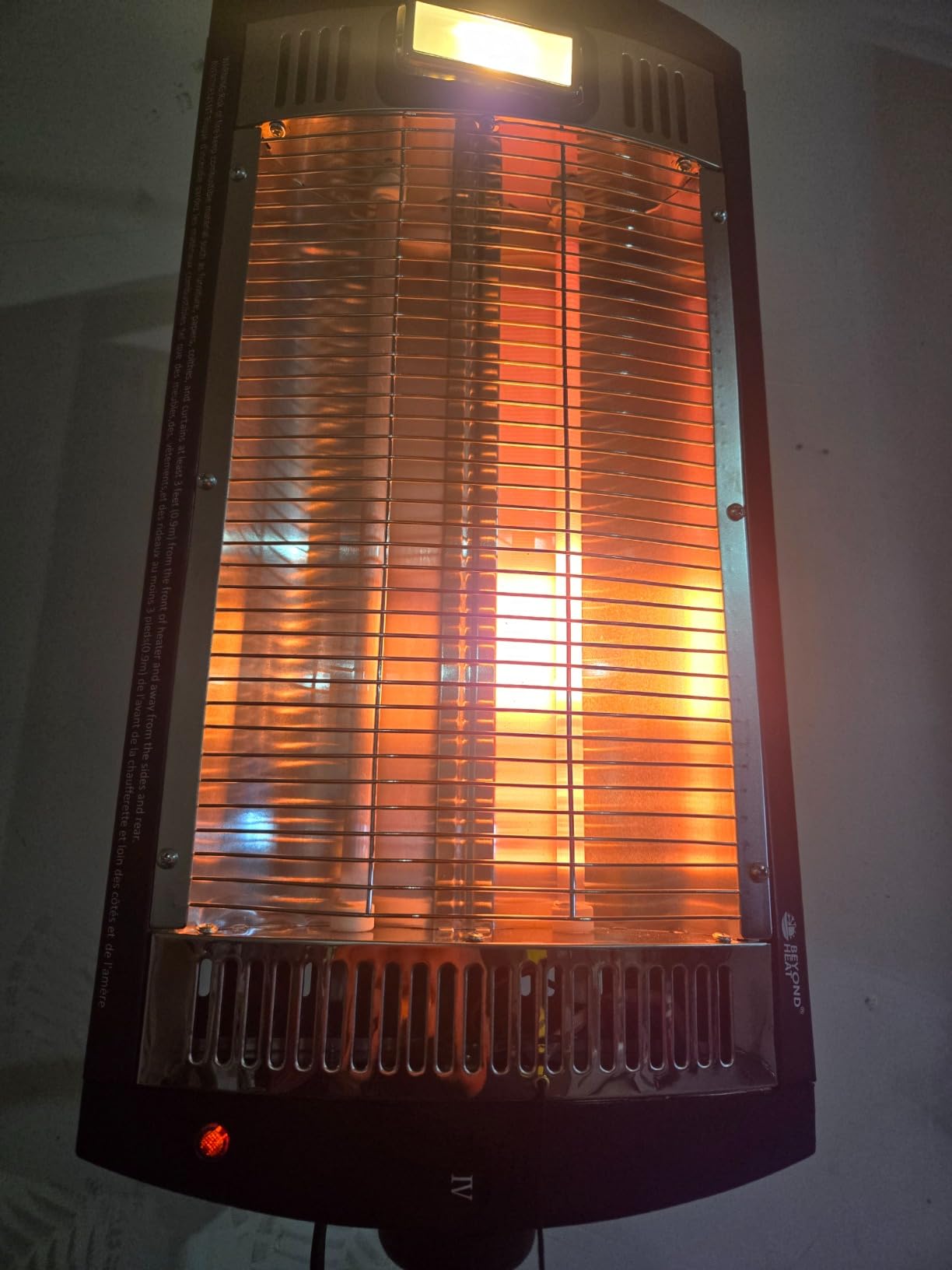
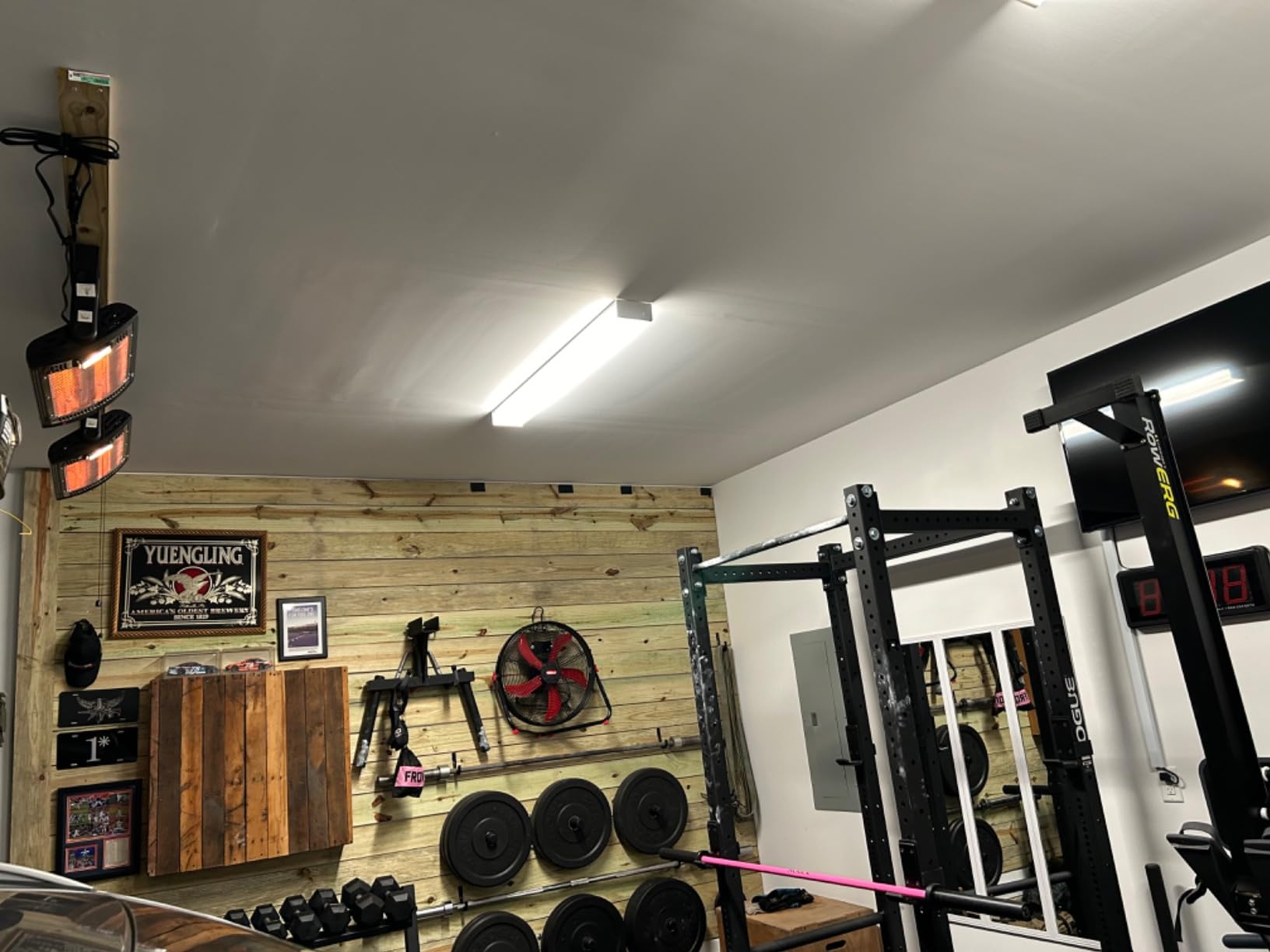
The thing that separates this ceiling unit from the other quartz-style heaters here is the halogen work light angled alongside the heat tubes. In a shop with a single overhead fixture, a heater that doubles as a task light over the bench removes a second piece of equipment from the ceiling and removes a shadow from your work.
Mounting is ceiling or wall with 90 degrees of tilt, and at 24 by 12.2 by 3.3 inches it is a slim profile that sits flat against framing. The pull-string switch for the two heat settings is a genuinely sensible choice for an overhead unit, because a wall switch you cannot reach is worse than no switch. The 3-prong grounded plug, metal grille, and overheat protection cover the basics.
At 235 reviews and 4.1 stars, the buyer profile is consistent: woodworkers and hobbyists running one unit per bay in an insulated garage, where several report holding the space near 70 degrees. That reported figure is for a reasonably insulated space, which is the condition you need to meet before expecting it from this class of heater.
The negatives are short throw and component life. Reviewers point out the radiant heat is only effective within a few feet of the tubes, and some report quartz tube burnouts on one of the two settings. Replacement bulbs and tubes are not easy to source, so treat the halogen light and the heating tubes as consumables you may not easily replace.
What to check before you buy this one
Work out the mounting height relative to where you stand. Quartz radiant tubes lose intensity as distance grows, and this unit is designed for overhead mounting close enough that the tilt points the output down at your working position. Mount it at a ceiling height in a 12-foot garage and it works. Mount it in a 16-foot space and it will not reach you well.
Insulation is the deciding variable. Multiple owners use one unit per bay and get usable results in insulated spaces, while feedback from uninsulated garages is much less favorable. Our winter workshop heater guide covers the insulation question in more detail.
Where it falls short in a workshop
There is no thermostat and no remote. You get a pull string and two fixed settings, which means the heater runs at full output or half output until you physically pull the string. In a shop where you step out for an hour, that wastes money.
Component replacement is the real long-term risk. A dead halogen bulb with no straightforward replacement source is a common complaint, and premature quartz tube failure appears often enough that owners should treat this as a consumable-component heater rather than a permanent install.
5. Briza 1500W Dual Mount Infrared Heater – Best Value for Flexibility
Briza Infrared Electric Patio Heater – Indoor/Outdoor Heater – Portable Wall/Garage Heater – 1500W – use with Stand – Mount to Ceiling/Wall)
1500 watts
120 volts
12.5 amps
35.5 inches tall
3 heat levels
Pros
- Wall and ceiling hardware plus an adjustable tripod stand in one box
- Carbon infrared warms surfaces like sunlight
- Remote control with a 1 to 9 hour timer
- Three heat levels at 900W 1200W and 1500W
Cons
- Heats people and objects in line of sight only
- Radiant benefit drops off a few feet from the unit
- Draws enough current that a shared circuit can trip
- Tripod positions the heater high for seated use
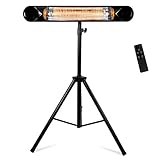
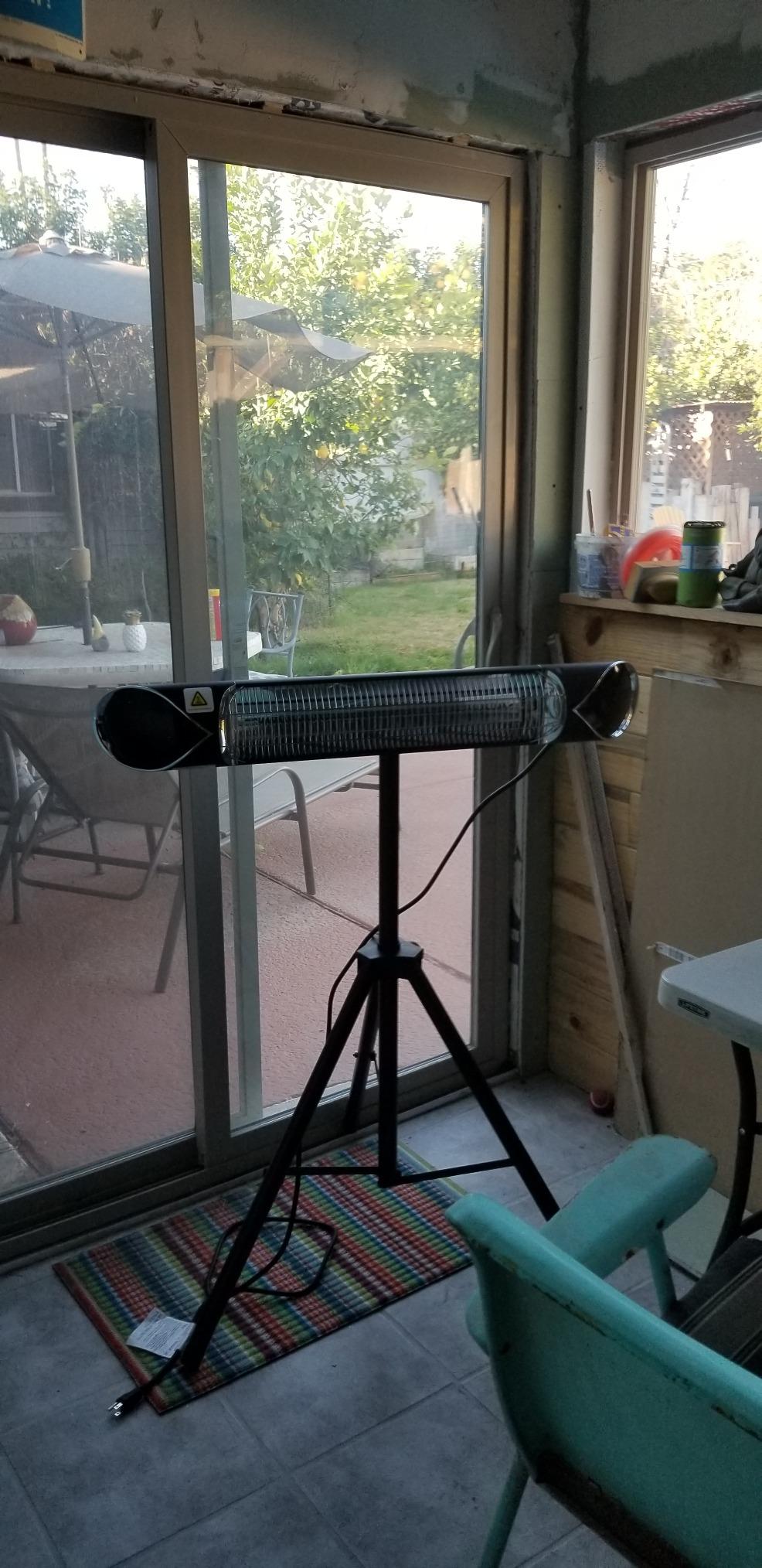
Most heaters in this roundup force a choice between fixed mounting and portability. The Briza does not, because the box contains wall hardware, ceiling hardware, and an adjustable tripod stand. That makes it the easiest unit here to move when your project changes, and the reason it has 1817 reviews at 4.1 stars.
The heating itself is carbon infrared, which means the rays are absorbed by surrounding surfaces and re-radiated as warmth rather than blasting air. In practice that reads as sun-like heat on your hands and forearms with no fan and no odor. The three heat levels at 900W, 1200W, and 1500W give finer control than most competitors, and the remote handles power, level, and a 1 to 9 hour timer.
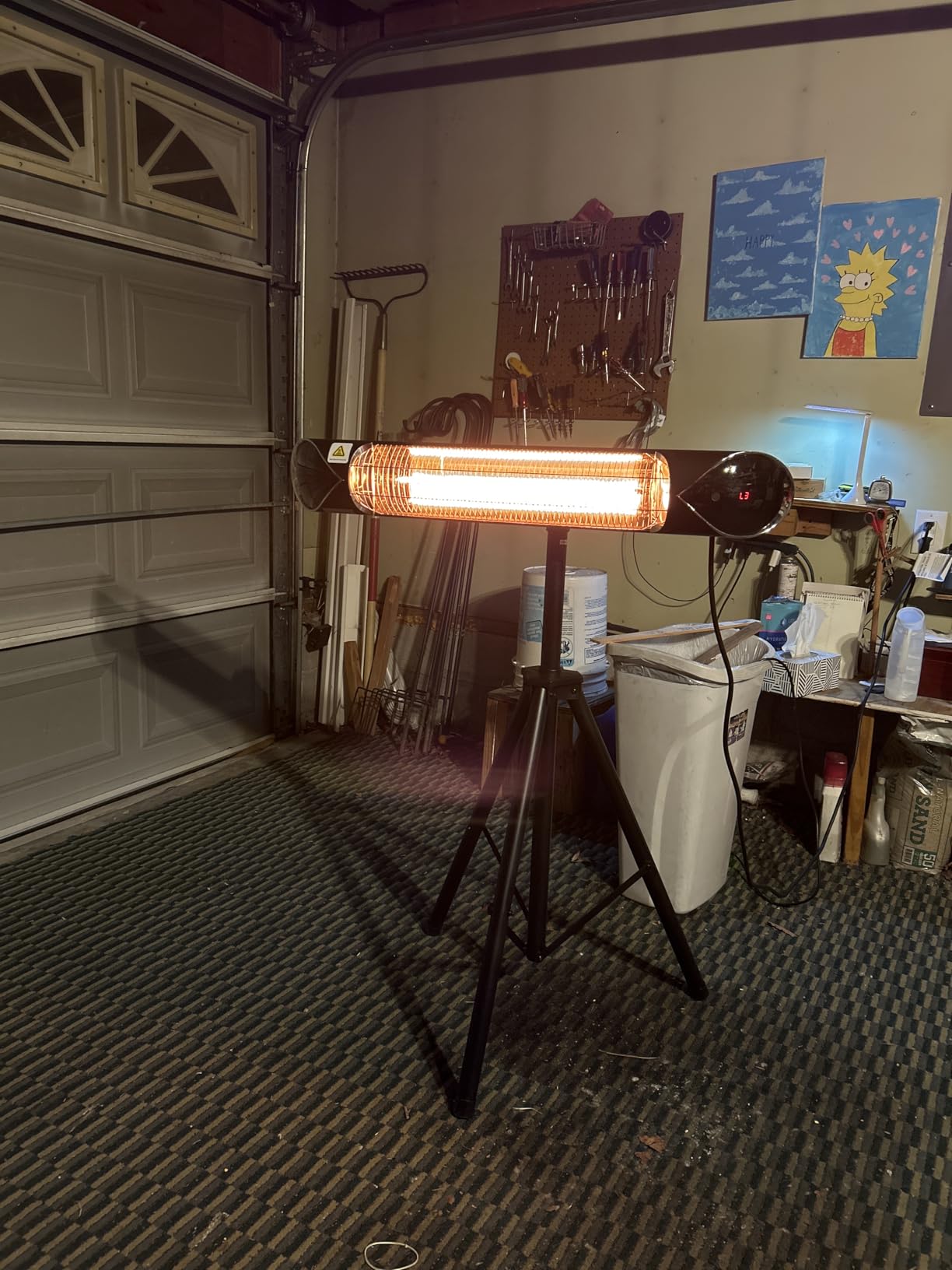
Safety is well covered for a portable unit: a built-in sensor cuts power if the heater is tipped, and the IP55 rating suits damp conditions. At 35.5 inches tall the tower format keeps the footprint small, and the 84-inch cable is long enough to reach an outlet from a bench position without an extension cord.
Buyers largely understand what this is, and the ones who do not are the source of the negative reviews. Owners use it at a workbench, at a patio table, and in a garage. The dominant complaint in the one-star reviews is always the same: it will not raise the air temperature of a detached garage, and that was never the design intent.
What to check before you buy this one
Sit in your intended position and confirm you will still feel it. Radiant throw is short, and the benefit drops off a few feet from the unit. If your work spot is more than six feet from where the heater can stand or hang, a larger unit is the better purchase.
Plan the circuit. At 12.5 amps this is near the 15-amp ceiling, and owners report breaker trips when it shares a circuit. If your shop has a compressor or a tool charger on the same receptacle, give the heater its own.
Where it falls short in a workshop
The tripod stand is adjustable, but it puts the heater high, which is awkward if the goal is warming yourself while seated. Several buyers point this out specifically. For a standing workbench, the stand works fine. For a chair by a desk in a converted shop, it does not.
It warms surfaces, not air. In a cold garage where you want to paint a car and need the panel at room temperature throughout, a radiant-only heater will not get you there on a 1500W budget.
6. Encyclpo 36 Inch Portable Infrared Tower – Best for a Garage Gym
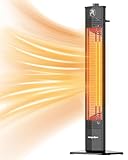
Encyclpo Patio Heater for Outdoor Use,1500W Infrared, 36 in Portable Tower Heater, 3 Levels, IPX5 Waterproof, Tip-Over&Overheat Protection for Garage, Indoor, Large Room, Backyard, Home
1500 watts
120 volts
36 inches tall
7.5 pounds
Three power levels
Pros
- Near instant warmth from dual carbon fiber elements with no fan
- IPX5 waterproofing suits damp garage and shed use
- Slim 36-inch 7.5 lb tower is easy to reposition
- Tip-over auto shutoff and overheat protection
Cons
- Effective radius is short and you need to sit close
- Tip-over sensor is sensitive to a slight nudge
- Power cord is short and extension cords are discouraged
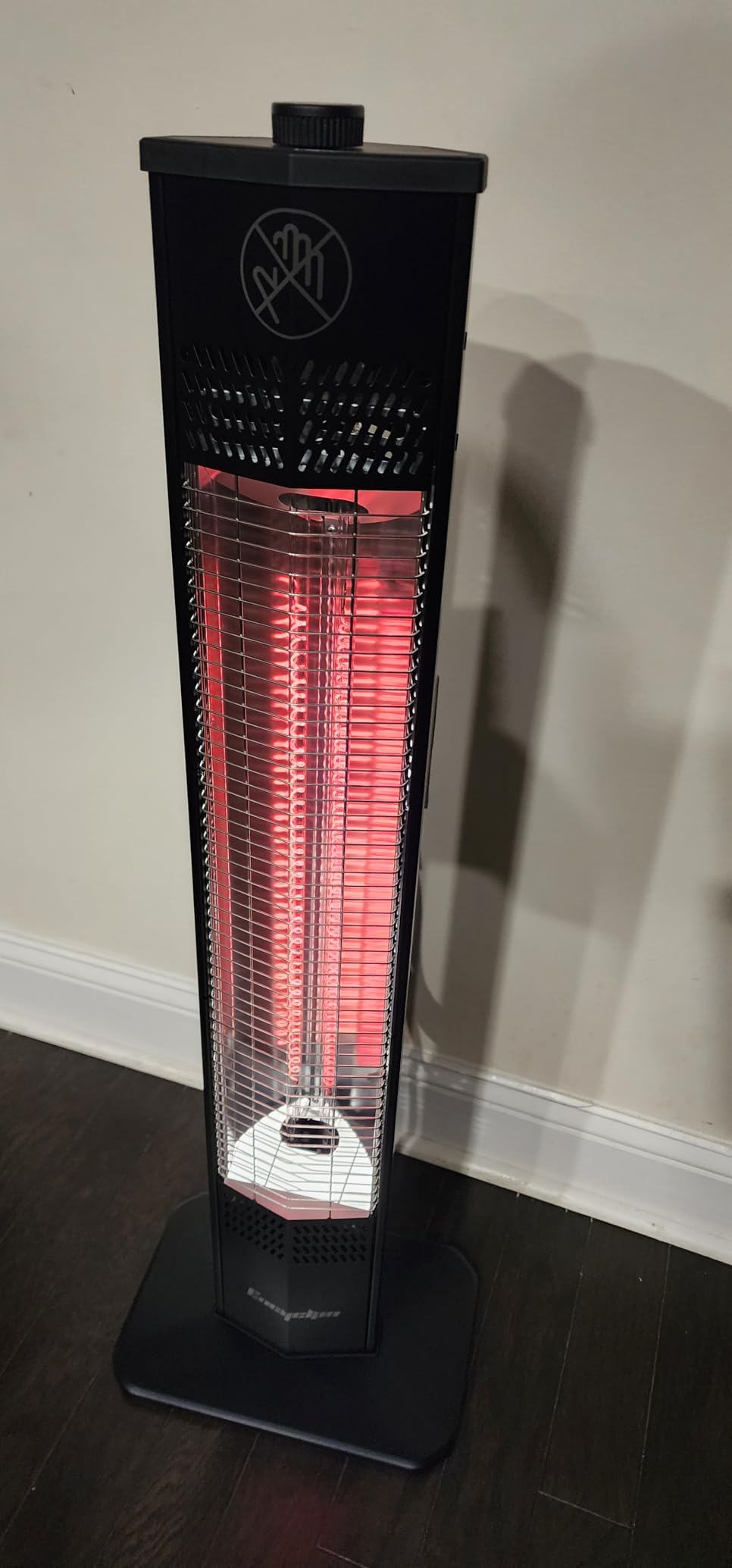
If your workshop use case is a garage gym, a squat rack, or a seated desk corner, a portable tower is the right shape. The Encyclpo runs at 600W, 900W, or 1500W and reaches working temperature almost immediately because there is no fan and no air to heat first. You feel it within seconds of switching it on.
It also holds a 4.3 rating from 293 reviews, and 74 percent of those owners gave it five stars. Buyers describe fast, silent, odorless infrared heat and easy assembly with no tools. The top-mounted controls are reachable, and the flame-retardant housing plus IPX5 rating handle a damp garage or basement without concern.
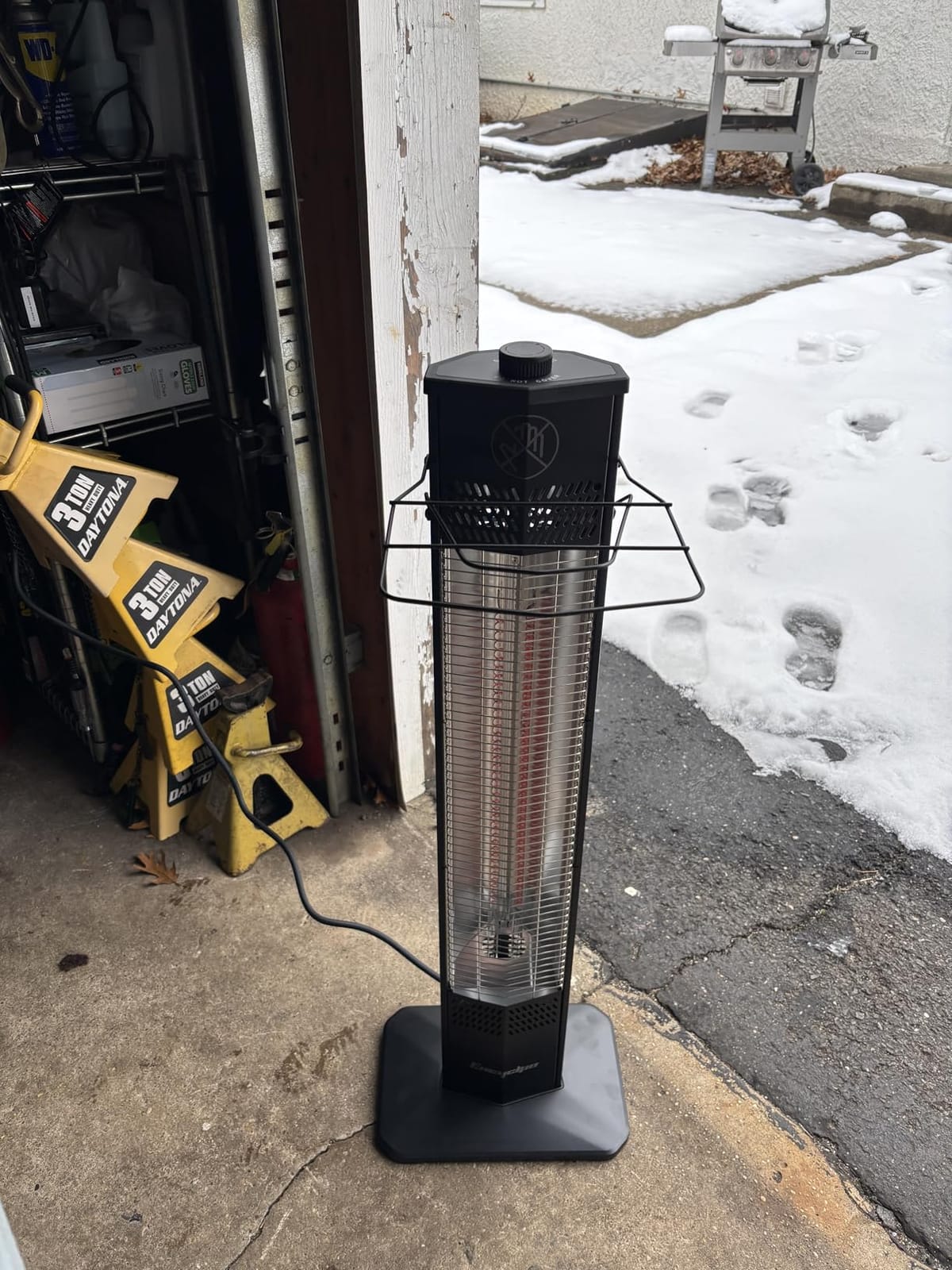
At 36 inches tall and 7.5 pounds, this is a genuinely easy unit to reposition. That matters in a garage gym where your training position changes with the season, and it also matters when you need the floor space for a car in the summer.
It is listed at 5000 BTU of heat output with a temperature range from 40 to 140 degrees and a manual thermostat. The dual carbon fiber elements are the reason the response feels instant, since carbon fiber reaches temperature faster than a quartz tube.
What to check before you buy this one
Position it for the person, not the room. Stand it about three feet from where you sit and aim it at torso height. Owners who place it too far away report disappointing results, and that is a placement problem rather than a product problem.
Be aware the tip-over sensor is sensitive. Several buyers describe the unit cutting out after a slight nudge, including accidental contact from a broom or a vacuum cord. It is a safety feature working as designed, but it does mean the heater wants a stable corner rather than a busy walkway.
Where it falls short in a workshop
The heat radius is short. This is a personal heater, not a bay heater, and the honest limitation is that you need to be close. Anyone hoping to warm a two-car garage with one of these will be disappointed regardless of how good the element is.
The power cord is short and extension cords are discouraged, so you need a receptacle within reach of wherever you want the unit. A cracked control knob appears in a small number of reviews, which is a build quality note worth keeping in mind.
7. ThermoMate 3000W 240V Hardwired Heater – Best for a Planned 240V Build

ThermoMate Infrared Electric Patio Heater, 3000W Carbon Fiber Heating for Outdoor/Indoor, Porch, Deck, Garage with Remote 24 Hours Timer, Hard Wired 240V
3000 watts
240 volts hardwired
41 inches long
7.8 pounds
45 degree adjustment
Pros
- 3000W output covers about 100 sq ft outdoors or 130 sq ft enclosed
- Hardwired 240V gives steady heat unaffected by draft
- Remote control with a 24 hour timer and low high switching
- Wall or ceiling mount with 45 degree aiming adjustment
Cons
- Must be hardwired to a dedicated circuit breaker by a qualified installer
- Minimum mounting height of 7.88 feet
- Short 6.3 foot cable for the wire connection
- Only 87 reviews so long-term evidence is limited
The ThermoMate is the bridge between a plug-in radiant heater and a hardwired shop unit. At 3000W on 240V it delivers roughly double the output of a 1500W plug-in while still using a carbon fiber element rather than a fan, so it heats fast and runs silently. It is rated at 4.4 stars across 87 reviews, the highest average in this group.
Coverage is listed at about 100 square feet outdoors or 130 square feet enclosed. Read that as a fixed zone. This is a bench heater that runs on a dedicated circuit, not a room heater, and the hardwired design means the output does not sag when a door opens and cold air rolls in.
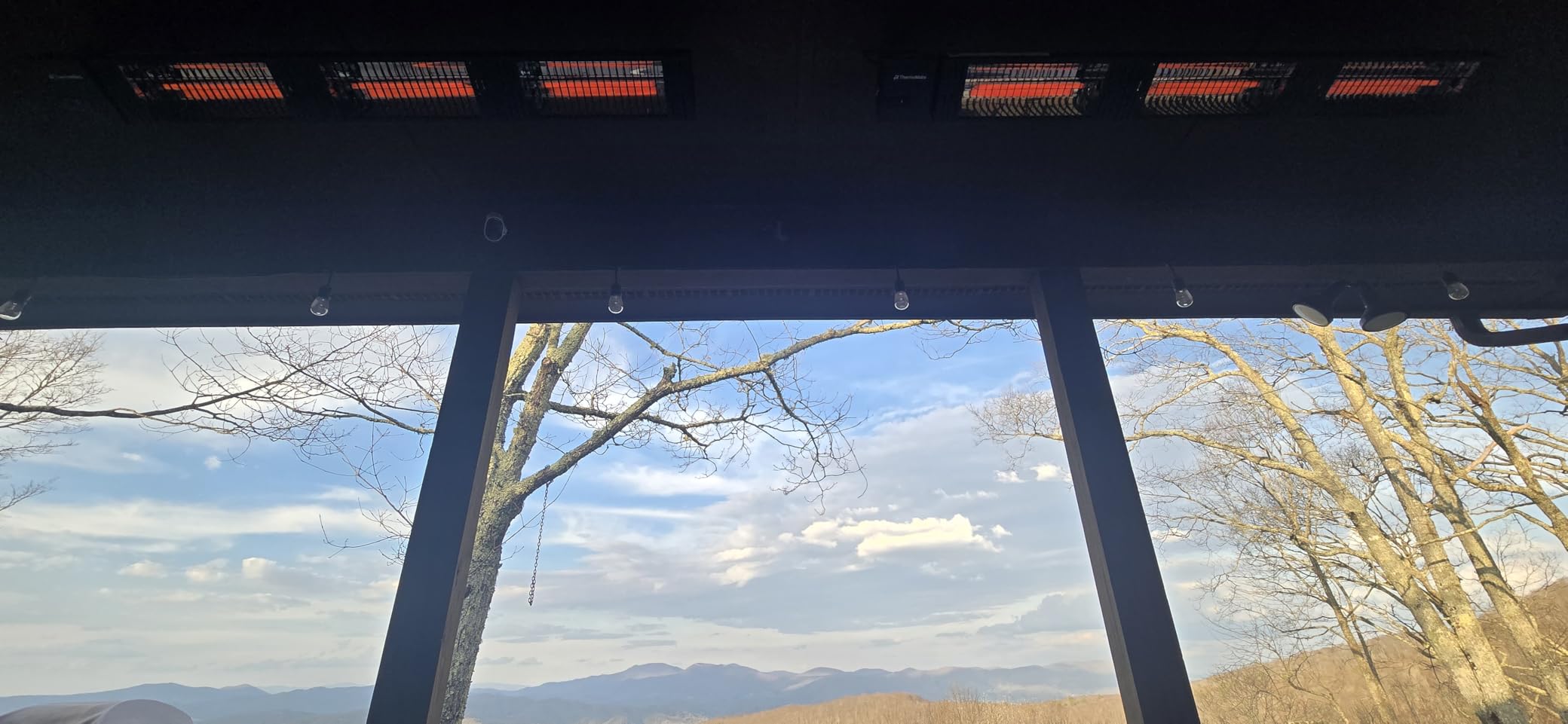
The remote gives you a 24-hour timer and low or high switching between 1500W and 3000W. The mounting bracket adjusts 45 degrees, and the slim 41-inch body at 7.8 pounds leaves the floor completely clear. Overheat protection, an IP54 rating, ETL certification, and a one-year heater warranty round out the package.
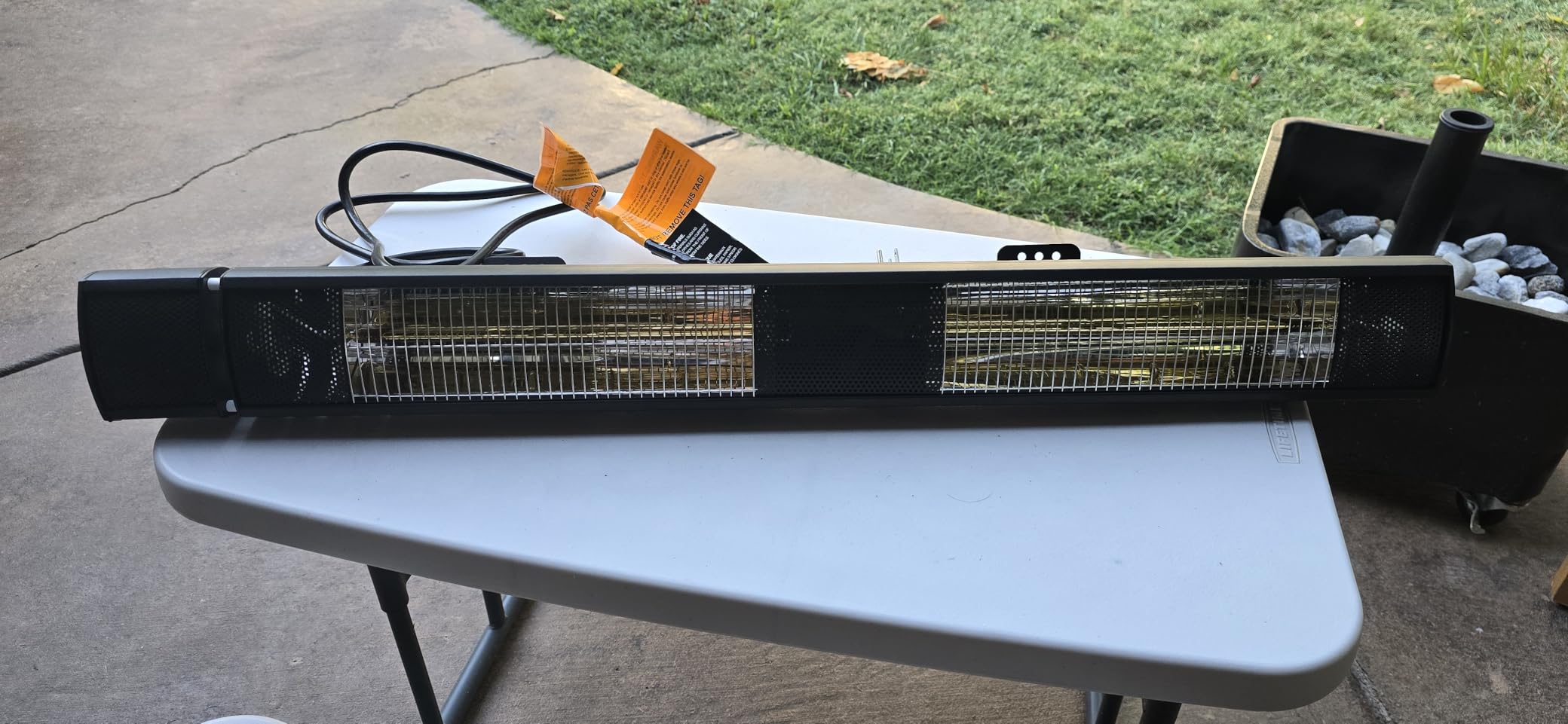
Owners describe it as genuinely powerful for a fixed work zone, heating a bench quickly and with no fan and no odor. The caveat they echo most often is installation, and they are right to. A 240V hardwired heater belongs in a planned build, not a Saturday afternoon.
What to check before you buy this one
The 7.88 foot minimum mounting height rules this out for any seated warming task. It has to go high, on a wall or ceiling, aimed down at a standing work zone. If your work happens at a seated bench, choose something else.
Budget for a dedicated circuit and a qualified installer. The included cable is a short 6.3 foot pigtail for the wire connection, so the run from your panel to the mounting location is on you. Owners with an existing garage subpanel report a straightforward install; everyone else reports a bigger project.
Where it falls short in a workshop
Only 87 reviews means thin long-term evidence. Nothing in the feedback suggests a problem, but a heater that is hardwired into your building deserves a longer service history than that before you commit.
It also has no thermostat beyond the remote’s low and high modes. That is adequate for a fixed zone you run on a schedule, and inadequate if the shop temperature swings through the day.
8. blessny 1500W Wall Mounted Heater – Best for Quiet Zone Heating

blessny 1500W Wall Mounted Electric Heater for Outdoor Patio & Garage
1500 watts
110 volts
34.3 inches wide
6.2 pounds
Three heat levels
Pros
- Adjustable wall brackets mount high over a bench or grill
- IP65 waterproofing with a carbon fiber tube
- Touch panel plus remote with a 24 hour timer
- Silent 0 dB operation with a 3 second warm-up
Cons
- No built-in thermostat only three fixed power levels
- You need to stand directly in front of it to feel warmth
- Timer is a countdown in hour increments not a clock
- Remote batteries not included
Silent operation is the headline here. The manufacturer lists 0 dB, and because there is no fan, that figure is not marketing filler. If your workshop time overlaps with recording, phone calls, or anything where background noise matters, this is the class of heater that does not interfere.
The 34.3 inch body on adjustable wall brackets is a good fit above a bench, over a sink, or over an outdoor grill. IP65 waterproofing and a carbon fiber tube make it appropriate for damp shop, greenhouse, and shed conditions, and the oxidized sprayed aluminum shell is built for long-term outdoor mounting.
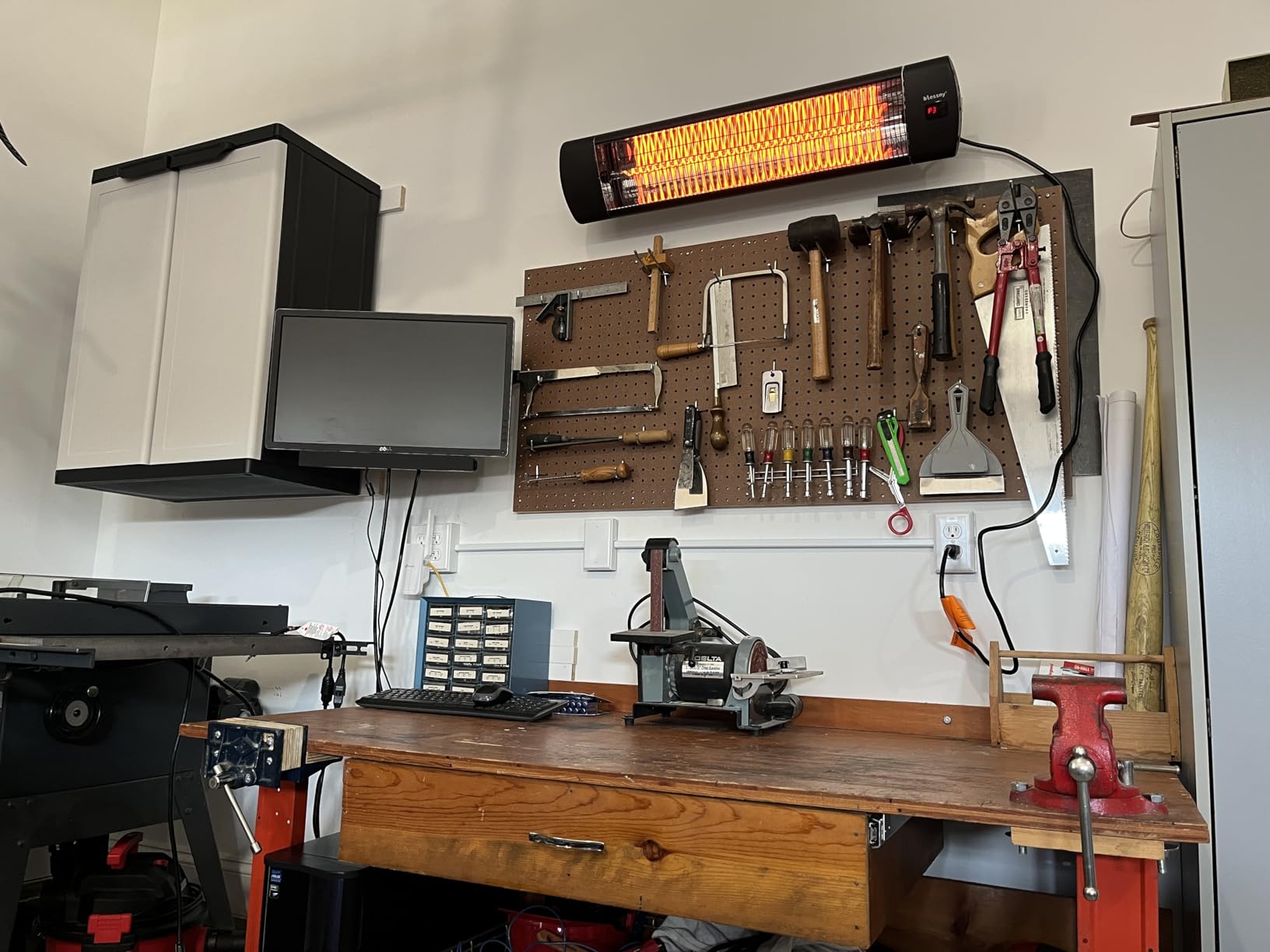
Control is available two ways, through a touch panel or the included remote, with a 24-hour timer and three heat levels. At 6.2 pounds with the installation hardware in the box, it is a light unit to handle. Owners report noticeably stronger output than cheaper big-box alternatives for the same wattage.
At 4.2 stars from 78 reviews, the sample is small but consistent. People use it over a grill, above a utility sink, or in an unheated garage. The most thoughtful negative review in the set makes the fairest case against it, noting the lack of a thermostat and a countdown-only timer.
What to check before you buy this one
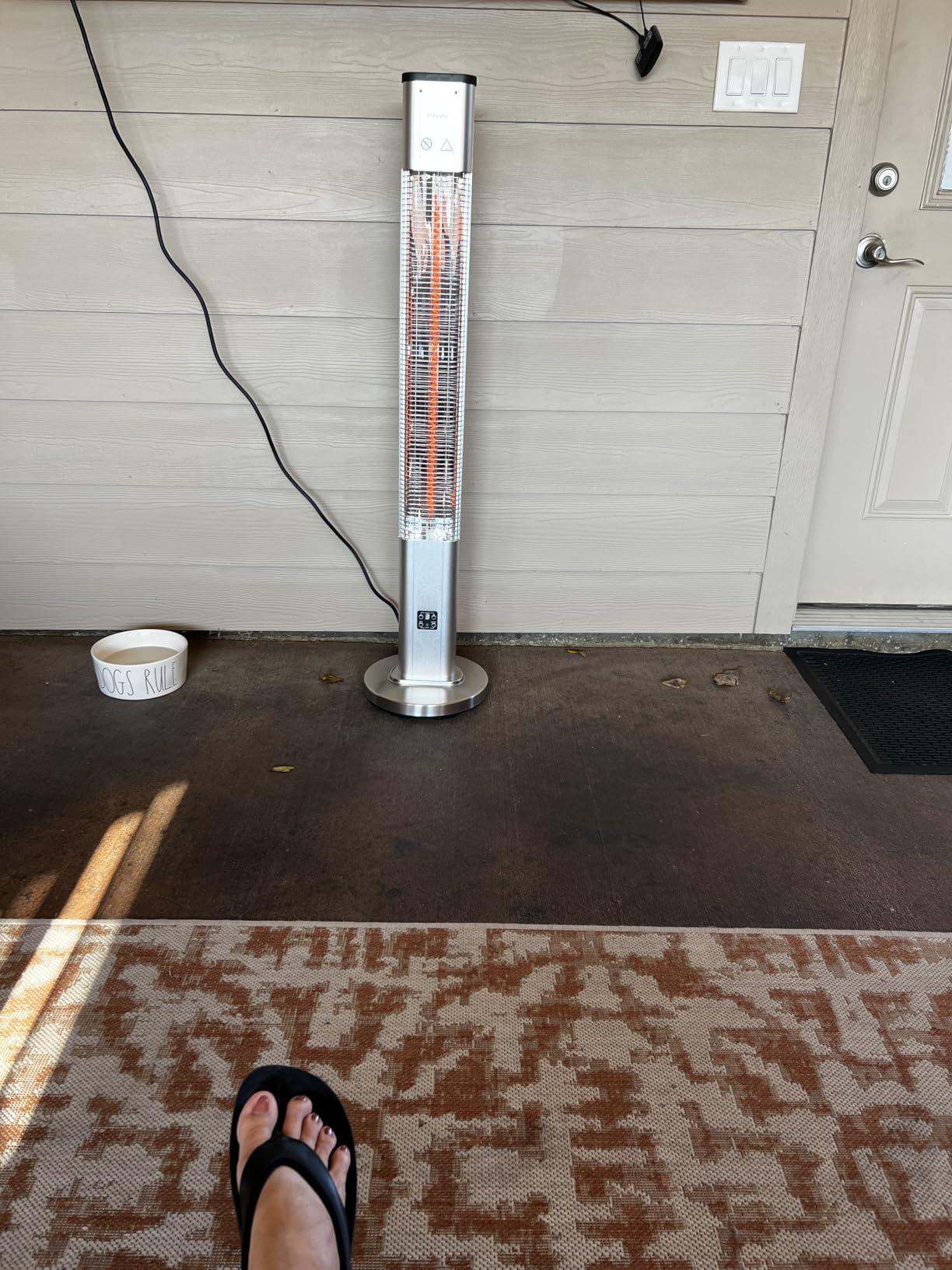
Stand where you will work and confirm the geometry. This heater has a narrow useful footprint and you need to be close and roughly in front of it. Mount it high over a bench with adjustable brackets and aim downward, which is the configuration owners recommend.
Supply the two AAA remote batteries yourself, since they are not included, and note that the documentation covers vertical wall mounting only. If you plan to hang it from a ceiling, confirm the hardware supports it before you drill.
Where it falls short in a workshop
No thermostat is the significant gap. Three fixed power levels with no temperature feedback means you either run high and waste energy or run low and stay cold. In a shop that swings between 35 and 55 degrees over a few hours, that is a real limitation.
The timer is a countdown in hour increments, not a scheduling clock. You cannot set it to come on at 6am before you arrive. If you want scheduling, you need a separate smart controller, which is worth weighing against heaters with app control.
9. Paraheeter 1500W Hanging Infrared Heater – Best for Overhead Zone Heat

Hanging Patio Heater, Outdoor Electric Heater, Wall Mounted & Ceiling Infrared Garage Heater for Outdoor/Indoor Use, 1500W, Remote Control, Black
1500 watts
120 volts
31.3 inches wide
3 heat levels
Wall mount or hanging
Pros
- Adjustable chain and wall mounting hardware both included
- Carbon fiber tubes with a stated 10000 hour lifespan
- IP65 weather resistance for damp garage bays
- Clean odorless noise-free heat with remote control
Cons
- Only 49 reviews so long-term owner feedback is limited
- Short 31 inch body has a narrow heat pattern
- Must be mounted overhead or high on a wall to work well
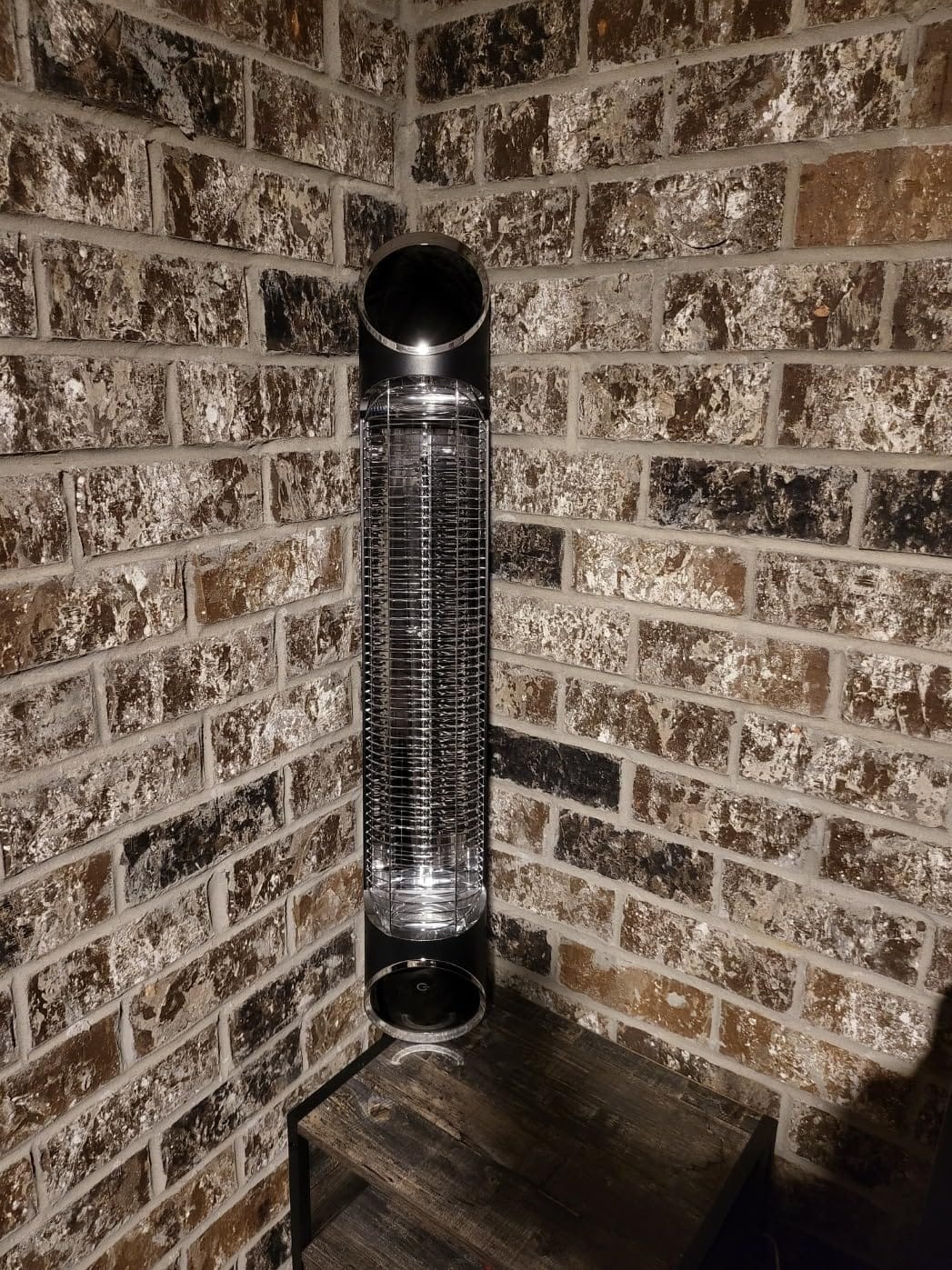
The selling point here is the mounting package. An adjustable chain and wall mounting accessories are both included in the box, so if your garage has an open joisted ceiling you can drop the unit into a bay without touching a drill. For a shop where floor space is the scarcest resource, that is a practical advantage over floor-standing cabinets.
It is a carbon infrared unit, so the heat is unaffected by wind and there is no fan, no odor, and no combustion. The IP65 rating is appropriate for a damp bay or a partially open space. The remote, child lock, protective grille, and grounded plug cover the safety basics, and the manufacturer rates the carbon fiber tubes at a 10000 hour lifespan.
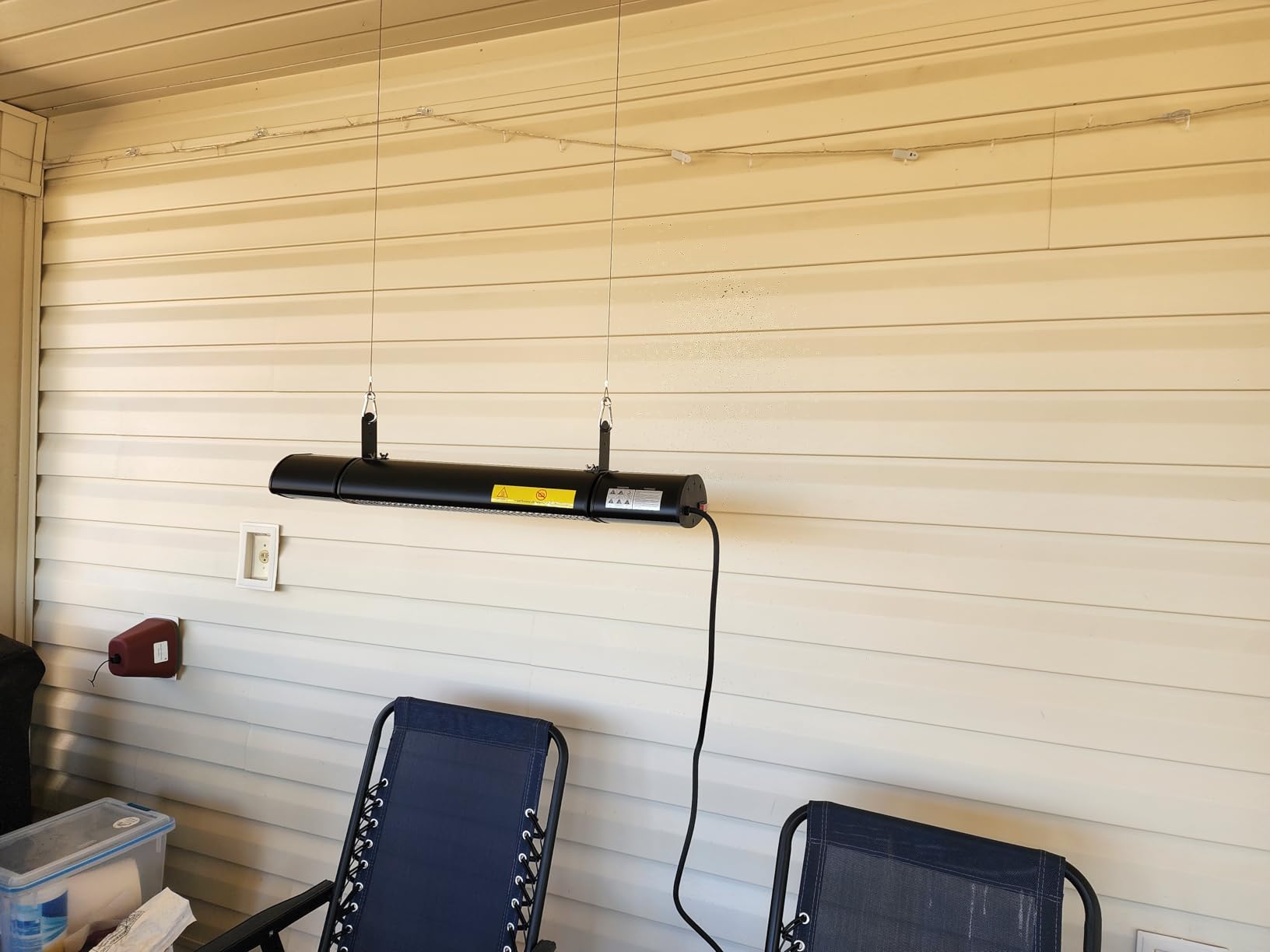
Three heat levels are available. At 31.3 inches long and 120 volts, it is a compact overhead unit that works well for a bench, a packing station, or a spot where you stand for extended periods.
This is the least-reviewed heater in the roundup at 49 reviews and 4.2 stars, so the evidence base is genuinely thin. What buyers do report is straightforward satisfaction with the heat and the mounting options. The three-star reviews are all the same note, that the heat footprint is narrow and only felt directly underneath.
What to check before you buy this one
Confirm you have a solid overhead structure. A chain-hung heater needs joists or a strut, not a drywall ceiling, and the unit needs enough clearance to swing without contact. A 12-foot ceiling with open joists is the easy case.
Map the heat footprint against your actual work position. A narrow pattern that lands squarely on your bench is fine. A narrow pattern that lands in the aisle is not, and no amount of wattage fixes aiming problems.
Where it falls short in a workshop
It only works well when mounted overhead or high on a wall. On the floor in the middle of a bay, a 1500W overhead-format unit is a poor choice, and the listing does not really support that use.
With 49 reviews, you are buying on spec sheet rather than on long-term owner experience. The stated tube lifespan is a manufacturer figure, and there is not yet a long service history in the feedback to corroborate it.
10. SereneLife 1500W Wall and Ceiling Heater – Best for Decks and Patios
SereneLife Portable Infrared Indoor and Outdoor Electric Space Heater with Remote, IP65 Approved, 1500 Watt Wall-Mounted Hanging for Patio, Restaurant, Backyard, Garage, Decks, Gazebos, Cafes
1500 watts
120 volts
12.5 amps
29.13 inches wide
6.2 pounds
Pros
- IP65 aluminum alloy frame suits damp garage conditions
- Carbon fiber element rated at 88 percent efficiency
- Wall or ceiling mounting with all hardware included
- Light 6.2 lb body that multiple buyers run in pairs
Cons
- Single heat setting with no thermostat
- Cannot be switched fully off because a standby light blinks
- Mounting instructions are metric only
- Four foam shipping inserts must be removed before use
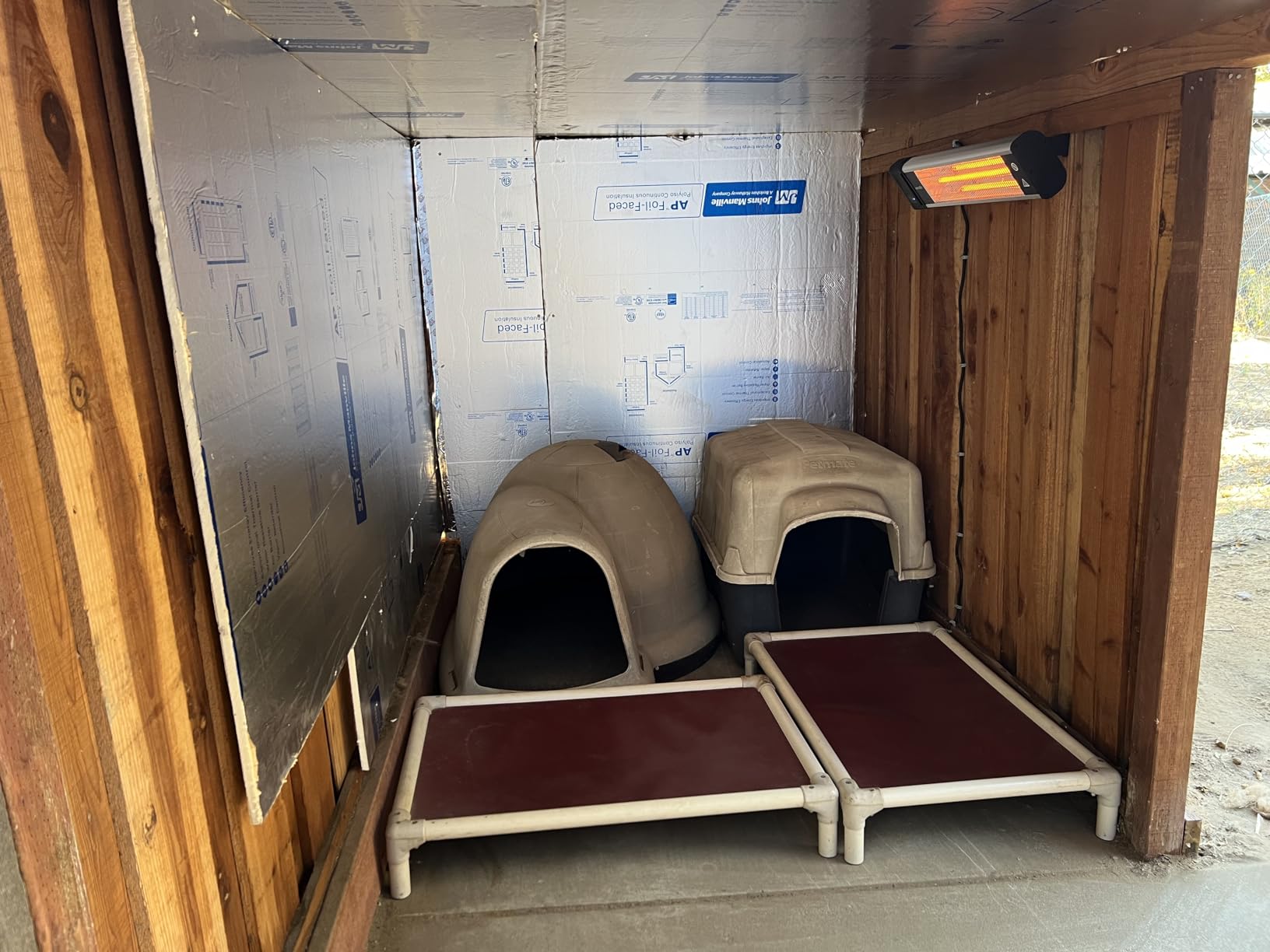
The SereneLife earns its place for spaces that are technically garages but function half the time as covered outdoor areas. An IP65 aluminum alloy frame handles corrosion and rain exposure, and the carbon fiber element is rated at 88 percent efficiency for fast, glare-free warmth over a seated area. Under a deck, in a gazebo, or on a covered patio, it does the job cleanly.
Wall and ceiling mounting hardware is included, so floor space stays clear, and at 6.2 pounds the unit is light to reposition. The two-button remote and touch control are about as simple as a control scheme gets, which is an advantage in a space where the heater is mounted high and rarely adjusted.
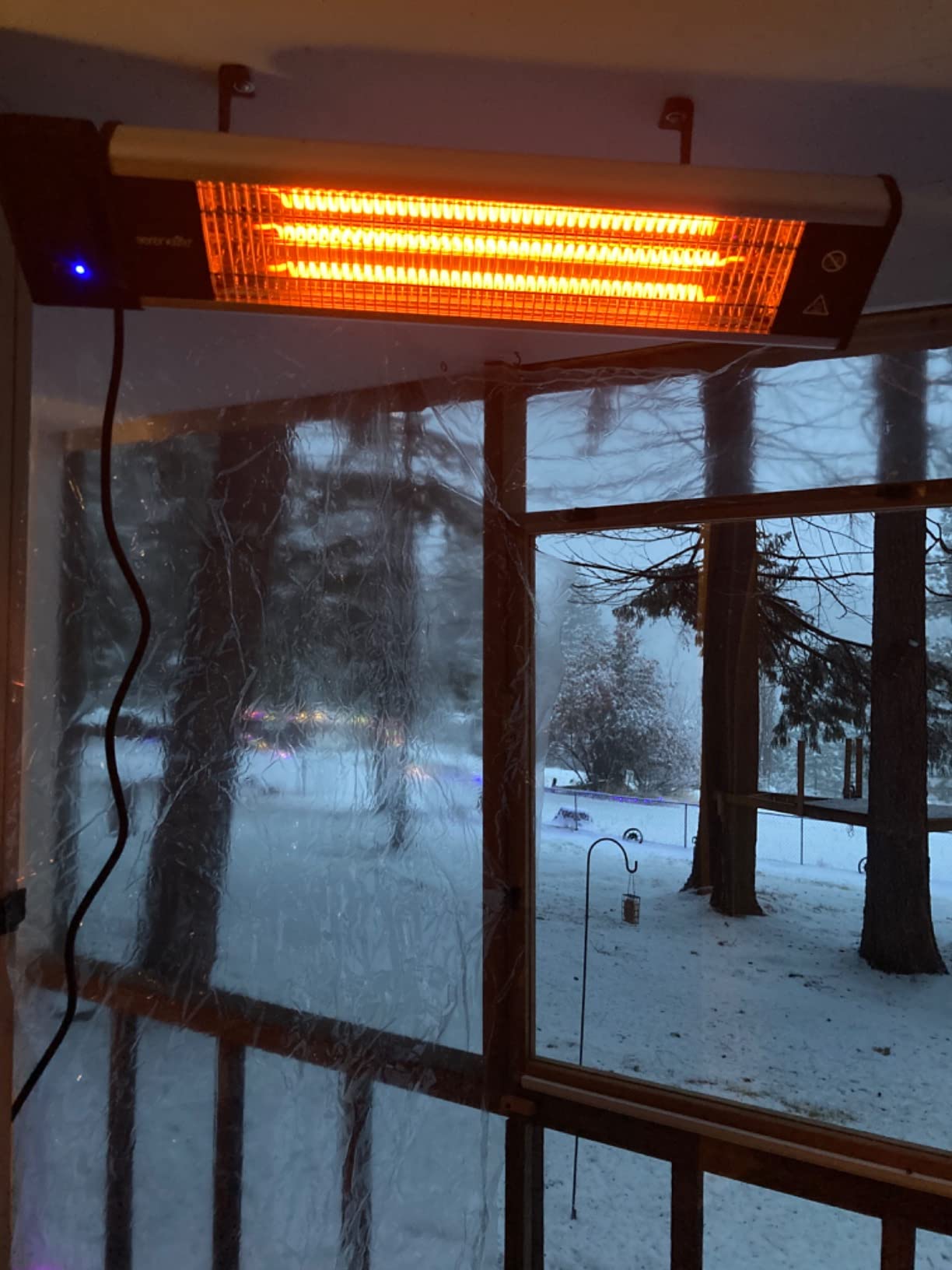
At 4.0 stars from 193 reviews it sits at the bottom of the rating range here, but the criticism is about small annoyances rather than performance. Buyers warn about two specific quirks that appear repeatedly, and both are worth knowing before you buy. First, there are four foam transit braces that must be pulled before powering on. Second, the unit has no true off state, and a blue standby indicator blinks constantly.
That constant indicator is a real nuisance in a bedroom-adjacent or home-office-adjacent space. It also means a small amount of standby draw that never fully stops, which matters if you are running a heat gun through a car wash bay all night.
What to check before you buy this one
Open the box and remove all four foam inserts before you plug it in. This appears often enough in the reviews to be a genuine risk, and a scorched housing is not a return you want to process.
Have a metric wrench or the correct hardware ready. The mounting instructions are metric-only, which catches out a lot of buyers in North American garages. Confirm your mounting surface suits an IP65 unit if the space is exposed to moisture.
Where it falls short in a workshop
Single heat setting and no thermostat is the core weakness. Running two of these is a workable strategy for an uninsulated garage, but neither unit can respond to temperature on its own.
Heating coverage is listed at 18 square meters, which is a small zone. That is appropriate for a seated patio spot or a single bench, and it will not do anything for a two-car garage with a car in it.
How to Choose an Infrared Garage Heater for a Workshop
Insulation decides how hard your heater works
Insulation matters more than heater brand, and the people who have already made this mistake will tell you the same thing. On garage workshop forums, owners consistently describe insulating first and then finding their gas or electric bills dropped sharply. One owner on garagejournal.com insulated walls to R15 and the attic to roughly R50, then reported the heating bill cut drastically after the attic work.
For radiant heaters specifically, the connection is direct. A radiant element warms surfaces, and those surfaces then give up heat to the air. If the walls, ceiling, and door are leaking heat, that surface layer never builds, so the heater runs continuously without ever making the space comfortable. An R-rated insulated garage lets a 1500W unit hold a workable temperature in a way the same unit cannot in bare sheet metal and fiberglass.
If your shop is uninsulated, treat any heater in this roundup as supplemental comfort for your work zone. Owners in that situation report success with two heaters placed where they actually spend time, not one unit placed in the center of the floor.
Ceiling height changes where you mount the unit
Ceiling height is the factor that quietly ruins the most infrared purchases. Workshop owners with 14-foot-plus ceilings report poor results, and the physics is simple. Radiant intensity falls off with distance, so a unit mounted on a 16-foot ceiling in a 40-foot shop delivers a fraction of the energy to a bench 12 feet below.
What to do about it depends on your space. Lower the mounting height with a suspended bracket or a chain drop so the unit sits closer to head level. Aim the louvers or tilt sharply downward. Or accept that overhead mounting in a tall space is a poor strategy and use a portable unit on a tripod instead, placed near where you stand. Comparing the two approaches, our garage ceiling fan guide covers the same high-ceiling clearance logic for airflow.
For a 14-foot shop, plan on a 240V hardwired unit aimed at a defined bay rather than a 1500W unit hung from the joists. The hardwired option has the output to project across the distance, and the fixed aim suits a space too large for any portable unit to serve.
Why 1500W is the ceiling on a 120V circuit
Every 1500W heater in this roundup draws 12.5 amps, and a standard 15-amp household circuit is the limit. That is not a marketing constraint, it is basic electrical math, and it explains why you will not find a 3000W 120V heater that is worth buying.
Past 1500W you need 240V, which means a double-pole breaker, heavier wire gauge, and a licensed electrician for most people. The DR-975 specifies 8 AWG copper for its hardwired connection, and the ThermoMate explicitly requires a dedicated circuit breaker installed by a qualified installer. Users on r/AskElectricians consistently raise breaker sizing, wire gauge, and NEMA outlet types as the first questions when someone proposes a 240V shop heater.
The practical consequence for most buyers is that a 1500W heater is a zone heater, full stop. If you need heat across a whole shop, plan the electrical work first and choose a hardwired unit.
Zone heat or whole-garage heat
No 1500W infrared heater on this list will heat a whole garage. The ratings say so plainly. The DR-268 covers 150 to 200 square feet, the DR-218 covers 150 square feet, and the SereneLife covers 18 square meters. The DR-975 is the outlier at a rated 800 square feet, and that is a 240V cabinet with forced air rather than a pure radiant panel.
Marketing coverage figures also deserve skepticism. Several products in this roundup carry generous claims, and reviewers repeatedly report that the felt warmth covers a good deal less than the stated area. The honest expectation for any radiant unit is a cone roughly six to eight feet in front of the face, and less if the air is moving.
If you genuinely need whole-space heat, the forum consensus is that forced air or gas wins and infrared loses. A 40 by 23 by 14.5 foot garage with three 9 by 9 doors drew consensus that forced air is better for intermittent use while radiant is better for consistent warmth at a specific spot. Decide which problem you actually have before buying.
Ceiling, wall, tripod or portable mounting
Ceiling mounting keeps floor space clear and puts the heat above you where your head and shoulders are, which is where you feel warmth fastest. Wall mounting gives you more control over aim and is easier to service. Tripod and floor placement maximize flexibility and are the only options if your ceiling is high or unfinished.
For a fixed workbench under open joists, ceiling mounting wins, and the tilt or louver adjustment matters enormously. For a bench against a wall where a car is sometimes parked in front of it, wall mounting lower and aimed at your position is better. For a garage gym, a portable tower you can move beats anything fixed.
One piece of forum advice worth repeating comes from owners of suspended commercial units, who note that rubber isolation mounts on the hangers measurably reduce the transmitted noise. That applies to a light residential unit too, though for most buyers the simpler fix is choosing a radiant-only model with no fan.
Our workbench roundup is useful here, because the bench position determines the mount position. Heat the space you work in, not the space you park in.
What running a 1500W heater costs in kWh
The arithmetic is simple enough to do before you buy. A 1500W heater running continuously draws 1.5 kWh per hour. Run it four hours on a workday and you are at 6 kWh a day, or roughly 150 kWh a month at 25 days. A 3000W 240V unit on high doubles every one of those numbers.
Multiply by your local electricity rate to get a monthly figure. The reason to do this calculation before buying is that a heater with a thermostat and a timer is dramatically cheaper to run than a fixed-output unit on a pull string, even when the thermostat-equipped unit costs more to purchase.
Two habits make the biggest difference. Schedule the heater with the DR-268’s auto mode or the Paraheeter’s child-lock remote so it does not heat an empty garage all afternoon. And insulate first, because an uninsulated shop can absorb every watt you push in through the ceiling and the door.
Carbon versus quartz elements
Carbon fiber elements reach temperature quickly and run cooler at the surface, which makes them a better fit for a shop where someone walks past a wall-mounted unit. The Briza, ThermoMate, blessny, Paraheeter, and SereneLife all use carbon fiber. They also tend to be rated for damp locations, which suits a garage floor or a greenhouse.
Quartz tubes put out more intense radiant heat per unit area and are cheaper to make, which is why the BEYOND HEAT ceiling unit uses two of them. The trade-offs are slower warm-up, a hotter surface, and a halogen lamp that provides useful bench light. Reviewers also report more frequent tube failure on quartz units, and replacement tubes are harder to find.
For a woodshop where the heater sits above a workbench and you want light as well as heat, quartz makes sense. For a damp or high-traffic space, carbon is the safer pick.
Remotes, timers and dusty workshops
Remote controls fail in dusty environments in a specific way: the infrared sensor window on the handset and the receiver on the heater both accumulate fine sawdust and shop grit, and the pair stops talking to each other. This shows up in owner reports about remotes becoming unreliable rather than the heater failing.
A wipe of the sensor window every few months solves most of it, and heaters with a physical backup control are worth favoring in a woodshop. The DR-268 keeps auto and manual modes on the unit itself, the Briza has a three-position remote, and the BEYOND HEAT pull string cannot fail because it has no electronics.
Wi-Fi and app control sounds useful, and workshop owners do like scheduling, but the value depends on your phone signal inside a metal-framed garage more than on the heater itself. A smart thermostat placed near the door is a more reliable route to the same outcome, which is the approach several shop owners describe using successfully.
Frequently Asked Questions
What is the best heater for a garage workshop?
The best heater for a garage workshop depends on whether you need bay heat or bench heat. A 240V hardwired unit such as the DR-975 at 7500W serves a full bay and is rated for 800 square feet. For bench heat, a 1500W plug-in radiant heater such as the DR-268 warms a work zone of 150 to 200 square feet and needs no electrical work.
What is the best infrared heater for a garage?
For most garages, the best infrared heater is one that mounts permanently at a fixed work position and runs quietly. The DR-268 leads on proven owner feedback with 6090 reviews, a digital thermostat, and wall, ceiling, or chain mounting. If you need a larger space heated, step up to a hardwired 240V model such as the DR-975 at 7500W.
What are the most efficient workshop heaters?
Efficiency comes down to matching output to the zone and reducing waste. A thermostat-equipped radiant heater is far cheaper to run than a fixed-output pull-string unit. A 1500W heater on 120V uses 1.5 kWh per hour, so four hours a day works out to roughly 150 kWh in a 25-day month before you multiply by your local electricity rate.
What are the downsides of using infrared heaters?
The main downsides of infrared heaters in a garage are that they warm only what is in their line of sight, and they do not raise the air temperature of a whole room. Radiant benefit drops off within a few feet, so a car parked in one spot for weeks can also receive concentrated heat. They are best treated as zone heaters for people and benches, not room heaters.
Will a 1500W infrared heater heat a whole garage?
No. Every 1500W heater in this roundup is rated between 150 and 200 square feet of coverage, and owners report the felt warmth covers less than the stated figure. A 1500W unit draws 12.5 amps, which is near the limit of a standard 15-amp circuit. Heating a whole garage requires a 240V hardwired unit or a forced-air or gas heater.
Our Verdict on the Best Infrared Garage Heaters for Workshops in 2026
The DR-975 is our pick for the best infrared garage heaters for workshops because it is the only heater here that can heat a real bay. At 7500W and 31.25 amps with a rated 800 square feet of coverage, it rewards you for doing the electrical work, and the remote thermostat with adjustable louvers means you can aim it at a work area rather than a doorway.
For everyone else, the DR-268 is the smarter purchase. With 6090 reviews behind it, a digital thermostat with a corded sensor probe, IPX5 water resistance, and three mounting methods, it does one job reliably and quietly. Pair two of them if your bench run is longer than one zone.
The rest of the roundup splits cleanly by job. The BEYOND HEAT wins when you want light over the bench, the Briza when you need to move the heat between projects, the Encyclpo when the workshop is really a gym, and the ThermoMate when your shop has a 240V circuit waiting for it. Insulate before you buy any of them, and remember that infrared heats a zone, not a building. If you are still weighing the categories, start with our infrared fireplace heater reviews for a different kind of radiant setup.