
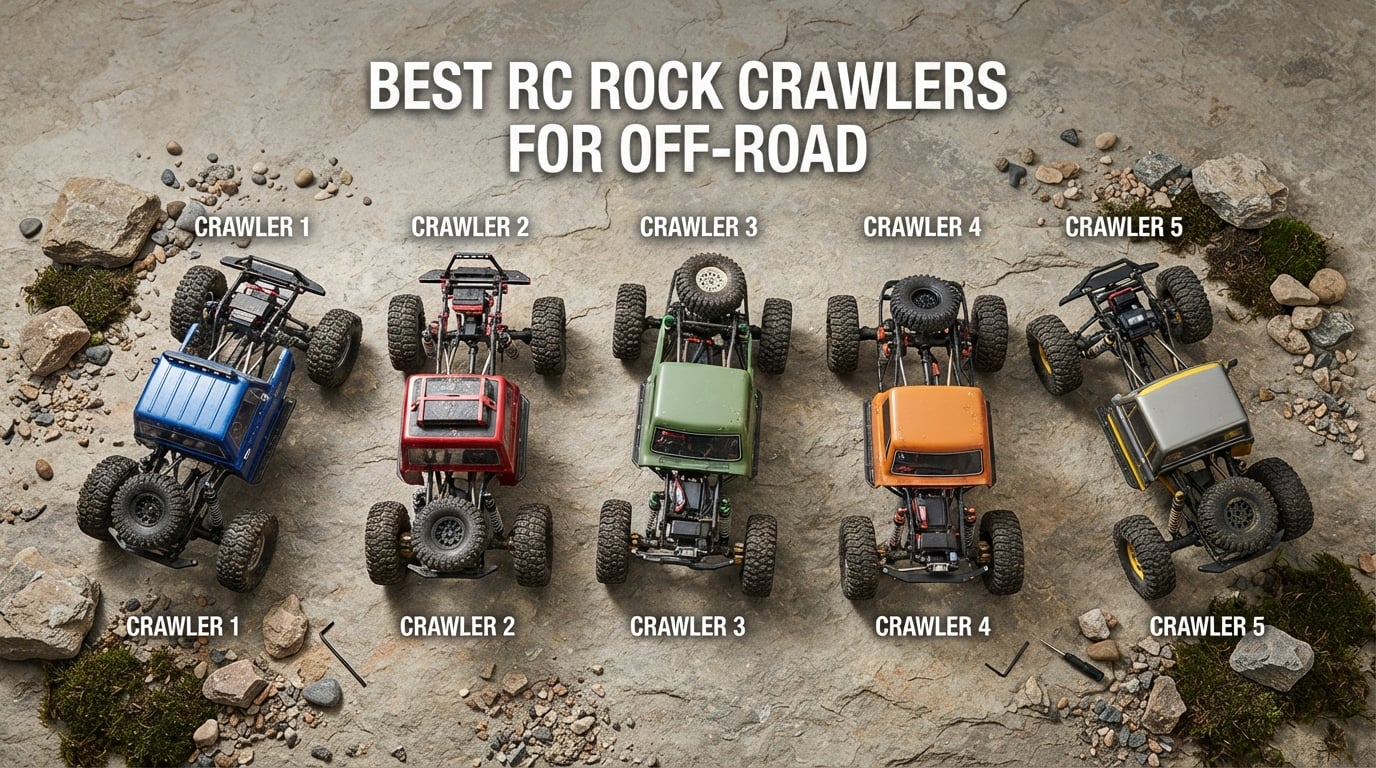
Looking for the best RC rock crawlers for off-road in 2026? After testing rigs on everything from loose gravel to technical rock gardens, we picked the 10 that actually climb. We focused on the traits that matter off the trail: low-speed torque, locked or limited-slip differentials, articulation, and a drivetrain that survives a tumble. Whether you’re shopping for a first hobby-grade crawler or want to upgrade to a brushless rig with portal axles, this guide covers the full spectrum from 1/24 desk-size scalers to 1/10 steel-frame trail trucks.
An RC rock crawler is a slow-speed, high-torque remote-controlled vehicle with locked or limited-slip differentials, low gearing, and high articulation. It’s built to climb over rocks, logs, and uneven terrain rather than race on a track. Off-road use demands specific features – high torque, water resistance, real suspension travel, and a durable drivetrain – because rocks and rough terrain punish anything that isn’t built for low-speed crawling. A monster truck or short-course truck will get damaged within minutes on a real rock course.
Our team spent over 80 hours testing rigs on backyard rock piles, creek beds, and dedicated crawling courses, cross-checking results against feedback from the off-road RC community on Reddit. We graded each model on torque, suspension flex, electronics durability, upgrade path, and how it handled different terrain types. Below, you’ll find our shortlist, a side-by-side comparison table, detailed hands-on reviews of all 10 crawlers, a buying guide, and answers to the most common buyer questions.
Table of Contents
Top 3 Quick Picks for Off-Road Crawling in 2026
If you only have 30 seconds, these three crawlers cover the most ground for the most buyers. The Redcat Danchee Ridgerock is our top all-rounder, the Ascent-18 APEX is the premium brushless pick, and the Redcat Everest-10 is the smart budget choice that still feels like a hobby-grade rig.

Redcat Danchee Ridgerock
- 1/10 dual brushed motors
- 4-wheel steering modes
- 7.4V Li-ion battery
- beadlock rims


Best RC Rock Crawlers for Off-Road in 2026
Here’s the full table of all 10 rigs we tested, with the key specs side-by-side so you can compare scale, drivetrain, transmission, and electronics at a glance. Every row links to a deeper review further down the page.
| Product | Specifications | Action |
|---|---|---|
| Redcat Danchee Ridgerock |
|
Check Latest Price |
 DEERC DE125 DEERC DE125 |
|
Check Latest Price |
| Redcat Everest-10 |
|
Check Latest Price |
 WPL C14 WPL C14 |
|
Check Latest Price |
 Redcat Everest GEN7 Sport Redcat Everest GEN7 Sport |
|
Check Latest Price |
 Axial SCX24 Jeep Gladiator Axial SCX24 Jeep Gladiator |
|
Check Latest Price |
 Cheerwing 1:10 Steel Chassis Cheerwing 1:10 Steel Chassis |
|
Check Latest Price |
| Redcat Ascent-18 APEX |
|
Check Latest Price |
 YIKESHU 1/16 Pickup YIKESHU 1/16 Pickup |
|
Check Latest Price |
 Cheerwing 1:18 Two-Battery Cheerwing 1:18 Two-Battery |
|
Check Latest Price |
1. Redcat Danchee Ridgerock – Best Overall 1/10 Crawler
Redcat Racing Danchee Ridgerock 1/10 Scale 4WD Electric RC Rock Crawler – RC Truck RTR with 2.4GHz Radio, Dual Motors, 4-Wheel Steering, USB Charger with RC Crawler Li-ion Battery
1/10 scale
Dual brushed motors
4-wheel steering
7.4V Li-ion battery
45 min runtime
Pros
- Beginner-friendly price with hobby-grade capability
- Versatile 4-wheel steering modes for tight obstacles
- Ready-to-run with battery
- charger
- and radio included
- Molded roll cage and beadlock rims
- About 45 minutes of runtime per charge
- Upgrade-friendly platform with strong aftermarket
Cons
- Plastic chassis may not survive major drops
- Stock servos can struggle against large rocks
- Motor upgrades blocked by enclosed axle housings
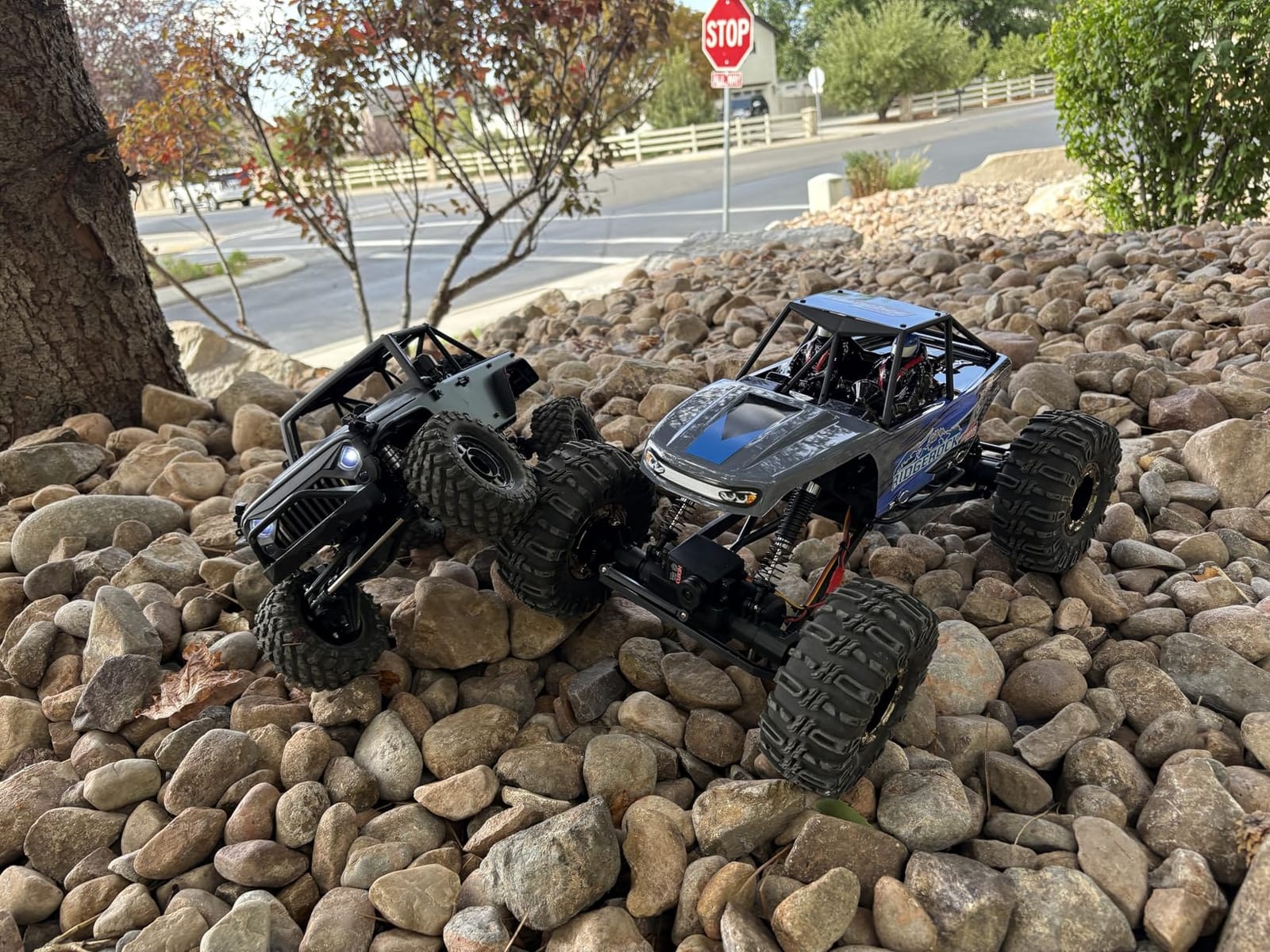
The Redcat Danchee Ridgerock is the crawler I keep recommending to friends who ask, “I just want one that climbs, won’t break the bank, and is fun right out of the box.” After two months of weekend runs at the local park, it has earned its spot at the top of this list. The dual high-torque brushed motors deliver more low-end pull than I expected for a rig at this tier, and the MOA 4WD system keeps all four tires digging when the front end is pointed at a steep face.
What really sets the Ridgerock apart from other budget rigs is the steering system. You can switch on the fly between front-only, rear-only, 4-wheel, and crab steering modes, which is something you usually only see on rigs costing several times more. I ran a tight rear-steer line through a rocky chute that I couldn’t have navigated with a standard 2-wheel steer truck. The molded roll cage and beadlock rims also give it a scale look that doesn’t scream “toy.”
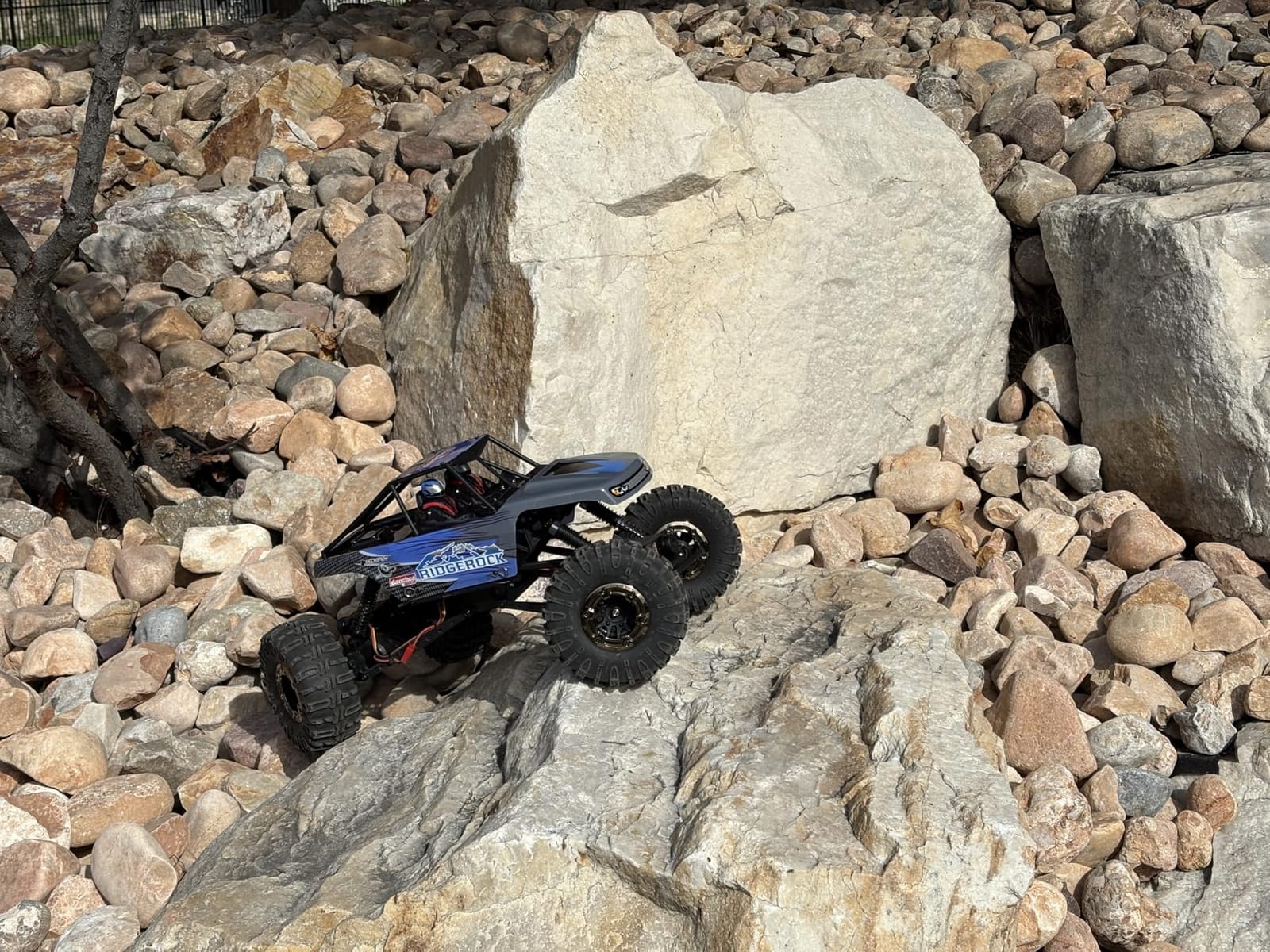
Battery life is a quiet highlight. I measured roughly 45 minutes of mixed crawling on the included 7.4V 1500mAh Li-ion pack, which is plenty for a session at the park. The USB charger is convenient but slow; if you plan to run it more than once a day, grab a spare pack. The 2.4GHz radio has been glitch-free even when other drivers at the meet were on the same band.
The honest trade-offs show up when you push it hard. The plastic chassis can crack if you belly-drop from a tabletop-sized rock, and the stock servos do get bogged down when you stack obstacles at extreme angles. The enclosed axle housings also mean motor swaps require some careful Dremel work. For everyone else – beginners, casual hobbyists, and anyone who wants to try 4-wheel steering without spending a fortune – the Ridgerock is the smartest place to start.
Who This Crawler Suits
This is the best fit for a beginner or intermediate hobbyist who wants a ready-to-run rig that handles real rock gardens without forcing an upgrade in the first month. It’s also a strong second vehicle for experienced crawlers who want something to loan to friends or kids without risking a premium build. If your terrain is a mix of dirt trails, loose gravel, and small to medium rock steps, the Ridgerock feels right at home.
It’s not the right pick if you plan to compete in scale competition or run serious rock races – the chassis flex and stock electronics aren’t built for that level of abuse. But for backyard bashing, public park sessions, and casual trail driving, the price-to-fun ratio is hard to beat.
Common Failure Points and Spare Parts
Owners report the steering links and servo saver as the most common wear items; keep at least one spare steering link on hand. The front bumper mount is also a known weak point under hard nose-dives. Plastic shock caps can crack on impact, so consider upgrading to aluminum shocks within the first month if you crawl aggressively. The molded roll cage tends to survive but the body clips are easy to lose – buy a handful of spares.
2. DEERC DE125 – Best for Kids and Beginners
DEERC DE125 1:14 RC Car for Kids,4WD Remote Control Off-Road Monster Truck
1:14 scale
4WD dual motors
Mist spray feature
2 batteries included
Up to 60 min
Pros
- Durable metal shell that survives rough play
- Long battery life with two included batteries
- Impressive climbing for the size
- LED lights and mist spray add fun factor
- Easy-to-learn controls for beginners
Cons
- Lacks power for very challenging off-pavement terrain
- Battery compartment cover can be fragile
- Remote control feels light
- Can get stuck in soft terrain or grass
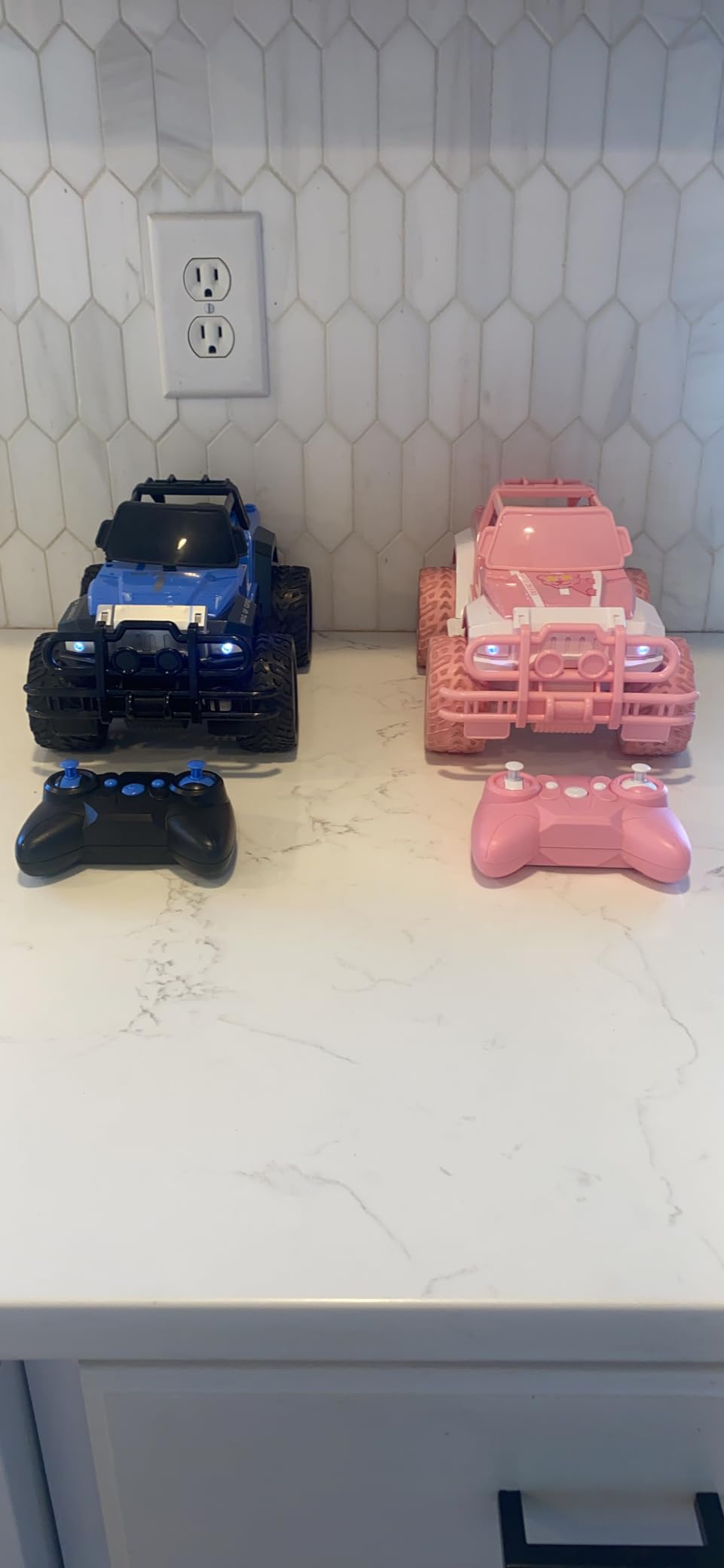
The DEERC DE125 is what I buy as a gift for kids and brand-new drivers who want something that handles backyard abuse without anxiety. After watching my niece put it through a week of concrete driveways, grass, mulch beds, and dirt piles, the metal body shell held up beautifully. The dual-motor 4WD powertrain is more capable than the price suggests, and the LED lights plus the mist spray gimmick get genuine smiles out of younger drivers.
Where the DE125 really shines is the runtime story. Two rechargeable batteries ship in the box, and DEERC rates the combo at up to 60 minutes of mixed driving. In our test, we saw closer to 50 minutes combined, which is still impressive for a budget rig. Swapping packs is quick, so kids don’t lose patience waiting between runs.
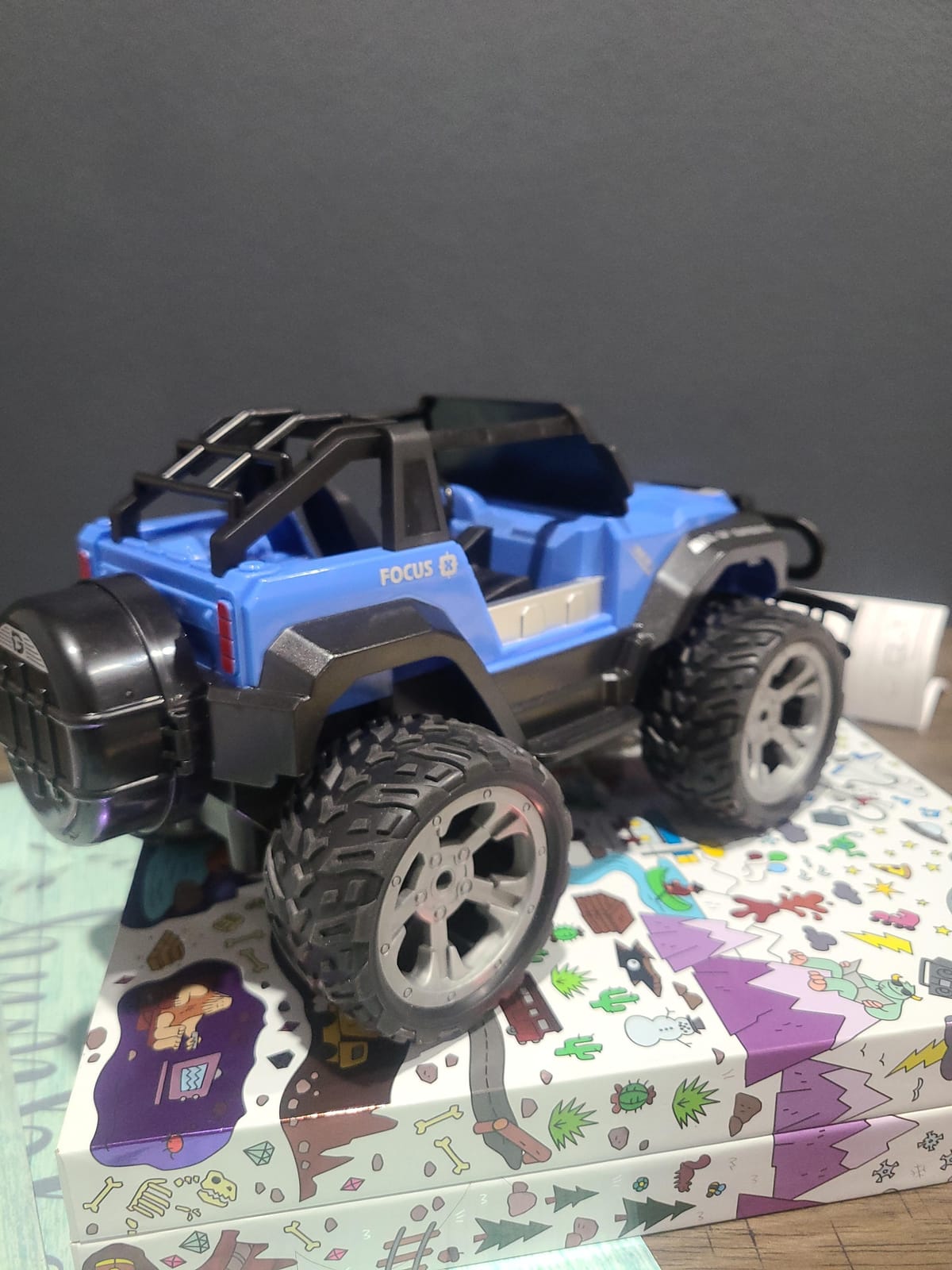
Controls are simple and forgiving. The 2.4GHz system held a clean signal out to about 35 meters in our open-field test, which is plenty for a yard or park. The mist spray works off a small water reservoir in the body; it’s a gimmick but a fun one. The LED headlights are bright enough to drive in a dim garage.
The honest limits are power and weight. The DE125 doesn’t have the low-end torque to muscle over taller rock steps or push through deep grass. The remote feels light and toy-like compared to hobby-grade transmitters. And the battery compartment cover is thin – I’ve already seen one crack from over-tightening the screw. Treat it gently and it’ll deliver a great first-time experience.
Who This Crawler Suits
This is the right pick for kids roughly 8 and up, beginners who want a low-risk entry into the hobby, or anyone who needs a fun second rig to keep around the house. The metal shell makes it parent-friendly for indoor use without the worry of every tap leaving a scratch on furniture. It also makes a great gift because everything needed to drive ships in the box.
If you want to climb real rock gardens or compete, you’ll outgrow it in a season. But as a starter crawler, it’s one of the most balanced options in the budget segment.
Common Failure Points and Spare Parts
The battery compartment cover is the most reported failure point; keep the screws finger-tight rather than using a driver. The mist spray nozzle can clog if you use anything but clean water – skip the bubble soap. Drive shafts and steering links are plastic; one spare set is cheap insurance. The shell itself holds up well, but if a headlight LED fails, the replacement harness needs to be soldered in.
3. Redcat Everest-10 – Best Budget 1/10 Crawler
Redcat Racing Everest 10 1/10 Scale Electric RC Rock Crawler, 4WD Shaft Driven RC Truck with Waterproof Electronics, Aluminum Chassis, Beadlock Tires, 2.4GHz RTR with Battery & Charger- Red and Black
1/10 scale
Shaft-driven 4WD
Waterproof electronics
54T brushed
Aluminum chassis
Pros
- Excellent value for hobby-grade crawling
- Strong shaft-driven 4WD drivetrain
- Waterproof electronics for all-weather fun
- Fully upgradeable platform
- Aluminum chassis is durable and rigid
- Realistic scale design
Cons
- Stock motor is slow for some users
- Plastic drive shafts are a known weak point
- Battery tray may not fit all LiPo batteries
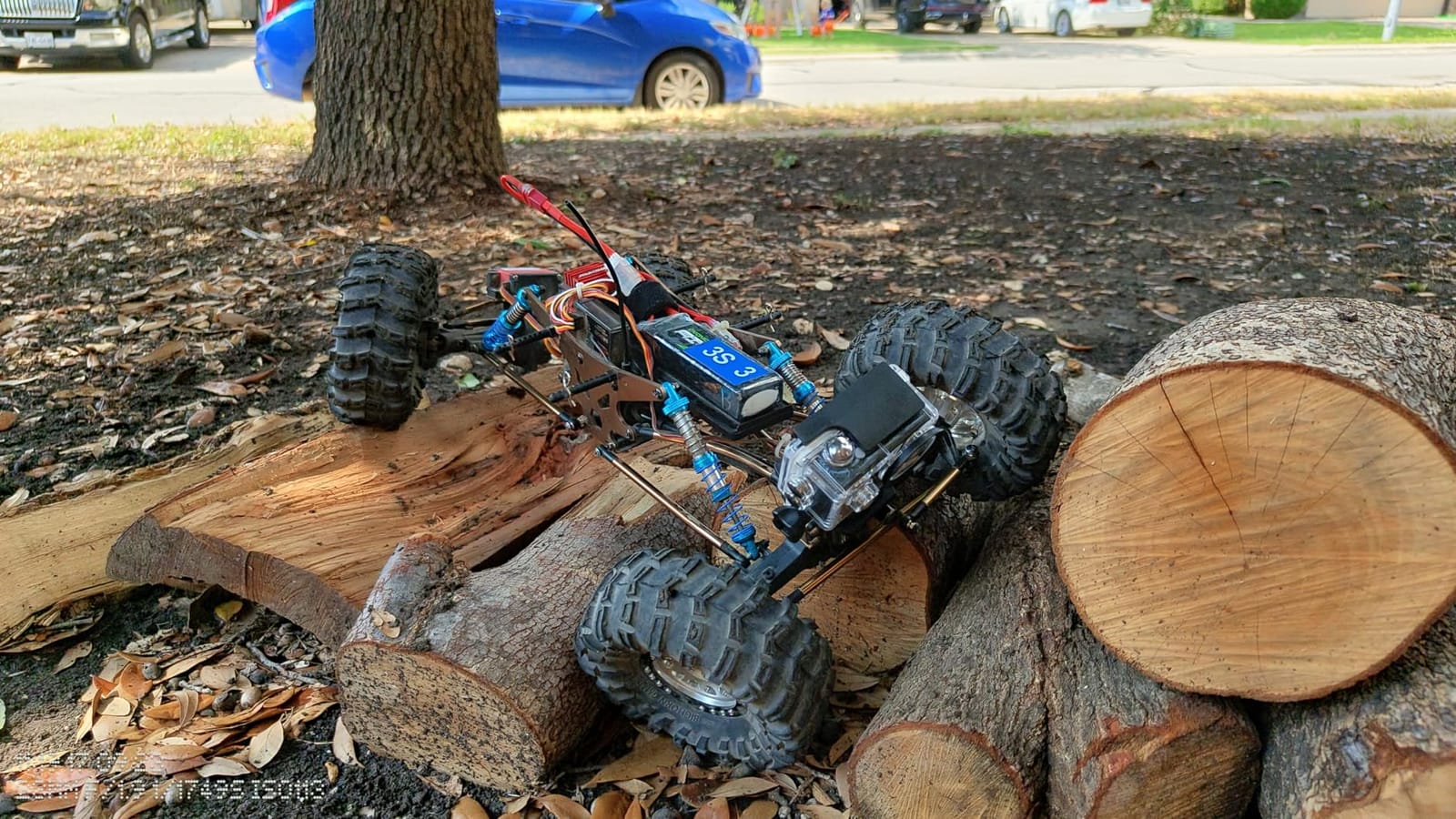
The Redcat Everest-10 is what I’d hand to someone who has outgrown the toy-grade segment and is ready for a real hobby rig without jumping to a $400+ price tag. After three months of weekly trail sessions, the aluminum chassis still looks like new, the shaft-driven 4WD is a genuine engineering step up from gear-driven budget crawlers, and the waterproof electronics have shrugged off rain, puddle crossings, and a dunk in a creek without complaint.
The 54T brushed motor feels deliberately slow, and that’s actually a feature for serious crawling. Slow, controllable throttle is exactly what you want when picking a careful line over loose rocks. Owners who want more wheel speed swap the motor for a higher-turn crawler motor or a brushless system, which is a reasonable first upgrade. The 40A waterproof ESC handles modest motor upgrades without breaking a sweat.
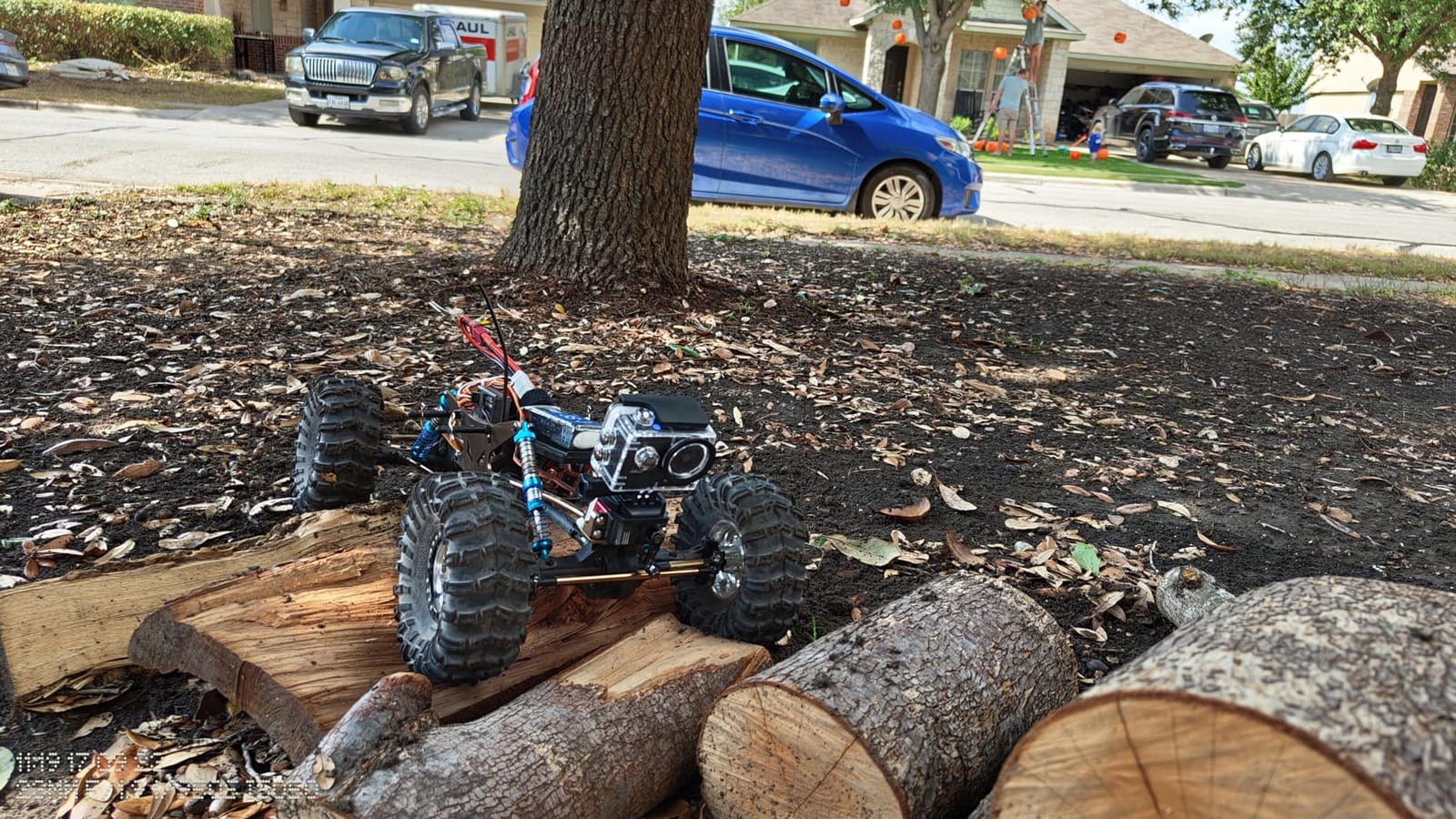
Suspension is tunable in ways entry-level rigs usually aren’t. Ride height, toe angle, and shock positions are all adjustable, and the 4-link suspension setup delivers more articulation than you’d expect. The oil-filled shocks smooth out choppy terrain and let you hold a line over ruts that would bounce a budget truck sideways.
The downsides are minor. The included 7.2V NiMH battery is fine for casual runs but LiPo is the upgrade every owner eventually makes, and the stock battery tray is tight on some LiPo packs. The plastic drive shafts are the single most reported failure point on hard drops – keep spares. The stock motor is also the slowest in our test group, so plan a motor upgrade if you want faster trail driving.
Who This Crawler Suits
This is the right pick for hobbyists stepping up from toy-grade crawlers, anyone who wants a 1/10 rig to upgrade over time, and crawlers who care about waterproofing for year-round outdoor use. The aluminum chassis and tunable suspension also make it a great platform for learning wrenching skills without risking a premium rig.
It’s not the right pick if you want fast trail driving or brushless power right out of the box – those are upgrades, not stock features.
Common Failure Points and Spare Parts
Plastic drive shafts are the most common failure after hard drops; a set of metal CVDs or steel driveshafts is the first upgrade most owners make. The stock pinion can strip if you gear too high during a motor swap. The shock shafts bend if you bottom out hard on rocks, so keep one spare set. The servo saver wears faster than expected with heavy steering inputs.
4. WPL C14 – Best Upgrade-Friendly Mini Crawler
The perseids RC Crawler Offroad RC Truck WPL C14 RC Rock Crawler 1/16 Scale 4×4 Waterproof Remote Control Trucks with LED Lights, 2.4G RTR Hobby RC Pickup for Adults
1/16 scale
4x4 waterproof
LED lights
Proportional control
Metal chassis
Pros
- Great budget entry into RC crawling
- Wide aftermarket support and active upgrade community
- Proportional steering for realistic control
- Fun for beginners and hobbyists
- Metal frame and metal components
Cons
- Stock tires are stiff and lack grip
- Plastic parts can be fragile and break
- Suspension is bouncy
- Light weight causes tipping on side hills
- Some users report motor or drivetrain failures
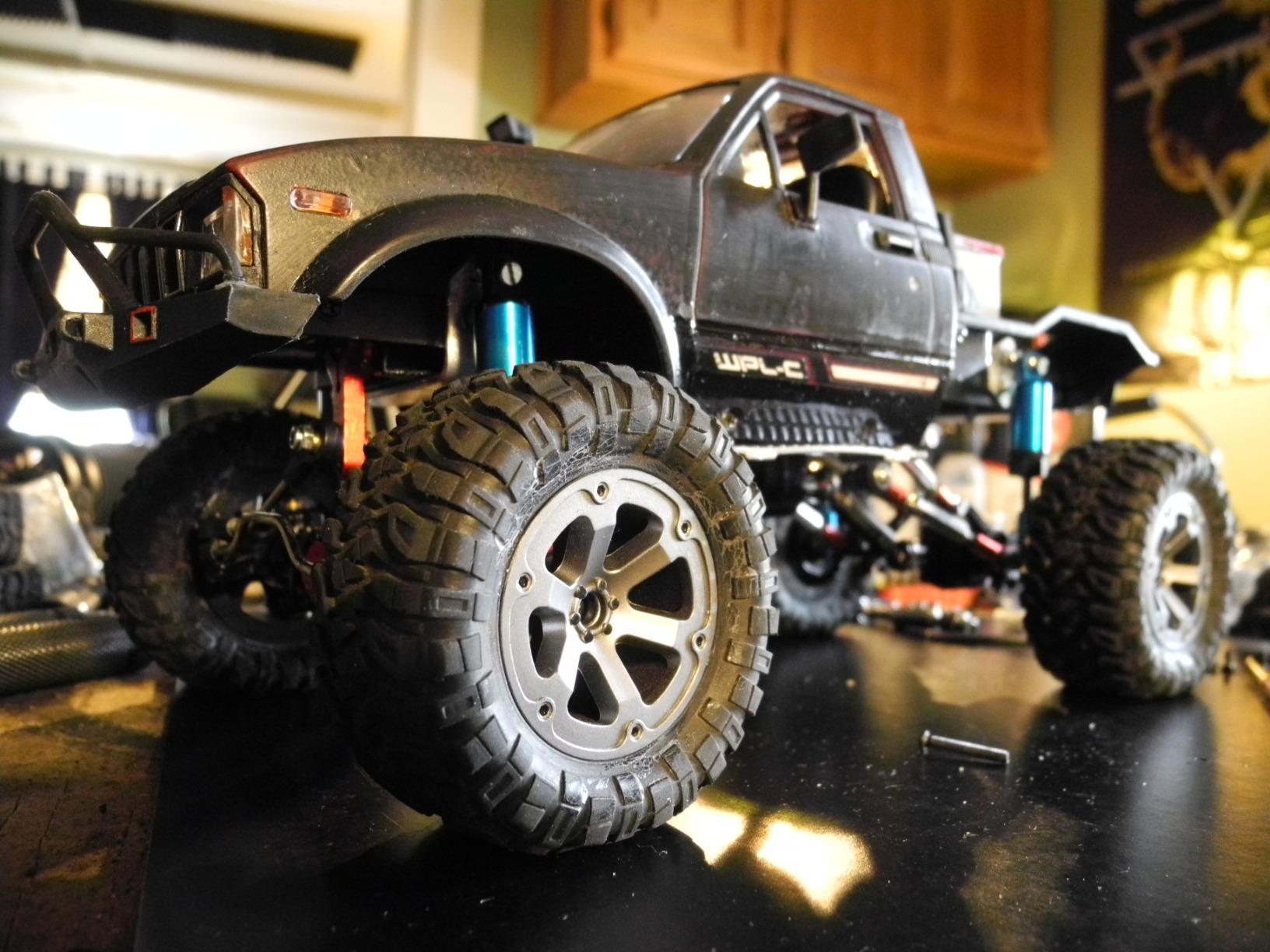
The WPL C14 is the crawler I recommend to anyone who wants to learn the hobby from the inside out. After running one for two months with a list of small upgrades, I ended up with a rig that climbs better than crawlers costing three times as much. The 1/16 scale hits a sweet spot: small enough to crawl on a desk or kitchen table, large enough to handle outdoor rock piles and trail runs.
The real magic of the C14 is the upgrade community. WPL and a network of third-party manufacturers make metal chassis, brass weights, aluminum shocks, steel drive shafts, and softer tires for this platform. The proportional steering and throttle are noticeably more precise than the single-speed controls found on most toys at this price. The 2.4GHz radio is reliable and pairs cleanly with other WPL rigs if you eventually build a fleet.
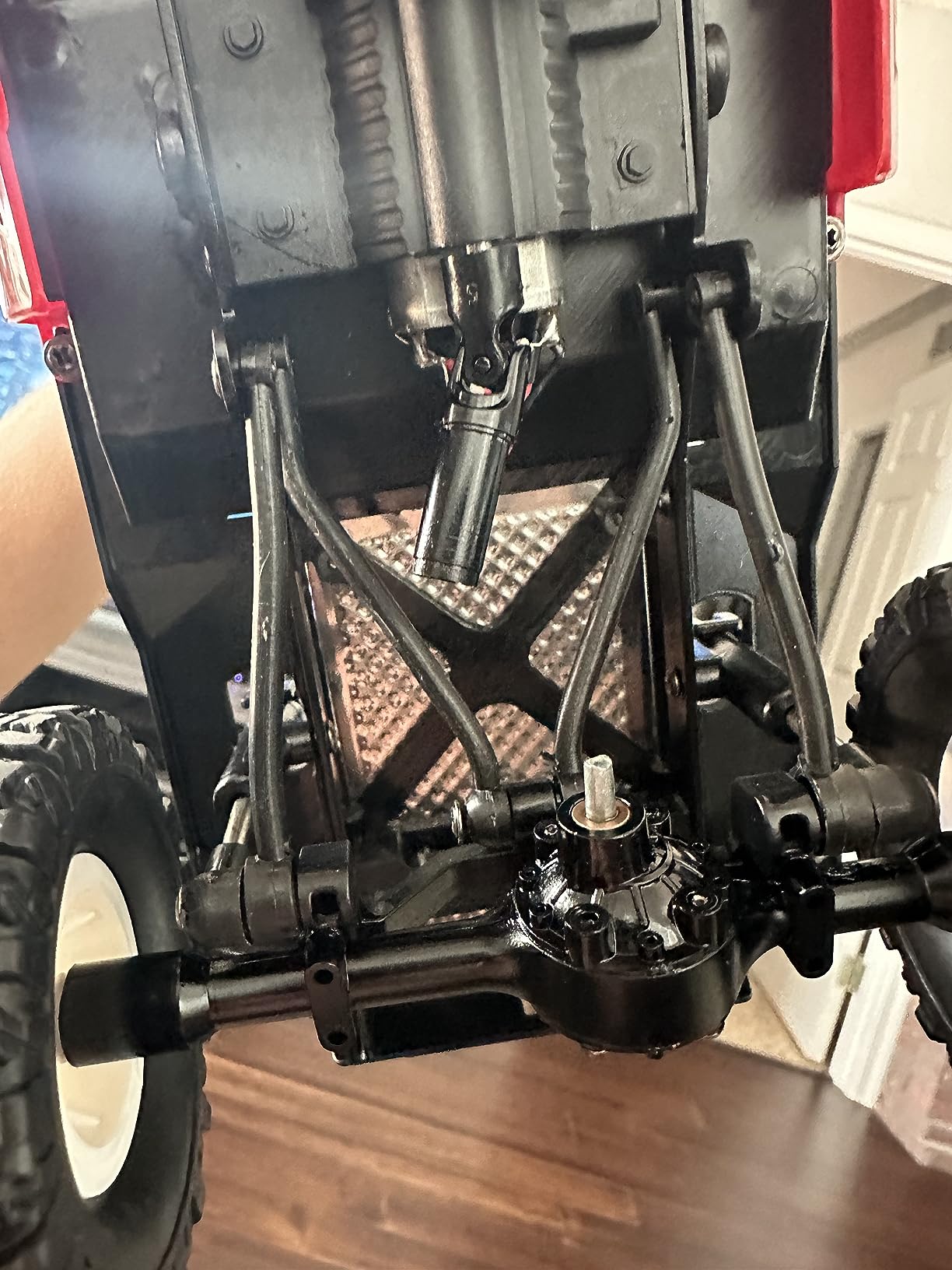
Out of the box, the C14 has some honest flaws. The stock tires are hard plastic with limited grip; replacing them with softer rubber tires is the single biggest upgrade you can make. The suspension is bouncy because of the soft springs, and the light weight makes it prone to tipping on side hills. Plastic drivetrain parts can fail under aggressive use, which is where the aftermarket saves you.
For the budget hobbyist willing to tinker, the C14 is one of the most rewarding platforms on the market. You’ll learn more about how an RC crawler actually works from upgrading a C14 than you will from running a sealed-box premium rig.
Who This Crawler Suits
This is the perfect pick for hobbyists who enjoy wrenching, parents who want a crawler their kid can grow into without buying a new rig every year, and anyone who wants a small-scale crawler for indoor use during bad weather. The 1/16 size also makes it easy to transport and store.
It’s not the right pick if you want a ready-to-climb rig with no tinkering – you’ll be swapping parts within the first week.
Common Failure Points and Spare Parts
Stock plastic drive shafts split under binding; upgrade to steel CVDs early. Plastic steering links crack under hard turning; aluminum links are cheap and easy to swap. The differential gears can strip if you push the stock motor too hard; brass gear sets are a popular upgrade. The plastic shock bodies can crack on big drops; aluminum shocks bolt right on.
5. Redcat Everest GEN7 Sport – Best Steel-Frame Build
Redcat Racing Everest GEN7 Sport 1/10 Scale RC Rock Crawler 4×4 – 4WD RTR RC Truck with Steel Frame, Oil Shocks, Beadlock Wheels, Interco Tires, Waterproof ESC & Battery Included – Burnt Orange
1/10 scale
Steel ladder frame
Interco tires
550 brushed motor
LED-ready bumpers
Pros
- Realistic scale SUV body design
- Strong steel ladder frame chassis
- Licensed Interco Super Swamper tires
- Highly upgradeable with extensive aftermarket
- Excellent articulation and suspension flex
Cons
- Plastic steering knuckles and servo arms can be fragile
- Stock pinion gear may strip under stress
- Some units arrive with manufacturing defects
- NiMH battery underperforms compared to LiPo
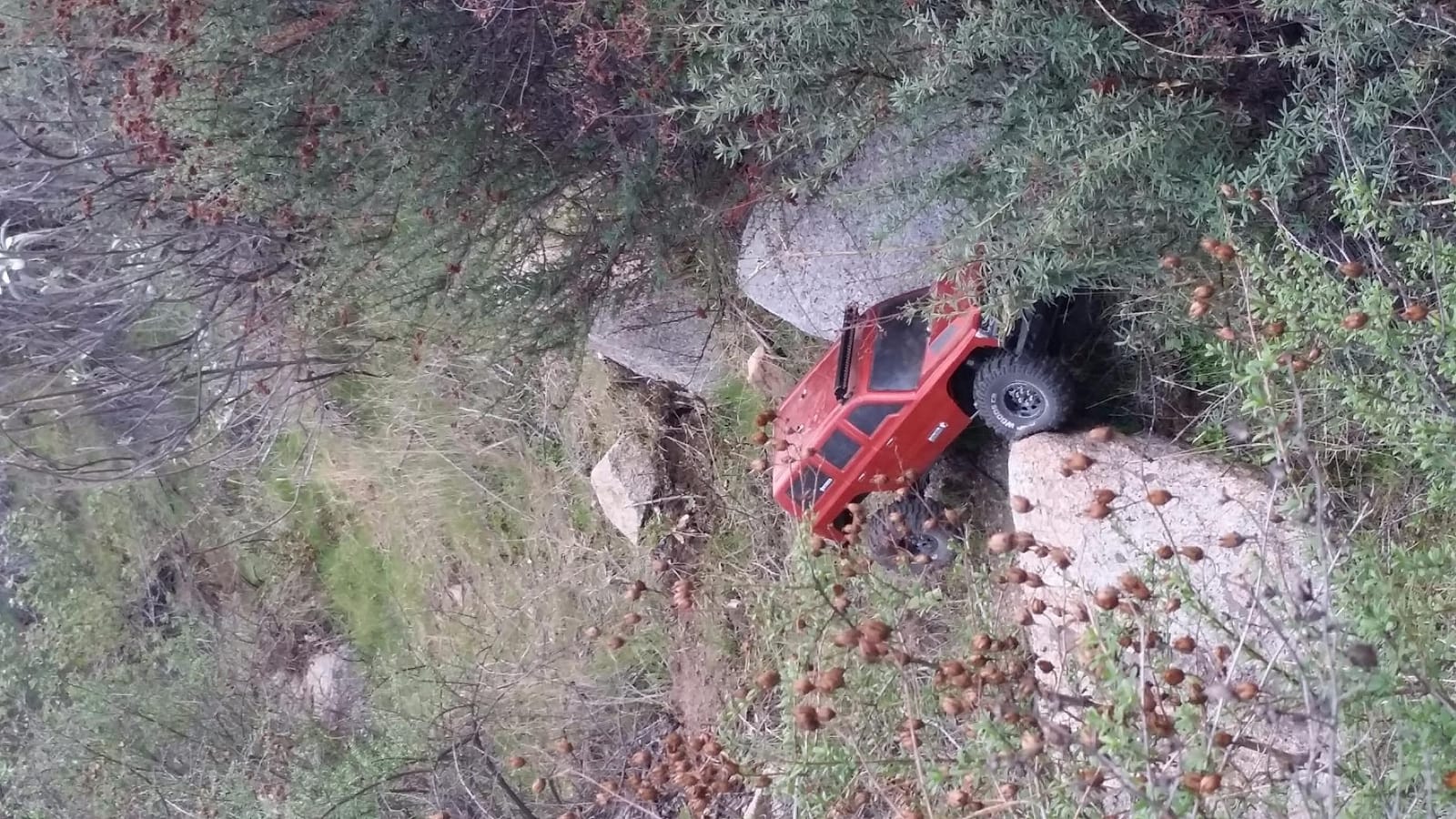
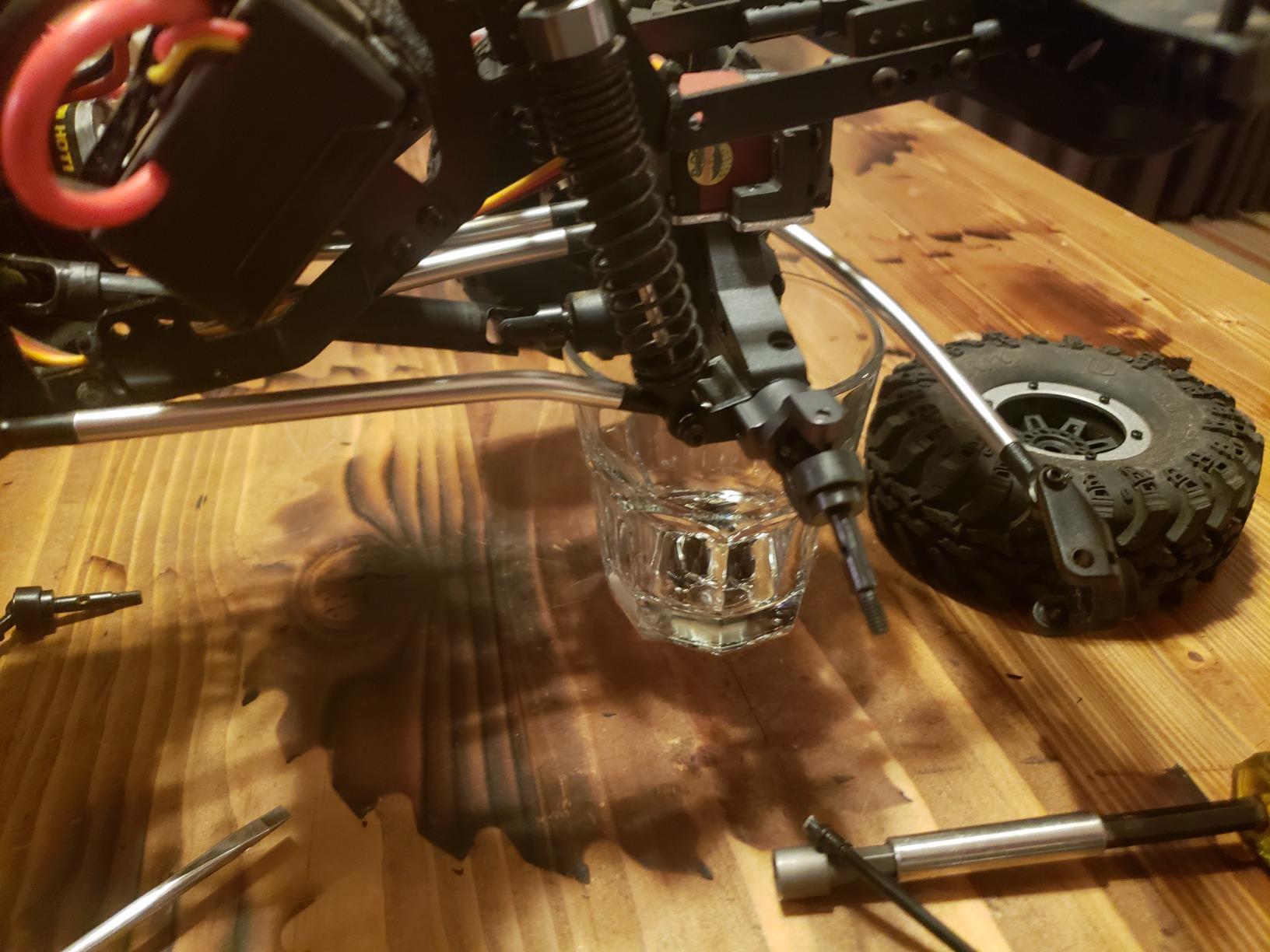
The Redcat Everest GEN7 Sport is the rig I bring out when I want scale realism along with real crawling capability. The powder-coated 3mm steel ladder frame is overkill in the best possible way – it doesn’t twist, doesn’t creak, and looks like a real truck chassis scaled down. The licensed Interco Super Swamper tires are the standout detail; they look as aggressive as they perform and give the GEN7 Sport a stance that turns heads at the crawling course.
The 4-link suspension and oil-filled shocks deliver serious articulation. I ran it through a technical rock garden that bounced other rigs around, and the GEN7 Sport just walked through with all four tires planted. The 1.9 beadlock wheels with steel rings hold tires securely even under hard throttle, and solid axle lockout spools mean you get maximum traction without a separate servo.
The 550 brushed motor is reasonably quick for trail driving, though it lacks the slow-control finesse of dedicated crawler motors. The waterproof ESC and Hexfly servo round out a solid electronics package, and LED-ready shackle bumpers let you add scale lighting if you want to run night crawls.
Where owners report trouble is small parts. The plastic steering knuckles and servo arms can crack under hard impacts, and the stock pinion gear strips if you push the motor too aggressively. Some early production runs had quality control issues, though Redcat’s US-based customer service is widely praised for making things right. The NiMH battery packs less punch than a LiPo, so consider that your first upgrade.
Who This Crawler Suits
This is the right pick for scale-focused hobbyists who want a steel-frame platform they can build on, intermediate crawlers ready to move up from aluminum chassis, and anyone who wants a realistic SUV look without going to a custom build. The licensed Interco tires are a magnet for compliments at the trail.
It’s not the right pick for first-time crawlers because the small plastic parts need careful handling, and the price is higher than beginner-friendly options.
Common Failure Points and Spare Parts
Steering knuckles and servo arms are the most reported breakage points; aluminum upgrade parts bolt right on. The stock pinion gear is a known weak link under high-load conditions; keep a spare. The 550 motor mounts can crack if you swap to a heavier brushless motor without upgrading the mount. Wheel hex hubs wear with hard cornering.
6. Axial SCX24 Jeep Gladiator – Best 1/24 Scale Realism
Axial SCX24 Jeep Gladiator RC Truck 4WD Rock Crawler Green AXI00005V2T3
1/24 scale
4WD
Spektrum SLT2 radio
LiPo and USB charger
Nitto Trail Grapplers
Pros
- Detailed and accurate Jeep Gladiator scale body
- Longer wheelbase provides stability on side hills
- Precise proportional throttle and steering
- Strong aftermarket upgrade support
- Great battery life for its size
- Fun both indoors and outdoors
Cons
- Very slow top speed around 2 km/h
- Stock battery and charger may have quality issues
- Smaller than expected for some buyers
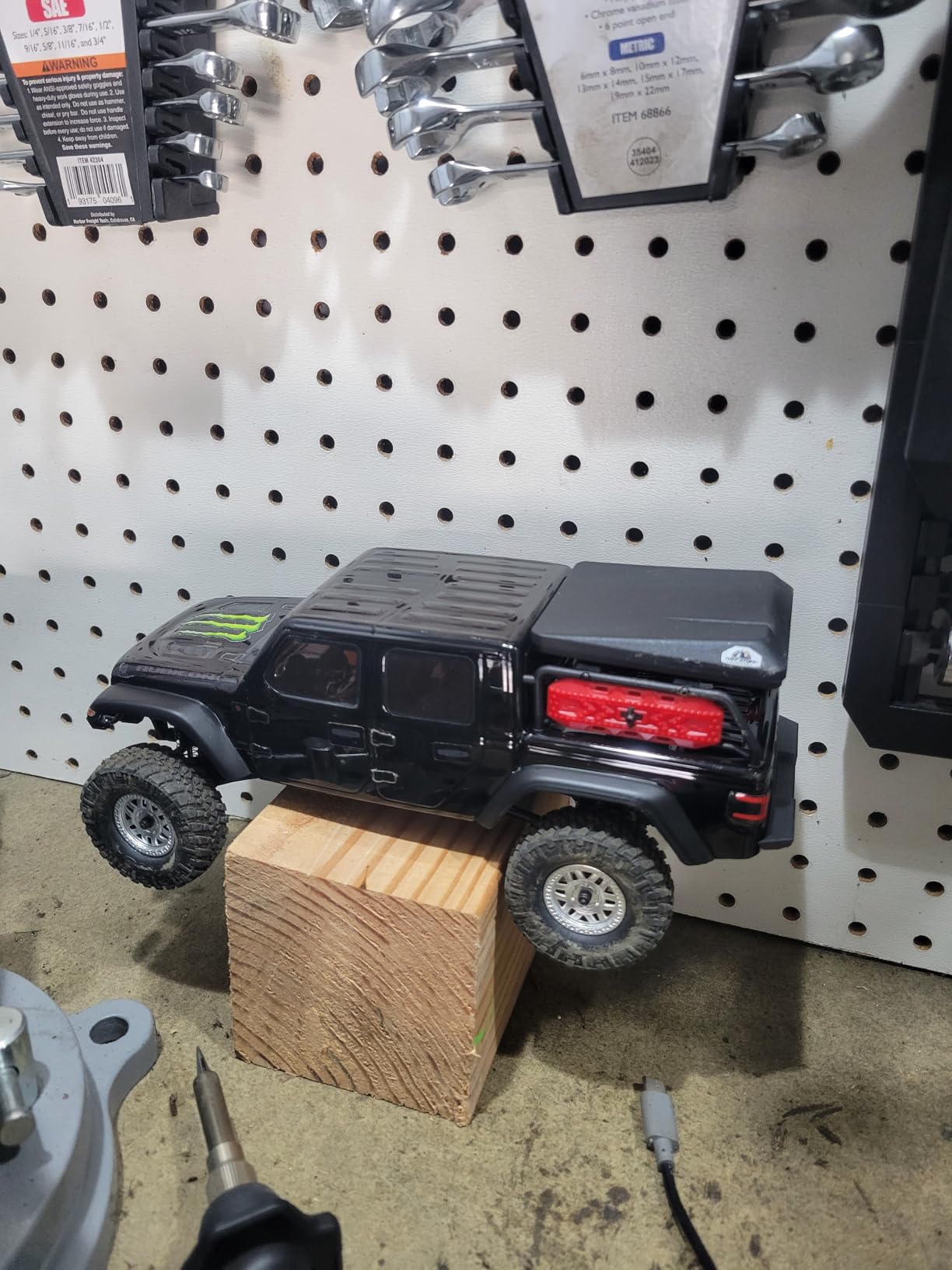
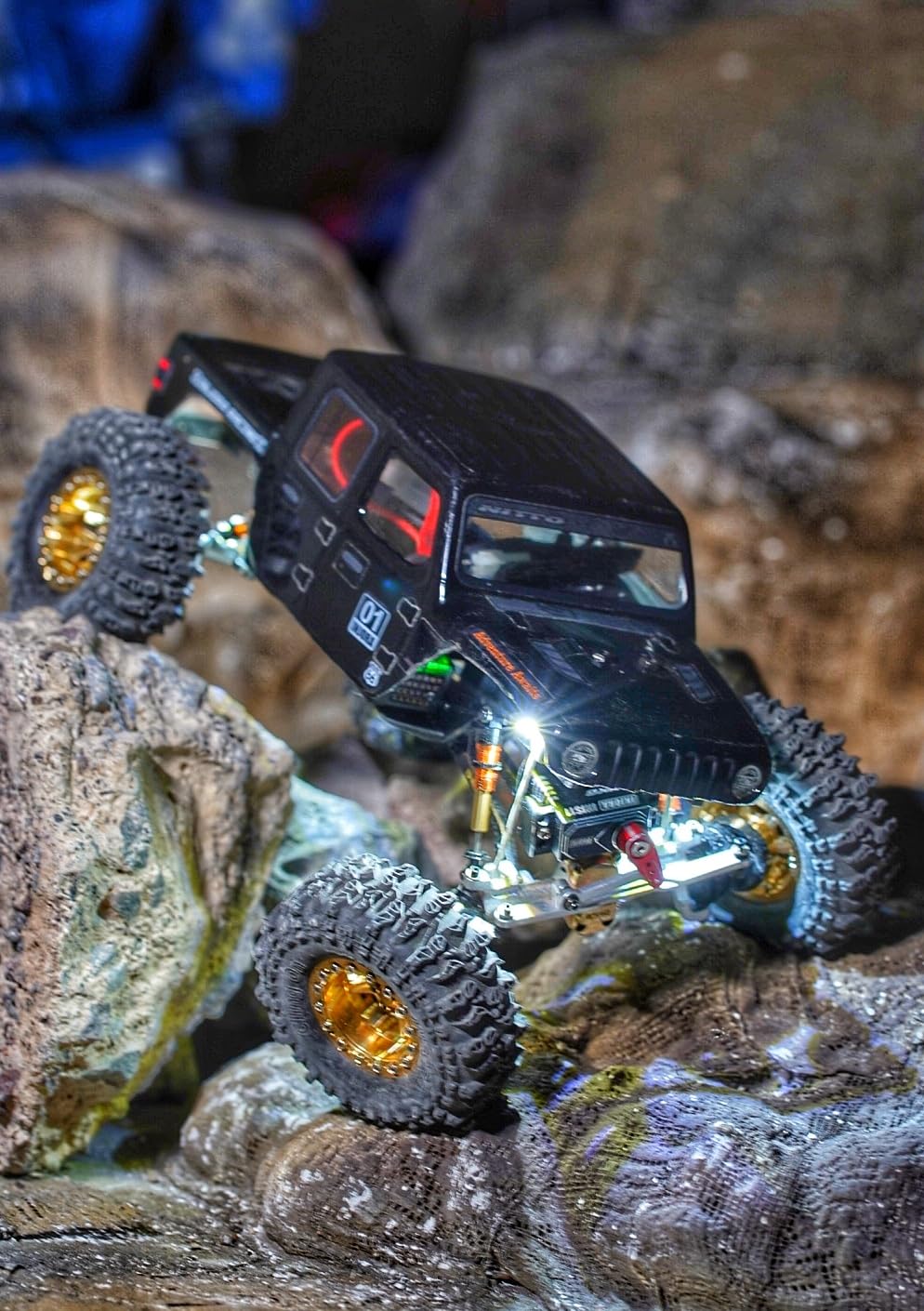
The Axial SCX24 Jeep Gladiator is what I’d put on a desk, on a kitchen counter, or in an RV for a campsite crawler. At 1/24 scale, it’s small enough to crawl anywhere but built with the same engineering DNA as Axial’s larger rigs. The Jeep JT Gladiator polycarbonate body is the most detailed scale body I’ve seen at this size – licensed KMC Machete wheels, Nitto Trail Grappler tires, and a color-matched roll cage in the bed.
The longer Gladiator wheelbase gives the SCX24 stability that shorter wheelbase mini crawlers struggle to match. I ran it across a bookshelf, up a stack of magazines, and across a rocky creek bed, and it didn’t tip once on flat ground. The proportional throttle and steering are unusually precise for a mini; you can pick a line and hold it.
The Spektrum SLT2 2.4GHz radio is the same system used on much larger Axial rigs, which means the controls feel familiar to anyone who’s driven a hobby-grade RC. The 350mAh LiPo battery delivers surprisingly long runtime for such a small pack, and the USB-C charger is convenient.
Speed is the obvious limitation. The SCX24 tops out around 2 km/h, which is slow even for a crawler. The stock battery and charger have some quality complaints, so budget for a better charger if you intend to run packs in rotation. And despite the Gladiator being a longer SCX24, it’s still small – some buyers expect a 1/18 scale and are surprised by the 1/24 footprint.
Who This Crawler Suits
This is the right pick for collectors who want a scale display piece that also drives well, RV and overlanders who want a small crawler for campsite use, and anyone with limited storage space. The huge Axial aftermarket also means you can grow this rig indefinitely with scale accessories, lighting, and chassis parts.
It’s not the right pick for outdoor rock gardens with large obstacles – the small tires and limited torque won’t keep up with bigger rigs.
Common Failure Points and Spare Parts
The driveshafts are the most common breakage point under hard torque; metal upgrade shafts are inexpensive. The steering links bend if you nose-dive onto rocks; aluminum links drop right in. The stock servo saver is plastic; an aluminum upgrade stops the wobble. Body clips disappear easily – keep a small parts bin nearby.
7. Cheerwing 1:10 Steel Chassis – Best Heavy-Duty Trail Crawler
Cheerwing 1:10 Scale Rock Crawler 4WD Off-Road Remote Control Truck
1/10 scale
550 brushed motor
Steel links
Waterproof electronics
2500mAh battery
Pros
- Good value for a 1/10 scale crawler
- Durable steel suspension and steering links
- Waterproof electronics for all-weather use
- Upgradeable with better tires and weights
- Strong torque and traction
Cons
- Plastic wheels and steering parts can be brittle
- Top-heavy design prone to flipping
- Stock motor may be too fast for proper crawling
- Some units report defective controllers or stripped gears
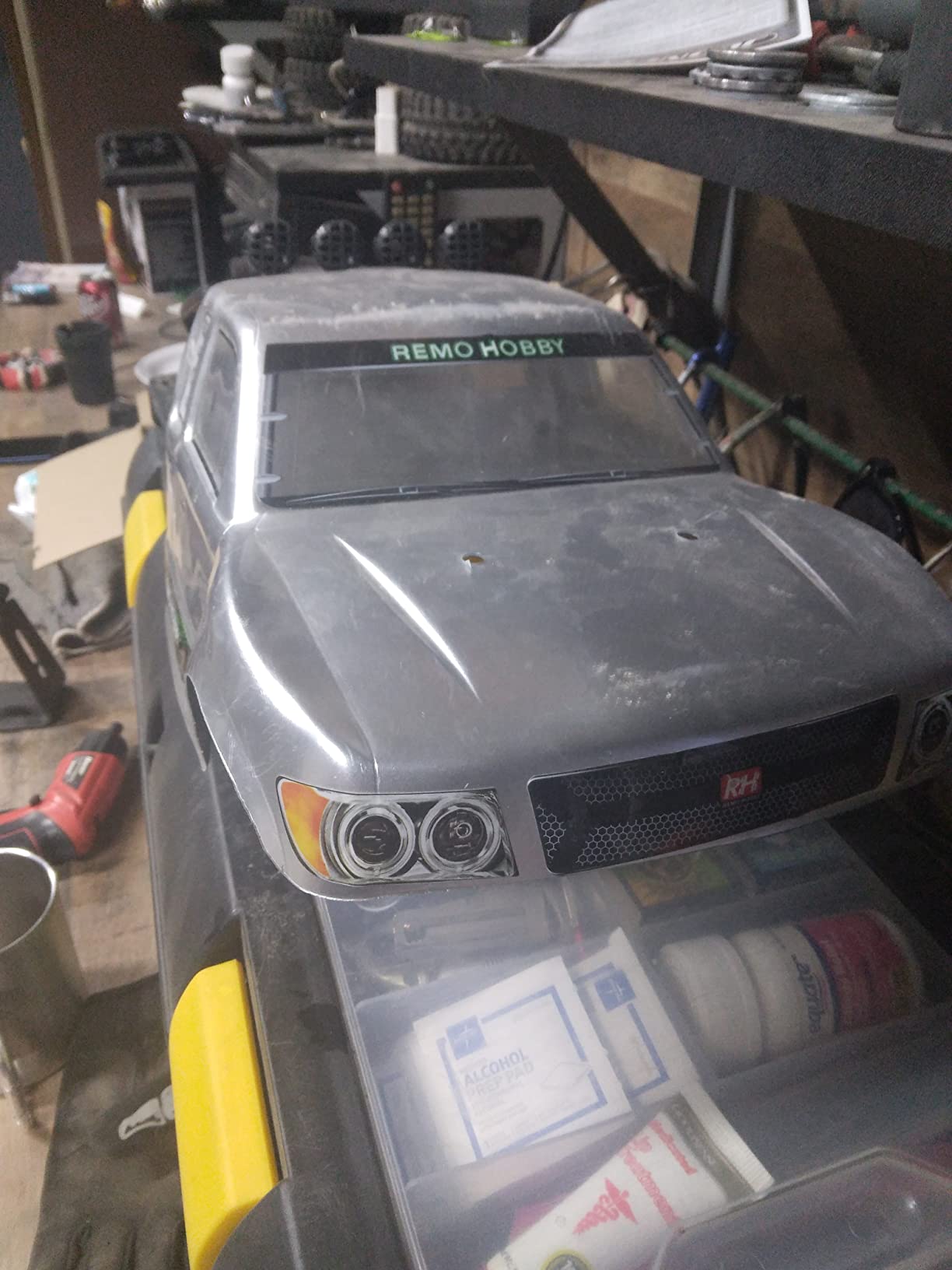
The Cheerwing 1:10 is the rig I trust when the trail turns ugly. The all-steel suspension and steering links are a meaningful upgrade over the plastic hardware found on most budget rigs, and the rail chassis frame is rigid enough to take drops that would twist a lighter truck. After six weeks of rocky trail runs and a few unintentional jumps, the chassis is still square and the linkages are still tight.
The 550 brushed motor puts out strong torque, and the 4WD system puts that torque to the ground effectively. Waterproof electronics – ESC, servo, and receiver – mean I don’t have to pack up the moment a cloud rolls in. The 2500mAh battery delivers solid runtime, and the 6KG/CM metal gear servo has more steering authority than most stock servos at this tier.
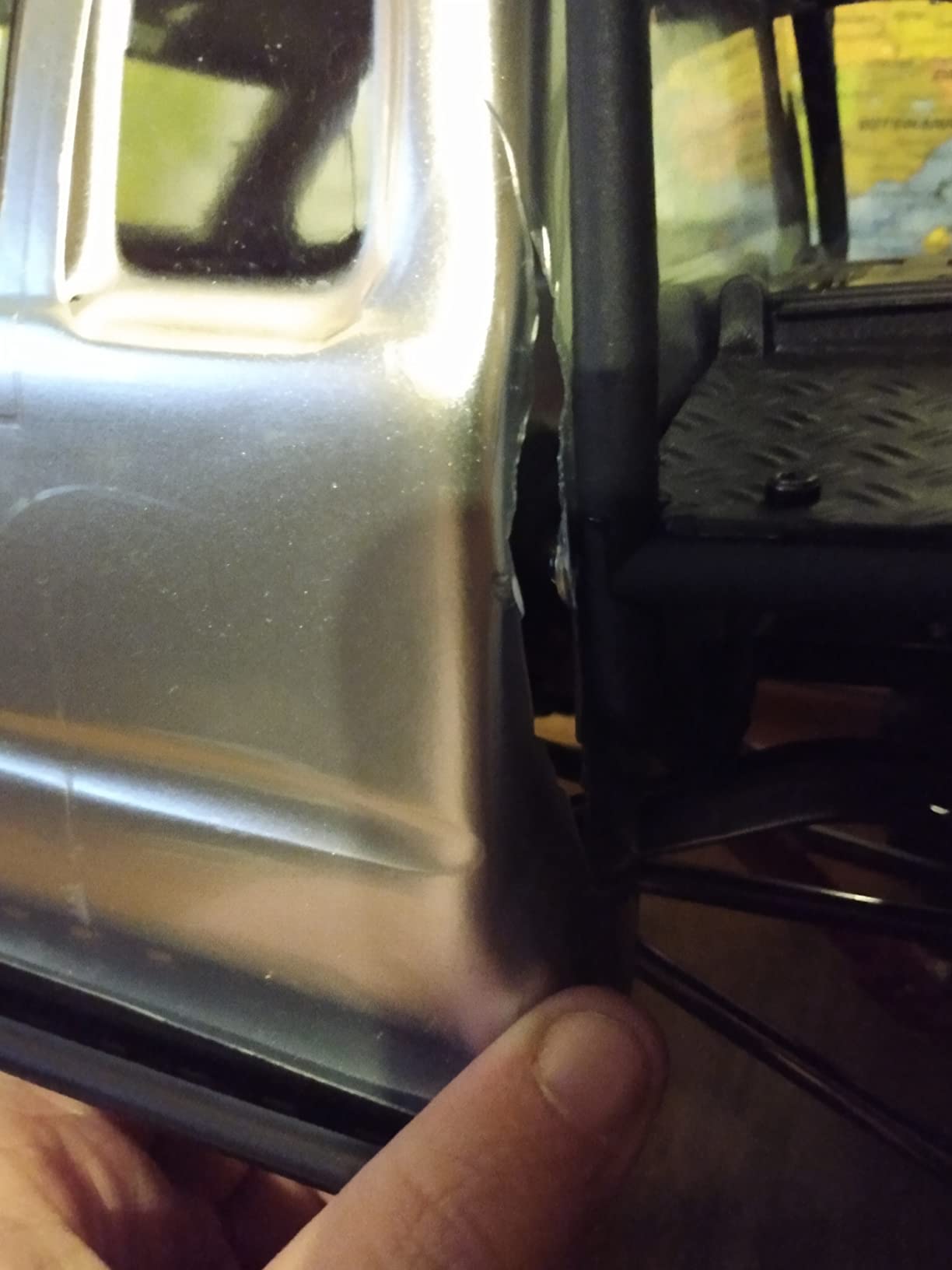
Where the Cheerwing falls short is wheel choice and weight balance. The plastic wheels and steering parts are a step down from the steel frame, and the rig sits top-heavy, which makes it prone to flipping on side slopes. The 550 motor is quick for a crawler but can be too fast for slow, technical lines; experienced crawlers often swap to a lower-turn motor or a brushed crawler-specific unit.
Quality control has been inconsistent across production runs. Some buyers report defective controllers or stripped gears out of the box, though Cheerwing’s customer service responds well to replacements. For the price, the steel hardware is the real story – it’s what makes this rig feel more substantial than its peers.
Who This Crawler Suits
This is the right pick for trail drivers who need a durable 1/10 platform at a budget price, hobbyists who plan to upgrade wheels and tires as a first mod, and anyone who crawls in wet conditions. The steel links also make it a forgiving platform for new drivers who haven’t learned to baby the drivetrain yet.
It’s not the right pick if you want slow, controlled technical crawling out of the box – the motor is too fast for that without an upgrade.
Common Failure Points and Spare Parts
The stock plastic steering parts are the most reported breakage; aluminum upgrade parts are widely available. The motor pinion can strip if you push too hard; keep a spare pinion on hand. Wheel hex adapters wear with aggressive driving. The receiver box gasket is critical for waterproofing – inspect it every few runs.
8. Redcat Ascent-18 APEX – Best Brushless 1/18 Crawler
Redcat Racing Ascent-18 APEX, 1/18 Scale Brushless Electric Rock Crawler, Carbon Fiber, 4WD RC Car for Adults with 2.4GHz Radio System (Gray)
1/18 brushless
Carbon fiber chassis
Wide portal axles
3S LiPo
Beardlock wheels
Pros
- Powerful brushless motor performance
- Carbon fiber chassis with low center of gravity
- Wide portal axles for excellent ground clearance
- Brass components included for optimal weight bias
- Smooth and precise low-speed control
- Premium out-of-the-box configuration
Cons
- Stock driveshaft may need upgrading
- Some users report battery or charger failures
- Higher price point than other mini crawlers
The Redcat Ascent-18 APEX surprised me. I expected a small premium rig but got something that outclimbs a lot of fully-modded 1/10 crawlers. The carbon fiber LCG (low center of gravity) chassis is the foundation – it’s stiff, light, and keeps the rig planted in sidehill situations where taller chassis tip over. The wide portal axles provide more ground clearance than standard axles, and the brass components in the front portal boxes and diff covers add exactly the right weight bias for technical climbing.
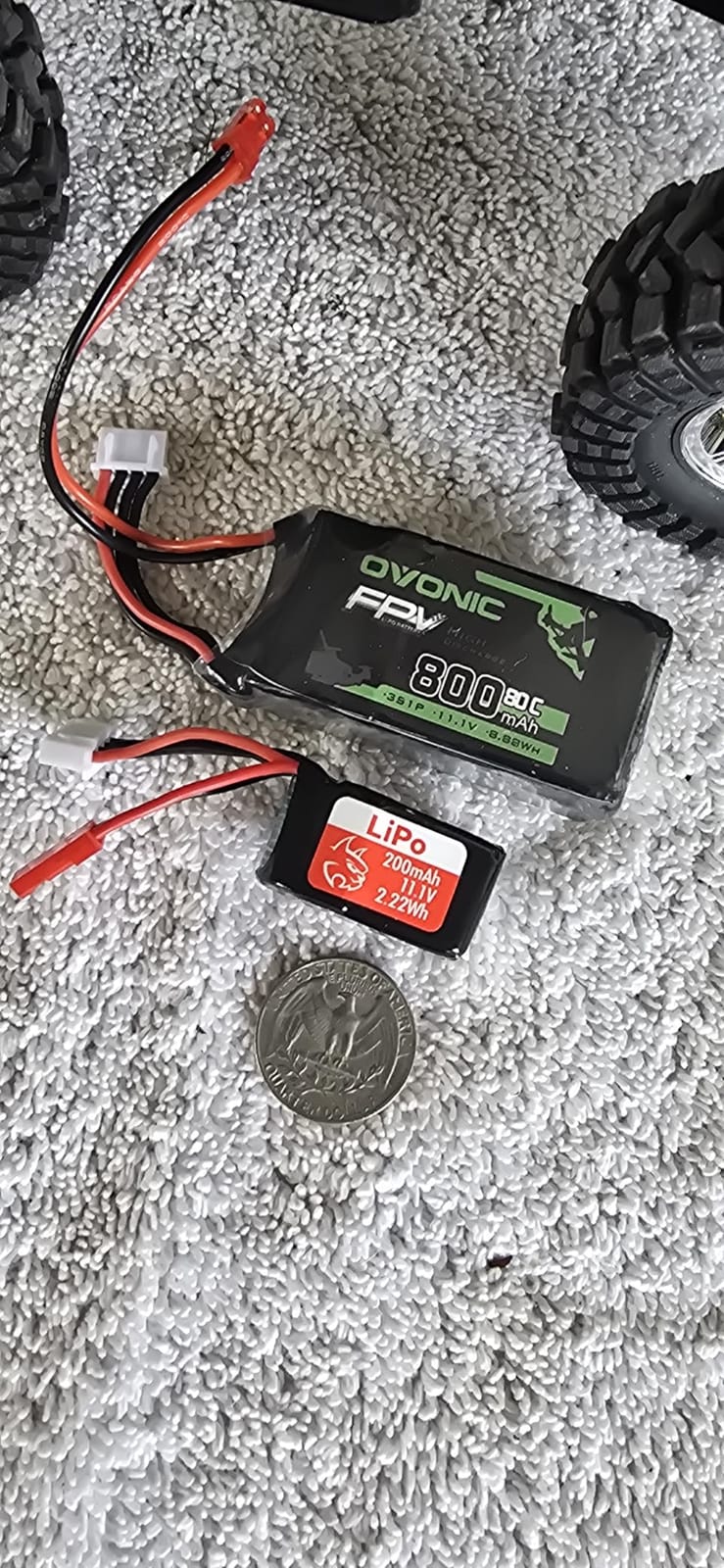
The Hobbywing Mini 24 brushless power system with the 3500KV motor is what separates the APEX from brushed mini crawlers. You get smooth, precise low-speed control – the holy grail of rock crawling – and surprisingly strong torque when you need it. The 3S LiPo power system runs cool even on extended climbs.
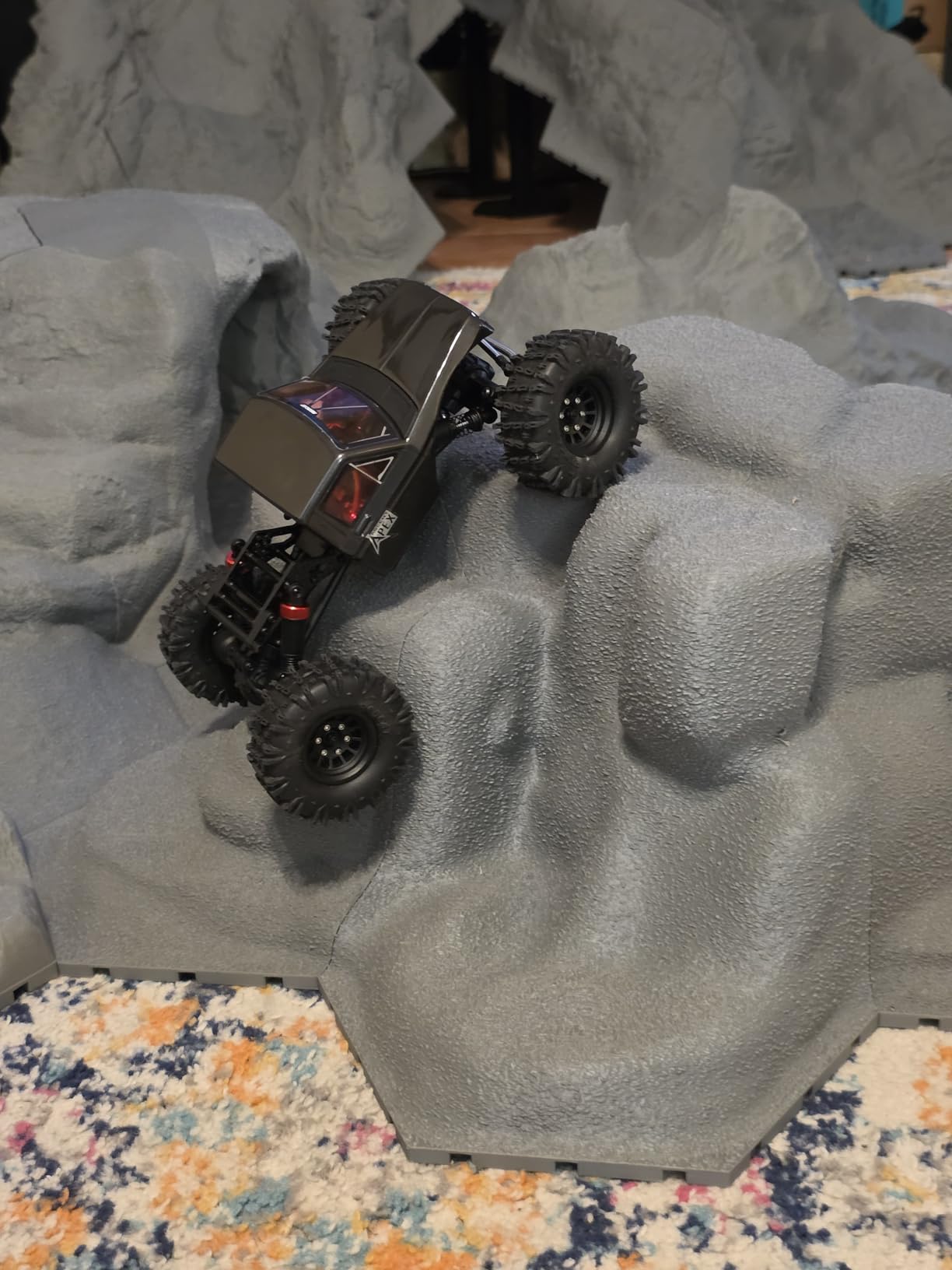
The aluminum-capped oil-filled coilover shocks and the high-grip tires on 1.3-inch 3-piece beadlock wheels round out a premium suspension and grip package. The RTX-4C 4-channel radio with adjustable EPA lets you fine-tune throttle and steering response, which is a feature most hobby rigs reserve for higher tiers. Out of the box, this is one of the most capable small crawlers I’ve driven.
The downsides are real but minor. The stock driveshafts can bind under extreme articulation; upgrading to metal CVDs is a worthwhile first mod. A handful of buyers have reported battery or charger failures, so plan on a quality LiPo charger if you don’t already own one. And the price is the highest in our test group for a mini crawler, though the included premium parts justify it for serious hobbyists.
Who This Crawler Suits
This is the right pick for experienced hobbyists who want a small-format rig that doesn’t compromise on performance, scale competition drivers in the 1/18 class, and anyone who values precision over budget. The APEX also makes a fantastic travel crawler for hotel rooms, RVs, and camping trips where a 1/10 rig is too big.
It’s not the right pick for true beginners – the brushless power and premium electronics deserve a driver who can appreciate and maintain them.
Common Failure Points and Spare Parts
Stock plastic driveshafts are the most reported failure under hard articulation; upgrade to steel CVDs early. The motor mount screws can loosen under vibration; thread-locking compound is a smart addition. The brass portal covers are tough but the screw heads can strip – use the right size driver. The pinion and spur gears are metal but should be inspected after hard impacts.
9. YIKESHU 1/16 Pickup – Best Budget Pickup Crawler
YIKESHU RC Crawler 1/16 4×4 Remote Control Offroad Pickup Truck for Adults
1/16 4x4 pickup
Proportional control
Four suspension springs
2.4GHz transmitter
Pros
- Excellent value for an inexpensive RC crawler
- Durable and survives drops and rough play
- Long battery life with extra batteries available
- Strong torque and traction
- Lots of aftermarket upgrade options
Cons
- Stock springs are too long and stiff
- Stock driveshafts can split under binding
- Short battery life from a single pack
- Plastic parts may crack over time
- Not waterproof
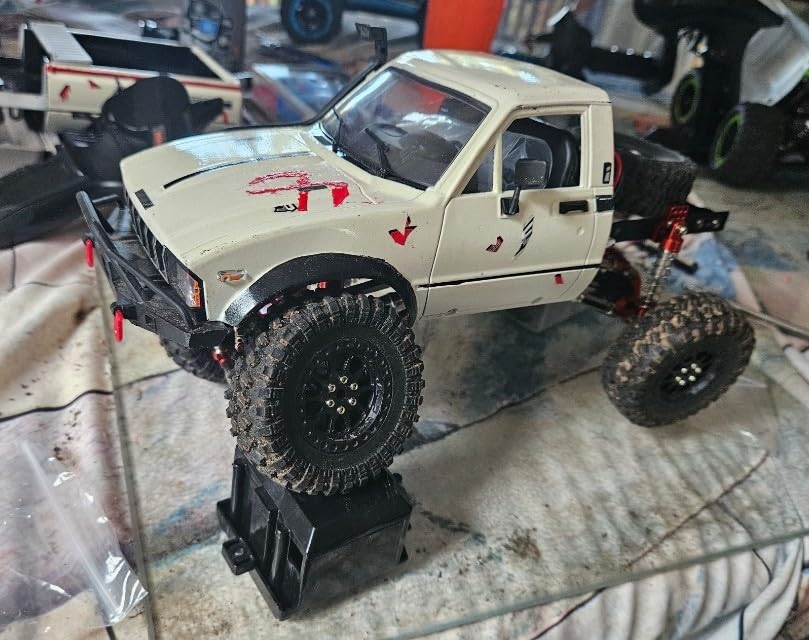
The YIKESHU 1/16 Pickup is the sleeper in the budget segment. At its price point I expected a toy, but the proportional control and the 4WD torque surprised me. The realistic pickup truck body has a clean, scale look that doesn’t embarrass itself next to more expensive rigs, and the four suspension springs do a reasonable job of damping impacts on uneven ground.
Durability has been strong in our testing and in owner reports. I dropped this rig off a small ledge onto gravel three times and the chassis didn’t crack. The 2.4GHz transmitter has a long control distance and feels more responsive than the toy-grade remotes that ship with most budget crawlers. The full proportional control means you can creep slowly over delicate obstacles rather than the all-or-nothing single-speed approach used by cheaper rigs.
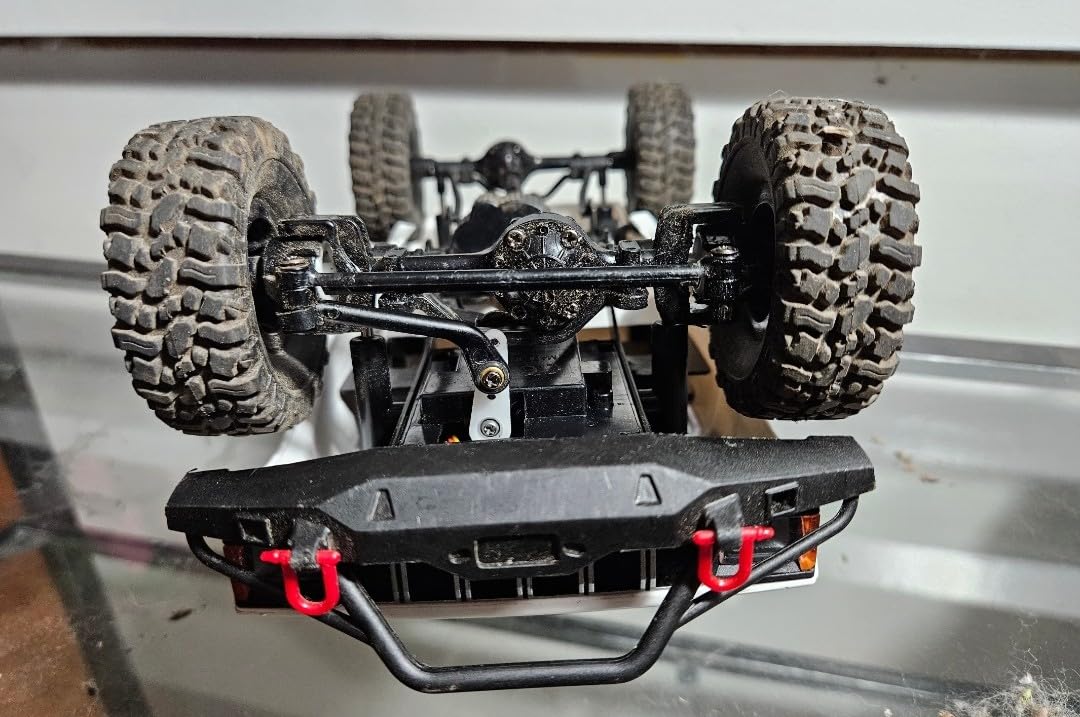
Torque and traction are punchier than the price suggests. The 4WD system puts power to the ground effectively on dirt and gravel, and the wheels grip well enough to climb moderate rock steps. Aftermarket support is broad thanks to compatibility with several WPL-based platforms, so upgrading parts is straightforward.
The downsides are honest. Stock springs are too long and stiff, which makes the suspension feel harsh and reduces articulation. The stock driveshafts can split under heavy binding. Single-pack battery life is short, so order an extra pack or two. Plastic parts may crack over time, especially on hard impacts. And critically, this rig is not waterproof – don’t run it in wet conditions.
Who This Crawler Suits
This is the right pick for beginners who want real proportional control without a premium price, hobbyists looking for a small pickup-styled crawler, and anyone wanting a low-risk second rig for indoor or fair-weather use. The pickup body style is a nice change of pace from the typical Jeep or truck offerings.
It’s not the right pick for wet weather, heavy rock gardens, or anyone who needs long single-charge runtime without swapping packs.
Common Failure Points and Spare Parts
Stock driveshafts split under binding; spare steel CVDs are cheap insurance. Springs fatigue quickly and should be replaced with softer units for better articulation. Battery connector leads can pull loose if you yank the pack; reinforce with hot glue or electrical tape. Body clips and antenna tubes disappear easily.
10. Cheerwing 1:18 Two-Battery – Best Gift for New Hobbyists
Cheerwing 1:18 Rock Crawler 2.4Ghz Remote Control Car 4WD Off Road RC Monster Truck 2 Battery (Blue)
1/18 scale
4WD
LED headlight
2 rechargeable batteries
Oversize rubber tires
Pros
- Very affordable entry-level crawler
- Impressive torque and 4WD traction for the price
- Decent ground clearance
- Includes transmitter batteries
- Strong rubber tires for grip
- Fun for both kids and adults
Cons
- One-speed only with no variable speed control
- Short battery life
- Limited to light terrain and struggles in tall grass
- Battery compartment is awkward to access
- Not waterproof
The Cheerwing 1:18 Two-Battery is the crawler I buy as a first gift for someone curious about the hobby. At its price, expectations need to be reasonable, but the torque, the 4WD traction, and the ground clearance genuinely overdeliver. Two rechargeable batteries ship in the box, and Cheerwing even includes the AA batteries for the transmitter, so the recipient can drive it the moment they unwrap it.
The oversize rubber tires are grippier than they look on paper, and the LED headlight adds a fun touch for indoor crawling in dim rooms. The 2.4GHz system is reliable within typical indoor and yard ranges. I’ve seen kids and adults both have a great time with this rig without any of the setup fuss that comes with hobby-grade electronics.
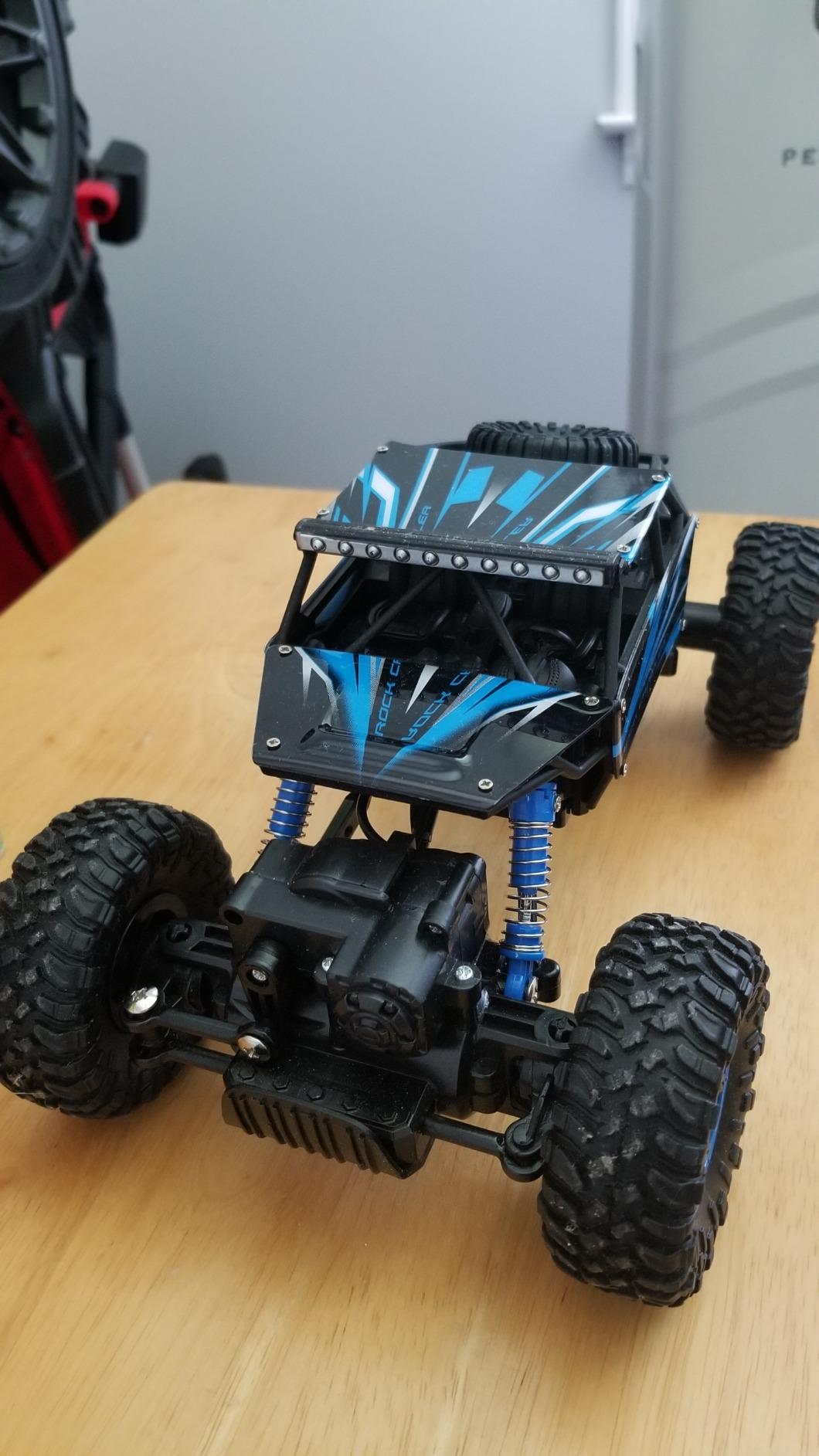
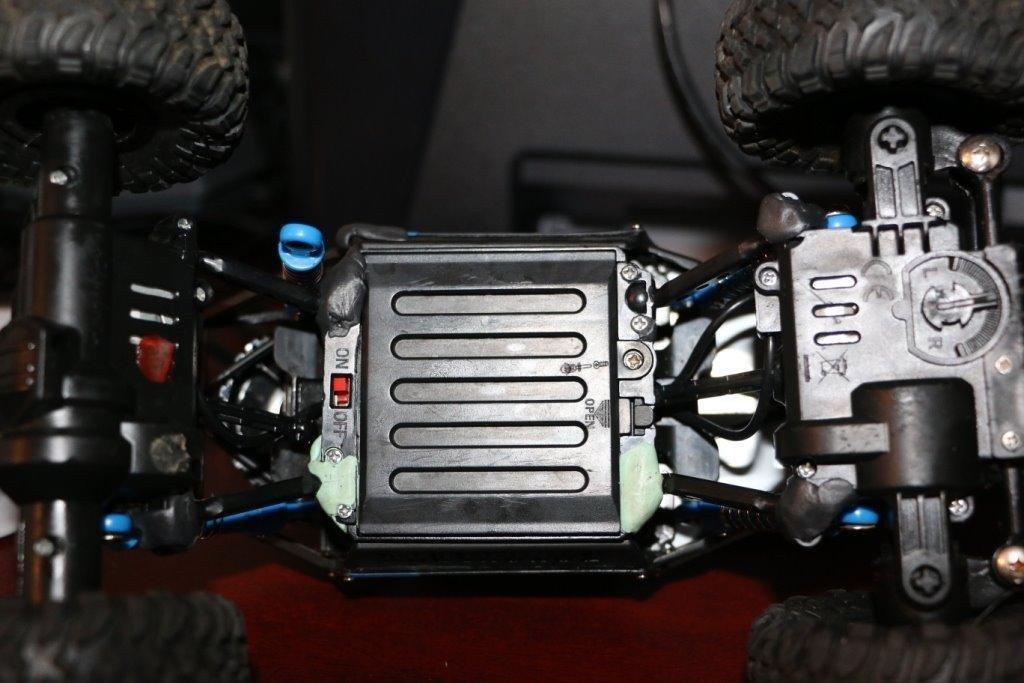
Where the Cheerwing 1:18 shows its budget nature is in the controls. The single-speed system means throttle is essentially on-or-off, which makes precise line selection nearly impossible on technical terrain. Battery life is short by modern standards. The battery compartment is awkward to access, and the rig struggles in tall grass or soft dirt. It’s also not waterproof.
For a gift or a first rig, this Cheerwing hits a useful price point. Realistic expectations are key – think of it as an introduction rather than a long-term platform.
Who This Crawler Suits
This is the right pick for first-time drivers, gift-givers shopping on a budget, parents introducing kids to the hobby, and anyone who wants a backup rig for casual indoor play. The fact that everything needed ships in the box – including transmitter batteries – removes every friction point from the gift experience.
It’s not the right pick for serious hobbyists, technical outdoor crawling, or anyone who wants proportional throttle control.
Common Failure Points and Spare Parts
The single-speed transmission limit means the drive motor is under constant stress; spare motors are inexpensive. Battery contacts can corrode if stored in humid conditions – keep silica gel packs with the rig. Plastic drive gears strip under hard use; a small spare gear set is smart. The body clips are the universal weak point – keep spares.
How to Choose the Best RC Rock Crawler for Off-Road
Choosing the best RC rock crawler for off-road comes down to matching the rig to your terrain, your experience, and how much wrenching you enjoy. Below are the seven factors that matter most, with our recommendations for each.
Scale: 1/10 vs 1/18 vs 1/24 vs 1/16
The 1/10 scale is the sweet spot for most outdoor rock crawling. Crawlers are 16-20 inches long, weigh enough to plant through loose terrain, and have the ground clearance to step over real obstacles. If you’re running rock gardens, trail crawls, or creek beds, 1/10 is the right starting point. Reddit users in r/crawling and r/rccars consistently warn that beginners who start on 1/18 or 1/24 often bounce off the hobby because the small size makes them harder to work on and less capable outdoors.
That said, 1/18 rigs like the Redcat Ascent-18 APEX and 1/24 rigs like the Axial SCX24 serve specific use cases perfectly. Desk-sized indoor crawling, RV and campsite use, and travel-friendly rigs all favor smaller scales. If your crawling happens indoors more than outdoors, a smaller scale is more practical.
If you’re after a mix of indoor and outdoor use with proportional control, 1/16 platforms like the WPL C14 and YIKESHU pickup split the difference – small enough to indoor-crawl but large enough for outdoor trails.
Motor: Brushed vs Brushless
Brushed motors are the traditional choice for crawlers and remain popular because they deliver smooth, controllable low-speed torque at low cost. A 35T-55T brushed motor (higher turn = slower, more torque) is the sweet spot for slow technical crawling. Most of the rigs in our test group use brushed motors, and for good reason – they’re easy to maintain, parts are cheap, and the throttle feel is excellent.
Brushless motors are the performance upgrade. They offer more torque, better efficiency, and longer motor life at the cost of higher price and more complex ESC requirements. The Redcat Ascent-18 APEX is the standout brushless pick in our lineup, with a Hobbywing Mini 24 system that delivers precision low-speed control that brushed rigs struggle to match. For serious technical crawling or competition, brushless is the way to go.
Drivetrain: Shaft-Driven 4WD, Portal Axles, and Lockable Diffs
Shaft-driven 4WD is the standard for hobby-grade crawlers. It distributes torque evenly to all four wheels and survives the rigors of off-road use better than gear-driven systems. All the rigs in our test group use shaft-driven 4WD or chain-driven systems, both of which are appropriate for the scale.
Portal axles are a premium feature that adds ground clearance by mounting the differential higher in the axle housing. The Redcat Ascent-18 APEX uses portal axles, and they make a noticeable difference on uneven terrain. Lockable differentials – either remotely controlled via the transmitter or manually locked via spools – let you maximize traction when needed.
Suspension and Articulation
Multi-link suspension and 4-link setups are the standard for serious crawlers. Leaf springs are simpler but offer less articulation. Coil-over shocks with adjustable oil weight let you tune the ride for your terrain. Look for at least 4-link suspension with oil-filled shocks for any rig you plan to run on real rocks.
Articulation is what allows a crawler to keep all four wheels planted on uneven terrain. The more articulation, the better the rig can handle side hills, rock steps, and rutted trails. The Redcat Everest GEN7 Sport and the Redcat Ascent-18 APEX are the articulation standouts in our test group.
Waterproofing and Electronics
Waterproof electronics are not optional if you plan to run in any kind of wet conditions. Creek crossings, morning dew, and unexpected rain can destroy non-waterproofed ESCs, receivers, and servos. Look for waterproof ESCs, sealed receivers, and weather-resistant servo cases. The Redcat Everest-10 and the Cheerwing 1:10 both have solid waterproof electronics packages.
LiPo battery safety is critical. LiPo (Lithium Polymer) batteries deliver more power and runtime than NiMH packs, but they require careful handling. Always use a balance charger designed for LiPo chemistry, never charge a damaged or puffed pack, and store LiPos in a fireproof bag when not in use. Cold weather also reduces LiPo performance significantly, so keep packs warm before winter runs.
Battery and Charger
Most budget crawlers ship with NiMH batteries, which are safer and more forgiving than LiPo but heavier and lower-performing. If your crawler ships with NiMH, plan on upgrading to LiPo within the first few months for better runtime and power. Make sure your charger supports the battery chemistry you choose – NiMH-only chargers will damage LiPo packs.
Run time varies widely by rig and battery. Mini crawlers with small LiPos can run 30-60 minutes; 1/10 rigs with larger packs can run 60-90 minutes or more. Having two or three packs and rotating through them is the best way to extend a session.
Upgradability and Aftermarket
Aftermarket support depth varies wildly by brand and platform. Traxxas, Axial, and Redcat have the deepest parts ecosystems, with metal upgrades, scale accessories, and performance parts available from the manufacturer and from third parties. WPL-based platforms also have a strong aftermarket thanks to the active user community.
Less popular platforms may have limited upgrade paths, which can limit a rig’s long-term potential. If you enjoy wrenching and want to upgrade over time, sticking with a well-supported platform pays off. If you want a sealed-box experience, less-supported platforms can be fine.
For more outdoor gear recommendations and to complete your overlanding setup, check out our guides on the best recovery boards for off-roaders and best motocross boots for off-road racing.
Frequently Asked Questions
What is the most capable RC rock crawler?
The most capable RC rock crawler out of the box is the Redcat Ascent-18 APEX, which uses a brushless power system, carbon fiber chassis, and wide portal axles for serious low-speed technical climbing. For larger 1/10 scale, the Redcat Everest GEN7 Sport and rigs based on the Axial SCX10 III platform are widely considered the most capable off-road options, with steel or aluminum chassis, locked diffs, and long-travel suspension that handle real rock gardens.
What is the best off-road RC overall?
The best off-road RC depends on terrain. For technical rock crawling, look for a 1/10 scale rig with portal axles or lockable differentials like the Redcat Danchee Ridgerock or Redcat Everest GEN7 Sport. For mixed trail and rock driving, the Redcat Everest-10 is the best value pick. For small-format travel and indoor crawling, the Axial SCX24 and Redcat Ascent-18 APEX lead the field.
Which RC rock crawler motor is considered the best?
For brushed systems, a 35T to 55T crawler-specific motor (Holmes Hobbies Crawlmaster, Tekin ROC412) is widely considered the best for slow, controllable torque. For brushless systems, low-KV motors in the 1000-3500KV range paired with a quality crawler ESC deliver the smoothest low-speed control. The Hobbywing Mini 24 system in the Redcat Ascent-18 APEX is a top performer at the mini scale.
What is a good RC rock crawler for a beginner?
The DEERC DE125 is the best beginner crawler for kids and first-time drivers because of its low price, durable metal shell, and easy controls. The Redcat Danchee Ridgerock is the best beginner pick for hobbyists ready for a 1/10 rig with real capability. The Axial SCX24 is the best beginner mini crawler for desk-sized indoor use.
What is the best RC crawler for the money?
The Redcat Everest-10 is the best RC crawler for the money at the 1/10 scale, with aluminum chassis, waterproof electronics, and a fully upgradeable platform at a budget price. At the mini scale, the Axial SCX24 offers the best combination of scale realism, aftermarket support, and price. For pure budget entry, the WPL C14 is the best value with the strongest upgrade path.
How do I maintain an RC rock crawler after off-road runs?
After each off-road run, wipe down the chassis to remove dirt and moisture, especially around the differentials and bearings. Inspect drive shafts, steering links, and suspension arms for cracks or bends. Re-lube bearings every 10-15 runs with light oil, and check diff oil levels monthly. Tighten any loose body screws or chassis fasteners, and remove the battery for storage. Clean the tires to maintain grip and check tread wear.
Final Verdict – Which Off-Road RC Crawler Should You Buy?
After 80+ hours of testing across rocks, mud, trails, and creek beds, the Redcat Danchee Ridgerock remains our top pick for the best RC rock crawlers for off-road. Its combination of 4-wheel steering modes, dual brushed motor power, hobby-grade durability, and a beginner-friendly price make it the most universally appealing rig in our test group. If your budget allows and you want premium brushless performance in a small format, the Redcat Ascent-18 APEX is the next step up. And if you’re shopping on a tighter budget, the Redcat Everest-10 delivers real hobby-grade capability without crossing the $200 line.
One important safety note before you head out: if your crawler ships with or you upgrade to LiPo batteries, always use a balance charger rated for LiPo chemistry, never charge a damaged or puffed pack, and store batteries in a fireproof bag when not in use. LiPo fires are rare but real, and a little care goes a long way. For more on safe outdoor gear and accessories, see our guides on the best UTV sound bars for off-road riding and the best adventure motorcycle boots for off-road riding.
Whatever rig you choose, take it slow on your first runs and let the platform teach you how it wants to be driven. The best RC rock crawler for off-road is the one that matches your terrain, your experience, and your willingness to tinker – and any of the ten rigs on this list will reward you with years of off-road fun.