
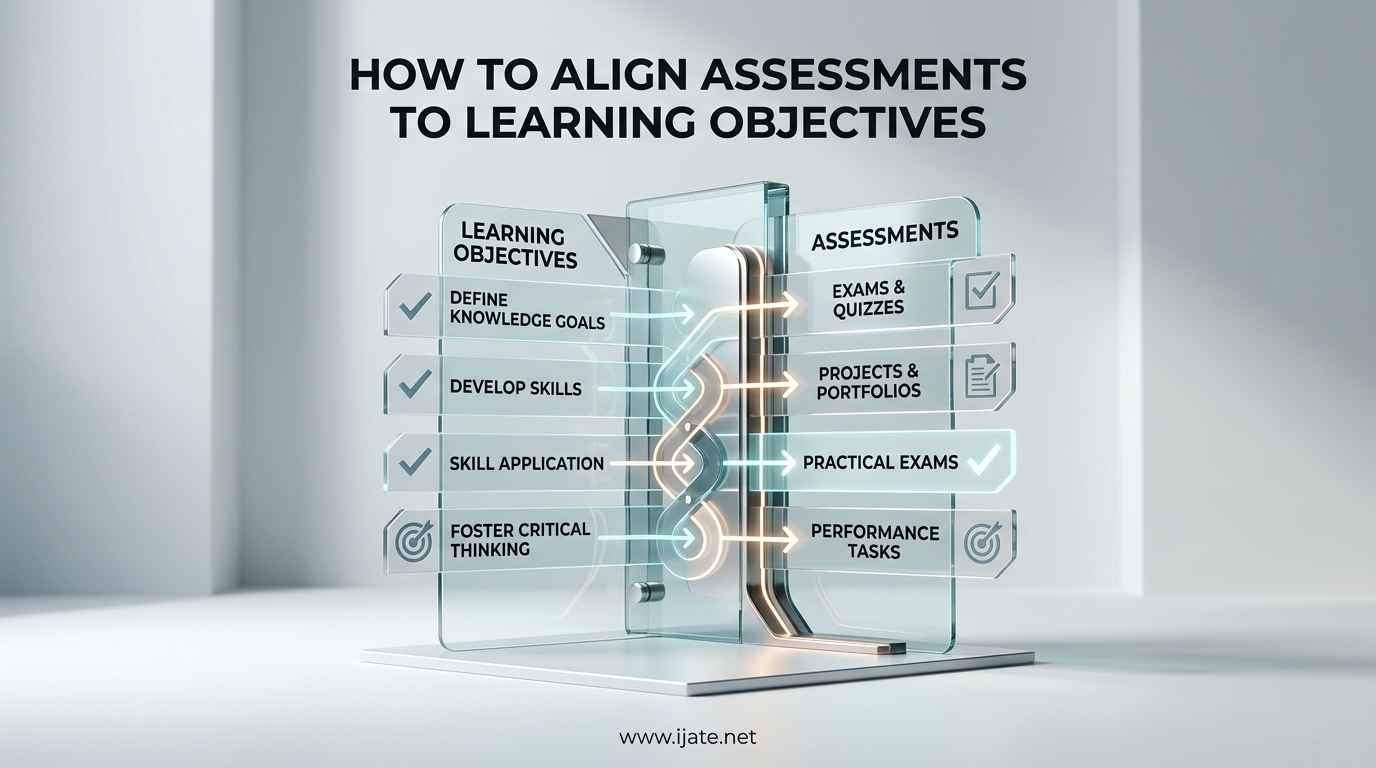
Assessment alignment connects what you teach with how you measure student learning. When your tests, assignments, and tasks directly reflect your learning objectives, you get accurate data about what students actually know and can do. Many educators design lessons and then create assessments separately, which often leads to gaps between intended and measured learning. In this guide, I will walk you through a practical framework for how to align assessment items to learning objectives step by step. The principles here reflect current best practices in 2026 education and apply to K-12 classrooms, higher education courses, and corporate training environments alike.
The process applies to K-12 classrooms, higher education courses, and even corporate training programs. Whether you are designing a single lesson or an entire course, alignment ensures that every assessment item serves a clear purpose. You will learn how to write measurable learning objectives, map them to the right assessment types, and avoid the most common misalignment mistakes. By the end, you will have a repeatable process and a checklist you can use immediately in your planning.
Effective alignment also improves student motivation. When learners see that assessments match what was taught, they trust the process and engage more deeply. Conversely, misaligned assessments create frustration and produce data that does not reflect true learning. I have seen this firsthand in course design work, and it is one of the most impactful improvements an educator can make. Let’s start with a clear definition of what assessment alignment actually means.
Table of Contents
What is Assessment Alignment?
Assessment alignment is the practice of designing test items, assignments, and tasks that directly measure the specific knowledge, skills, and abilities defined in your learning objectives. The goal is simple: ensure that what you assess matches what you intend for students to learn. This concept sits at the core of effective course design and instructional planning.
Constructive alignment, a term introduced by educational researcher John Biggs, extends this idea further. It means designing teaching activities, learning objectives, and assessments together as an integrated system rather than treating them as separate components. When all three elements point in the same direction, student learning becomes more coherent and measurable. Constructive alignment requires intentional design at every stage of the planning process.
Many educators confuse learning objectives with broader learning goals or learning targets. Learning objectives are specific, measurable statements about what students will be able to do by the end of a lesson or unit. Learning goals tend to be broader and longer-term. Learning targets break objectives down into daily or lesson-level statements students can understand. Clear, measurable objectives are the foundation of alignment because they give you a concrete target for your assessment design.
In online and hybrid learning environments, alignment becomes even more critical. Without the immediate feedback loop of a physical classroom, misaligned assessments can go undetected for longer periods, leaving students with gaps in their understanding. Online teaching requires deliberate attention to how assessment items map to objectives because students have fewer informal opportunities to clarify confusion. Digital assessment tools often provide analytics that can help identify misalignment patterns across large cohorts of students.
Why Alignment Matters
Assessment alignment matters because it directly affects the validity of your assessment data. When assessments are misaligned, they measure knowledge or skills that were never taught, producing results that tell you nothing about whether students achieved the intended learning. This is not just a theoretical concern. In practice, misaligned assessments waste instructional time, confuse students, and lead educators to draw incorrect conclusions about student progress.
Student motivation also suffers when assessments feel disconnected from instruction. A learner who studied for application-level tasks but faces a recall-only test will feel the assessment is unfair. Over time, this erodes trust in the assessment process and reduces engagement. Aligned assessments, by contrast, feel like natural extensions of the learning experience.
Grading fairness is another reason alignment matters. When assessments are misaligned, grades do not accurately reflect student learning. A student who mastered the objective may still receive a low grade because the test measured something different. This is particularly problematic in high-stakes contexts where grades determine advancement, placement, or graduation. Alignment ensures that grades communicate real learning.
Alignment also supports better instructional decisions. When your assessments reliably measure learning objectives, you can use the results to adjust instruction, provide targeted feedback, and demonstrate that your teaching is working. This is especially important for accountability purposes and for communicating learning outcomes to stakeholders. Established evaluation frameworks in education depend on assessment validity, and alignment is the most direct way to achieve it. Additionally, alignment ensures that scaffolding and instructional strategies are working as intended, giving you confidence that your course design is coherent and purposeful.
Step-by-Step Framework for Aligning Items to Objectives
Follow this six-step framework every time you design a new assessment. It will keep your process systematic and repeatable.
Step 1: Write Clear, Measurable Learning Objectives. Start with objectives that use action verbs from Bloom’s Taxonomy. Instead of writing “students will understand fractions,” write “students will solve fraction addition problems with 80% accuracy.” Measurable objectives tell you exactly what success looks like. Every objective should describe an observable behavior that you can evaluate.
Step 2: Identify the Cognitive Level. Determine which level of Bloom’s Taxonomy each objective targets. Is it Remember, Understand, Apply, Analyze, Evaluate, or Create? This decision shapes every assessment choice that follows. If you skip this step, you risk creating assessments that test the wrong cognitive level. Write the cognitive level next to each objective as you plan so it remains visible throughout the design process.
Step 3: Brainstorm Assessment Item Types. List assessment methods that naturally measure the target cognitive level. Multiple-choice questions work well for recall and recognition. Essays, projects, and performance tasks suit higher-order thinking. Match the assessment format to the thinking skill you want to measure. Consider your constraints, such as class size and available time, when selecting item types.
Step 4: Design the Assessment Items. Write or select items that directly address the objective’s content and cognitive level. Each item should require students to demonstrate the specific skill or knowledge described in the objective. Avoid adding content or complexity that the objective does not call for. Keep item language clear and unbiased. For complex objectives, you may need multiple items to fully cover the required skill.
Step 5: Review for Alignment. Compare each assessment item against its corresponding learning objective. Ask: does this item measure what the objective says? If you cannot clearly connect an item to an objective, either revise the item or clarify the objective. This review step catches misalignment before students take the assessment. Working with a colleague during this review often reveals gaps you would miss on your own.
Step 6: Pilot and Refine. Administer the assessment to a small group or review it with a colleague. Use the feedback to adjust items that are unclear, too easy, or misaligned. Continuous refinement improves both your assessments and your objective-writing skills over time. Over time, you will develop an instinct for alignment that speeds up this entire process.
This framework works because it forces you to make alignment an intentional step rather than an afterthought. Backward design, developed by Wiggins and McTighe, follows a similar logic. Instead of starting with activities and ending with a test, backward design begins with the desired learning outcomes, then determines what evidence will show those outcomes were achieved, and finally plans the instructional activities. This approach naturally produces aligned assessments because you identify what to measure before you decide how to teach.
Bloom’s Taxonomy Alignment Reference
Bloom’s Taxonomy provides the most widely used framework for matching learning objectives to appropriate assessment types. The table below maps each cognitive level to recommended assessment methods.
| Cognitive Level | Description | Recommended Assessment Types |
|---|---|---|
| Remember | Recall facts, terms, and basic concepts | Fill-in-the-blank, matching, multiple-choice, labeling |
| Understand | Explain ideas or concepts | Short answer, summary writing, paraphrasing, classification |
| Apply | Use information in new situations | Problem-solving tasks, case studies, simulations, demonstrations |
| Analyze | Draw connections between ideas | Compare/contrast essays, diagram labeling, cause-effect analysis |
| Evaluate | Justify a decision or position | Argumentative essays, debates, peer review, critiques |
| Create | Produce original work | Research projects, portfolios, original designs, performance compositions |
Each row represents a different level of cognitive demand. When your learning objective targets “Apply,” a multiple-choice recall question is misaligned no matter how well it is written. The assessment must require students to actually apply knowledge. Conversely, if your objective targets “Remember,” a lengthy essay requiring original analysis is misaligned because it demands more than the objective specifies.
Bloom’s Taxonomy is not just a reference tool. It is a diagnostic for alignment quality. After writing your objectives, identify the cognitive level for each one. Then verify that every corresponding assessment item targets the same level. If you find a mismatch, revise either the objective or the assessment item until they align. This simple check catches most alignment errors before they reach students. Over time, you will internalize these patterns and write more aligned objectives from the start.
Examples of Aligned and Misaligned Assessment Items
Seeing concrete examples makes alignment tangible. Here are pairs of learning objectives with both aligned and misaligned assessment items across different subject areas and cognitive levels.
Aligned Example. Learning Objective: Students will analyze the causes of the American Revolution by comparing at least three primary sources. Assessment Item: Read the three provided primary source documents. Write a 500-word analysis identifying two causes of the American Revolution supported by evidence from at least two documents. This item is aligned because it requires analysis, uses primary sources, and expects evidence-based writing. The assessment directly mirrors the objective.
Misaligned Example. Learning Objective: Students will analyze the causes of the American Revolution by comparing at least three primary sources. Assessment Item: List the five major events leading up to the American Revolution. This item is misaligned because it tests recall, not analysis. The student is not comparing sources or drawing conclusions. The assessment measures a different cognitive level than the objective describes.
Aligned Example. Learning Objective: Students will apply the Pythagorean theorem to solve real-world geometry problems. Assessment Item: A ladder leans against a wall forming a right triangle. The base is 6 feet from the wall and the ladder reaches 10 feet up the wall. How long is the ladder? Show your work. This item is aligned because it requires applying the theorem to a practical scenario.
Misaligned Example. Learning Objective: Students will apply the Pythagorean theorem to solve real-world geometry problems. Assessment Item: What is the formula for the Pythagorean theorem? This item tests memorization of a formula, not the ability to apply it. The assessment measures Remember-level knowledge while the objective targets Apply-level skill.
Aligned Example. Learning Objective: Students will create a persuasive essay arguing for or against a current environmental policy. Assessment Item: Choose one current environmental policy. Write a 750-word persuasive essay that includes a clear thesis, two supporting arguments with evidence, and a counterargument with a rebuttal. This item is aligned because it requires creating original argumentative writing that matches the objective.
Misaligned Example. Learning Objective: Students will create a persuasive essay arguing for or against a current environmental policy. Assessment Item: Identify three components of a persuasive essay. This item tests knowledge of essay structure, not the ability to create a persuasive argument. The cognitive levels do not match.
Aligned Example. Learning Objective: Students will evaluate the credibility of online sources by applying three criteria for source evaluation. Assessment Item: Review the three provided websites on climate change. Rate each source on authorship, evidence quality, and bias. Write a brief justification for each rating using specific evidence from the websites. This item is aligned because it requires evaluation using explicit criteria.
Misaligned Example. Learning Objective: Students will evaluate the credibility of online sources by applying three criteria for source evaluation. Assessment Item: List three types of websites found on the internet. This item tests categorization at the Remember level, not evaluation. The cognitive level mismatch is clear.
Peer assessment strategies can serve as aligned assessment types when designed with clear rubrics and structured protocols. For a practical example of peer assessment methodology in action, see research on peer assessment strategies. Authentic assessment approaches, where students perform real-world tasks, also naturally align with higher-order objectives when the task genuinely requires the target skill.
Common Mistakes When Aligning Assessments and How to Fix Them
Most alignment problems stem from a handful of recurring mistakes. Recognizing these patterns will help you avoid them.
Mistake 1: Writing Vague Learning Objectives. Objectives like “students will understand fractions” are unmeasurable. You cannot design an assessment that reliably measures “understanding.” Fix: Use action verbs from Bloom’s Taxonomy. Write “students will add fractions with unlike denominators with 80% accuracy” instead.
Mistake 2: Testing the Wrong Cognitive Level. Educators often write objectives targeting higher-order thinking but create assessments that only test recall. A common example is an objective calling for analysis paired with a multiple-choice test that only requires recognizing facts. Fix: Identify the cognitive level first, then choose assessment methods that match that level.
Mistake 3: Overloading Assessment Items. Some items try to measure multiple objectives at once. This makes it impossible to determine which objective a student mastered or missed. Fix: Keep items focused. One item should connect to one primary objective.
Mistake 4: Ignoring Diverse Learner Needs. When students have different starting skill levels, a single assessment may not provide valid data about whether each student met the objective. Fix: Use differentiated assessment approaches and scaffolding while keeping the objective constant.
Mistake 5: Letting Institutional Constraints Override Alignment. Standardized assessments or mandated curricula sometimes conflict with your carefully designed objectives. This is one of the most frustrating alignment challenges educators face. Many teachers end up using assessment items that test recall when their stated objective is application or analysis, simply because the required test format demands it. Fix: Document the mismatch, advocate for changes where possible, and supplement with classroom assessments that capture the learning your objectives describe. This tension between institutional requirements and instructional design is something many teachers navigate, and recognizing it explicitly helps you maintain professional integrity while working within constraints.
Mistake 6: Skipping the Alignment Review. In the rush to finish a unit, educators often skip the step of checking whether each item actually measures its objective. Administrators frequently use learning walks to identify gaps in instructional alignment before designing professional development. Fix: Use a simple checklist before finalizing any assessment. Read each item and ask what objective it measures. If the connection is unclear, revise.
How to Write Learning Objectives That Are Easy to Align
Well-written objectives make alignment almost automatic. Poorly written objectives make alignment impossible, no matter how carefully you design the assessment. Here is how to write objectives that support smooth alignment.
Start with measurable action verbs. Every objective should describe something a student does that you can observe or evaluate. Avoid verbs like “understand,” “appreciate,” or “learn” because they describe internal states you cannot directly measure. Instead, use verbs such as “solve,” “compare,” “design,” “explain,” “classify,” and “evaluate.” Bloom’s Taxonomy provides a comprehensive list of action verbs organized by cognitive level, making it a reliable reference. Using precise verbs also helps students understand exactly what is expected of them.
Specify the conditions and criteria. Tell students what resources they can use, what context applies, and what standard they must meet. “Students will solve linear equations with 80% accuracy on a 10-item quiz” is infinitely more alignable than “students will understand linear equations.” Developing self-directed learning skills depends on students knowing exactly what is expected, and clear objectives provide that clarity.
Keep objectives at an appropriate grain size. A single objective should describe one specific capability, not an entire unit’s worth of learning. Narrow objectives make it easier to design focused assessments and to interpret assessment results. If an objective feels too broad, break it into smaller objectives that you can assess individually. This granularity also helps you provide more specific feedback to students.
Review your objectives with a colleague before designing assessments. A fresh pair of eyes often catches vague language or cognitive level mismatches that you miss after writing. This review step is one of the fastest ways to improve alignment quality before you invest time in assessment design. Career-changing teachers often lack formal training in instructional alignment and must learn these skills on the job, making peer review especially valuable. Building a culture of collaborative objective review in your school or department can raise alignment quality across the board.
Formative vs Summative Assessment: Roles in Alignment
Formative and summative assessments serve different purposes in the alignment process, and understanding their distinct roles helps you use both effectively.
Formative assessments occur during instruction. They provide ongoing feedback about whether students are on track to meet learning objectives. Because they happen while learning is still happening, they allow you to adjust instruction before students complete a summative assessment. Formative items should align closely with the day-to-day learning targets derived from your broader objectives. Examples include entrance tickets, exit tickets, quick writes, and think-pair-share activities.
Summative assessments occur at the end of a unit or course. They measure whether students have achieved the learning objectives after instruction is complete. Summative items must comprehensively address the full range of objectives and the full range of cognitive levels those objectives target. Examples include final exams, research papers, capstone projects, and standardized tests.
Both types require alignment, but the stakes differ. A misaligned formative assessment means you miss an opportunity to intervene. A misaligned summative assessment means you draw false conclusions about student achievement. The solution is the same for both: start with clear objectives, design assessments that match those objectives, and review each item for alignment before using it.
Backward Design as an Alignment Strategy
Backward design is a curriculum planning model that makes alignment inevitable rather than incidental. Developed by Grant Wiggins and Jay McTighe, the model reverses the traditional planning sequence. Instead of starting with activities and ending with a test, backward design begins with the desired learning results, then determines acceptable evidence of those results, and finally plans the learning experiences and instruction.
The first stage asks: What should students know and be able to do by the end? This forces you to write clear, prioritized learning objectives. The second stage asks: How will we know if students have achieved these objectives? This pushes you to design assessments that directly measure the objectives before you plan any lessons. The third stage asks: What learning experiences and instruction will build the knowledge and skills students need to succeed on those assessments?
Because backward design identifies the assessment evidence before designing instruction, it naturally produces aligned assessments. You cannot teach activities that do not lead to the desired evidence, and you cannot assess objectives that were never defined. Many educators find that adopting backward design dramatically improves the coherence of their courses and reduces the alignment work required later.
Assessment Alignment Checklist
Use this checklist to verify that your assessments are properly aligned to your learning objectives before using them with students.
Review each objective. Does each objective use a measurable action verb? Does it specify conditions and criteria for success? If not, revise the objective before moving on.
Examine each assessment item. Can you point to the specific objective that the item measures? Does the item require the same cognitive level as the objective describes? If an item measures recall but the objective calls for application, you have a misalignment.
Check coverage. Does the set of assessment items collectively address every objective you intended to measure? Are there objectives with no corresponding assessment items? Are there assessment items that measure objectives you did not intend to emphasize?
Look for overloading. Does any single item try to measure two or more objectives at once? If so, split it into separate items or clarify which objective it primarily addresses.
Review difficulty and clarity. Are the item instructions clear? Does the difficulty level match what students were taught? Pilot the assessment with one or two students and observe whether they understand what is being asked.
Compare against rubrics. If you use scoring rubrics, verify that the rubric criteria directly reflect the learning objectives. A rubric that measures something the objective does not describe is a sign of misalignment.
Document your alignment decisions. Note which items map to which objectives and why. This documentation helps you refine your assessments over time and provides evidence of alignment quality for administrators or accreditation purposes. Constructive alignment requires intentional design at every stage, and documentation makes that design visible and improvable. For insights into how authentic assessment approaches are perceived and implemented, see research on parental perceptions about children’s authentic assessment.
FAQs
How are assessments aligned to learning objectives?
Assessment alignment means designing test items, assignments, and tasks that directly measure the specific knowledge and skills described in your learning objectives. Start by writing measurable objectives with action verbs from Bloom’s Taxonomy. Then design assessment items that require students to demonstrate the exact skill or knowledge the objective describes, ensuring the cognitive level of the assessment matches the cognitive level of the objective.
How do you ensure alignment between objective teaching and assessment?
Use a structured process. First, write clear measurable objectives. Second, identify the Bloom’s Taxonomy cognitive level for each objective. Third, brainstorm assessment types that naturally measure that cognitive level. Fourth, design items that directly address the objective’s content and skill. Fifth, review each item against its objective. Finally, pilot the assessment and refine based on results.
Why should assessment tasks be aligned to the learning outcome?
Aligned assessments produce valid data about student learning. When assessments match objectives, student performance accurately reflects whether learning occurred. Misaligned assessments measure skills or knowledge that were not taught, leading to misleading results, student frustration, and poor instructional decisions. Alignment also improves student motivation because learners see a clear connection between instruction and assessment.
What challenges do you foresee in aligning assessment to the learning objectives?
Common challenges include writing measurable objectives, identifying the correct cognitive level, working within time constraints, handling institutional standardized assessments that do not match your objectives, differentiating assessments for diverse learners, and distinguishing between learning goals and learning objectives. Each challenge can be addressed with systematic processes, peer review, and the alignment framework described in this guide.
Learning how to align assessment items to learning objectives transforms the quality of your instructional data and student learning outcomes. By starting with measurable objectives, matching them to appropriate assessment types, and reviewing for alignment at every step, you create assessments that genuinely reflect what students know and can do. The framework, checklist, and examples in this guide give you a repeatable process you can apply to any course, unit, or lesson. Start with one unit this term, use the alignment checklist, and refine based on results. Consistent alignment practice builds both instructional quality and student trust in the assessment process.