
Every course, training program, or workshop starts with the same question: what should learners actually be able to do when it’s over? Without clear answers, instruction drifts, assessments miss the mark, and nobody knows whether learning actually happened. That is exactly why knowing how to set performance targets for learning outcomes matters so much.
Performance targets give you a concrete way to define what success looks like before instruction begins. They turn vague hopes like “students will understand leadership” into specific, checkable statements like “learners will resolve three workplace conflict scenarios using active listening techniques.” Our team has spent years working with educators, corporate trainers, and instructional designers who wrestle with this process daily.
In this guide, you will learn what performance targets are, the four types of learning targets, how Bloom’s Taxonomy sharpens your objectives, and a step-by-step process for writing targets that actually work. We will also cover the SMART framework, compare alternative goal-setting systems, highlight common mistakes, and share real-world examples from corporate training, K-12 education, and higher education. By the end, you will have a repeatable system for creating measurable learning outcomes that stand up to real assessment.
Table of Contents
What Are Performance Targets for Learning Outcomes?
Performance targets for learning outcomes are specific, measurable goals that define exactly what learners should know, do, or value by the end of instruction. They describe observable behavior, not internal states like “understanding” or “appreciating.”
Many people use “learning objectives” and “learning outcomes” interchangeably, but there is an important distinction. Learning objectives describe what instruction aims to teach, while learning outcomes describe what learners actually demonstrate. Performance targets bridge that gap by setting the bar learners must clear.
Think of a performance target as the finish line in a race. Without it, learners run in different directions with no sense of progress. With it, everyone knows where they are headed and how close they are to getting there. Measurable learning outcomes depend on having that finish line clearly marked.
Effective performance targets share several traits. They use action verbs that describe visible behavior. They include criteria that define acceptable performance. They connect to broader course or organizational goals. And they give instructors a direct way to assess whether learning occurred.
Why Performance Targets Matter
Performance targets matter because they transform learning from a guessing game into a structured process. When you know the target, every decision about content, activities, and assessment becomes easier.
For instructional designers, performance targets guide what content to include and what to cut. If a piece of material does not help learners reach the target, it does not belong in the course. This prevents the “cram everything in” problem that bloats so many training programs.
For learners, clear targets reduce anxiety and improve motivation. Research consistently shows that when students understand what they are expected to accomplish, engagement and completion rates rise. Instead of wondering what will be on the test, learners focus their energy on meeting well-defined expectations.
For organizations, performance targets connect training investment to business results. A corporate training program that targets “reduce customer support call time by 15% within 90 days” delivers measurable value. One that simply aims to “improve customer service skills” cannot prove its worth.
Our team has seen this play out repeatedly. Programs with vague goals get cut during budget reviews. Programs with specific, measurable performance targets survive because they demonstrate clear return on investment.
The Four Types of Learning Targets
When learning how to set performance targets for learning outcomes, one of the first things to understand is that not all targets look the same. Educational researchers identify four primary types of learning targets, each requiring different instructional and assessment approaches.
1. Knowledge Targets
Knowledge targets focus on what learners need to know. These include facts, vocabulary, concepts, dates, and principles. A knowledge target might state that learners will “list the five stages of the project management lifecycle in correct order.”
Assessment for knowledge targets typically involves quizzes, short-answer questions, or recall exercises. These targets are foundational because higher-order skills build on them.
2. Reasoning Targets
Reasoning targets require learners to think beyond recall. They involve analysis, comparison, evaluation, inference, and problem-solving. A reasoning target might ask learners to “compare two competing marketing strategies and recommend the stronger approach based on ROI data.”
These targets demand more complex assessments like case studies, essays, or analytical projects. They push learners to use knowledge rather than simply store it.
3. Skill Targets
Skill targets focus on what learners can do. They involve physical demonstrations, performances, or behaviors that an observer can watch and evaluate. Examples include “perform CPR on a manikin following current AHA guidelines” or “operate a forklift through a designated obstacle course without safety violations.”
Skill targets require performance-based assessments where learners demonstrate the behavior under controlled conditions. Checklists and rubrics work well here.
4. Product Targets
Product targets specify tangible outputs learners must create. These include reports, presentations, portfolios, software programs, or physical objects. A product target might state that learners will “produce a 10-page market analysis report with at least five data visualizations and three strategic recommendations.”
Product targets are assessed by evaluating the quality of the final deliverable against predefined criteria. They integrate knowledge, reasoning, and skills into a single comprehensive output.
Understanding which type of target you need helps you choose the right verbs, the right activities, and the right assessments. Many courses mix multiple target types, which is perfectly fine as long as each one is written clearly.
How Bloom’s Taxonomy Strengthens Your Targets
Bloom’s Taxonomy is one of the most widely used frameworks for writing performance targets. Originally developed by Benjamin Bloom in 1956 and revised by Anderson and Krathwohl in 2001, it organizes cognitive processes into six levels of increasing complexity.
The six levels, from simplest to most complex, are: Remember, Understand, Apply, Analyze, Evaluate, and Create. Each level comes with specific action verbs that help you write precise, measurable targets.
At the Remember level, verbs include identify, list, name, recall, and define. At Understand, you use verbs like explain, summarize, classify, and interpret. Apply brings in verbs like demonstrate, calculate, solve, and implement.
The higher levels get even more powerful. Analyze uses verbs such as compare, contrast, examine, and differentiate. Evaluate brings assess, critique, justify, and recommend. Create uses design, develop, formulate, and construct.
Here is why this matters for performance targets. If your target says “learners will understand customer service,” you cannot measure “understanding” directly. But if you rewrite it using a Bloom’s verb, you get something measurable. “Learners will summarize three key principles of customer service” is checkable. “Learners will evaluate a customer interaction and recommend improvements” is even more measurable.
A good practice is to match your Bloom’s level to the complexity your learners actually need. A new-hire orientation might stay at Remember and Understand. A leadership development program should push into Analyze, Evaluate, and Create.
One mistake we see often is writing every target at the Remember level because those are easiest to assess. But real performance improvement happens at the higher levels where learners apply knowledge to real situations.
How to Set Performance Targets for Learning Outcomes: Step-by-Step
Now let us walk through the actual process. These seven steps will take you from a blank page to fully written, measurable performance targets.
Step 1: Identify the Learning Need
Start by asking what problem this learning experience solves. Is there a skills gap? A compliance requirement? A performance issue? A strategic initiative? The need drives everything that follows.
Talk to stakeholders, review performance data, and observe learners in their actual environment. The more specific you can be about the gap, the more targeted your performance goals will become.
For example, if customer satisfaction scores dropped 12% after a new product launch, your learning need is clear. Learners need deeper product knowledge and stronger troubleshooting skills. That need shapes your targets.
Step 2: Define the Audience and Context
Performance targets must fit the learners who will pursue them. A target appropriate for experienced managers will look very different from one written for entry-level employees.
Consider the prior knowledge, motivation levels, time constraints, and working conditions of your learners. A target that asks frontline workers to complete a complex analysis in under two minutes may be unrealistic. One that gives them realistic time and tools sets them up for success.
Document who the learners are, what they already know, and what resources they will have. This context prevents you from writing targets that are either too easy or impossibly hard.
Step 3: Choose Your Target Type
Using the four types described earlier, decide whether you need knowledge targets, reasoning targets, skill targets, product targets, or a combination. This choice determines which action verbs and assessment methods you will use.
For a sales training program, you might need knowledge targets about product features, skill targets for handling objections, and product targets like creating a personalized sales pitch deck.
Step 4: Select Action Verbs from Bloom’s Taxonomy
Choose verbs that describe observable, measurable behavior. Avoid internal verbs like know, understand, learn, appreciate, or feel. These cannot be assessed directly.
Instead, pick verbs tied to specific Bloom’s levels. If you want learners to remember product specifications, use “list” or “identify.” If you want them to apply that knowledge, use “demonstrate” or “explain to a customer.”
Write each verb choice down. You will use it to build the full target statement in the next step.
Step 5: Write the Full Target Statement
A complete performance target includes three components: who (the learner), what (the action verb and content), and how well (the criteria or standard). This structure is sometimes called the ABCD method: Audience, Behavior, Condition, Degree.
Here is an example. “Given a customer complaint scenario (condition), the customer service representative (audience) will write a response email (behavior) that addresses all three complaint points within 15 minutes (degree).” Every element is observable and measurable.
Write multiple target statements if needed. Aim for three to five targets per module or lesson. More than that becomes unwieldy. Fewer than that may not cover the essential outcomes.
Step 6: Align with Broader Goals
Every performance target should connect to a larger purpose. In education, that means aligning with course objectives and program outcomes. In corporate training, it means linking to business KPIs.
Create a simple mapping document. List each target and draw a line to the course goal or business metric it supports. If a target has no connection, either rewrite it or remove it. This exercise keeps your instruction focused and defensible.
Alignment also helps with stakeholder buy-in. When leadership sees how each target drives a business result, they are more likely to support the training program.
Step 7: Review and Refine
Before finalizing, test each target against a simple checklist. Is it specific? Is it measurable? Is it achievable for the target audience? Is it relevant to the learning need? Does it have a time frame? If any answer is no, revise.
Share draft targets with subject matter experts and a sample of learners. Their feedback will catch problems you missed. A target that seems clear to you might confuse someone outside your field.
Refinement takes time, but it is the difference between targets that sit in a syllabus unused and targets that actually drive learning design and assessment.
Using the SMART Framework for Learning Targets
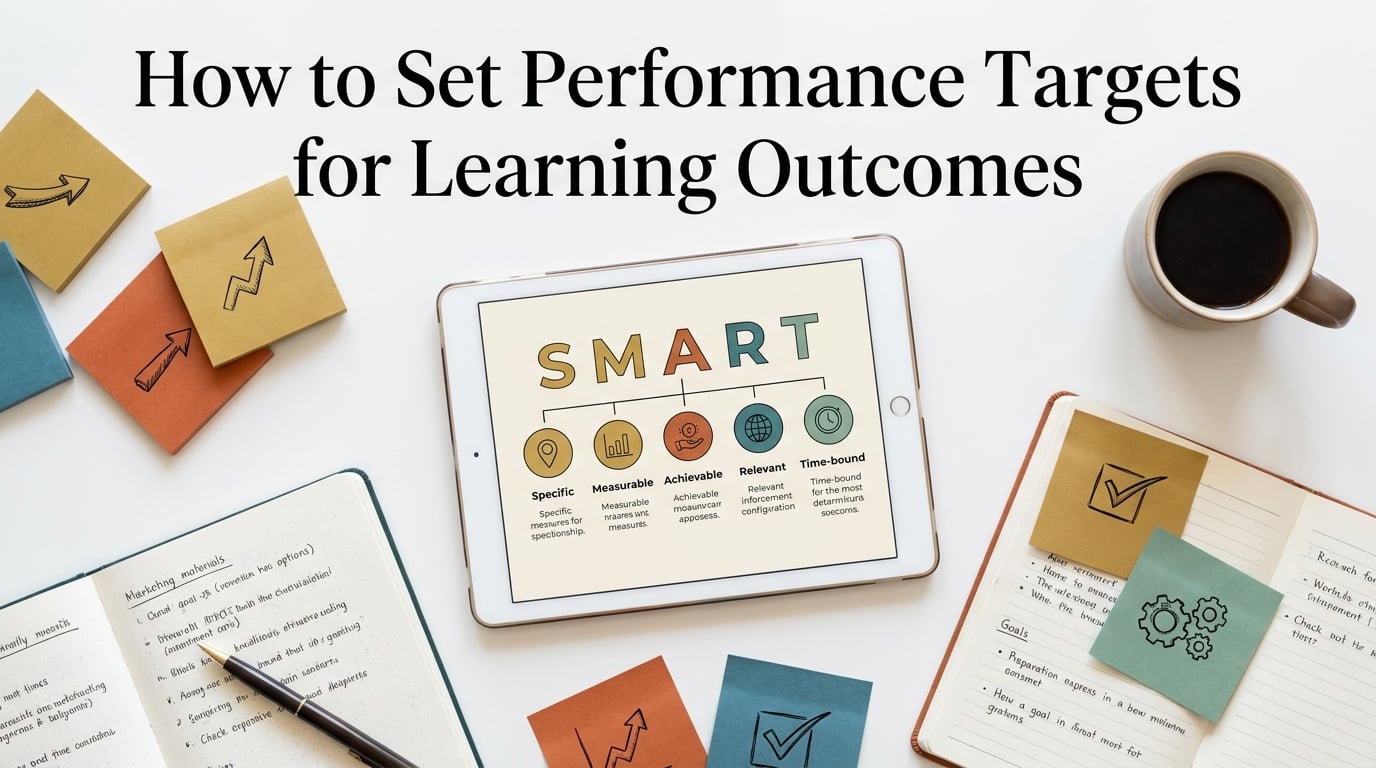
The SMART framework gives you a quick quality check for performance targets. Each letter stands for a criterion your target should meet.
Specific means the target names exactly what the learner will do. “Improve writing skills” is vague. “Write a three-paragraph persuasive email with a clear thesis statement” is specific.
Measurable means you can collect evidence of achievement. The target should describe behavior or output you can count, score, or evaluate against criteria.
Achievable means the target is realistic for the given audience, time frame, and resources. Setting the bar too high demoralizes learners. Too low wastes their time.
Relevant means the target connects to real learning or business needs. If achieving the target does not improve performance or understanding, it needs rethinking.
Time-bound means the target specifies when achievement is expected. “By the end of Module 3” or “within 90 days of program completion” gives learners and instructors a clear deadline.
Run every target through these five criteria. If one fails, rewrite it. This takes about two minutes per target and dramatically improves quality.
Other Goal-Setting Frameworks Compared
SMART is the most common framework for learning targets, but it is not the only option. Depending on your context, alternatives might serve you better.
OKR (Objectives and Key Results) works well for corporate learning programs tied to quarterly business cycles. You set an inspirational objective and pair it with 2-4 measurable key results. For example, an objective might be “Build a data-literate workforce” with key results like “80% of staff complete the data fundamentals course” and “average data tool usage increases by 30%.”
CLEAR goals (Collaborative, Limited, Emotional, Appreciable, Refinable) emphasize adaptability and team involvement. This framework suits learning programs that evolve based on feedback, such as agile team training or ongoing professional development.
WOOP (Wish, Outcome, Obstacle, Plan) focuses on individual motivation and obstacle management. It works well for self-directed learning paths where learners set personal goals around skill development.
For most instructional design work, SMART remains the best starting point. It is simple, widely understood, and directly applicable to writing measurable objectives. Consider OKR or CLEAR when you need organizational alignment, and WOOP when supporting individual learner motivation.
Common Mistakes to Avoid When Setting Targets
Our team has reviewed hundreds of courses and training programs. The same mistakes appear again and again. Here are the ones to watch for.
Using Unmeasurable Verbs
The single most common mistake is writing targets with verbs like understand, know, learn, or appreciate. These describe internal states that no one can observe. Replace them with Bloom’s verbs like explain, demonstrate, compare, or create.
One trick is to ask yourself: “Could I watch a learner do this and know whether they succeeded?” If the answer is no, the verb needs changing.
Cramming Too Many Targets Into One Module
Instructors on forums like Reddit’s r/instructionaldesign and r/Teachers frequently ask how many objectives belong in a single course or module. The consensus from experienced practitioners is three to five per module.
Too many targets overwhelm learners and dilute focus. Each target competes for attention, and none gets mastered. If you have fifteen targets for a single session, split it into multiple sessions or cut the non-essential ones.
Writing Targets That Feel Like Box-Ticking
Many educators admit that writing objectives feels like a compliance exercise rather than a useful activity. This happens when targets are written after the content is already built, just to fill in a syllabus template.
The fix is to write targets first, before designing content. Let the targets drive what you teach, what activities you include, and how you assess. When targets lead the process, they become tools rather than paperwork.
Failing to Communicate Targets to Learners
There is ongoing debate about whether stating learning objectives to students actually helps. Research suggests it does, but only when the objectives are shared in learner-friendly language at the start of each lesson or module.
Do not paste your formal performance targets on a slide and move on. Translate them into plain language learners understand. Tell them what they will be able to do and why it matters. This simple step improves engagement and completion.
Ignoring Alignment with Business or Course Goals
If your performance targets do not connect to a larger purpose, they become orphaned activities. Every target should trace back to a course objective, program outcome, or business KPI.
Instructional designers on r/Training frequently mention the difficulty of aligning learning objectives with business metrics. The solution is to involve stakeholders early. Ask what success looks like from their perspective, then build targets that deliver that success.
Real-World Examples Across Industries
Abstract advice only goes so far. Let us look at how performance targets look in different settings.
Corporate Training Example
A software company rolling out a new CRM system needs employees trained quickly. A performance target might read: “Given a sample customer record, sales representatives will enter and update all required CRM fields with 100% accuracy within 10 minutes by the end of the training session.”
This target is specific, measurable, tied to a real business need, and time-bound. Assessment is straightforward: observe trainees completing the task and check accuracy.
K-12 Education Example
A middle school science teacher wants students to grasp the scientific method. A performance target could state: “Students will design a simple experiment with one independent variable, one dependent variable, and a control, and present their design in a labeled diagram.”
This works because it combines reasoning and product targets. Students must think scientifically and produce a tangible output that the teacher can evaluate.
Higher Education Example
A university nursing program targets clinical competency. A target might read: “By the end of the clinical rotation, students will perform a complete patient assessment including vital signs, health history, and physical examination, meeting all 22 items on the clinical evaluation rubric.”
This integrates skill and knowledge targets with clear assessment criteria. Students know exactly what is expected, and instructors have a structured rubric for evaluation.
Healthcare Professional Development Example
A hospital training department wants to reduce medication errors. A target states: “Pharmacy staff will identify potential drug interactions in 10 sample prescriptions with at least 90% accuracy during the post-training assessment.”
The target connects directly to patient safety, uses measurable criteria, and assesses knowledge applied to realistic scenarios.
How to Measure and Track Learning Outcomes
Setting performance targets is only half the job. You also need a plan for measuring whether learners achieve them.
Match your assessment method to your target type. Knowledge targets pair well with quizzes and tests. Reasoning targets need case studies, essays, or analytical assignments. Skill targets require observed demonstrations. Product targets demand evaluation of the final deliverable against a rubric.
Build assessments before building content. This approach, called backward design, ensures every piece of instruction serves an assessment purpose. If you cannot figure out how to assess a target, the target probably needs reworking.
Use rubrics to make evaluation consistent and transparent. Share rubrics with learners ahead of time so they understand the performance criteria. This removes guesswork and helps learners self-assess as they work.
What happens when learners do not meet targets? This is a question many guides skip, but it is critical. When targets are missed, analyze why. Was the target too ambitious? Did the instruction fall short? Did learners lack prerequisite knowledge?
Use the data to adjust. If most learners miss a target, the target or instruction likely needs revision. If a few struggle, they may need additional support or remediation. Either way, missed targets are diagnostic information, not failures.
Five common examples of performance assessment include written exams measuring knowledge recall, practical demonstrations evaluating skill execution, portfolio reviews assessing product quality, case study analysis testing reasoning ability, and workplace observation verifying on-the-job application.
Frequently Asked Questions
What are the four types of learning targets?
The four types of learning targets are knowledge targets (facts and concepts learners must know), reasoning targets (thinking skills like analysis and evaluation), skill targets (demonstrable behaviors or performances), and product targets (tangible outputs learners create). Each type requires different instructional strategies and assessment methods.
What is an example of a performance goal setting?
A performance goal example for a customer service training program would be: given a sample customer complaint, the trainee will write a resolution email addressing all three complaint points with appropriate tone within 15 minutes. This goal is specific, measurable, achievable, relevant, and time-bound.
What are the 5 C’s of learning?
The 5 C’s of learning are critical thinking, communication, collaboration, creativity, and citizenship. These represent essential skills that modern education and training programs aim to develop in learners, complementing traditional academic and technical knowledge.
What are 5 examples of performance assessment?
Five examples of performance assessment are written exams testing knowledge recall, practical skill demonstrations evaluated against a checklist, portfolio reviews assessing accumulated work quality, case study analysis measuring reasoning and problem-solving, and direct workplace observation verifying on-the-job application of learned skills.
Conclusion
Learning how to set performance targets for learning outcomes is a skill that improves with practice. Start with a clear learning need, choose the right target type, select measurable action verbs from Bloom’s Taxonomy, and write full target statements using the SMART framework. Align every target with broader goals, communicate them to learners, and build assessments before content.
The seven-step process in this guide gives you a repeatable system. Use it for every course, module, or training program you design. The results will speak for themselves through better learner engagement, clearer assessment, and stronger evidence that your instruction actually works.
Your next step is simple. Pick one course or training module you are currently working on. Apply the seven steps to rewrite its performance targets using the frameworks and examples from this guide. The difference between vague goals and sharp, measurable targets will transform your instructional design work in 2026 and beyond.