
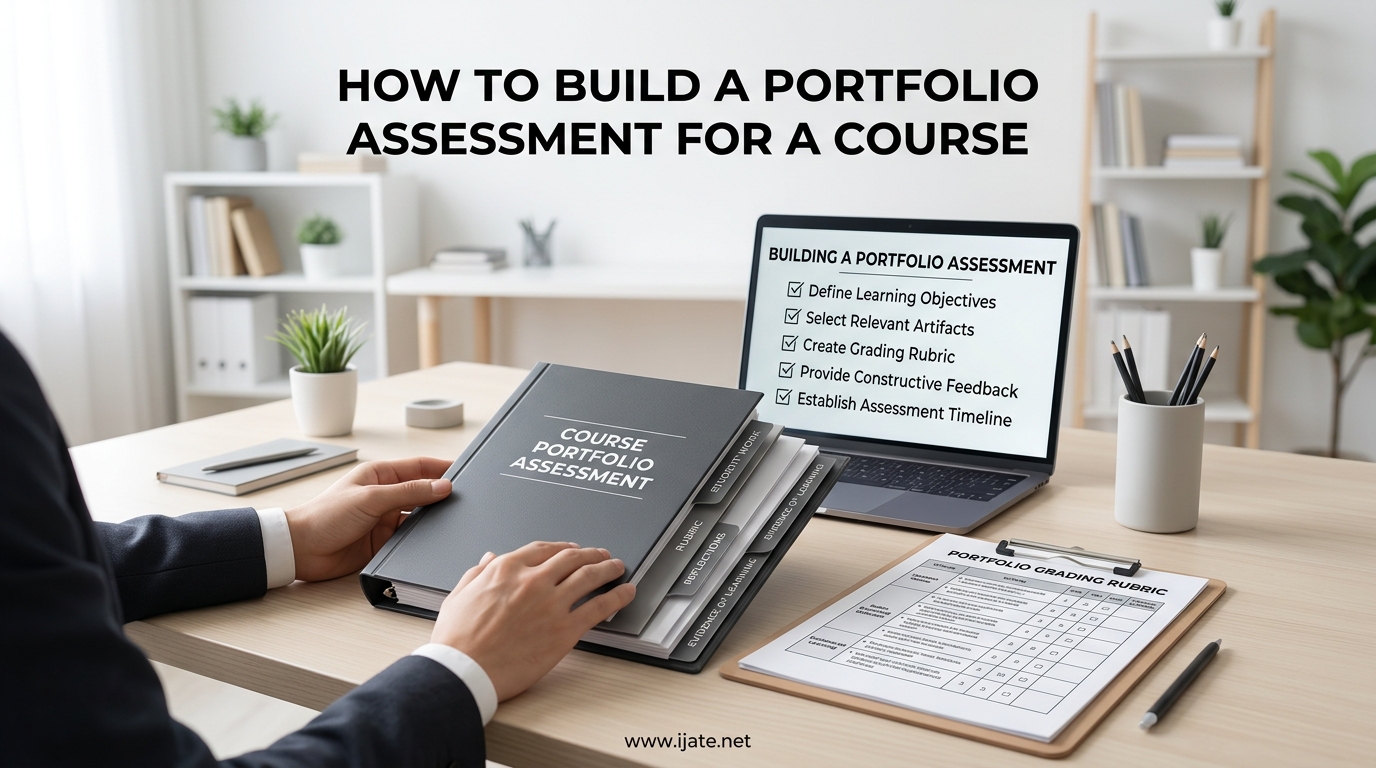
If you have ever graded a pile of final exams and wondered whether students actually understood the material or just memorized it for a week, you are not alone. More educators are moving toward portfolio assessment because it captures real learning over time instead of a single performance on test day. Knowing how to build a portfolio assessment for a course can transform how you measure student growth, encourage self-reflection, and create a more authentic picture of what learners actually accomplish.
Portfolio assessment is not just for art classes or creative writing seminars anymore. Instructors in economics, nursing, engineering, computer science, and K-12 classrooms now use portfolios to evaluate competencies that multiple-choice tests simply cannot reach. Whether you teach 25 students in a seminar or 380 students in a lecture hall, the principles remain the same. You need clear objectives, a well-defined structure, a solid rubric, and a plan for managing the grading load.
This guide walks you through the entire process from start to finish. We cover what portfolio assessment is, the different types you can choose from, a step-by-step implementation process, rubric design, platform options, AI policy considerations, workload management, and common mistakes to avoid. If you are also exploring peer-assessment strategies alongside portfolio work, this guide pairs well with complementary approaches to student evaluation.
By the end, you will have a practical framework you can adapt to any discipline, any class size, and any course format. Let us start with the fundamentals.
Table of Contents
What Is a Portfolio Assessment?
A portfolio assessment is an evaluation method where students compile a curated collection of their work over time, including artifacts, reflections, and evidence of learning, to demonstrate achievement of specific course learning outcomes. Instead of measuring performance at a single point in time, a portfolio captures the arc of learning from early drafts to polished final products.
The key word is purposeful. A portfolio is not a folder where students dump everything they produced during the semester. It is a structured, intentional collection where each artifact serves a clear purpose. Students select specific pieces, write reflective commentary explaining why they chose them, and organize the collection around learning goals you define at the start of the course.
This makes portfolio assessment a form of authentic assessment. Rather than asking students to recall facts under time pressure, portfolios ask them to show what they can do, how their thinking evolved, and what they understand about their own learning process. That reflective layer is what separates a portfolio from a simple work sample folder.
Portfolio Assessment vs. Traditional Testing
Traditional exams tell you what a student knew at 10:00 AM on a specific Tuesday. Portfolios tell you how a student grew over 15 weeks. Both have their place, but they measure fundamentally different things. A well-designed course often uses both: exams for knowledge checks and portfolios for deeper, integrated learning.
Exams excel at testing recall and basic application. Portfolios excel at measuring complex skills like critical thinking, problem-solving, communication, and metacognition. If your learning outcomes include phrases like “analyze,” “evaluate,” “create,” or “reflect,” a portfolio will capture evidence of those skills far better than a scantron sheet.
The Five Core Components of Any Assessment
Before diving into portfolio-specific design, it helps to understand the five components that apply to any assessment, including portfolios:
1. Purpose — What are you measuring, and why? Is the portfolio formative (helping students learn during the process) or summative (assigning a final grade)? The purpose shapes every other decision.
2. Learning Outcomes — What specific competencies should the portfolio demonstrate? These should map directly to your course objectives.
3. Artifacts and Evidence — What work samples will students include? Essays, projects, presentations, code, videos, lab reports, and reflective writing all qualify.
4. Assessment Criteria — How will you evaluate the portfolio? This is where your rubric comes in, and it needs to be shared with students from day one.
5. Feedback Loop — How will students receive and act on feedback? Portfolios without feedback become assignments. Portfolios with structured feedback become learning tools.
Key Benefits of Portfolio Assessment for Educators and Students
Portfolio assessment offers distinct advantages for both sides of the classroom. Understanding these benefits helps you make the case to students, administrators, and parents who may be skeptical of moving away from traditional testing.
Benefits for Educators
Richer evidence of learning. A portfolio gives you a window into how a student thinks, not just what they produce. You see drafts, revisions, and reflections that reveal the learning process itself. This makes it easier to identify where a student struggled and where they broke through.
Better alignment with learning outcomes. If your course goals include critical thinking, communication, or problem-solving, portfolios let you gather direct evidence of those skills. You are not inferring competence from a multiple-choice score.
Reduced grading pressure at end of term. When you design portfolios with checkpoint submissions throughout the semester, you spread your grading workload across weeks instead of facing a mountain of final exams in December. This is one of the most effective workload management strategies available.
Authentic assessment of real skills. Portfolios mirror how professionals actually work. Engineers compile project documentation, designers build portfolios for job interviews, and nurses maintain clinical logs. When you assess through portfolios, you are evaluating skills that transfer directly to careers.
Benefits for Students
Metacognitive development. The reflective component of portfolios forces students to think about their own thinking. Research consistently shows that metacognition, the ability to monitor and regulate your own learning, is one of the strongest predictors of academic success.
Student agency and ownership. When students choose which artifacts to include and write about why they chose them, they take ownership of their learning. This co-construction of assessment criteria is a powerful motivator. Students move from passive test-takers to active curators of their own evidence.
A record of growth over time. Students can see their own progress. Watching a week-2 draft sit next to a week-14 revision makes improvement visible in a way no grade ever can. This builds confidence and helps students develop a growth mindset.
A tangible product they can use beyond the course. A well-built portfolio becomes a professional asset. Students can share it in job interviews, graduate school applications, or performance reviews. This makes the work feel meaningful rather than transactional.
Lower test anxiety. Not every student performs well under timed exam conditions. Portfolios give students time to revise, reflect, and present their best work. This creates a more equitable assessment environment, particularly for students with test anxiety or learning differences.
Types of Portfolio Assessments
Not all portfolios serve the same purpose. Choosing the right type for your course depends on your goals, timeline, and assessment framework. Here are the four main types you should know.
1. Showcase Portfolio
A showcase portfolio is a curated collection of a student’s best work. The student selects pieces they are most proud of and presents them as evidence of mastery. Think of it as a greatest-hits album. This type works well for capstone courses, end-of-program reviews, and job-search preparation.
Showcase portfolios emphasize quality over quantity. Students typically include 3 to 7 artifacts, each accompanied by a reflective statement explaining why the piece represents their best work. The focus is on demonstrating what the student can produce at their peak.
2. Formative (Working) Portfolio
A formative portfolio, sometimes called a working portfolio, is a living document that students build throughout the course. It includes drafts, revisions, peer feedback, instructor comments, and reflections on the learning process. The goal is not to show polished final products but to capture the journey of learning.
Working portfolios are ideal for courses where process matters as much as product. Writing courses, design studios, and research methods classes benefit from this approach. You can assess growth, identify where students struggle, and provide feedback that actually shapes the next stage of their work.
3. Progress Portfolio
A progress portfolio sits between showcase and formative. It tracks development over time but with a focus on demonstrating specific growth against learning outcomes. Students submit work at multiple checkpoints, and you evaluate how their skills have advanced from one stage to the next.
This type is particularly effective for skill-based courses. A language class might use a progress portfolio where students submit speaking samples every three weeks, showing how their pronunciation and fluency improve over the semester. A coding bootcamp might track how students move from simple scripts to full applications.
4. Hybrid Portfolio
Many courses blend these approaches. A common hybrid model uses a working portfolio during the semester with formative checkpoints, then asks students to curate a final showcase portfolio at the end. This gives you the benefit of tracking growth while also producing a polished artifact students can use professionally.
Hybrid portfolios are flexible but require careful planning. You need to be explicit about what students submit at each stage and how each submission contributes to the final grade. The assessment frameworks you choose should clearly define these expectations.
Step-by-Step Guide: How to Build a Portfolio Assessment for a Course
This is the core of the process. Follow these steps in order, and you will have a portfolio assessment ready to deploy in your next course. Each step builds on the previous one, so do not skip ahead.
Step 1: Define Your Learning Outcomes
Start with the end in mind. What should students know and be able to do by the time they finish your course? Write 3 to 6 specific, measurable learning outcomes. These will anchor every other decision in your portfolio design.
Use action verbs from Bloom’s Taxonomy: analyze, evaluate, create, design, synthesize. Avoid vague terms like “understand” or “know about.” For example, instead of “Students will understand research methods,” write “Students will design and execute a research study using appropriate qualitative methods.”
Each artifact in the portfolio should map to at least one learning outcome. If an artifact does not connect to a stated outcome, either the artifact or the outcome needs to change. This alignment is what keeps the portfolio focused and purposeful.
Step 2: Choose Your Portfolio Type
Based on your learning outcomes and course structure, decide which type of portfolio fits best. A semester-long writing course might call for a formative working portfolio. A capstone seminar might need a showcase portfolio. A skills-based course might benefit from a progress portfolio.
Consider your class size as well. Large enrollment courses may need a more streamlined portfolio structure to keep grading manageable. A course with 40 students can support richer portfolios than one with 400.
Step 3: Determine What Artifacts Students Will Include
List the specific types of artifacts students should compile. Be concrete. “Three writing samples” is better than “some essays.” “A research proposal, literature review, and final paper” is even better.
Include diverse evidence types to capture different dimensions of learning:
– Written work (essays, reports, reflections)
– Projects and presentations (slides, recordings, posters)
– Creative work (designs, code repositories, media projects)
– Collaborative work (group project documentation, peer feedback)
– Reflective writing (learning journals, self-assessments, metacognitive essays)
For each artifact, specify whether the student chooses it, you assign it, or it is a combination. Student-selected artifacts build agency. Instructor-required artifacts ensure coverage of all learning outcomes. A blend of both is usually the strongest approach.
Step 4: Create a Well-Defined Structure
Students need to know exactly how to organize their portfolio. Provide a template or structural guide that specifies:
– How many artifacts to include (aim for 4 to 8, not 20)
– What reflective component accompanies each artifact (a short paragraph, a structured reflection form, or a voice memo)
– How artifacts should be organized (by learning outcome, chronologically, or by skill area)
– What overall reflective statement ties the portfolio together (an introduction, a cover letter, or a final synthesis essay)
– Format requirements (digital platform, page count, file types, accessibility standards)
The more structure you provide upfront, the less confusion and rework you will deal with later. Students who understand the expectations produce stronger portfolios.
Step 5: Build Your Rubric
This step is critical enough to warrant its own section later in this guide, but the short version is: design your rubric before the course begins, not after. Students should see the rubric on day one so they know exactly how their portfolio will be evaluated.
Your rubric should assess both the artifacts themselves and the reflective commentary. A brilliant essay with no reflection tells you less than a competent essay paired with thoughtful metacognitive analysis. The reflection is where the deepest learning happens, and your rubric should reward it.
Step 6: Communicate the Process to Students
Do not assume students know what a portfolio is or how to build one. Spend class time explaining the purpose, structure, timeline, and rubric. Show examples of strong portfolios from previous semesters if you have them (with student permission and names removed).
Create a one-page portfolio guidelines document that students can refer to throughout the course. Include the learning outcomes, required artifacts, submission checkpoints, rubric criteria, and technical instructions for whichever platform you use.
Set up at least two checkpoint submissions during the semester, not just a final submission. Checkpoints let you catch problems early, give formative feedback, and keep students from procrastinating until the last week.
Step 7: Incorporate Self-Assessment and Reflection
Build structured self-assessment into the portfolio process. At each checkpoint, ask students to evaluate their own work using the same rubric you will use. This develops metacognitive skills and helps students internalize the assessment criteria.
Reflection prompts should go beyond “what did you learn?” Try questions like: “How did your thinking about this topic change from the first draft to the final version?” or “What was the most difficult part of this project, and how did you work through it?” These questions push students to think deeply about their learning process.
Step 8: Pilot and Iterate
If this is your first time using portfolio assessment, pilot it with a smaller assignment or a subset of the course before going all-in. Run a mini-portfolio with 2 artifacts as a midterm activity. See how students respond, how long grading takes, and what confuses them. Use that experience to refine the full portfolio design.
After the course ends, gather student feedback on the portfolio process. What helped them learn? What felt like busywork? What would they change? Use this feedback to improve the next iteration.
Step 9: Evaluate Using the Rubric
When grading time arrives, use the rubric consistently across all portfolios. If possible, use collaborative marking with a colleague or teaching assistant. Having two graders evaluate a sample of portfolios and compare scores improves reliability and catches bias.
Score artifacts and reflections separately. A student might have strong work samples but shallow reflections, or vice versa. Breaking down the rubric lets you give targeted feedback that helps students understand exactly where to improve.
Step 10: Provide Meaningful Feedback
Portfolio feedback should be specific, actionable, and forward-looking. Instead of just assigning a score, tell students what they did well, where they fell short, and what they could do differently next time. If the portfolio is part of a larger program, connect your feedback to future courses or professional contexts.
Consider using audio or video feedback for portfolios. Hearing your voice explain nuances of their work can feel more personal and detailed than written comments, and it often takes less time to record than to type.
Designing an Effective Portfolio Assessment Rubric
A strong rubric is the backbone of any portfolio assessment system. Without one, grading becomes subjective and inconsistent. With one, students know exactly what is expected and you can evaluate efficiently and fairly.
Start With Your Learning Outcomes
Each criterion in your rubric should map to a learning outcome. If you have 5 learning outcomes, your rubric should have 5 criteria (possibly 6 if you add a category for overall organization and presentation). Do not create criteria that do not connect to stated outcomes.
This alignment ensures that the rubric measures what you actually care about. It also makes it easy to explain to students and administrators why each criterion matters.
Use Performance Levels That Describe Quality
Avoid simple number scales without descriptors. Instead, use 3 to 4 performance levels with clear descriptions of what each level looks like. A common structure uses four levels: Exemplary, Proficient, Developing, and Beginning.
Write descriptions that are observable and specific. “Demonstrates deep understanding of key concepts and applies them to novel situations” is far more useful than “Shows good understanding.” The more specific your descriptors, the more consistent your grading will be.
Include Reflection as a Separate Criterion
One of the most common mistakes in portfolio rubrics is lumping reflection in with content quality. These are different skills. A student can produce excellent work without reflecting meaningfully, and a student can write a strong reflection about work that needs improvement.
Give reflection its own criterion with its own performance descriptors. Something like: “Reflective commentary demonstrates metacognitive awareness, connects artifacts to learning outcomes, and articulates specific growth over time.”
Sample Portfolio Rubric Structure
Here is a rubric template you can adapt. It uses four performance levels across five criteria:
Criterion 1: Artifact Quality — Do the selected artifacts demonstrate competence in the course learning outcomes? (Exemplary: Artifacts show mastery with sophistication and originality. Proficient: Artifacts meet all expectations with minor gaps. Developing: Artifacts partially meet expectations. Beginning: Artifacts do not meet expectations.)
Criterion 2: Selection and Curation — Are the artifacts well-chosen and effectively organized to tell a story of learning? (Exemplary: Thoughtful selection creates a compelling narrative. Proficient: Artifacts are appropriate and well-organized. Developing: Selection is inconsistent. Beginning: Selection appears random.)
Criterion 3: Reflective Commentary — Does the student demonstrate metacognitive awareness and connect artifacts to learning outcomes? (Exemplary: Reflection shows deep self-awareness and growth. Proficient: Reflection is clear and relevant. Developing: Reflection is superficial. Beginning: Reflection is absent or off-topic.)
Criterion 4: Growth and Progress — Does the portfolio show development over time? (Exemplary: Clear evidence of significant growth. Proficient: Visible improvement. Developing: Limited evidence of growth. Beginning: No evidence of growth.)
Criterion 5: Presentation and Professionalism — Is the portfolio well-organized, accessible, and professional in appearance? (Exemplary: Outstanding organization and presentation. Proficient: Clean and functional. Developing: Disorganized. Beginning: Incomplete or inaccessible.)
Share the Rubric on Day One
Students should see the rubric before they start building their portfolios. Better yet, have them use it for self-assessment at each checkpoint. When students internalize the criteria, they start evaluating their own work against those standards. This is where the deepest learning happens.
Portfolio Tools and Platforms Overview
Choosing the right platform can make or break the portfolio experience for you and your students. The tool should be easy enough for students to use without extensive training, but powerful enough to support multimedia artifacts, reflective writing, and organized presentation.
Learning Management System Portfolios
Many learning management systems now include portfolio functionality. Canvas has its ePortfolio tool. Blackboard offers portfolio features within its course environment. Moodle has plugins that support portfolio compilation. The advantage of LMS-based portfolios is that students already have accounts and know the interface. The disadvantage is that students usually lose access after the course ends, which limits the portfolio’s value as a long-term professional asset.
Dedicated ePortfolio Platforms
Several platforms are designed specifically for digital portfolios. Mahara is an open-source ePortfolio system used widely in higher education. It supports a range of artifact types and gives students control over which items to display. FolioSpaces is another option built on the Mahara framework.
Google Sites offers a free, accessible option for building web-based portfolios. Students can create a simple website, embed documents, link to videos, and write reflective pages. The learning curve is low, and students keep ownership of the site after the course ends.
Choosing a Platform: Key Considerations
When evaluating platforms, consider these factors. Does the platform support the artifact types your course requires (text, images, video, audio, code)? Can students organize content by learning outcome or theme? Is the platform accessible to students with disabilities? Can students export or retain access after the course ends? Is the platform free or does it require a paid subscription?
For most courses, a simple platform that students can learn quickly is better than a feature-rich tool with a steep learning curve. The focus should be on learning, not technology troubleshooting.
AI Policy Considerations for Portfolio Assessment
Generative AI tools have changed the assessment landscape, and portfolio assessment is no exception. Students can now use AI to draft reflective essays, generate project documentation, and even produce artifacts. As an educator, you need a clear AI policy that addresses how these tools fit into your portfolio expectations.
Set Clear Boundaries Early
Your AI policy should be explicit and included in the portfolio guidelines from day one. State clearly which uses of AI are acceptable and which are not. For example, you might allow students to use AI for brainstorming and editing feedback but require that all artifacts and reflective commentary be their own original work.
Ambiguity benefits no one. When students do not know what is allowed, some will overuse AI and others will avoid it entirely out of fear. Clear boundaries create a level playing field.
Require Process Documentation
One effective strategy is to require students to document their process, not just their final product. Ask them to submit drafts, revision histories, and notes on how they approached each artifact. If a student used AI for brainstorming, ask them to include the prompts they used and how they built on the AI output.
Process documentation makes it harder to pass off AI-generated work as original. It also deepens the learning by making thinking visible. This aligns naturally with the portfolio philosophy of valuing process alongside product.
Focus Assessment on Reflection and Growth
AI can generate a competent essay or project report, but it struggles to fake genuine metacognitive reflection. When a student writes about how their thinking changed over the semester, what confused them, and how they worked through it, that kind of writing is hard to fabricate. Weighting your rubric toward reflection and growth over artifact production makes AI misuse less impactful.
Consider using oral reflections or in-class presentations alongside written portfolios. A five-minute conversation about their portfolio reveals whether a student truly understands their own work.
Have a Conversation, Not Just a Policy
Talk with students about AI use openly. Acknowledge that these tools exist and that learning to use them responsibly is part of modern education. When students understand why original reflection matters for their learning, they are more likely to engage honestly than when they feel policed.
Managing Grading Workload for Portfolio Assessment
One of the biggest concerns educators raise about portfolio assessment is grading time. Portfolios are more complex to evaluate than exams, and the reflective components require careful reading. But with the right strategies, you can keep grading manageable even for large classes.
Set Size Limits
Unlimited portfolios create unlimited grading. Cap the number of artifacts students can include. A portfolio with 5 well-curated artifacts is better for everyone than one with 20 items of varying quality. Set word limits on reflective statements as well. Clear boundaries make portfolios faster to grade and more focused to read.
Use Checkpoint Submissions
Instead of collecting everything at the end, spread submissions across the semester. Grade artifacts as they come in and give formative feedback. By the time the final portfolio arrives, you have already evaluated most of the content. The final grade becomes a matter of holistic review rather than reading everything from scratch.
Checkpoint grading also benefits students. They get feedback while there is still time to improve, rather than discovering at the end of the semester that their work fell short.
Leverage Peer Feedback
Build peer review into the portfolio process. Students give each other feedback at checkpoints using the rubric. This develops their evaluative skills and reduces the feedback burden on you. You still do the final grading, but students arrive at that point with stronger portfolios because of peer input.
Use Pre-Assessed Work
If students are including assignments that you already graded during the semester, do not regrade them from scratch. Acknowledge the existing score and focus your portfolio evaluation on the curation, reflection, and growth dimensions. This can cut grading time significantly.
Consider Collaborative Marking
If you have teaching assistants or co-instructors, use collaborative marking. Have two graders independently score a sample of portfolios, then compare and calibrate. This improves reliability and distributes the workload. Even without TAs, swapping a sample of portfolios with a colleague for moderation can catch bias and improve consistency.
Use Rubric-Based Efficiency
A well-structured rubric speeds grading dramatically. Instead of writing free-form comments on every portfolio, you select performance levels and add brief targeted notes. The rubric does the heavy lifting of communicating expectations, and your comments can focus on the most important insights.
Common Mistakes to Avoid When Building a Portfolio Assessment
Even well-intentioned portfolio assessments can go wrong. Here are the most common pitfalls and how to avoid them.
Mistake 1: No Clear Purpose
If students do not understand why they are building a portfolio, the exercise feels like busywork. Before assigning anything, articulate the purpose clearly. Is this about measuring growth? Demonstrating mastery? Building a professional showcase? Share that purpose with students in language they can connect to their own goals.
Mistake 2: Too Many Artifacts
More is not better. A portfolio with 15 artifacts overwhelms both the student curating it and the instructor grading it. Quality curation means choosing fewer pieces and explaining why each one matters. Cap artifacts at 5 to 8 and require a reflective statement for each.
Mistake 3: No Reflective Component
A portfolio without reflection is just a folder. The reflective commentary is where learning becomes visible. If you skip this component, you lose the metacognitive benefits that make portfolio assessment worth the effort in the first place. Make reflection a graded criterion, not an afterthought.
Mistake 4: Rubric Shared Too Late
Showing students the rubric at the end of the semester defeats the purpose. The rubric is a learning tool, not just a grading tool. Students need it from day one so they can self-assess, set goals, and understand what quality looks like. Distribute the rubric with the assignment instructions.
Mistake 5: No Checkpoints
If students submit the entire portfolio at the end of the term, you get a pile of unfiltered work with no opportunity for course correction. Checkpoints throughout the semester allow for formative feedback, keep students on track, and spread your grading across the course.
Mistake 6: Ignoring Accessibility
Digital portfolios need to be accessible to all students, including those with disabilities. Make sure your chosen platform supports screen readers, allows for alternative text on images, and accommodates various media formats. Build accessibility requirements into your portfolio guidelines, not as an afterthought.
Mistake 7: No Administrator or Parent Buy-In
If you teach in a K-12 setting, administrators and parents may not understand portfolio assessment. They may expect traditional grades and tests. Take time to explain the approach, share the rubric, and provide evidence of student learning. A well-communicated portfolio system can win over skeptics more effectively than any test score.
FAQs
How to create a portfolio assessment?
To create a portfolio assessment, follow these steps: 1) Define your learning outcomes, 2) Choose a portfolio type (showcase, formative, or progress), 3) Determine what artifacts students will include, 4) Create a structured template with size limits and format guidelines, 5) Build a rubric aligned to your learning outcomes, 6) Communicate the process and rubric to students on day one, 7) Set up checkpoint submissions throughout the semester, 8) Incorporate self-assessment and reflection, 9) Evaluate using the rubric, and 10) Provide meaningful feedback.
What is an example of a portfolio assessment?
An example of a portfolio assessment is a writing course where students compile 5 artifacts (an early draft, a revised essay, a research paper, a peer review, and a reflective cover letter) organized around 3 learning outcomes: thesis development, evidence integration, and revision skills. Each artifact includes a short reflection explaining what the student learned from producing it.
What are the 5 components of an assessment?
The 5 components of any assessment are: 1) Purpose (what you are measuring and why), 2) Learning outcomes (specific competencies being assessed), 3) Artifacts and evidence (the work students produce), 4) Assessment criteria (the rubric or scoring guide), and 5) Feedback loop (how students receive and act on feedback to improve).
What are the key elements of a portfolio assessment?
The key elements of a portfolio assessment are: clearly defined learning outcomes, a curated selection of student artifacts, reflective commentary for each artifact, a well-structured rubric aligned to outcomes, checkpoint submissions during the course, student self-assessment, evidence of growth over time, and meaningful instructor feedback.
Conclusion
Building a portfolio assessment for a course takes upfront planning, but the payoff is worth it. You get a richer picture of student learning, students develop metacognitive skills that serve them long after the course ends, and you create assessment evidence that reflects real growth rather than a single snapshot. The key is starting with clear learning outcomes, building a structured process with checkpoints, designing a rubric that rewards reflection alongside artifact quality, and managing your grading load through smart strategies like size limits and peer feedback.
Learning how to build a portfolio assessment for a course is not about getting everything perfect on the first try. Pilot it, gather feedback, iterate, and improve each semester. Your students will produce deeper, more meaningful work, and you will have assessment evidence you can actually feel confident about. Start small if you need to, but start.