
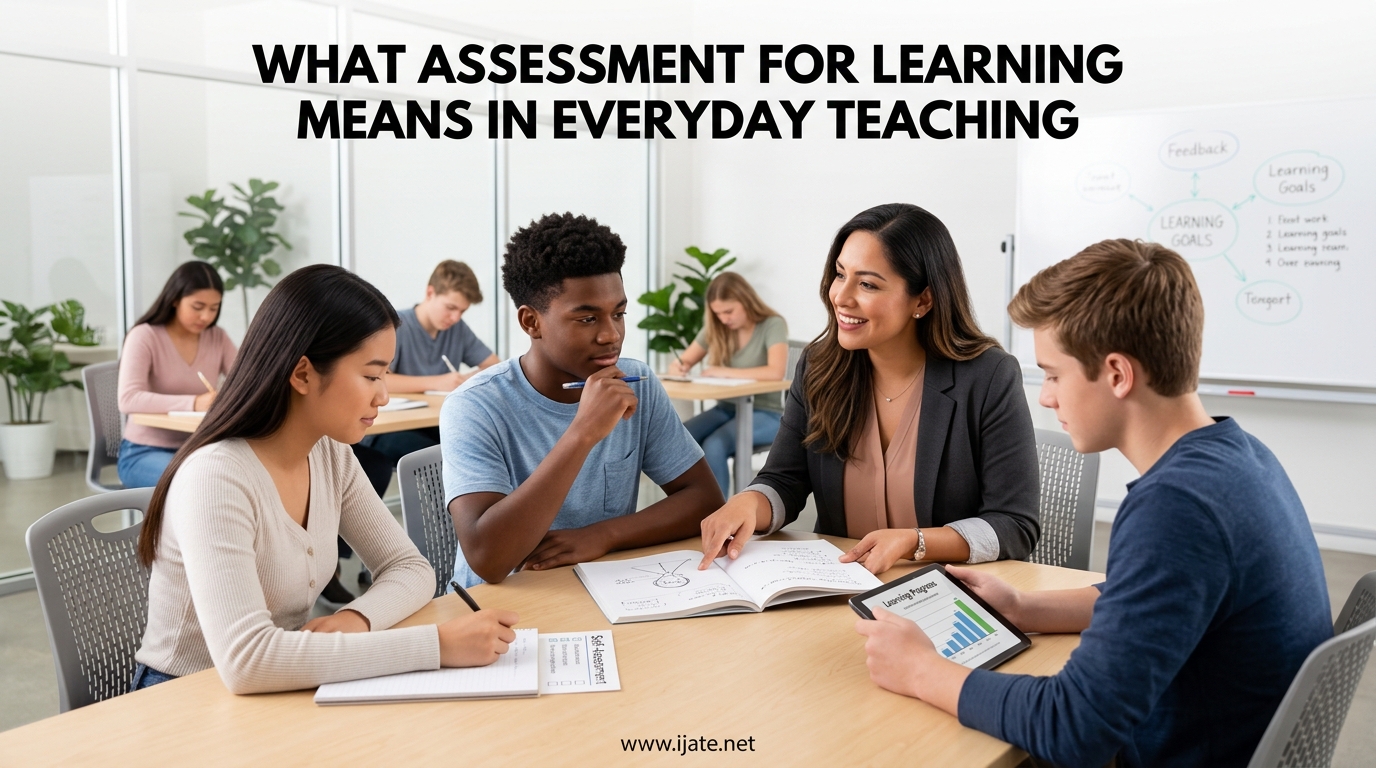
Assessment for learning (AFL) is an approach to teaching that uses ongoing, informal classroom assessments to monitor student progress and provide feedback that improves both teaching and learning while learning is still happening. If you have ever stopped mid-lesson to check whether your students understand, adjusted your explanation based on confused faces, or given a student a quick comment to help them improve their work, you were already doing assessment for learning.
When I first encountered the term in my own teaching practice, I assumed it meant adding more tests to my already packed schedule. What I discovered instead was that AFL is less about testing and more about the small, daily decisions teachers make to keep learning on track. It is a mindset shift from measuring learning after it happens to supporting learning while it unfolds.
This guide breaks down what assessment for learning means in everyday teaching, why decades of research back it, and how you can start using it in your classroom tomorrow. Whether you teach a class of 20 or a packed room of 35, the strategies here are designed to fit into real lessons without adding to your workload. For a broader look at assessment frameworks in education, you can explore how different evaluation models compare.
Table of Contents
What Is Assessment for Learning?
Assessment for learning is defined as an approach to teaching and learning that creates feedback used to improve students’ performance. The term was popularized in 1998 by Paul Black and Dylan Wiliam in their landmark review “Inside the Black Box,” which examined decades of classroom assessment research. They found that formative assessment practices, when used well, could help students learn at roughly double the expected rate.
Here is the key distinction that trips up many teachers. Assessment for learning is not a test, a quiz, or a grading instrument. It is a continuous process woven into the fabric of everyday instruction. Think of it as the GPS in your classroom. It tells you where students are right now, where they need to go, and what route will get them there.
In practical terms, AFL happens when a teacher asks a thoughtful question, listens to the answer, and uses that information to decide what to do next. It happens when students review their own work against clear criteria. It happens when peers give each other specific, helpful feedback. Every one of these moments generates evidence of learning that the teacher can act on immediately.
What makes AFL different from simply good teaching is intentionality. The assessment is planned with a purpose: to gather evidence that will inform the next instructional step. Research on effective feedback in the classroom shows that the quality and timing of that feedback matters more than the quantity.
Assessment FOR Learning vs Assessment OF Learning vs Assessment AS Learning
The three phrases sound almost identical, but they describe fundamentally different purposes. Getting this distinction clear is essential for understanding what assessment for learning means in everyday teaching.
Assessment OF learning is summative. It measures what students have learned after a unit, term, or course is complete. End-of-year exams, final projects, and standardized tests fall into this category. The results are used for grading, reporting, and accountability. Assessment of learning looks backward.
Assessment FOR learning is formative. It happens during the learning process and is designed to help students improve while there is still time to act. The information gathered is used by both teachers and students to make adjustments. Assessment for learning looks forward.
Assessment AS learning puts students in the driver’s seat. It involves students monitoring their own progress, reflecting on their thinking, and using that awareness to guide their next steps. This is where metacognition comes into play. Assessment as learning develops students who can regulate their own learning, which is closely tied to self-assessment and learner independence.
One way I like to think about it: assessment OF learning is the autopsy, assessment FOR learning is the checkup, and assessment AS learning is teaching the patient to read their own chart. All three have a place in education, but AFL and assessment as learning are where the most powerful day-to-day growth happens. Teachers interested in authentic assessment approaches will recognize this focus on meaningful, ongoing evidence.
Key Assessment for Learning Strategies You Can Use Today
The strength of assessment for learning lies in its strategies. These are not add-ons or extra tasks. They are teaching techniques you can integrate into lessons you are already teaching. Here are the four core strategies that research and classroom experience consistently support.
Effective Questioning Techniques
Questioning is the most accessible AFL strategy available to any teacher. But not all questions are created equal. The way you ask, who you ask, and how long you wait for an answer all determine whether your questioning generates useful evidence.
Open questions, which require students to explain, compare, or justify, reveal far more about their understanding than closed questions that can be answered with a single word. Instead of asking “Is this a prime number?” try asking “Why is this number prime while that one is not?” The second question forces students to show their reasoning, giving you a window into their thinking.
Wait time is another critical factor. Research by Mary Budd Rowe in the 1980s showed that when teachers wait just three to five seconds after asking a question before calling on a student, the quality and length of student responses increases dramatically. Most teachers, myself included, find this uncomfortable at first. The silence feels awkward. But that silence is where thinking happens.
Techniques like cold calling, where you call on students regardless of whether they have raised their hands, and think-pair-share, where students discuss with a partner before answering, both increase participation and give you broader evidence of understanding across the whole class.
Quality Feedback That Moves Learning Forward
Feedback is the engine of assessment for learning, but only when it is done right. John Hattie’s Visible Learning research, which synthesized over 800 meta-analyses, found that feedback has one of the highest effect sizes of any educational intervention. But Hattie was careful to note that not all feedback is effective. The most powerful feedback focuses on the task, not the person.
This is where comment-only marking comes in. When you give a grade alongside comments, students tend to focus on the grade and ignore the feedback. Research by Ruth Butler in 1988 demonstrated this clearly. When students received only comments, their performance improved significantly. When they received grades, performance did not improve, regardless of the quality of the accompanying comments.
Effective feedback answers three questions for the student: Where am I going? How am I doing? Where do I go next? If your feedback addresses all three, it gives students a clear path forward. Keep it specific, actionable, and focused on the work rather than the student’s ability.
Peer and Self-Assessment
Peer assessment turns students into learning resources for each other. When students evaluate a classmate’s work against clear success criteria, they develop a deeper understanding of what quality looks like. They also practice giving and receiving constructive feedback, a skill that extends far beyond the classroom.
Self-assessment builds metacognition, which is the ability to think about your own thinking. When students regularly assess their own work, they become more aware of their strengths, their gaps, and their next steps. This shifts the locus of control from teacher to student, which is one of the most powerful changes you can make in a classroom.
Both strategies require training. Students will not automatically know how to give useful feedback or assess their own work honestly. Start small, model the process, and provide sentence stems or rubrics to guide them. Over time, peer and self-assessment become self-sustaining parts of your classroom culture. For a real-world example, research on peer assessment strategies in the classroom shows how even social platforms can be leveraged for meaningful peer evaluation.
Learning Intentions and Success Criteria
If students do not know what they are supposed to be learning, they cannot assess their own progress toward it. Learning intentions state what students should know, understand, or be able to do by the end of a lesson. Success criteria describe what success looks like in concrete terms.
Sharing these at the start of a lesson seems simple, but its impact is significant. When students know the destination, they can monitor their own progress. They can ask better questions. And you, as the teacher, have a clear benchmark against which to assess their understanding throughout the lesson.
Even better, involve students in co-constructing success criteria. Ask them what they think a good piece of work would include. This deepens their understanding of quality and gives them ownership of the learning process.
What Assessment for Learning Looks Like in Everyday Teaching
Theory is one thing. What teachers need is a clear picture of what assessment for learning looks like in a real classroom, on a real Tuesday, with real students. Here is how AFL plays out across different moments of a typical lesson.
At the Start of a Lesson
Begin with a diagnostic check to find out what students already know. This could be a quick question on mini whiteboards, a traffic light card system where students hold up green, yellow, or red to signal their confidence, or a short discussion that surfaces prior knowledge. The point is not to grade anyone. It is to calibrate your instruction to where students actually are.
When I started using traffic light cards, I was surprised by how honest students were. Given a low-stakes way to signal confusion, many students who would have stayed silent in a whole-class question happily held up a red card. That information let me adjust my lesson before investing time in content they were not ready for.
During the Lesson
This is where most assessment for learning happens. Mini whiteboards are one of the most effective tools for in-the-moment assessment. Every student writes their answer and holds it up simultaneously. In five seconds, you can see the understanding of your entire class.
Exit tickets work well at the end of a segment. Ask students to write down one thing they learned and one question they still have. Collect these, review them quickly, and use the patterns to plan your next lesson.
Observation is the most underused AFL strategy. Walking around the room while students work, listening to their conversations, and looking at their notes gives you rich evidence of learning. You do not need to collect or grade anything. You just need to notice and respond.
Subject-Specific Examples
In mathematics, AFL might look like asking students to solve a problem in two different ways and then compare their approaches. In science, it could be having students predict the outcome of an experiment before running it, then discussing why their predictions were or were not accurate. In English or language arts, it might involve students reading each other’s drafts and highlighting where the argument is strongest and where it needs more evidence.
The specific strategy matters less than the principle. Every AFL moment gives you actionable evidence about what students understand and what they need next.
Adapting AFL for Large Classes
One of the most common concerns I hear from teachers, particularly in forums like r/Teachers and r/mathteachers, is that AFL strategies sound great in theory but do not work with 35 or more students. This is a legitimate concern, but it is not an insurmountable one.
Mini whiteboards scale perfectly to large classes because you can see all responses at a glance. Think-pair-share works in any class size because students discuss in pairs or small groups. Exit tickets are manageable if you focus on reviewing patterns rather than commenting on every single one. Peer assessment reduces the feedback burden on the teacher while increasing student engagement.
The key is choosing strategies that give you maximum information with minimum effort. You do not need to assess every student every minute. You need enough evidence to make a confident instructional decision.
Why Assessment for Learning Matters: The Research
The evidence base for assessment for learning is one of the strongest in all of education research. Black and Wiliam’s 1998 review of over 250 studies concluded that formative assessment practices produced significant learning gains, with effect sizes large enough to suggest that students taught with strong AFL practices learned at roughly double the rate of those without.
John Hattie’s synthesis, published in “Visible Learning,” assigned feedback an effect size of 0.70, well above the 0.40 threshold he considers the hinge point for a year’s worth of learning. In practical terms, this means that students who receive quality feedback as part of AFL practices make substantially more progress than those who do not.
The benefits extend beyond test scores. AFL develops metacognition, helping students become more aware of their own learning processes. It builds self-regulation, as students learn to set goals, monitor their progress, and adjust their strategies. And it shifts classroom culture from one of compliance to one of learning, where mistakes are treated as information rather than failures.
Research on self-assessment and learner independence reinforces this point. Students who learn to evaluate their own work become more autonomous learners, which pays dividends long after they leave your classroom.
Common Misconceptions About Assessment for Learning
Despite the strong research base, several misconceptions about AFL persist. These myths can prevent teachers from fully embracing the approach. Let me address the most common ones I encounter.
Misconception 1: AFL means more grading. This is perhaps the most damaging myth. AFL is not about adding more marking to your pile. In fact, effective AFL often reduces grading because it catches misunderstandings early, before they show up in summative assessments that require extensive marking. Comment-only feedback, exit tickets, and observation-based assessment are designed to be lightweight.
Misconception 2: AFL is just formative assessment with a fancy name. There is overlap, but the distinction matters. Formative assessment refers to the timing and type of assessment. Assessment for learning is a broader pedagogical approach that includes formative assessment as one component. AFL also encompasses the classroom culture, the role of students as assessors, and the learning-to-learn dimension. It is a philosophy of teaching, not just a category of tests.
Misconception 3: AFL creates classroom noise and chaos. Some teachers worry that peer discussion, self-assessment, and activities like think-pair-share will lead to classroom management issues. In my experience, the opposite is true. When students are engaged in meaningful learning tasks and know what success looks like, behavior problems tend to decrease. The key is establishing routines and expectations early.
Misconception 4: AFL does not work with large classes or exam-focused curricula. As discussed earlier, large classes require strategy selection, not abandonment of AFL. And exam pressure actually makes AFL more important, not less, because catching gaps early prevents them from becoming failures on high-stakes tests.
Real Challenges Teachers Face with AFL (And How to Overcome Them)
Implementing assessment for learning is not without real difficulties. Teachers in online forums regularly share their frustrations, and these concerns deserve honest responses rather than platitudes.
Challenge: Class sizes of 35 or more. Large classes make one-on-one assessment feel impossible. The solution is to prioritize strategies that scale. Mini whiteboards, voting systems, and paired discussion give you whole-class data in seconds. Focus on patterns rather than individual responses, and use peer assessment to multiply the feedback students receive.
Challenge: Observation and evaluation pressure. Many teachers report that AFL comes up as an area for development in formal observations. This creates pressure to perform AFL strategies rather than embed them authentically. The best response is to make AFL so routine in your daily practice that it naturally appears in any observation. When questioning, feedback, and student self-assessment are woven into every lesson, they become visible without effort.
Challenge: School culture that does not value AFL. Some schools define assessment narrowly, prioritizing summative data over formative growth. Teachers in these environments often feel they are pushing against the tide. Start small, document the impact, and share evidence of student growth with colleagues and leadership. Sometimes seeing the results is what changes minds.
Challenge: Time constraints. AFL strategies are designed to save time, not consume it. But learning any new approach takes initial investment. Pick one strategy, implement it consistently for a few weeks, and then add another. Trying to overhaul your entire assessment practice overnight is a recipe for burnout.
Your Everyday AFL Checklist
Here is a practical checklist to help you embed assessment for learning into your daily teaching routine. Print it, pin it above your desk, and use it as a quick reference.
Before the lesson:
- Write clear learning intentions that state what students should know or be able to do.
- Define success criteria that describe what good work looks like.
- Plan two or three key questions that will reveal student understanding.
- Decide how you will check understanding during the lesson (whiteboards, exit tickets, discussion).
During the lesson:
- Share learning intentions and success criteria with students at the start.
- Ask open questions and wait at least three seconds for responses.
- Use mini whiteboards or traffic light cards for quick whole-class checks.
- Circulate the room and observe student work in progress.
- Give task-focused, specific feedback rather than grades or generic praise.
After the lesson:
- Review exit tickets or quick-assessment results to identify patterns.
- Adjust your next lesson based on what the evidence tells you.
- Plan opportunities for peer or self-assessment in upcoming lessons.
- Reflect on which questions generated the most useful evidence.
FAQs
What is assessment for learning in teaching?
Assessment for learning in teaching is an approach that uses ongoing, informal assessment during the learning process to monitor student progress and provide feedback that improves both teaching and learning. Unlike summative assessment, which measures learning after it is complete, assessment for learning happens while learning is still taking place and gives teachers the information they need to adjust instruction in real time.
What are examples of assessment for learning?
Common examples of assessment for learning include questioning techniques with adequate wait time, mini whiteboards for whole-class responses, exit tickets at the end of lessons, traffic light cards for confidence checks, think-pair-share discussions, comment-only marking, peer assessment activities, and student self-assessment against success criteria. Each of these strategies generates evidence of learning that teachers can act on immediately.
What are the 4 types of assessment for learning?
The four main types or categories of assessment for learning are teacher assessment (questioning, observation, and feedback led by the teacher), self-assessment (students evaluating their own work), peer assessment (students evaluating each other’s work), and formative use of summative data (using test results diagnostically to guide future instruction). Together, these four types create a comprehensive assessment for learning approach.
What are the 4 components of assessment for learning?
The four core components of assessment for learning are clear learning intentions and success criteria, effective questioning and classroom dialogue, quality feedback focused on the task, and peer and self-assessment that develops student metacognition. These components work together to create a continuous cycle of evidence-gathering and instructional adjustment.
What is the difference between assessment for learning and assessment of learning?
Assessment for learning is formative and happens during the learning process to help students improve, while assessment of learning is summative and happens after learning to measure what students have achieved. Assessment for learning looks forward and informs next steps, whereas assessment of learning looks backward and assigns grades or reports achievement.
How do I implement assessment for learning with large classes?
To implement assessment for learning with large classes, choose strategies that scale efficiently. Mini whiteboards let you see all responses at once. Think-pair-share generates evidence through paired discussion. Exit tickets can be reviewed for patterns rather than individually. Peer assessment multiplies the feedback students receive without adding to teacher workload. Focus on gathering enough evidence to make confident instructional decisions rather than assessing every student every minute.
Conclusion: Making Assessment for Learning Part of Your Everyday Teaching
Understanding what assessment for learning means in everyday teaching comes down to one principle. Assessment should serve learning, not just measure it. When you ask better questions, give feedback that students can act on, and help students assess their own progress, you create a classroom where every lesson moves learning forward.
You do not need to transform your entire practice overnight. Start with one strategy from the checklist above. Use it consistently for a few weeks. Notice the difference it makes in what you know about your students and how they respond. Then add another. Before long, assessment for learning becomes not an add-on but a natural part of how you teach every day.
The research is clear. The strategies are proven. The only thing left is to start. Your students are giving you evidence of their learning every single lesson. Assessment for learning gives you the tools to notice it, interpret it, and use it to help them grow.