
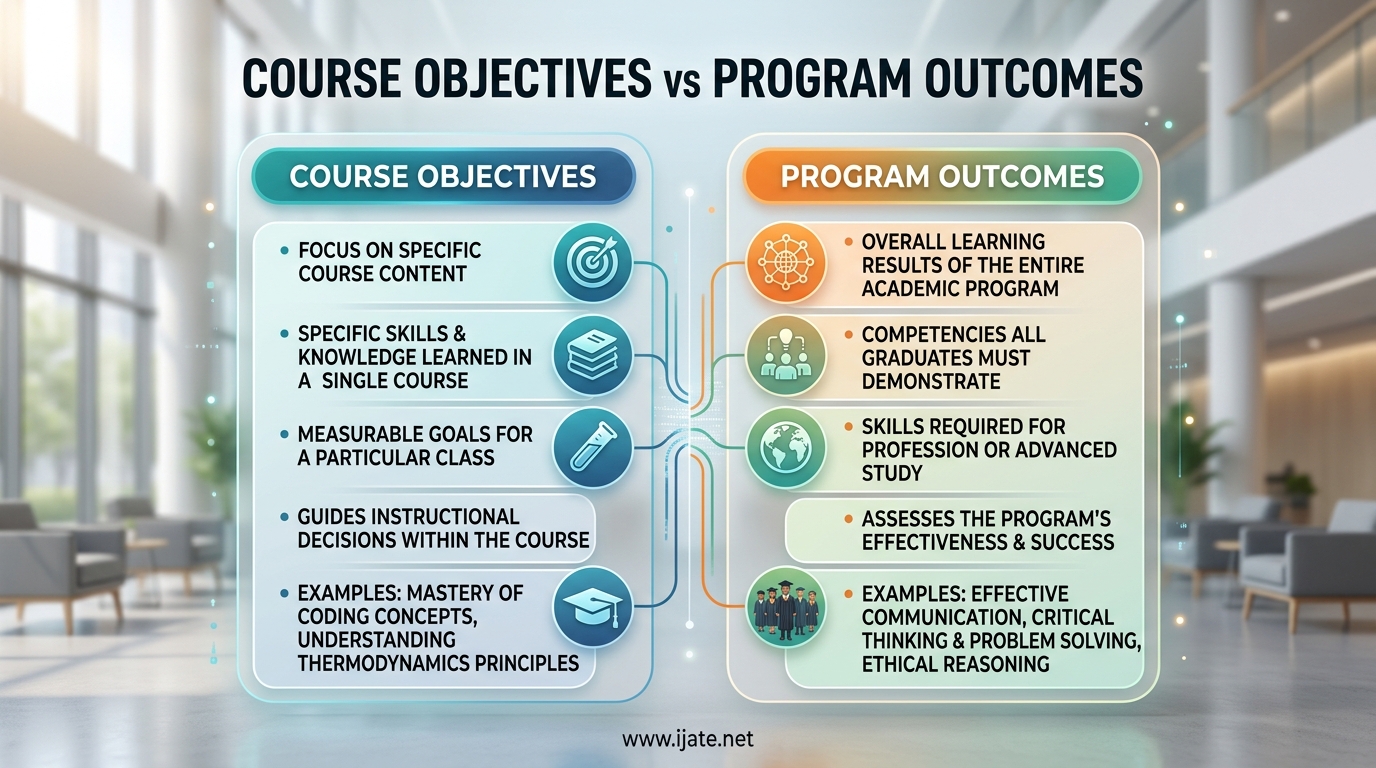
If you have ever sat in a curriculum committee meeting and watched faculty debate whether something is a course objective or a program outcome, you already know how muddy this terminology gets. The difference between course objectives and program outcomes comes down to scope, perspective, and measurability, and getting it wrong can derail accreditation reviews and confuse students.
Our team has spent years working with instructional designers, program coordinators, and accreditation committees. The same questions keep surfacing in faculty lounges, on Reddit’s r/instructionaldesign, and in syllabus workshops: Are these terms interchangeable? Do they serve the instructor or the learner? How do they connect?
This guide breaks down the difference between course objectives and program outcomes in plain language. You will get definitions, side-by-side comparisons, real examples from multiple disciplines, and a practical framework for writing both. By the end, you will be able to look at any learning statement and confidently identify which category it belongs to, and why that distinction matters.
Table of Contents
The Difference Between Course Objectives and Program Outcomes: A Quick Answer
Course objectives describe what an instructor intends to teach and cover within a single course, while program outcomes describe what students should be able to demonstrate after completing an entire academic program. The first is instructor-centered and narrower in scope; the second is student-centered, measurable, and broader.
Think of it this way: a course objective tells you what happens inside one classroom over one semester. A program outcome tells you what a graduate carries with them after two to four years of study. Course objectives are stepping stones that collectively build toward the larger program outcomes.
Another way to frame the distinction is perspective. Course objectives are typically written from the instructor’s point of view (“The course will introduce students to…”). Program outcomes are written from the student’s point of view (“Graduates will be able to…”). This shift in voice is not cosmetic. It reflects a fundamental difference in who the statement serves and how it gets assessed.
Understanding this distinction is more than a vocabulary exercise. It shapes how courses are designed, how student learning is assessed, and how programs demonstrate quality to accreditors, employers, and prospective students. When the terms get blurred, the entire chain of curriculum alignment weakens.
What Are Course Objectives?
Course objectives are specific, instructional-level statements that describe what a course aims to cover and what learning experiences the instructor plans to provide. They live on a syllabus, guide lesson planning, and signal to students what topics and skills a single course will address.
Course objectives tend to be narrower and more granular than program outcomes. They focus on a single course’s content, scope, and timeframe. A well-written course objective might describe the specific topics, competencies, or experiences students will encounter during that term.
Here are the key characteristics of course objectives:
- Instructor-centered: They describe what the instructor intends to teach or facilitate.
- Course-scoped: They apply to one course, not an entire degree program.
- Often broad: They may use general language about coverage and exposure.
- Syllabus-based: They appear on course syllabi and guide weekly planning.
- Foundational: They serve as building blocks that contribute to program outcomes.
A typical course objective might read: “This course will introduce students to the fundamental principles of financial accounting.” Notice the voice. The instructor and the course are the subject. The emphasis is on what gets taught.
Here are a few more course objective examples from different disciplines:
- “This course explores the major themes of 19th-century European history.”
- “Students will examine the biochemical pathways involved in cellular metabolism.”
- “The course prepares students to apply statistical methods to social science research questions.”
- “Learners will engage with contemporary debates in environmental policy.”
That said, many institutions now encourage faculty to write course objectives in student-centered, measurable language. This shift blurs the line between objectives and outcomes, which is one reason the terminology causes so much confusion. When a course objective is rewritten as “Students will be able to prepare a basic balance sheet,” it starts functioning like a course-level learning outcome.
What Are Program Outcomes?
Program outcomes describe the knowledge, skills, and abilities that students should be able to demonstrate upon completing an entire academic program. They are written from the student’s perspective, focus on observable and measurable behavior, and serve as the benchmark for program-level assessment.
Where course objectives zoom in on one class, program outcomes zoom out to the whole degree. A program outcome captures the cumulative effect of many courses, experiences, and assessments working together over multiple semesters or years.
Key characteristics of program outcomes include:
- Student-centered: They describe what the graduate can do, not what the program teaches.
- Measurable: They use observable action verbs that can be assessed with evidence.
- Program-scoped: They apply to the full program, not a single course.
- Cumulative: They reflect integrated learning across multiple courses.
- Accreditation-linked: They align with institutional and disciplinary accreditation standards.
A typical program outcome reads: “Graduates will be able to analyze complex financial statements and make evidence-based recommendations.” Notice the shift. The graduate is the subject. The verb is observable. The outcome can be assessed through capstone projects, portfolios, or licensing exams.
Here are additional program outcome examples across disciplines:
- “Graduates will be able to conduct independent historical research using primary and secondary sources.”
- “Graduates will be able to design experiments and interpret scientific data to address biological questions.”
- “Graduates will be able to evaluate public policy proposals using quantitative and qualitative evidence.”
- “Graduates will communicate effectively in professional and academic contexts.”
Program outcomes matter beyond the classroom. They appear in accreditation self-studies, program review documents, and curriculum maps. When an accrediting body asks how your program knows students are learning, program outcomes are the answer.
Course Objectives vs Program Outcomes: Key Differences
The easiest way to understand the difference between course objectives and program outcomes is to compare them side by side across several dimensions. The list below summarizes the core distinctions we use when training faculty.
- Perspective: Course objectives are instructor-centered (“The course will…”). Program outcomes are student-centered (“Graduates will be able to…”).
- Scope: Course objectives cover one course over one term. Program outcomes span an entire degree program.
- Timeframe: Course objectives address weeks or months. Program outcomes address years of study.
- Measurability: Course objectives may be broad and describe coverage. Program outcomes must be measurable and observable.
- Purpose: Course objectives guide teaching and lesson planning. Program outcomes guide program assessment and accreditation.
- Audience: Course objectives primarily serve students and the instructor. Program outcomes serve accreditors, employers, curriculum committees, and prospective students.
- Assessment level: Course objectives are assessed through exams, papers, and projects within the course. Program outcomes are assessed through capstones, portfolios, comprehensive exams, and aggregated data across cohorts.
- Granularity: Course objectives are granular and topic-specific. Program outcomes are integrative and competency-based.
- Direction of focus: Course objectives look at what is taught. Program outcomes look at what is demonstrated.
- Language register: Course objectives may use aspirational or descriptive verbs. Program outcomes require concrete, assessable action verbs.
One way we explain it to faculty: course objectives are the ingredients and steps in a recipe, while program outcomes are the finished dish. Individual steps matter, but what you ultimately evaluate is whether the graduate can produce the meal.
This distinction is not academic hair-splitting. Accreditation bodies like ABET, AACSB, and regional accreditors expect institutions to articulate program outcomes clearly and demonstrate that courses collectively prepare students to meet them. When the two get conflated, assessment data becomes muddy and accreditation reviews get harder.
The Hierarchy: Learning Goals, Objectives, and Outcomes
To fully grasp the difference between course objectives and program outcomes, it helps to place them within a larger hierarchy. Most instructional design frameworks recognize three nested levels: goals, objectives, and outcomes.
Learning goals are the broadest and most aspirational. They describe the general aims of a program or institution. A goal might be “Develop critical thinkers who can engage with complex societal problems.” Goals are visionary but not directly measurable.
Learning objectives sit in the middle. They are more specific than goals and describe what instruction intends to accomplish. Objectives break goals into actionable steps. A program-level objective might be “Provide students with foundational knowledge in research methods.”
Learning outcomes are the most specific and measurable. They describe what students can demonstrably do as a result of learning. An outcome might be “Students will be able to design and execute a qualitative research study using appropriate methodology.”
The hierarchy flows downward: goals inform objectives, and objectives inform outcomes. Course objectives live within this hierarchy as course-level operationalizations of broader program objectives. Program outcomes sit at the top of the assessment chain, representing what all of that instruction ultimately adds up to.
Understanding this hierarchy matters because it explains why terminology varies so much across institutions. Some schools use “objectives” and “outcomes” loosely and interchangeably. Others enforce strict distinctions. The framework above is the one most commonly endorsed by accreditation bodies and instructional design literature.
This three-tier structure also gives faculty a useful diagnostic tool. When you encounter a learning statement, ask: Is this aspirational and broad? Then it is likely a goal. Is it about what instruction will do? Then it is likely an objective. Is it about what students will demonstrably do? Then it is likely an outcome. That simple triage clears up most terminological debates.
How Course Objectives Map to Program Outcomes
One of the biggest content gaps we found across competitor resources is practical guidance on how course objectives actually connect to program outcomes. Faculty consistently ask: How do I know if my course objectives are doing their job? The answer is curriculum mapping.
Curriculum mapping is the process of aligning each course’s objectives with one or more program outcomes. This creates a visible web showing how individual courses contribute to the broader competencies a graduate must demonstrate.
Here is a step-by-step approach to mapping course objectives to program outcomes:
- List your program outcomes. Start with the three to seven outcomes your program has committed to. These should already be measurable and student-centered.
- Review each course’s objectives. Pull the objectives from every syllabus in the program. Tag each one with the program outcome it supports.
- Identify gaps and overlaps. Look for program outcomes that no course addresses. Look for courses trying to cover too many outcomes superficially.
- Adjust coverage. Reassign or revise course objectives so that every program outcome is addressed at the right depth across the curriculum.
- Document the map. Create a simple matrix with courses on one axis and program outcomes on the other. Mark where each outcome is introduced, reinforced, and mastered.
- Use the map for assessment. When you collect evidence of student learning, use the map to trace results back to specific courses and objectives.
This mapping process is what accreditation reviewers want to see. It demonstrates intentionality. It shows that your curriculum is not just a collection of courses but a coordinated pathway leading to defined graduate competencies.
A common mistake is treating mapping as a one-time exercise. Programs evolve, faculty change, and new courses get added. The most effective programs revisit their curriculum map annually and update it as part of regular program review.
Another tip: share the curriculum map with adjuncts and new faculty. When everyone teaching in the program understands which outcomes their course is responsible for, alignment improves naturally. The map becomes a communication tool, not just a compliance document.
Writing Effective Course Objectives and Program Outcomes
Writing strong course objectives and program outcomes is a skill. The most common framework for crafting measurable, student-centered statements is Bloom’s Taxonomy, which organizes cognitive skills into levels from simple recall to complex evaluation.
Here is a practical formula we recommend, adapted from DePaul’s Teaching Commons approach: Students will be able to + [action verb from Bloom’s Taxonomy] + [content or skill] + [condition or context].
For example: “Students will be able to analyze primary source documents from the early modern period.” The verb is observable, the content is specific, and the context is defined.
Here are action verbs that work well at each Bloom’s Taxonomy level:
- Remember: identify, list, name, recall, define
- Understand: explain, summarize, paraphrase, classify, describe
- Apply: demonstrate, calculate, implement, solve, use
- Analyze: compare, contrast, differentiate, examine, organize
- Evaluate: assess, critique, justify, defend, recommend
- Create: design, develop, formulate, construct, propose
Avoid vague verbs that resist measurement. Words like “understand,” “know,” “learn,” “appreciate,” and “be exposed to” tell you nothing about what observable behavior a student will produce. If you cannot design an assessment that captures it, rewrite it.
When writing program outcomes specifically, keep these principles in mind:
- Use student-centered language. The graduate is the subject, not the program.
- Keep outcomes to a manageable number. Three to seven is typical for a degree program.
- Make each outcome assessable through multiple measures across multiple courses.
- Ensure outcomes reflect both disciplinary content and transferable skills.
- Align outcomes with professional standards and accreditation expectations.
For course objectives, the bar is slightly different. They can be more numerous, more granular, and more closely tied to specific content. But they should still be clear enough that a student reading the syllabus understands what the course will address.
One quick test we teach faculty: read the statement aloud and ask, “Could I design an assignment that directly measures this?” If the answer is yes, you have a solid outcome or measurable objective. If the answer is no, the language is too vague and needs sharpening.
Examples in Context: Seeing the Distinction in Action
Definitions and frameworks help, but nothing clarifies the difference between course objectives and program outcomes like seeing them paired in context. Below are examples from four disciplines showing how a course objective and a program outcome work together.
Nursing. Course objective: “This course covers the principles of pharmacology and medication administration.” Program outcome: “Graduates will safely administer medications and evaluate patient responses using evidence-based practice.”
Computer Science. Course objective: “Students will learn data structures and their applications.” Program outcome: “Graduates will be able to design, implement, and evaluate computational solutions to complex problems.”
Business Administration. Course objective: “This course introduces students to marketing strategy frameworks.” Program outcome: “Graduates will be able to develop and defend strategic marketing plans grounded in market research and data analysis.”
Education. Course objective: “Students will explore theories of child development.” Program outcome: “Graduates will be able to apply developmental theory to design age-appropriate learning experiences for diverse learners.”
Notice the pattern in each pair. The course objective describes what the course covers. The program outcome describes what the graduate can do. The course is one contributing piece. The program outcome is the integrated result.
Stakeholder Perspectives: Who Cares and Why
The distinction between course objectives and program outcomes matters differently to different stakeholders. Understanding these perspectives helps explain why the terminology debate never fully goes away.
Instructors care most about course objectives. These guide their daily planning, shape assignments, and communicate expectations to students. For instructors, objectives are practical and immediate.
Program coordinators and department chairs care most about program outcomes. They need to demonstrate to deans, accreditors, and advisory boards that the curriculum produces competent graduates. For them, outcomes are strategic and evaluative.
Students benefit from both, but in different ways. Course objectives help them understand what a single class will demand. Program outcomes help them see the bigger picture of what their degree prepares them to do.
Accreditors and employers focus almost exclusively on program outcomes. They want evidence that graduates can perform. They rarely look at individual course objectives unless those objectives feed directly into assessment data.
Recognizing these different audiences explains why the same statement can be framed differently depending on who is reading it. A syllabus speaks to students. A program review speaks to accreditors. Both can be accurate; they just emphasize different levels of the hierarchy.
Common Mistakes to Avoid
After working with dozens of programs on curriculum design and accreditation prep, we see the same mistakes repeat. Here are the most common ones and how to fix them.
Using objectives and outcomes interchangeably. This is the top source of confusion. If your syllabus says “course outcomes” but lists instructor-centered statements about coverage, those are objectives, not outcomes. Clarify the language and adjust the framing.
Writing outcomes that cannot be measured. “Students will appreciate the value of scientific inquiry” sounds noble but cannot be assessed. Replace vague verbs with observable ones: “Students will articulate the role of scientific inquiry in addressing real-world problems.”
Confusing coverage with competence. Covering a topic in a lecture is not the same as students demonstrating competence. Course objectives that say “cover” or “expose students to” describe teaching activity, not learning results.
Treating the mapping exercise as busywork. A curriculum map sitting in a folder serves no one. Use it actively to guide assessment, identify gaps, and inform curriculum revisions.
Writing too many outcomes. Programs with 15 program outcomes cannot assess any of them well. Consolidate and prioritize. Aim for a small set of outcomes you can meaningfully measure.
Ignoring the student perspective. Outcomes written for accreditors but never shared with students miss the point. Publish your program outcomes in student-facing materials so learners understand what they are working toward.
Forgetting to update outcomes over time. Disciplines evolve, professional standards shift, and student populations change. Program outcomes that have not been reviewed in five years are likely stale. Build a regular review cycle into your program governance.
FAQs
Are course outcomes the same as course objectives?
No. Course objectives describe what an instructor intends to teach in a course and are often instructor-centered. Course outcomes describe what students will be able to demonstrate after completing the course and are student-centered and measurable. The terms are related but not interchangeable.
What is the difference between program objectives and program outcomes?
Program objectives describe what a program intends to provide or accomplish for students, such as exposing them to specific content or experiences. Program outcomes describe what graduates can demonstrably do after completing the program. Objectives are intention statements; outcomes are measurable results.
Is there a difference between objectives and outcomes?
Yes. Objectives describe intended goals from the instructor or program perspective. Outcomes describe the measurable knowledge and skills students actually demonstrate. Objectives focus on teaching intentions; outcomes focus on student achievement.
What is the difference between program outcome and course outcome?
A course outcome describes what a student can demonstrate after one course and is narrow in scope. A program outcome describes what a graduate can demonstrate after completing an entire degree program and reflects cumulative, integrated learning. Course outcomes should align with and build toward program outcomes.
Conclusion
The difference between course objectives and program outcomes comes down to perspective, scope, and measurability. Course objectives are instructor-centered statements that guide a single course. Program outcomes are student-centered, measurable statements that define what graduates can demonstrate after an entire program.
Getting this distinction right matters for curriculum design, assessment, and accreditation. Use curriculum mapping to connect your course objectives to program outcomes, write both with measurable Bloom’s Taxonomy verbs, and revisit your framework regularly as your program evolves. Your next step: pull out your current syllabus and program review documents, and check whether your objectives and outcomes are doing the jobs they are meant to do.