
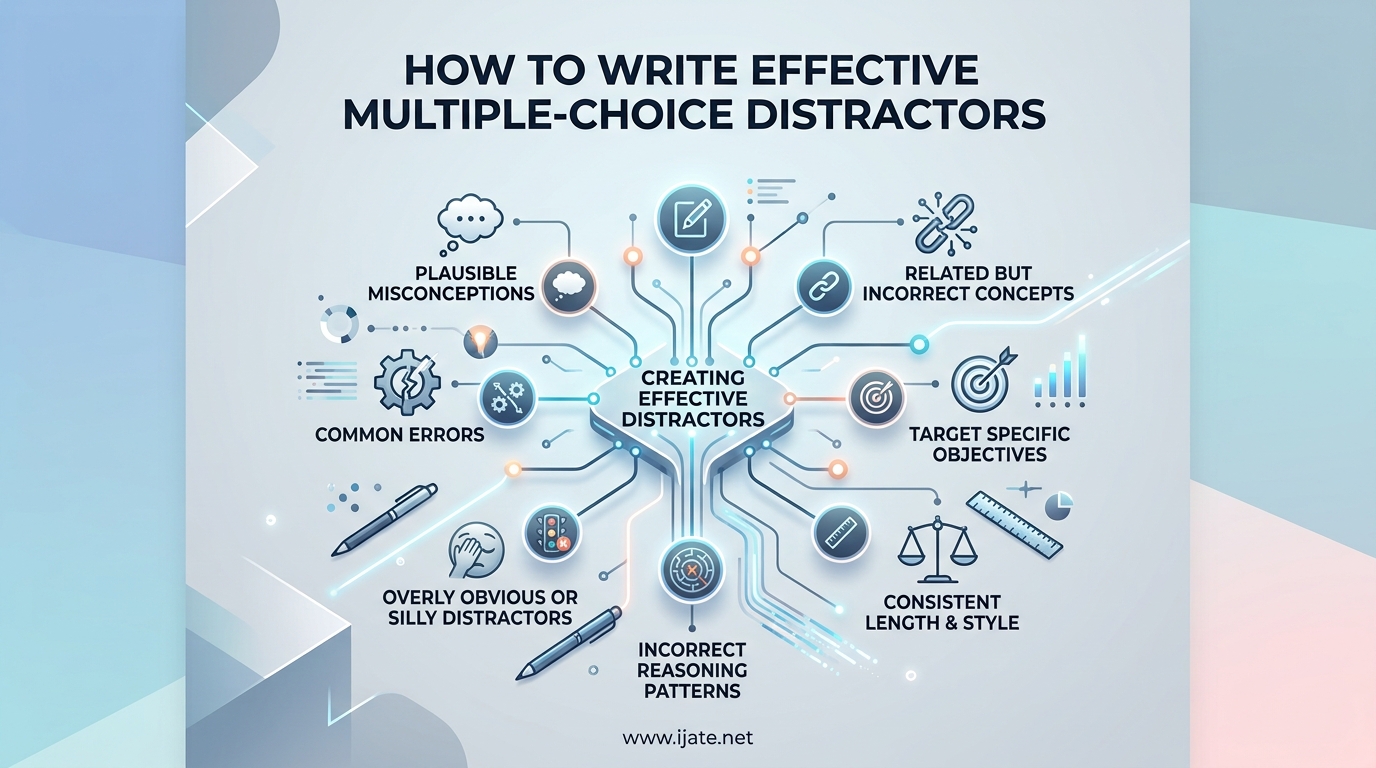
Writing multiple-choice questions is easy. Writing effective multiple-choice distractors, the wrong answer choices that actually test what students know, is the part that keeps instructors up at night. On faculty forums across the web, professors describe distractor writing as the single hardest part of assessment design. One Reddit thread on r/Professors called creating MCQs “a pain in the a**” and attracted dozens of agreements within hours.
If you have ever stared at a blank question stem wondering how to invent three plausible wrong answers, you are in the right place. This guide covers how to write effective multiple-choice distractors from start to finish, including a misconception-mapping framework, a step-by-step writing process, before-and-after examples, validation techniques using item analysis, and a section on AI-assisted distractor generation that no competing guide covers.
A distractor is an incorrect answer choice in a multiple-choice question that is intentionally designed to be plausible and attractive to students who have not mastered the content, while being clearly wrong to those who have. When you learn how to write effective multiple-choice distractors, every wrong option becomes a diagnostic signal that tells you exactly what a student does and does not understand.
Our team has spent years working with assessment designers, instructional faculty, and psychometricians to distill the research, including the Rodriguez 2005 meta-analysis on option count, Brame’s widely cited faculty guide, and Burton et al.’s checklist for item writers. What follows is the practical, evidence-based playbook we wish we had when we started writing MCQs.
Table of Contents
What Are Distractors and Why They Matter
Distractors are the incorrect response choices that surround the keyed (correct) answer in a multiple-choice question. The stem poses the problem, the key is the right answer, and every other option is a distractor. Their job is not to trick students. Their job is to attract students who hold specific misconceptions while being rejected by students who actually know the material.
This diagnostic function is what separates a real assessment from a guessing game. When a student picks a well-built distractor, the choice reveals a precise gap in understanding that you can act on with targeted feedback. For a broader look at how this fits into evaluation design, see this discussion of assessment frameworks in educational contexts.
Poorly written distractors defeat the entire purpose of the question. If your wrong answers are obviously wrong, every student picks the correct option by elimination and the question measures nothing. If your distractors are so similar to the key that two answers could be correct, students feel cheated and your test loses validity. Research consistently shows that question quality, not question quantity, drives test reliability.
The good news is that strong distractors follow predictable patterns. Once you internalize a handful of principles and a repeatable writing process, the work gets faster and the quality of your assessments rises sharply. The rest of this guide gives you both the principles and the process.
Core Principles of Effective Distractors
The principles below are the non-negotiable rules that separate strong distractors from filler. We have grouped them into the categories that matter most in practice: plausibility, misconception alignment, homogeneity, mutual exclusivity, grammatical consistency, and length uniformity.
Plausibility: Every Distractor Must Be Tempting to Someone
A plausible distractor is one that a student who has not mastered the content could reasonably believe is correct. If no student ever selects an option, that option is dead weight. It reduces the effective number of choices from four to three (or fewer) and makes the question easier than intended by widening the guessing odds.
The classic test for plausibility is the “would a smart-but-unprepared student pick this?” check. If the answer is no, the distractor is not pulling its weight. The best distractors are selected by low achievers and avoided by high achievers, which is exactly the discrimination pattern you want.
Misconception Alignment: Base Distractors on Real Errors
The most effective distractors represent mistakes that students actually make. Common errors, frequent confusions, partially correct reasoning, and stubborn myths all make excellent raw material. When each distractor maps to a specific misconception, the question becomes a diagnostic instrument that tells you which mistake a student fell for.
This is the heart of effective multiple-choice design, and it is why collecting student errors from homework, open-response questions, and prior exams is so valuable. Those real mistakes are worth more than any textbook list of “good distractor patterns.” More on this in the misconception-mapping section below.
Homogeneity: All Options Should Look Like They Belong Together
Homogeneous alternatives share the same format, the same level of detail, and the same general structure. If the correct answer is a complete sentence with a definition, every distractor should be a complete sentence with a definition. If the correct answer is a number with units, every distractor should be a number with the same units.
When one option stands out as longer, more detailed, or more formally worded, students spot the keyed answer without knowing the content. Semantic closeness, the property of all options sounding like they came from the same chapter, is what you are aiming for.
Mutual Exclusivity: Only One Option Can Be Defensibly Correct
Nothing damages student trust faster than a question with two defensible answers. Each distractor must be unambiguously wrong in a way you can defend if challenged. Avoid “trick” distractors that hinge on reading the stem in an unusual way. If a knowledgeable student could argue for a distractor, rewrite it.
Grammatical Consistency: No Cues From Language
The stem and every option must agree grammatically. If the stem ends with “an,” the correct answer must start with a vowel sound, but so must at least some distractors. Grammatical cues, also called cueing or clang associations, accidentally reveal the correct answer to observant students who do not know the content. Common grammatical traps include article mismatches, plural-singular disagreements, and verb-tense hints.
Length Uniformity: Avoid the “Longest Answer Is Correct” Bias
Test-wise students know that the longest, most detailed option is frequently the correct one, because item writers often add qualifiers to make the keyed answer airtight. Keep all options roughly the same length. If the correct answer needs more words to be precise, distribute similar qualifying language across the distractors so no single option stands out.
A Taxonomy of Distractor Types
One of the biggest gaps in existing guides is the lack of a clear taxonomy for the kinds of distractors you can write. We use a four-category framework that maps directly to Bloom’s taxonomy and to the types of errors students make at different cognitive levels. Knowing which type you are writing helps you pick the right strategy.
Factual Distractors
Factual distractors test recall of specific facts by substituting a wrong date, name, value, or definition. They are the simplest to write but the least diagnostic, because selecting one tells you only that the student did not remember the fact. Use them for foundational knowledge checks, but do not build an entire exam around them.
Conceptual Distractors
Conceptual distractors test understanding of relationships, principles, and categories. A conceptual distractor might swap cause and effect, confuse two related theories, or invert the direction of a relationship. These are highly diagnostic because each one corresponds to a specific misunderstanding of how concepts connect.
Procedural Distractors
Procedural distractors test whether a student knows the correct sequence, method, or algorithm. They insert a wrong step, skip a step, or apply a formula at the wrong stage. Procedural distractors are essential in STEM, clinical, and technical assessments where following the right process matters as much as reaching the right answer.
Common-Error Distractors
Common-error distractors are built from the mistakes your specific students actually make. They are the gold standard because they are by definition plausible, you collected them from real student work. If you keep an error log across semesters, you accumulate a bank of high-quality distractors that gets stronger every term.
How to Write Effective Multiple-Choice Distractors: Step-by-Step
This section walks through the full process of writing effective multiple-choice distractors from a blank page to a validated, deployment-ready question. Follow the steps in order the first few times. Once the workflow becomes familiar, you can adapt the sequence to your own style.
Step 1: Write a Clear, Stand-Alone Question Stem
The stem comes first because every distractor must respond to it. Write a stem that a knowledgeable student could answer correctly without seeing any options. This is the “cover test”: if covering the answer choices still leaves the question answerable, the stem is doing its job.
Put as much of the content as possible in the stem rather than repeating it in each option. Avoid negative phrasing, and if you must use a negative (“Which of the following is NOT…”), underline or bold the negative word. Stems that assess application, analysis, or evaluation produce higher-order questions than stems that simply ask “What is the definition of…”
Step 2: Write the Correct Answer (Key) Next
Write the keyed answer immediately after the stem so you know exactly what the question is measuring. Keep the key precise, concise, and defensible. If you find yourself adding qualifiers to make the answer correct, the stem may need reworking rather than a longer key.
Step 3: Identify the Misconceptions Each Distractor Will Target
Before drafting any wrong answers, decide which specific misconception each distractor will represent. For a four-option question, you need three misconceptions. Pull them from your error log, from common confusions you have observed in class, or from the taxonomy above. Mapping misconceptions first prevents you from falling into the trap of writing distractors that are minor word-variants of the key.
This misconception-mapping step is the single biggest quality lever in the entire process. It converts distractor writing from creative improvisation into targeted, diagnostic design. Many instructors report that once they adopted this step, their question-writing time dropped and their question quality rose simultaneously.
Step 4: Draft the Distractors
Now write each distractor to embody its assigned misconception. Use the same vocabulary register, the same sentence structure, and roughly the same length as the key. Resist the urge to make distractors obviously wrong for safety; that defeats the diagnostic purpose. If you are nervous a distractor is too tempting, remember that a strong distractor selected by 10 to 30 percent of students is doing exactly what it should.
For numerical answers, generate distractors using common computational errors: forgetting to convert units, reversing numerator and denominator, using the wrong formula, or stopping one step short. These procedural-error distractors are far more diagnostic than randomly chosen numbers.
Step 5: Check for Grammatical and Structural Cues
Read the stem followed by each option in sequence. Listen for grammatical mismatches, length outliers, and tone shifts. A useful trick: shuffle the options and have a colleague identify the correct answer without seeing the key. If your colleague cannot tell, your cue-control is solid.
Step 6: Randomize Answer Position
Place the keyed answer in a random position across the question set. Human item writers unconsciously favor middle positions (B and C in four-option items), and test-wise students exploit this pattern. If you write many questions, distribute keys roughly evenly across all positions to neutralize position bias.
Step 7: Before-and-After Quality Check
Compare your finished question against a weak version to confirm the improvement. Here is a side-by-side example from a biology assessment on cellular respiration.
Weak version (poor distractors): Which organelle is the site of cellular respiration?
A. Mitochondria (correct)
B. The moon
C. A shoe
D. Tennis
Options B, C, and D are absurd. Any student can eliminate them instantly, turning the question into a true/false item. The question measures nothing.
Strong version (effective distractors): Which organelle is the primary site of ATP production during aerobic cellular respiration?
A. Mitochondria (correct)
B. Chloroplast
C. Golgi apparatus
D. Nucleus
Each distractor is a real organelle that a confused student might pick. Selecting chloroplast reveals a photosynthesis-versus-respiration confusion. Selecting Golgi reveals a broader organelle-function gap. Selecting nucleus reveals a fundamental misunderstanding of where energy processes occur. Every wrong answer now teaches you something.
Notice also that all four options are single-word organelle names of similar length. There are no grammatical cues, no length outliers, and no absurdities. This is what effective multiple-choice distractors look like.
How to Validate Distractors After Deployment
Writing strong distractors is only half the job. After students take the assessment, you need data to confirm the distractors performed as intended. This is where item analysis comes in, and most learning management systems provide the metrics you need without external software.
The Discrimination Index
The discrimination index measures whether high achievers pick the correct answer more often than low achievers. A well-functioning question has a positive discrimination index, ideally above 0.30. If a distractor has a negative discrimination value, meaning strong students picked it more than weak students, the distractor is flawed and likely ambiguous. Rewrite or replace it.
For a deeper statistical treatment of how discrimination and difficulty interact, see this research on item response theory for assessing question quality and this companion piece on statistical methods for evaluating distractor performance.
The Difficulty Index
The difficulty index (often called the p-value) is the proportion of students who answered correctly. A p-value between 0.30 and 0.70 generally indicates a question of moderate difficulty that discriminates well. If a question is too easy (p above 0.90), your distractors may be too weak. If it is too hard (p below 0.20), the question or the distractors may be confusing even knowledgeable students.
Distractor Analysis
Beyond overall question metrics, look at how many students selected each individual distractor. A useful rule of thumb is that every distractor should be selected by at least 5 percent of students. Distractors chosen by nobody are non-functioning and should be replaced. Distractors chosen by more than half the class may be too attractive, or worse, arguably correct.
Using LMS Reports
Canvas, Moodle, and Blackboard all expose item analysis dashboards. In Canvas, the Quiz Statistics page shows the discrimination index and the distribution of responses per question. Schedule a review of these statistics after every assessment cycle and keep a running log of which distractors underperformed. Over time, you build a question bank where every item is empirically validated.
Common Mistakes to Avoid
Even experienced item writers fall into predictable traps. The list below covers the errors we see most often in faculty question banks and in published exams that go viral for the wrong reasons.
Using “All of the Above” or “None of the Above”
These compound options reduce diagnostic value and inflate correct-answer rates because students who can identify even one correct option can solve the item by elimination. Most assessment guidelines now recommend avoiding both. If you want to test whether students can identify multiple correct items, use a select-all-that-apply format instead.
Double Negatives
Stems like “Which of the following is NOT an example of a non-renewable resource?” force students to parse two layers of negation, which measures reading stamina rather than content knowledge. Use one negative at most, and bold it.
Overlapping or Partially Correct Options
If one option is a subset of another, or if two options could both be defensible depending on interpretation, the question is broken. Ensure every pair of options is mutually exclusive so only one can be correct under any reasonable reading.
Inconsistent Option Length
As mentioned earlier, test-wise students default to the longest option when they do not know the answer. Audit your questions for length consistency and trim or expand distractors so no option telegraphs itself.
Cultural and Linguistic Bias
Distractors that rely on idioms, region-specific examples, or culturally bound references disadvantage students from different backgrounds without measuring their actual knowledge. Review your question bank for fairness by asking a colleague from a different background to read the items. Accessibility also extends to reading level: keep vocabulary consistent with the course materials so you are testing content, not decoding ability.
AI-Assisted Distractor Writing
No major competitor guide addresses AI-assisted distractor generation, which is surprising given how many instructors now experiment with large language models for assessment design. Used carefully, AI can accelerate the brainstorming phase. Used carelessly, it produces bland, implausible, or even incorrect distractors that undermine your assessment.
The right workflow treats AI as a drafting partner, not a final author. Prompt the model with your stem, the correct answer, the specific misconceptions you want to target, and an instruction to produce several candidate distractors per misconception. Then manually review every candidate against the principles in this guide. Reject options that are off-topic, too vague, factually wrong, or stylistically inconsistent with your key.
AI-generated distractors tend to fail in predictable ways. They frequently produce options that are either obviously wrong (lacking plausibility) or subtly correct (because the model hedged). They also default to generic errors rather than the specific, course-relevant misconceptions your students actually hold. Always inject your own error-log data into the prompt so the model works from your students’ real mistakes.
A practical tip: ask the model to explain why each distractor would tempt an unprepared student. If the explanation is weak or generic, the distractor probably is too. This explanation-first approach doubles as a built-in quality filter and helps you write the feedback comments you will need for your LMS anyway.
Never paste student data, real names, or institution-identifiable information into a public AI tool. If you are working with sensitive assessment content, use an enterprise or locally hosted model that meets your institution’s data governance requirements.
FAQs
How can you get good ideas for effective distractors for multiple choice items?
The best ideas come from real student errors. Collect wrong answers from homework, open-response questions, and prior exams, then convert each recurring mistake into a distractor. You can also pull misconceptions from textbook errata, common-confusion lists in your discipline, and office-hour conversations. Mapping each distractor to a specific misconception before you draft it ensures the option is both plausible and diagnostic.
How do you write good distractors?
Write a clear stem, draft the correct answer, identify one misconception per distractor, then write each option to embody that misconception using the same length, grammar, and tone as the key. Avoid all-of-the-above, double negatives, length outliers, and grammatical cues. Validate every distractor with item analysis after deployment.
How to write effective multiple choice questions?
Start with a test blueprint that maps questions to learning objectives and Bloom levels. Write stems that can stand alone, place content in the stem rather than the options, and pair each stem with three to four options including plausible misconception-based distractors and one defensible key. Randomize answer position, avoid trick wording, and review item statistics after each administration to refine the bank over time.
Is it better to guess b or c?
Statistically, guess B or C only if the test writer failed to randomize answer positions, since human item writers unconsciously favor middle slots. On a well-constructed exam with randomized keys, every position is equally likely. As an assessment author, your job is to distribute correct answers evenly so that no positional strategy helps test-wise students.
Conclusion
Learning how to write effective multiple-choice distractors transforms MCQs from blunt recall checks into precise diagnostic instruments. The principles are simple: make every option plausible, base it on a real misconception, match length and grammar across all choices, ensure mutual exclusivity, and avoid worn-out patterns like all-of-the-above and double negatives. The process, mapped out step by step above, turns those principles into a repeatable workflow that any instructor can follow.
Start small. Pick one upcoming quiz and apply the misconception-mapping step before you draft any distractors. After the assessment, pull item-analysis statistics from your LMS and identify any non-functioning distractors. Replace them in your bank and iterate. Within a semester you will have a validated, diagnostic question set that rewards genuine understanding instead of test-taking savvy, and your students will get feedback that actually means something.