
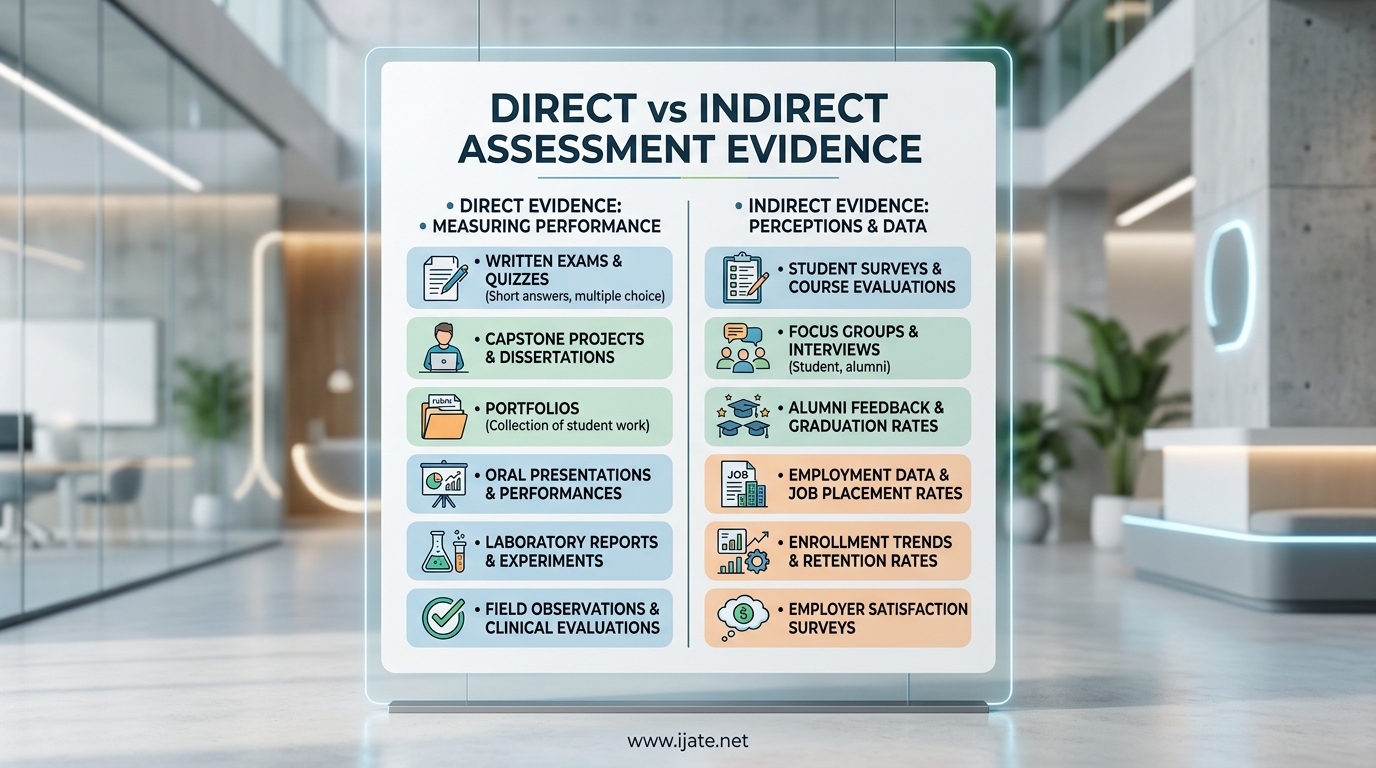
If you work in education, accreditation, or program evaluation, you have probably been asked to provide evidence of student learning. But not all evidence carries the same weight. Some shows exactly what a student can do, while other evidence hints at it through perception, opinion, or proxy measures. Knowing the difference between direct and indirect assessment evidence shapes how convincingly you can demonstrate learning outcomes to accreditors, faculty, and stakeholders.
Our team has spent years working with assessment data in higher education settings. We have seen well-meaning programs rely on student satisfaction surveys when they needed actual performance demonstrations, and we have seen others pile on standardized exams when a few focus groups would have explained why scores were dropping. The distinction matters because each type of evidence answers a different question, and accreditation reviewers expect to see both.
This guide breaks down what each type of evidence is, how to tell them apart, when to use each, and how to combine them for a more complete picture of learning. We also address the practical frustrations faculty face when implementing assessment plans, drawing on real conversations from educators in the field. Whether you are building an assessment plan from scratch or refining an existing one, understanding this distinction will make your evidence more credible and your reporting more compelling. For a broader perspective on evaluation frameworks in higher education, the limitations of popular models are worth understanding alongside your evidence strategy.
Table of Contents
Quick Answer: What Is the Difference Between Direct and Indirect Assessment Evidence?
Direct assessment evidence is tangible, visible, and measurable proof of what students have actually learned, demonstrated through tasks like exams, projects, portfolios, and performances that are evaluated against defined criteria.
Indirect assessment evidence is proxy information about learning, gathered through student self-reports, surveys, perceptions, or reflections that suggest learning has occurred but do not directly demonstrate it.
In short: direct evidence shows what students learned and how well, while indirect evidence suggests whether students believe they learned and offers clues about why. Both are valuable, but they answer fundamentally different questions about learning.
What Is Direct and Indirect Assessment Evidence?
The difference between direct and indirect assessment evidence comes down to one question: does the evidence show actual student performance, or does it point toward performance through inference? This single distinction determines how much weight the evidence carries in accreditation reviews, program improvement decisions, and institutional effectiveness reports.
Direct Assessment Evidence Defined
Direct assessment evidence is any artifact or observation that provides a firsthand look at what a student knows or can do. When you collect direct evidence, you are examining the actual product of student learning rather than asking someone what they think about it. A written exam, a research paper, a clinical skills demonstration, a capstone presentation, a coded software project, or a painting completed in a studio course all qualify as direct evidence.
The defining feature of direct evidence is that it requires students to demonstrate the targeted skill or knowledge in a measurable way. A faculty member or evaluator can look at the evidence and judge, against a rubric or scoring standard, exactly what level of proficiency the student has reached. This is why accreditation bodies consistently prioritize direct evidence as the most compelling proof of student learning.
Direct evidence is considered tangible because it exists as a product you can review, score, and compare. It is visible because the learning is observable in the work itself. And it is measurable because it can be evaluated against criteria using rubrics, scoring guides, or standardized benchmarks. These three qualities, tangibility, visibility, and measurability, are what make direct assessment evidence so powerful in program evaluation.
Indirect Assessment Evidence Defined
Indirect assessment evidence is information that suggests learning has occurred but does not directly demonstrate it. Instead of looking at student performance, you are looking at perceptions, opinions, self-reports, or proxy indicators that imply learning took place. A student survey asking whether learners feel confident in their research skills, an alumni questionnaire about career preparation, or attendance records at tutoring sessions are all forms of indirect evidence.
With indirect evidence, faculty must infer actual student competence from sources other than direct performance. The evidence does not show what students can do; it shows what students, employers, or others think students can do. This inference step is what makes indirect evidence less compelling on its own for proving learning outcomes.
That does not make indirect evidence weak or useless. Indirect measures provide context that direct measures cannot. They tell you whether students value what they learned, whether they feel prepared for the workforce, and what factors might be helping or hindering their progress. Without indirect evidence, you might know that students scored 78 percent on a clinical skills exam but have no idea why those scores are lower than expected or whether students feel prepared despite the numbers.
The Core Contrast in One Sentence
Direct evidence is the work itself. Indirect evidence is what people say about the work. Both are needed, but they serve different purposes in an assessment plan, and confusing one for the other weakens your ability to make claims about student learning.
Direct Assessment Evidence: A Deep Dive
Direct assessment involves measures that ask students to demonstrate the desired knowledge or skill in a concrete, observable way. These are the gold standard for proving what students have learned because they leave little room for interpretation about whether learning occurred. When a student writes a lab report, delivers a public speech, or solves a calculus problem on an exam, the evidence of their capability is right there in front of you.
The strength of direct evidence lies in its specificity. A well-designed direct assessment tied to a specific learning outcome can tell you not just whether a student passed, but exactly where their strengths and weaknesses lie. A rubric-scored research paper reveals whether a student can construct an argument, cite sources properly, synthesize literature, and write clearly. Each of these dimensions can be tracked separately across cohorts to identify curriculum-level patterns.
Characteristics of Strong Direct Evidence
Strong direct evidence shares several characteristics that distinguish it from weaker forms of assessment. First, it is aligned with clearly defined learning outcomes. A multiple-choice exam is only strong direct evidence if the questions map to the specific skills or knowledge the program claims to develop. Second, it is evaluated using consistent criteria, typically through rubrics or standardized scoring guides that multiple evaluators can apply reliably.
Third, strong direct evidence is authentic when possible. Authentic assessment asks students to perform tasks that mirror real-world professional or academic work rather than artificial test items. A nursing student taking vital signs on a simulated patient is more authentic than answering a multiple-choice question about vital signs, though both can be direct evidence. For programs working on standard-setting methods like the Angoff method, direct assessment results are what make it possible to establish meaningful performance benchmarks.
Examples of Direct Assessment Methods
The following list includes the most common and credible forms of direct assessment evidence used across educational programs. Each example requires students to produce work that can be evaluated against learning outcomes.
- Standardized exams and licensure tests that measure subject-area knowledge against national benchmarks
- Locally developed exams designed by faculty to assess program-specific learning outcomes
- Capstone projects that integrate learning from across a degree program into a single culminating work
- Portfolios containing a curated collection of student work developed and revised over time
- Rubric-scored term papers, research papers, and essays that evaluate specific writing and analytical skills
- Oral presentations and defenses evaluated by faculty panels using structured scoring guides
- Performances in the arts, such as recitals, exhibitions, theatrical productions, or studio critiques
- Clinical or practicum evaluations where supervisors assess hands-on professional skills in real settings
- Lab reports demonstrating scientific reasoning, methodology, and data interpretation
- Embedded assessments, where exam questions or assignments within regular coursework are scored separately for program assessment purposes
- Comprehensive exams required for graduation or advancement in graduate programs
- Performance-based assessments in professional fields, such as mock trials for law students or teaching demonstrations for education majors
When Direct Evidence Is Most Valuable
Direct evidence is most valuable when you need to make definitive claims about what students can do. Accreditation reviews, program reviews, and curriculum revision decisions all benefit from direct evidence because the claims are grounded in observable performance rather than perception. If your goal is to prove that 85 percent of graduates can write a persuasive argument supported by evidence, you need direct evidence such as rubric-scored essays to back that claim.
Direct assessment is also essential when you need to identify specific areas where students are struggling. Survey data might tell you that students feel unprepared in quantitative reasoning, but only a direct assessment like a standardized math exam or a data analysis project can pinpoint which specific quantitative skills are lacking. The analysis of test items and measurement validity is what transforms raw scores into actionable information about student learning.
Indirect Assessment Evidence: A Deep Dive
Indirect assessment measures provide signals about learning through perception, opinion, and proxy indicators rather than direct demonstration. While direct evidence shows what students can do, indirect evidence reveals how students experience their learning, whether they believe the program prepared them well, and what contextual factors might be influencing their performance. This type of evidence is gathered through self-report instruments and observational data that require interpretation.
The value of indirect evidence is often underestimated because it cannot independently prove that learning occurred. But indirect measures serve a critical complementary role. They help explain the story behind the direct evidence. If direct assessment scores are low in a particular area, indirect measures can help you understand why. Were students unmotivated? Did they feel the instruction was unclear? Did external obligations interfere with their learning? These are questions that direct evidence alone cannot answer.
Characteristics of Indirect Evidence
Indirect evidence is characterized by its reliance on self-report or proxy measurement. Students are asked about their learning rather than asked to demonstrate it. Employers are asked about graduate performance rather than being shown evidence of it. Focus groups gather perceptions about program quality. None of these methods produce tangible proof of learning, but all of them generate information that, when triangulated with direct evidence, deepens your understanding of the educational experience.
It is important to acknowledge that indirect evidence is subject to bias. Students may overestimate their abilities, a well-documented phenomenon known as the Dunning-Kruger effect. They may also report more positively than they genuinely feel if they fear consequences or want to please faculty. Employer surveys may reflect one person’s limited exposure to a graduate’s skills. Recognizing these limitations does not invalidate indirect evidence, but it does mean indirect measures should never be the sole basis for claims about student learning. For programs studying self-directed learning and self-assessment measurement, the gap between perceived and actual competence is an important consideration.
Examples of Indirect Assessment Methods
The following methods are the most widely used forms of indirect assessment evidence. Each provides contextual information about learning rather than direct proof of performance.
- Student self-assessment surveys asking learners to rate their own knowledge, skills, or confidence in targeted areas
- Course evaluation surveys measuring student satisfaction with instruction, materials, and overall learning experience
- Alumni surveys asking graduates to reflect on how well their program prepared them for careers or further study
- Employer surveys gathering feedback on the performance and preparedness of recent hires who graduated from the program
- Exit interviews conducted with graduating students to capture qualitative reflections on their educational experience
- Focus groups where students discuss their perceptions of program strengths and weaknesses in a guided group setting
- Graduation rates and retention rates used as proxy indicators of student success and program effectiveness
- Placement rates showing the percentage of graduates employed or enrolled in further education within a set timeframe
- Course enrollment and selection patterns suggesting student interest and engagement with specific topics
- Library usage statistics, tutoring center visits, and other engagement metrics used as proxy measures of student investment in learning
- Student reflections and journals where learners narrate their learning process and perceived growth over time
- Faculty observations reported through perception-based forms rather than structured performance evaluations
When Indirect Evidence Is Most Valuable
Indirect evidence shines when you need context, explanation, or stakeholder perspective that direct evidence cannot provide. If your direct assessment shows strong performance but alumni surveys reveal graduates feel unprepared for the workforce, that discrepancy is worth investigating. The indirect evidence has flagged a potential gap between academic performance and real-world readiness that direct evidence alone missed.
Indirect measures are also valuable for formative purposes during a program. Mid-semester feedback surveys can alert faculty to confusion or disengagement before it shows up on final exams. Focus groups conducted after a curriculum change can surface student concerns that quantitative measures would take longer to detect. The key is to treat indirect evidence as a complement to, not a replacement for, direct evidence.
Direct vs Indirect Assessment: A Side-by-Side Comparison
Understanding each type of evidence individually is important, but the real insight comes from seeing how they compare across key dimensions. The comparison below highlights the differences that matter most when designing an assessment plan.
Key Differences at a Glance
The most fundamental difference is tangibility. Direct evidence exists as a product you can hold, read, watch, or score. Indirect evidence exists as reported perceptions or proxy data that point toward learning without showing it. This tangibility gap is why accreditors prioritize direct evidence for making claims about what students have learned.
Another key difference is who provides the evidence. Direct evidence is produced by the student and evaluated by faculty or external reviewers using defined criteria. Indirect evidence is typically reported by students, alumni, or employers about their perceptions of learning. The source of the evidence affects its credibility and the types of claims you can make from it.
Actionability also differs. Direct evidence tells you exactly what students can and cannot do, making it highly actionable for curriculum changes. If 60 percent of students fail to properly cite sources on a rubric-scored paper, you know citation instruction needs attention. Indirect evidence is less directly actionable but more useful for understanding the broader context, such as whether students felt they received enough instruction on citation in the first place.
Comparison Summary
- Tangibility: Direct evidence is tangible and observable; indirect evidence is perceptual and inferred
- What it shows: Direct evidence shows what students learned and how well; indirect evidence shows whether students perceive they learned and why gaps might exist
- Who produces it: Students produce direct evidence through their work; students, alumni, and employers produce indirect evidence through self-report
- Evaluation method: Direct evidence uses rubrics, scoring guides, and standardized criteria; indirect evidence uses survey scales, qualitative coding, and descriptive statistics
- Strength for accreditation: Direct evidence is considered more compelling proof of learning; indirect evidence provides essential context and triangulation
- Actionability: Direct evidence pinpoints specific skill gaps; indirect evidence surfaces perceptions and contextual factors
- Best used for: Direct evidence proves outcomes were achieved; indirect evidence explains and contextualizes those outcomes
The Power of Triangulation
Using both direct and indirect evidence together creates a process called triangulation. Triangulation means drawing on multiple types of evidence to confirm findings and build a richer understanding of student learning. When direct and indirect measures point in the same direction, you can be more confident in your conclusions. When they diverge, the discrepancy itself becomes valuable information worth investigating.
Consider a scenario where a program’s direct assessment shows that 90 percent of students meet the benchmark on a capstone project rubric, but the alumni survey reveals that only 50 percent feel prepared for their first job. The direct evidence says learning outcomes are being met. The indirect evidence says something about the transition from academic to professional settings is not working as intended. Neither piece alone tells the full story, but together they reveal a gap worth addressing.
Triangulation also strengthens your position with accreditors. Reviewers expect to see both types of evidence because each compensates for the other’s limitations. Direct evidence without indirect context can feel mechanical and disconnected from the student experience. Indirect evidence without direct proof can feel anecdotal and unconvincing. Together, they present a layered, credible account of what students are learning and how they experience that learning.
How to Choose: A Decision Framework for Classifying Assessment Methods
One of the most common questions educators ask is how to classify borderline cases. Are course grades direct or indirect? What about peer review? Is a standardized test always direct evidence? The answer depends on two questions that cut through the ambiguity.
The Two-Question Classification Test
To classify any assessment method as direct or indirect, ask these two questions in order. The first question gets at the core distinction between demonstration and perception. The second question addresses whether the evidence captures the targeted skill specifically or bundles it with other factors.
Question 1: Does the method require students to demonstrate the targeted knowledge or skill? If the answer is yes, meaning students must actually perform the skill, produce work showing the skill, or answer questions testing the knowledge directly, then the method is likely direct. If the answer is no, meaning the method asks students to report on their learning or gathers proxy data, then the method is indirect.
Question 2: Does the evidence isolate the targeted skill, or does it blend multiple factors? This question matters because some methods technically require demonstration but mix so many factors that the evidence becomes indirect. Course grades are the classic example.
Borderline Case: Are Course Grades Direct or Indirect?
Course grades are one of the most debated classification questions in assessment. A grade in a writing course seems like direct evidence because the student wrote papers that were evaluated. But grades typically combine multiple factors, including attendance, participation, effort, extra credit, and grading leniency, that have nothing to do with the specific writing skill being assessed. Two students with identical writing ability could receive different grades based on participation alone.
For this reason, most assessment experts classify course grades as indirect evidence of specific learning outcomes. Grades may be direct evidence that a student completed a course, but they are indirect evidence of whether the student mastered a particular skill like argumentation or source integration. To get direct evidence of writing ability, you need rubric-scored writing samples evaluated independently of other course factors.
Borderline Case: Is Peer Review Direct or Indirect?
Peer review sits in a gray zone depending on how it is structured. If students evaluate peer work using a faculty-designed rubric and those evaluations are compared to faculty evaluations for calibration, the peer review process generates direct evidence about the work being reviewed. However, if peer review is used to gather student opinions about classmates’ performance without structured criteria, it functions as indirect evidence based on perception.
The classification depends on whether the peer review produces an evaluation grounded in observable criteria or an opinion grounded in impression. Structured, rubric-based peer review leans direct. Unstructured peer feedback leans indirect.
Practical Decision Framework
When in doubt, apply this simple framework. First, identify the specific learning outcome you are assessing. Second, determine whether the method asks students to demonstrate that outcome specifically. Third, check whether the evidence could be produced by a student who has not mastered the outcome due to confounding factors like effort, attendance, or perception bias. If confounding factors exist, the method is likely indirect regardless of whether it involves student work.
Common Challenges and Practical Solutions
Understanding the difference between direct and indirect assessment evidence is one thing. Implementing an assessment plan that uses both effectively is another challenge entirely. Based on conversations with faculty across higher education, several recurring frustrations deserve attention.
Challenge: Assessment Feels Like Bureaucratic Busywork
Many faculty members experience assessment as a compliance exercise rather than a meaningful improvement process. The paperwork can feel disconnected from actual teaching and learning. One professor described the shift from a simple question about how many students passed to a complex multi-page form that seemed designed to satisfy institutional reporting requirements rather than improve instruction.
The solution is to design assessment processes that are embedded in normal teaching activities rather than added on top of them. When direct assessment evidence comes from assignments students already complete as part of the course, and when indirect evidence is gathered through brief pulse surveys rather than lengthy end-of-semester forms, the assessment burden drops significantly. The goal is authentic, embedded assessment that serves double duty as both grading and program evidence.
Challenge: Faculty Resistance and Buy-In
Faculty resistance to assessment is often rooted in legitimate concerns about time, relevance, and respect for disciplinary expertise. When assessment requirements feel imposed from above without clear connection to teaching improvement, faculty push back. The perception that assessment teams exist to police rather than support teaching creates an adversarial dynamic that undermines the entire process.
Building buy-in requires shifting the conversation from compliance to curiosity. When faculty see assessment data that genuinely helps them understand and improve their teaching, resistance softens. This means assessment results need to be returned to faculty quickly, presented in usable formats, and connected to concrete decisions about curriculum and instruction. Assessment for improvement feels different from assessment for compliance, and faculty can tell the difference.
Challenge: Confusion About What Counts as Evidence
New faculty frequently ask what they should include in assessment reports. The confusion is understandable because the distinction between direct and indirect evidence is not always intuitive, and borderline cases like course grades create additional uncertainty. When expectations are unclear, faculty either over-report everything or under-report and miss key evidence.
Clear guidance documents, examples specific to each discipline, and ongoing professional development can address this challenge. A simple one-page reference showing examples of direct and indirect evidence relevant to the department, along with the two-question classification test, gives faculty a practical tool. Understanding the statistical foundations of assessment quality also helps faculty appreciate why certain types of evidence carry more weight than others.
Challenge: Balancing Breadth and Depth
Programs often struggle to decide how many assessment methods to use. Too few, and the evidence feels thin. Too many, and the reporting burden becomes unsustainable. There is no universal number, but a practical guideline is to maintain at least one strong direct measure and one complementary indirect measure for each major learning outcome. This minimum combination provides triangulation without overwhelming faculty.
Over time, programs can rotate which outcomes receive deep assessment attention each year rather than attempting to assess everything simultaneously. This cyclical approach keeps the workload manageable while ensuring every outcome receives periodic scrutiny through both direct and indirect lenses.
FAQs
What is direct and indirect evidence in assessment?
Direct evidence in assessment is tangible, visible proof of what students have actually learned, demonstrated through tasks like exams, projects, and performances that are evaluated against defined criteria. Indirect evidence is proxy information about learning, gathered through student self-reports, surveys, or perceptions, that suggests learning occurred but does not directly demonstrate it.
What is the difference between direct and indirect evidence?
The core difference is that direct evidence shows actual student performance while indirect evidence shows perceptions of performance. Direct evidence is tangible, measurable, and requires students to demonstrate skills or knowledge. Indirect evidence relies on self-report, opinion, or proxy indicators that require inference about whether learning actually occurred.
What is an example of a direct and indirect assessment?
A direct assessment example is a rubric-scored research paper where a faculty member evaluates a student’s actual writing and analytical work against defined criteria. An indirect assessment example is a student survey asking learners to rate their confidence in their research and writing skills without producing any actual work to demonstrate those skills.
What are examples of indirect assessment methods?
Common indirect assessment methods include student self-assessment surveys, course evaluation surveys, alumni surveys, employer feedback surveys, exit interviews, focus groups, graduation and retention rates, job placement rates, student reflection journals, and engagement metrics like library or tutoring center usage.
What are the 4 types of assessment methods?
The four broad categories of assessment methods are direct assessment, indirect assessment, formative assessment, and summative assessment. Direct and indirect refer to the type of evidence collected, while formative and summative refer to when and why the assessment is used. Formative assessment happens during learning to guide improvement, and summative assessment happens at the end to evaluate final achievement.
What is the difference between direct and indirect data collection?
In assessment, direct data collection means gathering primary evidence of student performance through exams, projects, or observations. Indirect data collection means gathering secondary or proxy information through surveys, interviews, or self-reports. In research more broadly, direct data collection involves gathering original data firsthand while indirect data collection uses existing secondary sources.
Conclusion: Putting It All Together
The difference between direct and indirect assessment evidence is not just an academic distinction. It is a practical framework for building credible, complete, and useful evidence of student learning. Direct evidence proves what students can do through tangible performance. Indirect evidence contextualizes that performance through perception, experience, and proxy data. Together, they create a fuller picture than either could alone.
As you refine your assessment plan, start by identifying the learning outcomes that matter most to your program. For each outcome, identify at least one strong direct measure and one complementary indirect measure. Use the two-question classification test when borderline cases arise, and remember that course grades, while useful for many purposes, are generally indirect evidence of specific learning outcomes. The goal is not to maximize the volume of evidence but to choose the right types of evidence for the questions you are trying to answer.
Most importantly, keep assessment connected to genuine improvement. The best assessment plans are the ones that produce insights faculty actually want to use. When direct and indirect evidence work together to reveal both what students are learning and why, assessment becomes a tool for curiosity rather than compliance. That shift in framing makes all the difference in building a culture where assessment is valued by the people who do the teaching.