
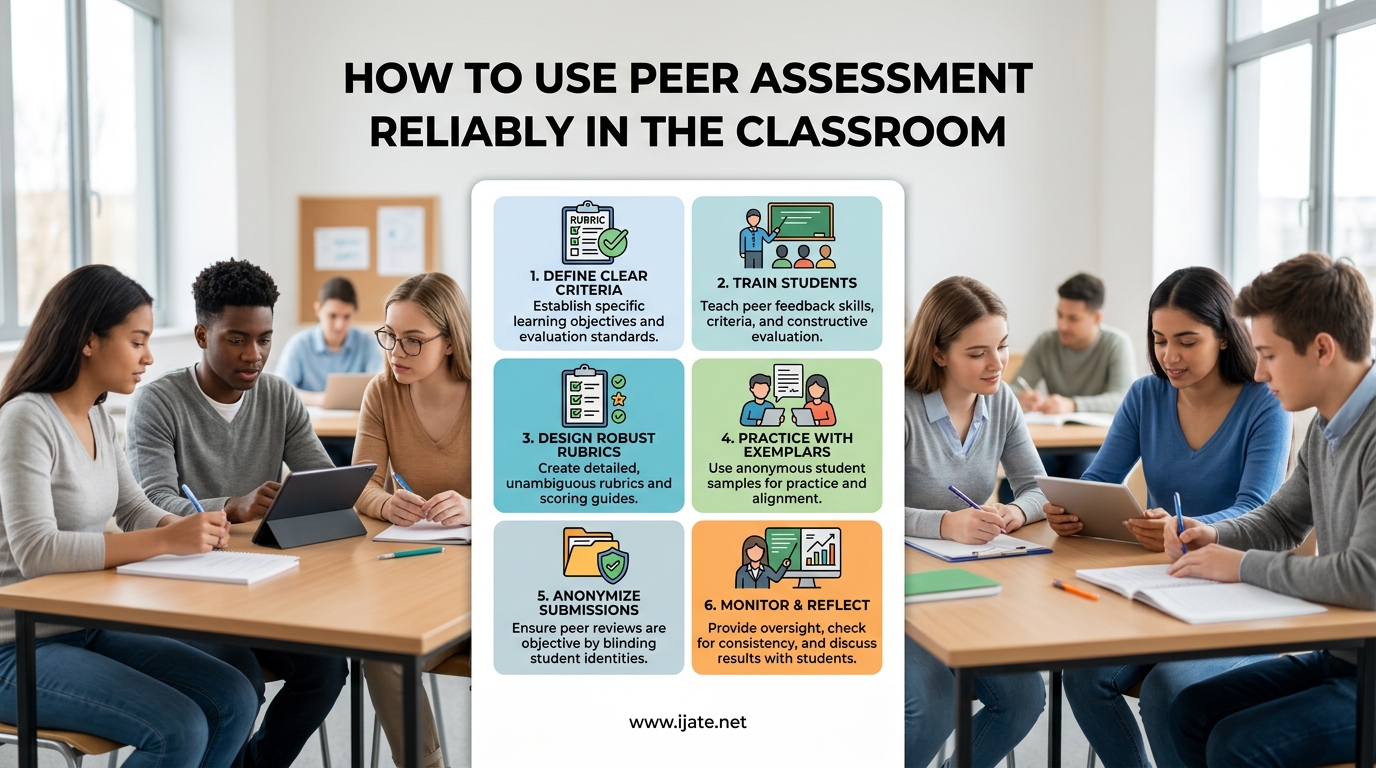
Peer assessment has become a staple of modern teaching, but most teachers skip the one step that makes it work. Without clear protocols and structured rubrics, peer assessment produces inconsistent grades, hurt feelings, and wasted class time. This guide shows you exactly how to use peer assessment reliably in the classroom, from designing rubrics to handling the social dynamics that derail even the best-planned activities. Whether you teach primary school or university-level courses, the strategies below will help you turn peer feedback into a dependable tool for student learning.
Table of Contents
Quick Overview
Using peer assessment reliably in the classroom requires four core elements: well-defined criteria, structured training for students, anonymity where appropriate, and ongoing calibration of the process. When these pieces are in place, peer assessment becomes one of the most powerful strategies available for developing critical thinking and metacognitive skills in students.
Peer assessment works best when teachers treat it as a skill to be taught, not an activity to assign. Students need modelling, practice, and clear expectations before they can evaluate each other’s work with any degree of consistency. Teachers who invest time in building these foundations report higher-quality feedback, stronger student buy-in, and significantly reduced grade inflation.
What Is Peer Assessment and Why Reliability Matters
Peer assessment is a process where students evaluate and provide feedback on each other’s work using agreed-upon criteria. It is also known as peer feedback, peer review, or peer evaluation, depending on the context. Unlike self-assessment, which relies on a student’s own judgment, peer assessment draws on multiple perspectives to create a more balanced picture of learning quality.
Reliability in peer assessment means that different reviewers produce similar scores for the same work, and that the process yields consistent results over time. Without reliability, peer assessment becomes a guessing game where grades fluctuate based on who happens to review a student’s paper rather than on the quality of the work itself. This matters because unreliable assessment undermines trust in the entire grading system.
Assessment for learning theory, also called formative assessment, positions peer assessment as a tool for improving student understanding rather than just measuring it. When peer feedback is reliable, students receive actionable information they can use to revise their work. When it is not, they receive confusing mixed signals that can actually harm learning outcomes.
Key Benefits of Reliable Peer Assessment
Reliable peer assessment delivers measurable benefits across multiple dimensions of classroom learning. Students who engage with structured peer review show deeper understanding of assessment criteria because they must apply success criteria to real examples before internalizing them. This process builds metacognitive skills that transfer to independent work.
From a teacher workload perspective, reliable peer assessment distributes the feedback burden across the entire class. A single instructor reviewing thirty essays produces one set of comments. Thirty students reviewing each other’s essays produce thirty sets of comments, giving each student multiple perspectives on their work. The key word here is reliable, because inconsistent peer feedback creates more problems than it solves.
Critical thinking improves when students must analyze a peer’s work against objective criteria. They learn to identify strengths and weaknesses, justify their judgments with evidence, and distinguish between surface-level errors and deeper conceptual problems. These skills carry over into their own writing and revision processes.
Common Reliability Challenges and How to Overcome Them
Grade inflation is the most frequently reported reliability problem in peer assessment. Students consistently rate their peers higher than instructors would, sometimes by a full grade level or more. This happens because students want to be liked, they hesitate to criticize, or they simply lack the expertise to identify deeper weaknesses. Research on assessment reliability confirms that peer scores tend to cluster near the top of any scale without structured calibration.
Friendship bias produces another layer of inconsistency. Students give higher scores to friends and lower scores to rivals, even when the rubric is explicit. This bias operates below conscious awareness for most students, which makes it difficult to address through simple warnings. Diversifying reviewer pools and using anonymity are the most effective countermeasures.
Lazy feedback occurs when students treat peer review as a checkbox activity. A comment like “good job” or “fix grammar” provides no actionable information for the writer. This problem stems from unclear expectations, insufficient training, and the absence of consequences for low-effort feedback. Teachers can combat it by requiring specific feedback elements and reviewing feedback quality before returning it to the original author.
Time constraints push teachers to rush the implementation process. Peer assessment that is introduced without adequate preparation consumes more time in the long run because teachers must repeatedly correct unreliable grades and mediate disputes. The initial investment in training and rubric design pays off within two to three assessment cycles.
Step-by-Step Implementation Guide
Start by introducing the purpose of peer assessment before assigning any review task. Explain to students why peer feedback matters, how it connects to their learning goals, and what they can expect to gain from the process. Students who understand the rationale participate more seriously than those who see peer review as busywork.
Design your rubric before you introduce the activity. A clear rubric with specific criteria and descriptors eliminates most sources of inconsistency. Share the rubric with students and walk through examples together before anyone begins reviewing. Model the process by reviewing a sample piece of work aloud, thinking through each criterion in front of the class.
Run a practice round using a deliberately crafted sample. Give students a short anonymous piece of writing to review using the full rubric. Collect their scores and feedback, then compare the range of scores they produced. If the spread is wide, use this as a teaching moment to discuss why different reviewers reached different conclusions and how to apply criteria more consistently.
Assign peer reviews with structured pairings. Decide whether students will review work from peers in their own group, from another group, or from a random pool. Each approach has trade-offs. Same-group reviewers understand the context but may be influenced by friendship dynamics. Cross-group reviewers reduce bias but may miss contextual details. Random assignments maximize fairness but can feel impersonal.
Review the feedback before returning it to authors. Scan comments for quality and tone. Flag feedback that is unhelpful, overly harsh, or violates classroom norms. You do not need to grade the peer feedback, but you should quality-check it. This step signals to students that their feedback matters and that low-effort comments will not pass through.
Give students time to act on the feedback they receive. Peer assessment only becomes assessment for learning when students can apply the suggestions. Build revision time into your schedule and ask students to submit a brief reflection on how they used the feedback. This closing loop transforms peer assessment from a grading exercise into a genuine learning experience.
If you are exploring digital tools for peer review, research on digital peer assessment platforms shows that online systems can improve consistency through automated scoring reminders and structured comment prompts. The Facebook as a Peer-Assessment Platform case study from ijate offers a practical example of how digital environments can support structured feedback in visual arts education.
Building and Using an Effective Feedback Rubric
A rubric is the backbone of reliable peer assessment. Without explicit criteria, every student applies their own invisible standard, and the resulting scores are incomparable. A well-designed rubric defines what good work looks like at multiple levels of performance, giving reviewers concrete anchors for their judgments.
Start with three to five criteria that directly reflect your learning objectives. If you are assessing a research essay, useful criteria might include thesis clarity, evidence use, organization, and writing mechanics. If you are evaluating an oral presentation, criteria might cover content accuracy, visual design, delivery, and response to questions. Each criterion should map to something you have taught and that students can recognize in each other’s work.
Write descriptors for each performance level, not just labels. A scale of “excellent, proficient, developing, beginning” is useless without descriptions that tell reviewers what to look for at each level. Effective descriptors use specific, observable language. Instead of “good organization,” write “the introduction states a clear thesis, each paragraph has a topic sentence, and transitions guide the reader between sections.”
Keep the rubric concise enough that students can use it in a single sitting. A rubric that spans multiple pages will not be read carefully. Aim for one page with clear headings and bullet points. Test it yourself by applying it to a real piece of student work before releasing it to the class.
| Criterion | Excellent (4) | Proficient (3) | Developing (2) | Beginning (1) |
|---|---|---|---|---|
| Thesis clarity | Clear, arguable, specific | Clear but slightly broad | Unclear or obvious | Missing or unfocused |
| Evidence use | Multiple relevant sources, well integrated | Relevant sources, adequate integration | Limited or weakly integrated sources | Little or no supporting evidence |
| Organization | Logical flow, smooth transitions | Clear structure, basic transitions | Some organizational problems | Disorganized or difficult to follow |
| Writing mechanics | Nearly flawless grammar and style | Minor errors, does not impede meaning | Frequent errors, occasionally impedes meaning | Persistent errors that impede meaning |
The sample rubric above illustrates a four-level scale applied to essay assessment. You can adapt this template by replacing the criteria with those relevant to your specific assignment type. The key is specificity at every level.
Training Students to Give Constructive Feedback
Most students have never received formal training in how to give feedback. They default to vague praise or harsh criticism because those are the modes they have observed in media and casual conversation. Training students to give constructive feedback is therefore not optional if you want reliable peer assessment.
Begin by modelling the process. Take a sample piece of student work and evaluate it aloud using the rubric. Narrate your thinking: “I am giving this a 3 on thesis clarity because the argument is present but it would be stronger if the author addressed the counterargument in the second paragraph.” Students need to hear the internal dialogue of a competent reviewer.
Use scaffolding to gradually release responsibility. In the first round, have students work in pairs to complete the rubric together. In the second round, have them complete it individually and then compare scores with a partner. In the third round, have them review independently and discuss any scoring discrepancies. This progression builds confidence and skill without throwing students into the deep end.
Teach the language of constructive feedback. Provide sentence starters that help students frame their comments productively. “One strength of this work is…” and “A suggestion for improvement would be…” give students a safe structure for delivering both positive and developmental comments. Role-play exercises can help students practice tone and phrasing before they apply these skills to real peer work.
Close the loop by asking students to reflect on the feedback they received. A brief written response such as “What is one piece of feedback you plan to act on, and how?” reinforces the connection between receiving feedback and improving work. This step also gives you insight into whether the peer feedback was clear enough to act on.
Handling Social Dynamics: Bias, Friendships, and Classroom Culture
The friend-enemy dynamic is real in peer assessment, and most teachers underestimate its impact. Students give systematically higher scores to friends and lower scores to perceived rivals, even when using identical rubrics. This bias is not necessarily malicious, but it destroys reliability. Anonymity is the most effective immediate remedy, as it removes the social context that triggers biased judgments.
Build a supportive assessment culture before introducing peer review. Students who feel safe in the classroom are more likely to give honest, balanced feedback. Establish norms that separate the person from the work, emphasize growth over fixed ability, and frame feedback as a gift rather than a judgment. These norms take time to establish but they pay dividends across every classroom activity, not just peer assessment.
Diversify reviewer assignments to disrupt cliques and prevent the same small group from always evaluating each other. Rotating reviewer pools means that any single biased review has less impact on the final score. Some teachers use software to randomize assignments, while others manually control the rotation to ensure that each student receives feedback from multiple perspectives.
Address discomfort directly. Some students feel anxious about evaluating peers or having their work evaluated by classmates. Acknowledge this discomfort openly, explain the safeguards you have put in place, and remind students that the goal is learning, not judgment. Research on supportive assessment practices shows that transparency about the purpose and process significantly reduces student anxiety. The supportive assessment practices research published by ijate provides a useful framework for understanding how classroom culture shapes assessment outcomes.
When to Use Peer Assessment: A Decision Framework
Peer assessment is not appropriate for every task. Using it reliably means knowing when it will work and when it will backfire. The following framework helps you make that decision based on five evidence-based questions drawn from current educational research.
| Question | Green Light | Red Light |
|---|---|---|
| Are students ready to provide meaningful feedback? | They have practised with the rubric and received modelling | This is their first peer review with no preparation |
| Are the stakes low enough? | Peer feedback is formative with revision time built in | Peer grades count heavily toward final marks |
| Is there time to act on the feedback? | Revision or follow-up tasks are scheduled | This is an end-of-term evaluation with no revision option |
| Is there sufficient class time? | Two to three sessions are allocated for review and discussion | The activity is squeezed into a five-minute slot |
| Is the classroom culture supportive? | Trust and respectful norms are established | There is a history of conflict or public embarrassment |
If you answer red to any of these questions, adjust your approach before proceeding. For example, if stakes are too high, decouple the peer feedback from the grade by using it solely as a revision tool. If students are not ready, invest in a practice round before the real assessment. Skipping these foundations is the single most common reason peer assessment fails.
Peer assessment excels in specific contexts. Draft review in writing courses, group project evaluation, retrieval practice quizzes, and oral presentation feedback all benefit from the multiple-perspective approach. End-of-term summative evaluations with no opportunity for revision are poor candidates for peer assessment because students cannot act on the feedback, making the process feel performative rather than useful.
Peer Assessment vs Self-Assessment vs Teacher Feedback
Understanding the trade-offs between peer assessment, self-assessment, and teacher feedback helps you choose the right approach for each learning situation. No single method is universally superior, but each has distinct strengths and limitations.
| Dimension | Peer Assessment | Self-Assessment | Teacher Feedback |
|---|---|---|---|
| Reliability | Moderate to high with training and rubrics | Low to moderate without calibration | High with consistent marking criteria |
| Learning value | Very high: students learn by evaluating others | High: develops self-reflection skills | Moderate: students receive but do not evaluate |
| Workload | Low for teacher, high for students | Minimal teacher involvement | High for teacher |
| Scalability | Excellent for large classes | Excellent for any class size | Difficult beyond 30-40 students |
| Best use case | Draft reviews, group projects, practice tasks | Reflection, self-regulated learning | Final grading, complex qualitative evaluation |
Many teachers combine all three methods for maximum impact. A typical sequence begins with self-assessment, moves to peer assessment for formative feedback, and concludes with teacher feedback on the revised work. This layered approach gives students multiple perspectives while maintaining reliability at the final grading stage.
Monitoring and Adjusting Peer Assessment Over Time
Implementing peer assessment reliably is not a one-time setup. You need to monitor the quality of feedback, the consistency of scores, and student attitudes across multiple cycles. Calibration exercises at the start of each semester help reviewers align their interpretations of the rubric.
Compare peer scores to teacher scores periodically. A simple scatterplot or correlation analysis will reveal whether peer reviewers are applying criteria consistently. If the correlation drops below 0.6, revisit your rubric design and retrain students. If peer grades consistently run higher than teacher grades, adjust the rubric language or introduce blind calibration tasks.
Collect student feedback on the peer assessment process. Ask students what worked, what confused them, and what they would change. Their responses often reveal usability problems that invisible to the instructor. A student who says “I did not know whether to comment on ideas or grammar” is telling you that your rubric criteria need clarification.
Feedback on feedback is a powerful refinement tool. After students receive peer comments, ask them to rate the helpfulness of each comment on a simple scale. Aggregate these ratings to identify which types of feedback students find most and least useful. Over time, this data helps you coach students toward the feedback patterns that actually support learning.
Related assessment research in education emphasizes the importance of validity alongside reliability. A process can be consistent without being accurate, so periodically check that your peer assessment is measuring what you intend to measure.
Frequently Asked Questions
What is peer assessment in the classroom?
Peer assessment is a process where students evaluate and provide feedback on each other’s work using shared criteria. It is also called peer feedback or peer review, and it helps students develop critical thinking skills while reducing the teacher’s feedback workload.
How can I make peer assessment more reliable?
Use a detailed rubric with specific descriptors, train students with practice rounds, diversify reviewer assignments, use anonymity where appropriate, and calibrate scores by comparing peer and teacher ratings. Review feedback quality before returning it to authors.
Is peer assessment actually reliable?
Research shows that peer assessment can achieve moderate to high reliability when teachers invest in training, rubrics, and anonymity. Without these structures, peer scores tend to inflate and vary widely between reviewers.
How do you prevent bias in peer assessment?
Use anonymous review assignments, rotate reviewer pools to disrupt friendship cliques, and discuss bias openly with students. Diversifying the set of reviewers for each piece of work reduces the impact of any single biased judgment.
When should I avoid using peer assessment?
Avoid peer assessment when stakes are very high, when students have not been trained, when there is no time for revision, or when the classroom culture lacks trust. Use the decision framework in this guide to evaluate your specific context.
Conclusion
Using peer assessment reliably in the classroom is less about the peer review activity itself and more about the systems you build around it. A detailed rubric, structured student training, anonymous assignments, and a supportive classroom culture together create the conditions where peer feedback becomes consistent, actionable, and genuinely useful for learning. Teachers who master these elements find that peer assessment reduces their workload while deepening student engagement. Start small with a single well-designed task, refine your approach based on what you observe, and expand the practice as your confidence grows. Over time, reliable peer assessment becomes one of the most impactful tools in your teaching repertoire.