
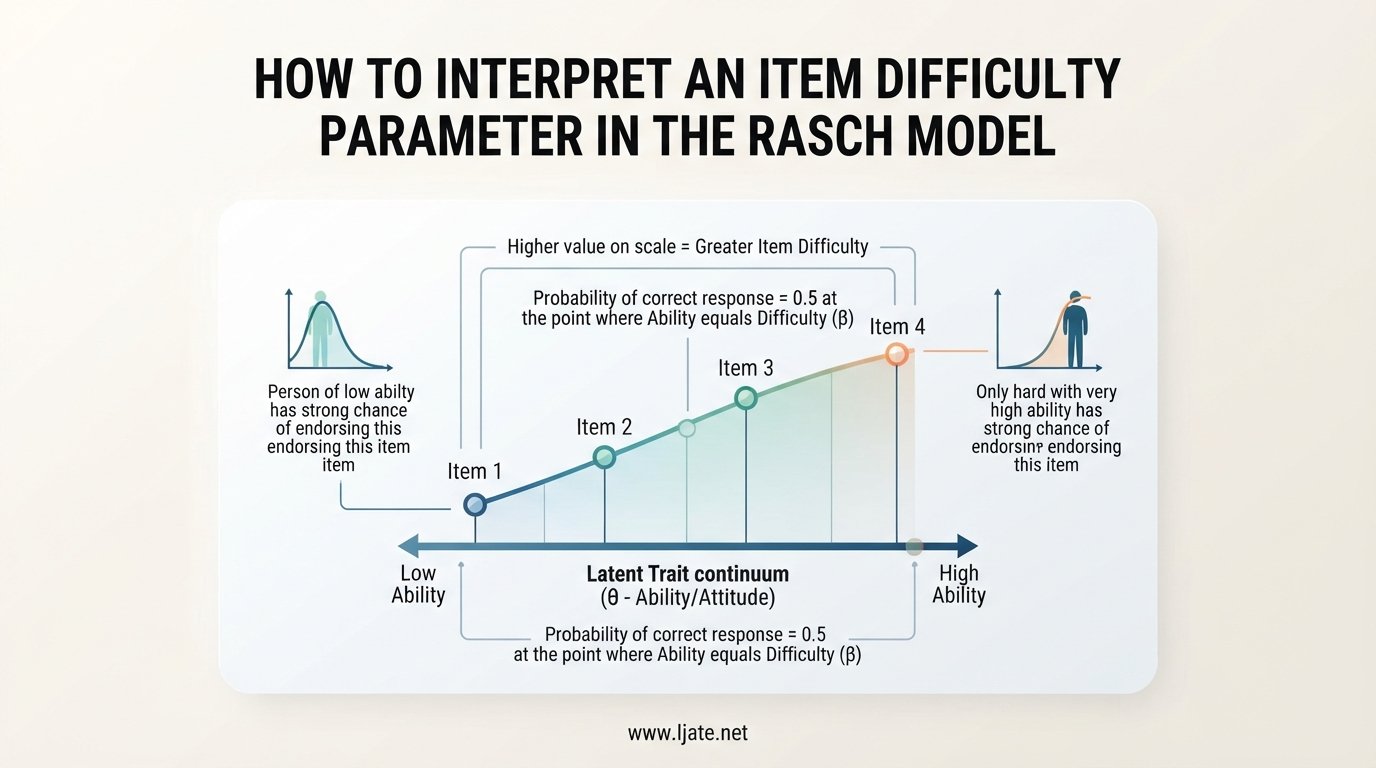
If you have ever built a test or a questionnaire and wondered whether all your items measure with equal precision, you have already stepped into the debate between the Rasch model and 2PL IRT. The difference between the Rasch model and 2PL IRT comes down to one parameter: whether item discrimination is fixed or allowed to vary. That single distinction shapes everything from the math to the philosophy of measurement.
Researchers in psychometrics, educational testing, and health outcomes measurement encounter this choice regularly. Pick the Rasch model and you get clean, invariant measurement but strict assumptions. Pick the 2PL model and you get better statistical fit but lose a property called specific objectivity.
In this guide, we break down both models from the ground up. You will see the mathematical formulas, understand the item characteristic curves, learn the philosophical divide, and walk away with a practical step-by-step process for choosing between them.
Table of Contents
Item Response Theory: The Shared Foundation
Item Response Theory (IRT) is a family of mathematical models that describe the relationship between a person’s latent trait and their probability of answering an item correctly. The latent trait, often called theta (theta), represents whatever the test measures: reading ability, anxiety level, physical function, or any other unobservable construct.
Both the Rasch model and 2PL IRT belong to this family. They share three core assumptions.
Unidimensionality means a single latent trait explains the responses. If your test mixes reading comprehension and math reasoning, neither model applies cleanly to the full instrument.
Local independence means that once you account for theta, responses to different items are statistically unrelated. A person’s answer to item 3 should not depend on their answer to item 7 beyond what theta already explains.
Monotonicity means that higher ability always leads to a higher probability of a correct response. The probability never goes down as theta increases.
Given these shared assumptions, the divergence between Rasch and 2PL is purely about how each item relates to the latent trait. That relationship is governed by item parameters, and this is where the two models part ways.
The Rasch Model: One Parameter, Strong Assumptions
The Rasch model, developed by Danish mathematician Georg Rasch in 1960, uses a single parameter per item: difficulty, denoted b. The probability of a correct response is calculated as:
P(X = 1) = exp(theta – b) / (1 + exp(theta – b))
In this formula, theta is person ability and b is item difficulty. When a person’s ability exactly equals the item’s difficulty, the probability of a correct answer is 0.50. The item difficulty parameter b represents the theta value at which the probability of success is 50 percent.
Notice what is missing: there is no discrimination parameter. The Rasch model implicitly fixes discrimination at 1 for every item. Every item has the same slope on its item characteristic curve (ICC).
This produces a distinctive visual signature. When you plot ICCs for multiple Rasch-calibrated items, the curves are all parallel. They never cross. A harder item simply shifts its curve to the right, but the shape stays identical.
This constraint is what gives the Rasch model its most celebrated property: specific objectivity. Because every item discriminates equally, comparisons between any two persons are independent of which items were used, and comparisons between any two items are independent of which persons responded. The measurement scale is invariant.
The trade-off is rigidity. Real-world data rarely cooperate with the assumption that all items discriminate equally. Items that are ambiguously worded, poorly targeted, or measure a slightly different facet will violate this constraint, and the Rasch model offers no flexibility to accommodate them. Researchers using Rasch must either drop misfitting items or revise them until they conform.
As one forum contributor on r/psychometrics put it: “Rasch modeling makes very strong assumptions about the behavior of your items. It is a strong measurement model for use when you really need invariant measurement.” Another user recommended starting with Rasch “since it is simpler than some more complex IRT models” before exploring more flexible alternatives.
The 2PL IRT Model: Adding Flexibility
The 2PL (two-parameter logistic) IRT model, developed by Frederick Lord and Allan Birnbaum, adds a second parameter per item: discrimination, denoted a. The probability formula becomes:
P(X = 1) = exp[a(theta – b)] / (1 + exp[a(theta – b)])
The discrimination parameter a controls how steeply the probability changes around the item’s difficulty point. A high a-value means the item sharply distinguishes between people above and below the difficulty threshold. A low a-value means the item is a weak differentiator.
This added flexibility has a direct visual consequence. When you plot ICCs for 2PL-calibrated items, the curves have different slopes and they intersect. Two items with the same difficulty but different discrimination values will agree on who is more likely to pass only at one specific point on the theta scale. Above and below that point, they tell different stories.
The practical benefit is better data fit. Real test items naturally vary in how well they discriminate. The 2PL model captures this variation rather than forcing it away. This typically results in higher overall model fit statistics compared to the Rasch model on the same dataset.
The cost is the loss of specific objectivity. Because items discriminate differently, the comparison between two persons now depends on which items you choose. A person might look more able on a set of high-discrimination items and less able on a set of low-discrimination items, even if their underlying theta is the same.
For many researchers, this is an acceptable trade. In large-scale educational testing, where the goal is accurate scoring rather than philosophical purity, the 2PL model is often the default choice. It describes the data as it is, without imposing a measurement ideal.
Key Differences Between the Rasch Model and 2PL IRT
The Rasch model vs 2PL IRT comparison can be understood through several interconnected differences. Let us walk through each one.
1. The Discrimination Parameter: Fixed vs Free
This is the single mathematical difference. The Rasch model fixes a = 1 for all items. The 2PL model estimates a freely for each item. Every other difference cascades from this one constraint.
Because of this, the Rasch model is sometimes called the 1PL (one-parameter logistic) model. However, there is a subtle distinction worth noting: the Rasch model is a specific measurement model with philosophical foundations, while the 1PL IRT is the statistical formulation of the same equation. They produce identical results mathematically but carry different interpretive frameworks.
2. Specific Objectivity vs Statistical Fit
Georg Rasch did not design his model to fit data. He designed it to produce measurement with a specific property: that item comparisons and person comparisons are separable and invariant. This property, specific objectivity, is the defining feature of Rasch measurement.
The 2PL model abandons specific objectivity in exchange for better fit. When items genuinely discriminate at different rates, the 2PL model captures that reality. The Rasch model either forces those items into an equal-discrimination framework or rejects them as misfitting.
This is why the debate is often framed as philosophical versus statistical. Rasch practitioners ask: “Does my data meet the requirements for fundamental measurement?” 2PL practitioners ask: “Which model best describes my data?”
3. The Nested Model Relationship
The Rasch model is nested within the 2PL model. This means the Rasch model is a special case of the 2PL where all discrimination parameters are constrained to 1. This nesting has a useful statistical consequence: you can formally test whether the 2PL fits significantly better than the Rasch model using a likelihood-ratio test.
The likelihood-ratio test compares the log-likelihood of both models. The test statistic is calculated as -2 times the difference in log-likelihoods, and it follows a chi-square distribution with degrees of freedom equal to the number of additional parameters in the 2PL model (the number of items minus one, since one discrimination parameter is fixed as the reference).
If the test is not significant, the Rasch model is sufficient. The added complexity of the 2PL is not justified. If the test is significant, the 2PL model fits meaningfully better, and you have statistical evidence that items discriminate at different rates.
4. Parallel vs Intersecting ICCs
Item characteristic curves tell the visual story. In the Rasch model, ICCs are parallel curves that never intersect. Every item has the same shape, just shifted along the theta axis by its difficulty.
In the 2PL model, ICCs intersect. Items with higher discrimination rise more steeply, creating crossover points. As the Rasch measurement community at rasch.org notes, this means “there is a different Rasch item difficulty for each item for each level of person ability” when discrimination varies. The ordering of item difficulty changes depending on where you stand on the ability scale.
5. Sample Size Requirements
The Rasch model, with fewer parameters, generally requires smaller samples for stable estimation. A common guideline is 100 to 250 persons for dichotomous Rasch analysis, though more is always better.
The 2PL model needs larger samples because it estimates an additional parameter per item. Guidelines typically suggest 250 to 500 persons minimum, with larger samples needed as the number of items grows. With small samples, the discrimination estimates become unstable, and the added flexibility of the 2PL can produce overfitting.
Rasch vs 2PL Side-by-Side Comparison
The table below summarizes the core distinctions. Use it as a quick reference when explaining the difference between the Rasch model and 2PL IRT to colleagues or students.
| Feature | Rasch Model | 2PL IRT Model |
|---|---|---|
| Item parameters | Difficulty only (b) | Difficulty (b) and discrimination (a) |
| Discrimination | Fixed at 1 for all items | Estimated freely per item |
| ICCs | Parallel, non-intersecting | Variable slopes, intersecting |
| Specific objectivity | Yes, by design | No |
| Nested within 2PL | Yes (special case) | General model |
| Model comparison | Use likelihood-ratio test | Reference model |
| Minimum sample size | 100 to 250 persons | 250 to 500 persons |
| Philosophical goal | Fundamental measurement | Best statistical description |
| Handling misfitting items | Revise or drop items | Model the variation |
| Typical use cases | High-stakes certification, instrument validation, item banking | Large-scale testing, adaptive testing, survey scoring |
| Software examples | Winsteps, RUMM, FACETS | IRTPRO, flexMIRT, mirt (R) |
When to Use the Rasch Model vs 2PL IRT
Choosing between the Rasch model and 2PL IRT is part statistics and part philosophy. Here is a step-by-step process our team recommends for making the decision.
Step 1: Define your measurement goal. If your primary goal is building a measurement instrument with invariant properties, where scores mean the same thing regardless of which items are administered, lean toward Rasch. If your goal is describing the data as accurately as possible with minimal assumptions about item behavior, lean toward 2PL.
Step 2: Check your sample size. If you have fewer than 250 respondents, the 2PL model’s discrimination estimates may be unstable. The Rasch model is the safer choice for small samples. With 500 or more respondents, both models are viable, and you can use formal model comparison.
Step 3: Fit both models and run a likelihood-ratio test. Because the Rasch model is nested within the 2PL, you can compare them directly. Fit both models to the same data and compute the likelihood-ratio test. If the result is non-significant, the Rasch model is sufficient and you gain the benefit of specific objectivity. If significant, the 2PL provides meaningfully better fit.
Step 4: Examine item fit and discrimination estimates. Even if the likelihood-ratio test favors 2PL, look at the individual discrimination parameters. If most items have a-values close to 1 with minor variation, the practical difference between models is small. If some items have dramatically different discrimination, the 2PL is capturing real structural differences in your items.
Step 5: Consider your validation requirements. For patient-reported outcome measures, certification exams, and any context where measurement invariance is legally or scientifically required, the Rasch model’s specific objectivity is a major advantage. For exploratory research, large-scale operational testing, or contexts where fit is prioritized over invariance, the 2PL model is often preferred.
As a Reddit user on r/psychometrics explained: “Rasch scaling is the way I need to go” when invariant measurement is the priority, while non-Rasch IRT techniques like 2PL and 3PL are “statistical models that deliberately make fewer assumptions about item behavior.” Both perspectives are valid, depending on your research question.
For beginners, another forum contributor recommended “starting with the Rasch model since it is simpler than some more complex IRT models.” The community-standard textbook “Applying the Rasch Model” by Trevor Bond and Christine Fox is frequently cited as the clearest entry point.
Quick Decision Guide
Use the Rasch model when: sample size is limited, specific objectivity is required, you are building an item bank for computer-adaptive testing, or you need cross-form linking and score comparability across different test forms.
Use the 2PL model when: sample size is adequate (250+), items are expected to discriminate at different rates, you prioritize statistical fit over measurement philosophy, or you are working in a large-scale operational testing program where the 2PL is the institutional standard.
Beyond Rasch and 2PL: The Broader IRT Family
The Rasch and 2PL models are not the only options. The 3PL model adds a guessing parameter c, which accounts for the probability that low-ability respondents answer correctly by chance. This is common in multiple-choice educational testing where guessing is a realistic behavior.
For polytomous data (items with more than two response categories), the Partial Credit Model and Rating Scale Model extend the Rasch framework, while the Graded Response Model and Generalized Partial Credit Model extend the 2PL framework. The same philosophical divide applies: the Rasch-family polytomous models preserve specific objectivity, while the IRT-family models prioritize fit.
Understanding the Rasch vs 2PL distinction makes it easier to navigate these more complex models. The core tension, fixed versus free discrimination, scales up to every member of the IRT family.
Common Mistakes When Comparing Rasch and 2PL
Several misconceptions appear repeatedly in forum discussions and even in published research. Avoiding these will sharpen your understanding.
Mistake 1: Treating Rasch and 1PL as completely different things. Mathematically, the Rasch model and the 1PL IRT model produce identical results. The difference is interpretive: Rasch is a measurement model with philosophical commitments, while 1PL is a statistical model. Practitioners in the Rasch tradition emphasize specific objectivity and fundamental measurement; those in the IRT tradition treat the 1PL as a constrained version of the 2PL.
Mistake 2: Choosing a model based only on fit statistics. Lower AIC or BIC values for the 2PL do not automatically mean it is the right choice. If specific objectivity matters for your application, the Rasch model’s fit may be “good enough” and its measurement properties make it preferable despite slightly worse fit indices. Fit is one criterion, not the only criterion.
Mistake 3: Ignoring the assumptions. Both models require unidimensionality, local independence, and monotonicity. A model comparison between Rasch and 2PL is meaningless if these assumptions are severely violated. Always check dimensionality (via factor analysis or PCA of residuals) and local independence before fitting either model.
Mistake 4: Assuming more parameters means a better model. The 2PL model has more parameters, but this means it is more complex, not necessarily better. Overfitting is a real risk, especially with smaller samples. The likelihood-ratio test exists precisely to determine whether the added complexity is justified.
FAQs
What is the difference between Rasch and IRT?
The Rasch model is a specific type of Item Response Theory model that fixes item discrimination at 1 for all items, ensuring specific objectivity. IRT is the broader family of models that includes the Rasch model, the 2PL model with free discrimination, and the 3PL model with a guessing parameter. In practice, when people say ‘IRT’ they often mean the 2PL or 3PL models, while ‘Rasch’ refers to the one-parameter approach.
What is the IRT 2PL model?
The 2PL (two-parameter logistic) IRT model estimates two parameters per item: difficulty (b) and discrimination (a). The probability of a correct response is P(X=1) = exp[a(theta – b)] / (1 + exp[a(theta – b)]). The discrimination parameter allows each item to have a different slope on its item characteristic curve, meaning some items distinguish between ability levels more sharply than others.
What is the difference between Rasch model and 1PL model?
Mathematically, the Rasch model and the 1PL IRT model are identical: both fix discrimination at 1 and estimate only item difficulty. The difference is philosophical. The Rasch model is treated as a measurement model designed to achieve specific objectivity, where data must fit the model. The 1PL is treated as a statistical model derived by constraining the 2PL, where the model is chosen to fit the data.
When to use the Rasch model?
Use the Rasch model when you need measurement invariance (specific objectivity), have a smaller sample (100 to 250 persons), are building an item bank for computer-adaptive testing, or are developing a patient-reported outcome measure that requires cross-form linking. Also use it when your items can reasonably be expected to discriminate equally and you are willing to revise or drop items that do not fit.
Conclusion
Understanding the difference between the Rasch model and 2PL IRT gives you a foundation for every psychometric decision that follows. The Rasch model fixes discrimination at 1, producing parallel ICCs and the powerful property of specific objectivity. The 2PL model frees discrimination, capturing real variation between items at the cost of that invariance.
Because the Rasch model is nested within the 2PL, you can make this choice empirically with a likelihood-ratio test. Fit both models, compare them, and let both the statistics and your measurement goals guide the decision. The best model is not the one with the most parameters, it is the one that aligns with your data, your sample size, and your purpose.