
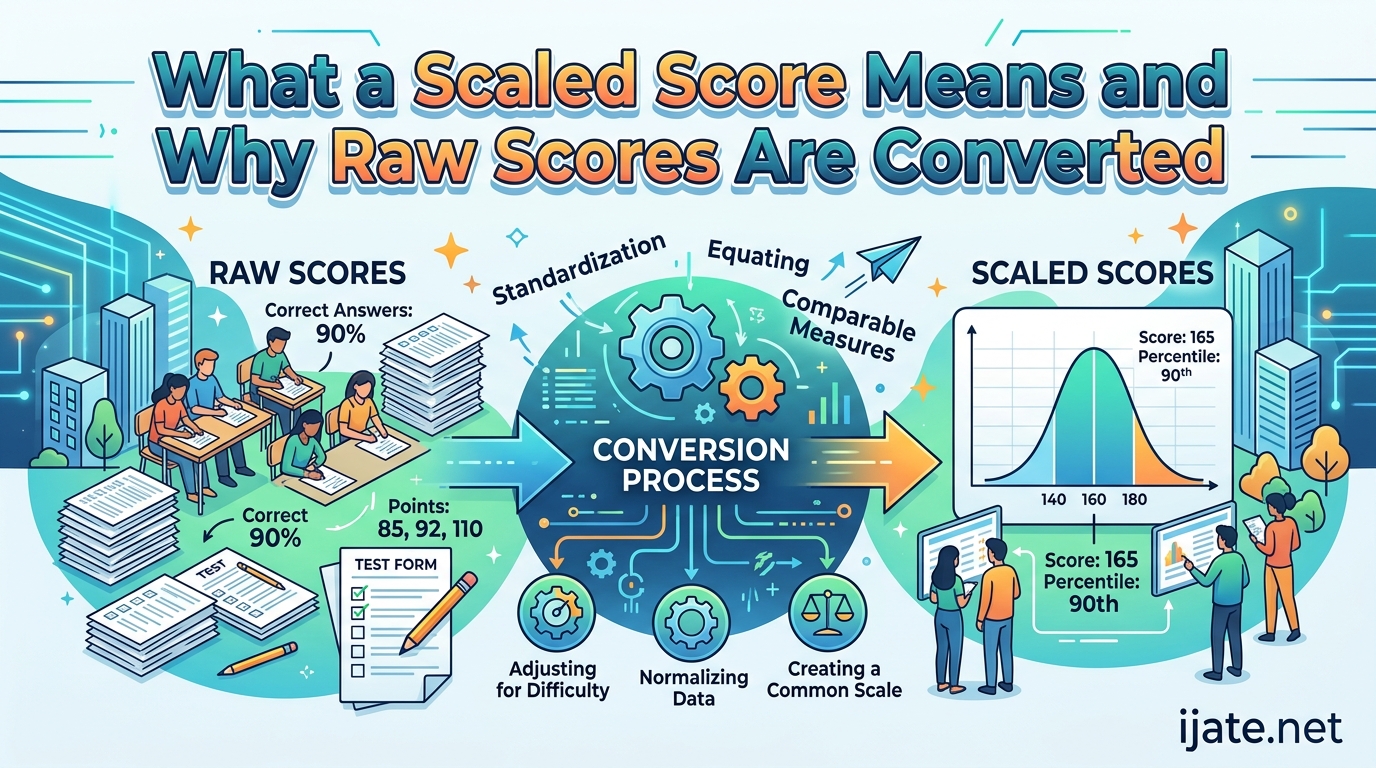
Have you ever taken a standardized test, gotten your results, and wondered why the number on your score report looks nothing like the number of questions you answered correctly? You are not alone. Understanding what a scaled score means and why raw scores are converted is one of the most common sources of confusion for students, parents, and even educators dealing with standardized test scores.
A scaled score is a mathematically transformed version of your raw score (the number of questions you got right) that has been placed onto a standardized scale. Testing organizations convert raw scores to scaled scores so that results stay fair and comparable across different test versions, dates, and difficulty levels.
In this guide, I will walk you through everything you need to know about scaled scoring. We will cover what raw scores are, what scaled scores are, why the conversion happens, how the math actually works, and real examples from tests like the ACT, SAT, and STAAR. By the end, you will understand exactly what that number on your score report means.
Table of Contents
What Is a Raw Score?
A raw score is the simplest and most straightforward measure of test performance. It is literally just the count of questions you answered correctly, with no adjustments, conversions, or statistical adjustments applied.
If you took a 60-question math test and answered 47 questions correctly, your raw score is 47. That is it. No formula, no conversion table, no scaling. The raw score represents your direct performance on that specific test form on that specific day.
Raw scores feel intuitive because they mirror what happens in a classroom. When a teacher hands back a quiz with “42 out of 50” written at the top, that fraction is essentially a raw score expressed as a ratio. Most of us grew up understanding grades this way, which is exactly why scaled scores feel so confusing by comparison.
Here is the important limitation of raw scores: they only make sense in the context of the specific test you took. A raw score of 47 on one math exam might represent outstanding performance, while the same raw score of 47 on a different math exam could be average or even below average. The difficulty of the questions matters enormously, and raw scores completely ignore that factor.
Think about it this way. If Test Form A happens to contain slightly harder questions than Test Form B, then a student who gets 47 correct on Form A has demonstrated more knowledge than a student who gets 47 correct on Form B. But their raw scores look identical. This is the core problem that scaled scoring exists to solve.
What a Scaled Score Means
A scaled score is a converted version of your raw score that has been placed onto a fixed, standardized scale. Testing organizations use a statistical process called equating to translate raw scores into scaled scores, so that the same level of knowledge always produces roughly the same scaled score regardless of which test form you happened to receive.
Here is the key idea: a scaled score meaning is about consistency, not about counting correct answers. When you see a scaled score of 500 on a test, that number does not mean you got 500 questions right. It means your performance level corresponds to a specific point on that test’s standardized scale, which was designed so that a 500 always represents the same amount of skill or knowledge.
Different tests use different scale ranges. The ACT uses a scale of 1 to 36. The SAT uses a scale of 400 to 1600. The STAAR test in Texas typically uses a scale around 1200 to 1900 depending on the subject and grade level. The Praxis teacher certification exams use a scale of 100 to 200. Each testing organization chooses a scale that works for their specific assessment, but the underlying principle is always the same.
What makes scaled scores so valuable is that they allow direct comparison. If you take the ACT in September and your friend takes a different form of the ACT in December, and you both earn a scaled score of 28, you can be confident that you demonstrated roughly equivalent skill. The scaled score erases the difference in difficulty between the two test forms.
This is also why scaled scores do not correspond to simple percentages. A student might earn a scaled score that maps to the 75th percentile even though they only answered 60 percent of questions correctly, because the questions were hard and the scaling adjusted upward. Conversely, an easy test form might require 80 percent correct just to reach an average scaled score.
Why Raw Scores Are Converted to Scaled Scores
The conversion from raw scores to scaled scores exists for one fundamental reason: fairness. Without scaling, standardized testing would be inherently unfair because no two test forms are ever exactly equal in difficulty.
Testing organizations go to great lengths to create equivalent exams, but perfect equivalence is mathematically impossible. Even when questions are piloted, calibrated, and carefully selected, minor variations in difficulty creep in. One reading passage might be slightly harder to parse. One set of math problems might require an extra step. These small differences add up across a full exam.
Here are the specific reasons raw scores are converted to scaled scores:
1. Accounting for difficulty differences across test forms. Every standardized test is administered multiple times per year, and each administration uses a different test form. If Form A is slightly harder than Form B, students taking Form A would be penalized without scaling. Equating adjusts the raw-to-scaled conversion so that the same skill level produces the same scaled score on either form.
2. Enabling score comparability across administrations. Colleges, employers, licensing boards, and state education agencies need to know that a score from March means the same thing as a score from October. Scaled scores make this possible. An ACT score of 25 represents the same approximate skill level whether you tested in 2024 or 2026.
3. Maintaining consistent passing standards over time. Professional certification exams and state proficiency tests need a passing score that means the same thing year after year. If a licensing board sets the passing scaled score at 162, that standard holds steady even as raw score requirements fluctuate with test difficulty.
4. Providing meaningful score interpretation. Raw scores by themselves tell you very little. A raw score of 42 out of 60 sounds good, but is it? Scaled scores come with context like percentile ranks, proficiency levels, and performance standards that help students, parents, and educators understand what the number actually represents.
5. Protecting test security. By using scaled scores, testing organizations can release different test forms without revealing exactly how many questions a student needed to correct for a given result. This adds a layer of security that makes it harder to game the system or share answer keys in a useful way.
Forum discussions on Reddit communities like r/LSAT and r/SHSAT frequently surface this exact confusion. Students notice that the same raw score can yield different scaled scores on different test dates, and they wonder whether the system is rigged. It is not. The variation is the equating process working exactly as intended, adjusting for the specific difficulty of each test form.
How the Conversion Process Works
The conversion from raw scores to scaled scores relies on a statistical method called equating. Equating is not a simple formula you can memorize or calculate on your own. It is a rigorous, research-backed process that testing organizations invest heavily in to ensure fairness.
Here is a step-by-step breakdown of how the conversion typically works:
Step 1: Question piloting and calibration. Before a question ever appears on a scored test, it goes through pretesting. Testing organizations embed unscored pilot questions in real exams to gather data on how students perform. This data helps them understand each question’s difficulty level before it counts toward anyone’s score.
Step 2: Building equivalent test forms. Test developers use the calibration data to assemble multiple test forms that are as similar as possible in overall difficulty. They balance content, question types, and difficulty distribution so that each form measures the same skills. However, they know perfect equivalence is impossible, which is why equating is still necessary.
Step 3: Equating through anchor items or common groups. There are two main equating approaches. The first uses anchor items, which are common questions that appear on multiple test forms. By comparing how students perform on those shared items, psychometricians can calculate the difficulty difference between forms. The second approach uses a common group of test-takers who take both forms, providing a direct comparison.
Step 4: Creating the conversion table. Using the equating data, statisticians build a raw-to-scaled conversion table specific to each test form. This table maps every possible raw score to its corresponding scaled score. A raw score of 47 on Form A might map to a scaled score of 29, while the same raw score of 47 on a harder Form B might map to a scaled score of 30.
Step 5: Applying the scale and reporting results. Once the conversion table is finalized, each student’s raw score is looked up and converted to a scaled score. That scaled score is what appears on the official score report, along with percentile ranks and any proficiency designations.
One thing that surprises many students is that the conversion is not always linear. A one-point increase in raw score might translate to a two-point jump in scaled score at certain ranges and a zero-point jump at others. The relationship between raw and scaled scores depends on where you fall on the curve and how the specific test form was equated.
This nonlinear relationship is why raw score conversion tables can look strange at first glance. On some tests, going from 50 to 51 correct might boost your scaled score significantly, while going from 55 to 56 correct might have almost no effect. The scaling reflects how many students typically score in each range and how much skill each additional correct answer represents.
It is also worth noting that testing organizations generally do not publish their exact equating formulas. The conversion tables themselves are often released, but the underlying statistical methodology is considered proprietary. This protects the integrity of the scaling process and prevents anyone from reverse-engineering the tests.
What a Scaled Score Means: Real-World Examples
Theory is helpful, but examples make scaled scoring concrete. Let us look at how three major testing programs handle the conversion from raw scores to scaled scores.
ACT scaled scores. The ACT reports four subject scores (English, Math, Reading, Science) on a scale of 1 to 36, plus a composite score that is the average of those four. The raw score for each subject is simply the number of correct answers on that section. The conversion table changes slightly with each test date because each form is equated separately. For example, on one form you might need 54 correct out of 75 English questions to earn a scaled score of 24, while on a harder form the same scaled score of 24 might require only 51 correct.
SAT scaled scores. The SAT uses a total score range of 400 to 1600, combining two section scores of 200 to 800 each (Reading and Writing, and Math). The raw score for each section is the number of correct answers, with no penalty for guessing. Those raw scores are converted through a process called equating, and the conversion table varies by test form. A raw math score of 45 out of 58 might produce a section score of 700 on one form and 720 on another, depending on difficulty calibration.
STAAR scaled scores. The State of Texas Assessments of Academic Readiness uses scaled scores to report student performance across grade levels and subjects. The Texas Education Agency publishes raw score conversion tables for each test administration. STAAR scaled scores typically range from roughly 1200 to 1900, and they correspond to performance levels: Did Not Meet Grade Level, Approaches Grade Level, Meets Grade Level, and Masters Grade Level. A student’s raw score is converted using that specific administration’s table, and the resulting scaled score determines which performance level they achieved.
Praxis and professional exams. Teacher certification exams like the Praxis use a scaled score range of 100 to 200. Each state sets its own passing score, often around 160 or 162. Because Praxis forms vary in difficulty, the raw score needed to pass varies by test form. A candidate might need 84 correct on one form and 88 correct on another to earn the same passing scaled score of 162.
What these examples all share is the principle that the scaled score, not the raw score, is the official measure of performance. When a college admissions officer looks at your ACT score or a state evaluates a school’s STAAR results, they are reading scaled scores. The raw score is just an intermediate step in the calculation.
Understanding Your Score Report
When you receive your score report from a standardized test, the scaled score is usually the headline number. But a good score report contains more than just that single figure, and understanding the additional information helps you interpret your performance accurately.
Most score reports include a percentile rank alongside the scaled score. The percentile rank tells you what percentage of test-takers scored at or below your level. A scaled score at the 80th percentile means you performed better than 80 percent of students who took the same test. This is often more meaningful than the scaled score itself, because percentiles provide immediate context about where you stand relative to peers.
Is your raw score your actual score? In one sense, yes, the raw score is the actual count of correct answers. But in terms of what gets reported, evaluated, and compared, the scaled score is your official score. Most testing organizations do not even include the raw score on the student-facing report. They show the scaled score, percentile rank, and any proficiency or performance-level designations.
For state tests like STAAR, the score report will typically show the scaled score, the performance level, and whether the student met the standard for their grade. Reports may also break down performance by reporting category or skill area, helping parents and teachers identify strengths and weaknesses.
One common frustration expressed in online forums is that scaled scores can feel opaque. Students want to know exactly how many questions they got right, and testing organizations often will not tell them. The rationale is that releasing raw score details could compromise test security and reveal too much about the equating process. While this can be frustrating, it is a deliberate policy choice designed to maintain the integrity of the testing system.
Frequently Asked Questions
How are raw scores converted to scaled scores?
Raw scores are converted to scaled scores through statistical equating. Testing organizations pilot and calibrate questions, build equivalent test forms, use anchor items or common groups to measure difficulty differences, and create a conversion table that maps each raw score to a scaled score for that specific test form.
What does raw score and scaled score mean?
A raw score is the simple count of questions you answered correctly on a test. A scaled score is that raw score mathematically converted onto a standardized scale so that scores remain comparable across different test versions and difficulty levels.
Why are raw scores converted to standard scores?
Raw scores are converted to scaled or standard scores to account for differences in difficulty across test forms, enable fair score comparisons across test dates, maintain consistent passing standards over time, and provide meaningful score interpretation through percentile ranks and proficiency levels.
Is your raw score your actual score?
Your raw score is the actual count of correct answers, but most testing organizations only report your scaled score as the official result. The scaled score, not the raw score, is what colleges, employers, and state agencies use to evaluate your performance.
What is a good scaled score?
What counts as a good scaled score depends on the test and your goals. A scaled score at or above the 75th percentile is generally considered strong. For the ACT, a composite of 24 or higher puts you in roughly the top 25 percent nationally. Check the specific test’s percentile data to see where your score lands.
Conclusion
Understanding what a scaled score means and why raw scores are converted comes down to one word: fairness. Scaled scoring ensures that every student is measured against the same standard, regardless of which test form they received or how difficult that particular set of questions happened to be.
The next time you look at a score report, remember that the scaled score represents your true performance level on a standardized scale. The raw score was just the starting point. The conversion process, through statistical equating, is what makes standardized testing genuinely standardized. If you are preparing for a specific exam, look up that test’s official conversion tables and percentile data so you know exactly what target you are aiming for.