
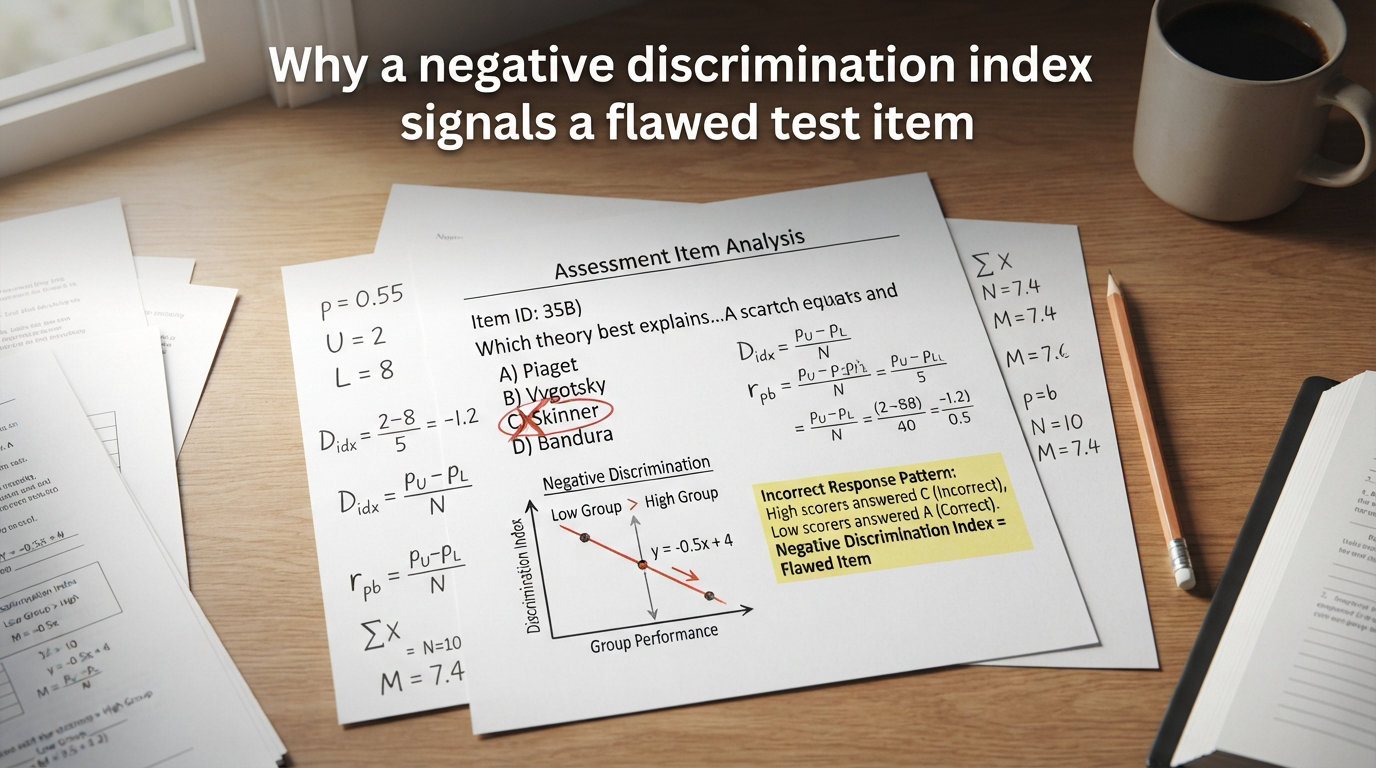
Imagine running an item analysis on your latest exam and watching every high-performing student get a particular question wrong while the lowest scorers nail it. That is exactly what a negative discrimination index test item looks like in real data, and it is one of the clearest red flags a test developer or classroom instructor can encounter. The discrimination index measures how well a single question separates students who truly know the material from those who do not, so when the number turns negative, the item is actively working against the test’s purpose.
A negative discrimination index means the item rewards weaker knowledge and penalizes stronger understanding. That inversion undermines test reliability, depresses validity evidence, and erodes the fairness of score-based decisions. In my work reviewing classroom and certification exams, I treat any item with a negative D-value as a stop signal: the question needs to be investigated, fixed, or removed before scores are reported.
This guide breaks down exactly why a negative discrimination index signals a flawed test item, what causes it, how to interpret the values, and what to do when you see one in your own item analysis report. Whether you teach a 30-student section or develop large-scale licensure assessments, the principles below will help you turn raw item statistics into better, fairer questions.
Table of Contents
What Is the Discrimination Index?
The discrimination index is an item statistic that shows how well a question differentiates between examinees who know the material and those who do not. It is one of the cornerstones of classical test theory and appears on nearly every standard item analysis report alongside the item difficulty index (the p-value). Together, these two numbers tell you whether an item is measuring what the test intends to measure.
The most common calculation uses the upper-lower group method. You rank examinees by total score, identify the top 27 percent (the upper group) and the bottom 27 percent (the lower group), and compare the proportion of correct answers in each. The formula is straightforward: D = (U minus L) divided by the number of groups compared. If 80 percent of the upper group answered correctly and 30 percent of the lower group answered correctly, the item earns a positive D-value of 0.50.
Many modern testing platforms replace the upper-lower method with the point-biserial correlation, which compares each examinee’s performance on the item to their performance on the overall test. Both approaches answer the same core question: does this item track with overall ability? A well-functioning item should be answered correctly more often by strong students than by weak students, producing a positive value.
What Does a Negative Discrimination Index Mean?
A negative discrimination index means that lower-performing examinees answer the item correctly more often than higher-performing examinees do. In plain terms, the students who scored poorly on the test overall are outperforming the top students on this one specific item. That pattern is the statistical opposite of what a measuring instrument is supposed to produce.
On a classroom test, a negatively discriminating item effectively penalizes students who studied. The strongest readers, problem solvers, or content experts consistently choose the wrong response, while students with weaker mastery pick the keyed answer. From a measurement standpoint, the item is pulling the test in the wrong direction.
This is why psychometricians treat negative D-values as urgent signals rather than minor statistical noise. A single negative-discrimination item lowers the test’s internal consistency, drags down Cronbach’s Alpha, and reduces the standard error of measurement. The more such items a test contains, the less confidence you can place in any score interpretation drawn from that test.
One Moodle forum user shared a striking example: they ran item analysis on an 80-question exam and found that every single item showed negative discrimination. That is not a fluke of one weak question; it suggests a systemic problem such as a misaligned answer key file, a scanning error, or a test form where the “correct” answers were uploaded in the wrong order. When the entire test inverts, the issue is almost always procedural rather than pedagogical.
Why a Negative Discrimination Index Signals a Flawed Test Item
Understanding why a negative discrimination index signals a flawed test item comes down to one principle: a valid measuring instrument should align with the construct it claims to measure. When high scorers miss a question that low scorers get right, the item is measuring something other than the intended knowledge, skill, or ability. It may be measuring test-taking tricks, reading comprehension quirks, ambiguous wording, or simply a wrong answer key.
Consider what happens during a well-constructed exam. Students who studied the material, attended class, and mastered the objectives should cluster toward correct answers on items aligned to those objectives. Their content knowledge functions as a signal that the item can detect. When that signal inverts, the item is no longer tracking knowledge at all; it is tracking noise, confusion, or error.
A negative D-value also damages the test as a whole. Reliability coefficients such as Cronbach’s Alpha depend on items moving together in the same direction. A negatively discriminating item acts like a rower paddling against the rest of the boat. Even one or two such items can noticeably depress reliability, especially on shorter tests where every item carries more weight.
Validity suffers too. If an item correlates negatively with total score, then including it in the test means the final score partly reflects a construct that contradicts what the test is supposed to measure. Score-based decisions, from grades to licensure, become harder to defend. For high-stakes exams, that is a legal and ethical concern, not just a statistical one.
Finally, fairness demands attention. Students who know the material should not be punished for that knowledge. When a flawed item systematically disadvantages strong students, the test produces scores that misrepresent what learners actually know. Catching these items through routine item analysis is how educators protect both the integrity of the assessment and the trust students place in it.
Common Causes of Negative Discrimination
Negative discrimination rarely appears without a reason. In most item review meetings I have participated in, the cause falls into one of five recognizable categories. Identifying which category applies is the first step toward fixing the item.
Mis-Keyed Items
The single most common cause of a negative discrimination index is a mis-keyed item. This happens when the answer recorded as correct in the scoring key does not match the option the question author actually intended to be correct. A high-performing student reads the question, reasons through the options, and confidently selects the response that is logically right. The scoring system marks it wrong because a different option was accidentally flagged as the key. The result is a clean inversion: the students who know the most get penalized. This cause is so common that many testing experts recommend checking the answer key first whenever you see a negative D-value.
Defective Item Construction
Defective construction covers a range of authoring problems. Two answer options may be technically correct, forcing knowledgeable students to choose between equally defensible responses while less-prepared students simply guess. A “none of the above” option that is actually keyed correct can produce the same effect. Clues such as grammatical inconsistencies, vague qualifiers like “always” or “never,” and options of wildly different lengths can also tip off sophisticated test takers in the wrong direction. These construction flaws reward superficial strategies over genuine understanding, which is exactly the inversion that drives D negative.
Low Cognitive Level
Items that test only rote recall of trivial details sometimes discriminate negatively, especially when the broader test rewards deeper reasoning. A strong student who reasoned through a complex scenario may overlook a minor factual detail that a weaker student happened to memorize. The item ends up tracking surface-level recognition rather than the higher-order thinking the test is supposed to reward. Researchers studying distractor efficiency, including the 2024 Rezigalla analysis published in peer-reviewed literature, have linked non-functioning distractors and low cognitive levels directly to negative or near-zero discrimination.
Ambiguous or Tricky Wording
Students with stronger content knowledge often read more carefully and notice ambiguities that weaker students miss. If the wording is genuinely ambiguous, those strong students may overthink the item, identify two defensible answers, and choose the one that was not keyed as correct. The weaker student, who reads quickly and picks the first plausible option, may stumble into the keyed answer. The item rewards speed over understanding.
Content Misalignment
Sometimes the item simply does not belong on the test. It may cover material not taught in the course, rely on outside knowledge that stronger students interpret differently, or assess a learning objective that was not emphasized. When content is misaligned, even well-prepared students can miss it, while students who guessed correctly by chance may have happened to pick the keyed option.
The Relationship Between Item Difficulty and Discrimination
Item difficulty and item discrimination are deeply connected statistics, and understanding that link helps explain when negative discrimination is most likely to appear. The difficulty index, often reported as the p-value, represents the proportion of examinees who answered correctly. A p-value of 0.85 means 85 percent got the item right.
The mathematical ceiling on discrimination depends on difficulty. Items that are extremely easy (p-values above 0.90) or extremely hard (p-values below 0.10) have very little room to distinguish between strong and weak students, because nearly everyone gets the easy ones right and nearly everyone gets the hard ones wrong. Maximum discrimination potential sits near a p-value of 0.50, which is why many testing guides recommend targeting that range for norm-referenced tests.
For more on the statistical and heuristic factors that influence item difficulty estimates, you can explore research on statistical difficulty estimates that examines how difficulty interacts with other item statistics.
This relationship matters because very easy items can produce negative or near-zero D-values without necessarily being broken. If 95 percent of students answer correctly, the small number who missed it may happen to include a few strong students by chance, producing a slightly negative point-biserial. Context matters: a D-value of minus 0.05 on an item with a p-value of 0.95 is far less alarming than a D-value of minus 0.30 on an item of moderate difficulty.
How to Interpret Discrimination Index Values
Reading a single D-value without context is risky. The interpretation table below reflects widely used thresholds adapted from Ebel and Frisbie’s classic guidance, and it is the framework I reach for first during item review.
0.40 and above: Excellent discrimination. The item separates strong and weak students very effectively.
0.30 to 0.39: Good discrimination. The item is functioning well and should be retained.
0.20 to 0.29: Fair discrimination. The item is borderline and may need revision.
0.10 to 0.19: Poor discrimination. The item is weak and should be revised or replaced.
0.00 to 0.09: Very poor discrimination. The item contributes almost nothing to measurement.
Negative values: The item discriminates in the wrong direction. Investigate immediately for mis-keying or construction flaws.
Keep in mind that these thresholds assume a reasonable sample size. Item statistics calculated from 30 students are far less stable than statistics from 300 students. A negative D-value of minus 0.10 on a class of 25 may reflect sampling noise; the same value on a 500-student exam is a genuine red flag worth investigating.
For norm-referenced tests, the bar is higher because every item is expected to contribute to score spread. For criterion-referenced tests, where the goal is mastery rather than ranking, slightly lower discrimination may be tolerable, but negative values still warrant review because they indicate the item is measuring the wrong thing.
How to Fix Test Items With Negative Discrimination
Fixing items with negative discrimination is where most competitors stop short, so this is the section I want educators to actually use. The process below is the one I follow in item review meetings, and it works for classroom quizzes, departmental exams, and large-scale assessments alike.
Step 1: Verify the answer key. Before doing anything else, confirm that the keyed correct answer is actually the intended correct answer. Recheck the original question file, the answer sheet, and any scanning or data-entry steps. Mis-keying is the most common cause and the easiest to fix. If the key was wrong, simply correcting it often flips the discrimination index from strongly negative to strongly positive.
Step 2: Run a distractor analysis. Look at how many students chose each response option. A well-functioning distractor should attract more students from the lower group than from the upper group. If one distractor is pulling strong students away from the keyed answer, that option is likely too plausible or the keyed answer is unclear. Non-functioning distractors, chosen by almost no one, also reduce discrimination because they make the item effectively easier than intended.
Step 3: Examine the wording. Read the stem and every option aloud. Look for double negatives, ambiguous qualifiers, grammatical cues, and options that could be defended as correct by a knowledgeable student. If two answers are defensible, the item is defective and needs revision regardless of which one is keyed.
Step 4: Check content alignment. Confirm the item maps to a learning objective that was actually taught and that the cognitive demand matches the objective. A recall-level item on a test that otherwise rewards analysis may discriminate poorly because the strongest students are reasoning past the surface detail the item rewards.
Step 5: Revise and pilot. Rewrite the stem, rework the distractors, or replace the item entirely. Then pilot the revised version with a new group of students before relying on it for scored decisions. Track the new D-value on the next administration to confirm the fix worked.
Step 6: Document the decision. Record what was wrong, what you changed, and what happened on re-administration. This documentation protects you if scores are challenged and builds an item bank of questions with known, strong psychometric performance.
Following sound assessment practices throughout this process keeps your review consistent and defensible. The goal is not just to fix one item but to build a repeatable workflow that catches flawed items before they affect reported scores.
When Negative Discrimination Might Be Acceptable
Negative discrimination is almost never desirable, but in a small number of situations it is at least explainable rather than alarming. Very easy items on a mastery test can show slightly negative D-values simply because so few students miss them that the statistic becomes unstable. If the p-value is 0.97 and the D-value is minus 0.04, the item may still be measuring what it should; it just has almost no discriminating power left to give.
Pretest or field-test items are another case. These items are embedded in operational forms without contributing to scores precisely because their psychometric properties are unknown. A negative D-value on a pretest item is data, not a defect. The item should be revised or rejected before it ever counts toward a student’s score.
The key judgment is whether the negative value reflects a fixable flaw or an artifact of difficulty and sample size. When in doubt, investigate. The cost of checking is small; the cost of leaving a broken item on a scored test can be significant.
Conclusion
A negative discrimination index test item is the clearest statistical warning that something is wrong with a question. It means stronger students are getting the item wrong while weaker students get it right, which is the opposite of what any measuring instrument should do. By understanding why a negative discrimination index signals a flawed test item, identifying common causes like mis-keying and defective construction, and following a structured remediation process, you can protect the reliability, validity, and fairness of every assessment you build. The next time a negative D-value shows up on your item analysis report, treat it as a prompt to investigate, not a reason to panic.
FAQs
What does it mean if a test item has a negative discrimination index?
A negative discrimination index means that lower-performing examinees answered the item correctly more often than higher-performing examinees did. In other words, the students who scored well on the test overall tended to get this specific item wrong, while weaker students got it right. This inversion usually signals a flawed test item caused by mis-keying, ambiguous wording, or defective construction.
What does the discrimination index in a test item measure?
The discrimination index measures how well an individual test item differentiates between examinees who know the material and those who do not. It is typically calculated by comparing the proportion of correct answers in the upper-scoring group to the proportion in the lower-scoring group, or by using a point-biserial correlation between item performance and total test score.
What is a good discrimination index score?
A discrimination index of 0.40 or higher is considered excellent, 0.30 to 0.39 is good, and 0.20 to 0.29 is fair. Values between 0.10 and 0.19 are poor and indicate the item needs revision. Anything at or near zero contributes almost nothing to measurement, and negative values indicate the item is discriminating in the wrong direction and should be investigated immediately.
What causes negative discrimination in test items?
The most common causes are a mis-keyed answer, where the wrong option was flagged as correct; defective item construction, such as two defensible answers; low cognitive level, where the item rewards rote recall instead of reasoning; ambiguous wording that strong students overthink; and content misalignment, where the item covers material not taught in the course.
What should I do if all items on my test have negative discrimination?
If every item shows negative discrimination, the problem is almost certainly procedural rather than pedagogical. Check the answer key file for errors, verify that scanning or data entry was completed correctly, and confirm that the answer key matches the form students actually took. A full inversion usually means the key was uploaded in the wrong order or matched to the wrong test form.
When is negative discrimination acceptable?
Negative discrimination is rarely acceptable on scored items, but it can be explainable on very easy items where the p-value is above 0.95 and the negative D-value is very small, or on pretest items that do not contribute to student scores. In both cases, the item should still be reviewed and revised before it counts toward reported results.