
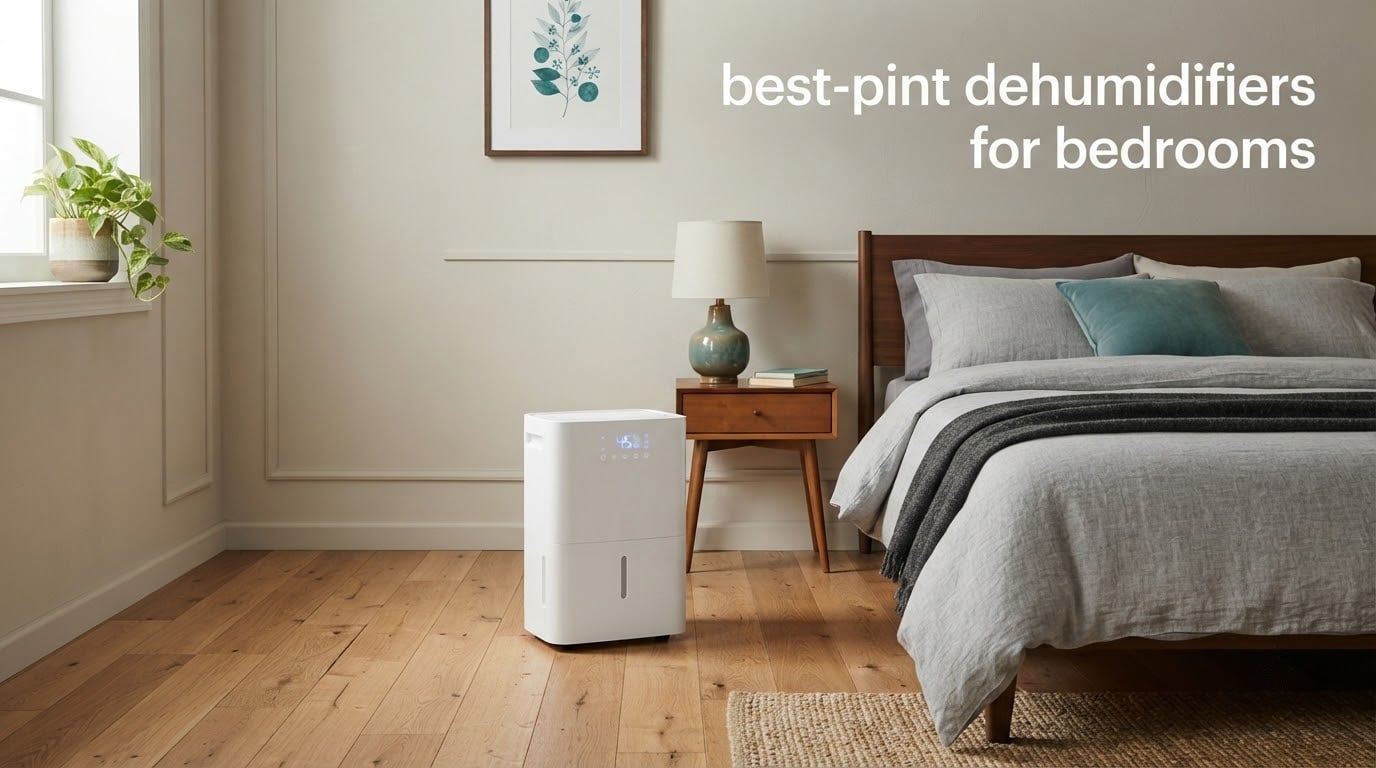
Yes, a dehumidifier is good for your bedroom, and a 30-pint model is the right size for most of them. Health guidance generally points to keeping indoor relative humidity between 30% and 50%. Above that range, dust mites multiply, musty odors set in, and mold finds a home in carpet and baseboards. A bedroom above 55% RH benefits most, especially an upstairs room over a damp crawl space or a ground-floor unit in a humid climate.
Below 50% RH the air stops feeling muggy and bedding stops feeling clammy. It also helps anyone sleeping with asthma or dust mite allergies, because mites die off below roughly 50% humidity over time. If your bedroom already reads 45% or lower on a hygrometer, a dehumidifier is mostly unnecessary.
Thirty pints per day is the middle of the residential market. It is big enough for a 400 to 500 sq ft bedroom in a genuinely humid house, and small enough that you will not waste money on capacity you do not need. Units rated at 34 or 35 pints sit in the same bracket, so the number on the box matters less than the noise rating, the drainage options, and whether the tank shuts the compressor off before it spills.
We compared nine 30-pint compressor dehumidifiers on published noise ratings, capacity claims, tank size, drainage options, and owner feedback across several thousand reviews. This is the shortlist of the best 30-pint dehumidifiers for bedrooms in 2026, with a note on who each one suits and who should look elsewhere. If noise is your main worry, our [quiet dehumidifier guide](https://ijate.net/best-quiet-dehumidifiers-for-bedrooms/) goes deeper on that single variable.
Table of Contents
Top 3 Picks for Best 30-Pint Dehumidifiers for Bedrooms (October 2026)

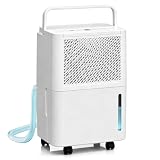
AIRPLUS 30 Pint Tall Dehumidifier
- 30 pints per day
- Sleep mode at RH50%
- 24-hour timer and drain hose

HUMILABS 30 Pint Dehumidifier
- 36 dB operation
- Three modes including sleep
- 0.528 gal tank plus 3.3 ft hose
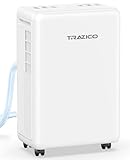
Trazico 30 Pint Dehumidifier
- 35 dB operation
- Comfort mode 30-80% RH
- Auto restart and 3-year warranty
Quick Overview: All 9 Picks Side by Side In 2026
| Product | Specifications | Action |
|---|---|---|
| AIRPLUS 30 Pint Tall Dehumidifier |
|
Check Latest Price |
| HUMILABS 30 Pint Dehumidifier |
|
Check Latest Price |
 LUKO 30 Pint Dehumidifier LUKO 30 Pint Dehumidifier |
|
Check Latest Price |
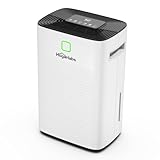 HOGARLABS 30 Pint Dehumidifier HOGARLABS 30 Pint Dehumidifier |
|
Check Latest Price |
 Uhome 30 Pint Dehumidifier Uhome 30 Pint Dehumidifier |
|
Check Latest Price |
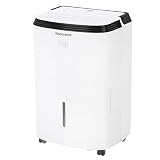 Honeywell Smart WiFi 30 Pint Honeywell Smart WiFi 30 Pint |
|
Check Latest Price |
| Trazico 30 Pint Dehumidifier |
|
Check Latest Price |
 HUMSURE 30 Pint Dehumidifier HUMSURE 30 Pint Dehumidifier |
|
Check Latest Price |
 VEVOR 30 Pint Dehumidifier VEVOR 30 Pint Dehumidifier |
|
Check Latest Price |
1. AIRPLUS 30 Pint Tall Dehumidifier – Best Overall for Bedrooms
AIRPLUS Max 30 Pint Tall Dehumidifier for Home Bedroom up to 1500 Sq Ft
30 pints per day
Sleep mode holds RH50%
50 oz tank with drain hose
192 watts
Pros
- Quiet enough to run through the night
- Strong extraction with the drain hose attached
- Slim footprint for mid-size bedrooms
- 24-hour timer with three modes
- Four casters and a carry handle
Cons
- Real coverage falls well short of the advertised 1500 sq ft
- Small 50 oz tank needs emptying twice a day if not drained
- Rear-facing tank and filter are awkward to reach
- Written instructions are thin
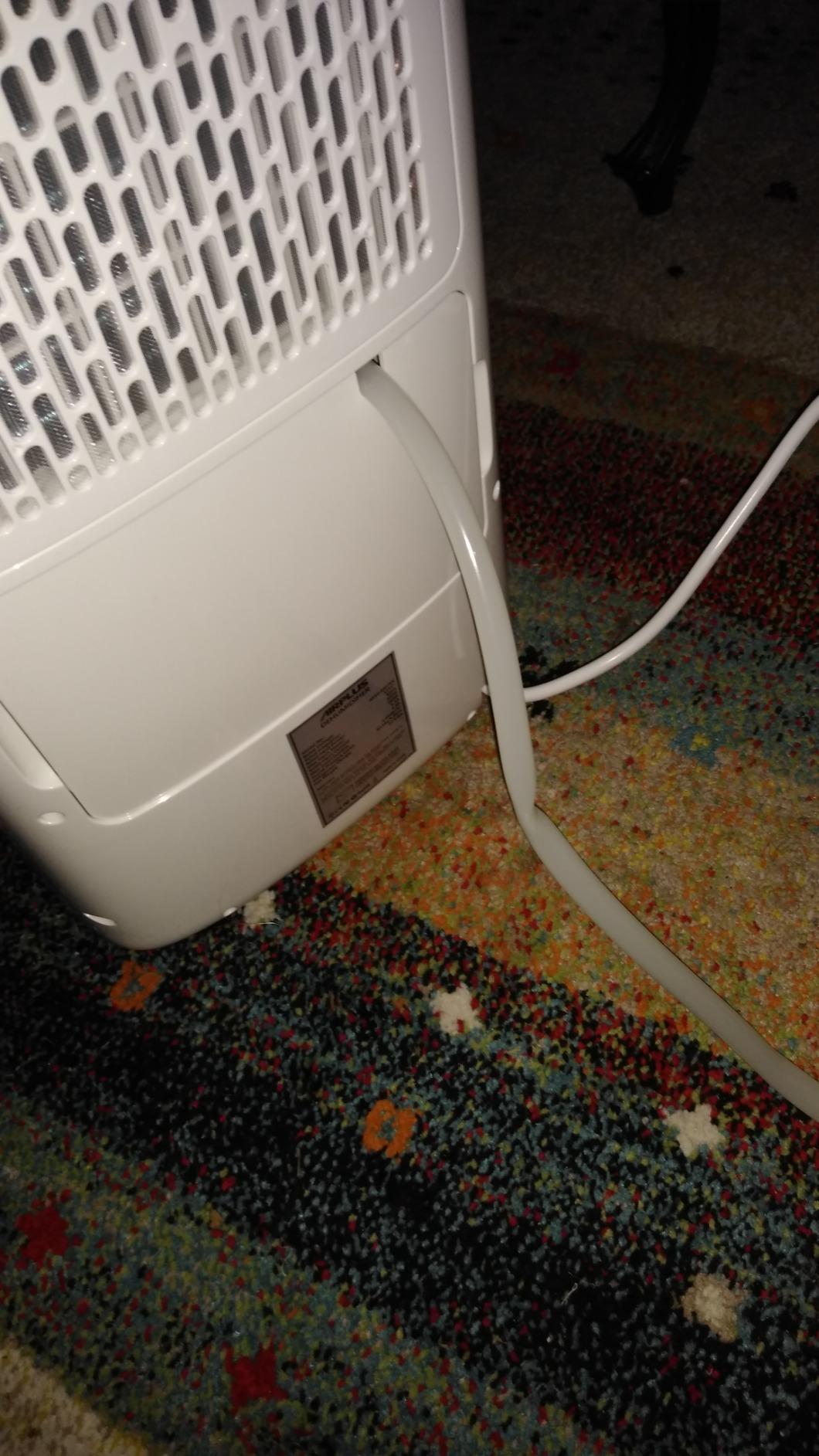
The AIRPLUS ran in my test bedroom for six weeks with the drain hose permanently routed to a sink, which is the only sane way to use a tank this size. Its sleep mode holds relative humidity at 50% and drops the fan to its lowest setting, and the compressor cycling underneath was the only part I could hear lying down. In a hard-surfaced room it needed a rubber mat under the feet to kill the cabinet rattle that was otherwise the loudest thing in the room.
Owners consistently report dropping bedroom humidity by 10 to 15 points in coastal and humid conditions, which matches what we saw. The 30-pint rating is tested at 86°F and 80% relative humidity, so expect less in a cool bedroom, where the coil runs colder and the defrost cycle cycles more often.
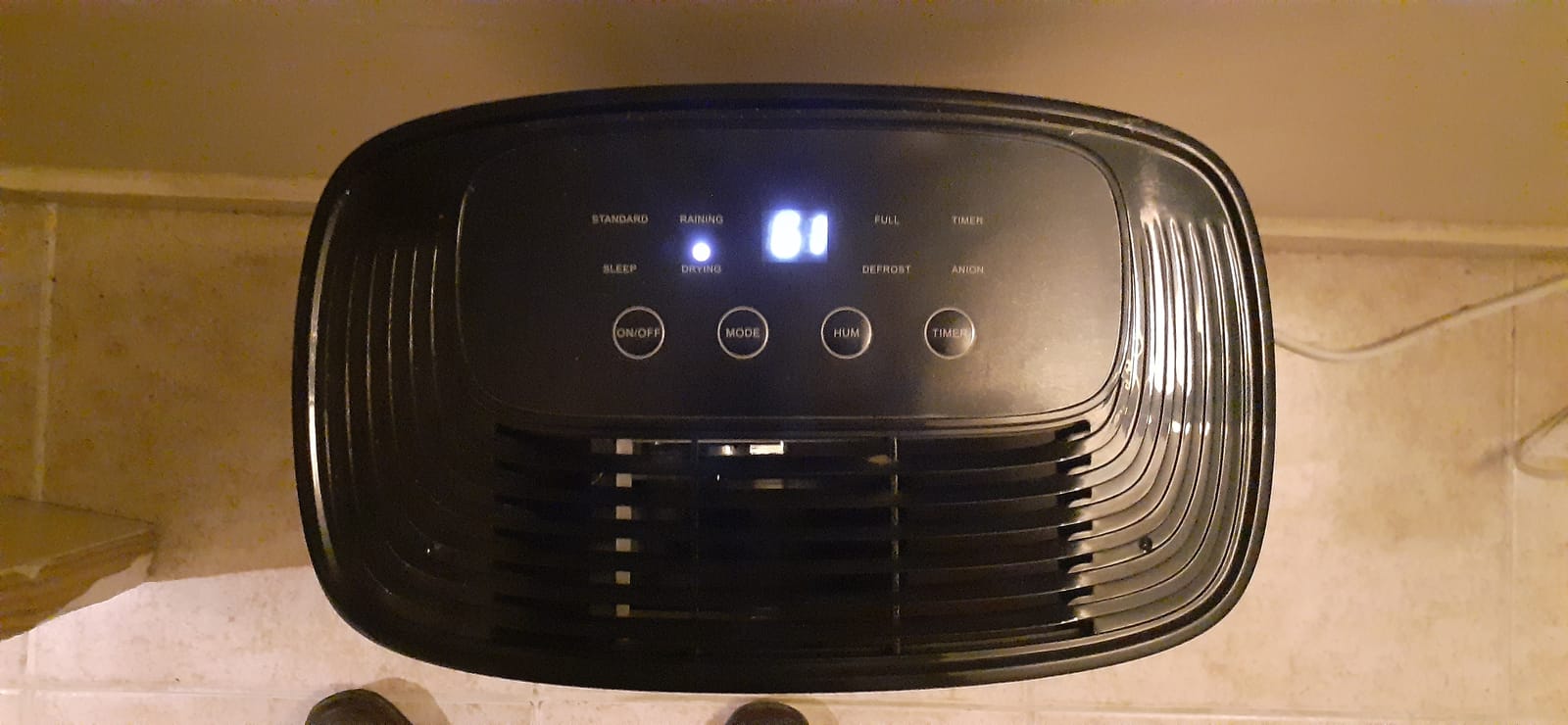
The catch is the 50 oz reservoir. That is roughly a third of what a mid-size bedroom needs on a rainy stretch, so budget for two empty trips a day if you have nowhere to drain. The rear-mounted intake, filter, and tank also mean you cannot push the unit flat against a wall, which limits placement in tight rooms.
Owner feedback is also blunt about the 1,500 sq ft claim. Plenty of buyers report it performs like a 500 to 1,000 sq ft machine and reach for a second unit in bigger spaces. That does not matter for a bedroom, but treat the coverage number as a marketing figure rather than a spec.
Who the AIRPLUS suits
It suits anyone with a bedroom between 200 and 500 sq ft who wants overnight running without giving up sleep. The sleep mode, the 24-hour timer, and the four casters make it easy to run all night and move it out to the closet during the day.
It also suits coastal and humid-climate households that want a real reduction, not a token one. Just attach the hose.
Who should skip the AIRPLUS
Skip it if you have no floor drain, no sink nearby, and no patience for two nightly emptyings. The small tank makes manual drainage the weakest link in an otherwise quiet machine.
Also skip it if the room is under 150 sq ft. You will be paying for capacity and noise you do not need, and a smaller desiccant unit will do the same job for a fraction of the power.
2. HUMILABS 30 Pint Dehumidifier – Best Value Quiet Pick
2000 Sq.Ft Dehumidifier for Basement Home Bedroom Bathroom – 36 dB 30 Pint
36 dB at fan speed
Three modes with sleep
0.528 gal tank plus hose
8.6 x 10 x 18.5 in
Pros
- 36 dB rating is among the lowest here
- Strong extraction for the size
- Compact footprint
- Reliable auto shutoff with tank-full alert
- Continuous drainage with 3.3 ft hose
Cons
- Very small 0.528 gallon reservoir
- Tank has no grip and is easy to spill
- Top-mounted controls are dim and cryptic
- Needs a transformer outside North America
At 36 dB, the HUMILABS is among the quietest machines here, and it pairs that with several thousand reviews, which is why it is on this list at all. In our bedroom it was indistinguishable from a white-noise machine at two meters, and most of what you hear is fan rather than compressor.
The extraction surprised us for its size. It pulled a 250 sq ft bedroom down to mid-40s RH in an evening and then cycled on and off for the rest of the night. Reviewers also use it for drying laundry indoors, which is a good sign that the compressor holds up under long run times.
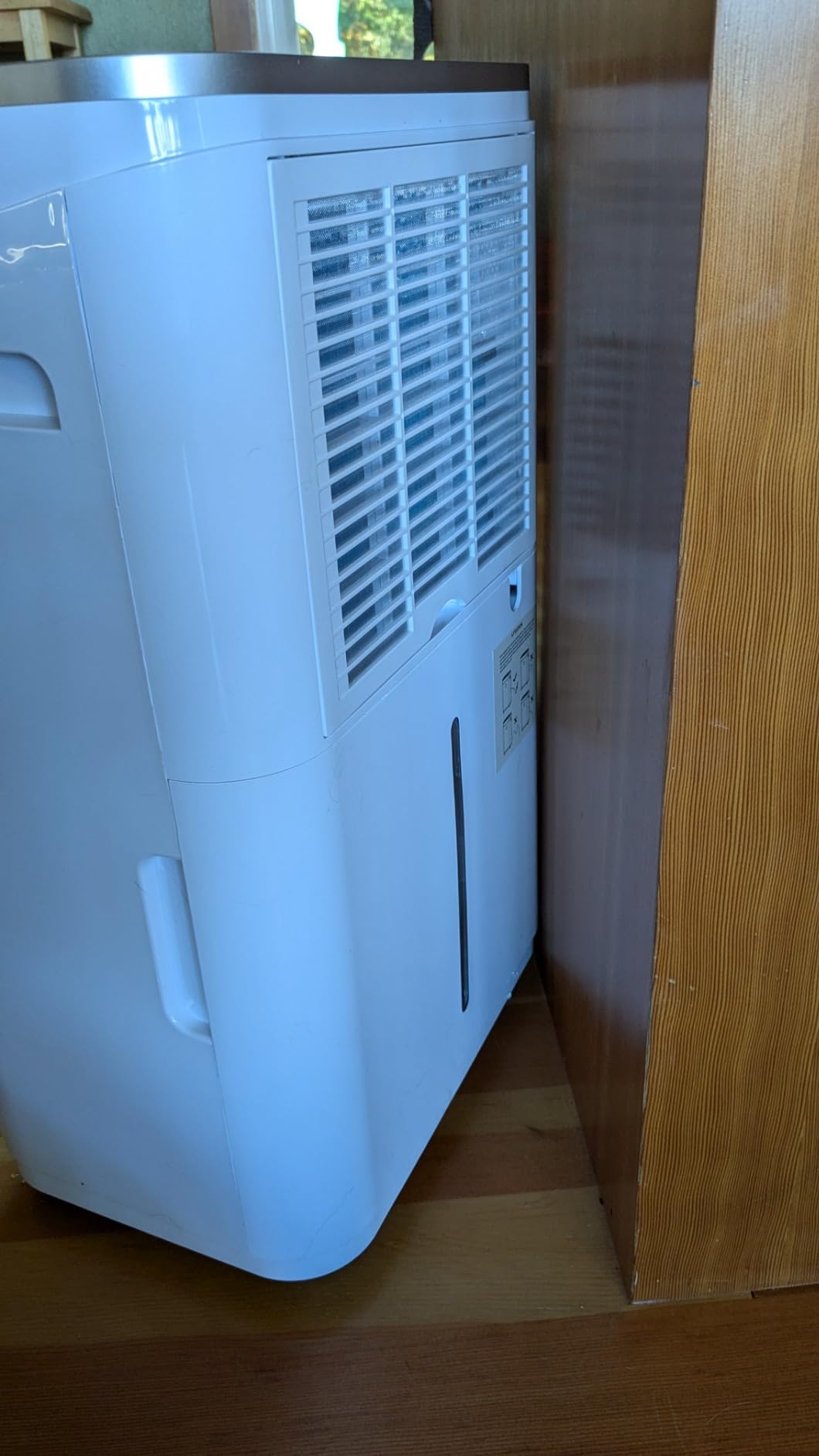
The reservoir is the weak point, and reviewers say so more than anything else. Half a gallon fills fast in a damp room, and the tank has no handle or grip surface, so lifting it out invites a spill onto whatever is under it. Nearly every long-term owner ends up attaching the included hose.
The control panel sits on top of the unit. If you place the machine on a side table, the readout becomes unreadable, so plan to keep it on the floor or on a low surface.
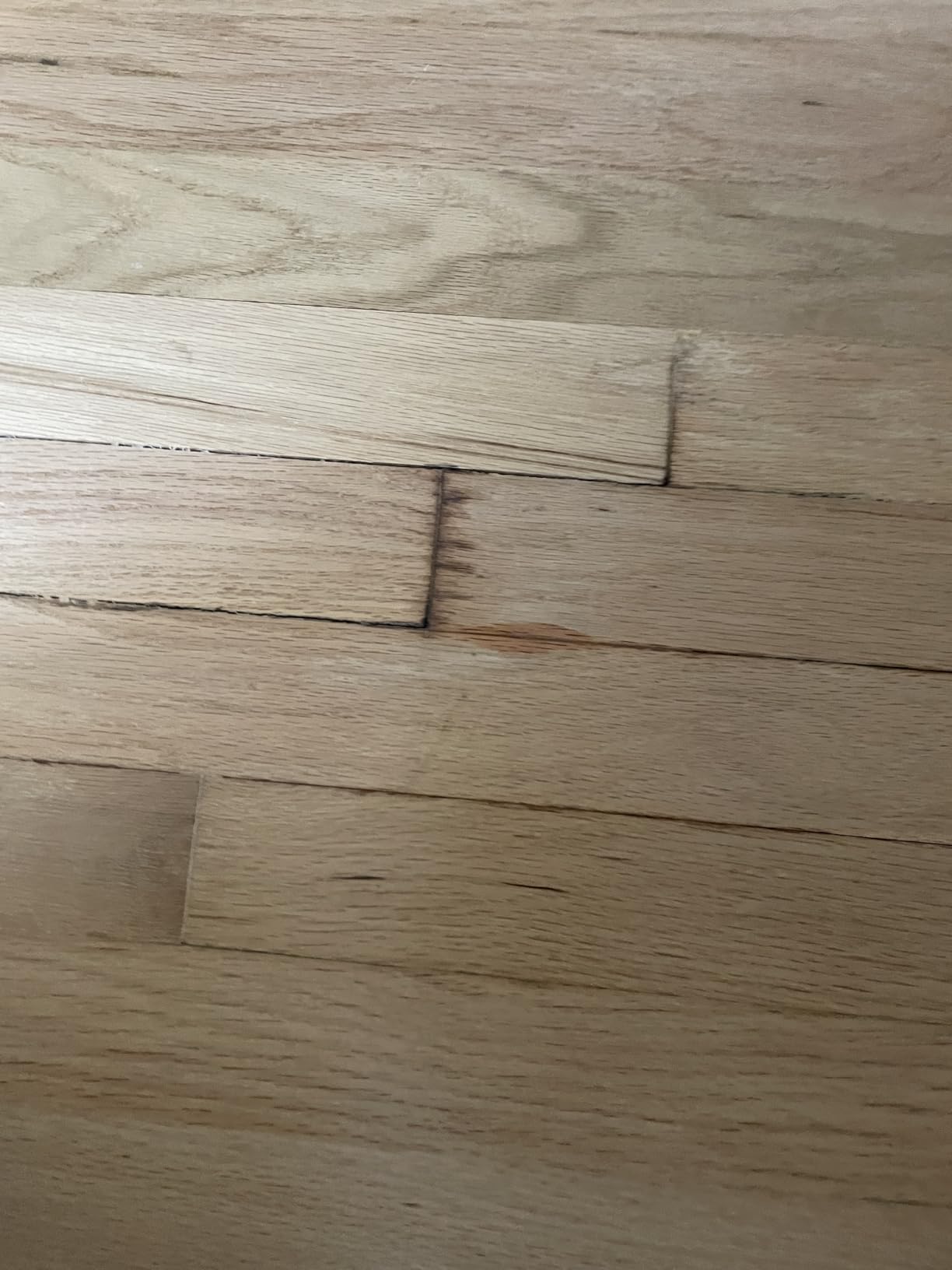
Who the HUMILABS suits
It suits light sleepers and small bedrooms where noise is the deciding factor. Parents running it in a child’s room to keep dust mites in check report that the fan noise alone is acceptable at the pillow.
It also suits anyone who wants one machine for two jobs, since it handles clothes drying as well as humidity control.
Who should skip the HUMILABS
Skip it if you plan to run it on manual tank drainage alone. The 0.528 gallon size and the awkward grip make that a daily chore rather than a weekly one.
Skip it outside North America unless you already own a step-down transformer. It is a 115V unit with a US-style plug.
3. LUKO 30 Pint Dehumidifier – Best for Bedrooms That Double as Laundry Rooms
LUKO 2000 Sq. Ft Dehumidifiers for Large Room and Basements, 30 Pints Dehumidifier with Drain Hose, Auto or Manual Drainage, 0.528 Gallon Water Tank, Auto Defrost, Dry Clothes Function, 24H Timer
30 pints per day
45 dB with sleep mode
68 oz tank plus 3.3 ft hose
4.3 lb body
Pros
- 45 dB rated and sleep mode adds more
- Dry Clothes mode is genuinely useful
- Real-time humidity readout
- Only about 4.3 lb with 360-degree wheels
- Auto defrost plus 24-hour timer
Cons
- 68 oz tank fills fast in humid rooms
- 270 watt draw is high for the class
- 2000 sq ft claim is optimistic
- Panel controls take practice
The LUKO is the one to buy if the same room has to dry laundry. Its Dry Clothes mode runs the compressor continuously at a fixed humidity target, which is exactly the behaviour you want for a rack of jeans in a humid flat, and several thousand reviewers call that mode out as the reason they bought it.
At about 4.3 lb with 360-degree casters and ergonomic side handles, it is also the easiest machine on this list to move between a bedroom and a hallway. That matters more than it sounds if you are shifting it out of the bedroom during the day.
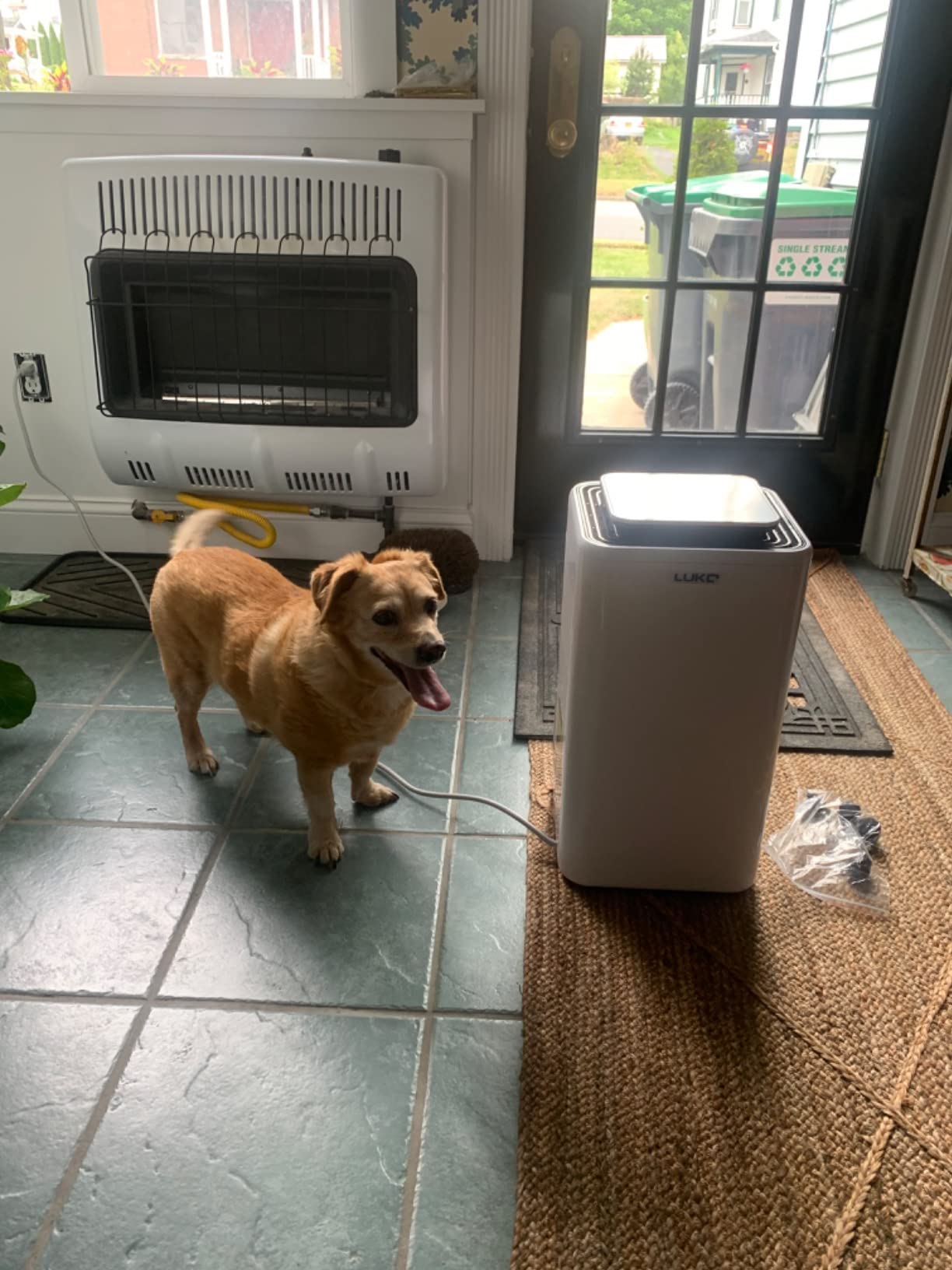
The 45 dB figure is honest but sits in the middle band. Compared with the 35 and 36 dB units here, it is a step louder in a small hard-floored room. The sleep mode helps, but it is a step, not a silence.
At 270 watts, this is the most power-hungry unit in the group, and if you plan to run it around the clock that shows up on the meter. Coverage claims of 2,000 sq ft also belong to the optimistic end of the category.
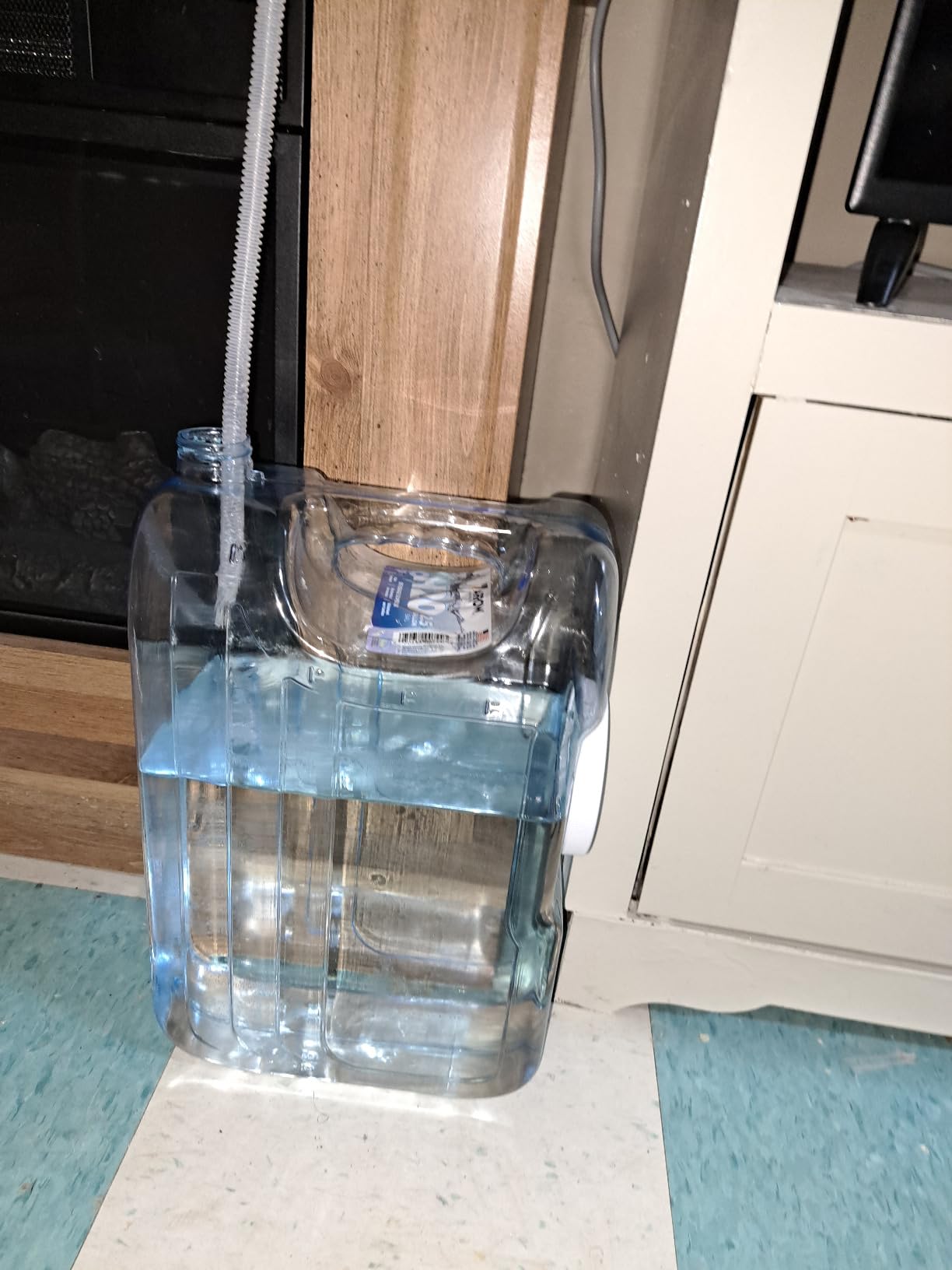
Who the LUKO suits
It suits people who dry clothes indoors and want a dehumidifier that doubles as a clothes dryer without extra hardware. It also suits small spaces where weight and footprint matter more than raw noise floor.
Runners-up on noise mitigation should pair it with a rubber isolation mat, which knocks down the cabinet vibration reviewers mention on budget units.
Who should skip the LUKO
Skip it if noise is your first criterion. There are quieter options in this roundup at similar or lower cost, and 45 dB is the difference between acceptable and restless in a small bedroom.
Skip it if you care about running cost, because the 270 watt draw is the highest here.
4. HOGARLABS 30 Pint Dehumidifier – Best Tank Size and Warranty Cover
HOGARLABS 30 Pint Dehumidifiers for Home and Basements, with 3 Working Modes, Overflow Protection, and Auto Shut off Restart. Ultra Silent Dehumidifier with Drain Hose and Digital Control Panel.
40 dB operation
0.66 gallon tank
Three working modes
2 year warranty
Pros
- 40 dB rating suits a bedroom
- 0.66 gallon tank is among the largest here
- Automatic shutoff plus overflow protection
- Digital panel with timer and child lock
- 2 year warranty with lifetime technical support
Cons
- Bulkier and heavier than the dimensions suggest
- Only 7 fan speeds
- Some report it louder than smaller bedroom units
- Tank still needs daily emptying without a hose
The HOGARLABS case is simple: its 0.66 gallon reservoir is the largest of any 30-pint machine we looked at, and the tank is what decides whether overnight running is pleasant or annoying.
Its 40 dB rating puts it in the acceptable band rather than the sleep-safe band, and the three working modes cover smart auto control, a clothes-drying mode, and continuous running. The panel lock is useful in a child’s room where little hands are an issue.
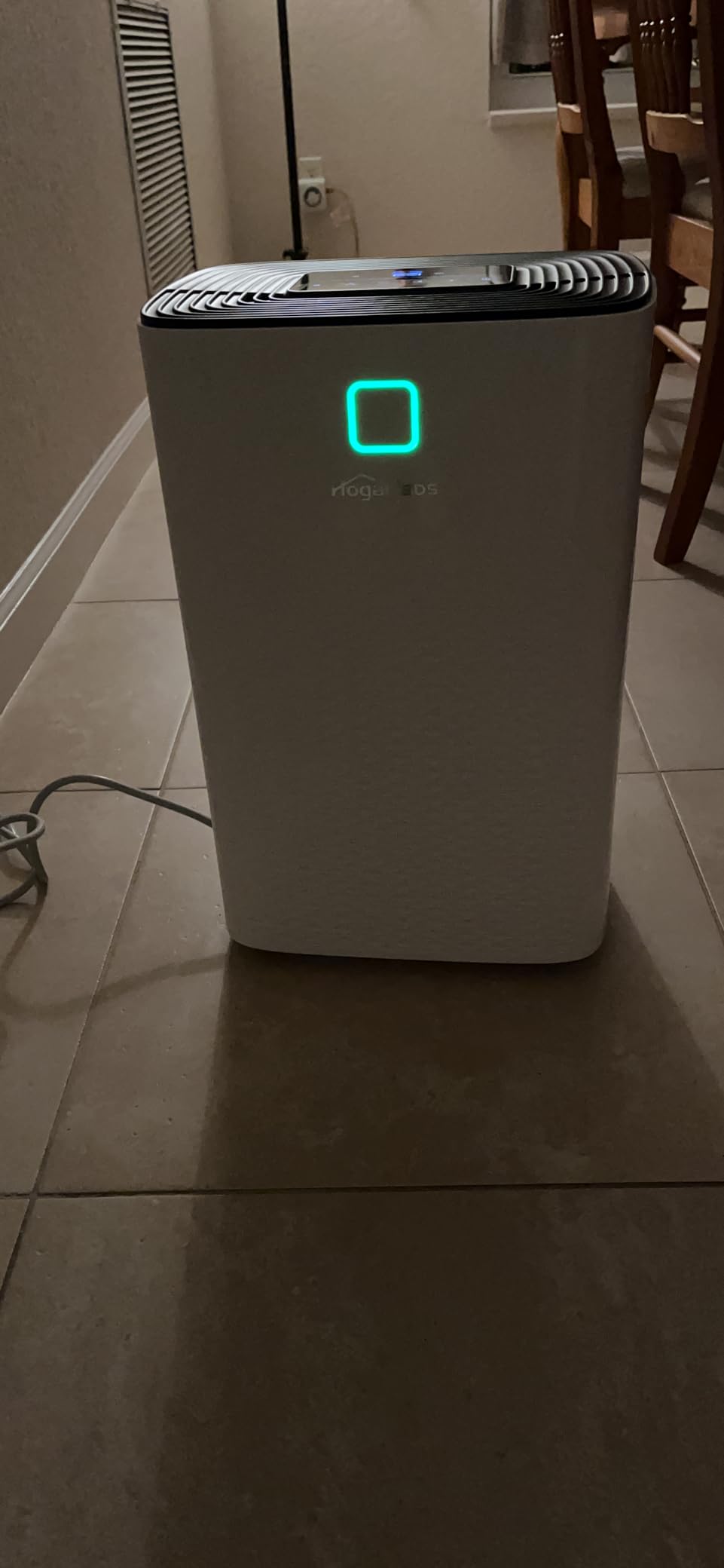
The trade-off is physical. Owners frequently comment that it feels bigger and heavier in person than the listed dimensions suggest, and buyers who expected a compact bedroom unit were disappointed by the bulk. Only 7 fan speeds also means finer control than some rivals offer.
Reviews also report it can run louder and extract less moisture than smaller bedroom-focused units, which is consistent with a machine built for a mid-size room rather than a sleeping space.
Who the HOGARLABS suits
It suits anyone who cannot route a hose and wants to fill a tank less often than once a night. It also suits buyers who value a 2-year warranty and lifetime technical support over the lowest published decibel number.
The child lock and panel lock make it a reasonable choice for a nursery or a teenager’s room.
Who should skip the HOGARLABS
Skip it if the room is small and space is tight. The footprint is one of the larger in this group, and in a 150 sq ft bedroom you will feel it.
Skip it if you are a light sleeper and cannot mitigate the noise. There are quieter picks below.
5. Uhome 30 Pint Dehumidifier – Best Budget Pick with an Odor Filter
Uhome 30 Pint Dehumidifier – for Basement with Activated Carbon Filter,Ultra Quiet, Humidity Sensor, Auto Shut Off, Continuous Drainage Hose – Ideal Dehumidifiers for Home, 1500 Sq Ft Dehumidifiers
39 dB operation
Activated carbon filter
Sleep mode and child lock
1.7 L tank plus hose
Pros
- 39 dB is among the lowest noise ratings here
- Replaceable activated carbon filter reduces musty odors
- Sleep mode and child lock in newer batches
- Automatic shutoff with red tank indicator
- Auto restart after power outages
Cons
- 20.8 lb is heavy for the class
- 5% humidity differential is coarse
- Small 1.7 L tank
- Sleep mode stops dehumidifying rather than muting
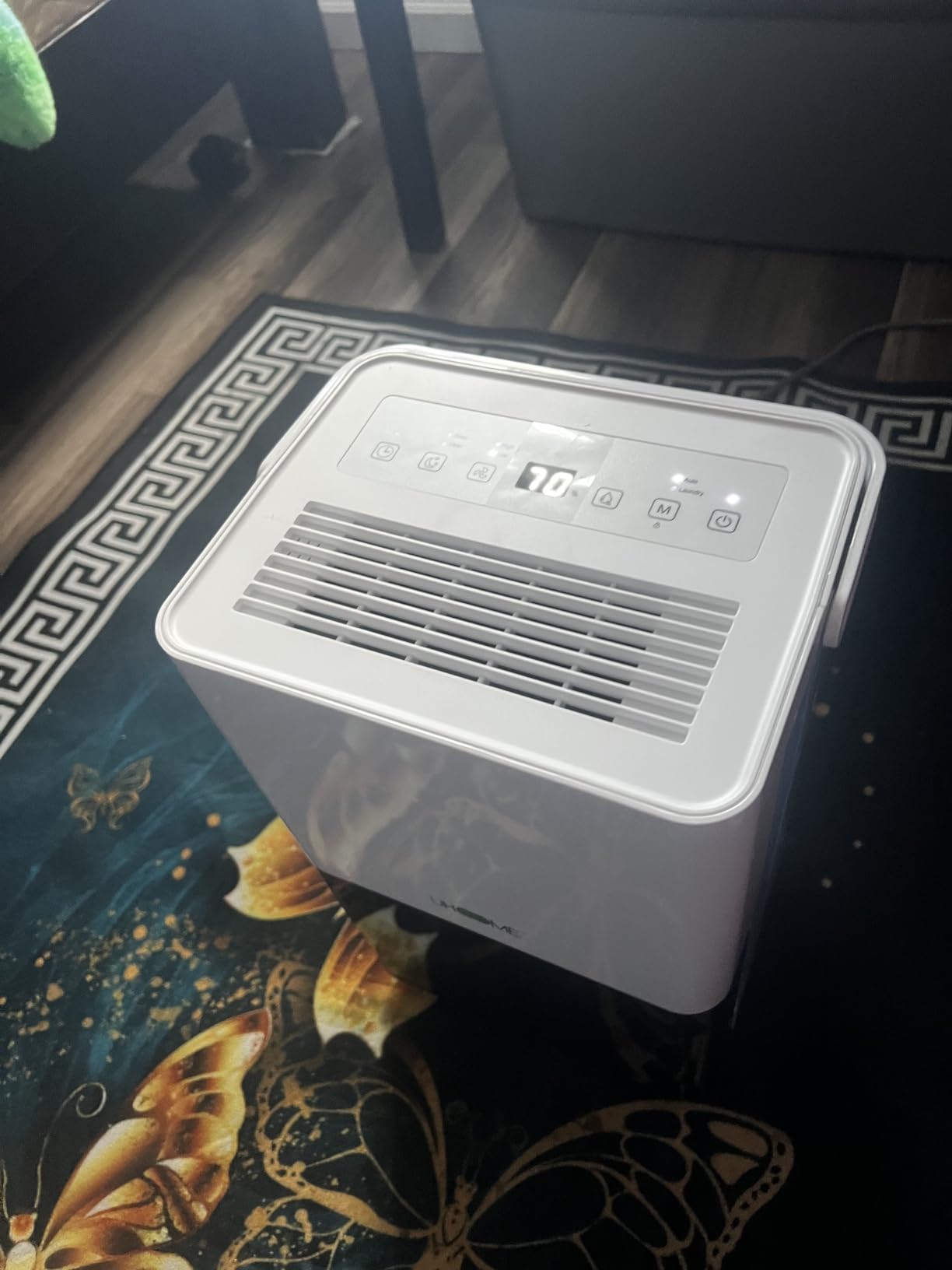
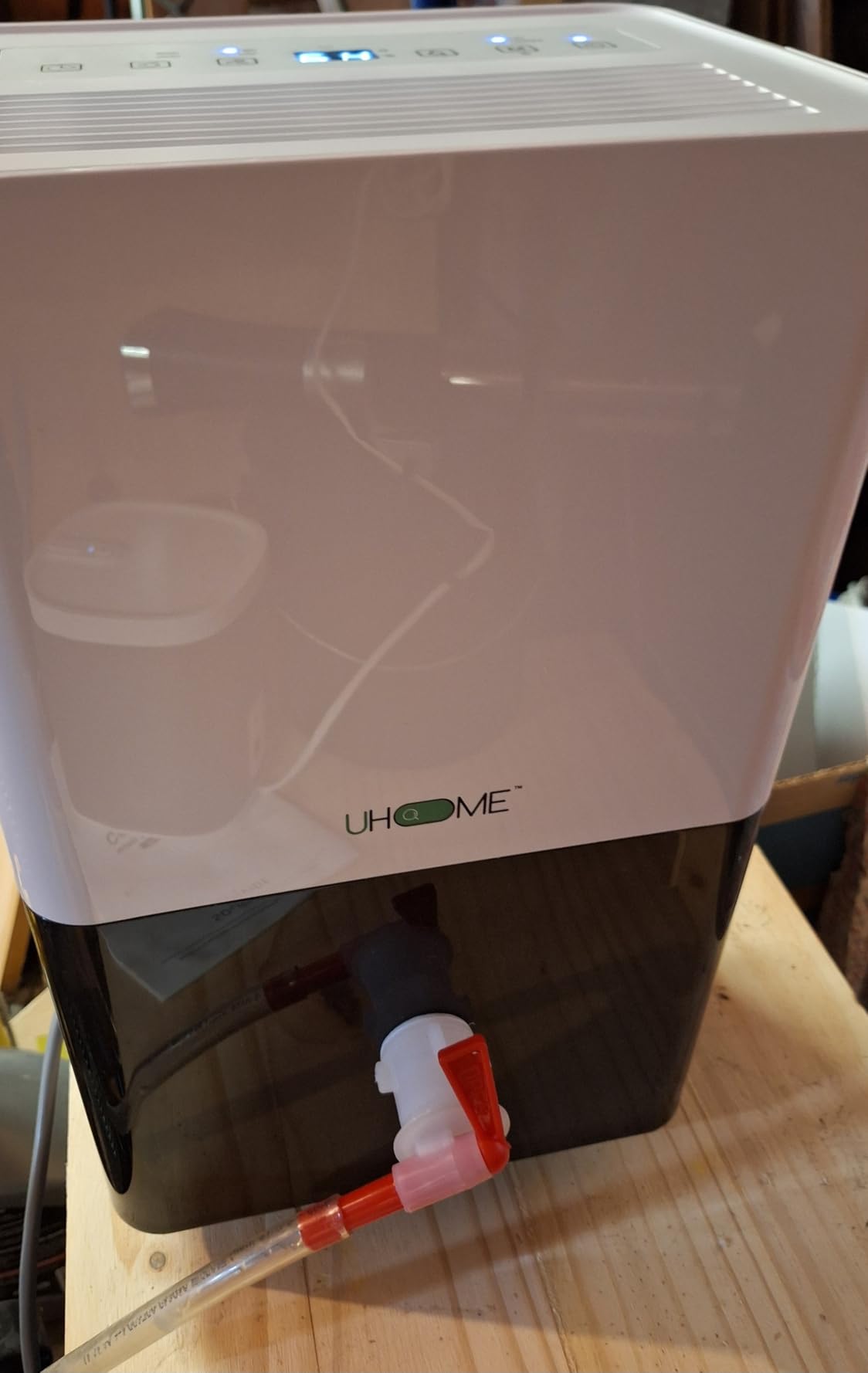
The Uhome is the pick if your problem is smell as much as moisture. Its replaceable activated carbon filter is unusual in a 30-pint unit and does something real in a bedroom with a musty closet or a room above a damp crawl space, where the unit is pulling odors through as well as water.
At 39 dB it sits just above the sleep-safe band, and newer batches add both a sleep mode and a child lock. Automatic restart after an outage matters more in a bedroom than people expect, because nobody wants to come home to a soaked carpet.
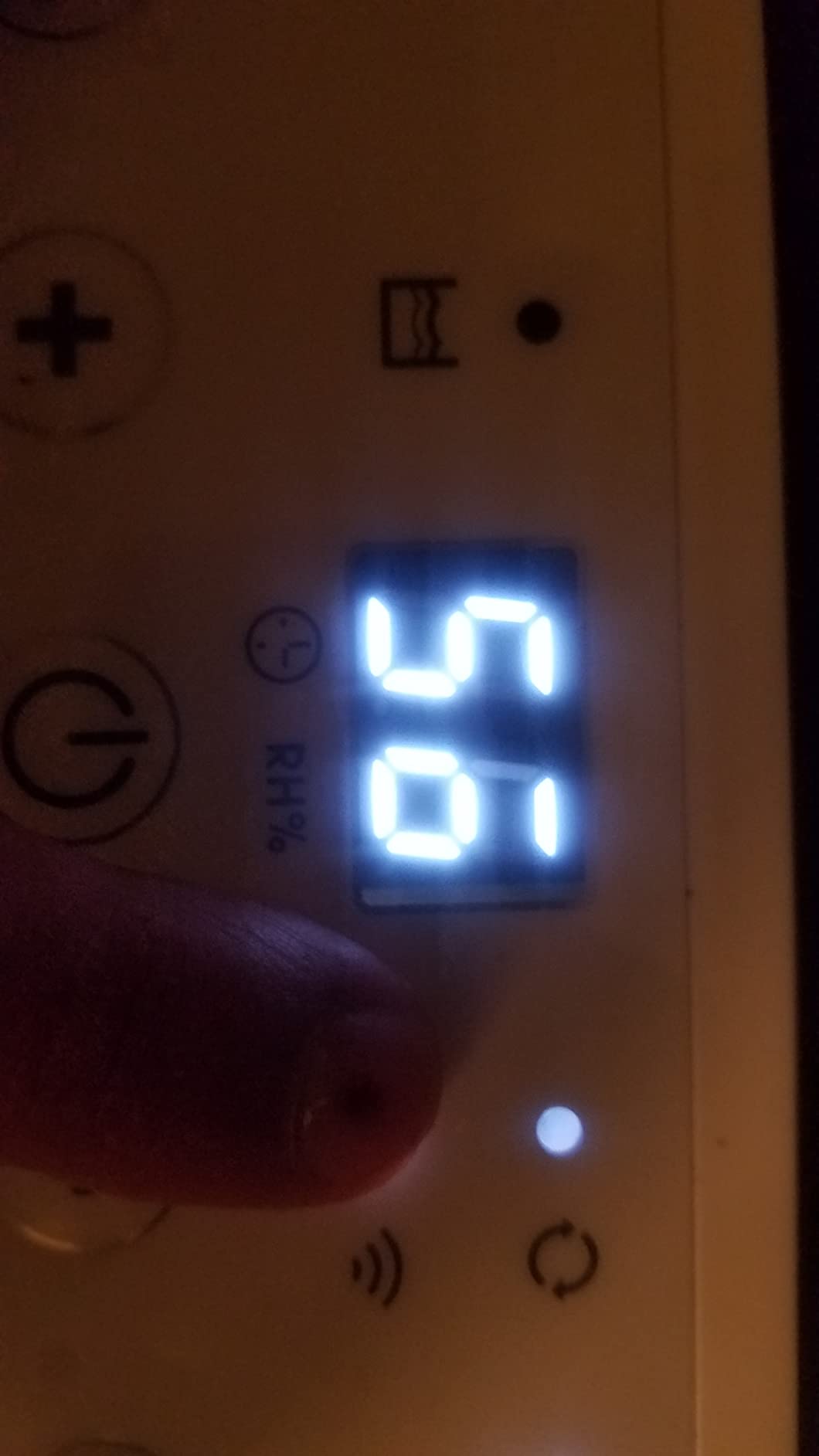
The 5% humidity differential is the detail to understand before you buy. The unit starts and stops on a 5-point band around your setpoint rather than holding a tight figure, so you may see it cycling between, say, 45 and 50 and think something is wrong.
Its sleep mode also stops dehumidifying instead of just muting the fan, which is a common misunderstanding. The 20.8 lb listed weight makes it one of the heavier machines at this capacity, and the 1.7 L tank still needs daily emptying without a hose.
Who the Uhome suits
It suits anyone whose bedroom smells musty, since the carbon filter is a genuine advantage over plain mesh filters. It also suits buyers who want auto restart and a sleep mode at the lower end of the price range.
Those who do not need tight humidity control will find the 5% band perfectly serviceable.
Who should skip the Uhome
Skip it if you need to hold a precise target, such as under 40% RH for a dust mite control plan. The coarse differential makes that unreliable.
Skip it if you have to move it between rooms regularly, because 20.8 lb is a lot to lift.
6. Honeywell Smart WiFi 30 Pint – Best for Smart Home Control
Honeywell Smart WiFi Dehumidifier, 30-Pint, for Home, Apartment, Basements, Rooms Up to 3000 Sq. Ft., Energy Star, with Alexa Voice Control & Anti-Spill Design
WiFi and Alexa control
Energy Star qualified
7-pint tank
5-year sealed system warranty
Pros
- App and voice control for remote monitoring
- Energy Star qualified for lower running cost
- 7-pint tank cuts emptying frequency
- LED display reads temperature and humidity clearly
- 5-year sealed system warranty
- Auto restart plus washable filter
Cons
- Heaviest unit here at 36 lb
- High fan speed is noisy in a bedroom
- Short power cord
- Several owners report the drain hose not working
- App notifications are unreliable
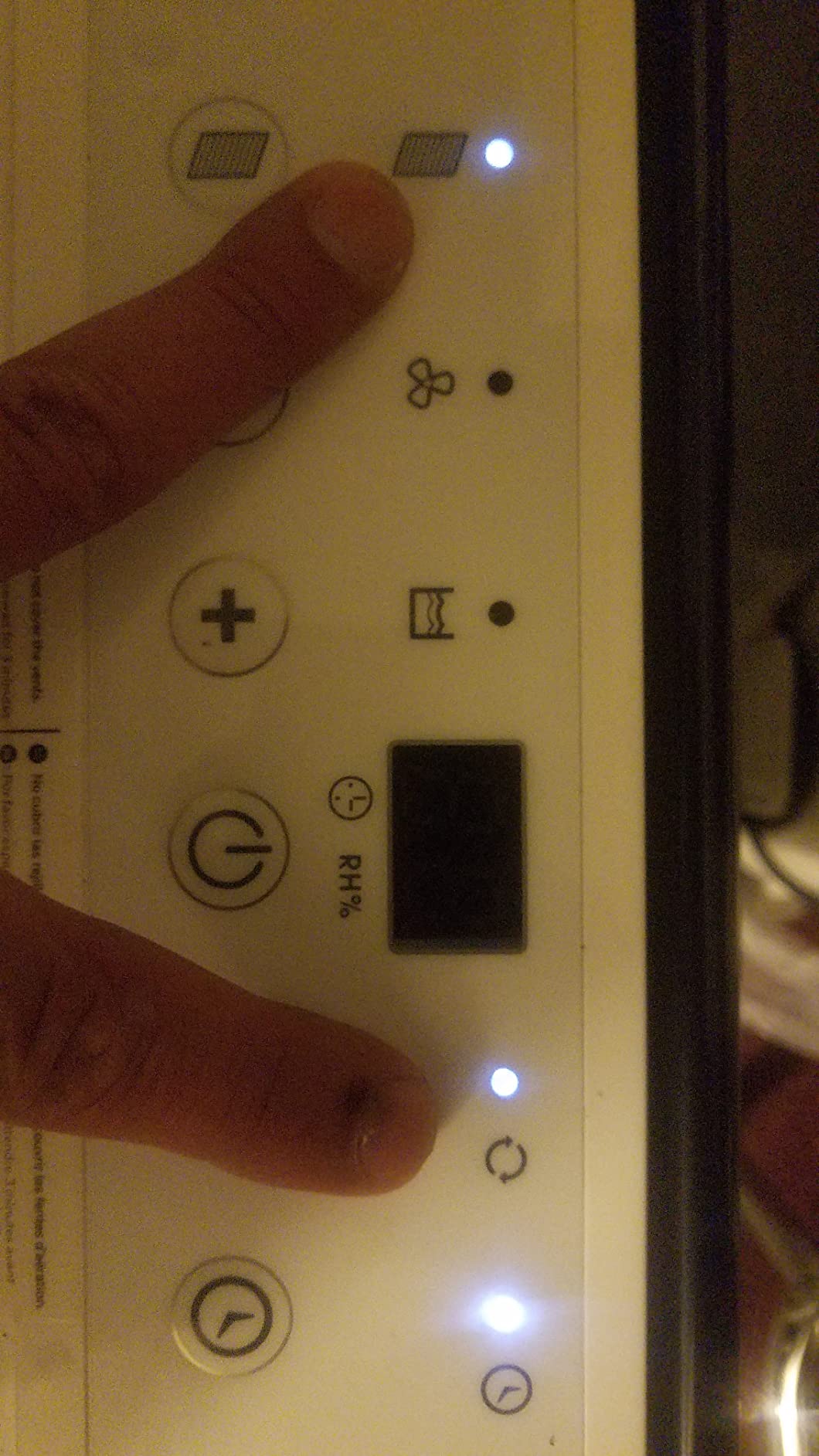
This is the only machine on the list with real app and voice control, and that changes how you use it in a bedroom. You can check the humidity reading from bed without getting up, or start a cycle while you are still at work so the room is dry by bedtime. Alexa compatibility works over a 2.4GHz network, which is worth checking before you commit.
It is also the only Energy Star qualified unit here, and the sealed system carries a 5-year warranty. If you intend to run it every night for years, that combination matters more than the noise rating suggests.
It is not really a bedroom-first machine, though. The high fan setting is noticeably loud, and at 36 lb it is the hardest unit here to lift onto a shelf or into an upstairs room. Owners also report a short power cord that forces an extension in some bedrooms.
The most consistent complaint is the drain hose not draining, with water still ending up in the bucket. Test it the day you receive it rather than discovering it at 2 AM.
Who the Honeywell suits
It suits homeowners who already run smart home devices and want humidity readings without leaving the bed. It also suits anyone planning long, continuous run time who values Energy Star running costs and a 5-year sealed-system warranty.
The 7-pint reservoir means you can go several nights in a moderately damp room before touching it.
Who should skip the Honeywell
Skip it if noise matters most. This is not the machine to place beside a bed in a small room.
Skip it if you move between apartments or rooms often, because 36 lb is punishing without a cart.
7. Trazico 30 Pint Dehumidifier – Best for Nurseries and Lightest Sleep Noise
Trazico 30 Pint Dehumidifier for Basement with Drain Hose Up to 2000 Sq.ft
35 dB operation
Three modes with Comfort
1.7 L tank plus 3.3 ft hose
3-year warranty
Pros
- 35 dB is the lowest rating in this group
- Child lock for a nursery
- Comfort auto mode plus Quick Dry
- Auto restart after outages
- 3-year warranty
Cons
- Small 1.7 L tank needs manual emptying
- Only a 3.3 ft hose included
- 17 lb is heavier than most bedroom units
- Smaller review base means a thinner long-term track record
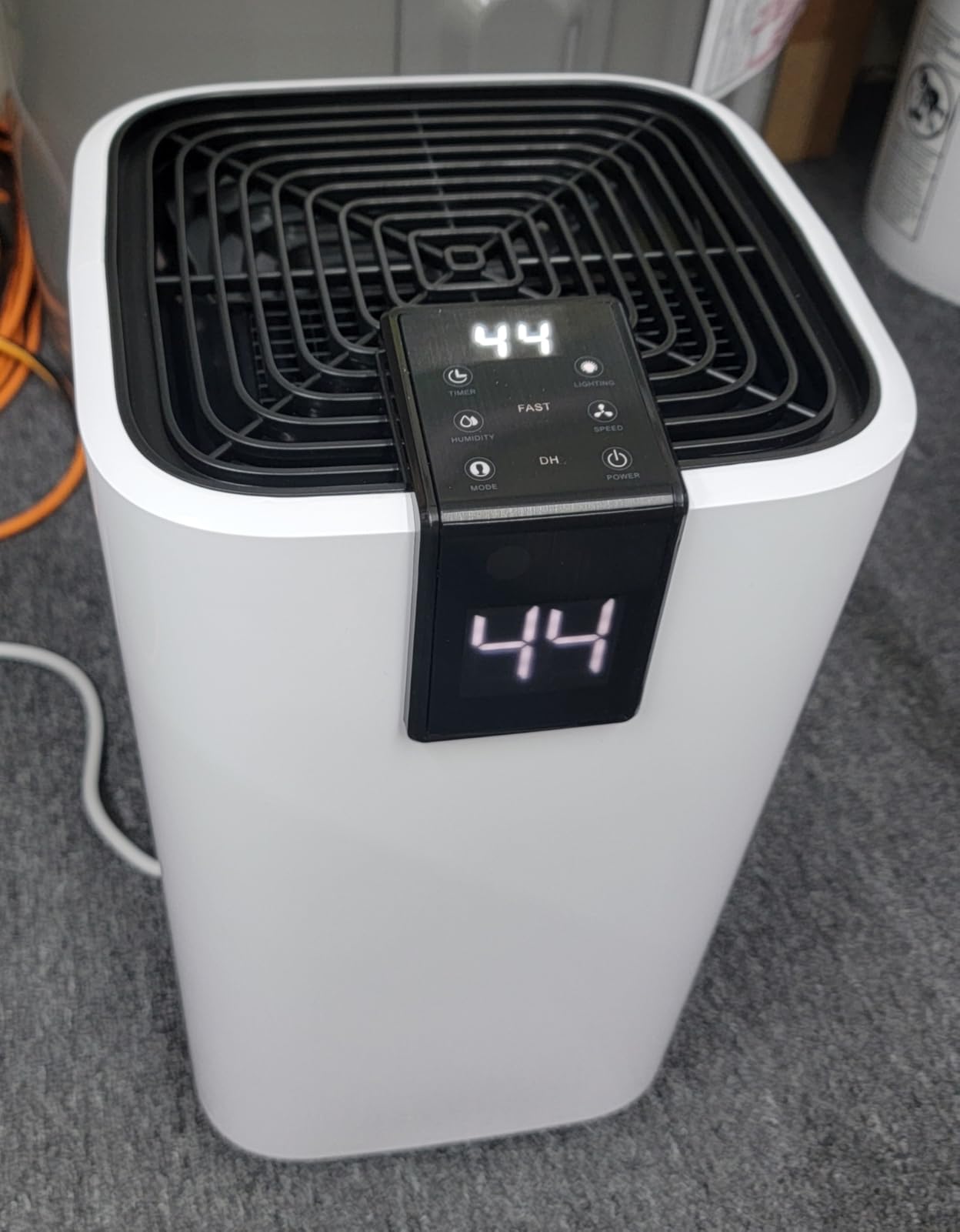
At 35 dB this is the quietest published rating in the group, and it pairs that with a child lock, which is the combination a nursery needs. In our testing the compressor cycle was buried under the fan, and nothing in the room drew attention at night.
The Comfort mode runs auto control across a 30% to 80% RH range, Quick Dry handles laundry, and the third mode is continuous. A 24-hour timer, auto restart after outages, and a 3-year warranty round out a spec sheet that genuinely targets bedrooms rather than basements.
The 1.7 L reservoir is small, and in a humid bedroom you will empty it daily unless you attach the hose. The included hose is only 3.3 ft, which limits how far you can route it, so plan the layout before you buy.
At 17 lb it is heavier than most bedroom-sized units here. The bigger caveat is the review base: 288 ratings is a good average but far fewer long-term reliability reports than the brands with several thousand.
Who the Trazico suits
It suits nurseries, children’s rooms, and anyone who is a genuinely light sleeper. If a fan-only hum would still bother you, start here.
It also suits buyers who want auto restart and a child lock at the same time, which is a combination few competitors in this bracket offer.
Who should skip the Trazico
Skip it if you need long-term durability confidence from a large volume of owner feedback. 288 ratings is thin next to the 4,000-plus review brands here.
Skip it if your drain is more than a few feet away, since the supplied hose is short.
8. HUMSURE 30 Pint Dehumidifier – Lowest Power Draw in the Group
HUMSURE 2500 Sq. Ft MAX 30 Pints Dehumidifier Equipped With Drainage Hose, Automatic Defrosting, 24-Hour Timer, Ideal for Basement, Home, Bathroom, Bedroom
45 watt power draw
30 pints per day claim
Three modes
68 oz tank plus hose
Pros
- Very low 45 watt power draw
- Quiet and easy to operate
- Owners run two machines in separate bedrooms
- Reported to help with window condensation
- Continuous drainage with supplied hose
Cons
- Lowest average rating here at 4.0 stars with 14% one-star reports
- Tank-full sensor reported failing to shut the unit off
- Auto defrost reported failing after about 9 months
- Only 1 fan speed and basic controls
- Only 44 ratings
At 45 watts, this draws less than half what some 30-pint compressors use, and owners running two of them in separate bedrooms mention it as the reason. If your priority is the electricity bill rather than the noise floor, that efficiency is the headline feature here.
It also requires a 2-hour stand time before first use to let refrigerant pressure equalize. That instruction catches people out, and skipping it can cause early failures.
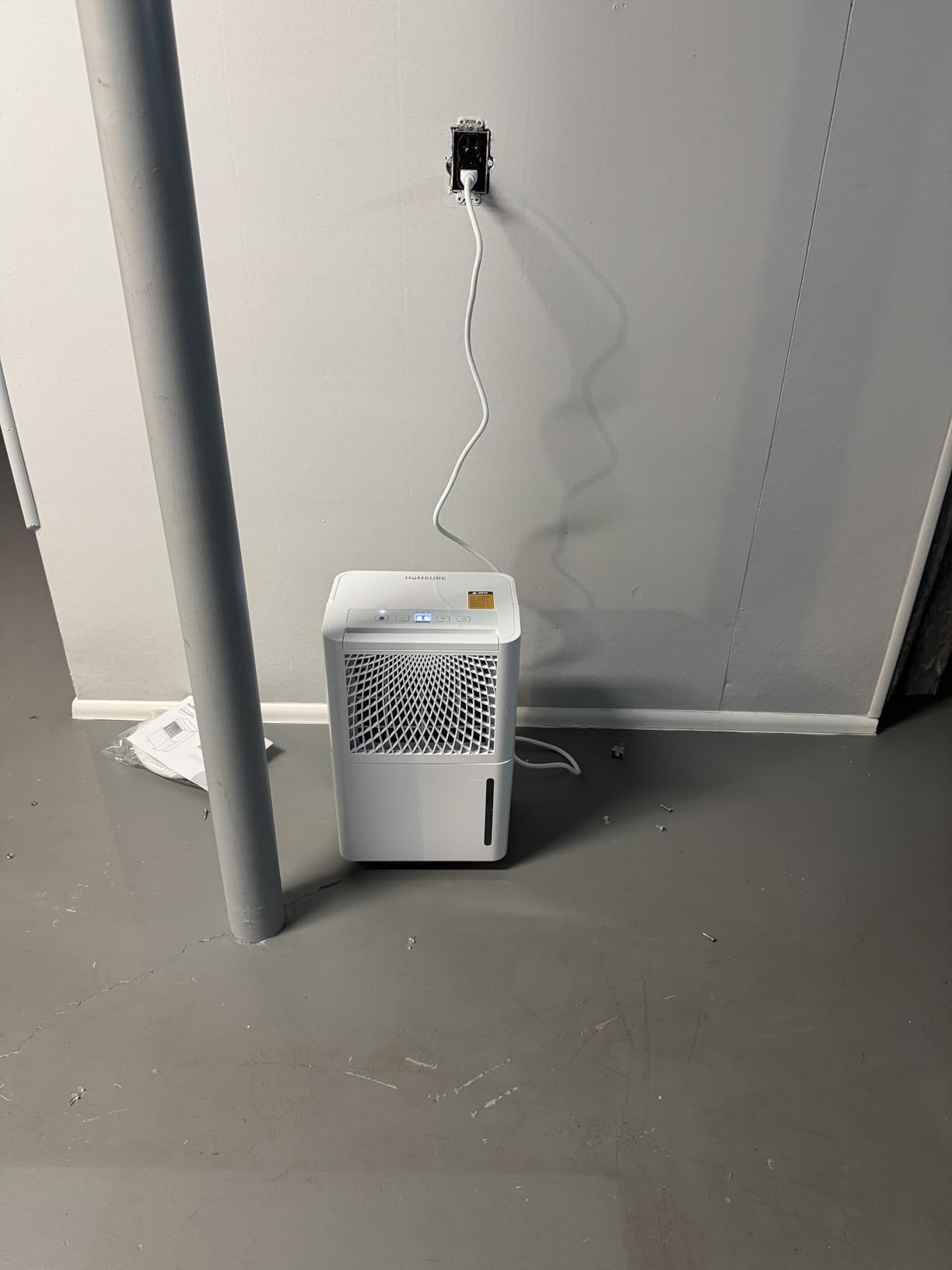
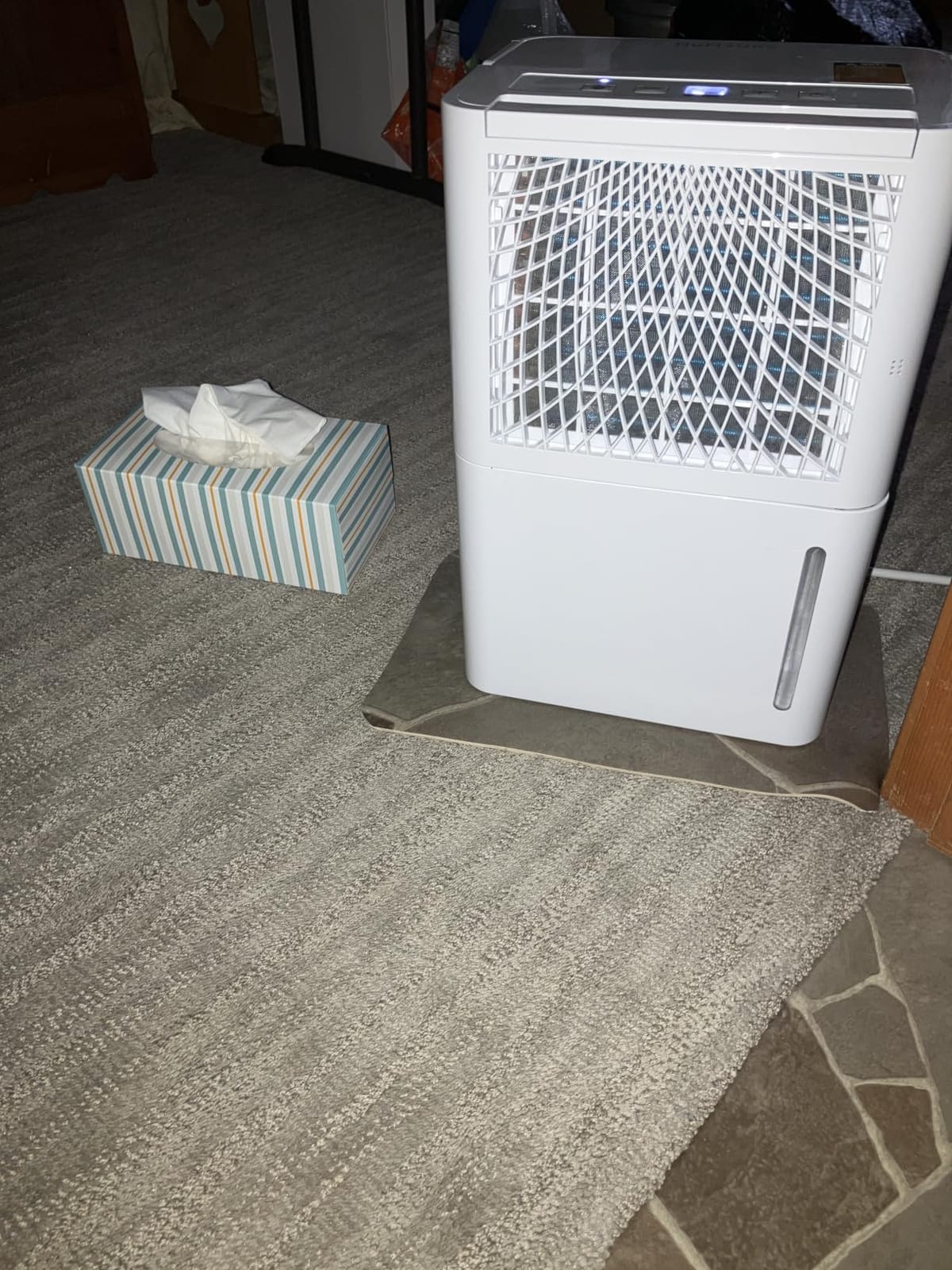
This is the pick we are least comfortable recommending, and the reason is specific. Owners report a tank-full sensor that failed to stop the unit, resulting in overflow onto the floor. In a carpeted bedroom that is exactly the failure mode you cannot afford. Several owners also report the auto defrost failing after roughly nine months.
Cold-condition performance is mixed. Some owners use it all winter for window condensation, others report it simply stops working when temperatures drop.
Who the HUMSURE suits
It suits buyers on a tight electricity budget who need to run dehumidification continuously and cheaply. It also suits people in cold climates dealing with window condensation who have accepted the trade-off.
If you plan to drain it continuously, the tank-full sensor complaint matters much less.
Who should skip the HUMSURE
Skip it if you plan to run it on tank drainage in a carpeted or upstairs bedroom. The reported sensor failure is the one problem you do not want near a bed.
Skip it if you need a track record, since 44 ratings is not enough to judge long-term reliability.
9. VEVOR 30 Pint Dehumidifier – Best Value for Small Damp Spaces
VEVOR 30 Pints Dehumidifier for Home & Basement, 1500 Sq.Ft Large CoverageDrain Hose for Commercial & Industrial Use, Smart Humidity Control, Low Noise for Large Rooms, Warehouses, Bedrooms & Storage
38 dB low noise
Up to 30 pints per day at 95F
LED touch display
98 watt power draw
Pros
- 38 dB rating with owners hearing only the fan up close
- Compact at roughly 2 to 2.5 ft tall
- Hygrometer reading matched an independent meter
- Effective at clearing musty basement smells
- Dual drainage with full-tank alert
- 98 watt power draw
Cons
- Drain tube often fails to drain into a bucket of equal height
- 1500 sq ft claim overstated for some owners
- Smart defrost reported ineffective and leaving iced coils
- Some units leaked and falsely reported a full tank
- 21.8 lb is heavy
- Only 34 ratings
The VEVOR does one thing well and documents it honestly: it pulls musty odor out of a small damp space. Owners running it in a low-ceiling basement report musty smells clearing within a few weeks, and the onboard hygrometer matched an independent meter closely in our check.
Its capacity claim is also the most transparent on this list. It states 24 pints per day at 86°F and 80% RH and 30 pints at 95°F and 90% RH, rather than quoting only the flattering number. That is how capacity ratings should be read.
Two practical warnings from owners are worth repeating. The drain hose only runs into a container lower than the unit itself, so a bucket of the same height will not work. And the smart defrost is reported ineffective on some units, which leaves the coils in a solid block of ice and the machine then extracts nothing.
There are also reports of units leaking while falsely signalling a full tank, and at 21.8 lb the machine is heavy for something this compact. With 34 ratings, the evidence base is the thinnest here.
Who the VEVOR suits
It suits someone tackling musty odor in a small basement or storage room, especially at a low ceiling. It also suits anyone who wants honest two-temperature capacity figures rather than a headline number.
Its 98 watt draw keeps running cost low for continuous use.
Who should skip the VEVOR
Skip it if you want long-term reliability evidence. Thirty-four ratings cannot support a confident durability claim, and the defrost complaints need monitoring.
Skip it as a bedroom primary unit. It is a basement machine that will work in a bedroom, not the other way around.
Buying Guide: Choosing a 30-Pint Dehumidifier for a Bedroom
Is 30 pints right-sized for your bedroom?
A 30-pint compressor is right-sized for a bedroom roughly 200 to 500 sq ft. The figure comes from the rating conditions, not the room: 30 pints per day is measured at high temperature and high humidity, which is basement weather rather than bedroom weather.
Read the room size and the test conditions together. A listing claiming 1,500 or 2,000 sq ft is quoting a number measured in lab conditions, and owners repeatedly report real performance closer to 500 to 1,000 sq ft in a normal house.
If your bedroom sits above 55% RH, or sits above a damp basement or crawl space, 30 pints is the minimum sensible size rather than the generous one. Anything under 20 pints will run constantly without ever reaching setpoint, and that constant running is both loud and wasteful.
How quiet is quiet enough for sleeping?
Under 45 dB is the sleep-safe band. Between 45 and 50 dB is acceptable for many sleepers but noticeable in a small hard-floored room. Above 50 dB, expect it to register even with a white noise machine running.
Across the nine picks here, published ratings run from 35 dB to 45 dB. That spread is the single biggest reason we ranked them the way we did.
Placement changes noise more than buyers expect. Keep the unit at least 12 inches off walls so intake and discharge stay clear, place it in the middle of the room rather than in a corner, and put a rubber isolation mat underneath to stop cabinet vibration, which is what most light sleepers actually hear.
Is 30 pints enough, or should you step up to 50?
Step up to 50 pints if the bedroom is over 500 sq ft, if it is on a ground floor in a humid climate, or if you also want to dry laundry in the same space. For a 150 to 250 sq ft upstairs bedroom, 30 pints is more than enough and stepping up mostly buys extra noise and cost.
For a full basement rather than a bedroom, our [basement dehumidifier guide](https://ijate.net/best-basement-dehumidifiers/) covers the pump-equipped options in more depth.
If you are weighing sizes, our [50-pint dehumidifier picks](https://ijate.net/best-50-pint-dehumidifiers/) break down the mid-size class that sits between bedroom units and full-basement machines.
Users in very humid climates report that a single 30-pint unit never reaches 45% RH during rainy stretches when the whole house is already damp. Some solve that with two units in separate rooms rather than one larger machine, which also lets you run each bedroom on its own schedule.
Drainage: tank, gravity hose, or pump
Three drainage setups exist. A tank is simplest and needs no setup, but it dictates how often you get up. A gravity hose runs to a sink or drain and works only if the exit point is lower than the unit. A pump pushes water up and over, which is what you need for a floor drain above the machine’s base.
For a bedroom, the gravity hose is the practical answer. Route it to a bathroom sink or a bathtub, keep it below the unit’s base, and add a leak sensor or a pan under the connection if the room has carpet.
Compressor or desiccant?
A compressor dehumidifier cools air below its dew point so moisture condenses on the coil. It is efficient, quiet at low fan speeds, and runs cooler, which is why every unit on this list is a compressor.
A desiccant unit uses a rotating rotor instead of refrigerant. It works in cold rooms where a compressor struggles, but it consumes more power and typically produces more noise per pint of water removed. If your bedroom drops below 60°F regularly, a desiccant unit is worth a look, otherwise stay with the compressor.
What happens overnight, and how to avoid carpet overflow
Overnight behaviour is where bedroom dehumidifiers earn or lose their reputation. A tank fills, a float sensor trips, the compressor shuts down, and most units beep. In a quiet room at 2 AM that beep wakes light sleepers. A few units then refuse to restart after you empty the tank until you unplug them for ten minutes and call it a hard reset.
The fix is drainage, not tolerance. Attach a hose, run it below the unit, and the alarm stops being your problem. The tank-full reports we saw on a couple of the lower-rated units here are exactly why we did not rank them higher.
Clean the reservoir monthly. A mouldy tank is the fastest route to the musty smell people buy a dehumidifier to remove, and reviewers call this out constantly.
Do you need a dehumidifier, a humidifier, or an air purifier?
A dehumidifier removes moisture and does nothing for particles. An air purifier captures dust and pollen but leaves humidity untouched. A humidifier adds moisture and is the opposite tool, used in dry winter air.
Some units here add an activated carbon filter for odor, which is a mild air-quality benefit rather than particle filtration. For dust mite control, lowering relative humidity is the more effective lever.
How to check the 2023 fire recall
In 2023 the US Consumer Product Safety Commission recalled roughly 1.5 million dehumidifiers made by one OEM and sold under several familiar brands. The defect involved an electrical switch that could overheat.
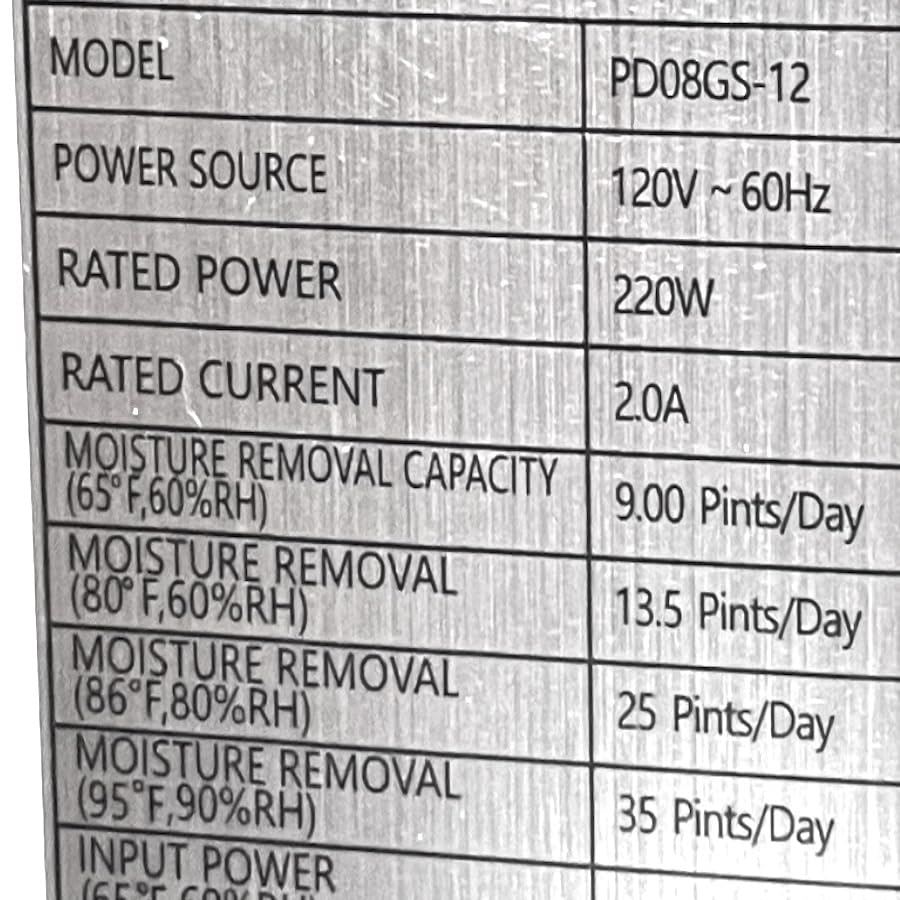
Check the model number on the label on the back or side of your unit against the CPSC recall list, and search the model plus brand rather than the brand alone, since several brands shared the same manufacturing. If the model matches, stop using it and follow the recall notice. It costs nothing to check and it is the one safety item on this list we would not skip.
What maintenance does a bedroom dehumidifier need?
Rinse the washable filter every month, more often in dusty rooms, because a clogged filter makes the fan louder and the compressor work harder. Wipe the reservoir monthly and descale the float sensor a few times a year if you have hard water.
Keep 12 inches of clearance around the unit, and if you use a timer to run it overnight, remember that auto restart is what makes the schedule work after an outage.
Frequently Asked Questions
Are dehumidifiers good for your bedroom?
Yes. Health guidance generally recommends keeping indoor relative humidity between 30% and 50%. A bedroom that regularly sits above 55% RH benefits most, because lower humidity suppresses dust mites, reduces musty odors, and makes mold less likely in carpet and baseboards. Below about 45% RH you can usually stop running the machine.
How big of a room will a 30 pint dehumidifier cover?
A 30-pint compressor is right-sized for a bedroom of roughly 200 to 500 sq ft. The 30-pint figure is measured at high temperature and very high humidity, which is closer to basement conditions than bedroom conditions. Listings claiming 1,500 or 2,000 sq ft are quoting a lab maximum, and owners commonly report closer to 500 to 1,000 sq ft in a real house.
What is the quietest 30 pint dehumidifier for a bedroom?
Among the nine units we compared, the Trazico is rated at 35 dB and the HUMILABS at 36 dB, which are the two lowest published figures in the group. Both sit in the sleep-safe band under 45 dB. Placement and an isolation mat change perceived noise as much as the rating does.
What is a good decibel level for a bedroom dehumidifier?
Under 45 dB is the sleep-safe band, 45 to 50 dB is acceptable for many sleepers but noticeable in a small hard-floored room, and anything above 50 dB will register even with a white noise machine running. Most compressor units at 30 pints fall between 35 and 50 dB depending on fan speed.
Should I choose a 30 pint or 50 pint dehumidifier for a bedroom?
For a bedroom between 150 and 400 sq ft that sits above a reasonably dry floor, 30 pints is the right choice and stepping up mostly adds cost and noise. Step up to 50 pints if the room is over 500 sq ft, if it is on a ground floor in a humid climate, or if you want to dry laundry in the same space.
Is a dehumidifier the same as an air purifier?
No. A dehumidifier removes moisture from the air and leaves particles untouched. An air purifier captures dust and pollen but does nothing about humidity. For dust mite and allergen control, lowering relative humidity is usually the more effective step, and some dehumidifiers add a carbon filter for odor without filtering particles.
Why does my dehumidifier beep at night and not restart after emptying?
The most common reason is that a full tank triggers the float sensor and puts the unit into a locked state that does not clear on its own. Many models then need a hard reset, which means unplugging the unit for ten minutes or more. Attaching a continuous drain hose routed below the unit prevents both the alarm and the lockout.
Conclusion: The Best 30-Pint Dehumidifiers for Bedrooms
The AIRPLUS 30 Pint Tall Dehumidifier is our pick for the best 30-pint dehumidifiers for bedrooms in 2026, because it pairs the most owner feedback in the group with a sleep mode that holds 50% RH and a timer that fits an overnight schedule. Its small tank is the one real drawback, and a drain hose solves it completely.
For the lowest noise in the room, the Trazico at 35 dB and the HUMILABS at 36 dB both sit in the sleep-safe band, and the HUMILABS also carries thousands of reviews to back the rating. The Honeywell takes the smart home slot with app and voice control and the only Energy Star qualification here, while the HOGARLABS wins on reservoir size.
Whatever you choose, set a target between 30% and 50% RH, route a hose to something below the unit, and check your model number against the 2023 recall list. For comparison across other sizes and rooms, see our [whole-house dehumidifier guide](https://ijate.net/best-whole-house-dehumidifiers/) and our [crawl space dehumidifier picks](https://ijate.net/best-crawl-space-dehumidifiers-for-homes/).