
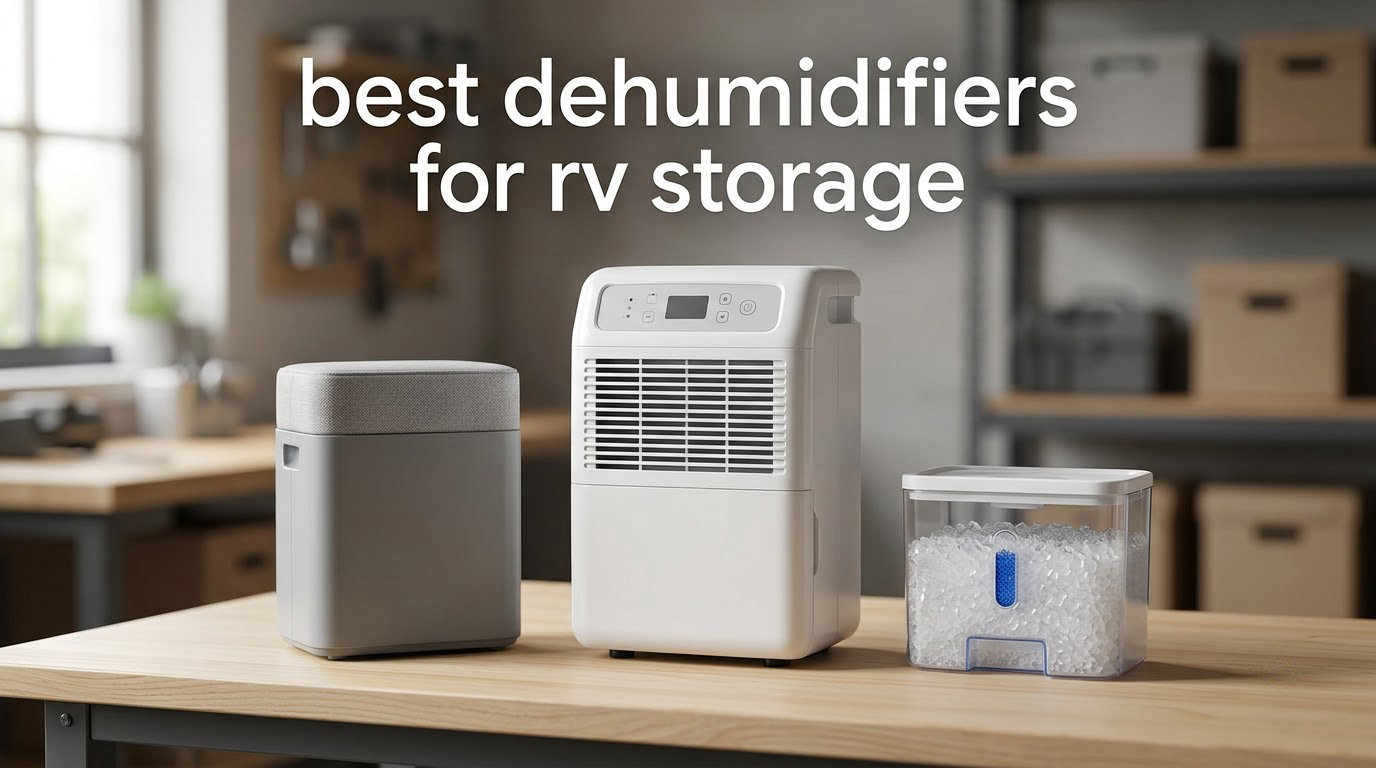
Quick answer: for long-term unpowered RV storage, the Eva-Dry E-500 renewable silica gel unit is the best overall pick among these ten, because it pulls 6-8 oz of moisture in sealed spaces up to 500 cubic feet, needs no power at all while it works, and recharges on a wall outlet only every two to four weeks. If your storage bay has 120V power, the Pro Breeze PB-03-US is the strongest pick you can run unattended, and if you mainly need to protect one closet or cabinet, the Eva-Dry E-333 is the most proven.
Humidity is the quiet enemy of a parked RV. A sealed trailer sitting in coastal, Gulf Coast or Pacific Northwest conditions traps warm damp air against cool exterior walls, and relative humidity climbs past the 60% threshold where mold, mildew and musty odors start. The EPA guideline is to keep indoor relative humidity below 60% RH, and for a rig in storage the practical target is 35-50% RH. Getting there is mostly about how long the trailer sits, not about how nice the interior is.
Here is the honest problem with almost every roundup on this topic: most of the devices sold as RV dehumidifiers are far too small to change the humidity of a whole trailer. A thermo-electric Peltier unit pulls somewhere around 0.4 to 1 liter per day, and a passive silica gel unit collects grams at a time. Those numbers are fine for a closet, a storage bay or a small van, and misleading for a 30-foot travel trailer. I compared ten real units on the criteria that actually matter in storage: extraction rate, power draw, minimum operating temperature, tank size, drainage method and noise.
The second thing almost every roundup leaves out is coil freeze. A refrigerant compressor unit that works brilliantly in a basement can ice over and shut down in an unheated storage bay once the space drops toward its rated floor. Every unit below states its temperature threshold so you can match it to the climate your rig lives in. Our general guidance for larger covered spaces is in our crawl space dehumidifier guide, since the physics of a sealed low-slung enclosure are much the same.
Before buying anything, check the temperature your storage space actually holds through the winter. That single fact rules most devices in or out.
Table of Contents
Top 3 Picks for RV Storage (October 2026)

Eva-Dry E-500 Silica Gel
- 6-8 oz absorbed
- Cordless while in use
- Recharges in 16-18 hours
- Up to 500 cu ft

Eva-Dry E-333 Cordless
- 6 oz capacity
- 20-30 days per charge
- No power or batteries
- Hangs or stands anywhere
Best Dehumidifiers for RV Storage in 2026: Quick Overview
All ten units below are grouped by what they are actually good at, not by category labels. Note the power column carefully, because it decides where in your storage facility each one can go.
| Product | Specifications | Action |
|---|---|---|
| Eva-Dry E-500 Silica Gel |
|
Check Latest Price |
| Pro Breeze 52 oz Mini |
|
Check Latest Price |
| Eva-Dry E-333 Cordless |
|
Check Latest Price |
 Levoair 68 oz with Drain Hose Levoair 68 oz with Drain Hose |
|
Check Latest Price |
 Eva-Dry EDV-1100 Petite Eva-Dry EDV-1100 Petite |
|
Check Latest Price |
 SANVINDER 25 oz Unit SANVINDER 25 oz Unit |
|
Check Latest Price |
 Pro Breeze Osmo Absorber Pro Breeze Osmo Absorber |
|
Check Latest Price |
 Camco Moisture Absorber Camco Moisture Absorber |
|
Check Latest Price |
 SEEKR Stor-Dry Circulator SEEKR Stor-Dry Circulator |
|
Check Latest Price |
 Deyagoo 50 oz Unit Deyagoo 50 oz Unit |
|
Check Latest Price |
1. Eva-Dry E-500 Renewable Silica Gel Unit: Best Overall for Unpowered Storage
Eva-Dry E-500 Renewable Silica Gel Dehumidifier, Cordless, No Batteries
Absorbs 6-8 oz in up to 500 cu ft
Cordless while in use
2.25 x 8.5 x 5.5 inch, 1.8 lbs
Pros
- Works with zero power draw while dehumidifying
- Cordless and battery-free
- Renewable for up to 10 years with no refills
- Silent with no moving parts
Cons
- Needs a planned 16-18 hour recharge every two to four weeks
- Recharge on a power strip rather than a wall outlet
- Far too small to change humidity in an open living area
The E-500 is a passive silica gel desiccant unit. You plug it in to renew it, then unplug it and it keeps absorbing moisture from the surrounding air with no cord, no battery and no fan. That single design choice is what makes it the right answer for the majority of stored trailers, because most storage bays have no power at all and adding a circuit is not always possible.
Our team has run these in wardrobes, under-bed storage compartments and enclosed bays, and the pattern holds every time: the unit works properly only in a genuinely sealed volume. Up to 500 cubic feet is the useful ceiling, and inside a closed cabinet or storage compartment it quietly removes musty odor and surface damp for weeks at a time. Buyers report some units still going after a decade of service, which is why we weight long-term reports so heavily on this kind of device.
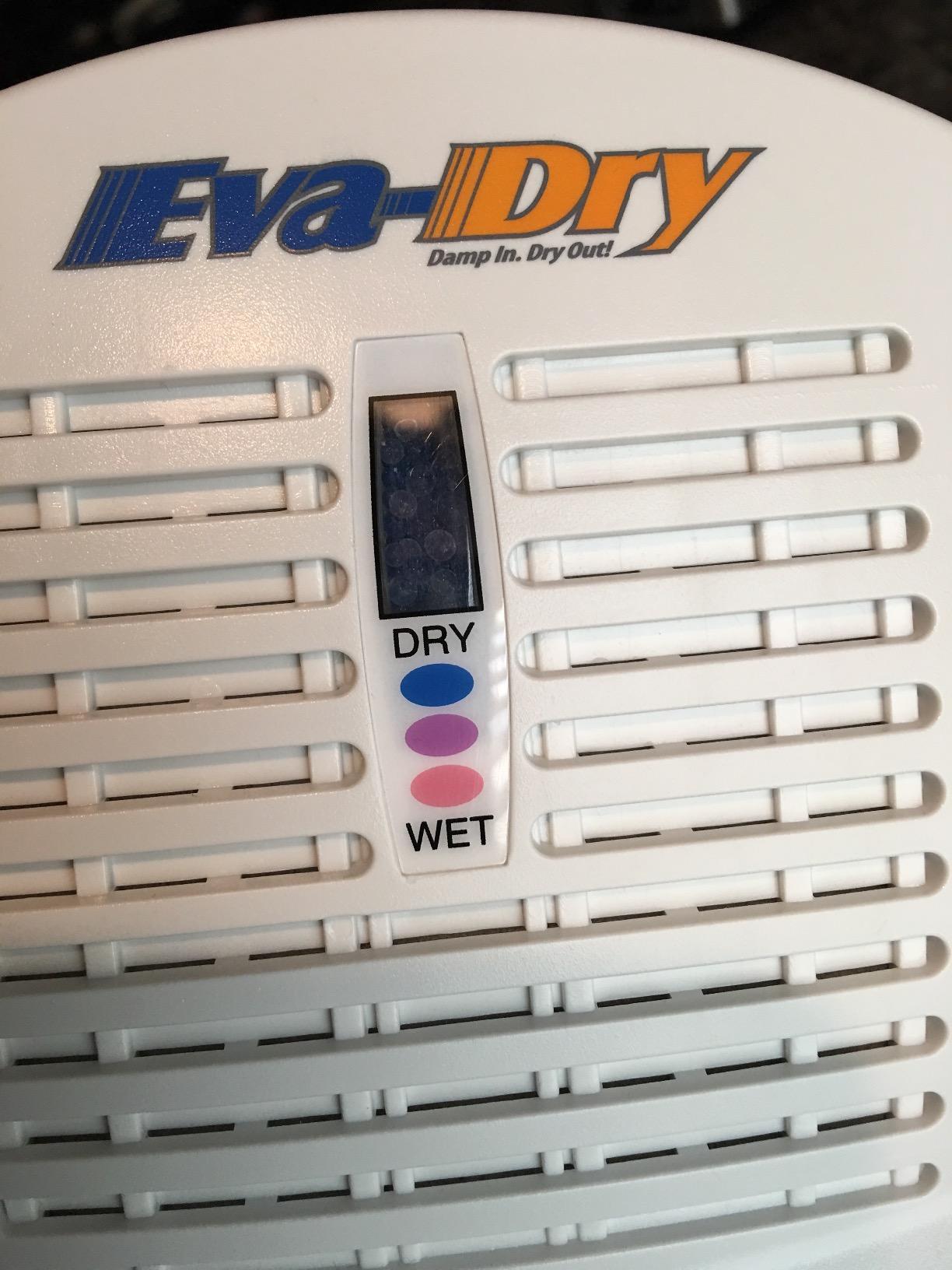
The renewal cycle is the part you have to plan for. After two to four weeks of use the gel is saturated and the unit needs 16-18 hours plugged into a mains outlet. It gets hot during renewal, and a full cycle is required even if the unit is only partly saturated, so there is no topping up partway.
Because of the 1.8 lb weight, never renew it directly in a wall outlet where it could fall out. Set it on a flat surface or a power strip, on something that can take the heat. Owners who ignore this are the ones who report a unit ending up on the floor mid-cycle.
Passive means passive. Nothing here will move the reading on a hygrometer sitting in the middle of a 30-foot trailer, and we would not pretend otherwise. What it will do is protect the enclosed spaces where mold actually starts.
What to check before you buy the E-500
First, measure the volume you actually want to control. A closet, a storage bay or a set of cabinets is ideal. An open floor plan is not, and no quantity of these units will fix an open space because passive absorption has no air movement to draw moisture through it.
Second, plan the recharge calendar into your routine. If you only visit the rig a few times a year, put the renewal on the same visit as your walkthrough so the unit is always charged when the trailer is sealed up. The included hanging hook also makes it easy to position it high in a compartment where the coolest, densest air settles.
Where the E-500 falls short
It is a consumable-free but maintenance-aware device. Owners who expected a plug-and-forget solution are disappointed, because a 16-18 hour charge every few weeks is a real recurring task. The instructions for the hanger and the renewal procedure are also thin, so plan the first cycle yourself rather than following the box.
Do not buy it expecting whole-trailer control, and do not buy multiple units hoping to cover a large motorhome. Multiple units only make sense across multiple sealed compartments, which is exactly the job it is built for.
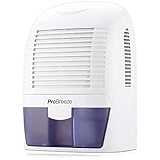
2. Pro Breeze PB-03-US 52 oz Mini Dehumidifier: Best Value for Powered Bays
Pro Breeze Electric Mini Dehumidifier, 2200 Cubic Feet (250 sq ft), Compact and Portable for High Humidity in Home, Kitchen, Bedroom, Basement, Caravan, Office, Garage
Up to 18 oz of water per day
52 oz tank with auto shut-off
No compressor, thermo-electric
Pros
- Largest reservoir in the compact class at 52 oz
- Removes up to 18 oz per day in ideal conditions
- No compressor so running noise stays low
- Explicitly marketed for RV and caravan use
- Low 40 watt power draw
Cons
- Only pulls about 0.5 liters per day
- Will not operate below 41F
- A 15 percent share of 1-star ratings reflects disappointment with output
This is the best-reviewed powered unit in the group, with more than fifteen thousand ratings behind it. It is a thermo-electric Peltier dehumidifier rated for 250 square feet, and it is the strongest device here that you can genuinely leave running unattended in a small to mid-size RV storage bay that has a 120V outlet.
What makes it stand out for RV use is the reservoir. At 52 oz, this tank is several times larger than the 6-16 oz tanks on the typical thermo-electric unit, and in moderate humidity it means days between emptyings rather than a daily trip to the storage facility. Owners cite it as the reason they upgraded from a smaller box unit.
The honest limit is the extraction rate. Rated at up to 18 oz per day under ideal conditions, the practical figure in a real damp trailer is closer to half that, and it will not do the work of a refrigerant compressor unit pulling 20 or 50 pints a day. If you want to protect a whole Class C motorhome in a humid coastal climate, this is not the tool. If you want to hold down humidity in a pop-top, a Class B van, a 20 to 25 foot trailer, or the closet and bedroom section of a larger rig, it is genuinely capable.
The 41F operating floor matters. Below that temperature the semiconductor plate stops producing condensation, so in an unheated bay in a cold climate this unit will do nothing. Confirm the winter temperature of your storage space before you commit.
Why the 52 oz tank changes RV ownership
Tank size is the difference between a device you use and a device you abandon. A small tank in a humid bay fills every one to two days, and if the auto shut-off fires while you are not there, water sits in the tray with no way to drain it. A larger reservoir buys you a long enough interval to check in on a normal schedule without risking an overflow onto the floor or a cabinet base.
Because it draws only 40 watts, it is comfortable on a small storage-facility circuit or an inverter bank, which is a genuine advantage if you are powering the bay from solar rather than a metered outlet.
Where this unit falls short
There is no drain hose, so it is tank dependent for long runs. If you want truly unattended operation over weeks, pair it with a periodic visit or look at a unit with continuous drainage. Reviewers also flag the 41F floor and the modest daily output as the two reasons it cannot hold a very wet trailer below 60% RH on its own.
A 15 percent share of one-star ratings is the largest dissatisfaction signal in this lineup, and almost all of it traces back to the same thing: buyers expecting more extraction than a 0.5 liter per day semiconductor can deliver. Size your expectations to the label, not to the word dehumidifier.
3. Eva-Dry E-333 Wireless Mini Dehumidifier: Best Proven for Closets and Cabinets
Eva-Dry Wireless Mini Dehumidifier, White (E-333)
Absorbs up to 6 oz
20-30 days per charge
6.25 x 1.25 x 4.75 inch, 1.5 lbs
5-year warranty
Pros
- Most reviews of any unit in this group
- Cordless and battery-free while working
- Absorbs up to 6 oz for 20-30 days
- Hanging hook and slim profile suit RV cabinets
- Non-toxic and child and pet safe
Cons
- Will not meaningfully lower room-level humidity
- Condensation can leak from the vented back during recharge
- No auto shut-off or recharge indicator
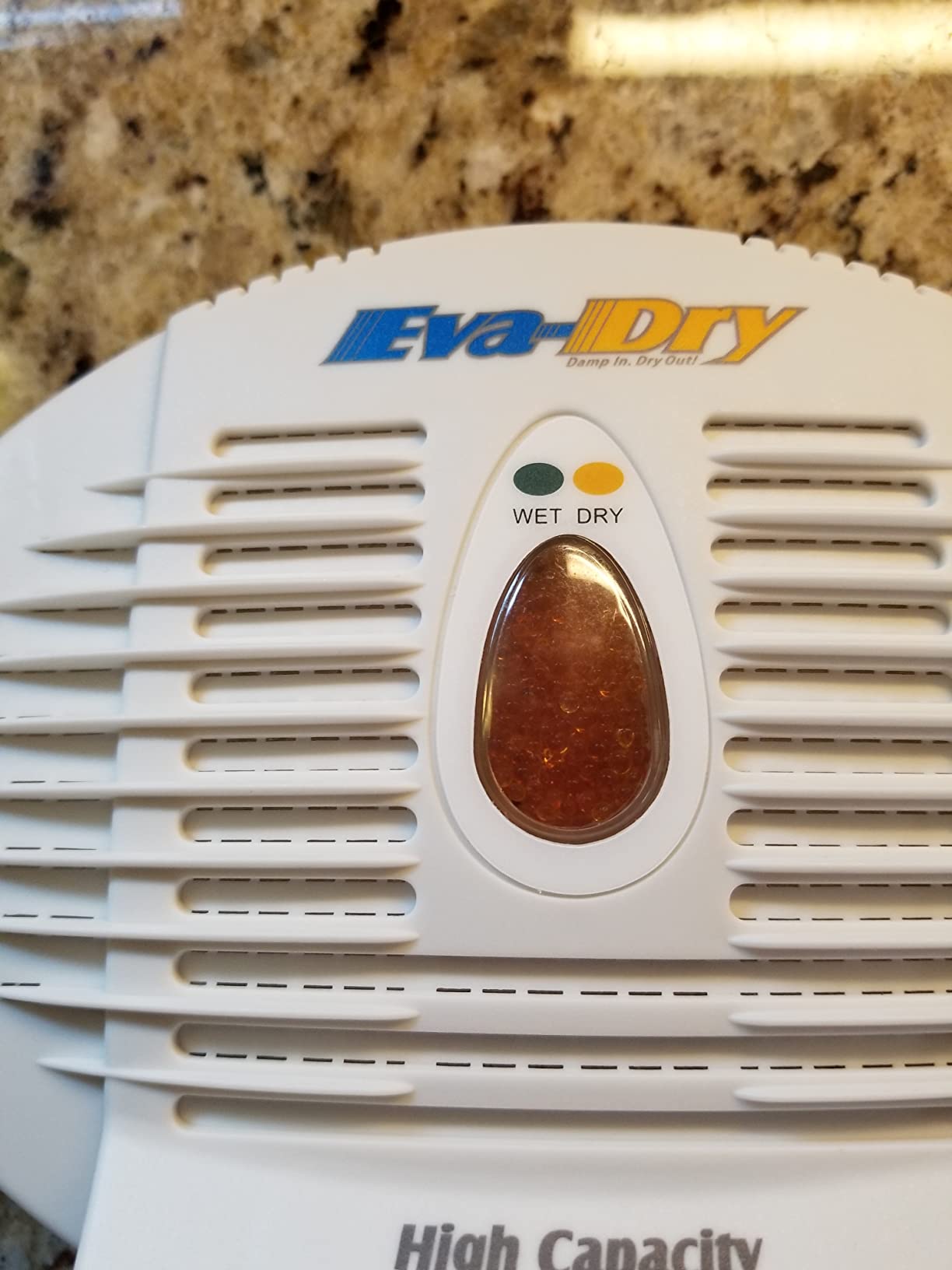
The E-333 is the same passive desiccant idea as the E-500 in a slimmer body, and it is the most proven device in the entire category with over 35,000 ratings. It absorbs up to 6 oz and then works for 20 to 30 days before it needs regenerating in a microwave or oven. It has no cord, no battery and no fan while it is running.
Where we use these is inside a wardrobe, a cabinet under a bed, a storage bay in a Class B van, or anywhere else in a parked trailer where air exchange is essentially zero. Multiple long-term owners report units that have kept working for ten years or more with nothing more than periodic reheating, and the top-12 sales rank in the Dehumidifiers category reflects how settled that track record is.
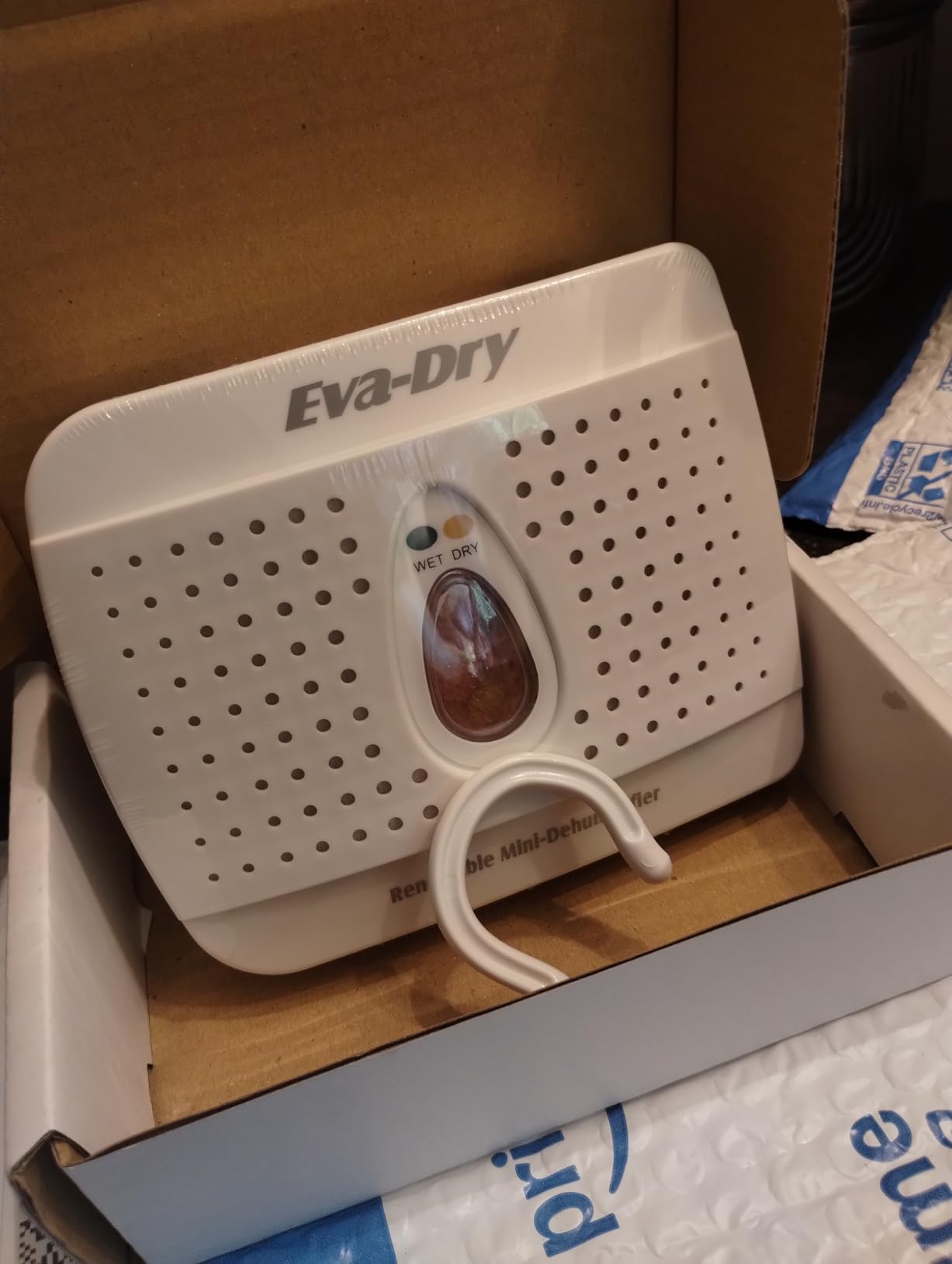
Do not expect it to move a hygrometer reading in an open room. Multiple reviewers make exactly this point, and they are right. Passive absorption works by diffusion, so it needs a small sealed volume to be effective. In a closed cabinet it prevents mildew and musty odor; in an open trailer interior it does essentially nothing.
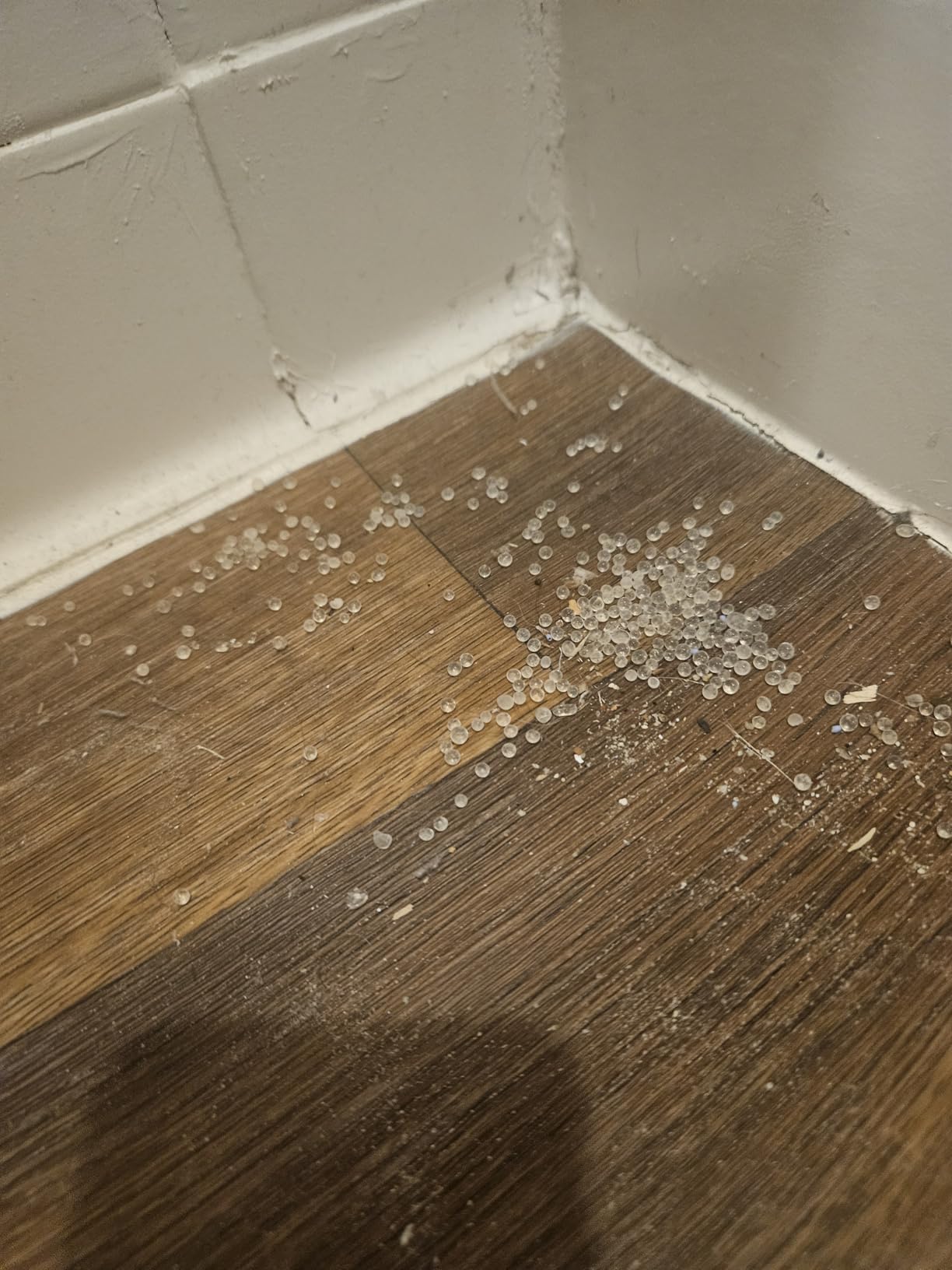
One practical warning that shows up repeatedly in reviews: condensation can weep from the vented back during the recharge cycle, so never run the microwave or oven cycle sitting directly in a wall outlet. Reheat it on a hard surface, and give it time to cool fully before you seal the compartment again.
What to check before buying the E-333
Check the recharge method matches your routine. This unit is renewed in a microwave or oven, so if your storage routine never includes a trip to a kitchen, that is a real friction point. Plan it the same way you plan a walkthrough of the rig.
Check the space is genuinely enclosed. A hanging hook is included, and the 1.25 inch profile means it fits in spaces a box unit cannot. Also worth noting: overcharging can permanently darken the indicator beads and permanently reduce capacity, so use the timed cycle rather than leaving it running until the beads look right.
Where the E-333 falls short
The included plastic hanger is awkward to fit, and the unit will tip if you stand it upright, so it is really a hang-it product. The color change from orange to green is the only signal you get, since there is no auto shut-off and no recharge indicator.
Its 6 oz capacity is the smaller of the two Eva-Dry passive models here, which is the trade for the slimmer profile. If you have several large cabinets rather than a handful of small ones, the E-500 below covers more volume per unit.
4. Levoair YXTX-607D 68 oz Unit with Drain Hose: Best for Unattended Long Runs
Dehumidifier 68oz(2000ml) Small Dehumidifier with Drain Hose for Up to 650 sq.ft Ultra Quiet Mini Portable Air for Home Basements Bathroom Bedroom Closet Kitchen RV
68 oz tank with 5 ft drain hose
Up to 35 oz per day
Rated for 650 sq ft
5 lb body, 14 inch tall
Pros
- Only unit in this group with an included continuous drain hose
- 68 oz tank means long intervals between checks
- Rated up to 650 sq ft
- Memory function resumes the previous setting after emptying
Cons
- Dehumidification weak below 59F or 40 percent RH
- Does not auto restart after a power cut
- Top exhaust can be awkward against low ceilings
The defining feature here is the hose. A 5 ft continuous drain line is included in the box, and it is the one accessory that changes the economics of long-term storage, because it removes the tank from the equation entirely. Route the hose out through a window vent or a gap in the bay door and the unit can run for weeks without anyone emptying anything.
At 68 oz it also has the largest tank of any powered unit in this group, with claimed extraction up to 35 oz per day at 86F and 80 percent RH. That claim is measured in laboratory conditions, so treat it as a ceiling rather than an expectation, but it is a considerably more capable spec sheet than the other thermo-electric models here.
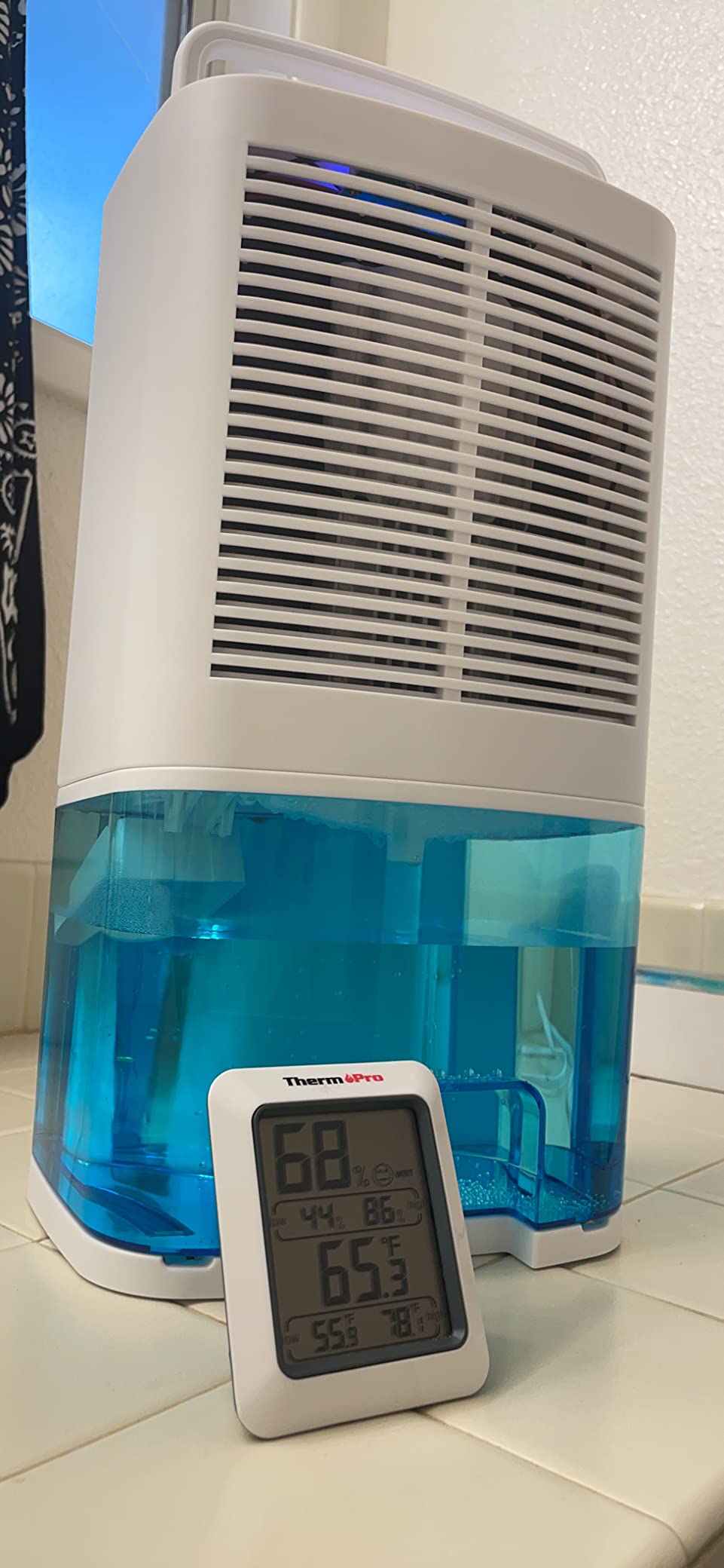
Owners in humid and coastal areas report it successfully drying kitchen cabinets, small bathrooms and RV interiors, and the drain hose is the feature mentioned most in reviews. Our own view is that a memory function, which resumes the previous setting after the tank is emptied, is a small but genuinely thoughtful touch for unattended use.
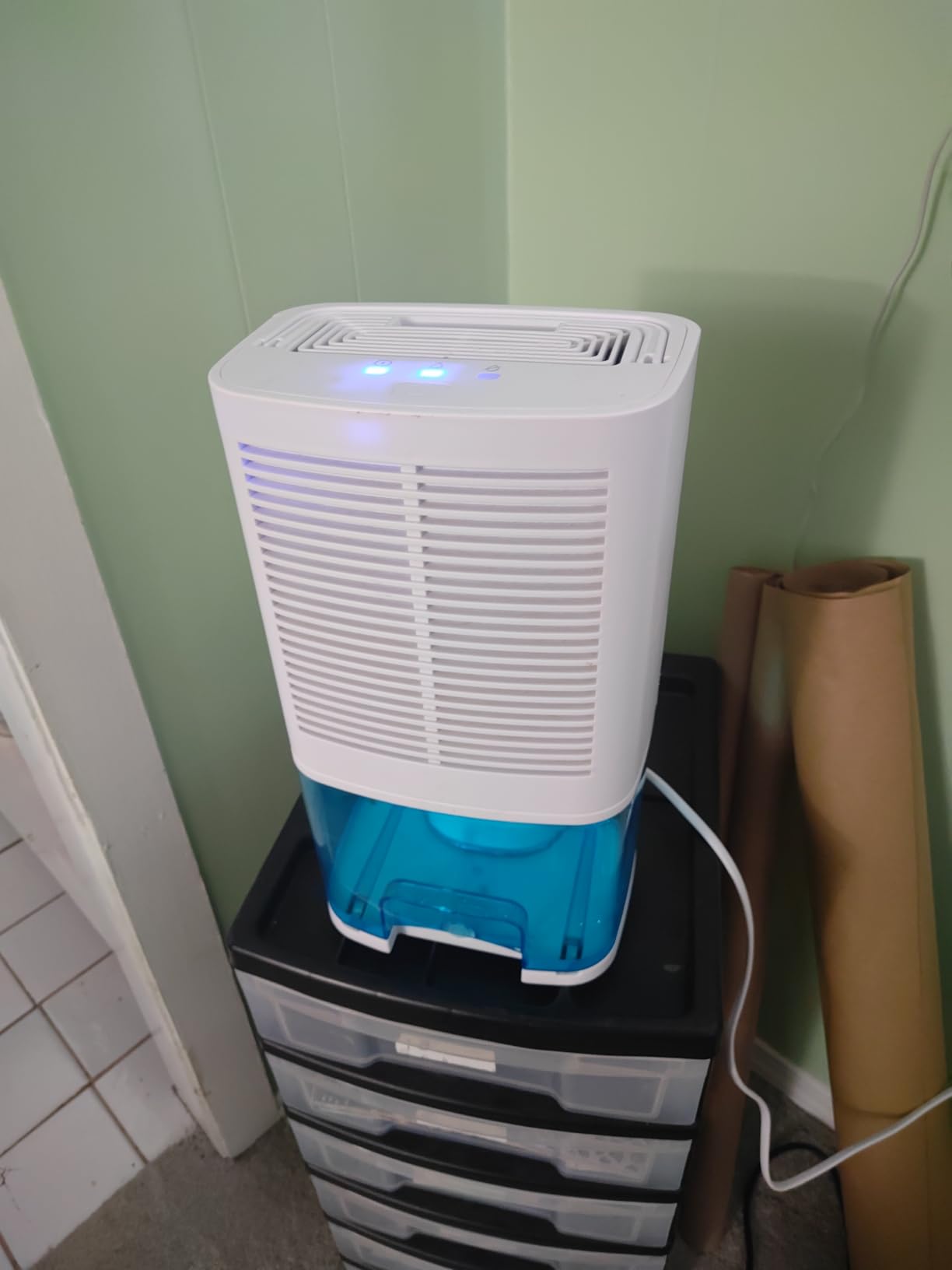
There is a catch. The unit does not automatically restart after a power cut, so if the storage facility has a momentary outage you will need to visit and switch it back on. For a bay that sees occasional power blips, that is a genuine drawback against models with auto restart.
How to set up the drain line in a stored RV
Run the hose to the lowest practical exit point. In most trailers that is a plumbing bay or a bay door, and you want the end of the hose outside the shell so the water leaves the rig entirely. Secure the line so it cannot kink, because a kinked line fills the tank and then the auto shut-off stops the cycle.
If your rig has a grey water tank that is not in use, a forum technique that works well is routing the hose into the grey tank through the toilet valve or a fresh-water drain. Owners report this combination removing a surprising volume of water over a couple of months. Check your plumbing layout first, and never leave a hose attached in a way that blocks a drain you still need.
Where this unit falls short
The 59F and 40 percent RH thresholds are the main limits, and the manufacturer states plainly that effectiveness drops below them. That rules out cold-climate unheated storage. It is also a thermo-electric unit, so the real-world extraction in a genuinely damp trailer will be well short of the headline 35 oz.
It blows exhaust out of the top rather than the side, which matters in a low-clearance storage bay. And a small number of owners report leaking, so place it on a surface where a small spill will not reach a cabinet base.
5. Eva-Dry EDV-1100 Petite 16 oz Unit: Best for Silent Cabinet Control
Eva-Dry EDV-1100 Whisper-quiet 16 OZ Dehumidifier with Auto Shut Off and Restart for small spaces in your Home, RV, Automobile, and Storage up to 122 sq. ft
Up to 16 oz per week
33 dB operation
6.5 x 5.3 x 11 inch
Not recommended below 50F
Pros
- Very quiet at 33 dB
- well below the category average
- Compact footprint fits tight RV cabinets
- Auto shut-off plus auto restart after a power interruption
- Removable tank is easy to empty and refit
Cons
- 16 oz reservoir needs emptying every one to three days
- Only rated for spaces up to 122 sq ft
- AC power adapter is a common failure point
The EDV-1100 is a small thermo-electric unit rated for spaces up to 122 square feet, and its selling point is quiet. At 33 dB it is well below the typical thermo-electric average, which matters if the storage bay is directly outside a living space you still use, or if you visit the rig and want to work inside it without a constant fan noise.
The 5.3 by 6.5 by 11 inch body fits into cabinet spaces that reject a boxier unit, and the 16 oz weight is light enough to reposition between compartments easily. Auto shut-off with a yellow indicator tells you the reservoir is full, and auto restart after a power interruption is a feature worth having in a facility where the power flickers.
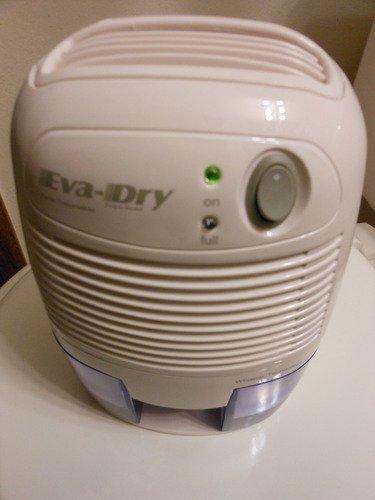
Be clear-eyed about the rate. This unit removes up to 16 oz of moisture per week when run continuously, which is a slow, steady reduction rather than an aggressive fix. Owners consistently describe it that way, and many report a decade or more of continuous use in a small volume. Several buyers returned it after comparing its output against a larger unit, which is the correct decision for anyone with a serious dampness problem.
The temperature floor of 50F is the other thing to check. It is not recommended below that, which again rules out a cold unheated bay. In a climate where the storage space stays above 50F year-round, that constraint is irrelevant.

When a small unit is genuinely the right answer
Small units make sense when the volume is small. A single wardrobe, a cabinet under a bunk, a storage compartment in a Class B van, or a document locker in a motorhome are all well matched to a 122 square foot rating. In those spaces the 16 oz per week rate is more than enough, because the enclosed volume means very little moisture needs removing.
The refill cycle is the practical detail. A 16 oz tank in a humid closet means emptying every one to three days, so this works best in a space you already visit regularly, or paired with the E-500 in the same compartment as a lower-maintenance backstop.
Where the EDV-1100 falls short
The AC power adapter is a documented weak point, and replacements are hard to source. That is the single most common long-term complaint across thousands of reviews, so treat the adapter as a consumable and consider buying a spare.
It is also manual operation, which in this category usually means no humidity setpoint. The unit runs when it runs. For a storage bay, that is acceptable, but if you want the unit to hold a specific relative humidity you will need a model with a humidistat.
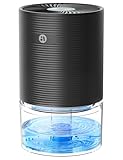
6. SANVINDER 25 oz Unit: Best for the Lowest Power Draw
SANVINDER Dehumidifiers for Home, 25oz Dehumidifier for Bedroom with Auto-off, Ultra Quiet Energy Saving for Bathroom Closet Wardrobe Office RV (285sq.ft)
Up to 16 oz per day at 86F and 80 percent RH
25 oz tank
23 watt draw
Under 35 dB
Pros
- Low energy use of about 0.96 kWh per day
- Quiet at under 35 dB
- Auto shut-off with a flashing red light
- Compact 5 x 5 x 8.4 inch body
Cons
- Extraction modest in very humid enclosed spaces
- Power adapters have failed for some buyers
- Unsuitable for genuinely high humidity
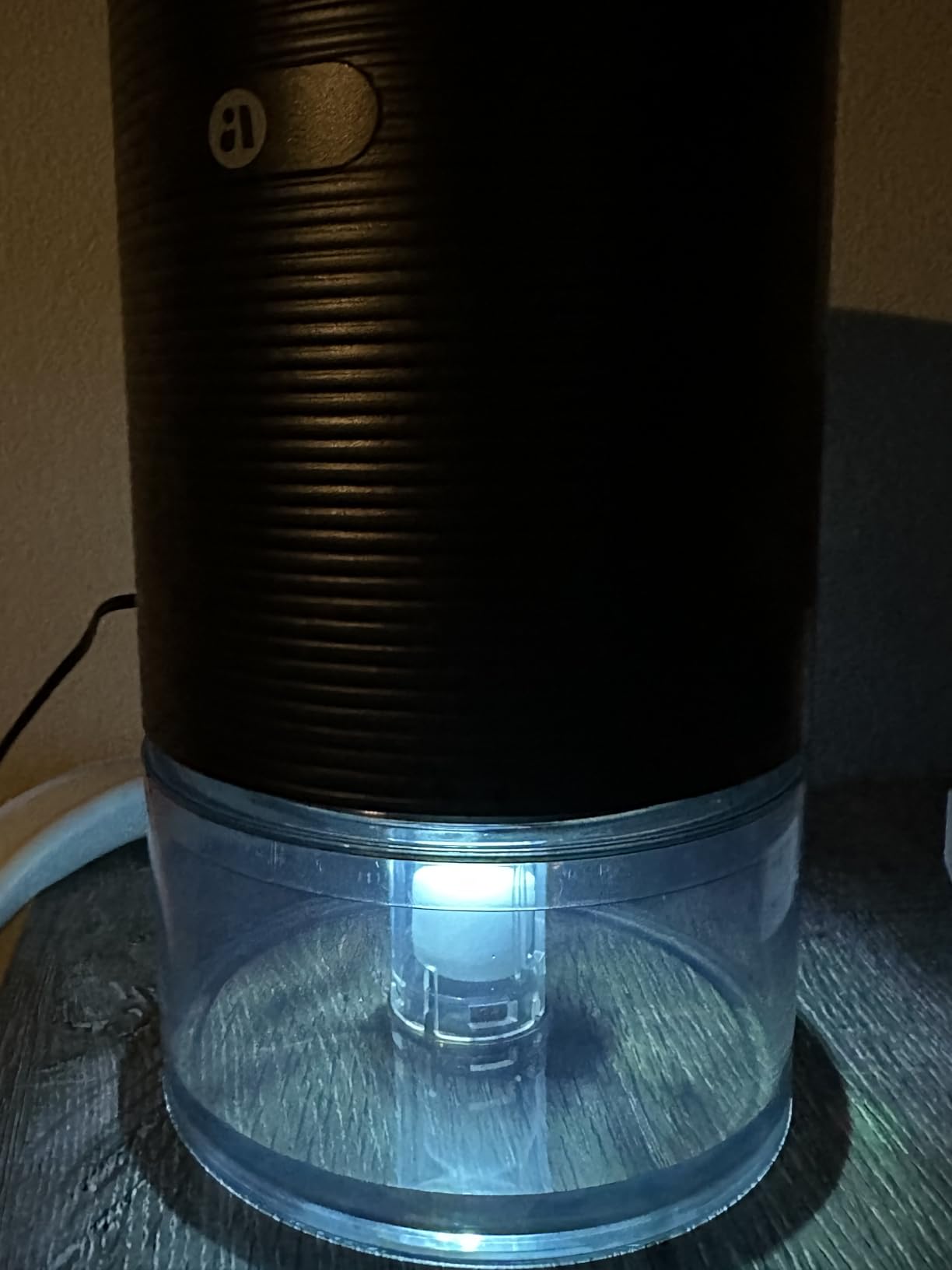
At 23 watts, this is one of the least demanding units on the list to leave running for months, and that single number can be decisive. If your storage bay is powered by a small inverter or a modest solar array, the energy budget for a dehumidifier is often the first constraint you hit, and 0.96 kWh per day is about as light as these devices get.
Owners report collecting water within the first hour of use in a small space and a visible improvement in bedroom air quality. At under 35 dB it is quieter than a gaming console by owner accounts, and the 5 by 5 by 8.4 inch body will fit into most RV cabinet runs and closets without dominating the space.
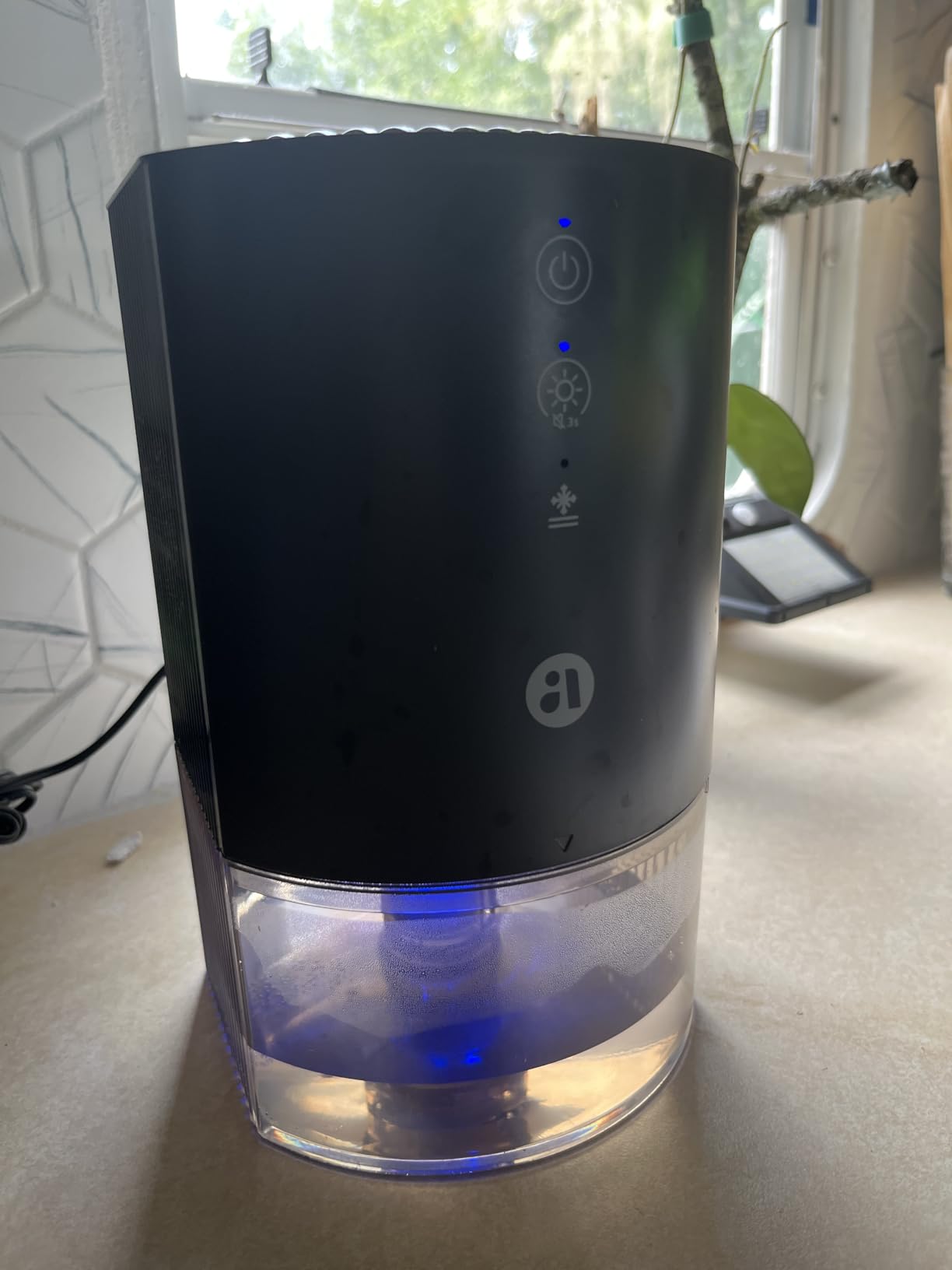
RV is named directly in the product positioning, and the 285 square foot rating covers a small trailer interior or a single large compartment. The 25 oz tank with auto shut-off and a flashing red indicator is a sensible middle ground between the tiny 6-16 oz units and the 68 oz model further up this list.
Several owners report it outperforming passive Damp-Rid style absorbers in the same volume, which is a fair comparison, since the recurring complaint about passive absorbers is that they barely dent a humidity reading. In a genuinely enclosed space, that extra capability is real.
When power, not capacity, is the deciding factor
Run the numbers on a solar or battery setup and the ranking often flips. A 23 watt unit drawing 0.96 kWh per day is a load you can size a small panel around. If the storage bay is metered and cheap, use a larger tank instead and accept a higher draw.
Also consider the adapter runs warm during continuous operation. In a closed compartment that is a minor heat source, and in a cold bay it is a small benefit rather than a problem.
Where the SANVINDER falls short
Extraction is modest. One reviewer found it barely registers in a double kitchen cabinet at 78 percent RH, which tells you something important about a Peltier unit in a space that is already very wet. It handles moderate dampness well and severe dampness poorly.
Power adapter failures are reported by multiple owners, and a minority of international buyers report plug format incompatibility outside North America. Neither is a deal breaker, but both argue for checking the adapter before you commit to a season of unattended running.
7. Pro Breeze Osmo Non-Electric Absorber: Best for Silent Unpowered Storage
Pro Breeze Osmo Moisture Absorber, 100 Day Lasting Tablet Included, 44 fl.oz, Non-Electric Mini Dehumidifier, Silent Humidity Absorber for Closet, Bathroom, Bedroom & RV, Fragrance Free, Grey
44 fl oz refillable tank
1.54 lb refillable tablet
No power, batteries or plug
Pros
- Completely silent with no power source at all
- Refillable 44 oz tank keeps working after the tablet dissolves
- Large 1.54 lb tablet with a wide collection surface
- Visible water level window and easy-pour spout
Cons
- Does not measurably reduce room-level humidity in several owner tests
- Refill tablets can be expensive if bought often
- Housing can come apart if lifted when not fully seated
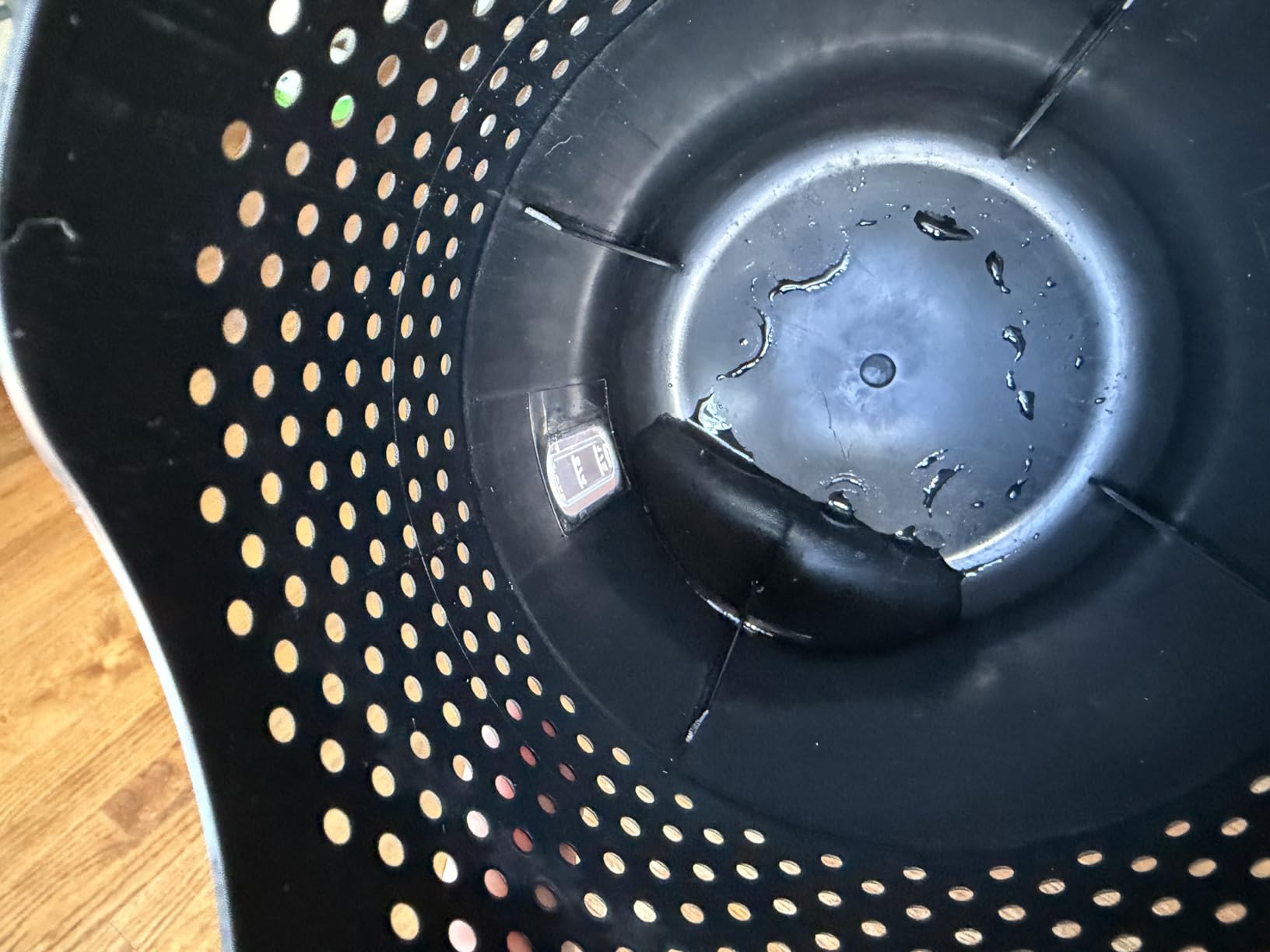
The Osmo is a passive absorber with a twist: instead of a hanging bag it uses a large 1.54 lb tablet sitting in a 44 fluid ounce tank, so you can see how much water it has collected and pour it out. The design is rated to work for up to 100 days depending on conditions, and it needs no power, no batteries and no plug of any kind.
That combination is why it suits storage. In a bay with no electrical service, a device that is completely silent and cannot fail because of a power interruption removes an entire category of risk. The 360 degree perforated housing and safety lid also make it safer to place near stored fabrics than a loose bag of beads.

Where owners are split is on whether it does anything measurable. Several reviewers who tested with a hygrometer found no meaningful humidity drop and treat it as a moisture buffer rather than a dehumidifier. One owner collected under 250 ml in a month in a bedroom, and about a liter over five months in a small washroom. If you are holding a whole trailer to a target relative humidity number, this will not get you there.
Others are happy with it for what it is: quiet, power-free odor control in a closet, wardrobe or small storage area. The visible water level and simple pour-out design get specific praise, and the reusable format avoids the recurring waste of disposable hanging absorbers.
Passive absorber or electric unit: the practical split
Think of an absorber as a slow buffer and an electric unit as an active control. If the space has no power, an absorber is not a cheaper alternative, it is the only category available. If the space has power and you care about a humidity number, the electric unit is the tool and the absorber is a supplement.
Our standard arrangement for an unpowered bay is two or three absorbers distributed across separate compartments, paired with a sealed silica gel unit in the main closet. That covers odor and surface damp in the small volumes without pretending to control the whole trailer.
Where the Osmo falls short
Refill economics are the real cost concern. One reviewer estimated only about two months per tablet, and buying tablets frequently adds up over a multi-season storage schedule. Measure how full the tank gets before committing to a long rotation.
The handling instructions carry many prominent warnings, and the housing can come apart when lifted if it is not fully seated. Treat it with a bit of care when you pour it out, and the tab and warnings are less irritating once you have done it twice.
8. Camco Moisture Absorber Bucket: Best for Storage Bays With No Power
Camco Moisture Absorber Bucket – Features Fast-Acting Moisture-Absorbing Agent – No-Fragrance Beads – Use with RV Storage, Camper Organization & More (44282)
5 lb fragrance-free beads
Absorbs up to 3x its weight
8.75 x 8 x 8.75 inch, 6.1 lbs
Pros
- Highest average rating in this group at 4.5 with 74 percent five-star
- Purpose-built and marketed for RV and camper storage
- Fragrance-free beads
- which matters in enclosed unventilated spaces
- Absorbs up to 3x its own weight in moisture
Cons
- Single-use consumable replaced on a schedule
- Absorption is gradual and will not lower humidity in a damp RV
- No electricity required and no regeneration option
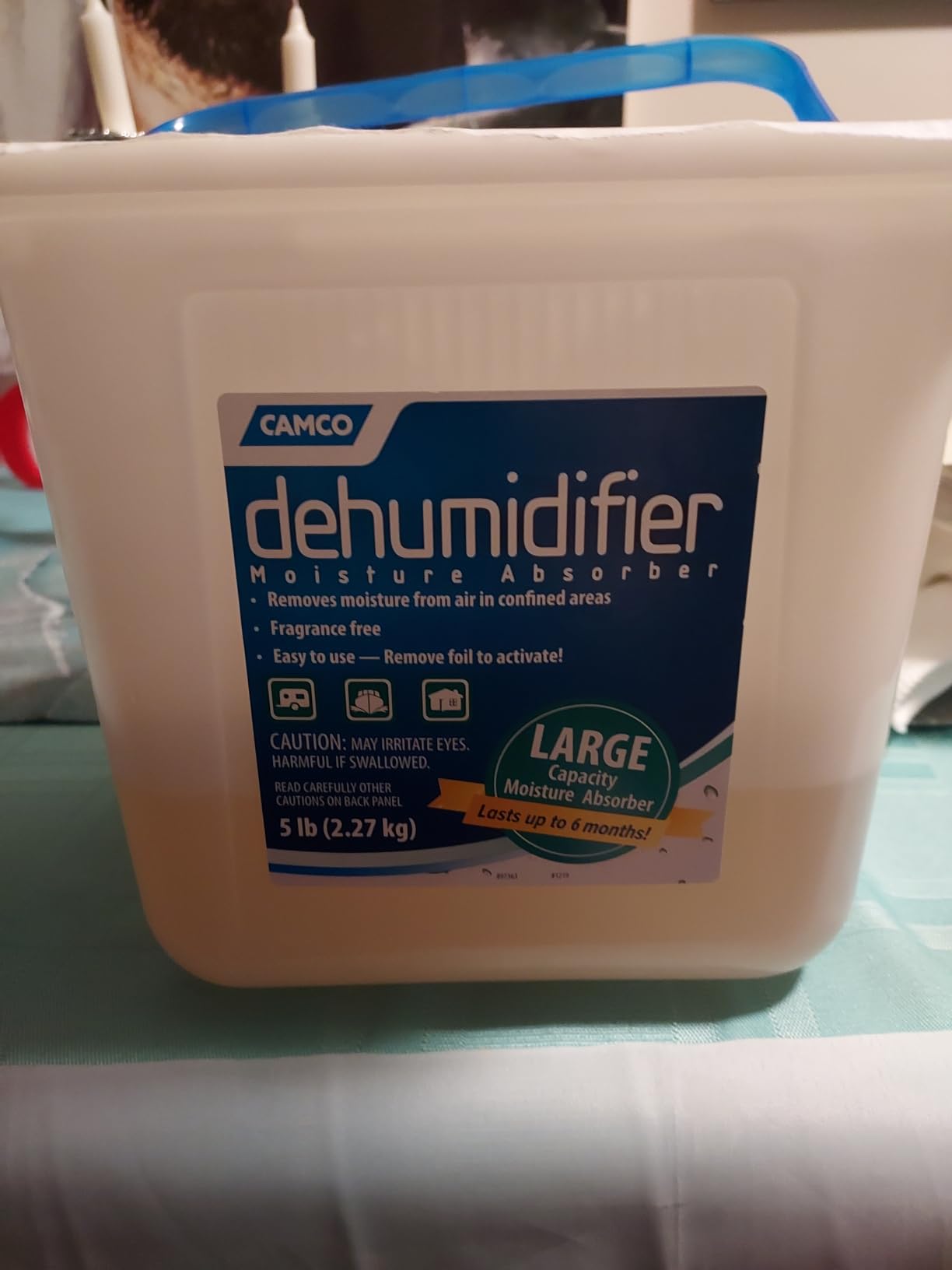
The Camco bucket is the simplest device in this roundup and the one most clearly designed for the job. It is a 5 lb bucket of fragrance-free moisture-absorbing beads, marketed specifically for RV storage and camper organization, and it absorbs up to three times its own weight in water before the beads need replacing.
Fragrance matters more here than it does in a basement. In a sealed trailer you do not want scented beads adding a chemical odor to upholstery and soft goods, and these are unscented. The bucket form is also stable and low enough to fit discreetly into a storage compartment instead of hanging off a shelf.

RV and camper owners use these in storage compartments, wardrobes and laid directly over stored clothing and soft goods. The bucket holds 10 fluid ounces of collected liquid before it needs emptying, so the maintenance rhythm is simple: check the beads, empty the bucket, replace the insert when the beads turn gel-like.
Owners consistently describe it as eliminating musty odor at the source rather than masking it, which is the right mental model. It is a passive buffer working in enclosed spaces, not a device that will change a relative humidity reading across an open trailer.
Why a passive bucket still belongs in a powered bay
Even with an electric unit running, the enclosed compartments inside a trailer are the places mold actually starts. A bucket in a wardrobe and another under a bed costs almost nothing to maintain and covers the small sealed volumes an electric unit will never reach. Most owners we spoke to run both rather than either alone.
The other advantage is resilience. If the power goes out in a storage facility for a week, a bucket keeps working the whole time. Nothing about it depends on a circuit being live.
Where the Camco bucket falls short
It is a consumable, not a device. You replace it on a schedule, and there is no regeneration option, so the cost of ownership is recurring by design. Owners accept this because the alternative is an electric unit with its own recurring costs and failure modes.
The absorption rate is gradual by nature, which makes it unsuited to actively lowering humidity in a damp RV. If you already have standing damp and a musty smell you need to clear quickly, pair it with an electric unit rather than expecting it to do both jobs.
9. SEEKR Stor-Dry 9406 Warm Air Circulator: Best for Marine and Corrosive Bays
SEEKR by Caframo Stor-Dry 9406 110V Warm Air Circulator & Dehumidifier – 75W
110V warm air circulator and dehumidifier
70 watt draw
Corrosion-proof metal, 2.7 lbs
Pros
- Corrosion-proof metal construction built for marine and RV storage
- Silent operation at a low 70 watt draw
- Circulates 1000 cubic feet per hour
- Compact 2.7 lb body that is easy to reposition
Cons
- Does not collect water into a tank
- Works by air circulation only rather than extraction
- 120V unit needs a compatible outlet in the storage bay
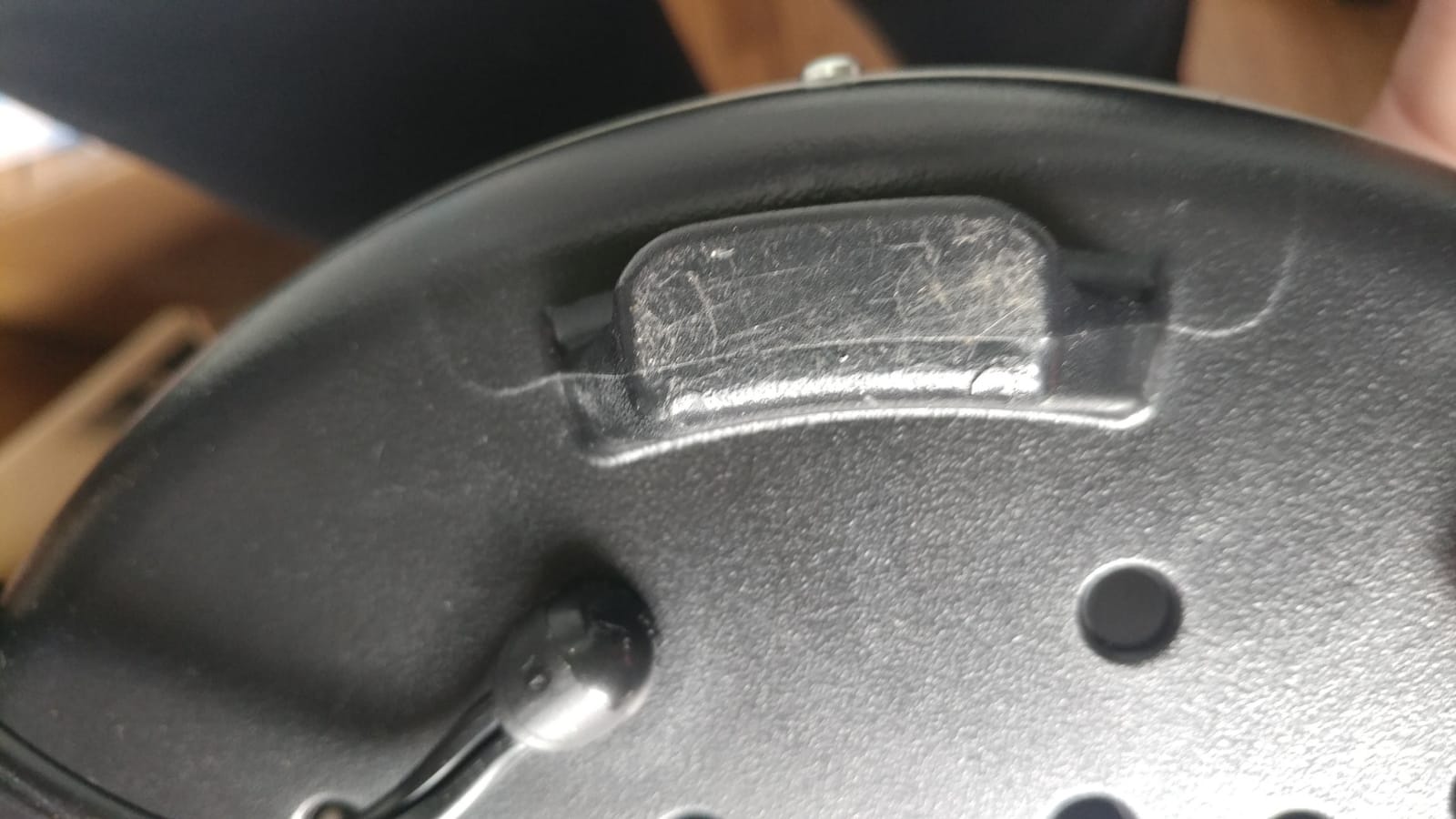
The Stor-Dry is not a collecting dehumidifier, and that distinction is the whole point of it. It is a 110V warm air circulator that moves 1000 cubic feet per hour through a corrosion-proof aluminum body, gently heating and moving the air in a closed space so that trapped moisture does not settle and condense on surfaces.
That makes it a genuinely useful complement rather than a competitor. In a covered RV storage building or a bay near salt air, circulating warm air across a closed-up trailer keeps interior surfaces moving and prevents the mustiness that owners on RV forums repeatedly describe as the first sign of a problem. The corrosion-proof metal housing is built for exactly this environment.

It is also the quietest powered option here. At 70 watts and with silent operation, you can leave it running in a space where noise matters, and it draws less than most compressor units. The 9 by 9 by 4.75 inch body at 2.7 lb is easy to reposition from compartment to compartment.
Owners rate it highly, with a 4.4 average across 976 ratings and 73 percent five-star, and reviewers consistently frame it correctly as a moisture-management circulator rather than a water collector. Setting expectations that way is important, because there is no tank to empty and no reading to look at.
Where a circulator fits in a storage plan
Use it as the always-on baseline. Run the Stor-Dry continuously in a closed-up trailer to keep air moving and warm, and layer a passive absorber or an electric unit on top for the enclosed compartments and the actual moisture load. Many owners on RV forums put the same pairing together, describing ventilation and air movement as the primary fix and any dehumidifier as the second layer.
It is also the right pick when the environment is corrosive. Aluminum and marine-grade construction tolerate damp, salty air in a way that a plastic-bodied unit over a long storage season may not.
Where the Stor-Dry falls short
It does not extract water, so it cannot lower a relative humidity reading on its own. If your priority is a measurable number, you need a collecting unit as well. It is a supporting role, not a primary one.
It is a 120V unit and needs a compatible outlet in the RV or storage bay. In a storage building with only 30A service shared across several rigs, count the draw of everything else on that circuit before adding a heater and a dehumidifier together, since that pairing is what tends to strain a facility circuit.
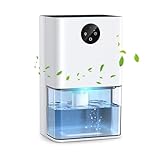
10. Deyagoo DY501 50 oz Unit: Best for Visible Tank Monitoring
50OZ Dehumidifier, Small-Space Dehumidifier for Bedroom RV Closet 200 Sq.Ft
400 ml per day at 86F and 80 percent RH
50 oz transparent tank
30 dB, 28 watt draw
Pros
- Large 50 oz transparent tank with a real-time water level
- Very quiet at 30 dB
- Quietest powered unit in this group
- Low 28 watt draw and a compact footprint
Cons
- Extracts only about 400 ml per 24 hours
- Top air inlet and back outlet must stay unblocked
- 11 percent of ratings are 1-star over limited extraction
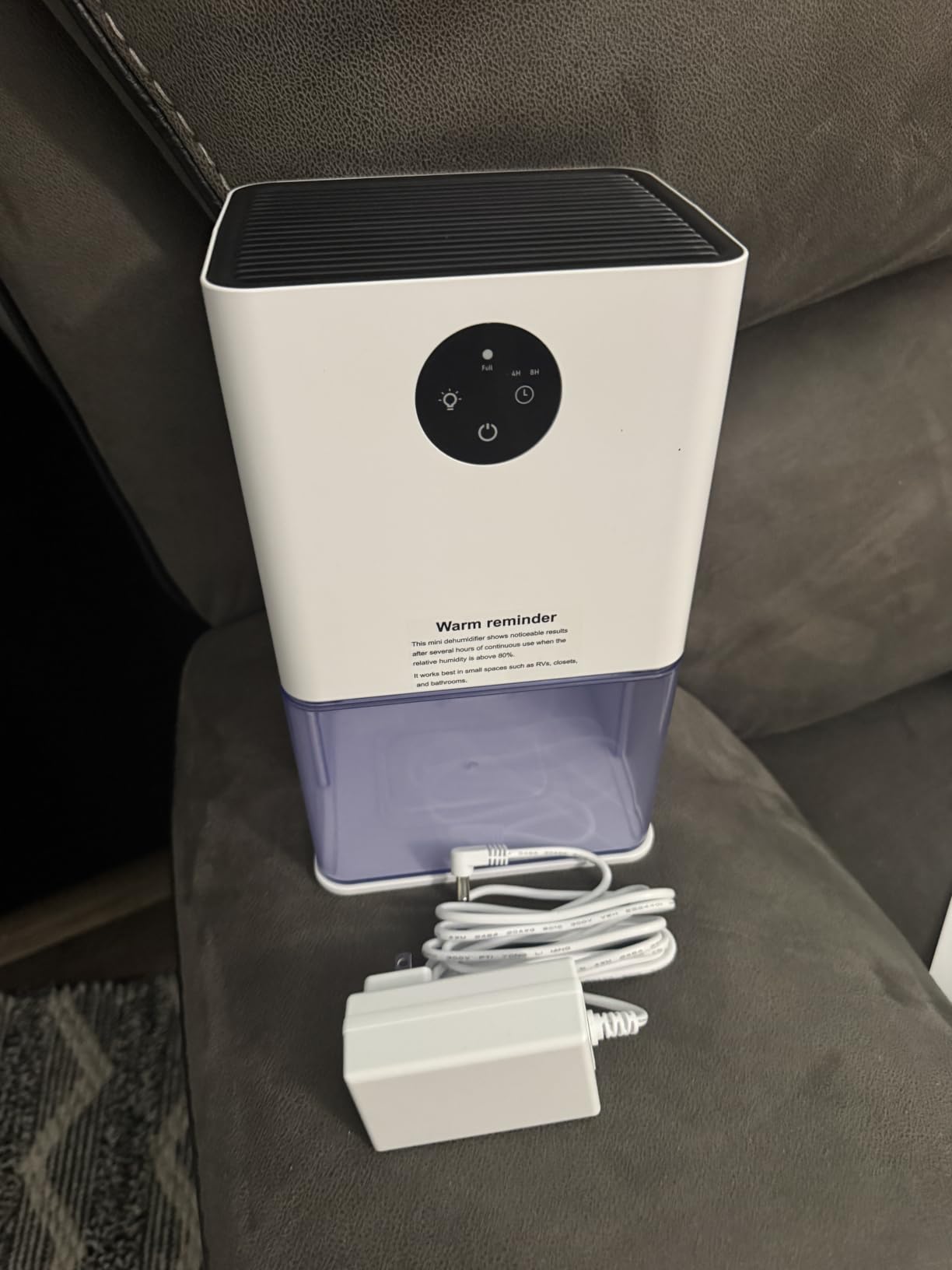
The DY501 is a small-space unit rated for 200 to 300 square feet, and the feature that owners single out is the 50 oz transparent tank. Because the tank is clear and the water level is visible in real time, you can walk into a storage facility and know at a glance whether the unit is still collecting, without lifting a lid or reading a float.
It is also the quietest powered option in this roundup at 30 dB, and it draws 28 watts with a daily consumption of no more than 1 kWh. The 5.91 by 4.72 by 9.84 inch body is compact enough for a closet or a small trailer compartment.
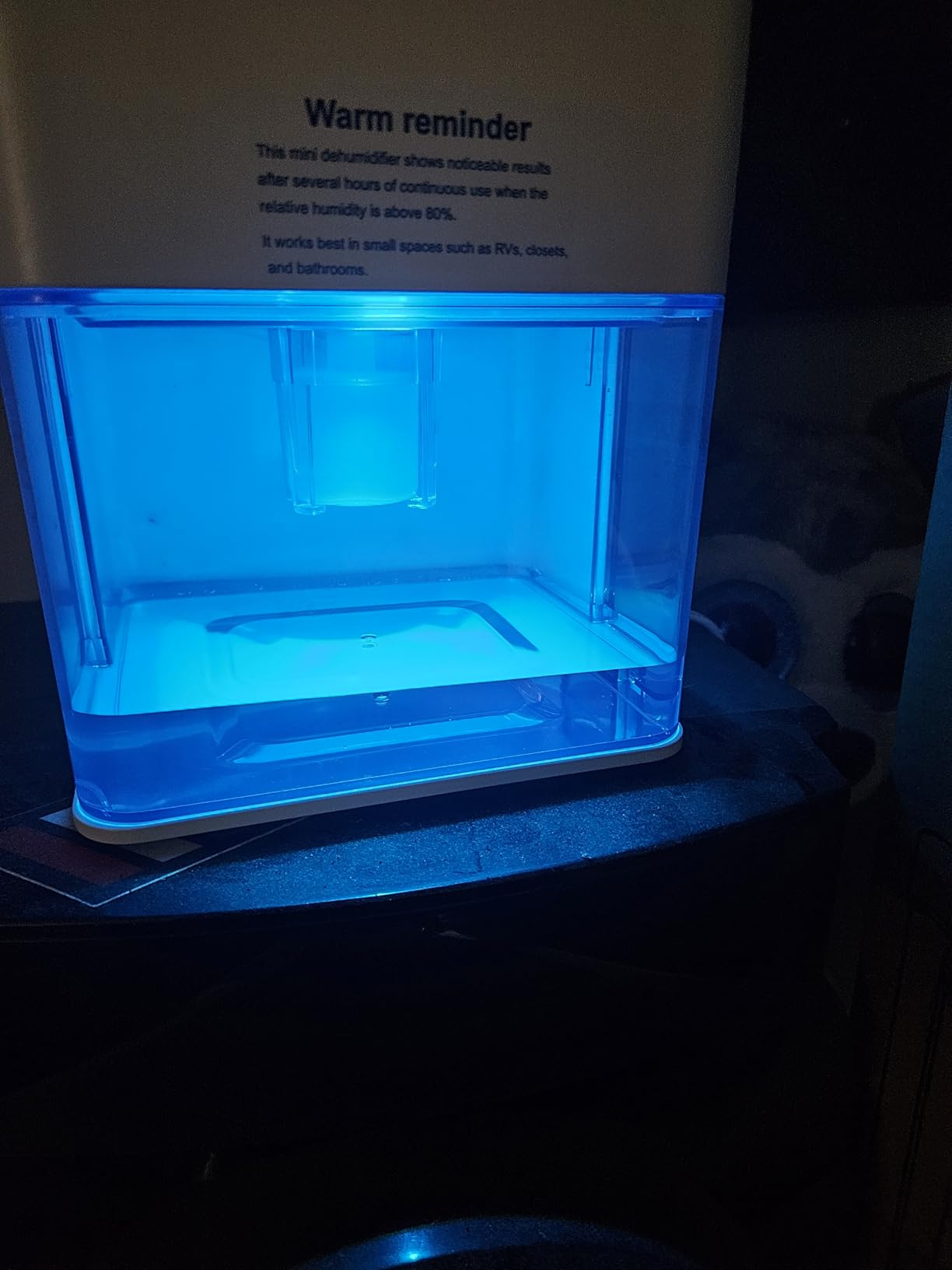
Auto shut-off with a flashing red light triggers at 1300 to 1500 ml, and a groove at the base of the tank makes it easy to lift, pour and clean. A seven-color atmosphere light is included with its own button, which is the sort of feature that does nothing for humidity but does make checking the unit less of a chore.
The realistic limit is 400 ml per 24 hours at 86F and 80 percent RH. That makes a dent in a small closet or an RV cubby rather than addressing a genuinely damp room, and it is the reason 11 percent of ratings are one-star.
Why visible tank level changes the maintenance rhythm
On a long storage schedule, the deciding factor is often whether you can tell the state of the unit at a glance. Opaque tanks force you to lift and check, and skipped checks are how tanks overflow. A transparent tank turns a two-second glance into your entire monitoring routine, which makes it a good fit for a bay you visit monthly.
Keep the top air inlet and the back outlet clear, though. Owners report performance dropping sharply when the vents are blocked by stored items, and in a packed trailer it is easy to do that unintentionally.
Where the DY501 falls short
At roughly 400 ml per day it is the smallest extraction in the powered group here, so it is a small-space device by design and should not be asked to handle a whole trailer. It also has the smallest review base of the ten at 324 ratings, which means less long-term evidence than the other products.
It is rated for 200 to 300 square feet, so anything larger is out of scope. If you need more pull, the 68 oz unit with a drain hose earlier in this list is the more capable choice at a similar size.
How to size a dehumidifier for RV storage
Match the device to the sealed volume you can actually control, not to the floor area of the trailer. A 20 foot trailer is roughly 300 to 400 cubic feet of interior air, and a 30 foot travel trailer lands somewhere around 500 to 700 cubic feet. For those volumes, a passive silica gel unit or a thermo-electric unit is a realistic match, and a refrigerant compressor unit pulling 20 or 50 pints a day is what you need only if you are humidifying a whole storage building rather than a single rig.
As a rough guide: enclosed compartments under 500 cubic feet are best served by a renewable desiccant unit, small RV interiors up to 250 square feet suit a 20 to 35 oz thermo-electric unit with a large tank, and anything larger or permanently damp needs a compressor unit. Our guide to the best 50-pint dehumidifiers covers the compressor end of the range in detail, including the pints-per-day figures that make sense for a whole storage building.
One number to read carefully is pints per day. It is measured at a fixed laboratory condition, typically 80F and 60 percent relative humidity, and it assumes the unit is already at temperature. In a cold, damp trailer you will see a fraction of the rated figure, which is also why a thermostat-controlled space produces better results from the same unit. If you want a wider view of capacity matching, our picks for basement dehumidifiers and whole-house dehumidifiers both size by volume in the same way.
Powered vs unpowered storage: the first decision
Yes, you should put a dehumidifier in your RV if it is going to sit for more than a few weeks, but the right device is decided by whether the storage space has reliable power. With 120V service, an electric unit gives you actual humidity control. Without it, a passive desiccant or absorber unit is not a compromise, it is the only category that will work at all.
The second fork is temperature. Every thermo-electric unit in this roundup has a documented floor between 41F and 59F, and refrigerant compressor units have their own lower limit. If your bay drops below those numbers in winter, either keep the space above roughly 55 to 60F, or choose a passive unit. Owners report frozen compressor coils leaving them with a dead unit and no warning, which is the single most common failure story in RV forums.
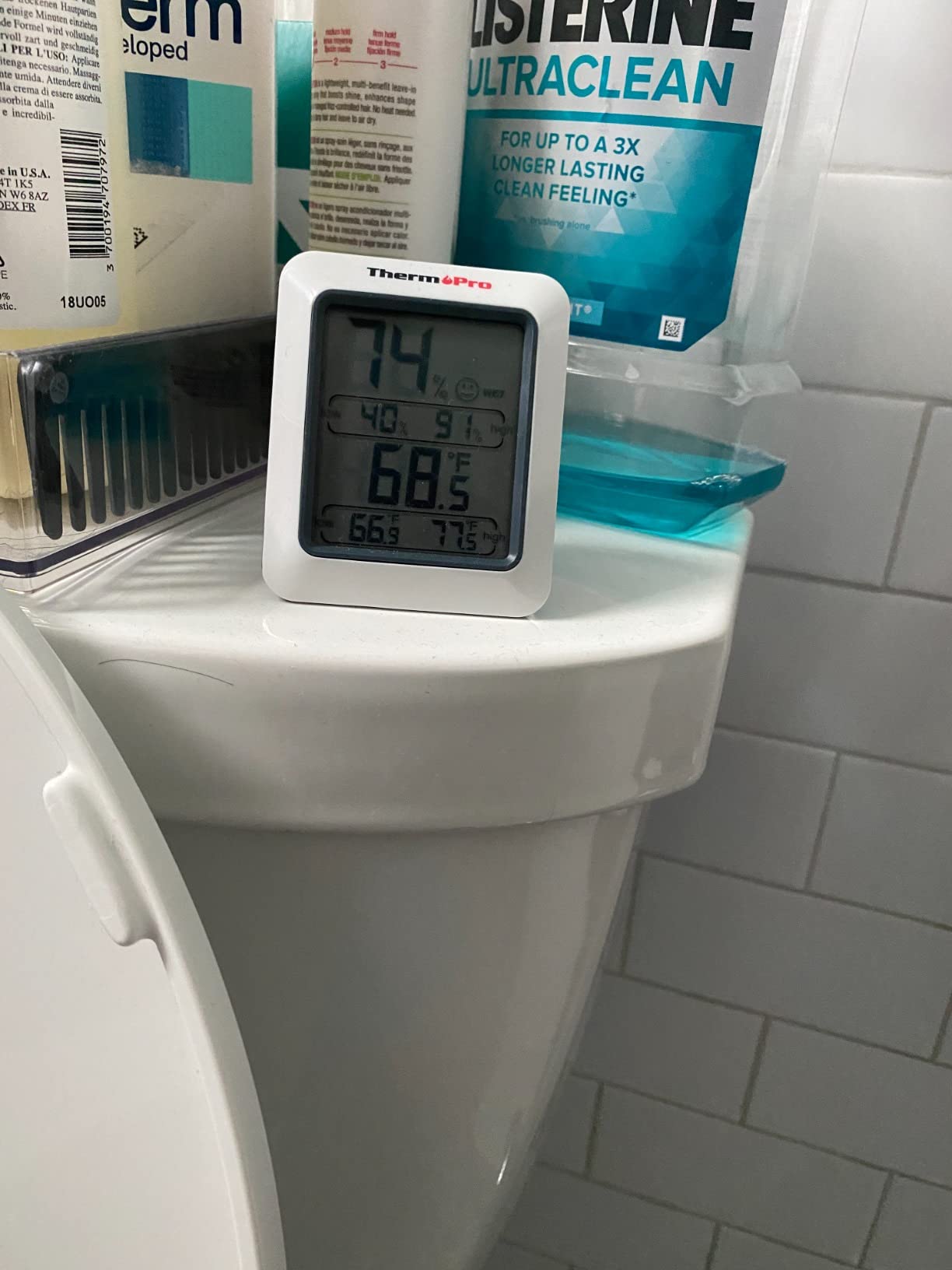
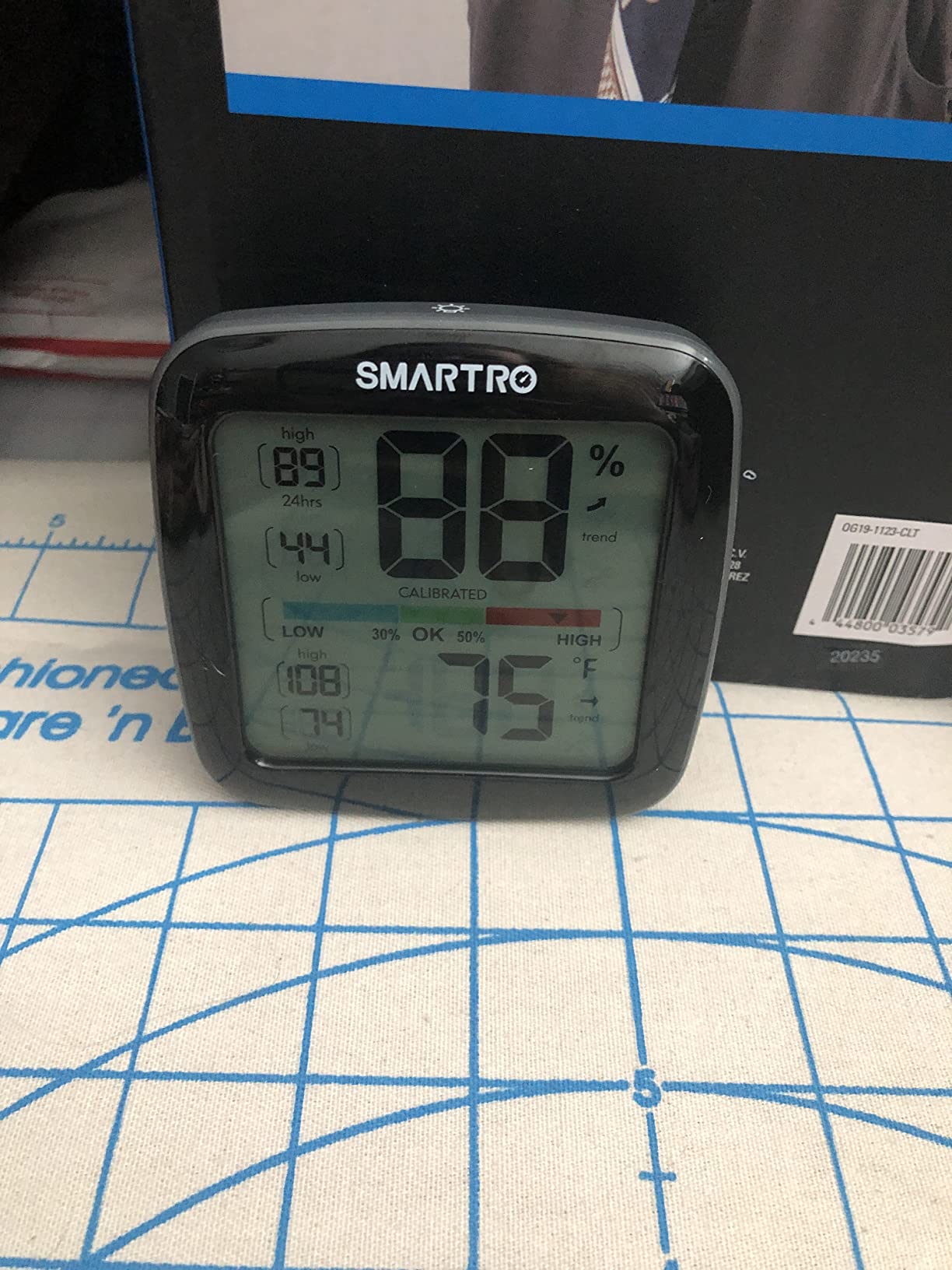
The third fork is the level of control you want. Ventilation and air movement do more for a closed-up trailer than most buyers expect, and pairing a circulator with a passive absorber is a legitimate, low-cost plan. A humidistat and a remote temperature and humidity monitor are what turn a device into a controlled system, and they matter most in a bay nobody is watching.
Freeze protection, placement and drainage in a stored RV
Placement. Put the unit in the largest open space, centered rather than tucked into a corner, and leave clearance from the cold exterior walls where condensation forms first. Keep the intake and outlet clear of stored items, and set the unit on a surface that will not be damaged by a small spill.
Freeze protection. Compressor coils freeze when the surrounding air drops below the unit’s rated floor. Keeping the storage space above 55 to 60F with a small heater paired with the dehumidifier is the method experienced owners describe, and the two together draw more current than either alone, so check the circuit. If you cannot keep the space warm, run a desiccant unit instead of an electric one.
Drainage. A continuous drain hose removes the tank from your maintenance routine entirely. Route it outside the shell through a vent or the bay door, or into an unused grey water tank, and check the line does not kink. If you have no drain route, set your visit interval from the tank size: small tanks in humid conditions fill every one to three days, which is the most common complaint owners report.
Before you start. If there is already a musty smell or visible mold, clean it first. Owners on RV forums describe mold remediation with a diluted bleach solution on affected surfaces, and no dehumidifier will fix a colony you have left in place. Then run the unit and watch a remote hygrometer, targeting 35-50 percent RH, with 60 percent RH as the ceiling.
Frequently Asked Questions
What is the best dehumidifier for an RV storage unit?
The Eva-Dry E-500 is the best overall pick for RV storage because it absorbs 6-8 oz of moisture in sealed spaces up to 500 cubic feet, draws no power while it works, and recharges on a mains outlet only every two to four weeks. If your storage bay has 120V service, the Pro Breeze PB-03-US is the strongest powered option, offering up to 18 oz per day into a 52 oz tank.
Should I put a dehumidifier in my RV?
Yes, if the rig is stored for more than a few weeks. An enclosed trailer traps warm humid air against cool exterior walls and relative humidity can pass 60 percent RH within days, which is where mold and mildew start. Aim for 35-50 percent RH, the level at which mold growth is suppressed.
What is the best moisture absorber for an RV?
The Camco Moisture Absorber Bucket is the best passive option for an RV. Its 5 lb of fragrance-free beads absorb up to three times their own weight in water, it is designed specifically for RV storage and camper use, and the 74 percent five-star rating is the highest in this group. For enclosed cabinets where you want no consumables, the Eva-Dry E-500 absorbs 6-8 oz and is renewable for up to 10 years.
What is the most reliable 50 pint dehumidifier?
For RV storage the relevant comparison is capacity against volume, and a 50 pint compressor unit is a storage-building device rather than a single-trailer device. It is built to dehumidify a whole shed, where a single parked trailer contributes only a fraction of that load. Inside one trailer, a 20 to 35 oz thermo-electric unit with a large tank is the realistic match.
Which compressor dehumidifier is the best?
None of the ten units in this roundup is a refrigerant compressor dehumidifier, because a compressor unit needs far more capacity than one parked trailer can justify and its coils freeze in unheated storage. Compressor units are the right call when you are controlling humidity in an entire storage building or a basement, and our guides to the best 50-pint and whole-house dehumidifiers cover those cases in detail.
Conclusion
The Eva-Dry E-500 is the pick we would make for most stored RVs, because it is the only device here that works with no power at all, covers a genuine 500 cubic foot sealed volume, and never needs a refill. Where 120V is available, the Pro Breeze PB-03-US handles a small trailer interior, and the Levoair with its drain hose is the one to buy if you want months of unattended running.
Match the technology to the storage bay before you match the price. Confirm the winter temperature, confirm the power, then pick from the best dehumidifiers for RV storage above. Keep a remote hygrometer in the rig and you will see the difference within the first month.