
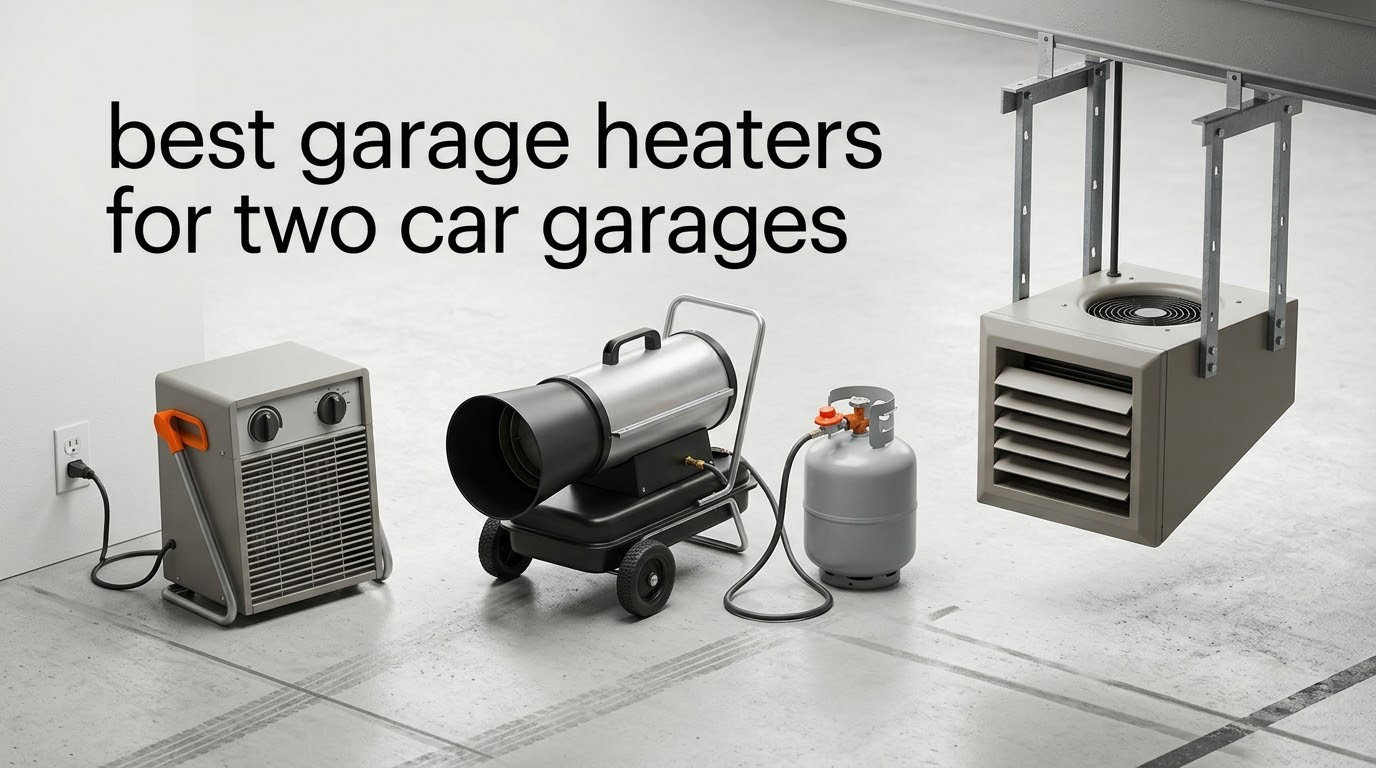
A two-car garage is a small, leaky box with a very large door. Picking a heater for one usually comes down to a number most people never calculate: how many BTUs the space actually loses, and how fast you want it to come up to temperature. Get that wrong and a capable heater burns fuel for six hours a night and never gets the far corner above 50 °F.
This roundup covers the best garage heaters for two car garages, from plug-in 120V radiant spot heaters to 125,000 BTU portable propane units and hardwired 240V fan-forced models. We broke the picks into the categories that matter for a two-bay space, and we put the sizing math in front of the products so you can match output to square footage before you spend anything.
Two things shape almost every recommendation here. First, heat loss through the garage door dwarfs heat loss through the walls, so insulation work changes the required heater size more than any other factor. Second, forum complaints about 240V electric heaters cluster around one thing: the cost per hour of the heat itself, which runs higher than gas for the same delivered BTUs. We also lean on manufacturer specification sheets rather than seller page claims, which is how you separate a 25,600 BTU unit from a unit that merely says “garage.”
If you want a broader view of the categories first, our guide to the 8 best garage heaters for winter workshops covers the same fuel types from a workshop angle.
Table of Contents
Top 3 Picks for a Two-Car Garage in 2026
The three picks below cover the most common two-car garage situations: a fully hardwired bay that needs real forced-air heat, an insulated garage on a standard 240V circuit, and a workshop where workbench heat and mixing matter more than even air temperatures.

Comfort Zone CZ220BK 5,000W
- Ceiling-mount fan-forced
- 17065 BTU output
- 20.4 lb steel body
- ETL listed

Comfort Zone CZ230ERBK 7,500W
- 25600 BTU output
- Digital thermostat 45-95 F
- Remote and 12-hour timer

Dr. Infrared DR-966 6,000W
- 3
- 000W or 6
- 000W selectable
- UL/CUL listed
- External thermostat ready
All 10 Best Garage Heaters for Two Car Garages (October 2026)
Every heater below is listed with its real output rating, fuel type, and mounting style so you can match it to your garage rather than to a marketing phrase. Coverage figures are the manufacturers’ own, which is why they vary so widely.
| Product | Specifications | Action |
|---|---|---|
| Comfort Zone CZ220BK 5,000W |
|
Check Latest Price |
| Comfort Zone CZ230ERBK 7,500W |
|
Check Latest Price |
| Dr. Infrared DR-966 6,000W |
|
Check Latest Price |
 TEMPWARE 7,500W TEMPWARE 7,500W |
|
Check Latest Price |
 Mr. Heater 50,000 BTU Unit Heater Mr. Heater 50,000 BTU Unit Heater |
|
Check Latest Price |
 Remington 60,000 BTU Propane Remington 60,000 BTU Propane |
|
Check Latest Price |
 Mr. Heater 30,000 BTU Blue Flame Mr. Heater 30,000 BTU Blue Flame |
|
Check Latest Price |
 Mr. Heater Portable Buddy 9,000 BTU Mr. Heater Portable Buddy 9,000 BTU |
|
Check Latest Price |
 GASLAND 125,000 BTU Propane GASLAND 125,000 BTU Propane |
|
Check Latest Price |
 Shinic 2-Pack 1,500W Radiant Shinic 2-Pack 1,500W Radiant |
|
Check Latest Price |
1. Comfort Zone CZ220BK 5,000W – The Most Proven Electric Pick for a Two-Car Garage
Comfort Zone Hard-Wired Ceiling Mount Garage Electric Space Heater, Fan-Forced, 5,000 watt, 240 volt, Overheat Protection, Thermal Cut-Out Switch, Ideal for Workshop & Garage, ETL Compliant, CZ220BK
17065 BTU
5000 watt 240V hardwired
Ceiling mount
Coverage up to 1000 sq. ft.
20.4 lb steel body
Pros
- 3550 reviews at 4.4 stars
- proven electric platform
- Ceiling mount keeps the garage floor clear
- Heavy-gauge steel for poorly insulated spaces
- Automatic overheat sensor with power indicator
- Adjustable louvers and tilting bracket
Cons
- Manual dual-knob thermostat is less precise than a digital model
- Hardwired 240V install needs an electrician
- Indoor use only
- Not for wet areas
This is the pick for a two-car garage that already has, or will get, a dedicated 240V circuit and an insulated shell. With 3,550 reviews at 4.4 stars and 71 percent five-star ratings, it has more real-world history than any other 5,000 watt ceiling unit in this roundup, and that track record is why we put it first.
Its 17,065 BTU output and 1,000 sq. ft. coverage rating put it squarely against a 20×20 insulated bay with 8 ft ceilings. It pulls 20.9 amps, which is a lighter continuous load than the 7,500 watt models, and the technical data recommends a dedicated 240V circuit sized for the class of unit. Heavier gauge steel than most household heaters, which matters in a space where tools get dropped.
The dual knob thermostat with a quick on and off is the one part reviewers single out as dated. Owners moving up to a digital model describe the step from analog to digital as the biggest quality-of-life change, particularly if you want the heater to hold a narrow band overnight rather than cycle wide.
Ceiling mounting is the quiet advantage in a two-car bay. With the door tracks, a wall of shelving, and two vehicles to work around, a floor-standing unit is dead space, and this model’s tilting bracket plus adjustable louvers let you aim the airflow at the work bay rather than at the ceiling joists.

Will it hold temperature in a cold two-car garage?
In an insulated garage with a door that is used rather than left open, owners report it holding setpoint through the season. It is a 17,065 BTU source, so it matches the calculated load of a 20×20 space almost exactly, which is the condition under which any heater performs well.
On an uninsulated slab or an older garage with no wall insulation at all, it will run near continuously during the coldest weeks and may never close the gap on the far side of the bay. The fix there is insulation, not a bigger unit.
Is the basic thermostat and hardwired install worth accepting?
If your panel has spare 240V capacity or a nearby circuit, the install is a one-time electrician job and the unit itself has a one-year warranty against manufacturer defects. The manual thermostat is the part you will notice daily, and the ETL listing plus automatic overheat sensor are the parts you will only notice by their absence if they are missing.
We would pick this model for a garage you heat regularly and want even, mixed air. Our electric garage heater picks for workshops go deeper on the circuit requirements.
2. Comfort Zone CZ230ERBK 7,500W – Best Value for a Bigger Insulated Bay
Comfort Zone Hard-Wired Ceiling Mount Garage Space Heater with Remote, 7,500 Watt, 240 Volt, Fan-Forced, Overheat Protection, Digital Thermostat, 12-Hour Timer, Ideal for Garage & Workshop, CZ230ERBK
25600 BTU
7500 watt 240V hardwired
Digital thermostat 45-95 F
Remote and 12-hour timer
Coverage up to 1250 sq. ft.
Pros
- 25600 BTU covers a 24x24 insulated garage
- Remote and digital thermostat
- 12-hour timer schedules shutdown
- Quiet for its output class
- 3 fan speeds and adjustable louvers
- Owners report 40 F to 68 F in about 15 minutes
Cons
- Requires a 40A 240V circuit and hardwired install
- Some examples report E1 fault codes after extended use
- Included lag bolts are thin for drywall
- Customer service response is often slow
This is our best value pick for a 24×24 insulated two-car garage, and it is the one electric unit here with the output to hold a large bay rather than a single bay. At 25,600 BTU it is the top of the 240V range in this roundup, and the 1,250 sq. ft. coverage rating lines up with a 24×24 footprint with typical ceilings.
Owners report taking a two-car garage from 40 °F to 68 °F in about 15 minutes, which is a genuinely useful recovery number on a cold Saturday morning. The 3 fan speeds let you dial the noise down when you are working quietly, and the unit is repeatedly described as quiet for its output class.
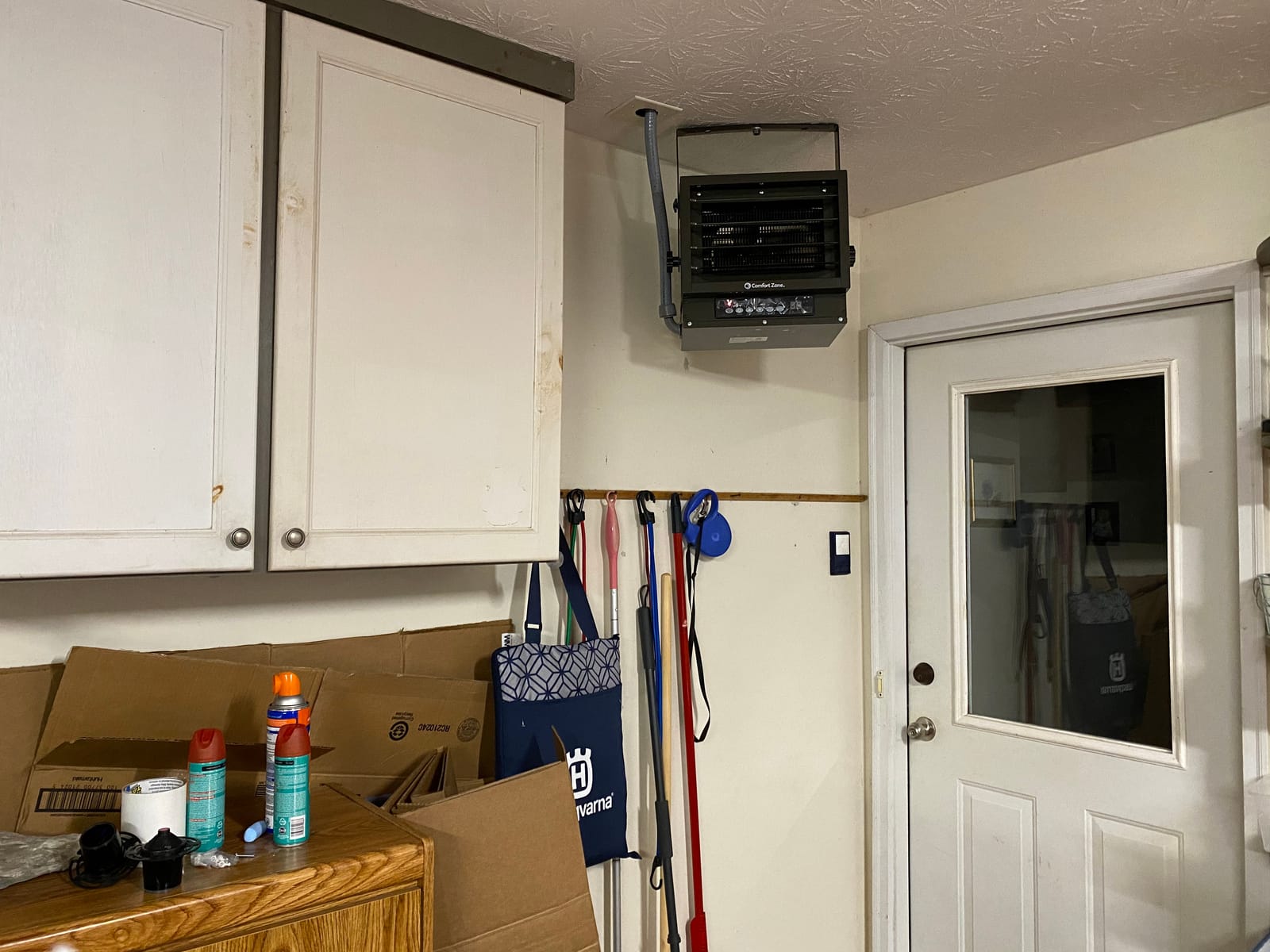
Control is where this unit clearly outclasses the analog models. The digital thermostat adjusts from 45 °F to 95 °F, the included remote changes heat from the workbench, and the 12-hour timer shuts it down when your work session ends rather than leaving it cycling all night.
The negatives are reliability and hardware rather than heat output. A number of owners report an E1 error code after extended use that required cleaning or a sensor connector swap, and the included lag bolts are thin for securing through drywall. Factory customer service is frequently described as unhelpful, and buyers outside the US report limited support.
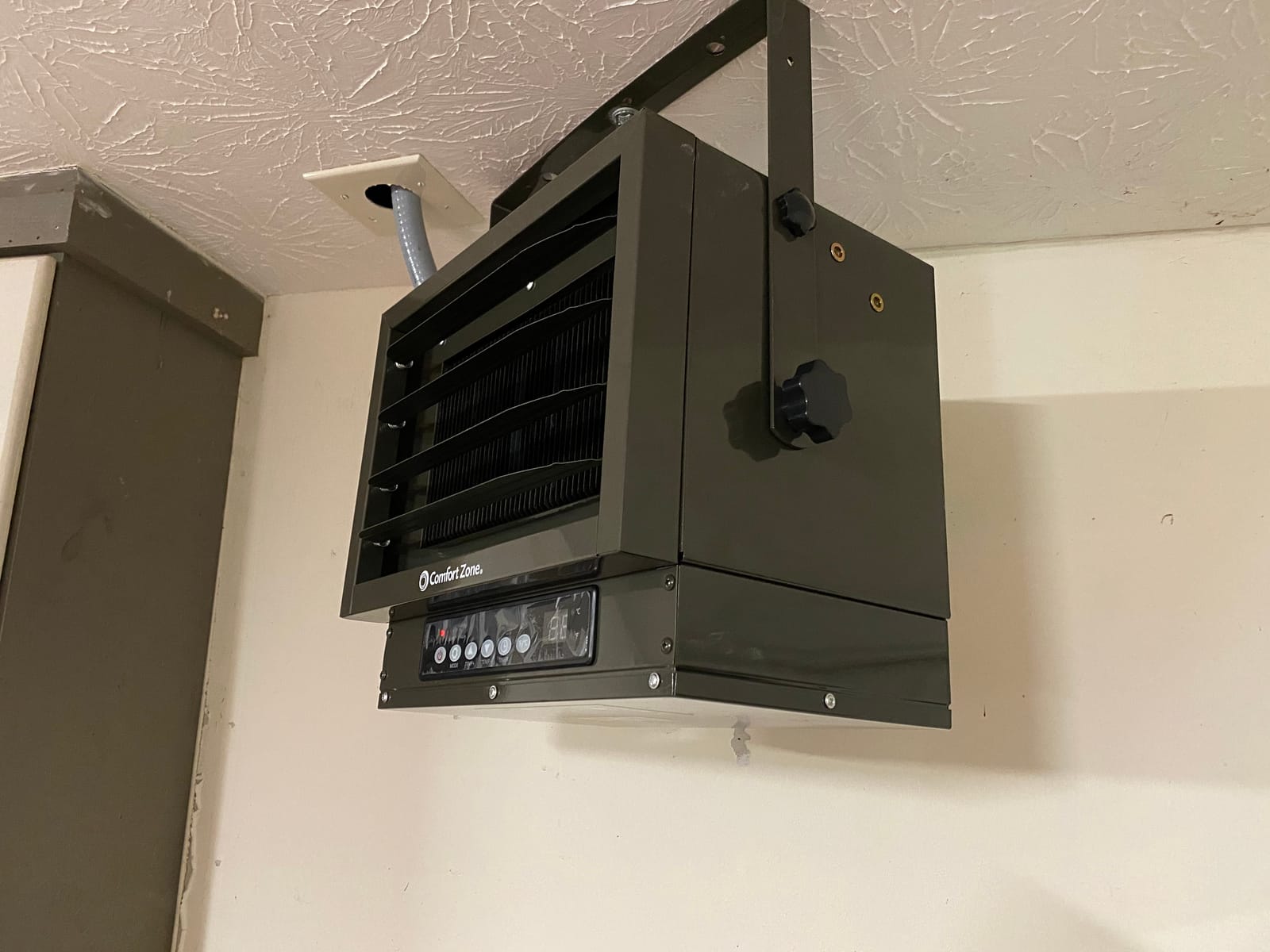
Does 7,500 watts really cover a 24×24 two-car garage?
Yes, with insulation in place. The 25,600 BTU output is roughly equivalent to 40,000 BTU of propane on a fuel-cost basis, and the coverage rating of 1,250 sq. ft. matches a 24×24 bay. Owners running it in insulated two-car garages report holding setpoint all winter.
Without insulation the same 31.3 amp draw becomes a very expensive comfort upgrade. A 40A double-pole circuit is required, and that is the first thing to verify before you plan the purchase.
Who should skip this model?
Skip it if your garage is uninsulated, if the amperage is a concern on your panel, or if you are outside the US and value replacement parts and support. The electronics-heavy feature set is a liability for buyers who cannot source a sensor or a control board locally.
For a garage that only needs spot heat, a radiant unit like the one in our infrared space heater guide is a more sensible spend.
3. Dr. Infrared DR-966 6,000W – Best for Workbench Heat and Long Service
Dr. Infrared Heater DR-966 240-Volt Hardwired Shop Garage Commercial Heater, 3000 Watt / 6000 Watt
3000W or 6000W selectable
25 A 240V single phase
UL/CUL wall or ceiling mount
600 sq ft rated
27 lb cabinet
Pros
- 4159 reviews at 4.3 stars
- UL/CUL listed with one-year parts and labor warranty
- 3000W low draw can share a 30A circuit
- Reported to outperform 7500 watt comparables
- Accepts a 6-50 welder outlet cord
- 5 louvers plus tilt head
Cons
- Internal thermostat reads high when mounted above head height
- Ground wire too short and oversized conduit knockout
- 27 lb unit needs two people or a lift to mount
- Some installations have no on/off switch
The DR-966 is the pick when one bay needs serious heat more than the whole garage needs even heat. At 4,159 reviews it has the largest proven base among the hardwired electric models here, and it is UL/CUL listed with a one-year parts and labor warranty, which is unusual in this category.
The selectable 3,000 watt low setting is the underrated feature. At that setting the draw drops to a level that can share a 30A circuit with other 120V tools, which is genuinely useful in a workshop where a welder or saw is also in use. Owners report the 6,000 watt setting performing like units with substantially higher wattage.
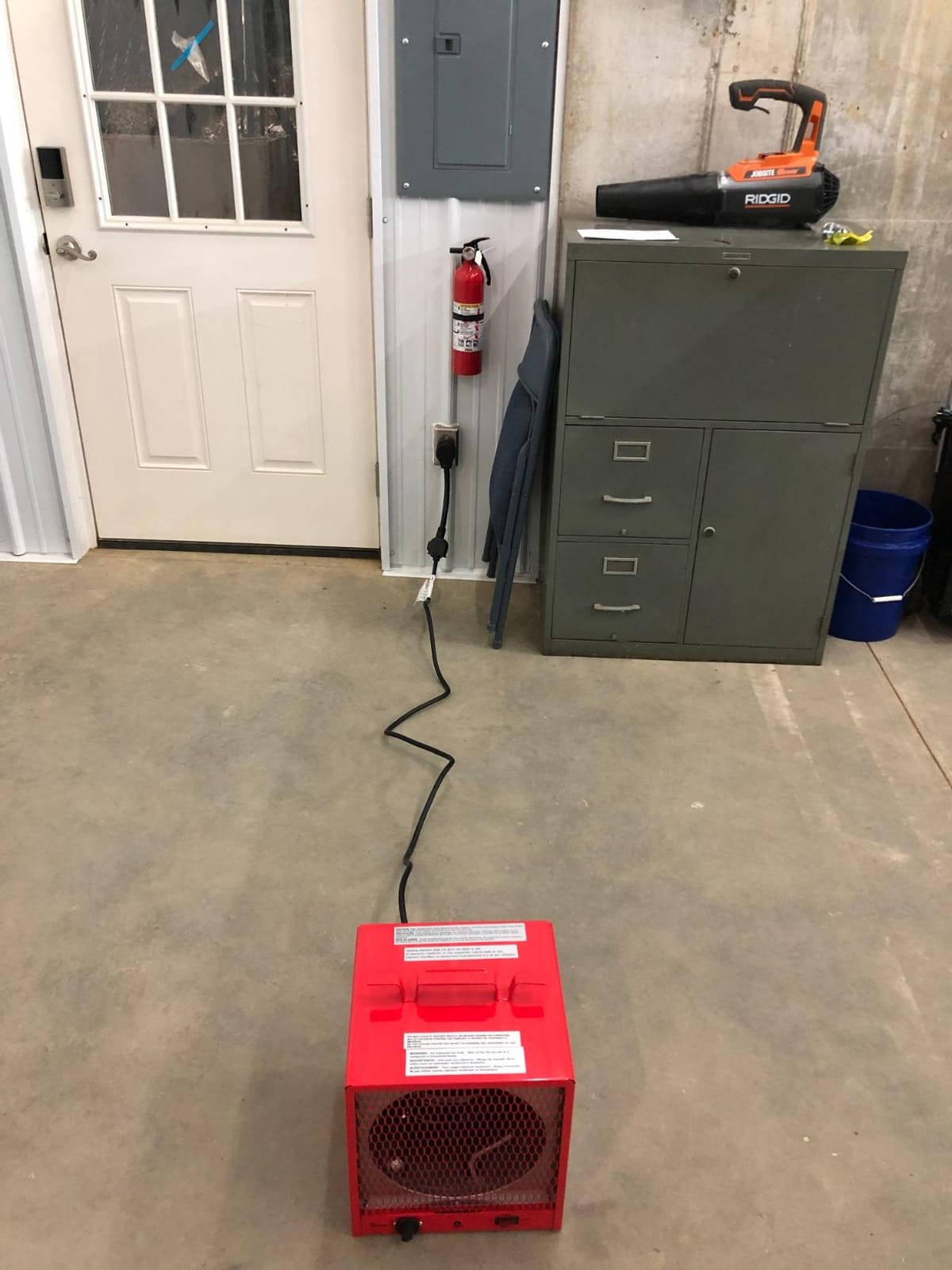
It accepts a NEMA 6-50P cord, so owners with a welder outlet can skip hardwiring entirely using an inexpensive adapter cable. That single feature can remove the electrician from the equation entirely, which is the most common install barrier for electric garage heat.
The recurring complaint is thermostat accuracy at height. Mounted near the ceiling, the internal sensor reads high because it sits in the warmest air in the room, so the unit cycles short. Pair it with an external thermostat through the provided terminals, which several owners do and report restoring setpoint accuracy within a degree or so.
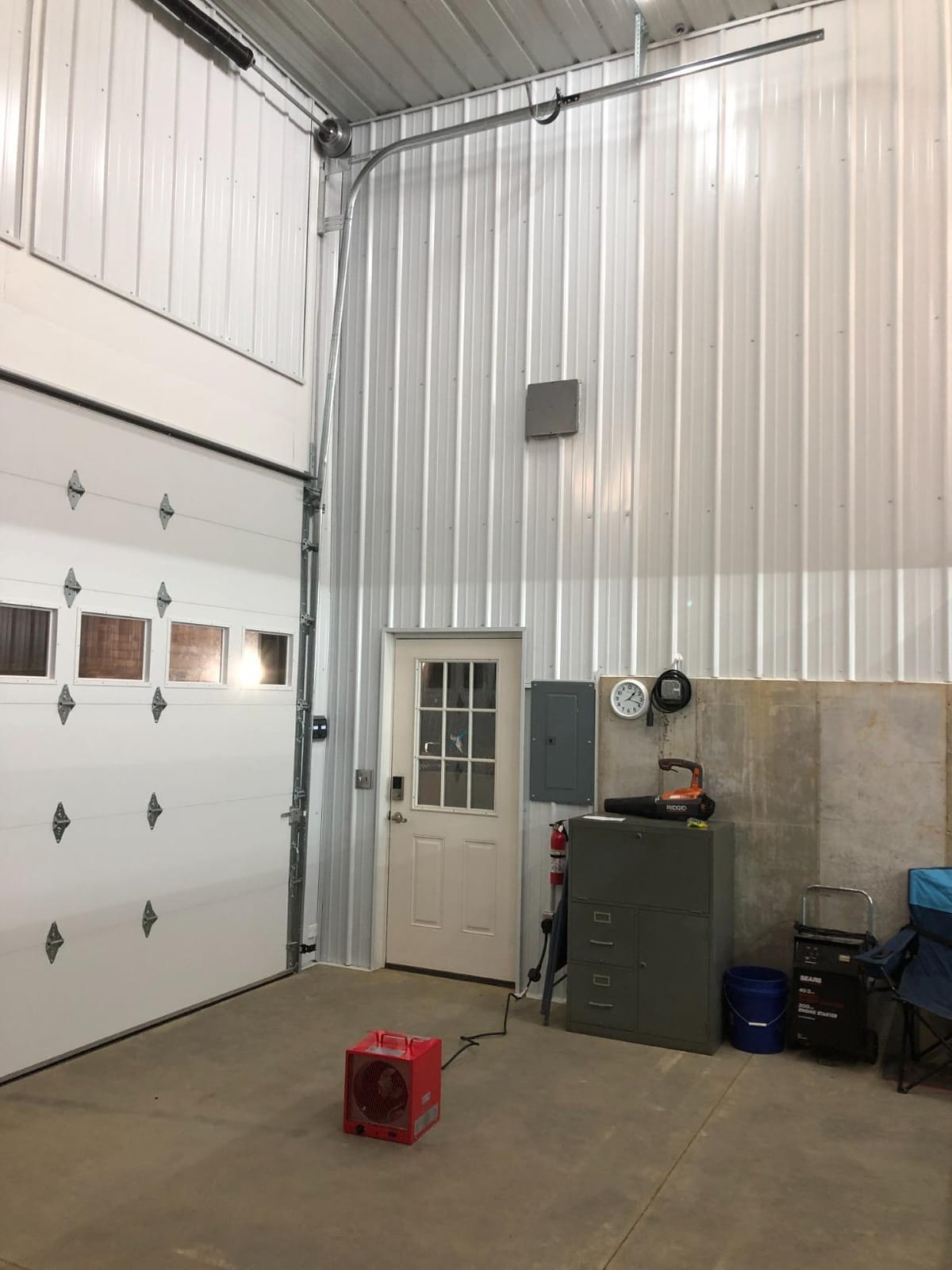
Is a 6,000 watt heater enough for half a two-car garage?
For one working bay, yes. The manufacturer rates it to 600 sq. ft., which is roughly a single bay plus storage, and owners in uninsulated spaces report it holding above freezing through extreme cold. For the full 400 to 576 sq. ft. footprint of a two-car garage, it is undersized unless the space is well insulated.
What makes installation awkward on this model?
At 27 lb it is a two-person mount or a lift, and the reported ground wire length and oversized conduit knockout are the kinds of detail that turn a quick install into a parts run. Check your mounting height against your garage door track before you buy, because that clearance is a deal breaker in many two-car bays.
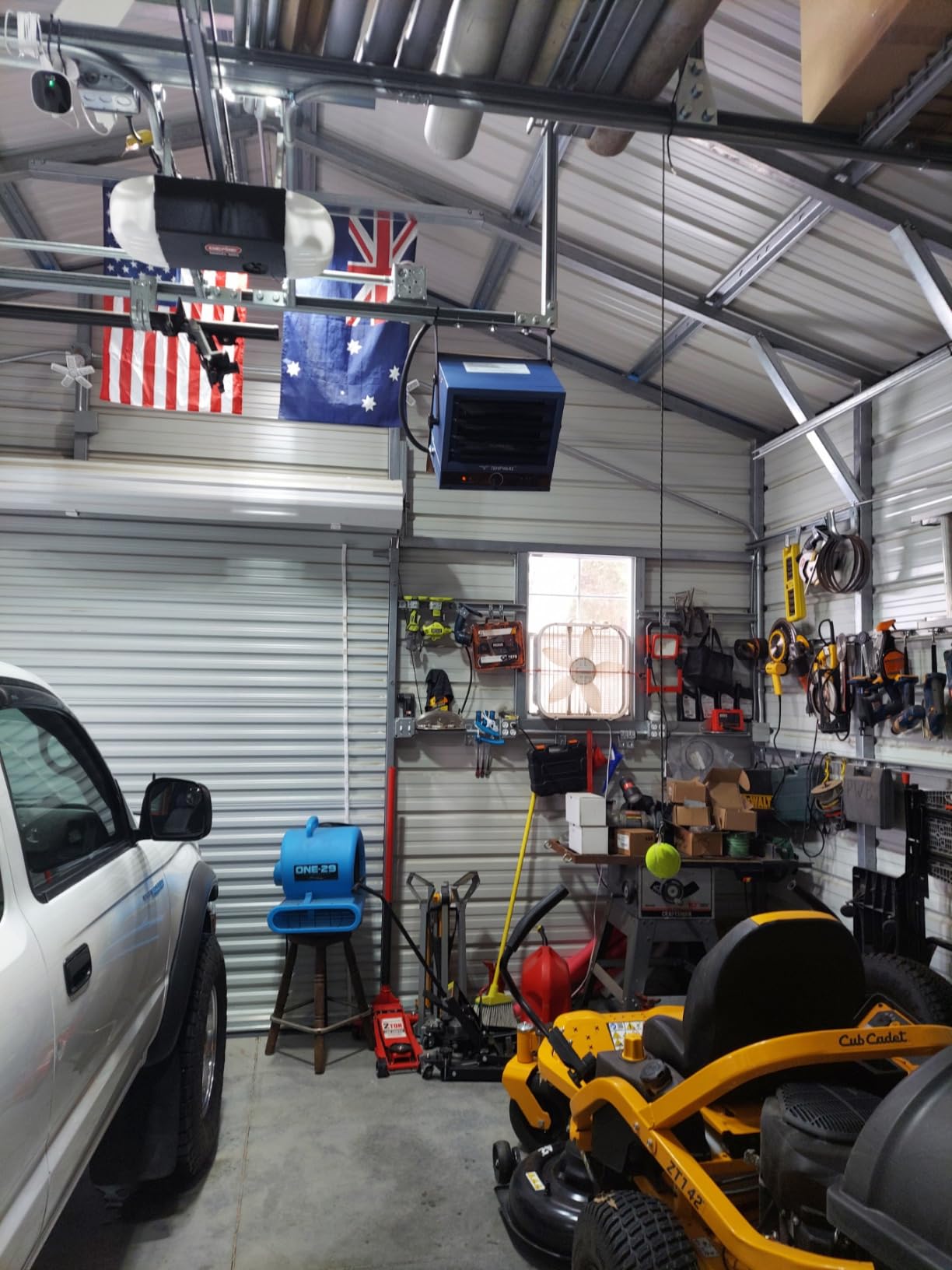
4. TEMPWARE GR7500ER-EC 7,500W – Most Control Features in the Electric Tier
TEMPWARE 7500W Electric Garage Heater, 240V Hardwired Heater, 2026 Upgraded
25590 BTU
5000W to 7500W selectable
240V hardwired,31.25 A
Digital thermostat 45-95 F with ECO mode
Coverage up to 1250 sq. ft.
Pros
- Selectable wattage lets you match a 30A or 40A circuit
- Digital thermostat with ECO output management
- Remote plus on-unit touch panel
- 12-hour programmable timer
- Automatic overheat protection
- Ceiling mount clears floor space
Cons
- Hardwired 240V only with no power cord included
- Thinner listing detail than the established brands
- Weight and dimensions not published
- On-screen controls are awkward with work gloves
This unit matches the 7,500 watt output of the Comfort Zone above while adding an ECO mode and a selectable 5,000 watt setting, which is the feature that matters most if your electrical panel cannot carry the full 31.25 amp draw. It carries a 4.4 star rating across 414 reviews with 73 percent five-star, so the sentiment is strong even though the sample is far smaller.
Operating it is the best part. The remote and the touch panel both work, the digital thermostat spans 45 °F to 95 °F, and the 12-hour timer handles the shutdown. Owners value being able to trim output to match their circuit rather than committing to a full 40A branch from day one.
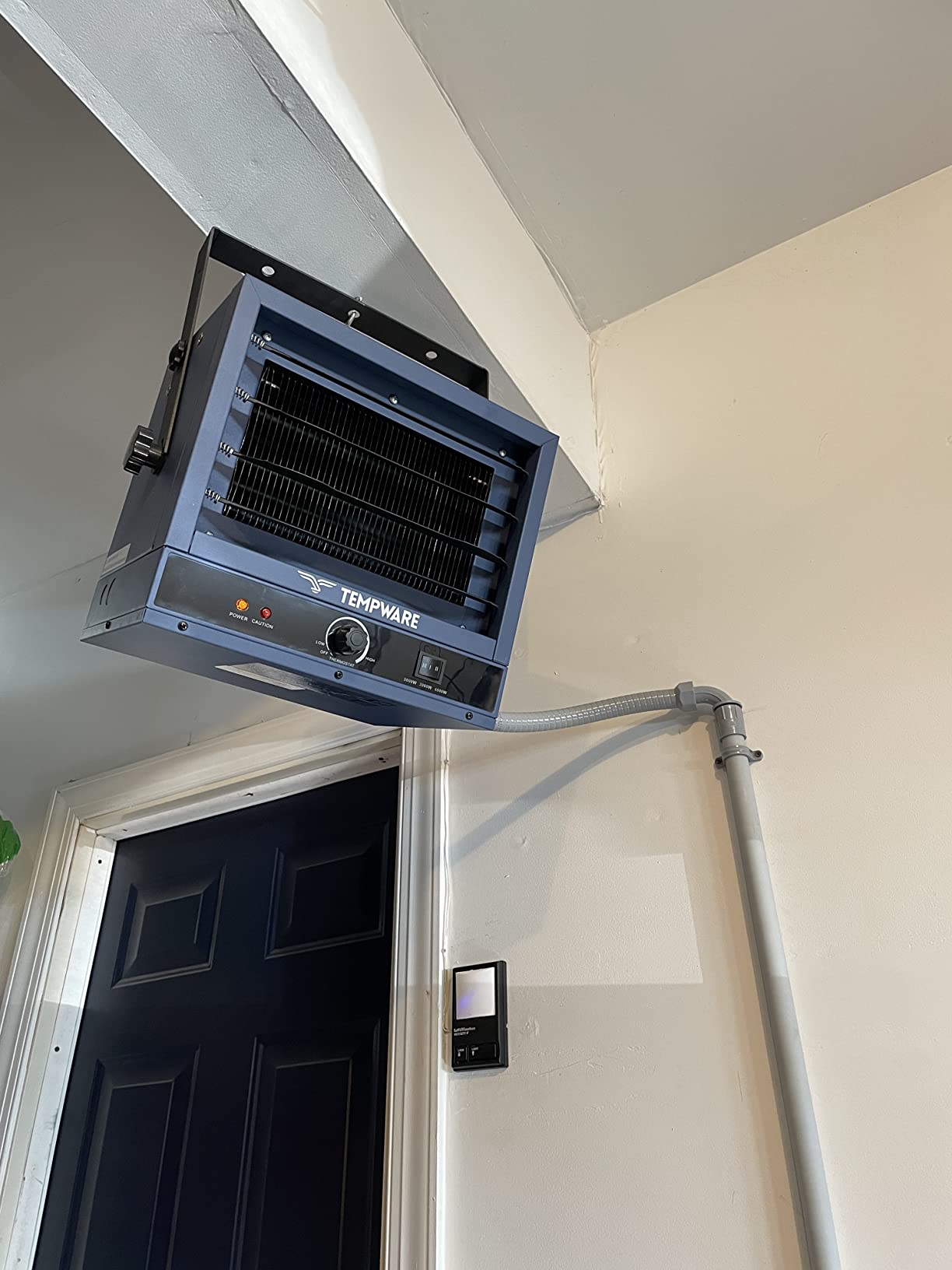
The honest caveat is documentation. Weight and exact dimensions are not published in the listing data, and the sales rank in its category sits well behind the established Comfort Zone and Dr. Infrared models. That matters if you are comparing side by side and trying to confirm ceiling clearance.
The touch controls are also a minor irritation with work gloves on, which is a real consideration in a garage where you are handling parts. Owners transitioning from analog dials notice this immediately.
Who should buy the TEMPWARE instead of the Comfort Zone?
Buy it if your panel is limited and the 5,000 watt selectable setting lets you install on a 30A circuit, or if you want the ECO mode to reduce output during shoulder seasons. The 25,590 BTU output and 1,250 sq. ft. rating put it in the same tier as the CZ230ERBK.
What are the reasons to look elsewhere?
Long-term buyers should weigh the smaller review base and the thinner published specification set. If you want a documented warranty from a long-established manufacturer and a parts supply you can rely on, the higher-volume models are the safer bet for the same wattage.
5. Mr. Heater F260550 50,000 BTU – Best for a Permanently Heated Garage with a Gas Line
Mr. Heater 50,000 BTU Forced-Air Unit Heater (Propane or Natural Gas)
50000 BTU forced air
Ceiling mount natural gas
NG to LP conversion kit included
Coverage up to 1667 sq. ft.
60.3 lb unit
Pros
- 50000 BTU holds setpoint in deep cold
- Coverage rating of 1667 sq. ft. is generous for a two-car bay
- Works with standard 24V and Wi-Fi thermostats
- Owners report 10 F gains in 15-20 minutes
- Low runtime at setpoint keeps fuel use down
- Multiple seasons of reliable service reported
Cons
- Requires professional gas line and roof vent installation
- Vent pipe
- thermostat and some hardware not included
- 60 lb overhead mount needs two people or a lift
- Some examples arrive with a noisy fan assembly
- Customer service response reported as very long
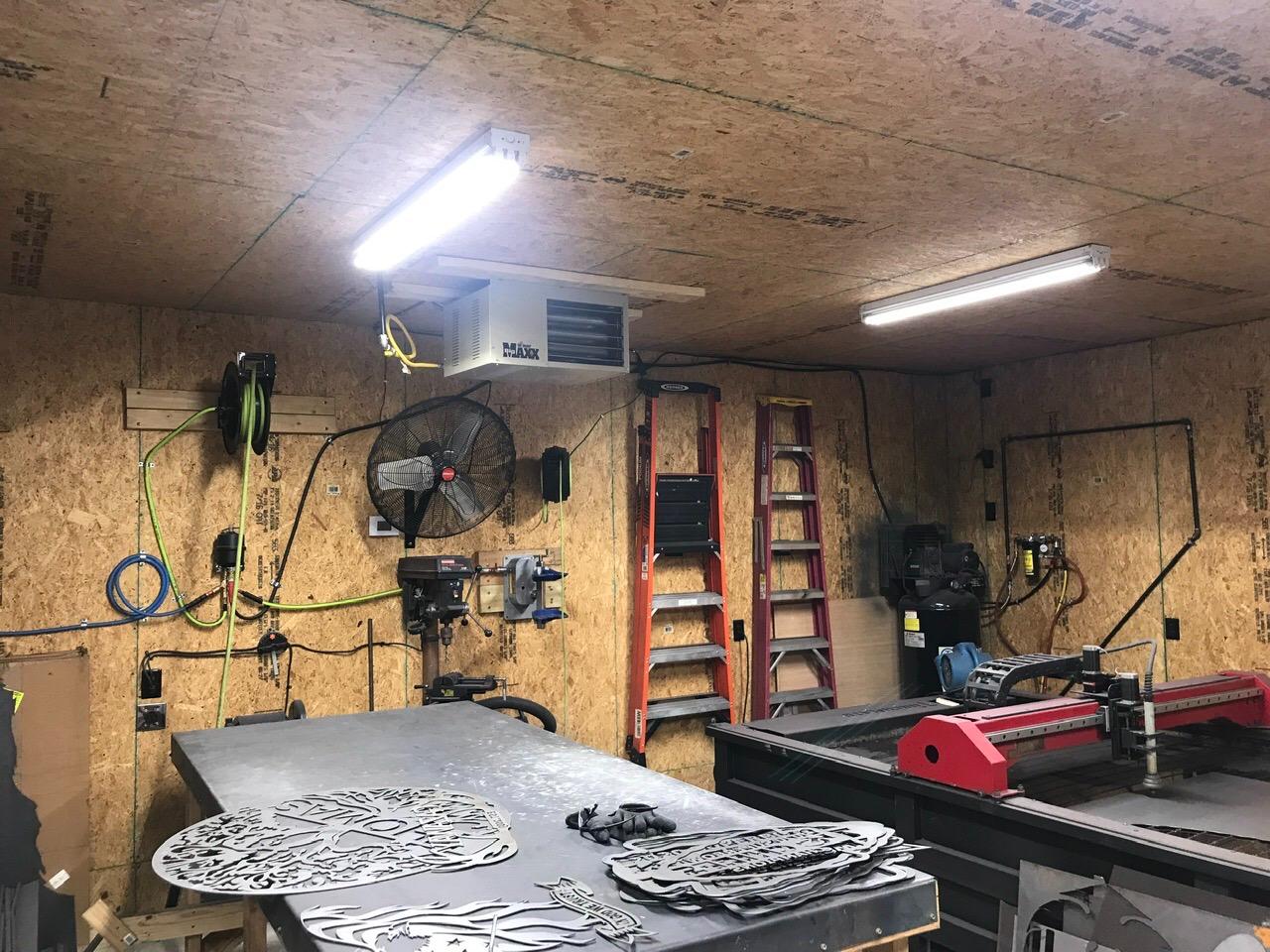
This is the right answer for an attached or detached two-car garage that will be heated all winter and has a natural gas line, and it is the category that most roundups of this topic leave out entirely. At 50,000 BTU with a 1,667 sq. ft. coverage rating, it is deliberately oversized for a 400 to 576 sq. ft. two-car space, and that headroom is the point: it reaches temperature in deep cold and then drops to a very short runtime at setpoint.
Owners document a 10 °F rise in 15 to 20 minutes and low run times once the garage is warm, which is exactly the behaviour you want from a permanently heated shop. It works with standard 24V thermostats and with Wi-Fi-enabled models, so you are not locked into the manufacturer controller.
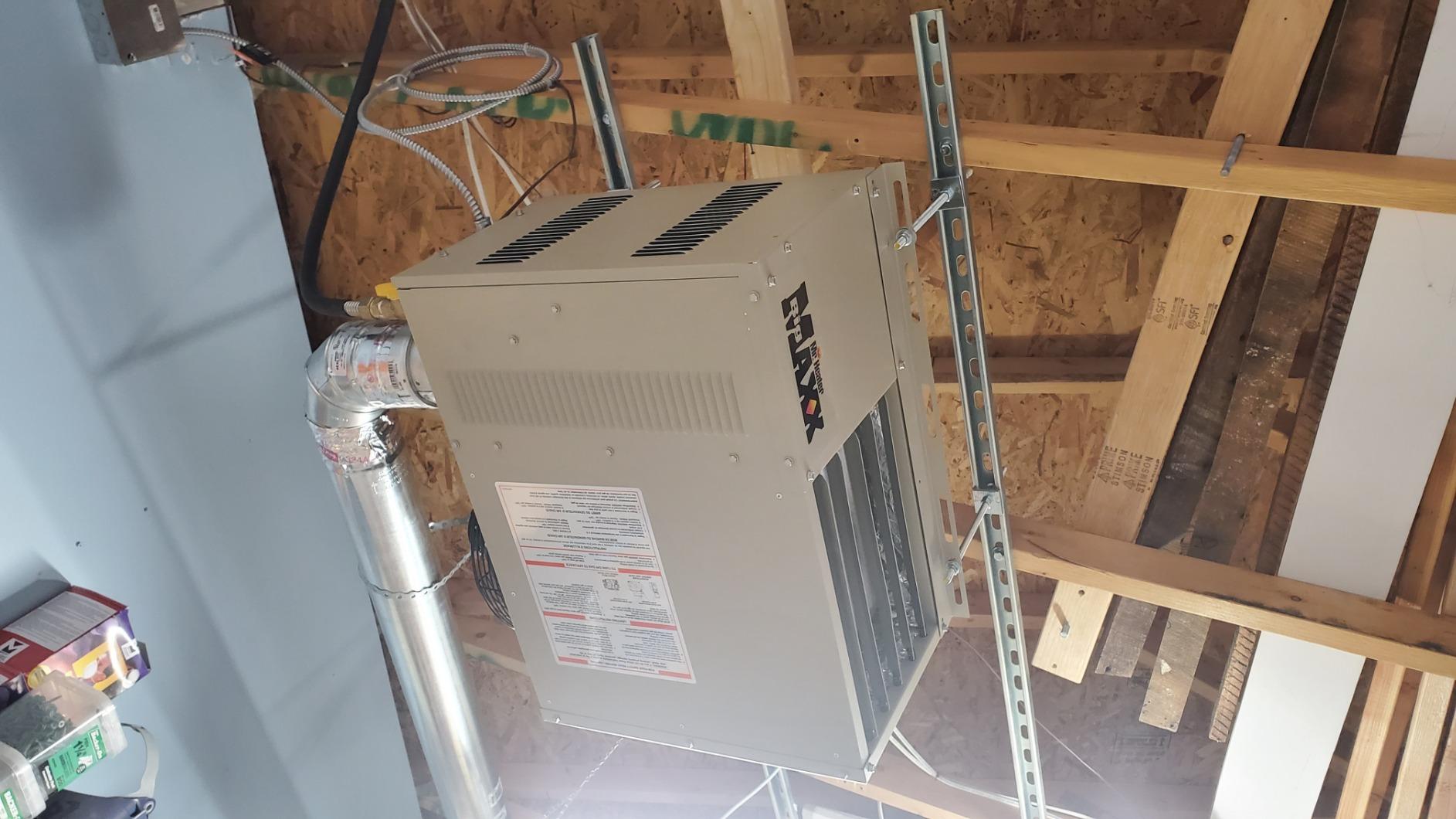
The installation requirements are the real story. The unit needs 10 ft minimum ceiling height, 8 ft of clearance from the base of the heater to the floor, and flue venting through the roof. Venting hardware, the thermostat, and some mounting extras are sold separately, so the delivered cost of this choice is meaningfully higher than the unit cost suggests.
At 60.3 lb it is not a solo overhead install. Some examples arrive with a noisy or unbalanced fan assembly that needs adjustment or replacement, and reviews describe control board failures with very slow customer service response. One recurring note worth heeding: the manual instructs pitching vent pipe upward, which owners say causes condensation damage, so have your gas fitter run it sloping down instead.
Is 50,000 BTU too much for a two-car garage?
No, and the sizing math supports it. A 24×24 garage with 9 ft ceilings comes to roughly 15,500 to 25,900 BTU before loss factors, and an uninsulated or very cold-climate space doubles that. A 50,000 BTU unit simply reaches temperature faster and cycles less, and for gas fuel the hourly cost of running it at part load remains lower than the electric alternative.
Who is this unit wrong for?
It is wrong for a garage without a gas line, for anyone unwilling to have venting installed, and for a bay with a ceiling under 10 ft. If your use is occasional weekend warmth, a portable propane unit delivers a similar result with no installation at all.
6. Remington REM-60V-GFA-O 60,000 BTU – Best Propane Pick for Fast Warm-Ups
Remington LP Forced Air Heater, Portable 60,000 BTU Space Heater for up to 1500 Square Feet – Liquid Propane Gas Powered, Tank Not Included
60000 BTU/hr propane
Coverage up to 1500 sq. ft.
Forced air with variable heat settings
11 lb freestanding
120V ignition, tank not included
Pros
- Owners report warming a two-car garage in about 10 minutes
- 60000 BTU covers up to 1500 sq. ft.
- Only 11 lb and freestanding
- Continuous electronic ignition
- Three-layer safety suite
- Tank not included
Cons
- Loud
- and unacceptable in quiet spaces
- Propane cylinder not included
- Listed for outdoor use with ventilation required
- Short power cord on some examples
- Some have arrived broken
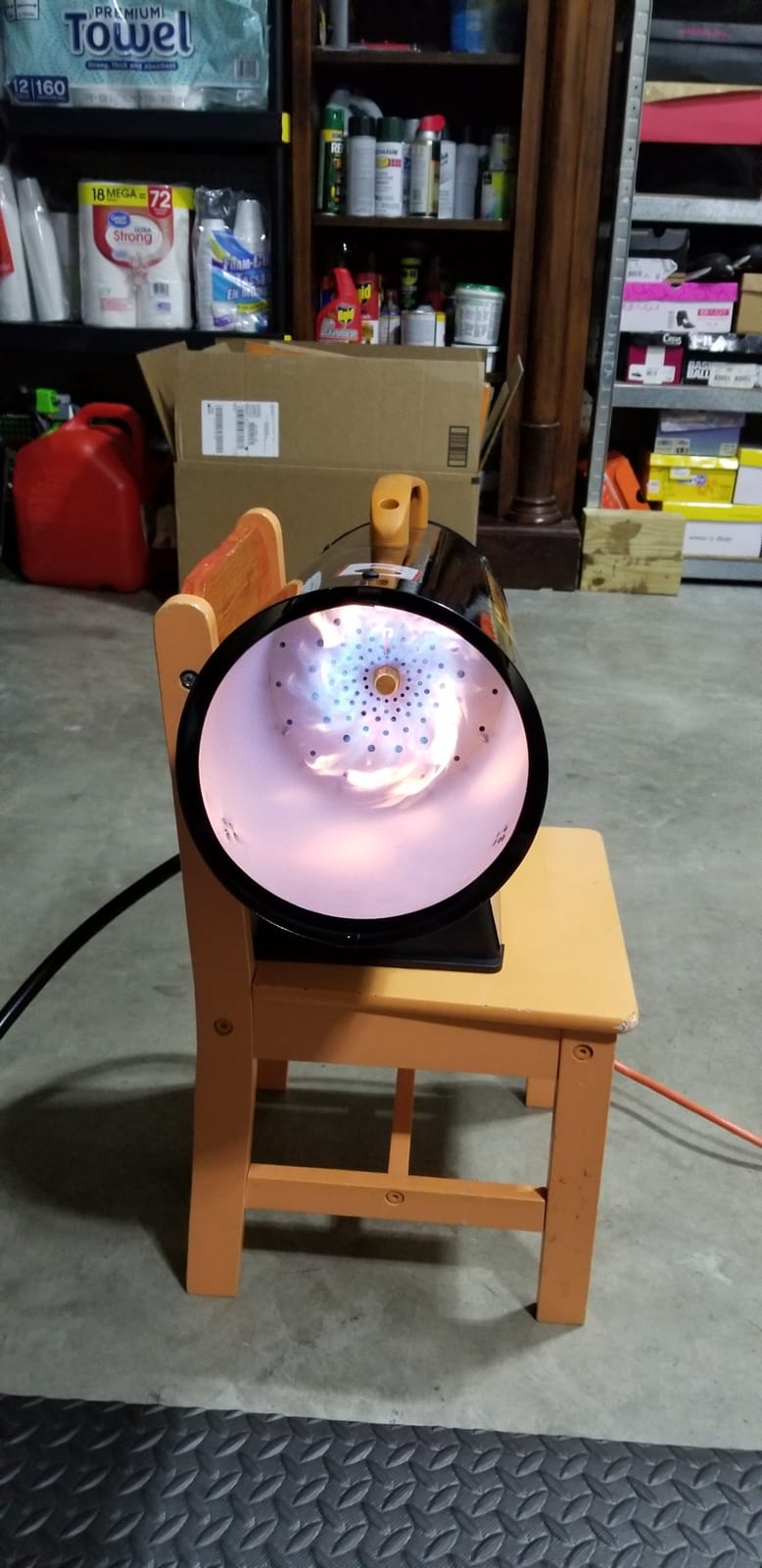
The Remington is the propane counterpart to the gas unit above, and it earns a 4.5 star rating across 736 reviews with 74 percent five-star. At 60,000 BTU it covers up to 1,500 sq. ft., which oversizes a two-car garage comfortably, and owners report bringing a two-car space up to working temperature in about 10 minutes even with a window cracked open.
It weighs 11 lb and stands on a pedestal, so it moves out of the way when the cars come in and takes no permanent floor space. The included 10 ft propane hose and regulator mean the only extra purchase is the cylinder itself. Continuous electronic ignition removes the relighting chore entirely.
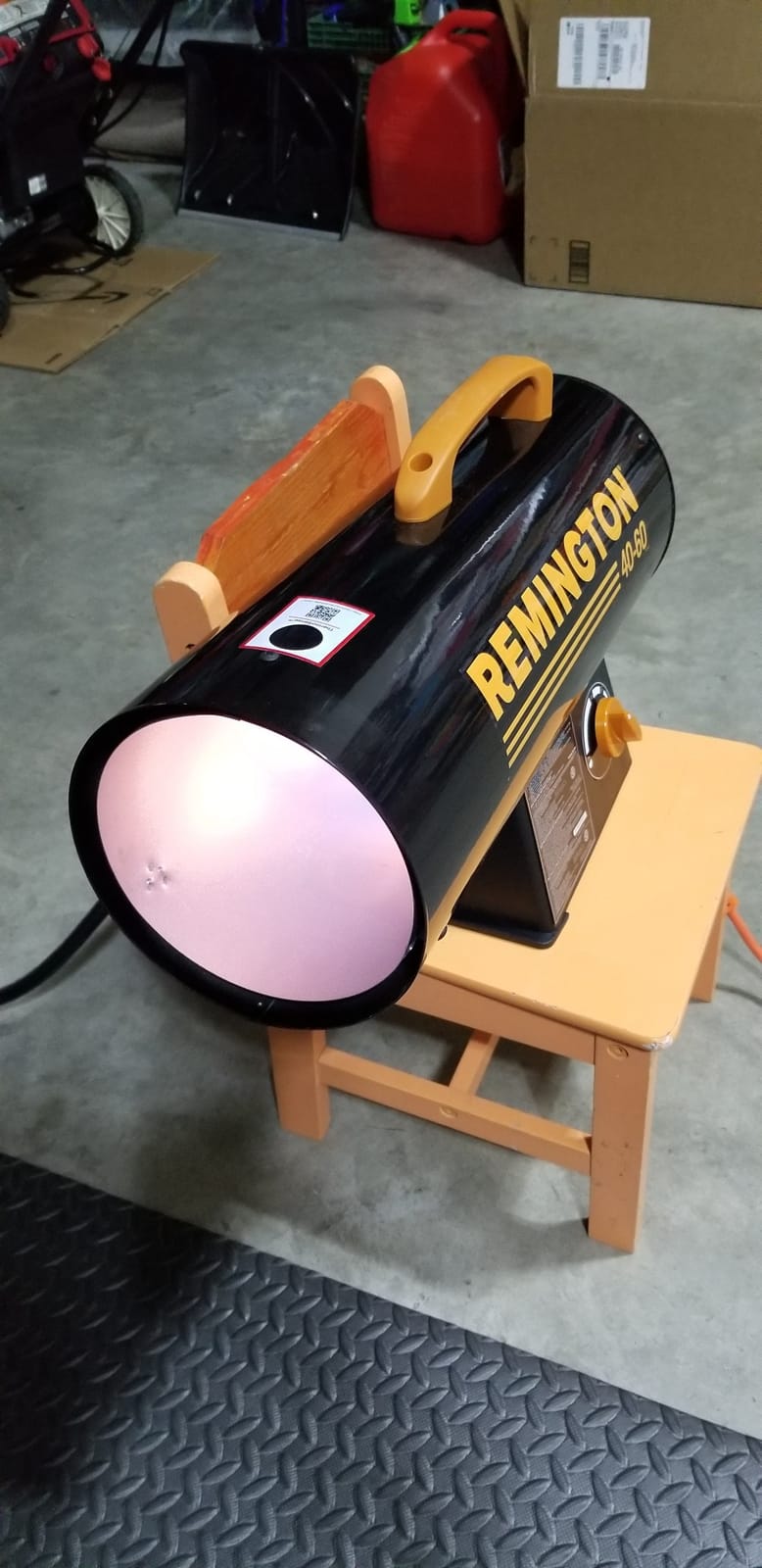
Noise is the drawback that decides this one for or against you. Owners describe the fan as the main complaint and at least one returned the unit specifically for being too loud, so it is a poor match for a garage converted into a home gym. A heat-sensitive indicator sticker on the tube shows when the outlet is cool to touch, which is a small but genuinely useful safety feature.
The safety suite is the strongest on this list: a thermocouple, a high temperature limit shut-off, and a flame-out fuel cut-off, all working together. Note that ventilation is required for indoor use and the unit is listed for outdoor use, so read the placement rules carefully in an enclosed garage.
Is 60,000 BTU propane enough for an uninsulated two-car garage?
More than enough for the load calculation, and 60,000 BTU sits above the 23,000 to 39,000 BTU range that a drafty 24×24 space typically requires. Owners who switched from electric to propane describe the running cost as the biggest surprise in their favour, because gas carries far more energy per unit of fuel cost.
What are the deal breakers on this model?
Noise in a quiet workspace, a short ignition power cord, and the fact that propane is a consumable you have to refill. For owners heating only on weekends, the refill logistics and tank handling are the practical friction points that show up in forum threads.
For job sites rather than a home garage, our propane picks for job sites go into the cylinder and transport details.
7. Mr. Heater F299731 30,000 BTU Blue Flame – Best When Venting Is Not an Option
Mr. Heater 30,000 BTU Vent Free Blue Flame Natural Gas Heater
30000 BTU/hr vent-free blue flame
Natural gas
Coverage up to 1000 sq. ft.
Battery electronic ignition, no electricity needed
Low oxygen safety shut-off
Pros
- 4469 reviews at 4.5 stars
- the largest proven base here
- Runs without electricity
- Built-in adjustable thermostat
- Low oxygen safety shut-off
- Wall mounting hardware included
Cons
- Requires a professionally installed gas line
- Blue flame does not move air so cold pockets persist
- Blower fan kit is a separate purchase
- Not rated for outdoor use
This is the pick for an attached two-car garage where running a flue through the roof is not realistic. As a vent-free blue flame unit it needs no venting at all, and with 4,469 reviews at 4.5 stars and 76 percent five-star ratings, it has the most established track record of any product in this roundup.
Its 30,000 BTU output and 1,000 sq. ft. coverage rating match a standard insulated 20×20 two-car bay almost perfectly. Battery-operated electronic ignition means it runs with no electricity at all, which keeps working during an outage, and the built-in adjustable thermostat plus low oxygen safety shut-off handle control and protection without extra accessories.
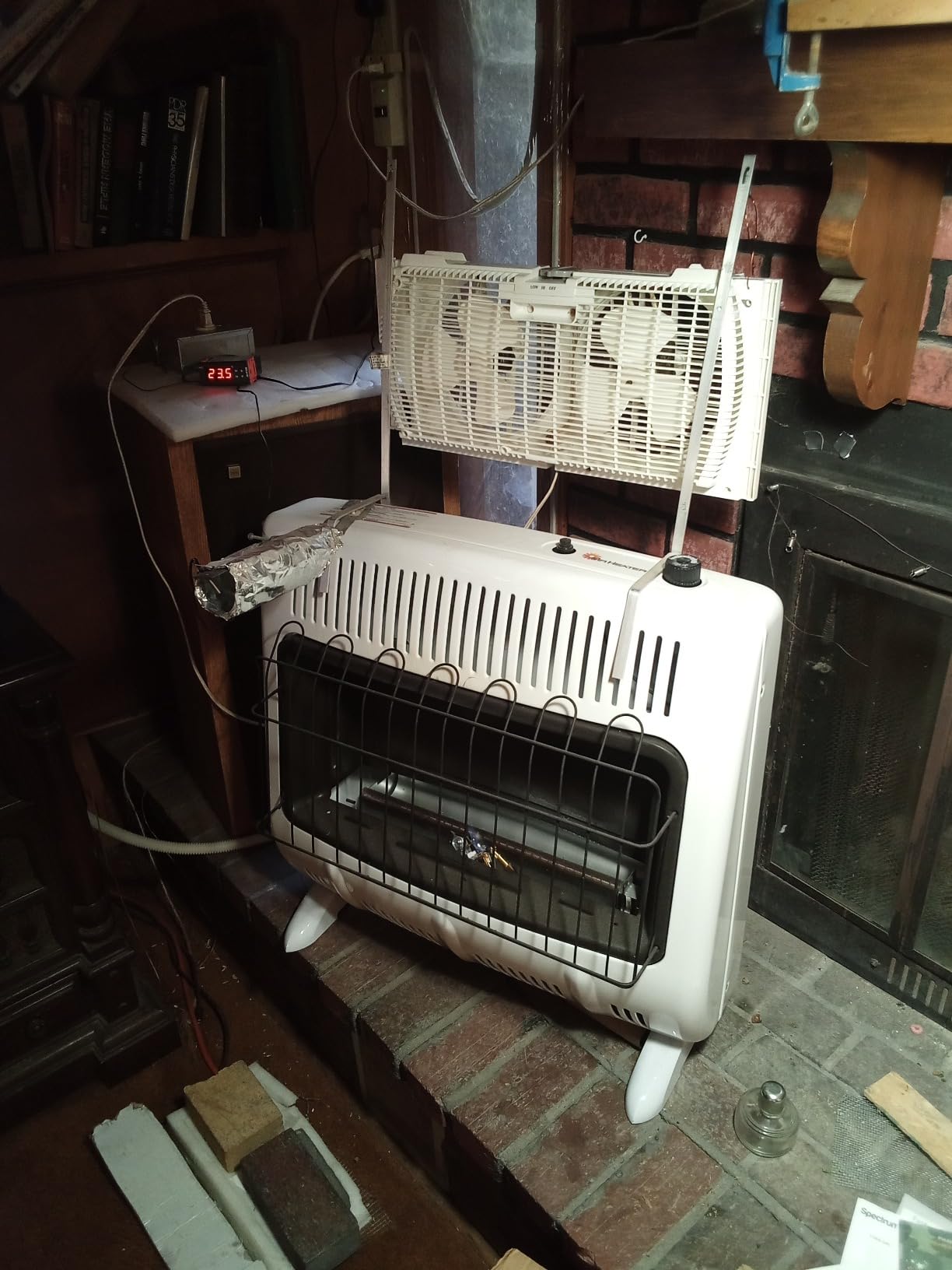
Wall mounting hardware is included, so the unit can sit above the work area rather than occupying a bay, and the installation burden is reduced to running a gas line into the garage. For most owners that is still a professional job, but it is a smaller one than fitting a vent through a roof.
The honest limitation is air movement. Blue flame convection spreads warmth evenly once it is running, but it does not circulate air, so in a large open two-car bay owners report cold pockets persisting until the space has had a few minutes to even out. A blower fan kit is available separately if you want forced circulation.
Is a vent-free gas heater safe in an attached garage?
Vent-free gas heaters are designed and listed for indoor use, and this one includes a low oxygen safety shut-off for exactly that reason. Placement and clearance rules from the manufacturer still apply, and a working carbon monoxide detector is not optional in a garage attached to living space.
Owners consistently treat the vent-free approach as workable provided the clearances are respected and CO detection is in place. What is not acceptable is treating a vent-free unit as a substitute for a properly vented one in a space that requires venting.
Who should not buy this model?
Owners without access to a natural gas line, and anyone who wants fast, forced circulation across the full bay. Blue flame heaters also make poor emergency heat, since there is no fan and no cordless operation to start from.
8. Mr. Heater Portable Buddy 9,000 BTU – Top Rated Pick for Work Corners and Emergency Heat
Mr. Heater 9,000 BTU Portable Buddy Radiant Propane Heater
4000 or 9000 BTU/hr radiant
Indoor and outdoor approved
5.4 hours on low per 1 lb cylinder
225 sq ft coverage
7.1 lb portable
Pros
- 4.7 star rating across 29212 reviews
- the largest sample here
- Runs on a 1 lb propane cylinder with no wiring
- Indoor and outdoor approved
- 7.1 lb and compact
- Radiant heat warms people directly
- Low oxygen safety system and self-extinguishing construction
Cons
- 9000 BTU covers only about 225 sq. ft.
- Runtime is about 2.4 hours on high per cylinder
- No forced air so heat does not circulate
- Propane cylinder is a recurring consumable
The Portable Buddy is the highest-rated product in this roundup at 4.7 stars across 29,212 reviews, with 84 percent five-star and only 2 percent one-star. That is a reliability record no other heater here comes close to, and it is why it remains the default answer to what to keep in the corner of a garage.
Its limit is size. At 4,000 or 9,000 BTU with roughly 225 sq. ft. of coverage, it heats a work corner, a vehicle being worked on, or an emergency during a power outage. It is not a solution for a full two-car garage, and buying it expecting it to heat 480 sq. ft. is the most common sizing mistake in this category.
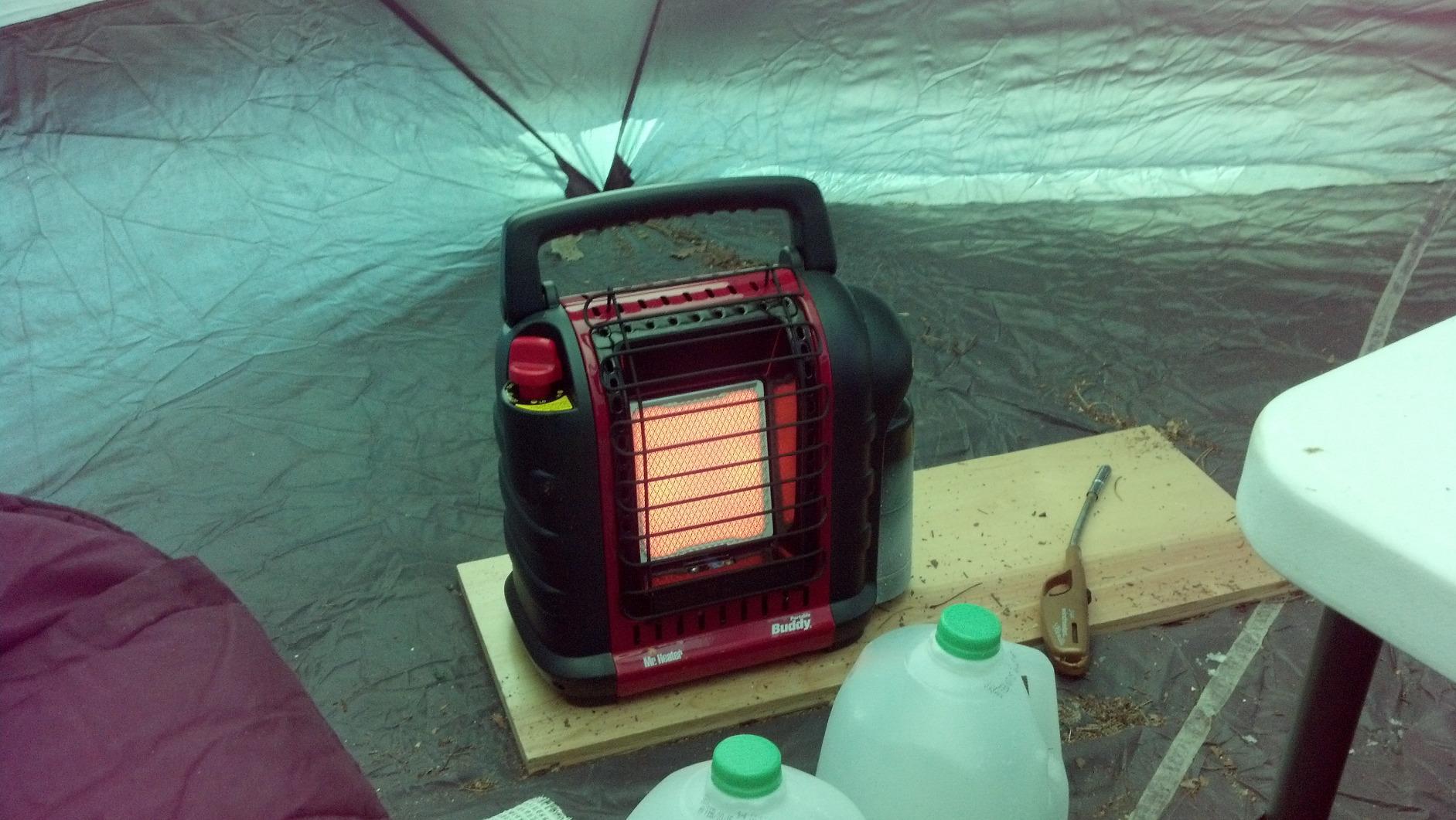
Where it is used as intended, the simplicity is the selling point. It runs 5.4 hours on low and 2.4 hours on high from a 1 lb propane cylinder, carries a piezo igniter, needs no wiring or circuit, weighs 7.1 lb, and is approved for both indoor and outdoor use. The emergency low oxygen safety system and self-extinguishing construction are standard on a unit with this service life.
Radiant heat means it warms you directly rather than the air, which is how most owners use it: at the bench, near a work light, or at the tailgate in winter. Our infrared space heater picks cover the same principle in electric form.
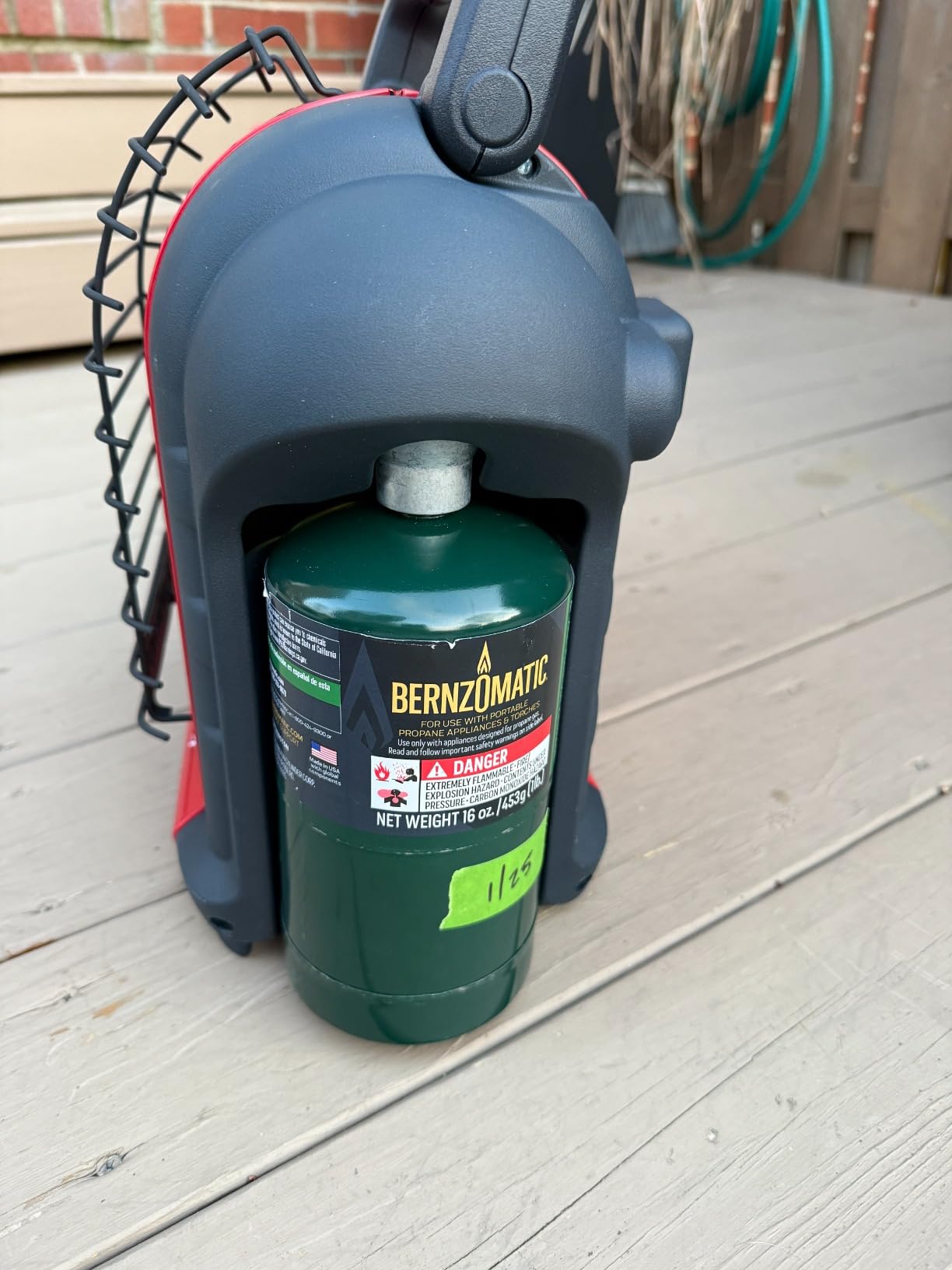
Is 9,000 BTU enough for a two-car garage?
No. Coverage of roughly 225 sq. ft. is less than half the footprint of a typical two-car garage, and radiant output does not accumulate into room temperature the way forced air does. It is designed to warm a person or a project, not to raise the space to 65 °F.
What is the Portable Buddy genuinely good for?
Workbench heat, emergency heat during outages, garage clean-out days in cold weather, and warming a vehicle interior before starting it. At 7.1 lb it moves from the garage to a driveway without effort, and its decades-long service life means it is often the last garage purchase anyone makes.
9. GASLAND FH12FB 125,000 BTU – Best for Large Open Areas and Driveways
GASLAND 125,000 BTU Propane Force Air Heater for Garage, Heat Up 3100 Sq.Ft
75000 to 125000 BTU variable
Propane forced air
Coverage up to 3100 sq. ft.
CSA certified
13 lb portable, includes hose and regulator
Pros
- Highest propane output in this roundup at 125000 BTU
- Variable output from 75000 to 125000 BTU
- Coverage rating up to 3100 sq. ft.
- About 5 hours on low from a 20 lb tank
- CSA certified with flame-failure gas shutoff
- 13 lb with adjustable heat angle
Cons
- Requires ventilation and is listed for well-ventilated areas
- Propane tank not included
- Overkill for a typical two-car garage on high setting
- Not designed for enclosed indoor use
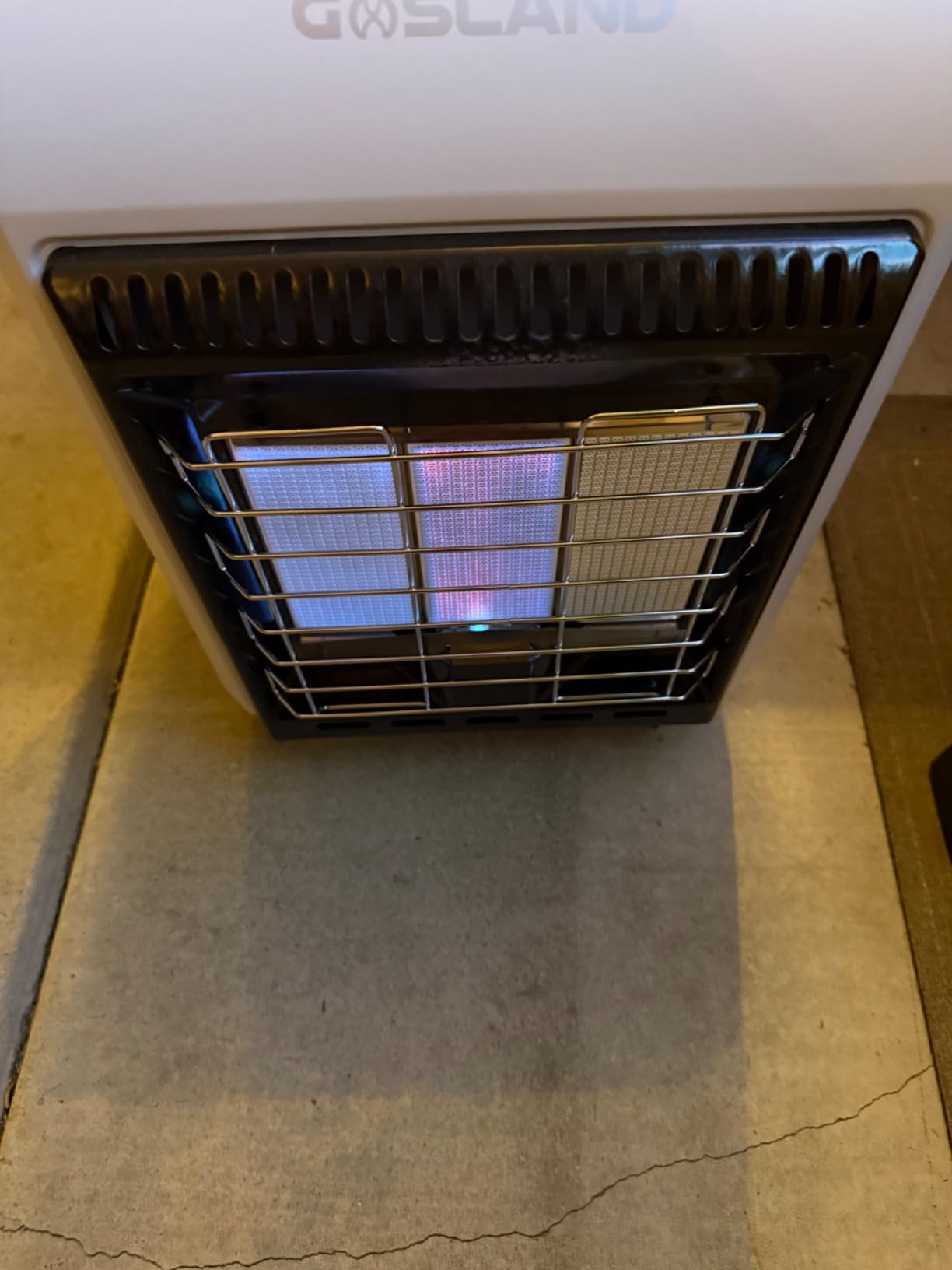
The GASLAND is the largest portable propane heater here, and at 125,000 BTU with coverage rated to 3,100 sq. ft. it treats a two-car garage the way the Comfort Zone treats a workshop bench. That is a real mismatch, and it is worth naming plainly: for a standard two-car bay this is a shop and job site heater, not a garage heater.
Where it earns its place is a garage with a large open door, a driveway, or a two-car bay plus a workshop area that never closes. The variable output from 75,000 to 125,000 BTU is the feature that makes it usable in a smaller space, because the low setting prevents the overheating a fixed high output would cause.
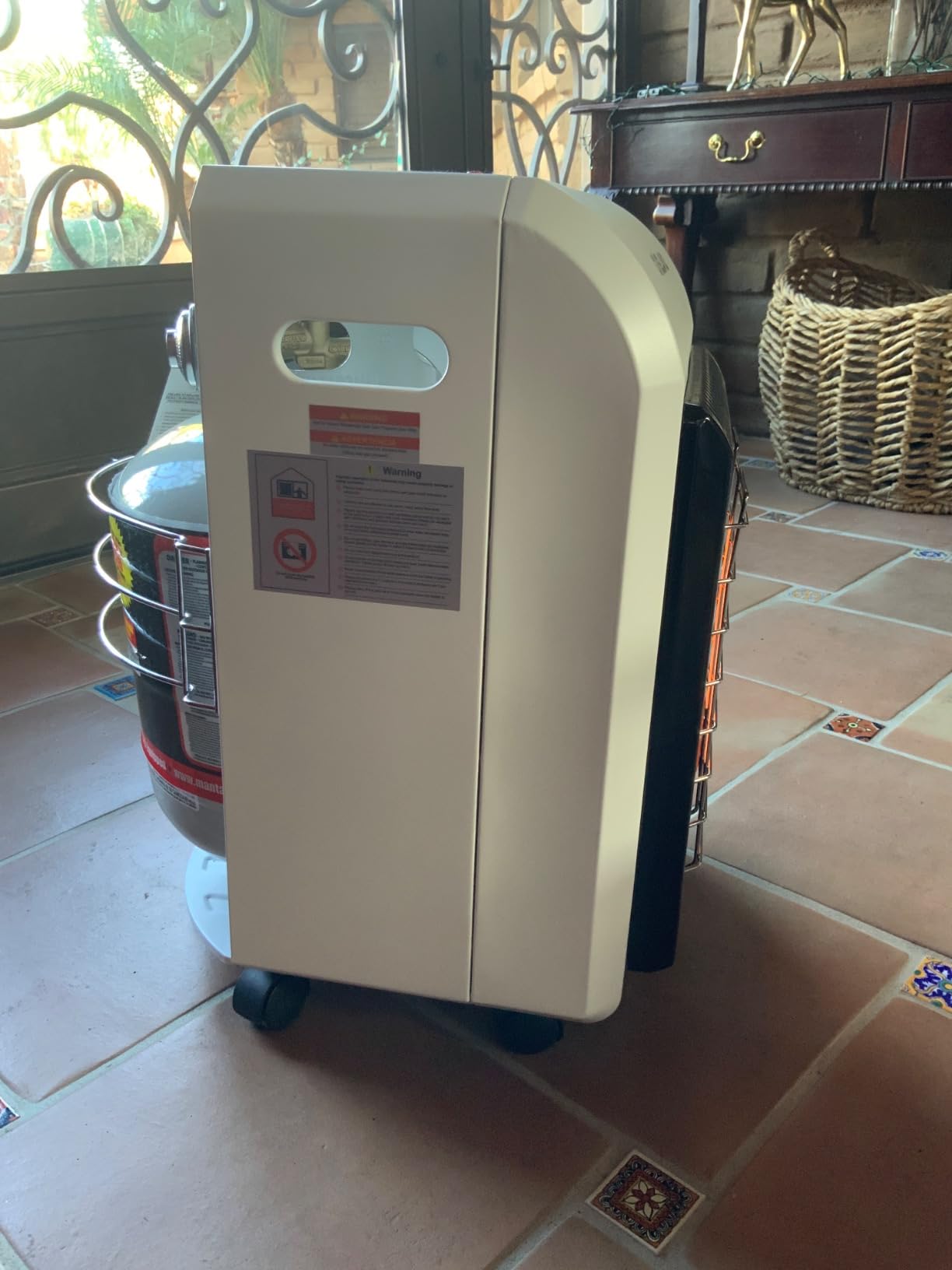
The safety package is solid for a portable unit: CSA certification, overheat detection, and a thermo-electric safety valve that shuts off gas if the flame goes out. Continuous electronic ignition handles cold starts, the 10 ft propane hose and regulator are included, and you get roughly 5 hours of run time on low from a standard 20 lb tank.
At 13 lb with an adjustable heat angle it is still portable, so moving it back inside the bay at the end of a job is easy. The constraint is placement: it needs ventilation and is not designed for enclosed indoor use, which in practice means you are running it in a garage with the door open or cracked.
Can 125,000 BTU overheat a two-car garage?
On the high setting, yes, which is why the variable output range matters. Owners who run it in a two-car bay use the lower end of the dial and the adjustable angle to keep the heat where they want it. Sized correctly against the 20,000 to 40,000 BTU a two-car garage actually needs, the top of this range is roughly three times the required output.
Who is the GASLAND right for?
Owners heating an open-sided shop, a driveway, or a bay that doubles as a vehicle work area, and anyone who wants one portable unit that can cover both a small bay and a large open space. It is also a reasonable emergency heat source, since it needs no electricity beyond its ignition circuit.
10. Shinic QGW15-602 2-Pack 1,500W – Best for Plug-In Spot Heat With No Wiring
Shinic 2-Pack 120V Electric Garage Heater,1500W/750W Ceiling Mounted Heater
Two 1500W radiant quartz heaters
5120 BTU each
120V grounded plug, 12.5 A
Coverage 400-600 sq. ft. each
Overheat auto-off, ETL listed
Pros
- Plugs into a standard 120V outlet with no wiring
- Two heaters cover two work zones
- Built-in halogen work light for night work
- Ceiling mount with 90 degree rotation
- Overheat auto-off with metal housing
- Five pull-string settings including light-only
Cons
- Lowest rating in the roundup at 4.0 stars
- 5120 BTU each is far below 240V output
- Quartz elements are fragile if adjusted roughly
- 11 percent one-star reviews
- Pull-string switches lack a thermostat
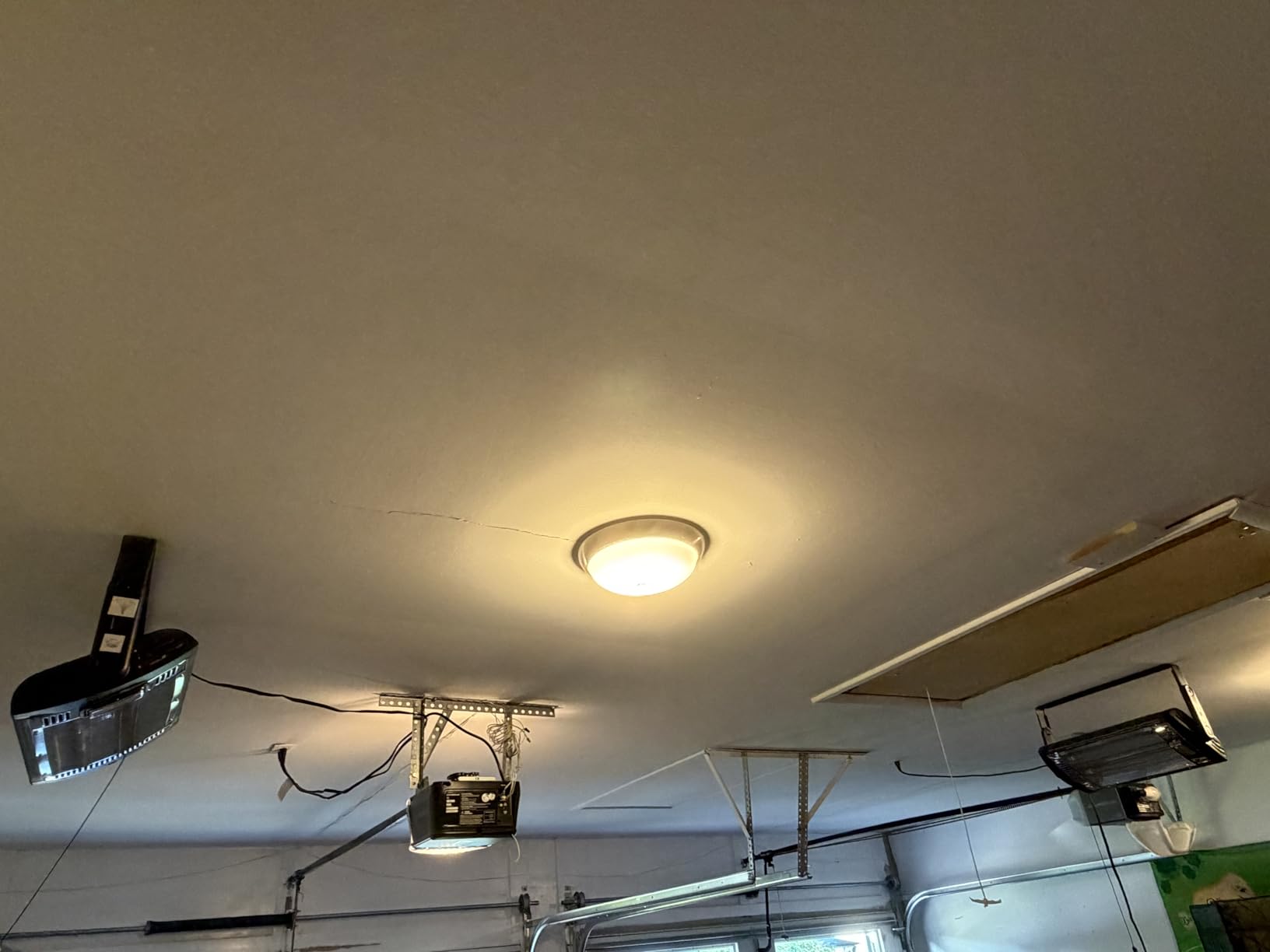
The Shinic 2-pack is the only option here that requires nothing from an electrician: two 1,500 watt ceiling radiant heaters, each with a 3-prong grounded plug, a 12.5 amp draw, and ETL listing. If you want heat at a workbench this month rather than after an electrical inspection, this is the honest starting point.
Each unit delivers 5,120 BTU of radiant heat across a 400 to 600 sq. ft. rating, and the two-pack format means you can heat one bay and keep the other cold, or cover two work zones. The built-in halogen work light is a genuinely useful addition for night work, and the ceiling bracket rotates 90 degrees to aim the radiant cone where you need it.
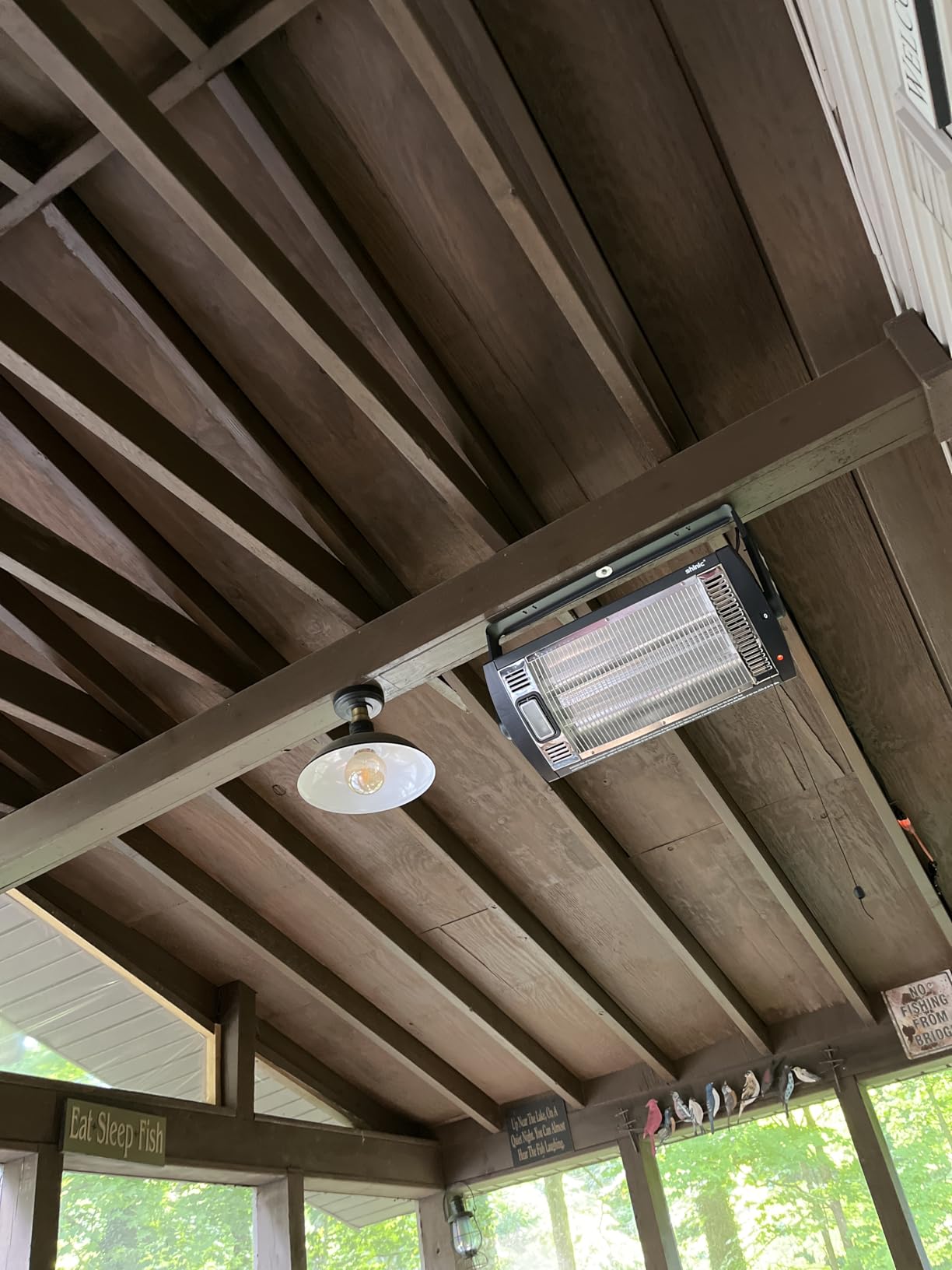
It carries the lowest rating in the roundup at 4.0 stars, with 57 percent five-star but 11 percent one-star, which signals a wider spread of experiences than the higher-rated units. The most common failure theme is quartz element durability, since the tubes break if mounted or adjusted roughly.
Be clear on what radiant quartz heat does. It warms whatever is in front of the unit, which is exactly right for someone sitting at a bench and exactly wrong for raising the temperature of a 480 sq. ft. garage. The pull-string settings include light-only and low combinations, which is handy for task lighting without full heat.
Will 1,500 watts heat a two-car garage?
No, not as room heat. A 1,500 watt radiant unit produces 5,120 BTU aimed in a cone, against the 20,000 to 40,000 BTU a two-car garage typically needs. The two-pack doubles the output but not the coverage pattern, so it still cannot raise the air temperature across the full footprint.
What is this heater genuinely useful for?
Spot heat at a bench, a hobby area, a home gym corner, or supplemental warmth while you work with the garage door open. The zero-install design is the decisive advantage, and the halogen work light makes the pair worth keeping even when you are not heating.
How Many BTUs for a Two-Car Garage? Sizing It Right
A two-car garage needs roughly 20,000 to 40,000 BTU of heater output depending on insulation and climate, and the fastest way to land in that range is a volumetric calculation: square feet multiplied by ceiling height multiplied by 3 to 5 BTU per cubic foot. A 20×20 garage with 8 ft ceilings gives 3,200 cubic feet, which works out to 9,600 BTU as a floor and 16,000 BTU as a comfortable ceiling for a well-insulated space. Anything uninsulated or in a genuinely cold climate needs roughly double that once you account for continuous loss through the door and walls.
Worked example one, the standard insulated two-car garage. At 20×20 with an 8 ft ceiling you are looking at 3,200 cubic feet. Multiply by 4 BTU per cubic foot and you land on 12,800 BTU as a working target. That lines up neatly with a 5,000 watt 240V electric unit, which converts to 17,065 BTU, or with a 30,000 BTU vent-free blue flame gas heater with plenty of headroom for door openings.
Worked example two, the 24×24 two-car garage. At 24×24 with a 9 ft ceiling you have 5,184 cubic feet. At 3 BTU per cubic foot that is 15,552 BTU; at 5 BTU per cubic foot it is 25,920 BTU. Add a 1.5x factor for a detached, uninsulated or drafty garage and you land between 23,000 and 39,000 BTU, which is where a 60,000 BTU portable propane unit or a 7,500 watt hardwired heater starts to make sense.
Here is how the ten products in this roundup map to those numbers, using only the coverage ratings their manufacturers publish.
Vent-free blue flame natural gas at 30,000 BTU, rated to 1,000 sq. ft. Suits a standard insulated 20×20 bay.
5,000 watt hardwired electric at 17,065 BTU, rated to 1,000 sq. ft. Matches the same garage with no fuel logistics.
6,000 watt selectable hardwired electric, rated to 600 sq. ft. A good match for a single working bay rather than the full footprint.
7,500 watt hardwired electric at 25,600 BTU, rated to 1,250 sq. ft. The strongest starting point for a 24×24 insulated garage.
50,000 BTU ceiling-mounted natural gas unit, rated to 1,667 sq. ft. Deliberately oversized for deep-cold holding.
60,000 BTU portable propane, rated to 1,500 sq. ft. Fast recovery with no installation.
9,000 BTU radiant propane, rated to 225 sq. ft. A work corner or emergency heat, never the whole bay.
125,000 BTU variable propane forced air, rated to 3,100 sq. ft. Built for open bays and driveways.
1,500 watt radiant quartz at 5,120 BTU, rated to 400 to 600 sq. ft. Spot heat over a bench.
Will a 5,000 watt heater heat a 2 car garage? Yes, for an insulated 20×20 bay, and the answer is no for a drafty or uninsulated one. A 5,000 watt unit delivers 17,065 BTU, which covers roughly 1,000 sq. ft. according to the manufacturer, and it will hold temperature in an insulated garage through a normal winter. In an uninsulated space the same unit runs continuously without ever closing the gap, which is when the cost per hour starts to hurt.
Propane vs Electric vs Natural Gas – What Actually Costs Less
Natural gas delivers the cheapest heat per hour of delivered BTUs, propane comes next, and 240V electric is the most expensive to run for the same amount of warmth. The gap comes down to how much energy each fuel carries: a 20 lb propane cylinder holds roughly 24,000 BTU of usable combustion energy, natural gas bills are metered in therms that each represent about 100,000 BTU, and one kilowatt-hour of electricity converts to 3,412 BTU once the resistance element is heated.
Electric wins on everything except the utility bill. It converts essentially all of its input energy to heat at the point of use, it needs no combustion air, and it produces no carbon monoxide. Gas heaters do the opposite: they pull in more total energy per unit of fuel cost, but they also need venting, a gas line, or a cylinder you refill yourself.
That is why running cost is the most common complaint we found in garage and DIY forums about 240V units, and why so many owners who moved from electric to propane describe the change as a regret-reversal. A 7,500 watt unit drawing 31.3 amps is a serious continuous load, and in a garage that is uninsulated, that load runs for hours every cold evening.
If propane is your fuel, spend a few minutes comparing the 10 best propane garage heaters we cover in more detail, including the safety equipment that matters most in an enclosed space.
Garage Heater Safety – Carbon Monoxide, Clearances, and Venting
You can run a propane heater in a closed garage only if the unit is specifically listed for indoor use, placed within the manufacturer’s clearance rules, and paired with a working carbon monoxide detector. The Consumer Product Safety Commission and the Centers for Disease Control and Prevention both treat any fuel-burning appliance in an enclosed space as a carbon monoxide risk, and neither treats an “I ran it for ten minutes” exception as a real defence.
Carbon monoxide is odourless and colourless, and the CDC lists the symptoms to watch for as headache, dizziness, weakness, nausea, vomiting, chest pain, and confusion. If a person in the garage experiences those symptoms, the correct response is to get everyone and pets out of the space and into fresh air immediately, then call emergency services.
There are three distinct safety categories among the heaters here, and they are not interchangeable.
Vent-free gas heaters such as the 30,000 BTU blue flame heater are listed for indoor use and include a low oxygen safety shut-off, but placement clearances still apply and CO detection is required.
Portable propane forced air heaters such as the 60,000 BTU and 125,000 BTU models are listed for outdoor or well-ventilated use, so indoor garage use means providing ventilation as the manual requires.
Electric units produce no combustion gases at all, which removes the carbon monoxide question entirely and leaves only heat and electrical safety.
Beyond CO, the placement rules matter more than buyers expect. Manufacturers specify minimum clearances to combustibles, and the 50,000 BTU ceiling unit requires 10 ft of ceiling height and 8 ft of clearance from the base of the heater down to the floor. In a two-car garage, the door tracks, shelving, and vehicle height are what usually violate those clearances, so measure before you buy.
One more workshop-specific hazard: sawdust, dryer lint, solvent storage, and paint thinner. A radiant heater that operates at 900 °F on its surface should never share a wall or shelf clearance with any of those.
Installing a Hardwired 240V Garage Heater
A hardwired 240V garage heater needs a dedicated circuit, and in most homes that means a licensed electrician. The 7,500 watt heaters in this roundup draw 31.25 to 31.3 amps and require a 40A double-pole breaker with 8 AWG copper supply wire; the 5,000 watt unit draws 20.9 amps and the manufacturer’s data recommends a dedicated circuit in its class.
Before the purchase, walk through this list. Confirm your electrical panel has two spare breaker slots and the amperage to spare, because a full panel is the single most common reason an electric garage heater purchase gets abandoned. Check the ceiling clearance against your garage door track and the tallest vehicle you own, since a tilting mount still needs room to be serviced.
Confirm the circuit rating against the unit’s low setting rather than its high setting. The Dr. Infrared DR-966 at its 3,000 watt setting is the one model here that can share a 30A circuit with other 120V tools, and its acceptance of a NEMA 6-50P cord means a welder outlet can substitute for a hardwired run entirely.
Vent pipe, thermostats, and some mounting hardware are frequently extra purchases, particularly on the gas unit heaters, so ask your gas fitter or electrician to quote the full install rather than assuming the accessories are included. Our workshop electric heater guide covers the same circuit details from an install angle.
Insulation: The Cheapest Way to Heat Less
Insulate the garage before you size the heater. A garage door insulation kit is reported to produce a 10 to 15 degree temperature difference in the space, which can mean the heater you already own is suddenly large enough, and it costs a fraction of what a bigger heater costs to run for a decade.
The door is the reason. Even a well-insulated wall loses a fraction of what a bare, uninsulated sectional door loses, which is why two-car garages with insulated doors and weatherstripping on the header and jambs hold setpoint while structurally similar garages do not. Add weatherstripping around the door perimeter and the header before anything else; it is the cheapest hour of work in this entire article.
The most common misconception we found in owner discussions is assuming 1990s-standard construction insulation is adequate. Multiple owners report chronic under-heating that turned out to be envelope loss rather than an undersized heater, and the fix was sealing and insulating rather than buying a bigger unit. You can also improve results by adding an exhaust fan sized to exchange the air in the space every few minutes, which moves warm air down off the ceiling where forced air tends to leave it.
How to Choose the Right Garage Heater for Two Cars
Start with occupancy pattern, because it decides the fuel. Heating a two-car garage a few weekend mornings a season calls for a portable propane unit, since there is nothing to install. Heating it every evening through winter, with a gas line already in place, calls for a 30,000 or 50,000 BTU gas unit. Heating a well-insulated garage with a 240V circuit available calls for electric, and the trade is cost per hour against zero installation and no combustion.
Next check the constraint you cannot change. Panel capacity for a hardwired unit, a gas line and roof access for a vented heater, ceiling height for an overhead mount, and clearances around the door tracks. Forum discussions consistently rank unexpected install cost as a bigger deal breaker than heater output.
Then check the noise tolerance. If the space is a garage gym or a room where you work quietly, the fan-forced propane heaters and electric heaters with 3 fan speeds are the ones with documentation on being quiet, and the 9,000 BTU radiant unit is quiet by virtue of having no fan at all.
Finally, what to avoid. Do not buy from unauthorized sellers or accept a unit with no UL, ETL, or CSA listing, because counterfeit and no-name imported heaters are a recurring problem in this category and they carry no warranty and no safety certification. Do not buy a vented unit and try to run it unvented, or a vent-free unit in a space that requires venting. Do not size on the square footage in a listing when that figure assumes insulation you do not have.
Frequently Asked Questions
How many BTUs do I need for a two car garage?
A two-car garage typically needs 20,000 to 40,000 BTU of heater output. The standard method is square feet multiplied by ceiling height multiplied by 3 to 5 BTU per cubic foot, then roughly doubled for an uninsulated or drafty space. A 20×20 garage with 8 ft ceilings comes to 9,600 to 16,000 BTU before loss factors, and a 24×24 garage with 9 ft ceilings comes to about 15,500 to 25,900 BTU.
Will a 5000 watt heater heat a 2 car garage?
Yes, for an insulated 20×20 bay. A 5,000 watt 240V unit delivers 17,065 BTU and is rated to cover 1,000 sq. ft., which matches a standard insulated two-car garage. In an uninsulated or drafty space the same unit runs continuously without closing the gap, and 7,500 watts becomes the better starting point.
Can I run a propane heater in a closed garage?
Only if the heater is specifically listed for indoor use, is placed within the manufacturer’s clearance rules, and a working carbon monoxide detector is installed. The CPSC and CDC treat any fuel-burning appliance in an enclosed space as a carbon monoxide risk. Many portable propane forced air units are listed for outdoor or well-ventilated use only, so check the manual before you light it.
Is propane or electric cheaper to heat a garage?
Electric is the most expensive to run per hour of delivered heat, propane comes next, and natural gas is the cheapest. Electric converts about 100 percent of its energy to heat at the point of use but the delivered BTUs are expensive; a 7,500 watt unit drawing 31.3 amps is a heavy continuous load. Gas heaters need venting or a gas line, which is where the higher installation cost sits.
What does a hardwired 240V garage heater require?
A dedicated 240V circuit, and usually a licensed electrician to install it. A 7,500 watt unit draws roughly 31.25 amps and needs a 40A double-pole breaker with 8 AWG copper supply wire. A 5,000 watt unit draws 20.9 amps. Check for two spare panel slots and ceiling clearance against your garage door track before you buy.
Should I insulate my garage before buying a heater?
Insulate first, because heat loss through the garage door dwarfs loss through the walls. A garage door insulation kit is reported to produce a 10 to 15 degree temperature difference, and weatherstripping on the door and header is the cheapest hour of work available. Insulating first can mean the heater you already own is suddenly the right size.
Bottom Line
For most two-car garages in 2026, the best garage heater is a hardwired 240V fan-forced unit, and the best garage heaters for two car garages overall start with the Comfort Zone CZ220BK at 17,065 BTU for an insulated 20×20 bay, or the CZ230ERBK at 25,600 BTU when the garage is 24×24. If a gas line is already in the space, the 30,000 BTU vent-free blue flame heater is the cheapest to run and the simplest to install, and a 50,000 BTU vented unit is the right call for permanent shop heat.
For intermittent use with no wiring at all, the 60,000 BTU portable propane unit warms a two-car garage in about 10 minutes, and the 9,000 BTU Portable Buddy stays on hand for workbench and emergency heat. Size the heater to the space, insulate the door, and install a carbon monoxide detector before the first cold night.