
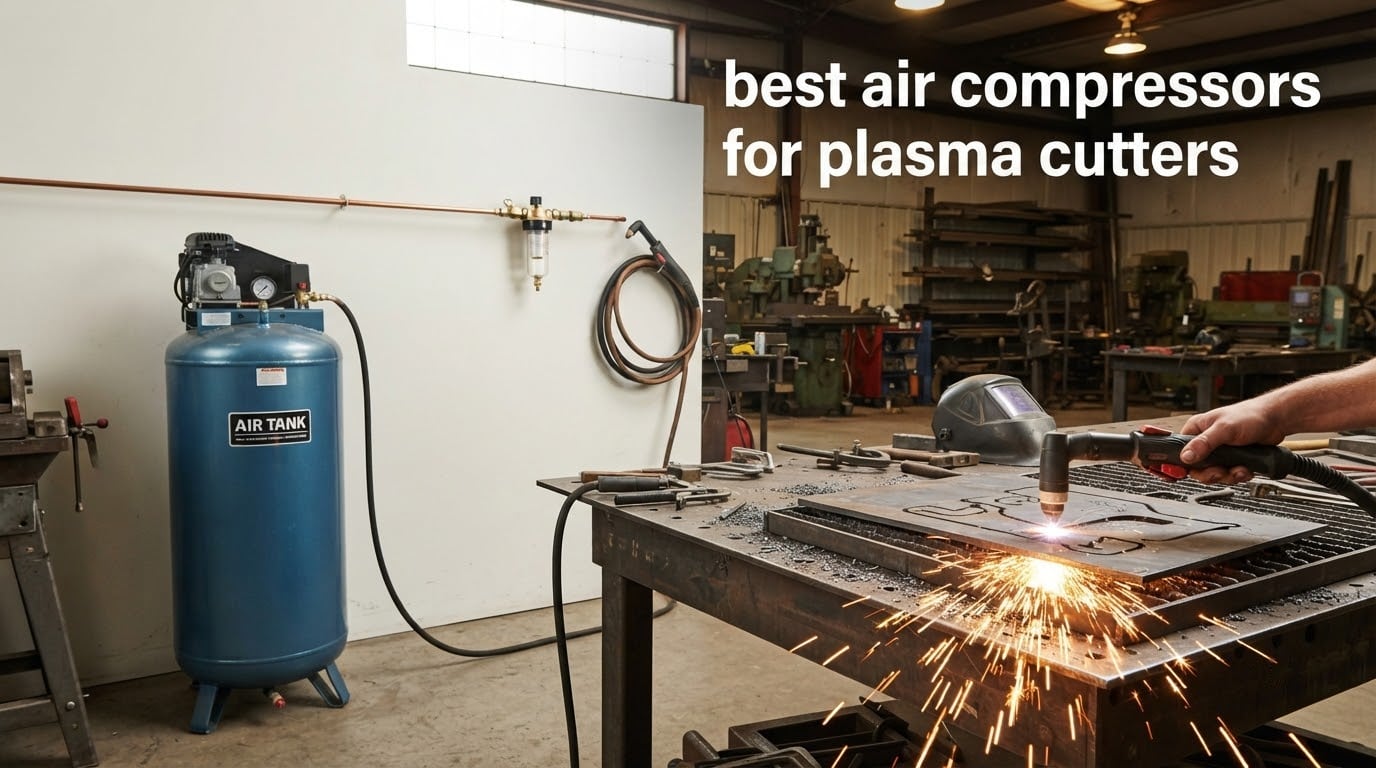
A plasma cutter runs on compressed air, so yes, it runs off an air compressor, and the size of that compressor decides whether your cuts stay steady or the arc stutters halfway through a plate. The short version: match the compressor’s CFM at 90 PSI to your cutter’s rated air consumption, then add roughly 50% headroom. A light-duty torch pulling 4 to 5 CFM wants a compressor delivering 6 to 8 CFM at 90 PSI, with a tank of at least 15 gallons. That is the whole sizing rule, and everything else in this guide is detail around it.
I have spent the last few months putting together the best air compressors for plasma cutters by reading owner reviews, comparing rated airflow against real plasma demand, and checking what each machine does when the tank gets low mid-cut. Ten compressors made the cut. They cover everything from a 2-gallon unit that belongs on a workbench for finish work to a 29-gallon vertical that will keep a torch fed through a long production day.
If you have not picked a torch yet, start with our home shop plasma cutter guide first, because the torch’s rated CFM sets your ceiling. If your garage is already full of pneumatic tools competing for the same air, our garage air compressor picks cover the general tool market. For the units here, the deciding factor was always the same: sustained CFM at 90 PSI, not headline horsepower.
Table of Contents
Top 3 Best Air Compressors for Plasma Cutters in 2026

Makita MAC2400
- 4.2 CFM at 90 PSI
- Cast iron Big Bore cylinder
- 2.5 HP 4-pole motor
- 12.3 A start-up draw

California Air Tools 10020C
- 5.30 CFM at 90 PSI
- 10-gallon steel tank
- 70 dBA noise
- Oil-free dual piston
Best Air Compressors for Plasma Cutters Compared in 2026
| Product | Specifications | Action |
|---|---|---|
| Makita MAC2400 2.5 HP Big Bore |
|
Check Latest Price |
| California Air Tools 10020C |
|
Check Latest Price |
 Metabo HPT EC914S Metabo HPT EC914S |
|
Check Latest Price |
 Makita MAC210Q Quiet Series Makita MAC210Q Quiet Series |
|
Check Latest Price |
 Klutch 29-Gallon Vertical Klutch 29-Gallon Vertical |
|
Check Latest Price |
 Stealth 20 Gallon Ultra Quiet Stealth 20 Gallon Ultra Quiet |
|
Check Latest Price |
 VEVOR 15 Gallon VEVOR 15 Gallon |
|
Check Latest Price |
 DEWALT D55146 DEWALT D55146 |
|
Check Latest Price |
 Limodot LJ8120K Limodot LJ8120K |
|
Check Latest Price |
 Stealth 12 Gallon Ultra Quiet Stealth 12 Gallon Ultra Quiet |
|
Check Latest Price |
1. Makita MAC2400: Best Air Compressors for Plasma Cutters Overall
Makita MAC2400 2.5 HP* Big Bore™ Air Compressor
4.2 CFM at 90 PSI
4.2-gallon cast iron tank
2.5 HP 4-pole motor
120V at 12.3 A
Pros
- Cast iron Big Bore cylinder recovers fast between cuts
- Oil-lubricated pump runs cooler than oil-free
- Low 12.3 A start-up draw suits household circuits
- Roll-cage frame and industrial air filter
Cons
- Only a 4.2-gallon tank holds very little reserve
- 79 dB is louder than the quiet models in this group
- Needs periodic oil checks and changes
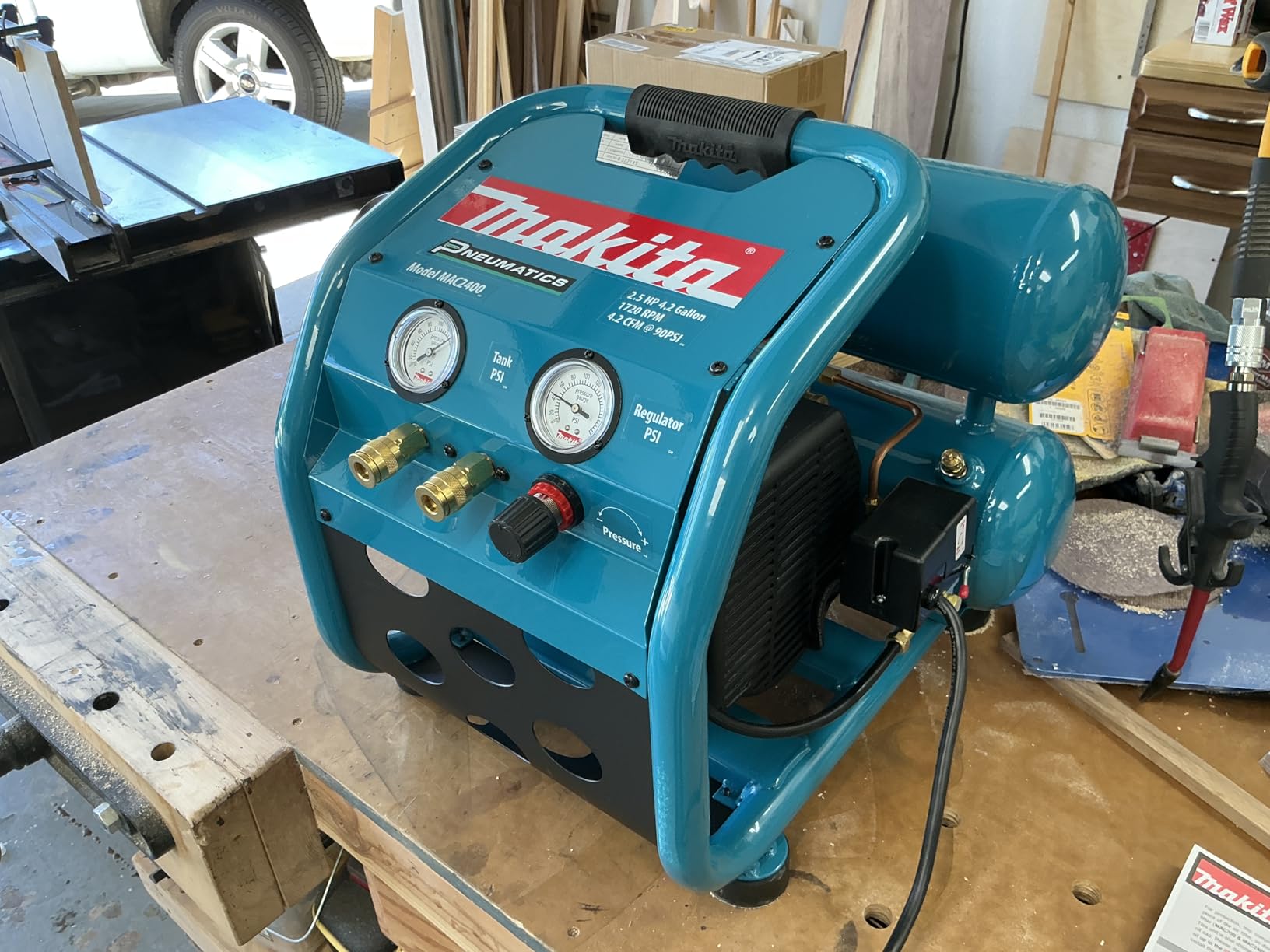
The MAC2400 is the compressor I kept coming back to while working through this list, because it does the one thing a plasma torch cares about better than most of its class: it recovers. The cast iron Big Bore cylinder and piston move more air per cycle than a typical small-bore pump, and that is exactly the parameter that decides whether the arc holds steady through a 12-inch cut in quarter-inch plate.
Rated at 4.2 CFM at 90 PSI from a 2.5 HP four-pole motor, it does not lead this group on raw airflow. The California Air Tools 10020C and the VEVOR both push more. What the Makita wins on is the quality of that air delivery: owners consistently describe recovery as quick enough that they never wait on the tank during normal sheet-metal work.
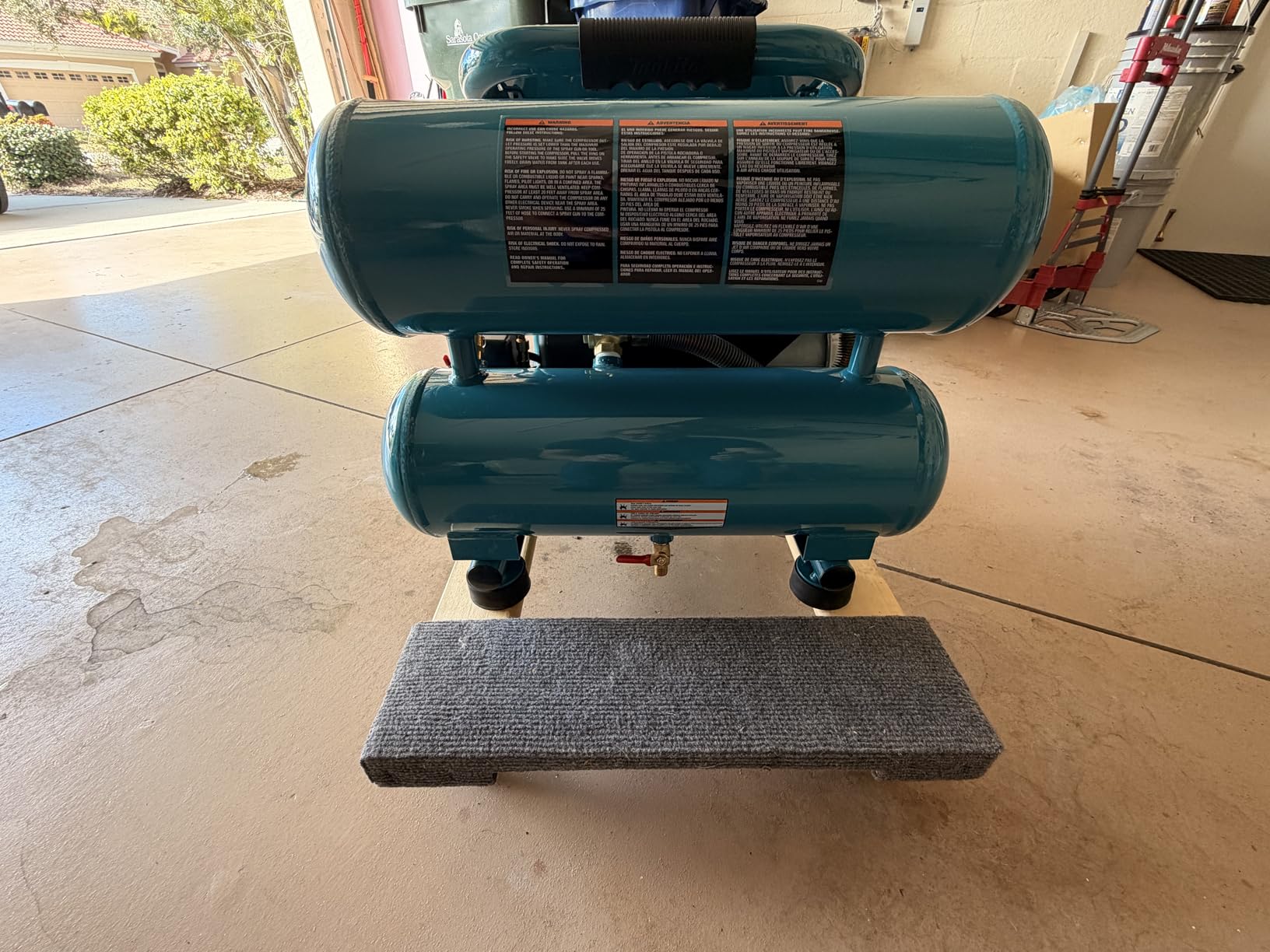
The oil-lubricated design is worth pausing on. While a plasma setup always benefits from a separator or dryer, an oil-lube pump runs cooler and wears slower than an oil-free piston pump of the same size, and this one is built on that principle rather than fighting it. It also pulls only 12.3 A, which matters if you are running it off a shared 120V circuit with a welder or a dust collector.
The honest weakness is the 4.2-gallon tank. That is a small reserve for a torch with an appetite. If your cutting is short passes on thin gauge, the tank hides it. If you plan to cut thicker plate or run long CNC programs, pair this with a larger tank or plan your cuts in segments. We covered portable-format options in our portable compressor guide if weight is part of the equation.
Why the MAC2400 works for a plasma torch
The Big Bore cylinder’s job is to refill the receiver fast. A plasma cutter pulls air continuously while the arc is lit, so a compressor that cycles quickly between cut segments avoids the pressure dip that makes an arc stutter. Owners cutting thin sheet report steady pressure through long beads, and the roll-cage frame plus the removable cast iron cylinder mean the pump is serviceable rather than sealed.
There is one caveat with an oil-lubricated pump on a plasma table: plan on a water separator and a final filter at the torch. It is a small addition to the install, and it is the difference between clean arcs and shortened electrode life.
Where the MAC2400 falls short
The 4.2-gallon receiver is the number to respect. Owners note that sustained air demand outruns the stored reserve, which shows up as brief pressure dips on the longest cuts. For light fabrication and hobby plate work that is a non-issue; for a full-day CNC table it is the reason we did not rank it first for heavy users.
At 79 dB it is also not the quietest machine here. In a detached shop that is noise nobody hears, but in an attached garage the conversation-stopper class of machine will make itself known during every fill cycle.
2. California Air Tools 10020C: Best Air Compressors for Plasma Cutters Overall Airflow
California Air Tools 10020C 2.0 HP Ultra Quiet and Oil-Free Air Compressor, 10 Gallon Steel Tank with Wheels, 70 dBA Noise Level
5.30 CFM at 90 PSI
10-gallon steel tank
70 dBA
2.0 HP oil-free pump
Pros
- 70 dBA lets you hold a conversation beside it
- Oil-free dual piston pump rated past 3000 hours
- 10-gallon tank gives real reserve air
- Compact vertical footprint with wheels and handle
Cons
- Oil-free pumps are not built for continuous duty
- Cut-out lands closer to 120 PSI than 125
- Occasional switch or small leak reports over time
The 10020C has the largest owner review base in this roundup, and the pattern across those reviews is remarkably consistent: people bought it for the noise level and stayed for the tank. At 70 dBA it is quiet enough to sit next to a plasma table in a residential garage without dominating the room, and the 10-gallon vertical receiver stores enough air to ride through the gaps between cut segments.
On paper it is also the best-balanced airflow number here: 6.40 CFM at 40 PSI and 5.30 CFM at 90 PSI from a 2.0 HP motor spinning at just 1680 RPM. That low RPM is the trick behind the quiet operation, and it is also why the pump runs cooler than faster oil-free machines.
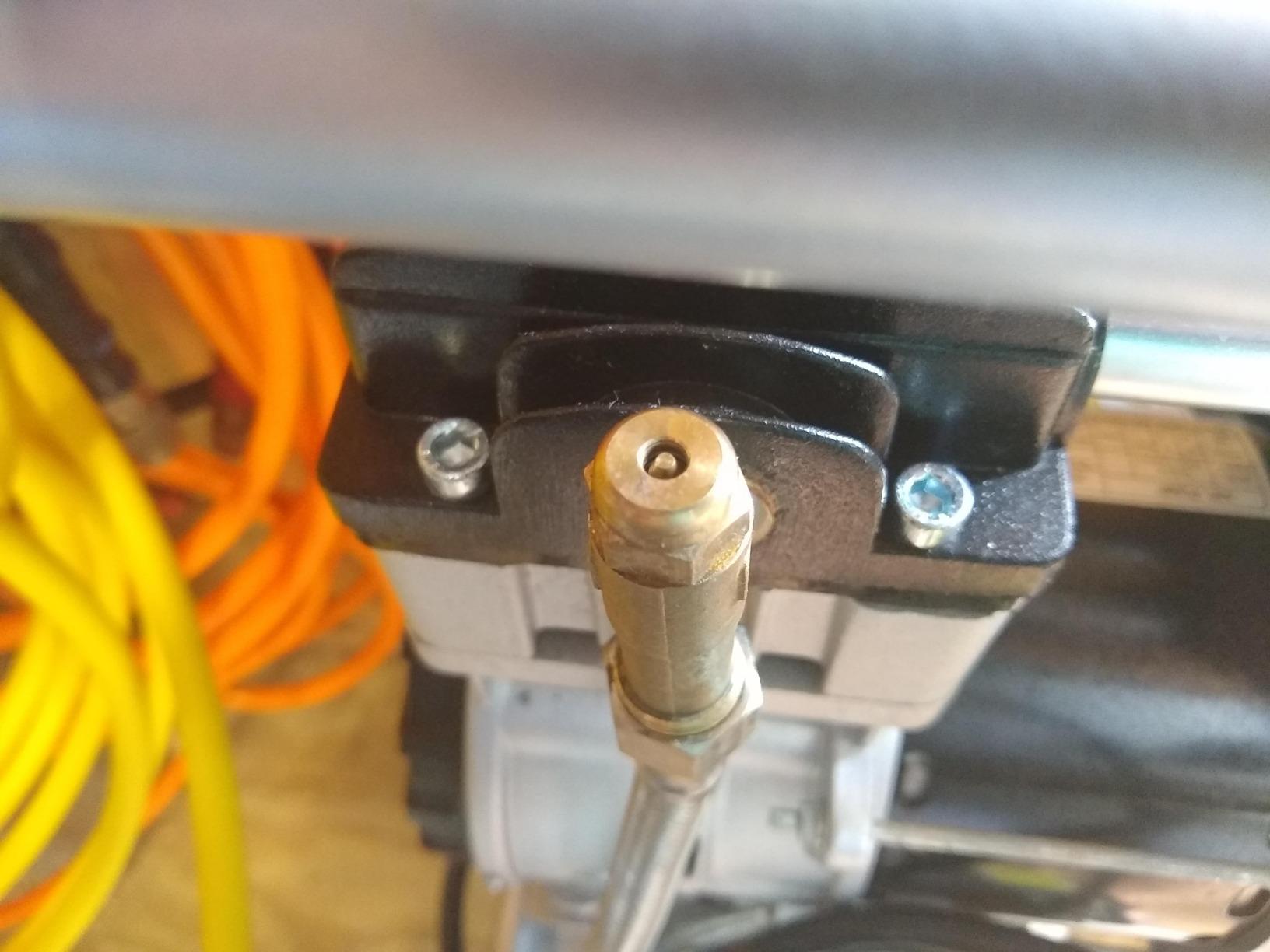
The oil-free dual piston pump has a listed life cycle of more than 3000 hours and needs no oil changes, no filter swaps, and no cold-weather warm-up. For plasma work that matters more than it does for nailers: no oil in the delivered air means fewer surprises at the nozzle, and the maintenance-free nature means the machine keeps doing its job while you are busy cutting rather than sitting in a service loop.
Weighing 82.5 pounds with a wheeled base and a sturdy handle, it moves around a shop floor without drama. The 16 by 15 by 36 inch footprint keeps it out of the way against a wall, which is where a plasma setup usually lives.
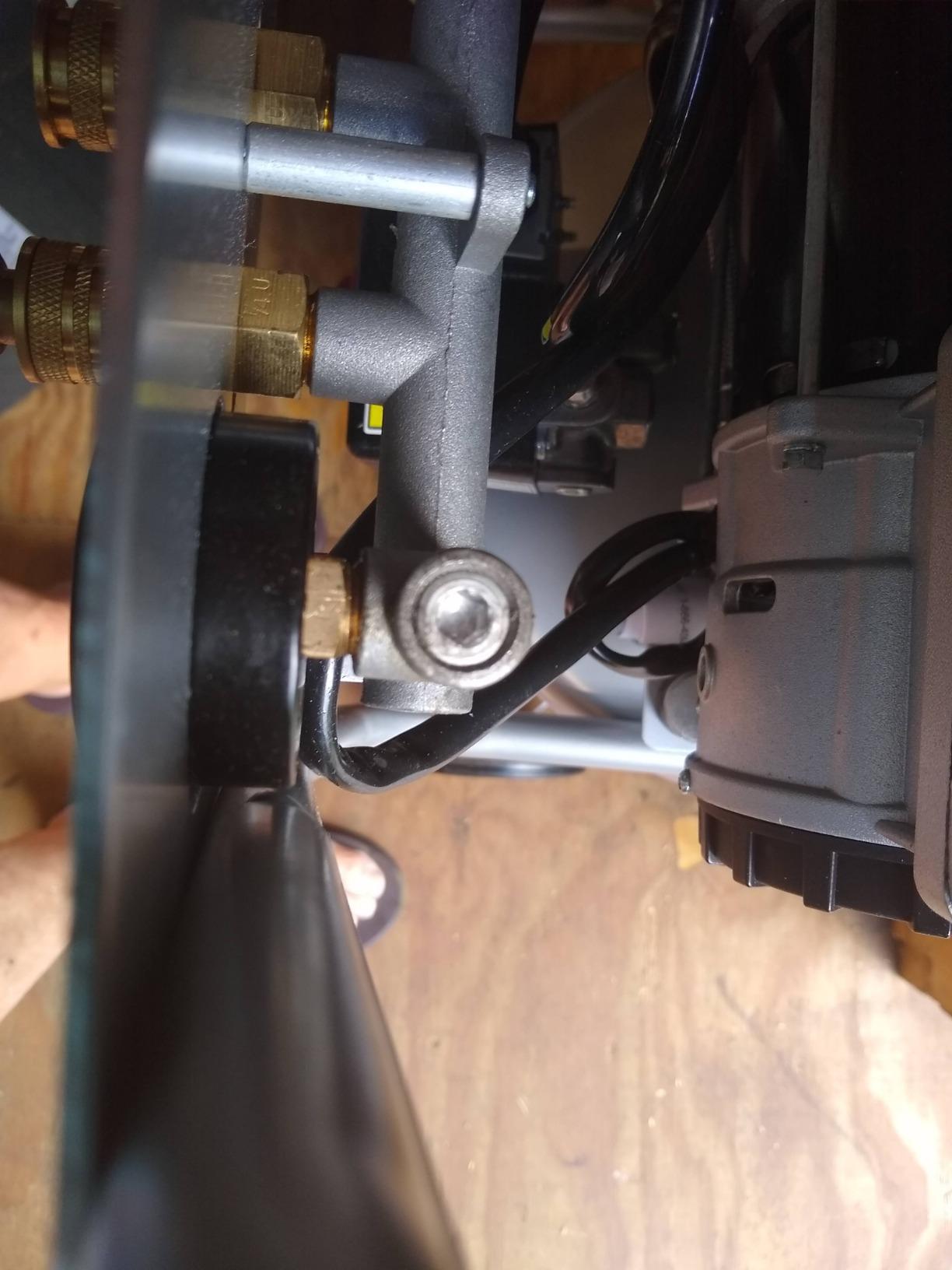
Why quiet matters more than you expect
Many plasma operators work with the unit running in the same room as the cut, not across the street. At 70 dBA you can hear a torch arc over the pump, talk through a cut, and keep your hearing protection off for light work. Owners confirm this by describing normal conversations held a few feet away while the machine cycles.
That low RPM also translates to a steadier pressure curve, which is what keeps an arc from thinning out during the middle of a pass. Combined with the 10-gallon receiver, this is the combination we would trust most for intermittent cutting in a home shop.
Where the 10020C falls short
Oil-free pumps are not continuous-duty machines, and owners say so plainly. Run a machine hard for long stretches and the pump can overheat or warp, which ends any plasma session built on steady delivery. If your plan is eight hours of plate cutting a day, this is not the machine.
Some owners also report the cut-out landing closer to 120 PSI than the advertised 125, which pushes the needle into the red. A dedicated regulator downstream fixes that, and a few owners report small switch or leak issues after extended ownership, so budget for a service call rather than assuming zero maintenance on the electrical side.
3. Metabo HPT EC914S: Best Air Compressors for Plasma Cutters You Carry to the Job
Metabo HPT Portable Pancake Air Compressor, 6 Gallon 200 PSI, EC914S
4 CFM at 90 PSI
200 PSI maximum tank pressure
6-gallon tank
41 lb portable weight
Pros
- 200 PSI tank pressure beats nearly every 6-gallon rival
- Only 41 lb so it is genuinely one-person carry
- Oil-free design means no oil in the plasma air line
- Fills and recovers quickly between cuts
Cons
- Louder than the dedicated ultra-quiet models
- 4 CFM is modest for prolonged high-volume work
- Fill time lengthens noticeably at high altitude
The EC914S is called The Tank for good reason: 200 PSI of storage pressure in a 6-gallon pancake, which is roughly 25 percent more than a basic pancake offers. For plasma cutting, storage pressure is not the headline number, but a higher ceiling means more usable air delivered between pump cycles, and that is what keeps short passes from dipping.
Owners repeatedly praise two things: the speed of recovery and the weight. At 41 pounds this is a compressor one person can lift into a truck bed without planning the lift, which is unusual for a machine with a 200 PSI tank. For a contractor cutting in the field rather than in a fixed shop, that is worth more than extra gallons.
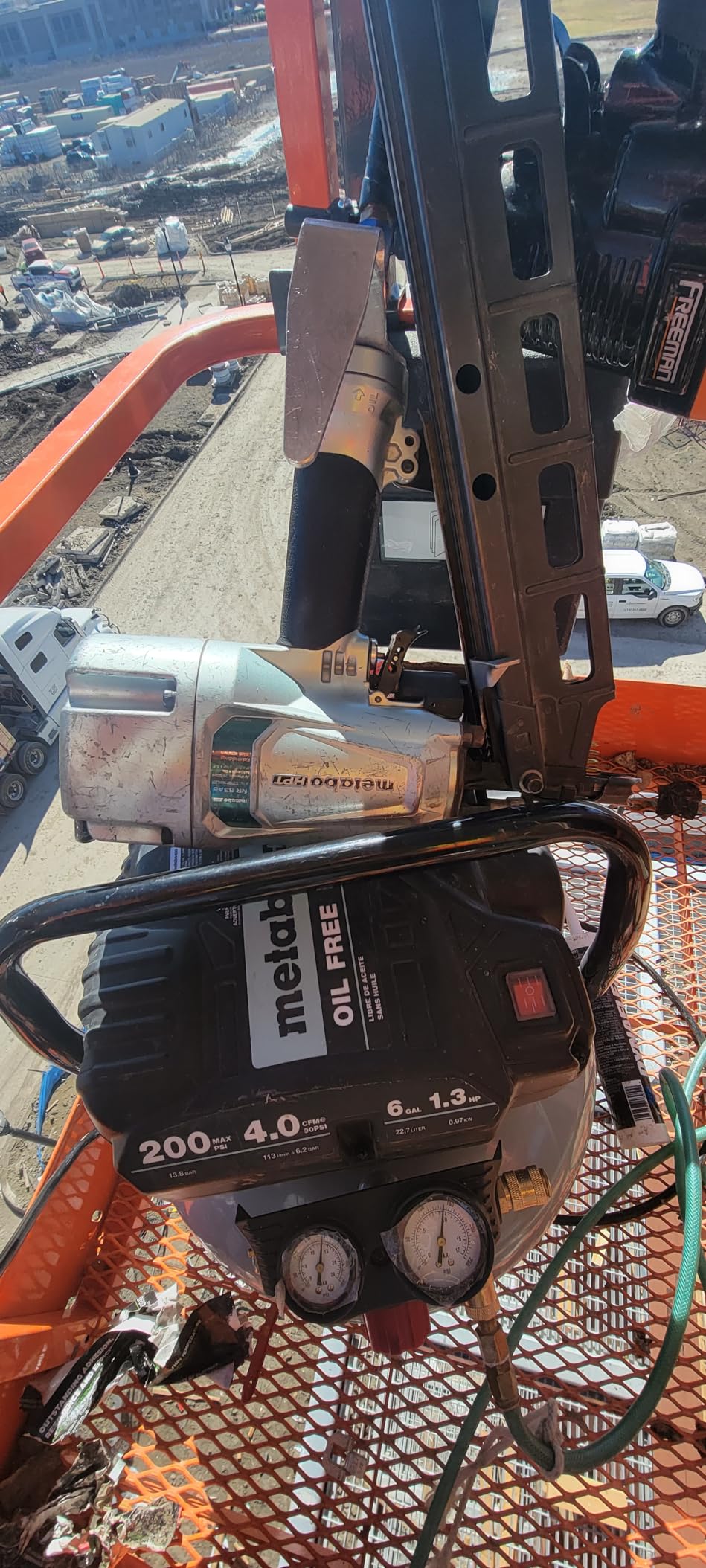
The oil-free pump inside is a genuine advantage for torch work. No oil purchases, no filter changes, and it starts without fuss in cold conditions, which matters on a winter job site. Several owners also report that the reserve is enough to match a plasma cutter’s air demand for typical sheet work, though they qualify that with the observation that 4 CFM is not a lot of headroom.
Reported noise sits at 73 dBA, which is a reasonable claim for the class but not genuinely quiet next to the 60 dBA machines further down this list. Owners call noise the most common complaint, so treat the spec as marketing-adjacent rather than measured.
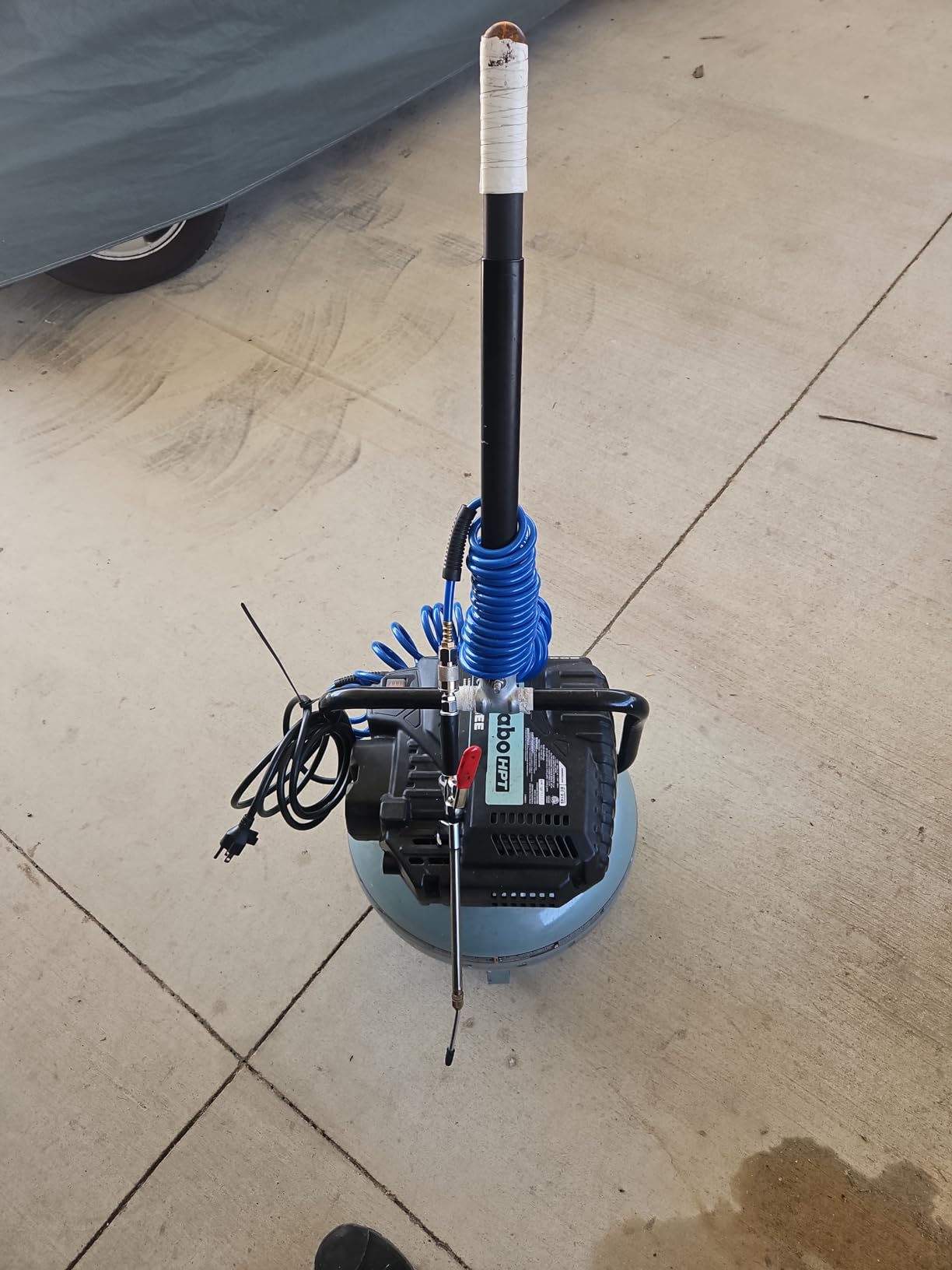
Why 200 PSI matters more than it sounds
Plasma torches run at 70 to 120 PSI at the torch, but the tank behind it has to hold enough reserve to feed that flow without a collapse. A 200 PSI tank at 6 gallons delivers more air above the 90 PSI working band than a 150 PSI tank of the same size. Owners cutting short shapes and repair work on mild steel report the machine keeping up comfortably between segments.
The unit is also rated to run two framing, two roofing, and two siding nailers at once, which tells you the recovery profile is designed for parallel demand rather than a single tool.
Where the EC914S falls short
Four CFM at 90 PSI is a modest number. For long cuts, thick plate, or a CNC program with a long pierce and a slow traverse, the pump will be working continuously and the tank will rarely recover. It is built for intermittent duty, and pretending otherwise leads to the classic complaint: the arc fades mid-cut.
At altitude the picture gets worse, since thinner air means longer fill times. If you are above a few thousand feet, add tank capacity or accept longer recovery between cuts.
4. Makita MAC210Q: Best Air Compressors for Plasma Cutters Where Noise Rules
Makita MAC210Q Quiet Series, 1 HP, 2 Gallon, Oil-Free, Electric Air Compressor
1.6 CFM airflow
2-gallon oil-free tank
60 dBA Quiet Series
135 PSI maximum
Pros
- Quietest machine here with a measured 57.7 dB reading
- Oil-free dual piston fills 0 to 100 PSI in just over a minute
- Holds tank pressure for days without running
- Complete roll-cage construction
Cons
- 1.6 CFM and a 2-gallon tank cycle constantly under load
- Heavier than advertised for a portable unit
- Will not run on a smart plug due to the start capacitor
The MAC210Q carries the highest owner rating in this roundup, and the reason is simple: it is the quietest thing here by a wide margin. Owners report a measured 57.7 dB, quieter than a household refrigerator, which is not a marketing number but an observation from people who put a meter on it.
That silence comes from a Quiet Series design rated at 60 dBA running the pump at 1750 RPM with an oil-free dual piston. Fill time from empty to 100 PSI takes just over a minute, and because it is oil-free there are no consumables to buy and no warm-up period to wait out.
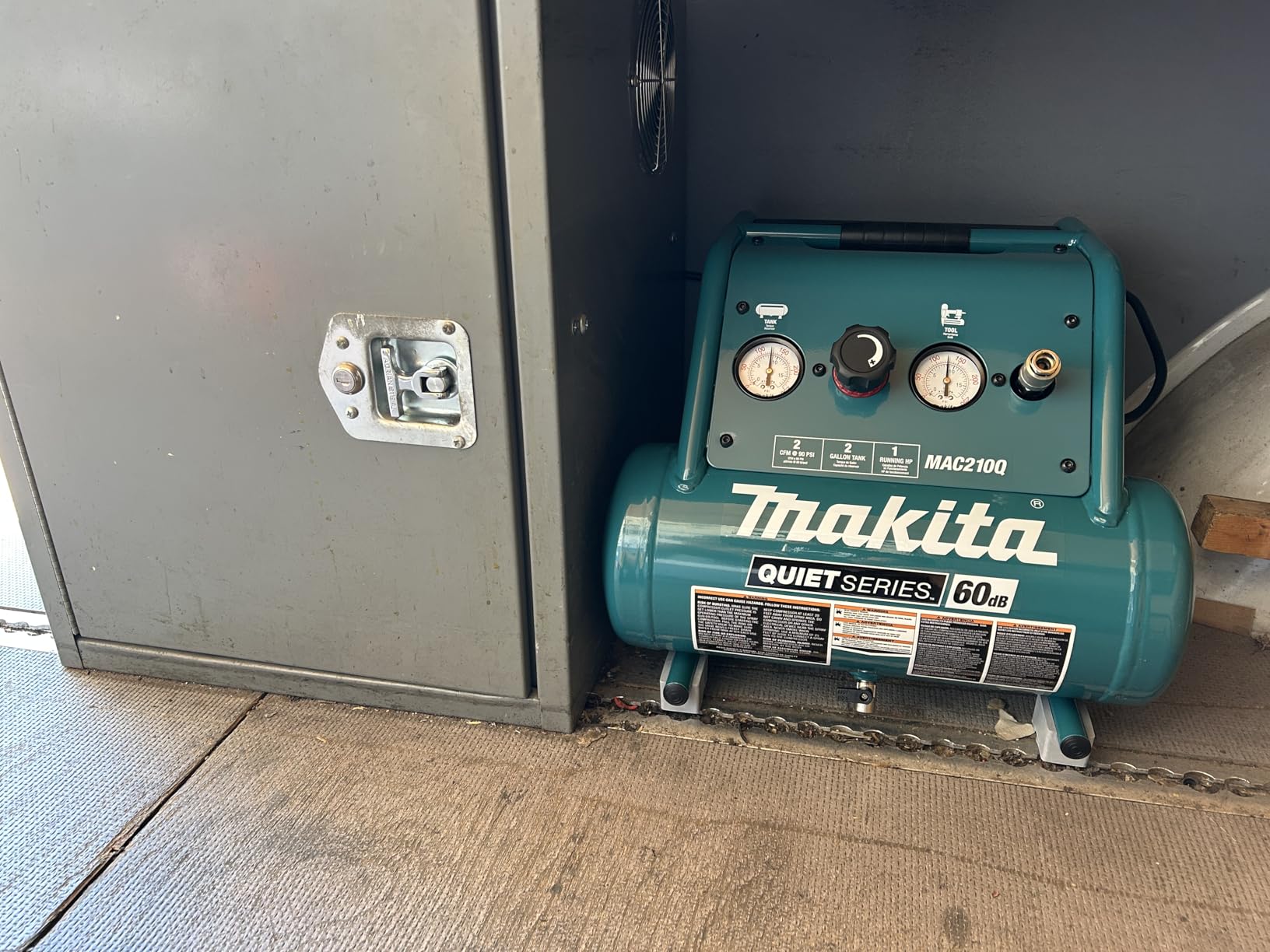
Be clear-eyed about the trade-off, though: 1.6 CFM into a 2-gallon tank is a finishing machine, not a production machine. If you clip this to a plasma torch expecting a plate cut, it will cycle almost constantly, and that constant cycling is the noise problem it was supposed to solve.
Where it does shine is detail work, small parts, and finishing passes on thin gauge where you want the air but not the racket. Owners also report that it holds tank pressure for days without running, so a garage that only needs air a few times a week pays nothing in noise between uses.
When this is the right machine for plasma work
Two situations. First, a home shop cutting thin sheet and small brackets where the torch’s rated consumption is modest and the priority is a room you can work in quietly. Second, a finishing station, where the machine handles cleanup, blow-off, and short touch-up cuts without living in the middle of the shop.
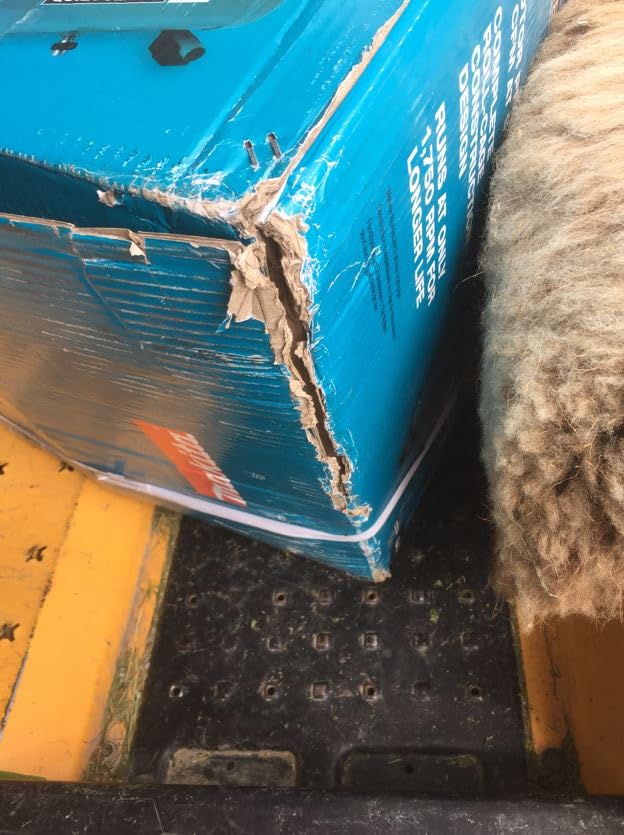
Owners value the roll-cage construction for protection during transport and storage, and the oil-free pump for cold-weather starts. At roughly 45 pounds it is portable but not effortless, and several buyers mention stairs as the sticking point.
Where the MAC210Q falls short
The 135 PSI ceiling is the number that rules it out for serious plasma work. Most torches are set between 70 and 120 PSI, but the tank has to sit comfortably above that band to feed flow, and 135 leaves very little cushion before the pump has to catch up.
Beyond the numbers, a 2-gallon tank cycling on constant means the motor runs far more hours than the pump is built for. If you want this quiet machine in your plasma setup, think of it as a trim compressor that also happens to run a small torch, not as the supply for your table.
5. Klutch 29-Gallon: Best Air Compressors for Plasma Cutters on Tank Reserve
Klutch 29-Gallon Air Compressor, 2.5 HP, 120V, 175 PSI, 5.1 CFM at 90 PSI
29-gallon vertical tank
5.1 CFM at 90 PSI
175 PSI maximum
2.5 HP on 120V
Pros
- 29-gallon vertical receiver stores serious reserve air
- 175 PSI maximum gives more headroom than most
- Vertical footprint saves floor space in tight workshops
- Flat-free tires and build quality feel like shop equipment
Cons
- 81 dB is loud for a home garage
- 127 pounds is a two-person move
- One review reports a safety switch that would not interrupt power
The Klutch is the largest receiver in this group and that is the entire argument. A 29-gallon vertical tank at 175 PSI stores enough compressed air to carry a torch through a multi-pass cut, a pierce, and a reposition without the pump ever catching up from a standstill.
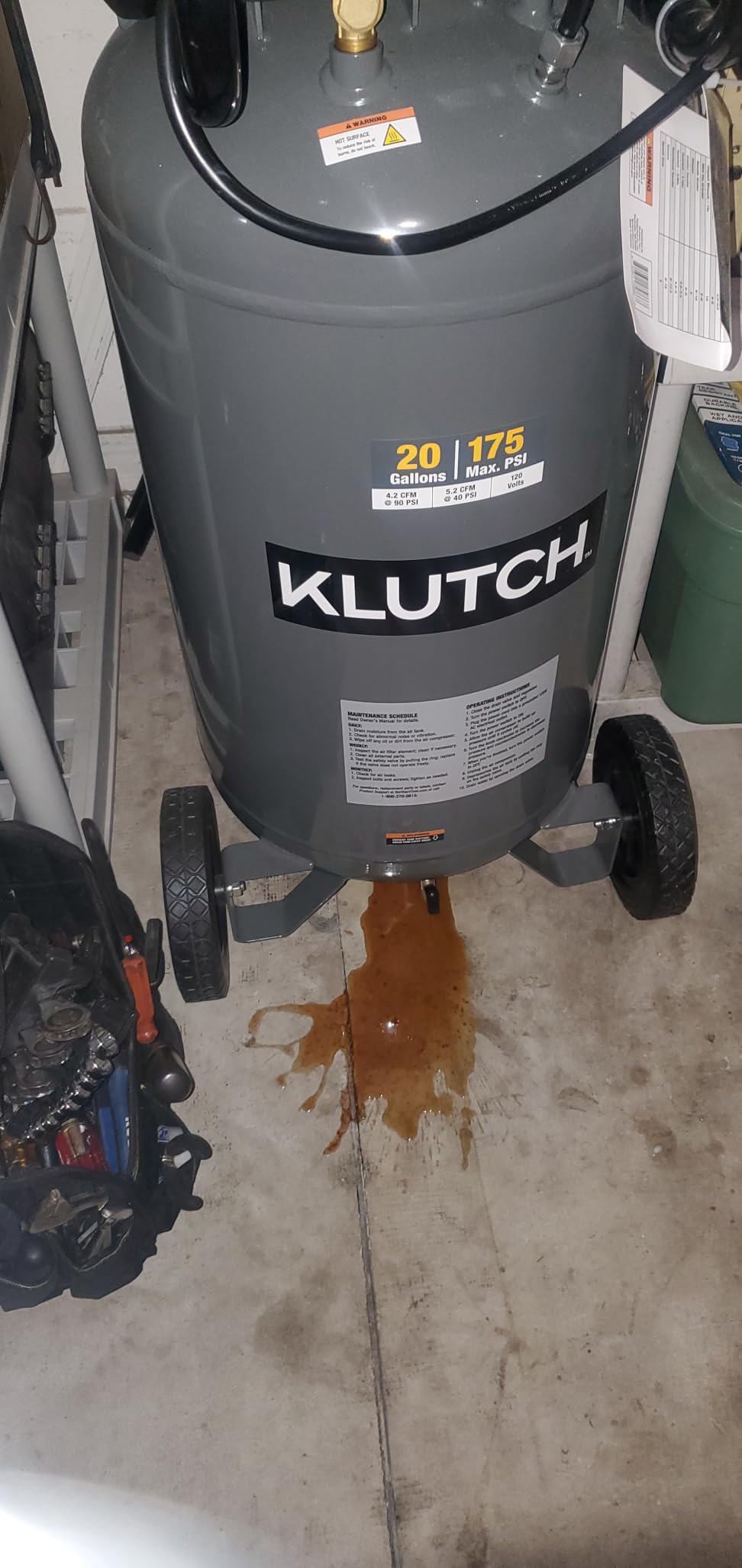
Rated airflow is 5.1 SCFM at 90 PSI from a 2.5 HP motor on 120V, with a 14.5 A draw. The pump is oil-free, so there is no oil carryover risk heading into a plasma torch and no oil changes on the schedule, and the vertical layout keeps the footprint to 23 by 21 by 45 inches.
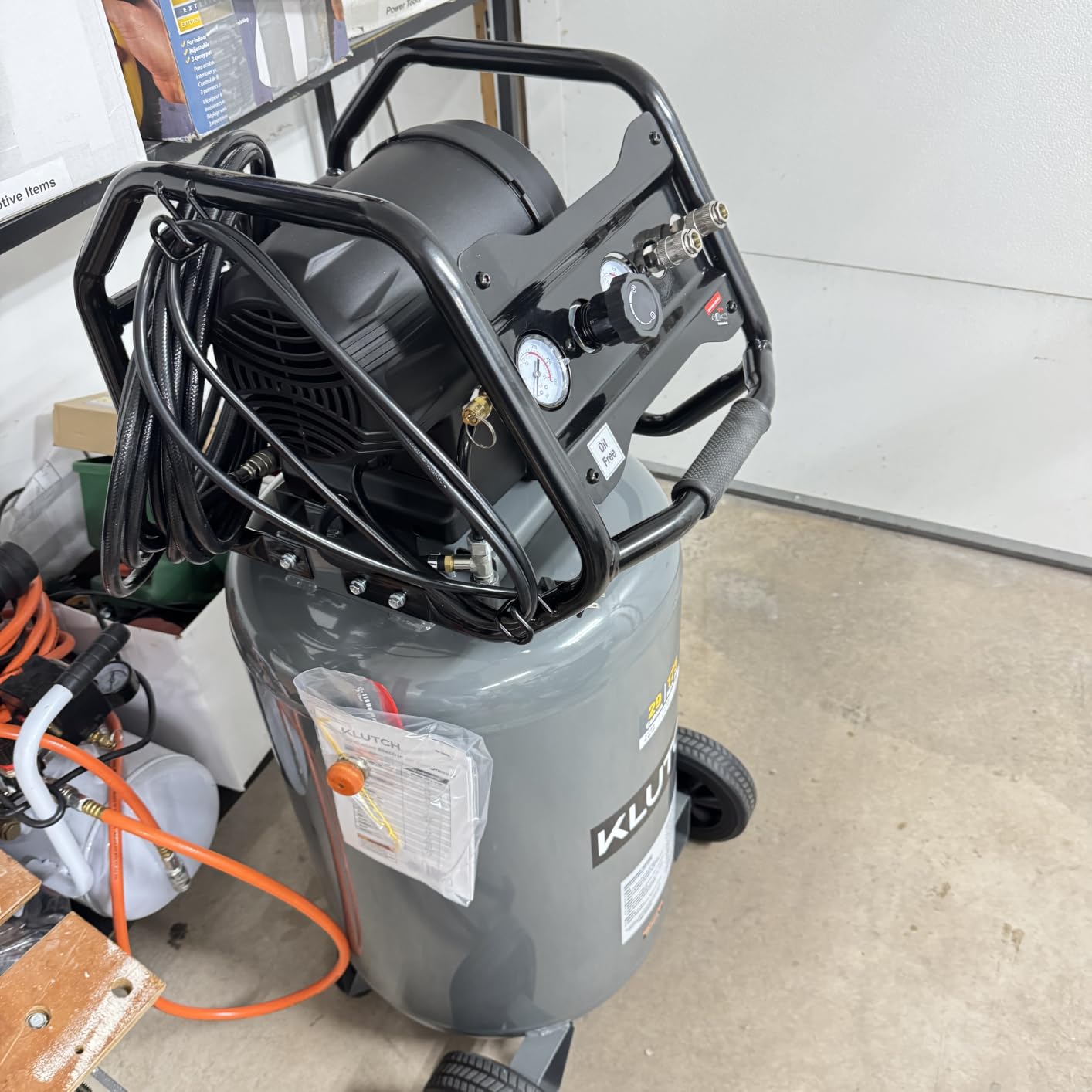
Owners describe it as shop equipment rather than a garage toy, and the flat-free tires plus a full handle make sense of that: rolling it across concrete and shop debris is not an event. The brass quick-connect coupler for one-handed hose changes is a small touch that matters when you swap between a torch and an air tool repeatedly.
This is the machine we would point someone toward if they plan to add a CNC plasma table later. The reserve means a single compressor can serve the torch and still refill for a nailer or grinder, which is the situation that trips up owners of small-tank units.
Why tank size changes the cutting experience
Tank size is not a case of capacity for its own sake. It is about how much air sits between the regulator and the torch while the pump works. Bigger receiver means longer intervals at stable pressure, which means the arc holds its temperature and the cut kerf stays consistent instead of pinching and widening as the pressure sags.
It also changes duty. A 29-gallon tank lets the pump rest longer between cycles, and resting is what extends pump life. Owners who switched from small tanks to a large vertical report fewer stalls mid-job and a noticeably calmer cutting rhythm.
Where the Klutch falls short
At 81 dB it is the loudest machine in this roundup. In a detached shop that is fine. In an attached garage, a neighbour who can hear your compressor through the wall is a real risk, and there is no easy fix besides building an acoustic box.
At 127 pounds it is a two-person move without the wheels, and one detailed review reports a bypassed power switch that would not interrupt power. That is a single report against hundreds of positive ones, but on electrical safety it is worth testing the switch yourself the day the machine arrives.
6. Stealth 20 Gallon Ultra Quiet: Best Air Compressors for Plasma Cutters in a Basement Shop
Stealth 20 Gallon Ultra Quiet Air Compressor,1.8 HP Oil-Free Peak 150 PSI 68 Decibel, 5.5 CFM @ 40 PSI 5 CFM @ 90 PSI Silent Long Life Electric Air Compressor W/Wheel for Garage
5 CFM at 90 PSI
20-gallon alloy steel tank
68 dBA claimed
150 PSI peak
Pros
- Noticeably quieter than typical oil-lube compressors
- 20-gallon tank holds pressure well between uses
- Measured noise near 65 dB at 8 to 10 feet
- Oil-free motor starts easily in cold weather
Cons
- 121 pounds makes it a two-person lift
- Some machines tripped breakers within a couple of weeks
- 20 gallons is the largest size offered
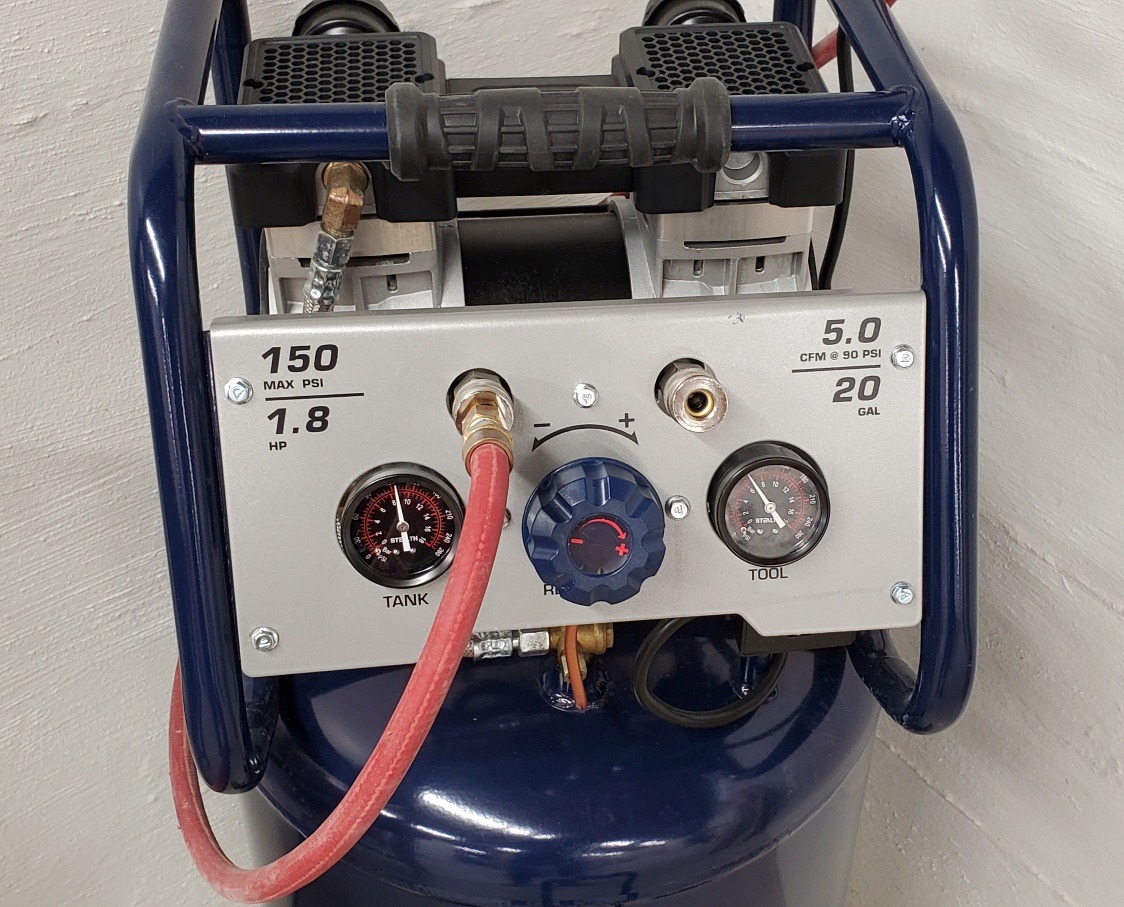
The Stealth 20-gallon hits a combination nobody else on this list manages at once: a genuine 20-gallon tank, 5 CFM at 90 PSI, and a claimed 68 dBA. One owner in a basement shop measured closer to 65 dB at 8 to 10 feet, which is the number that matters once the machine is behind you rather than in front of you.
For plasma work, 5 CFM at 90 PSI sits right at the bottom of the acceptable band for a light torch, and 20 gallons of reserve means it holds pressure between jobs. The 150 PSI peak gives fast recovery, and two quick couplers let you keep a torch line and a tool line connected at the same time.
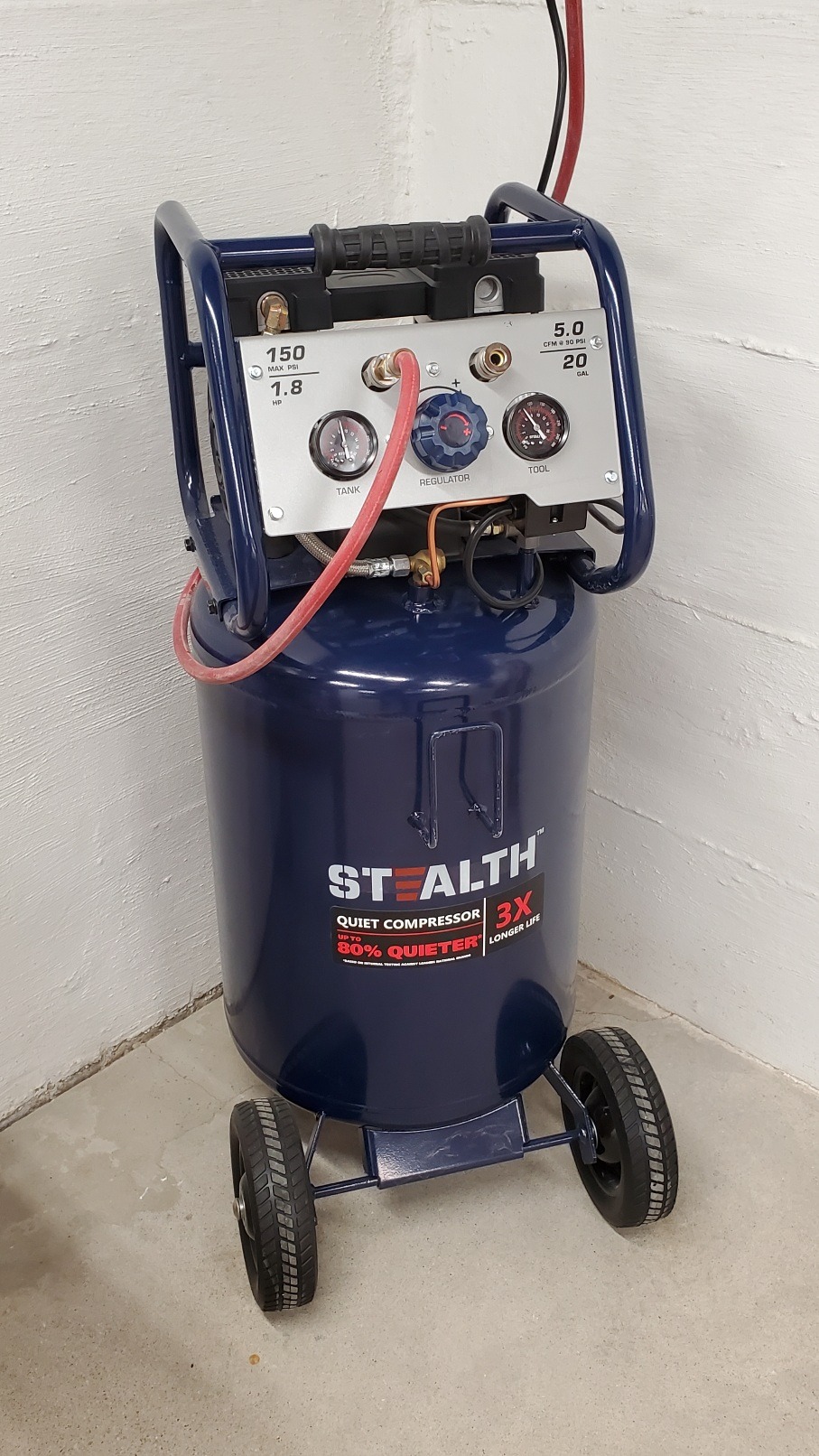
The oil-free motor needs no oil changes and starts without fuss in cold weather, and the outer packaging is solid enough that the machine tends to arrive undamaged. That detail matters more than it sounds when you are comparing brands with thinner service support.
Where the reviews diverge is on electrical reliability and support. Several buyers report machines that tripped breakers within the first couple of weeks, and others describe a customer service form that returned errors, complicating returns. If your garage circuit is marginal, test the machine on a known-good outlet before committing to it as your primary supply.
Why this works for intermittent plate cutting
The combination to focus on is 20 gallons plus 5 CFM. That is enough stored air to cover the moment between a pierce and the traverse when the arc is lit continuously, which is exactly where smaller machines stumble. For cutting one or two-inch plate in short segments, with pauses to reposition, this machine keeps the arc alive.
The quiet operation is the reason to choose it over louder machines of similar size. If your shop is shared with a workspace, a stairwell, or a neighbour’s wall, 68 dBA versus 81 dB is the difference between a conversation and an argument.
Where the Stealth 20 falls short
At 121 pounds it is heavy for a machine you might want to reposition, and it does not fit under a bench the way a pancake will. It is also the largest tank size this brand offers, which leaves owners wanting more capacity as their cutting grows.
The 4.2-star average reflects more than noise. The electrical complaints and the support experience are the reason we would not hand this to a first-time buyer as their only compressor, even though the core machine is capable.
7. VEVOR 15 Gallon: Best Air Compressors for Plasma Cutters on Paper Specs
VEVOR Air Compressor, 15 Gallon Steel Tank, 2HP 5.3 CFM@90 PSI Oil Free Air Compressor & Max. 125PSI Pressure, 78dB Ultra Quiet Portable Compressor, for Auto Repair, Tire Inflation, Spray Painting
5.3 CFM at 90 PSI
15-gallon steel tank
78 dBA operation
125 PSI maximum
Pros
- 5.3 CFM at 90 PSI is the strongest rated airflow in this roundup
- Fast fill and recovery for continuous tool use
- Dual outlets let two hoses run off one unit
- Strong value against compressors with similar specs
Cons
- Short cord and poor performance on extension cords
- Wheels and handle feel cheap next to the machine
- Motor housing runs hot during sustained use
On paper the VEVOR is one of the most capable machines in this group for a home workshop: 5.3 CFM at 90 PSI, the best rated airflow here, from a 2 HP oil-free motor running at 1680 RPM. Add a 15-gallon tank and you have a compressor with real reserve and real flow, which is the pairing plasma work rewards.
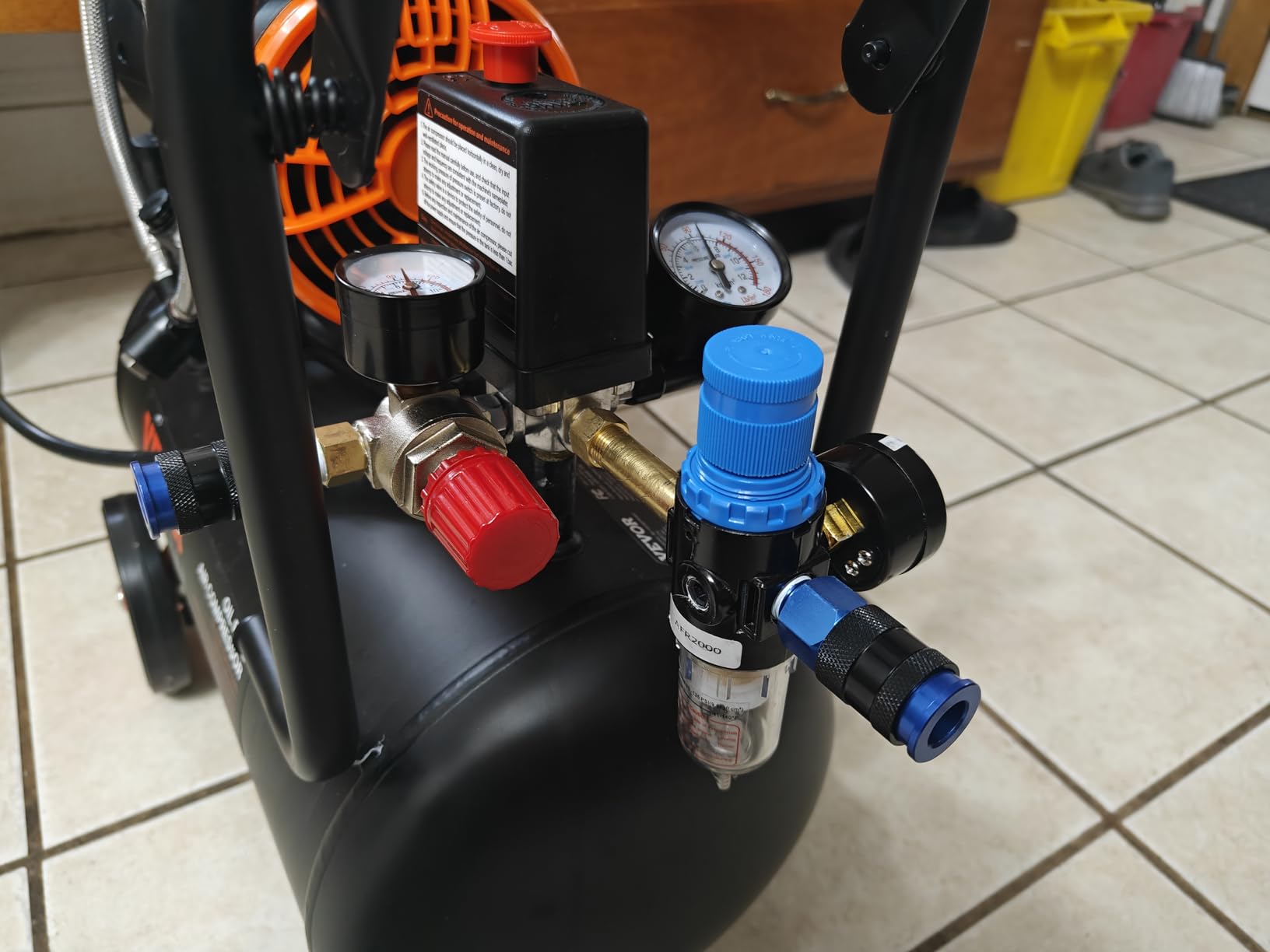
Owners back up the fill and recovery story, describing a machine that keeps up with continuous tool use without long pauses. Dual quick-connect outlets on the larger variants let two hoses run at once, so a torch line and an air tool can share the receiver.
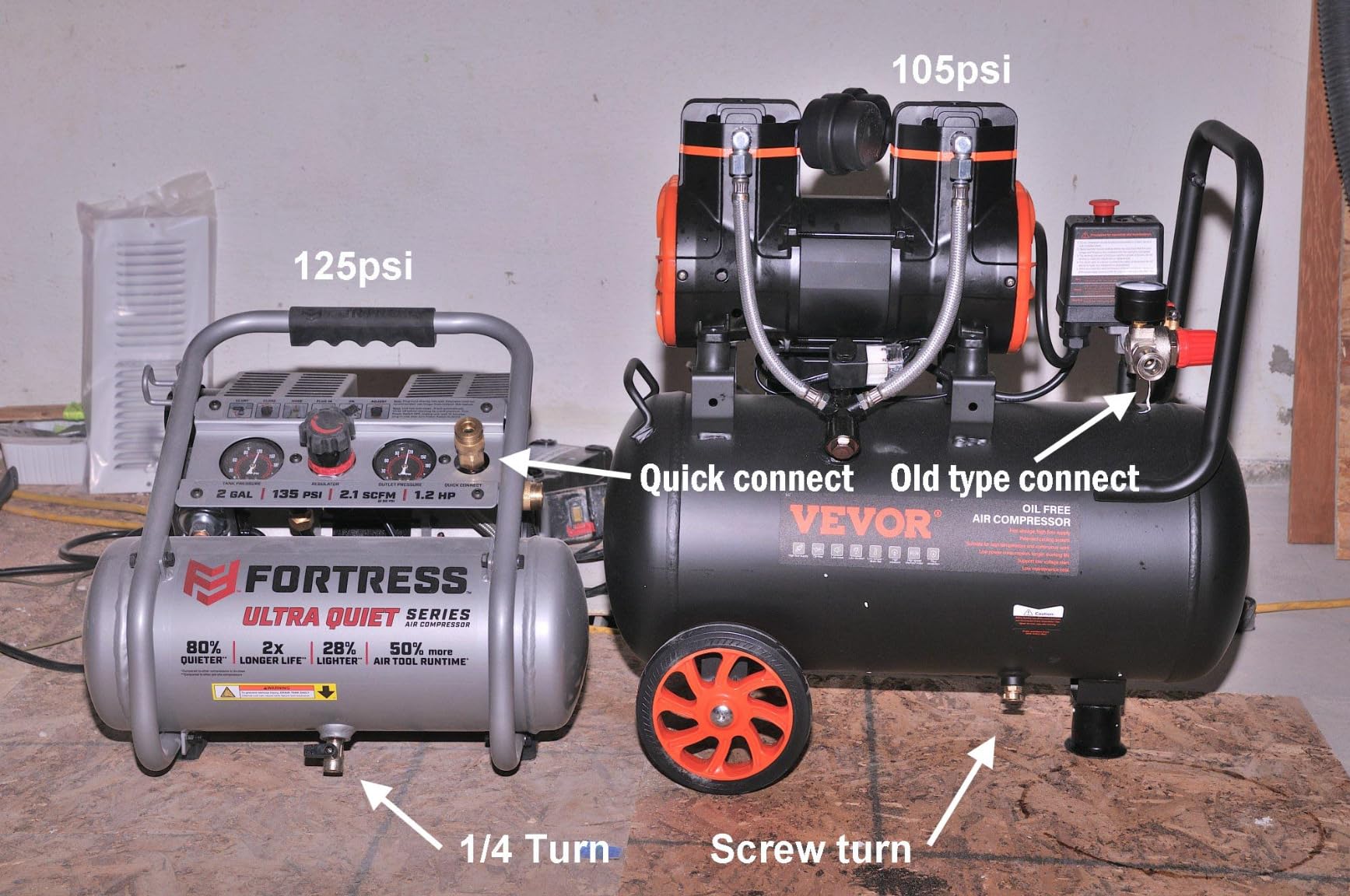
Noise is listed at 78 dBA and attributed to a layered silencer with filter cotton. That is mid-pack for the class: quieter than the loudest vertical machines here, louder than the dedicated quiet units. It is a working-shop noise level rather than a residential one.
Two design details protect the machine. A silicone and stainless steel braided intake pipe resists heat and corrosion, and the tank uses a three-layer construction with a rust-resistant inner layer over powder coat and Q235B structural steel. A large cooling fan with automatic overheat and over-pressure cutoff protects the motor.
Why 5.3 CFM at 90 PSI is the number to shop on
Most published CFM figures for small compressors are measured at 40 PSI, where airflow looks flattering. The 90 PSI figure is the honest one, because that is the band a plasma regulator delivers. Buying on the 40 PSI number is how people end up with a compressor that cannot hold an arc on quarter-inch material.
This unit’s 5.3 CFM at 90 PSI, paired with 15 gallons, covers a light-to-mid torch with reasonable margin. It is the airflow number we would want to see on any shortlist, and it is the reason this machine sits here despite the caveats.
Where the VEVOR falls short
Power delivery is the main weakness. The cord is short, and owners report performance dropping on multiple extension cords, with some machines refusing to start reliably on long runs. Run it from a properly grounded outlet directly, or from a dedicated circuit, and it will behave.
The rolling hardware is also reported as noticeably lower quality than the machine itself, and the motor housing runs hot enough to burn skin during sustained use. Neither is fatal, but both are reasons to treat it as a workshop machine rather than something to drag to a client’s driveway.
8. DEWALT D55146: Best Air Compressors for Plasma Cutters Needing High Tank Pressure
DEWALT Air Compressor, 225-PSI Max, Hand Carry with Wheels, 4-1/2 Gallon (D55146)
225 PSI max tank pressure
4.5-gallon oil-free tank
5 CFM airflow
15 A maximum draw
Pros
- 225 PSI storage far above typical 125 to 150 PSI units
- Around 5 CFM for framing nailers and light grinding
- Oil-free pump means no oil and no warm-up
- Long-term owners report years of service with seal kits only
Cons
- Draws close to a full 15 A so circuits trip
- Tank must be tilted about 45 degrees to drain
- Heavy and bulky for a 4.5-gallon tank
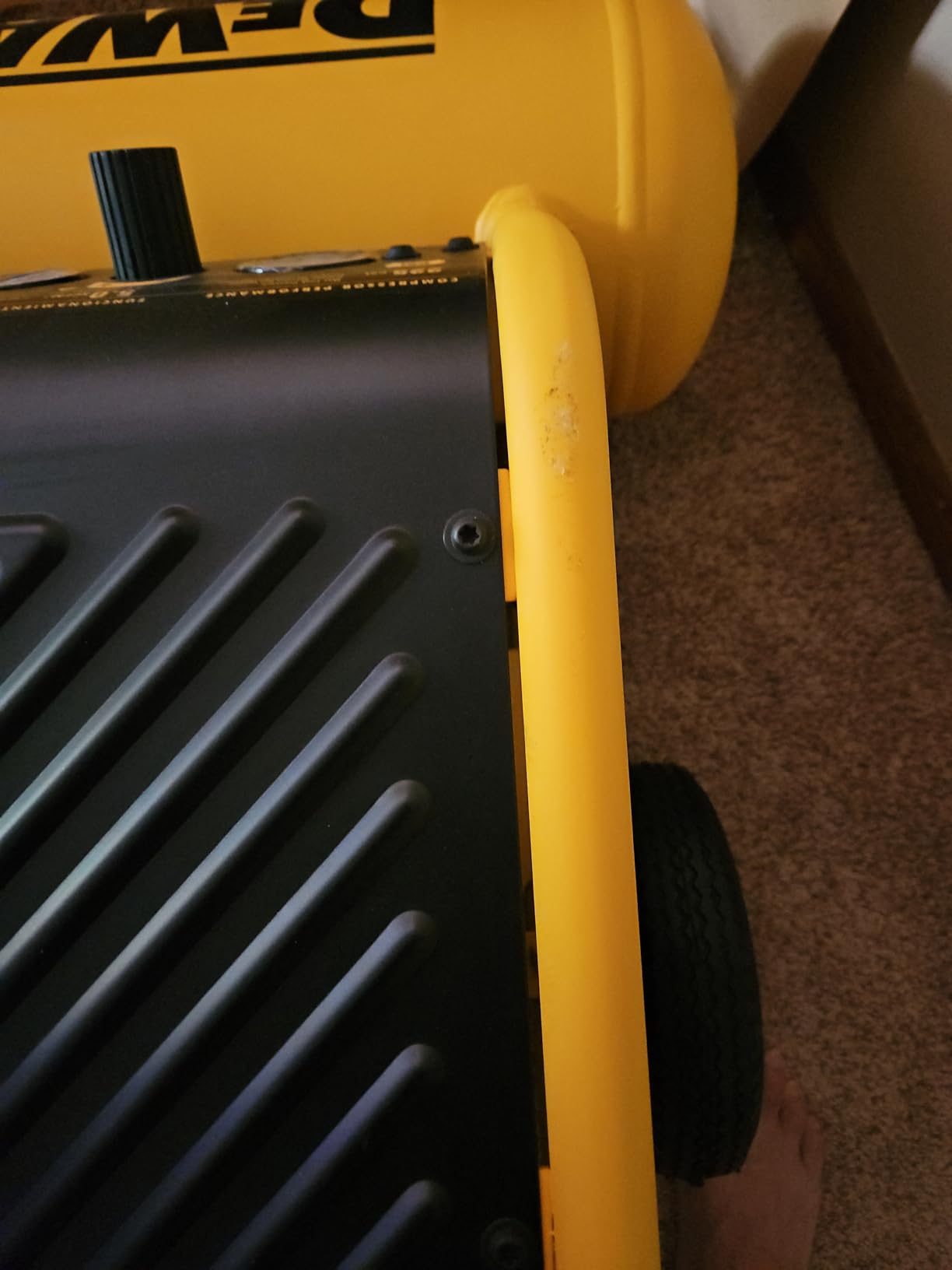
The DEWALT’s signature is 225 PSI of tank storage, well above the 125 to 150 PSI you see on most machines of this size. That is an unusual amount of headroom, and it exists to increase usable air output: more pressure in the receiver means more air delivered before the pump has to catch up.
Airflow lands around 5 CFM, enough for framing nailers and light grinding, and the pump is oil-free so there is no oil in the delivered air and no warm-up period. The display console puts 2-inch gauges, couplers, and the regulator behind a metal panel, which is a nicer arrangement than exposed fittings that take a knock.
The strongest thing owners report is longevity. Buyers with ten-plus years of ownership describe reliable service with only seal kits needed, and that track record is unusual in this category where most machines are three to five years old and tired.
That history explains why we still include a 4.5-gallon machine in a roundup about plasma supply. The tank is small, but the pressure headroom and the free-air delivery mean a torch gets a steadier feed than the gallon count alone would suggest.
Why 225 PSI is a real advantage for cutting
A plasma torch only sees 70 to 120 PSI at the torch head, so the extra pressure is not about pushing more air through the torch. It is about reserve depth. With a 225 PSI tank, the working band sits in the middle of the curve rather than at the bottom, so the receiver keeps feeding flow even as the pump is catching up from empty.
Owners note the high-flow coupler also helps with cut-off tools that spike demand quickly, which is the same kind of spike a plasma pierce creates.
Where the DEWALT falls short
The 15 A draw is the practical problem. On a shared household circuit that trips breakers, so plan a dedicated outlet. At 88 pounds and 28 by 24 by 16 inches, it is also heavy and awkward for a 4.5-gallon tank, particularly on stairs or into a truck bed.
Two smaller annoyances recur: the tank has to be tilted about 45 degrees to drain properly, and the regulator will not pass more than about 150 PSI even though the tank holds more. If you plan to run a torch at the higher end of its band, budget for an external regulator downstream.
9. Limodot LJ8120K Quiet Oil-Free 8 Gallon: Best Air Compressors for Plasma Cutters on a Starter Budget
Quiet Oil-Free Air Compressor, 68 dB, 2.8 CFM @ 90 PSI, 8 Gallon Air Tank
2.8 CFM at 90 PSI
8-gallon alloy steel tank
68 dBA claimed
25 ft hose and kit included
Pros
- Lowest entry point in this group with hose and kit included
- Refills empty to full in about 120 seconds with 30-second recovery
- Oil-free pump starts reliably in cold weather
- 68 dBA class output is usable in residential settings
Cons
- 2.8 CFM at 90 PSI is the lowest airflow here
- 120 PSI maximum is low for modern plasma work
- 8-gallon tank is modest for a two-machine shop
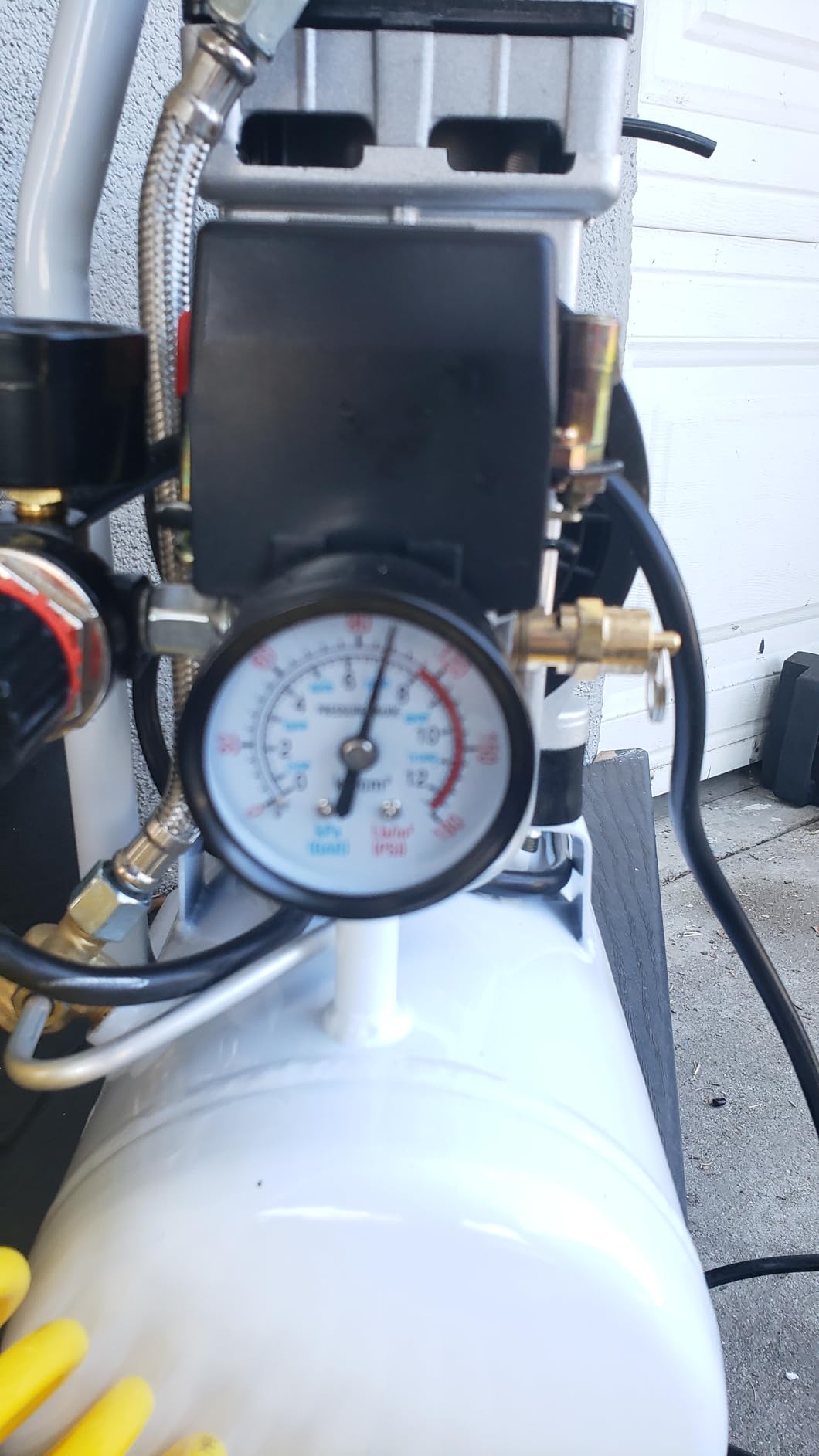
The Limodot is the honest entry point. An 8-gallon alloy steel tank, a 1.2 HP induction motor, a claimed 68 dBA, and a 25-foot PVC hose plus a quick-connect fitting and an 11-piece accessory kit in the box. For someone whose plasma cutting is occasional sheet-metal trim rather than production plate, the box contents alone change the math.
Refill from empty to full takes about 120 seconds and recovery is around 30 seconds, which sounds quick until you compare it against the 5 CFM class. The tank fills fast; it simply does not hold very much once it is full.
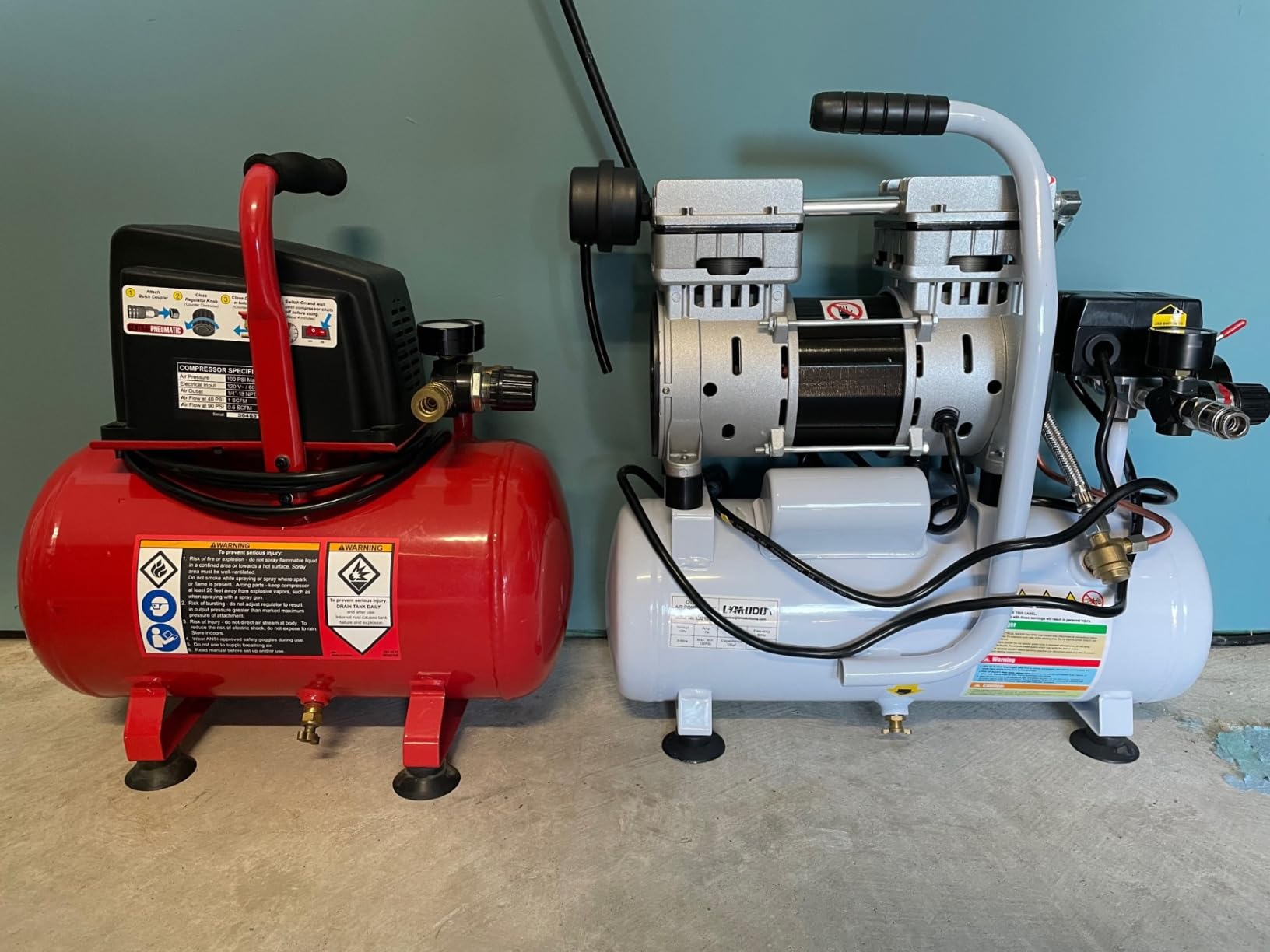
The oil-free design eliminates oil purchases, filter changes, and cold-weather start issues, and the wheels kit makes it movable around a garage. Buyers treat it as an excellent starter or finish-nailing compressor, and that is an accurate description of where it fits in a plasma setup too.
It is the quietest-rated machine in the group alongside the 68 dBA units, and at that level it is usable indoors and in residential settings. That is a genuine advantage for someone working in a basement rather than a detached shop.
Where a starter compressor makes sense for plasma
Thin gauge, short cuts, occasional brackets. A torch that consumes a few CFM can run off this machine for a minute or two at a time, and the 120-second fill means the pump is not the bottleneck for that kind of work. It is also a reasonable companion machine for blowing off swarf and cleaning cut edges.
The oil-free induction motor at 3400 RPM is the part that suits a plasma setup most, since there is no oil in the air to foul a torch and no seasonal start complaints in a cold garage.
Where the Limodot falls short
The 120 PSI ceiling is the hard limit. A torch set at 90 PSI leaves almost no cushion in the tank, so you are effectively running at low tank pressure constantly, which invites pressure fluctuation at the torch and an unstable arc.
Two point eight CFM at 90 PSI is also the lowest airflow in this roundup. If your cutting grows into thicker material, you will outgrow this machine quickly, and the 8-gallon tank will not stretch to cover a second tool running alongside a torch.
10. Stealth 12 Gallon: Best Air Compressors for Plasma Cutters in a Compact Shop
Stealth 12 Gallon Ultra Quiet Air Compressor, 1.5 HP Oil-Free Peak 150 PSI 68 Decibel,5 CFM @ 40 PSI 4 CFM @ 90 PSI Silent Portable Long Life Electric Air Compressor W/Wheel for Garage
4 CFM at 90 PSI
12-gallon Q235B steel tank
68 dBA claimed
150 PSI peak
Pros
- Quiet operation for a full-size vertical tank compressor
- 150 PSI peak and 4 CFM cover typical cutting demand
- Oil-free pump needs no oil changes and starts in cold weather
- Steel tank and reinforced wheels roll on rough floors
Cons
- 12 gallons sits between pancake and vertical sizes
- 95 pounds is heavy for the class
- Some machines needed the tank fully emptied first
The 12-gallon Stealth exists in the awkward middle ground where the pancake feels too small and the 20-gallon feels too big for the space. At 20 by 18 by 29 inches it fits beside a bench, and it delivers 5 CFM at 40 PSI and 4 CFM at 90 PSI with a 150 PSI peak, which is a workable combination for intermittent torch work.
The 1.5 HP induction motor is oil-free and maintenance-free, so no oil changes and no cold-weather hesitation. Rated cycle life is listed above 1000 hours, and the Q235B steel tank rides on 7-inch rubber reinforced wheels that owners say handle rough shop floors.
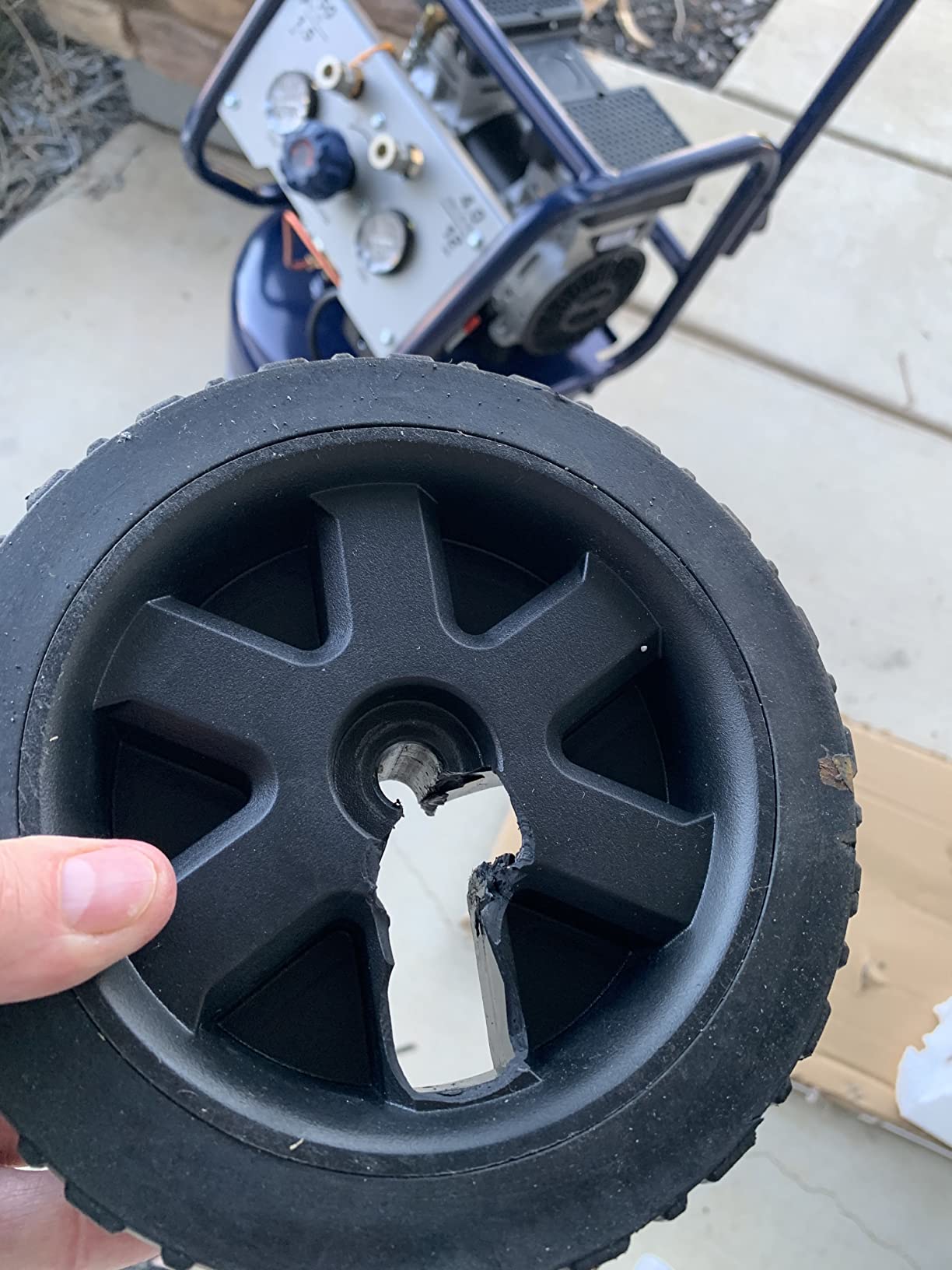
The claimed 68 dBA is the reason this machine exists in this roundup. For a compact shop, a basement, or a shared workspace where a 70 dBA machine is the limit, this delivers full-size vertical tank capacity at quiet-compressor noise levels.
It arrives with the compressor, a 6-foot electric cord, and a manual, and carries a limited lifetime warranty. Owners generally like the low noise and the oil-free convenience.
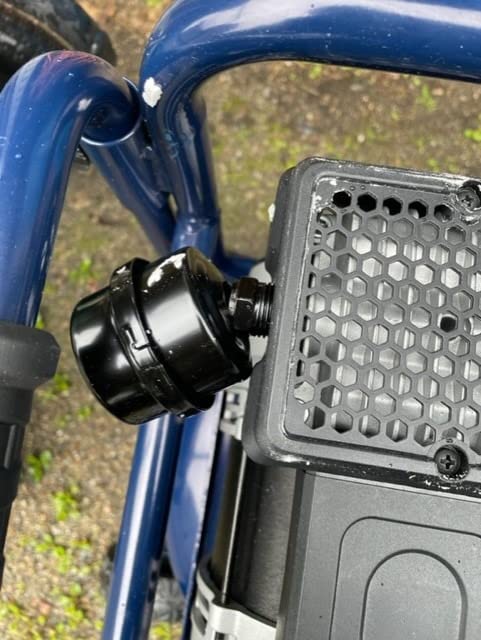
Why mid-size tanks get overlooked
A 12-gallon tank holds roughly twice the air of a 6-gallon pancake, which is the difference between covering a single pierce and covering a full profile. The 150 PSI peak gives the receiver enough range that the torch regulator sees a stable feed rather than the sawtooth pattern a small pancake produces.
For sheet-metal work with frequent stops and starts, that mid-size reserve is often the sweet spot. You do not pay for 20 gallons you will never use, and you are not fighting a 6-gallon tank on every pass.
Where the 12-gallon Stealth falls short
It sits between the two classes without beating either on a headline number: more capacity than a pancake but less airflow than a large vertical, and less capacity than the 20-gallon version of the same machine. If you know you will grow into thick plate work, buy up rather than sideways.
At 95 pounds it is heavy for its size, some owners needed the tank fully emptied before it would restart under load, and it carries the lowest sales rank of the compressors in this roundup, which usually points to thinner support when something goes wrong.
How Much Airflow a Plasma Cutter Actually Needs
Start with your torch manual and find the rated air consumption in CFM at the operating pressure. Most plasma cutters are quoted between 70 and 120 PSI, and that pressure band is where you must compare. A compressor rated at a generous CFM at 40 PSI tells you nothing useful about a torch running at 90.
Then add 50 percent. If your torch is rated at 5 CFM, you want a compressor that delivers at least 7.5 CFM at 90 PSI, and many fabricators go higher. The repeated advice across shop forums is a buffer of one-and-a-half to two times the cutter’s requirement, and the reason is simple: a buffer absorbs the moment when a pierce spikes demand, an aftercooler adds a small restriction, and a long air line drops pressure.
As a working reference, an owner running a 45XP-class torch paired it with a large shop compressor delivering 15.3 CFM and reported being very happy with the result. That is a big buffer, and it is the reason the setup never stuttered. The same owner added an aftercooler and a refrigerated dryer, which is exactly the arrangement we recommend below.
Tank size follows from airflow. A rough rule that holds up in practice: tanks under 10 gallons suit intermittent short cuts, 15 to 20 gallons cover most sheet and light plate work, and anything above that belongs to production schedules or multiple machines. Duty cycle matters in parallel. Below a 50 percent duty cycle, the pump rests often and lasts longer. Above 75 percent continuously, you are looking at a compressor that needs serious cooling or a different pump type altogether.
How to Choose the Best Air Compressors for Plasma Cutters
Match airflow at 90 PSI, not headline CFM
Every manufacturer quotes a CFM figure, and most quote it at 40 PSI where airflow is flattering. Compare like with like: take each machine’s 90 PSI number, subtract the buffer you need for your torch, and see what is left. The VEVOR’s 5.3 CFM at 90 PSI and the California Air Tools’ 5.30 CFM at 90 PSI are genuinely useful numbers. A spec sheet that only offers 40 PSI is a spec sheet that is hiding something.
Tank size and duty cycle for real cutting
Between cut segments, the tank is your buffer. Doubling tank capacity roughly doubles how long you can cut at steady pressure before the pump has to recover. That is why a 29-gallon vertical feels calmer on plate than a 6-gallon pancake even when the pancake has a faster fill time. For duty cycle, treat anything above 75 percent continuous as a sign you need more airflow, not a bigger tank, since a bigger tank on a small pump just means longer fill times.
Oil-free versus oil-lubricated
Oil-free pumps remove an entire category of risk from plasma work. No oil carryover to foul a nozzle, no oil changes on a schedule, no warm-up period in a cold garage. The cost is noise and a finite pump life: oil-free piston pumps are not continuous-duty machines and can overheat or warp if run long stretches. Oil-lubricated pumps run cooler, wear slower, and are cheaper per hour of runtime, but they need a water separator and a good filter on the way to the torch. For a home shop cutting a few hours a week, oil-free wins on simplicity. For a shop running daily, a lubricated pump with proper filtration lasts longer.
Filtration and moisture control, in order
Moisture in the air line is what kills electrodes and nozzles fastest, and it shows up as erratic arc behaviour long before anything visibly fails. Install in this sequence: an aftercooler as close to the compressor discharge as possible to knock out heat and bulk water, then an automatic drain separator, then a refrigerated dryer if you need a controlled dew point, and finally a filter at the torch itself as the last line of defence.
Between refrigerated and desiccant dryers, the decision is about how dry and how much. A refrigerated dryer pulls air down to roughly 35 to 50 F dew point and costs less to run, which suits most plasma work. A desiccant dryer reaches much colder dew points for high-quality or repeat-production cuts where any water film on the kerf matters. If you are not cutting stainless-critical work or doing finish passes that must be cosmetically clean, the refrigerated unit is the better value. One forum-installed setup people return to combines a refrigerated dryer, an aftercooler, and an auto-drain separator, and that combination covers the vast majority of shops.
Air line material matters more than most buyers expect. Copper is preferred for permanent installations because it resists corrosion, holds fittings tightly, and drops less pressure over distance than rubber hose. If you are running from the compressor to a plasma table more than 20 feet away, plumbed copper with a regulator at the table end will hold pressure better than a coiled hose on a reel.
110V versus 220V, the electrical reality check
Every machine in this roundup runs on household voltage. Current draw is the variable, and it is the one that trips people up. The Makita MAC2400 pulls 12.3 A, the California Air Tools 10020C draws up to 14 A, the Klutch runs 14.5 A, and the DEWALT D55146 sits close to a full 15 A. A 120V household branch circuit is rated 15 A, which leaves no headroom for anything else on the same circuit.
So the practical rule: one compressor per dedicated circuit, and if you plan to run a plasma cutter, a welder, and a dust collector in the same shop, you want 220V circuits and a bigger compressor. A plasma cutter’s torch draws significant current itself, and sharing a circuit with a compressor is how you end up with a torch that browns out mid-cut. Check your panel before buying, not after.
Where the machine lives
Noise is a placement decision as much as a purchase decision. Everything at 75 dBA and above wants to be in a detached shop, a garage with a closed door, or inside an acoustic box built with foam panels. Everything at 68 dBA and below can live beside you. If you are planning a second machine later, our compressor picks for overlanding cover the portable end of the market where a fixed receiver is not practical.
Break in a new compressor before you trust it
No competitor covers this, so here is the short version. Run the new unit unloaded for about 30 minutes so the pump and motor stabilise. If it is oil-lubricated, check the oil level once it has cooled. Drain the tank fully, then run it back up to full pressure and confirm the cut-out and the gauge agree. After that, add an aftercooler and a separator before the first real cut, because the water that condenses in the first few cycles is the stuff that will end up in your torch.
On used machines, the inspection list is similar but sharper: verify the receiver has never been welded, spin the pump by hand with the power off, listen for a steady cut-off valve, check for rust around the tank base, and replace the first separator and dryer regardless of what the seller says. Our metal fabrication plasma cutter picks are worth a look if you are building the whole side of the setup at once.
Frequently Asked Questions
What size air compressor do I need for a plasma cutter?
Match the compressor’s CFM at 90 PSI to your torch’s rated air consumption, then add about 50 percent headroom. A light torch pulling 4 to 5 CFM needs a compressor delivering 6 to 8 CFM at 90 PSI with a tank of at least 15 gallons. For thicker plate or long CNC programs, go to 20 gallons or more and target 10 CFM or above at 90 PSI.
How much air pressure do I need to run a plasma cutter?
Most plasma torches run best between 70 and 120 PSI at the torch head, so set the regulator in that band. The compressor tank needs to sit comfortably above that range to feed continuous flow, which is why a 150 to 175 PSI tank gives steadier pressure than a 120 PSI unit. Always install a dedicated regulator rather than relying on the one built into the compressor.
Do plasma cutters run off an air compressor?
Yes. A plasma cutter is an air-consuming tool that needs continuous compressed air to hold the arc. It runs from any compressor that can supply its rated CFM at the operating pressure, with a good regulator and filtration between the tank and the torch.
Will a 20 gallon air compressor run a plasma cutter?
Yes, provided the airflow rating matches. A 20-gallon tank holds plenty of reserve air, but the deciding factor is CFM at 90 PSI rather than tank size. A 20-gallon machine delivering 5 CFM at 90 PSI will run a light torch for intermittent sheet work. For thick plate or long traverses, look for 7 CFM or more at 90 PSI in the same tank size.
What is the best air compressor for a CNC plasma table?
A CNC table runs the torch almost continuously, so you want high airflow and a large receiver rather than a quiet compact unit. Look for at least 8 to 10 CFM at 90 PSI with a 20-gallon tank or larger, plus a rotary screw or high-duty two-stage pump. A 60-gallon setup is common in shops that also run a mill or other pneumatic tools on the same system.
Is an oil-free compressor better for a plasma cutter?
Oil-free is safer and simpler because there is no oil carryover to foul the nozzle and no oil changes to schedule. The trade-off is noise and pump life, since oil-free piston pumps are not continuous-duty and can overheat or warp under long runs. An oil-lubricated pump lasts longer and runs cooler, but it needs a water separator and filter on the way to the torch.
Do I need an air dryer for plasma cutting?
For occasional sheet-metal work you can get by with a water separator, but a dryer pays for itself quickly. Install in this order: aftercooler at the compressor discharge, automatic drain separator, then a refrigerated dryer for roughly a 35 to 50 F dew point, and a final filter at the torch. Clean air extends electrode and nozzle life, which is where the cost sits.
Final Verdict: Best Air Compressors for Plasma Cutters in 2026
The best air compressors for plasma cutters are not the biggest or the cheapest, they are the ones whose CFM at 90 PSI covers your torch with about 50 percent to spare and whose tank holds enough reserve to bridge the gaps between cuts. The Makita MAC2400 wins here on recovery and build quality for anyone cutting regularly in a home shop. The California Air Tools 10020C is the quiet-and-capable compromise, with the largest tank-to-noise balance you can get at 70 dBA. The Metabo HPT EC914S covers the contractor who needs to carry the machine to the job.
Two situations change the answer. If you run a CNC plasma table for hours at a time, none of these machines is enough on its own, and you should be sizing toward a rotary screw unit well beyond this class. If your cutting is thin gauge and occasional, the Metabo or the California Air Tools will serve you for years, and adding an aftercooler, separator, and final filter at the torch will protect your consumables far more than a bigger compressor would.
Whichever one you pick, buy it for the CFM number at 90 PSI and give it a dedicated circuit. Then run the break-in cycle, drain the tank once more, and check that your regulator holds steady under load before the first real plate goes in the machine.